
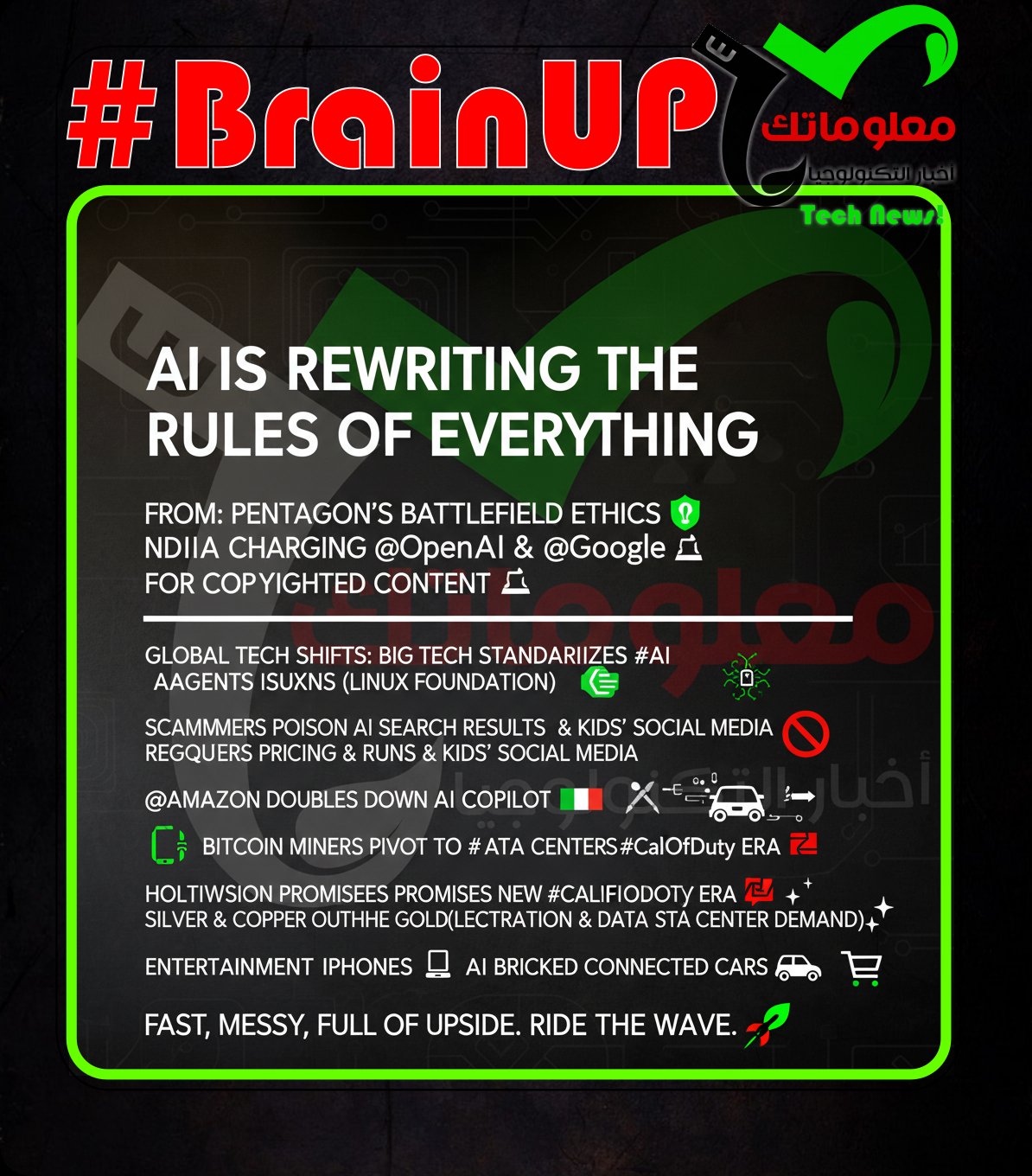
#BrainUp Daily Tech News – (Wednesday, December 10ᵗʰ)
Welcome to today’s curated collection of interesting links and insights for 2025/12/10. Our Hand-picked, AI-optimized system has processed and summarized 24 articles from all over the internet to bring you the latest technology news.
As previously aired🔴LIVE on Clubhouse, Chatter Social, Instagram, Twitch, X, YouTube, and TikTok.
Also available as a #Podcast on Apple 📻, Spotify🛜, Anghami, and Amazon🎧 or anywhere else you listen to podcasts.
1. The military’s new AI says ‘hypothetical’ boat strike scenario ‘unambiguously illegal’
The Pentagon’s newly unveiled AI chatbot states that a hypothetical boat strike against suspected drug smugglers at sea would be unambiguously illegal. The AI described airstrikes in that scenario as illegal. This raises questions about how the Pentagon’s #AI interprets rules of engagement and legality in military planning. The incident highlights the growing role of #AI in military decision-making and the need for clear guidelines on how such tools are described and used. As debates around #autonomous-weapons and #international-law continue, this example shows AI’s potential to shape perceptions of legality in conflict scenarios.
2. Nvidia builds location verification tech that could help fight chip smuggling
Nvidia is developing location verification technology designed to combat semiconductor chip smuggling by ensuring chips are used only in authorized regions. The technology leverages advanced digital signatures embedded in chips that can verify their geographic origin, addressing growing concerns over unauthorized exports and illicit trade. This system enhances supply chain security by allowing companies and governments to detect and prevent chips from being diverted for unintended uses. Nvidia’s innovation responds to increased regulatory scrutiny and geopolitical tensions affecting semiconductor supply chains. The technology aims to strengthen trust and compliance in global chip distribution networks by integrating location verification capabilities.
3. Scammers are poisoning AI search results to steer you straight into their traps – here’s how
A new #LLM #phone-number poisoning attack is poisoning public content to make AI search results surface scam numbers, affecting tools like @Google AI Overview and @Perplexity Comet. Aurascape’s @AuraLabs researchers say threat actors systematically manipulate high-authority sites, including government and university domains, and abuse @YouTube and @Yelp to plant #GEO and #AEO-optimized text and reviews that embed scam numbers. This poisoned data is structured for easy scraping by LLMs, enabling AI assistants to merge sources into digestible, seemingly trusted answers that steer users toward fraudulent call centers. The tactic resembles prompt-injection but targets data sources via #GEO and #AEO rather than attacking the models directly. The risk underscores the need to verify numbers through official channels and to scrutinize AI-provided contact details, as poisoned sources can slip into AI summaries and browsers.
Trump’s plan to allow Nvidia to ship its H200 AI chips to approved buyers in China and elsewhere hinges on the U.S. taking a 25% cut of chip sales, a condition he says @Xi Jinping responded positively to. The arrangement would require 25% of revenue to go to the U.S. government, and Nvidia and @AMD had already agreed to share 15% of China sales with the U.S. government. Xi’s positive reaction and the Commerce Department’s ongoing finalization indicate policy details are being negotiated amid the broader #semiconductors and #AI race. The H200 is a higher-grade chip than Nvidia’s H20 but not the top model, and Nvidia’s stock rose before paring gains on the news. Nvidia framed the plan as supporting American jobs and manufacturing, suggesting a balance that could shape access to critical AI technology while the U.S. seeks to protect its economic interests.
5. Big Tech joins forces with Linux Foundation to standardize AI agents
A coalition led by the Linux Foundation launches the Agentic AI Foundation (#AAIF) to promote interoperability among #MCP, #goose, and #AGENTS.md, uniting @Anthropic, @Block, and @OpenAI. The #MCP standard is described as a ‘USB-C port for AI’ that standardizes how AI agents connect to data sources and has gained traction across the industry, with @Google and @OpenAI among early adopters. Block’s #goose is a customizable open-source agent for coding that can run locally or in the cloud and includes built-in MCP support. OpenAI’s #AGENTS.md provides a markdown-based guide to steering AI coding agents toward more predictable behavior. The move, backed by the Linux Foundation’s history of neutral, interoperable projects such as the CNCF, signals a concerted effort to standardize in a fast-moving, high-stakes field.
6. Call of Duty won’t release Modern Warfare or Black Ops back to back anymore
@Activision says future #CallOfDuty releases will be an absolutely unique experience each year, ending back-to-back launches of Modern Warfare or Black Ops. The blog post notes the last four releases were MW II (2022), MW III (2023), Black Ops 6 (2024), and Black Ops 7 (2025), with a disappointing European launch for Black Ops 7. @Treyarch’s Yale Miller warned that Black Ops 6 and Black Ops 7 risk being seen as too similar, and Activision adds, “We will drive innovation that is meaningful, not incremental”. The post says the next era of Call of Duty will deliver what you want along with surprises that push the franchise and the genre forward, despite competition from #Battlefield6 and #ArcRaiders. This shift aligns with @Activision’s stated aim and signals that #CallOfDuty will pursue new directions to stay strong in a crowded shooter market.
Australia has enacted a world-first ban that blocks social media access for users under 16, with platforms beginning to remove under-16 accounts as the regime starts #ageassurance #under16 #onlinesafety. Facebook, Instagram, Threads, X, YouTube, Snapchat, Reddit, Kick, Twitch and TikTok are expected to remove under-16 accounts and prevent new registrations, with non-compliance risking fines up to $49.5m. There have been teething problems with age checks, including some accounts passing facial age assurance, while Bluesky has also moved to ban under-16s and the age-verification service @k_ID has conducted hundreds of thousands of checks. Parents report a spectrum of reactions, from distress at losing access to viewing age-verified peers to some instructing their children on bypass methods, and the prime minister @Anthony_Albanese has warned the process may not be perfect. This landmark measure signals a broader push toward online safety, balancing #privacy and #digitalparticipation while aiming to protect #under16 users.
8. Paramount Pictures X Account Hacked to Read ‘Proud Arm of the Fascist Regime’
Paramount Pictures’ official X account was hacked, with the bio rewritten to read ‘Proud arm of the fascist regime’. The account has nearly 3.5 million followers and the change appeared on Tuesday before being reverted to the normal description. The timing coincided with @DavidEllison’s #Skydance launching a direct-to-shareholders bid for @WarnerBrosDiscovery, and it came three days after Netflix and WBD announced a deal. Variety reached out to Paramount for comment, and the bio was restored soon after the report was published. The incident illustrates how social-media breaches can intersect with high-stakes corporate moves in the entertainment industry, highlighting the fragility of public-facing accounts during upheaval.
9. Online shoppers in New York are seeing a new warning about price hikes
New York online shoppers are now encountering a new warning about potential price hikes following the state’s law against price gouging during emergencies. The law targets unfair price increases for essential goods and services, especially relevant in times like the COVID-19 pandemic. E-commerce platforms and retailers in New York are implementing these warnings to inform consumers about regulated pricing policies. This measure aims to protect consumers from exploitative pricing practices while ensuring transparency in the digital marketplace. It reflects New York’s proactive approach to maintaining fair commerce standards amid fluctuating market conditions.
10. Amazon to invest over $35 billion in India by 2030 to expand operations and boost AI
Amazon plans to invest more than $35 billion in India by 2030 to significantly expand its operations and enhance its artificial intelligence (#AI) capabilities. The investment will support the growth of Amazon’s retail business, cloud services (@AWS), and increase local infrastructure, including fulfillment centers and technology hubs. This strategic move aligns with India’s growing digital economy and rising consumer demand, positioning Amazon to compete more effectively with local and global competitors. By boosting AI innovation, Amazon aims to improve customer experience and operational efficiency in one of its fastest-growing markets. This substantial investment underlines Amazon’s commitment to India’s long-term economic growth and digital transformation.
The Intercept reports that a proposed #RightToRepair provision in the National Defense Authorization Act was killed after defense industry meetings on Capitol Hill, leaving service members unable to fix equipment in the field and forcing repairs through contractors. The measures, co‑sponsored by @Elizabeth Warren and @Tim Sheehy, would have required defense contractors to share technical data, maintenance manuals, engineering drawings, and replacement-part lists as a condition of Pentagon contracts, enabling field repairs via 3D printing or readily available spares. The decision to strip the measure came after a closed‑door conference of top officials, including Speaker @Mike Johnson and Senate Majority Leader @John Thune, with consumer advocates saying defense contractors pressed to remove the provisions. Critics such as @Isaac Bowers of @USPIRG argue that defense contractors wield substantial influence on Capitol Hill, a dynamic the piece frames as part of a broader pattern of contractor profits shaping Pentagon policy and costs, noting that operations and maintenance costs amount to about 40% of the budget per @Julia Gledhill of the @StimsonCenter. In sum, the piece suggests that while the #RightToRepair enjoys broad appeal, the outcome highlights how the military–industrial complex can trump service member needs in defense spending, aligning with concerns about #ContractorProfiteering and O&M costs.
12. Xbox was outsold by a little-known Kinect-style console during Black Friday | VGC
During Black Friday week in the US, @Xbox was outsold by the little-known @NexPlayground, which captured 14% of the market behind @PlayStation5’s 47% and @NintendoSwitch2’s 24%. That @NexPlayground is an Android-powered console launched in 2023 with a motion camera similar to #Kinect and a library of family games, typically priced at $250 and discounted to under $200. Pricing and stock constraints for @Xbox appear to have limited its performance during the period. As noted by @RobFahey in @GamesIndustry.biz, @NexPlayground represents a smart play for an ‘industry blind spot,’ a view echoed by UK trends where @PlayStation5 dominated Black Friday week.
13. All of Russia’s Porsches Were Bricked by a Mysterious Satellite Outage
A mysterious satellite outage caused all Porsche vehicles in Russia to become inoperable, affecting their remote and online functionalities. This widespread bricking deprived owners of critical control features, highlighting the vulnerabilities of connected car technologies dependent on satellite communications. The incident demonstrates a risk for modern vehicles as they increasingly rely on external networks for key operations. Given the geopolitical tensions and satellite interference concerns, this event raises questions about the security and resilience of automotive connectivity in Russia. The outage underscores the need for carmakers and satellite providers to enhance safeguards against such disruptions.
14. High-tech thieves use Wi-Fi jammer to disrupt Bellaire home security cameras during burglary
Thieves used a high-tech Wi-Fi jammer to disable security cameras during a burglary in Bellaire, illustrating a new level of sophistication in criminal tactics. This method effectively cut off the home’s surveillance system, preventing the recording of the incident. The use of jammers challenges traditional home security measures and emphasizes the need for updated technology and strategies. Homeowners are advised to consider security systems that can detect or resist such electronic interference. The incident highlights how advancements in technology can both aid security and empower criminals, urging increased awareness and innovation.
15. Elon Musk plans SpaceX IPO next year
Elon Musk is considering taking #SpaceX public through an initial public offering (IPO) as early as next year to fund its ambitious satellite internet project, Starlink. The decision reflects SpaceX’s growing confidence after successful satellite launches and increasing private investment. An IPO could provide significant capital to expand Starlink’s global broadband network while giving public investors access to a major player in #space exploration and communications. However, Musk has cautioned that the timing of the IPO depends on regulatory approvals and market conditions, indicating flexibility in the plan. This move aligns with broader trends of commercializing space technology and could enhance SpaceX’s financial footing amid its pursuit of interplanetary missions.
16. India proposes charging OpenAI, Google for training AI on copyrighted content
India’s government plans to introduce regulations requiring AI companies like OpenAI and Google to pay for using copyrighted content in training their models. This proposal seeks to address concerns over intellectual property rights as AI systems increasingly rely on vast datasets, including copyrighted material, to improve their outputs. By enforcing licensing fees, India aims to create a fairer ecosystem that compensates content creators while regulating AI development. This approach could set a precedent for global AI policy, balancing innovation with respect for creators’ rights. The proposal highlights India’s proactive stance on shaping AI governance amid rapid technological advancements.
17. Google’s AI try-on app Doppl adds a shoppable discovery feed | TechCrunch
@Google’s AI try-on app Doppl now includes a shoppable discovery feed that surfaces AI-generated product videos and outfits, with nearly everything in the feed linked directly to merchants. The feed personalizes recommendations by analyzing the preferences you share with Doppl and the items you interact with, and it uses AI-generated videos of real products to show how outfits might look #AI-generated videos. Unlike some platforms that rely on real influencers, Google’s feed consists of AI-created content, offering a familiar, scrollable shopping surface. It reflects a broader e-commerce push as Google competes with @Amazon and other social platforms, echoing similar AI video efforts like @OpenAI’s Sora and @Meta’s Vibes. The discovery feed is rolling out to Doppl on iOS and Android in the U.S. for users 18 and above.
18. Samsung Display Will Make 11 Million OLED Panels For Apple’s Foldable iPhone In 2026
Samsung Display is set to produce 11 million #OLED panels for @Apple’s foldable iPhone in 2026, signaling a significant collaboration in the foldable device market. This production volume reflects aggressive plans by Apple to enter the foldable smartphone space, relying on Samsung’s expertise in flexible display technology. The partnership underscores Samsung’s dominant role as a supplier in the smartphone display industry, especially for foldables, and suggests a strong market demand for such innovative devices. These displays are expected to feature advanced specifications tailored to Apple’s design requirements, highlighting the competition among manufacturers to lead in the foldable segment. This development positions both companies to accelerate innovation and consumer adoption of foldable smartphones.
19. AI’s Slop Problem Exposed by Sora on Social Media
AI-generated content often suffers from a phenomenon known as ‘slop’, which entails the generation of verbose, low-quality material that inundates social platforms and diminishes user experience. Sora, a new social media AI tool, exemplifies this issue by producing excessive and cluttered posts that fail to engage audiences effectively. This sloppiness stems from AI’s reliance on pattern recognition rather than understanding nuances, leading to repetitive or irrelevant outputs. Addressing this challenge requires enhanced algorithms focused on quality and relevance, demonstrating the need for the AI community to prioritize content integrity. The rise of tools like Sora highlights the urgency for balancing AI innovation with the quality of digital communications.
20. Instacart’s AI Pricing Experiment Inflated Grocery Bills, Raising Consumer Concerns
Instacart implemented an AI-driven pricing experiment that increased grocery bills for some customers without clear transparency, sparking concerns about deceptive business practices. Consumer complaints and data analyses reveal that prices for identical items varied widely based on factors like location and time, suggesting algorithmic pricing manipulation. This experiment highlights the lack of consumer awareness and the potential for technology to be used in ways that undermine trust in digital marketplaces. The controversy underscores the importance of regulatory scrutiny on #AI pricing strategies to protect consumers from unfair billing. Instacart’s approach serves as a cautionary example of how #machinelearning applications in commerce require ethical oversight to ensure fairness.
21. Rivian is building its own AI assistant | TechCrunch
Rivian is building its own AI assistant that is separate from its VW joint venture and is designed to be integrated with all vehicle controls through a model- and platform-agnostic architecture. The in-house team, based in Palo Alto, has prioritized software layers that coordinate workflows and resolve conflicts within an agentic framework, creating an in-vehicle platform that can interface with different models. The effort includes a hybrid stack that blends edge #AI and cloud #AI, with emphasis on RTOS, ADAS, thermal dynamics, safety, and the infotainment system, and Rivian has overhauled its R1T and R1S software and hardware to support this approach. Rivian plans to share more during its AI & Autonomy Day livestream on December 11, after Rivian’s software chief Wassym Bensaid indicated a potential end-of-year timeline. This push reflects Rivian’s vertical integration strategy and mirrors the momentum from foundational AI players @Anthropic @Google @Microsoft @Meta @OpenAI as industries race to embed intelligent assistants in vehicles.
22. Paramount fights Netflix for Warner Bros and the future of Hollywood
Paramount is aggressively competing with Netflix to acquire Warner Bros, a move that could reshape Hollywood’s landscape and streaming dynamics. The battle highlights ongoing challenges in the entertainment industry, where legacy studios like Warner Bros face pressure from streaming giants to adapt to digital consumption trends. Paramount’s strategy involves leveraging its existing assets and industry expertise to counter Netflix’s dominant position and expand its content portfolio. This contest underscores the broader #mediaindustry shifts as companies vie to control content libraries and global distribution channels. The outcome will significantly influence future production, distribution models, and consumer access to entertainment.
23. Silver, Copper Eclipse Gold as Top Metals Bets on Supply Fears
Silver and copper have eclipsed gold as the top metals bets heading into 2026, with institutional and retail traders pricing in ongoing supply fears and strong #demand from #India and #silver-backed ETFs. Silver has nearly doubled this year, driven by a London supply squeeze and surging demand, while copper has also risen, and Chinese inventories sit at decade lows. Analyst @Ed Meir of Marex Group Inc. notes the rally is steeper and more concentrated than prior rallies, while options activity has surged with elevated volatility and a near $1 billion ETF inflow. The copper outlook reflects electrification for #AI data centers and clean-energy projects, suggesting ongoing supply shortfalls could persist in coming years.
24. Bitcoin Miners Are Betting AI Will Boost Their Profits
Bitcoin miners are transitioning their operations to support AI data centers, repurposing their specialized hardware and abundant electrical infrastructure to tap into the growing demand for AI services. This shift is driven by the volatility and diminishing returns in cryptocurrency mining, prompting miners to seek more stable and lucrative avenues by leveraging their existing assets for AI computation. The trend highlights a convergence between the crypto mining sector and the AI industry, where surplus computing power and energy resources are redirected to train and run large AI models efficiently. Analysts note this pivot could reshape the economics of both industries, enhancing miners’ revenue streams while accelerating the expansion of AI infrastructure. Overall, this evolution links the future of blockchain mining with the rising AI market, demonstrating adaptability in a rapidly changing tech landscape.
That’s all for today’s digest for 2025/12/10! We picked, and processed 24 Articles. Stay tuned for tomorrow’s collection of insights and discoveries.
Thanks, Patricia Zougheib and Dr Badawi, for curating the links
See you in the next one! 🚀
