
#BrainUp Daily Tech News – (Monday, December 8ᵗʰ)
Welcome to today’s curated collection of interesting links and insights for 2025/12/08. Our Hand-picked, AI-optimized system has processed and summarized 11 articles from all over the internet to bring you the latest technology news.
As previously aired🔴LIVE on Clubhouse, Chatter Social, Instagram, Twitch, X, YouTube, and TikTok.
Also available as a #Podcast on Apple 📻, Spotify🛜, Anghami, and Amazon🎧 or anywhere else you listen to podcasts.
1. Block all AI browsers for the foreseeable future: Gartner
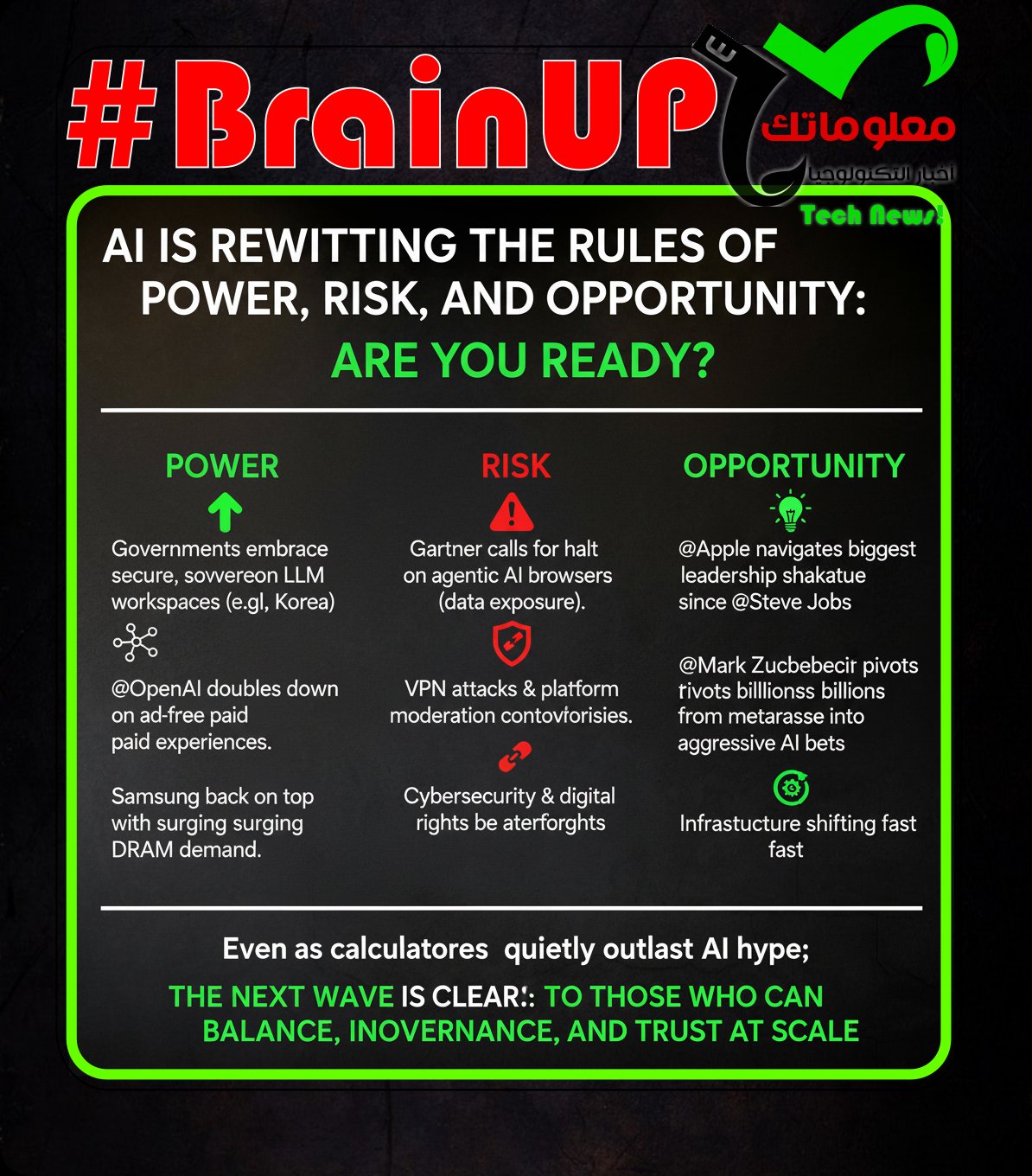
Gartner warns that agentic AI browsers pose too much risk for most organizations and urges blocking them for the foreseeable future, per their advisory ‘Cybersecurity Must Block AI Browsers for Now’. AI browsers are defined as tools with an AI sidebar and an agentic transaction capability that can autonomously navigate and complete tasks on websites, often within authenticated sessions, which can cause sensitive data from active tabs and histories to be sent to cloud AI back ends. They warn of risks such as indirect prompt-injection, inaccurate or harmful agent actions, and credential loss if the browser is deceived into phishing, and caution that even risk assessments can yield a long list of prohibited use cases requiring heavy monitoring. If the back-end AI is deemed acceptable after assessment, they urge educating users that data may be sent to the AI service and advocate mitigations like disabling email for agents, preventing data retention, and blocking downloads/installations of AI browsers. In sum, the analysts (@Dennis Xu, @Evgeny Mirolyubov, @John Watts) believe AI browsers are too dangerous to use without risk controls and will likely remain restricted for the time being, with ongoing scrutiny of potential use cases #AIbrowsers #dataexposure #indirect-prompt-injection.
2. A Journalist Reported From Palestine. YouTube Deleted His Account Claiming He’s an Iranian Agent.
Independent British journalist @RobertInlakesh saw his YouTube page documenting Israel’s occupation of the West Bank abruptly deleted in February 2024, followed by the removal of his private backup and Google account. YouTube’s explanations shifted from severe or repeated Community Guidelines violations to alleged spam or scam content, and nearly two years later to a claim of links to an Iranian influence campaign, without public evidence. The @TheIntercept notes the explanations as inconsistent and opaque, suggesting a broader pattern of pro‑Israel censorship by Big Tech that targets #Palestine reporting, raising questions about transparency in moderation decisions. Inlakesh had worked 2019–2021 with London’s office of @PressTV, a state‑funded outlet under U.S. sanctions, but he argues that this should not erase the majority of his independent reporting about Palestinians. Google also closed more than 30 accounts linked to Iran, and while Inlakesh’s case remains unresolved, the episode underscores the vulnerability of journalists who rely on platforms like #YouTube and #Google to share critical work, calling for scrutiny of evidence in moderation.
3. OpenAI denies rolling out ads on ChatGPT paid plans
OpenAI has clarified that it has not implemented advertisements on ChatGPT’s paid subscription services like ChatGPT Plus. Despite recent misinformation suggesting that ads would appear for paying users, @OpenAI firmly denied these claims, emphasizing a commitment to a user experience free from ads for subscribers. This reassurance addresses concerns from the #ChatGPT community about the potential commercialization of the platform. The company’s stance reflects its focus on delivering value through subscription rather than ad revenue. Maintaining an ad-free environment for paid users supports user satisfaction and trust, reinforcing OpenAI’s business model and user engagement strategy.
Upstage becomes Korea’s first approved public-sector generative AI provider, signaling a system-level shift in government digital transformation as it registers its “Public AI Workspace” on the PPS Digital Service Mall on December 4, becoming the nation’s first generative AI solution provider for public administration. The arrangement will supply the Generative AI Office Support Service to government ministries, municipalities, and public agencies, enabling use inside segregated networks that safeguard cybersecurity; the Public AI Workspace integrates Upstage’s proprietary LLM “Solar” with OCR-based document-processing technology, allowing users to upload #HWP, #Word, or #PDF files for search, question answering, summarization, and information extraction within a secure environment. Korea’s public sector had long barred cloud-based AI due to network separation mandates, but the PPS created a Generative AI Office Support Service category to deploy AI inside restricted systems via vetted suppliers meeting high security and transparency standards, marking a policy-level breakthrough aligned with the goal of boosting administrative efficiency and reducing manual documentation. @KimSung-hoon, Upstage’s CEO, calls the deal a sign that world-class Korean generative AI begins full deployment in government operations, and the company is showcasing the Public AI Workspace at the 2025 Korea Government Innovation Expo in Cheongju Osong (Dec 3–5) for officials to test AI features tailored to real workflows, signaling momentum toward enterprise-grade AI adoption in Korea.
Samsung is poised to reclaim its position as the leading DRAM manufacturer from SK hynix due to a significant rebound in earnings driven by rising #memory prices and strong demand growth. Despite a tough prior market environment, the company’s strategic investments and competitive production capacity have enabled it to capitalize on the recovering memory market. This resurgence reflects the broader cyclical nature of the semiconductor industry where supply-demand imbalances strongly influence profitability. Samsung’s lead in DRAM technology and economies of scale underpin its competitive advantage in regaining the top spot. The shift highlights the dynamic competition in the #semiconductor sector and Samsung’s resilience in navigating market cycles.
6. New wave of VPN login attempts targets Palo Alto GlobalProtect portals
A recent surge in brute-force login attempts is targeting Palo Alto Networks’ GlobalProtect VPN portals, exposing vulnerabilities in enterprise remote access systems. Attackers use automated tools to exploit weak or reused credentials, attempting to gain unauthorized access to corporate networks. Security researchers highlight that this trend reflects growing interest in compromising #VPN infrastructures to leverage them as entry points for broader attacks. Organizations are urged to implement strong authentication methods, monitor login activities, and apply security patches to protect against these attempts. This wave of attacks underscores the ongoing risks faced by #cybersecurity defenses in the expanding remote work environment.
7. Dubai set to open world’s tallest hotel, Ciel Tower
Dubai is set to open the Ciel Tower, which will be the world’s tallest hotel with 356 meters in height. The tower features 805 luxuriously appointed rooms across 82 floors, designed by the architecture firm Kohn Pedersen Fox, highlighting Dubai’s ambition to lead in architectural innovation and hospitality. Ciel Tower aims to attract high-end tourists and business travelers by offering unique amenities and panoramic views, thereby boosting Dubai’s global tourism profile. This development reinforces Dubai’s strategy to diversify its economy beyond oil dependency by investing in tourism and construction sectors. The hotel’s opening is expected to enhance Dubai’s standing as a premier international destination with cutting-edge landmarks and luxury experiences.
8. Why Fewer People Are Flying Passenger Jets
Passenger air travel has declined significantly due to a combination of environmental concerns and changing travel habits following the COVID-19 pandemic. Rising awareness of aviation’s carbon footprint and corporate #sustainability policies have led many to reduce flying or seek alternatives like high-speed rail. The pandemic accelerated remote work trends, reducing the need for business travel and affecting airline revenues. Additionally, growing environmental activism and social pressure discourage frequent flying, especially among younger generations. This shift signals a broader transformation in transportation preferences aligned with climate commitments and evolving lifestyle patterns.
Apple is undergoing its most extensive leadership shake-up in the Tim Cook era, with more than half a dozen senior exits signaling a major realignment since the passing of @Steve Jobs in 2011. The departures span critical areas from #AI to design, legal affairs, environmental policy, and operations, including @Lisa Jackson retiring in 2026, @Kate Adams stepping down next year, and earlier exits of @John Giannandrea and @Alan Dye to @Meta, along with @Ruoming Pang, @Ke Yang, and @Jian Zhang leaving for Meta this year. The upheaval has intensified succession planning, with Bloomberg and FT reports that @John Ternus has emerged as the leading internal candidate to succeed @Tim Cook when he retires in 2026, reflecting a shift toward hardware expertise. Apple is also consolidating leadership by appointing @Jennifer Newstead to replace Adams as general counsel and merging Adams’ and Jackson’s roles, while @Alan Dye will be replaced by @Stephen Lemay, signaling a broader reorganization that could shape its approach to #AI, new product categories like #VisionPro, and ongoing initiatives such as #AppleCar.
@Mark Zuckerberg rebranded Facebook as @Meta in 2021 and framed the #metaverse as the successor to the mobile internet, but four years and more than $70 billion in losses later the push is being reined in. Meta’s #RealityLabs has burned through over $70B since 2021 on blocky virtual environments, glitchy avatars, expensive headsets, and a user base of about 38 people in 2022, with limited compelling content beyond niche gaming. The value proposition remains unclear and VR faces serious structural limits, making most users see no must-have reason to ditch phones or laptops. A 30% cut to #RealityLabs’ budget is underway, potentially trimming $4–6B and possibly triggering layoffs as early as January after a Hawaii strategy session where executives were told to find deeper cuts. Meanwhile, the company is shifting toward #AI, planning to divert investment from the metaverse to AI glasses and wearables (e.g., Ray-Ban smart glasses, whose sales reportedly tripled), with Meta aiming to spend about $72B on AI this year; investors are more excited about AI burn than metaverse burn, while analysts seek clarity on total spend, and executives on earnings calls avoided mentioning ‘metaverse’.
11. Number’s up: Calculators hold out against AI
Despite rapid advances in #AI, pocket calculators continue to hold out, prized for reliability, simplicity, and independence from connectivity in schools and workplaces. Casio chief @TomoakiSato says calculators ‘always give the correct answer,’ a contrast to AI that can hallucinate, while Casio reports 39 million calculators sold in the year to March 2025 across about 100 countries. The devices are cheaper than smartphones and run on batteries or solar power, qualities that make them attractive in developing countries and for educators seeking durable tools, as @RyoheiSaito notes. Retailers describe mixed demand but emphasize durability and tactile use, with customers like @ThitinanSuntisubpool praising the large calculator’s resilience and straightforward use. Even as AI models reach gold level scores in the #IMO, calculators remain relevant for essential calculations and specific markets, suggesting a continued, if narrower, role for traditional devices #education #developingcountries.
That’s all for today’s digest for 2025/12/08! We picked, and processed 11 Articles. Stay tuned for tomorrow’s collection of insights and discoveries.
Thanks, Patricia Zougheib and Dr Badawi, for curating the links
See you in the next one! 🚀
