
#BrainUp Daily Tech News – (Sunday, December 7ᵗʰ)
Welcome to today’s curated collection of interesting links and insights for 2025/12/07. Our Hand-picked, AI-optimized system has processed and summarized 19 articles from all over the internet to bring you the latest technology news.
As previously aired🔴LIVE on Clubhouse, Chatter Social, Instagram, Twitch, X, YouTube, and TikTok.
Also available as a #Podcast on Apple 📻, Spotify🛜, Anghami, and Amazon🎧 or anywhere else you listen to podcasts.
1. Australia expects platforms to stop under-16s from using VPNs to evade social media ban
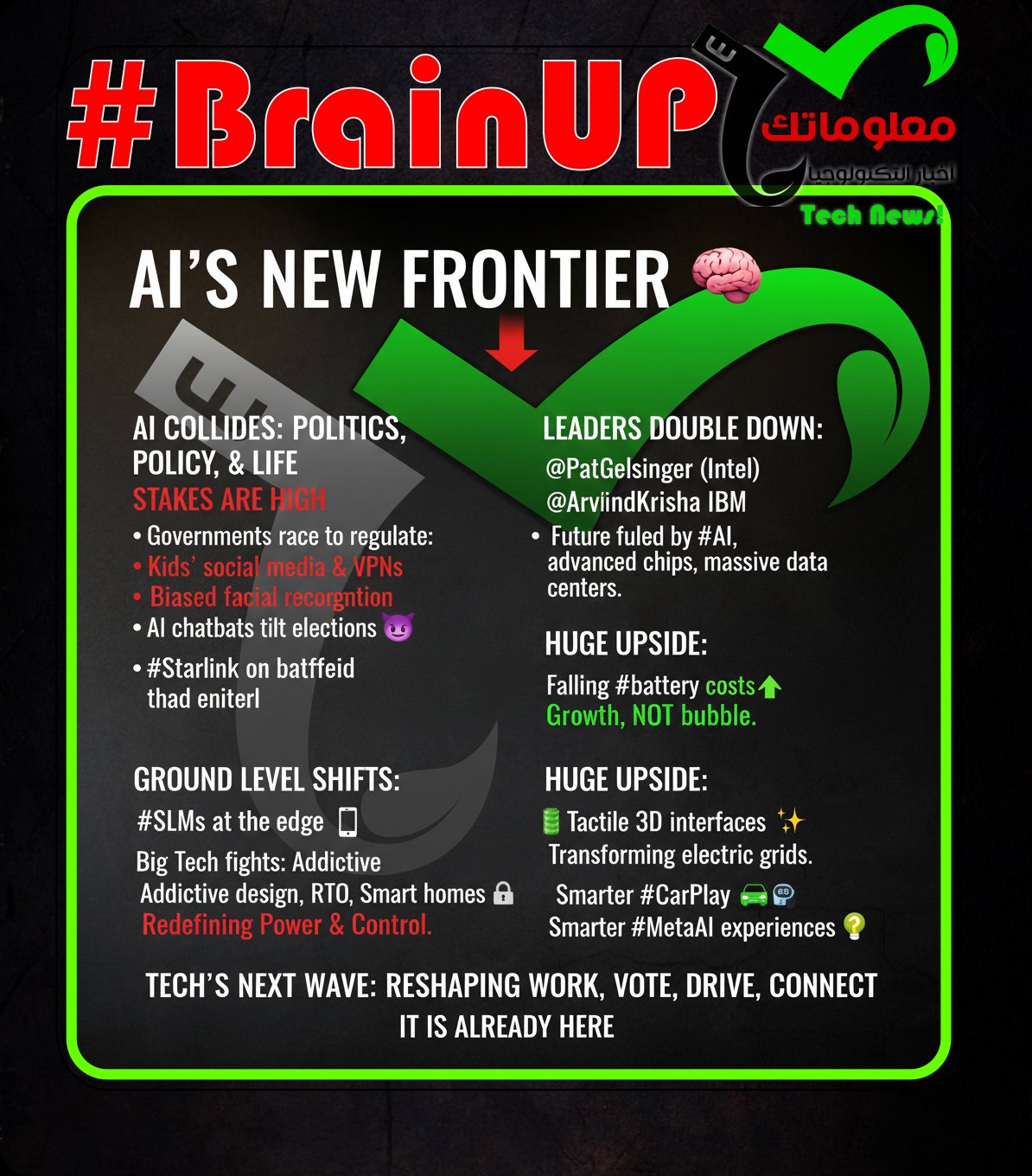
Australia is seeking to prevent under-16s from accessing social media platforms by circumventing age restrictions with VPNs. The government expects platforms to implement measures that block underage users from evading bans by using virtual private networks. This initiative aims to protect minors from the risks associated with early social media exposure and enforce stricter compliance on user age verification. By targeting the use of VPNs, authorities intend to strengthen online safety and uphold privacy laws. These efforts reflect Australia’s broader commitment to fostering a safer digital environment for children.
2. Pat Gelsinger wants to save Moore’s Law with a little help from the feds
Intel CEO @PatGelsinger emphasizes the importance of revitalizing #MooresLaw to sustain semiconductor innovation and global competitiveness. He advocates for increased federal support in the form of funding and policy initiatives to accelerate chip manufacturing and research advancement. Gelsinger highlights how public-private partnerships can enhance the U.S. semiconductor ecosystem amidst rising international competition and supply chain challenges. By aligning government incentives with industry investments, Intel aims to drive breakthroughs in chip technology and production capacity. This strategy reflects a broader effort to secure technological leadership and economic resilience through collaborative innovation.
3. How AI Chatbots Form and Express Political Opinions
Recent research reveals that AI chatbots often generate political opinions based on the training data’s biases and interaction context, which can influence their responses in ways that reflect or amplify political leanings. The study demonstrates that when prompted, AI models like those developed by #OpenAI or #Google can adapt their answers to align with perceived political spectra, sometimes reinforcing existing polarization. This suggests that despite their design to be neutral, AI chatbots may unintentionally perpetuate partisan viewpoints, raising questions about the ethical responsibilities of developers in managing #AI_bias. Understanding these dynamics is crucial for developing fair and transparent AI communication tools as they increasingly enter public discourse. Maintaining AI neutrality requires ongoing scrutiny and deliberate adjustments to training processes and deployment practices.
4. Scientists Are Increasingly Worried AI Will Sway Elections
AI chatbots can meaningfully sway voters toward or away from candidates and may spread misinformation, raising alarms about #AI in elections. In a @Nature study, the pro-Harris chatbot moved likely Trump voters by 3.9 points (four times the impact of traditional video ads) in the U.S. with 2,306 participants, and the pro-Trump bot nudged Harris supporters by 1.51 points; Canadian and Polish experiments (1,530 and 2,118 participants) showed shifts up to 10 percentage points. The primary mechanism appears to be fact-based arguments, and the more prior evidence heard, the less responsive participants become; across all three nations, bots for right-leaning candidates made more inaccurate claims than those boosting left-leaning candidates. These results, described in @Nature and @Science, led by @David Rand, highlight why experts warn about AI-powered political persuasion and the need for scrutiny of such technologies.
5. Home Office admits facial recognition tech issue with black and Asian subjects
The Home Office acknowledges bias in facial recognition technology used by police, finding it more likely to misidentify Black and Asian people than White people in certain settings, according to testing by the National Physical Laboratory (#NPL). The retrospective FPIR rates at a lower setting show White subjects 0.04%, Asian 4.0%, Black 5.5%, with Black women at 9.9% and Black men at 0.4%. The Association of Police and Crime Commissioners says the findings reveal an inbuilt bias and warns that safeguards were not adequately in place as the technology was deployed, urging transparency with affected communities. The government has launched a 10-week public consultation on whether police should access additional databases, such as passport and driving licence images, to broaden tracking, as civil servants and police plan a national facial recognition system holding millions of images (#passport #drivinglicence). The tension is underscored by @SarahJones, the policing minister, who had described the technology as the “biggest breakthrough since DNA matching,” highlighting the clash between potential benefits and safeguards.
6. Brace Yourself: Laptops Prices Are About to Skyrocket
Prices for laptops are set to rise as memory shortages push costs and manufacturers signal price hikes, a trend @TrendForce notes across major makers like @Lenovo. Lenovo has warned retailers that current prices will expire on Jan 1, 2026, signaling higher SRPs for consumers. @Dell and others are cited as planning about 15-20% hikes as early as mid-December, while @HP and @Dell are reexamining product roadmaps ahead of CES 2026 due to memory costs that drive on-device RAM needs, with @Apple moving to 16GB as the base on all MacBook models. The DRAM and NAND squeeze, fed by AI workloads, could hurt smaller brands such as @OneXPlayer, which has halted new orders, prompting some buyers to lock in prices now.
Nvidia’s @JensenHuang argues that while the @US still leads in chips, #China has an edge in infrastructure speed and energy to power #AI expansion. He notes that building a data center in the U.S. from groundbreaking to AI-ready could take about three years, whereas #China can build a hospital in a weekend. He adds that #China has roughly twice as much energy as the U.S. and that its energy capacity is rising, while U.S. capacity remains relatively flat. Despite these gaps, Nvidia says it remains generations ahead in AI chip technology and cautions that assuming #China cannot manufacture would be a big idea missed; @DonaldTrump’s push to reshore manufacturing could shape AI investment. Industry estimates from DataBank’s Raul Martynek place data center costs at $10-15 million per MW, with 40 MW typical, and 5-7 GW expected online next year, totaling roughly $50-105 billion and underscoring how infrastructure scale and policy influence AI demand.
AI adoption will be gradual, but when it hits, it could reshape the job market and even spark new roles like robot tailors and an industry for robot apparel #robotapparel. In a Rogan interview @JensenHuang warned that routine tasks are most at risk, giving the example that chopping vegetables could be replaced by machines, while he suggests radiologists may stay relevant because interpretation of images matters beyond mere scanning. He acknowledged some jobs may disappear but others will adapt, and he even imagines a future where technicians maintain AI assistants and related systems, expanding employment horizons rather than simply erasing them. A MIT study cited by Fortune suggests AI could replace work equivalent to about 12% of U.S. jobs, roughly 151 million workers and over $1 trillion in pay, underscoring the scale of disruption and the emergence of new roles. The piece also notes that major players like @ElonMusk are pursuing robot-centric strategies with Optimus and that even if the pace is gradual, the eventual shift could redefine work and economy, potentially bringing a cultural and market shift as automation seeps into everyday life.
9. Small Language Models Create New Security Risks
Edge AI rollout introduces new security risks as small language models (SLMs) are embedded in increasingly complex hardware and interact across devices, changing the risk equation. The push for local compute—driven by energy and latency benefits of keeping data on-premises—spurs broader deployment of SLMs and scaled-down LLMs across vertical markets for training and inference. @Niranjan_Sitapure notes that SLMs are becoming more capable, with multilingual capabilities and even basic reasoning for math and coding, amplifying choices about which models to deploy or fine-tune for a given task. SLMs can self-optimize, update, and interact with other SLMs, widening the attack surface in ways that are hard to predict and increasing security complexity for IoT devices where consistency lags behind safety-critical automotive systems. As the edge ecosystem expands, the crowded SLM landscape, task-specific tuning, and cross-device orchestration raise new considerations for hardware and software security that must be addressed to prevent attackers from exploiting these interactions and gaps. #edgeAI #SLMs #security #IoT #orchestration
10. New haptic display technology creates 3D graphics you can see and feel
A UCSB team has created a display that makes 3D graphics both visible and tactile using arrays of optotactile pixels. Each pixel has an air-filled cavity and a suspended graphite film that absorbs light from a low‑power scanning laser, heating the air and deflecting the top surface by up to about 1 millimeter to form a palpable bump. The same laser provides illumination and power and sweeps across pixels to generate dynamic contours, shapes and characters with a refresh rate fast enough to feel continuous, while the surface contains no embedded wiring. Led by @Max Linnander in the RE Touch Lab of @Yon Visell, the work, published in #ScienceRobotics, demonstrates a path to scalable devices with more than 1,500 independently addressable pixels. The researchers envision applications in high‑definition visual‑haptic touch screens for cars, mobile computing or intelligent architectural walls that users can both see and feel.
11. Falling Battery Prices Could Transform Electric Grids
Falling #battery prices are set to revolutionize electric grids by enabling greater storage capacity and renewable energy integration. Recent data shows cost declines of more than 80% over the past decade, making grid-scale batteries more economically viable. Experts highlight that this shift could reduce reliance on fossil fuels and increase grid resilience against outages and demand spikes. @EnergyAnalysts note that the confluence of technological advances and policy incentives supports faster adoption of battery storage. These trends indicate an impending transformation in how electric utilities manage supply, stability, and sustainability in power systems.
12. AMD, IBM CEOs don’t see AI bubble, only early stages of growth
AMD CEO @LisaSu and IBM CEO @ArvindKrishna believe the current enthusiasm for #AI does not reflect a speculative bubble but rather the early stages of a transformative technology trend. Su highlighted the rapid advancements in AI and the integration of AI workloads into heterogeneous computing, signaling long-term growth opportunities for semiconductors. Krishna emphasized AI’s practical applications across industries and the substantial investments being made in AI research and hardware, suggesting sustainable momentum in the AI sector. Both CEOs see AI as evolving with increasing enterprise adoption rather than experiencing a temporary hype cycle. Their perspectives align on AI’s potential to reshape technology infrastructure and drive ongoing innovation rather than a fleeting market fad.
Despite claims by the U.S. Department of Defense that the threat was mitigated, reports indicate that Russia continues to utilize Starlink-guided drones in Ukraine, with evidence including imagery of a Starlink Mini device atop a grounded drone. This suggests an ongoing challenge with controlling #Starlink technology as it has been repurposed by Russian forces, raising concerns about the security of satellite-based communications systems. Analysts highlight that while @ElonMusk’s #SpaceX initially provided Starlink terminals to Ukraine to enhance communications, the technology’s adaptation by Russian forces reflects complex implications for battlefield communications and drone warfare. The persistence of these drones with Starlink guidance underscores evolving warfare dynamics and technology vulnerabilities. This situation demonstrates the difficulties in preventing the adversarial use of widely available commercial satellite internet systems during conflict.
Massachusetts’ highest court heard oral arguments in the state’s lawsuit alleging that Meta designed features on @Facebook and @Instagram to be addictive to young users. The filing contends these features were intentionally crafted to increase engagement and time spent by minors. Critics argue the design choices raise questions about protecting children online and the responsibility of social platforms, potentially under consumer protection or child-safety norms. The case could influence how digital platforms balance user engagement with safety, shaping future accountability for #addictive-design practices.
15. Google, Apple urged by House committee to pull apps tracking ICE agents
A House Committee on Homeland Security pressed @SundarPichai and @TimCook to outline what actions Google and Apple will take to remove apps that monitor federal immigration agents, centering on #ICEBlock. Google says ICEBlock was never on the Play Store and similar apps were removed for policy violations, while Apple said it removed ICEBlock and other tracking apps after pressure from the Trump administration. The committee argues these apps risk jeopardizing the safety of DHS personnel and asked for a briefing by Dec. 12, demanding assurances that such apps cannot be used to target agents or obstruct immigration enforcement. ICEBlock had more than a million users before removal, and while its supporters frame it as protected speech, critics note the potential harm to law enforcement; the dispute highlights tensions between #FirstAmendment protections and public-safety concerns in #immigrationenforcement.
16. Instagram Head Announces a Strict New RTO Policy
Instagram’s head Adam Mosseri has implemented a stringent new return-to-office (#RTO) policy requiring employees to work from the office at least three days a week. This move reverses previous remote work flexibility and signals a shift in Meta’s approach to hybrid work culture, emphasizing in-person collaboration. Mosseri argues that being physically present is essential for productivity and innovation, impacting Instagram’s operational dynamics. The policy change reflects broader trends among tech companies reevaluating remote work, highlighting tensions between employee preferences and managerial expectations. Ultimately, the new RTO guidelines aim to balance company culture rejuvenation with maintaining productivity.
17. Chamberlain blocks smart home integrations with its garage door openers — again
Chamberlain’s Security+ 3.0 platform tightens control over smart garage door integrations by shutting down third‑party workarounds and steering users toward the MyQ app and subscription‑based partners. It blocks aftermarket controllers from Ratgdo, Tailwind, and Meross that previously enabled integrations with @Apple @HomeKit, @Google Assistant, and @Amazon Alexa. The shift pushes users into Chamberlain’s ad‑studded #MyQ app and a narrow list of paid partners, most of which require subscriptions. The move fits a broader pattern of locking down MyQ technology and comes as Chamberlain exits the #Matter standards group, signaling a push toward interoperability restrictions even as the industry warms to garage door controllers. For users, this underscores the ongoing #GarageDoorWars as the market consolidates around a proprietary, subscription‑driven ecosystem.
18. iOS 26.2 Will Add Two New Features To CarPlay In December – BGR
iOS 26.2 will add two CarPlay features in December: the ability to unpin messages from the infotainment display and the option to add more widgets. The Verge’s @TomWarren notes that some CarPlay systems can display three widgets at once, such as a clock, weather, and the Spotify widget, though having three widgets may prevent Live Activities. This enhancement follows earlier iOS 26 CarPlay changes like the Liquid Glass design and a redesigned, more compact notification view, which aim to reduce distractions while driving. Overall, the updates illustrate Apple’s ongoing push to improve #CarPlay usability and integration with #LiveActivities and widgets, expanding customization while maintaining safety.
Meta has signed commercial AI data agreements with publishers to surface real-time global, entertainment, and breaking news on Meta AI, with responses that include links to articles from multiple sources. Partners include @CNN, @FoxNews, @FoxSports, Le Monde Group, the People Inc. portfolio of media brands, The Daily Caller, The Washington Examiner, and USA Today, with plans to add more. The move follows Meta’s shift away from making its platforms news hubs and its 2022 pause on publisher payments, as the company says Meta AI should be more responsive, accurate, and balanced #AI #MetaAI. By integrating more sources, Meta aims to improve coverage of real-time events and present a wider range of viewpoints, helping attract users amid competition and the earlier Llama 4 controversy #news. Meta AI is available in over 200 countries through its apps and the standalone Meta AI app #AI
That’s all for today’s digest for 2025/12/07! We picked, and processed 19 Articles. Stay tuned for tomorrow’s collection of insights and discoveries.
Thanks, Patricia Zougheib and Dr Badawi, for curating the links
See you in the next one! 🚀
