
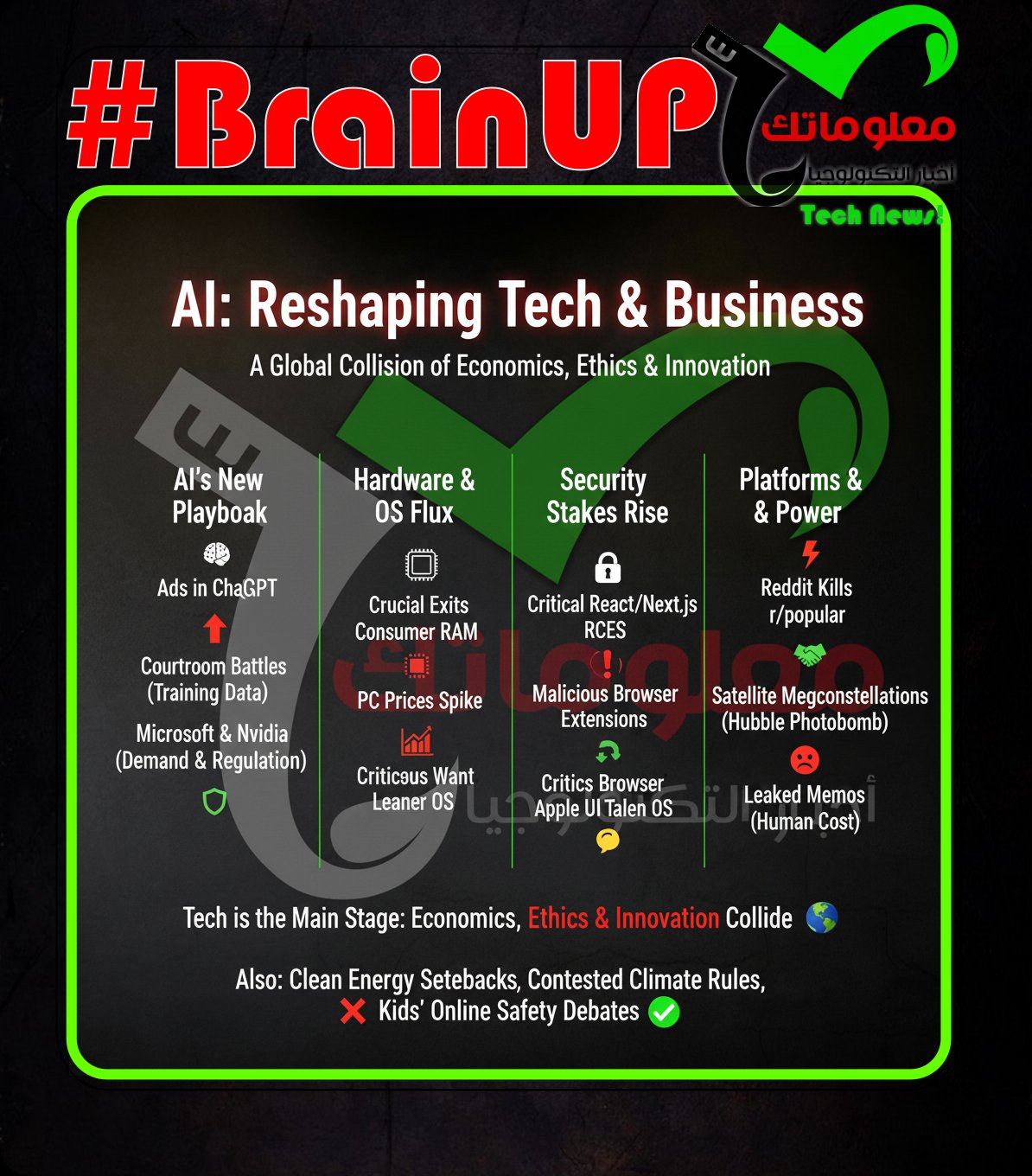
#BrainUp Daily Tech News – (Thursday, December 4ᵗʰ)
Welcome to today’s curated collection of interesting links and insights for 2025/12/04. Our Hand-picked, AI-optimized system has processed and summarized 22 articles from all over the internet to bring you the latest technology news.
As previously aired🔴LIVE on Clubhouse, Chatter Social, Instagram, Twitch, X, YouTube, and TikTok.
Also available as a #Podcast on Apple 📻, Spotify🛜, Anghami, and Amazon🎧 or anywhere else you listen to podcasts.
OpenAI has introduced ads and app suggestions within ChatGPT’s interface, including for users paying $200 a month for the Pro+ subscription, triggering user frustration. The new feature displays suggested apps below chat boxes, promoting third-party applications, essentially marking the start of monetization through #advertising in ChatGPT, even at higher-tier subscriptions. Users express annoyance as this move seemingly contradicts expectations of an ad-free experience for premium subscribers. This development reflects OpenAI’s strategy to monetize its AI platform beyond subscription fees, possibly balancing operational costs. The inclusion of ads in ChatGPT raises important questions about user experience and the evolving commercialization of AI tools.
2. After nearly 30 years, Crucial will stop selling RAM to consumers
Micron Technology will exit the consumer RAM business in 2026, ending 29 years of selling RAM and SSDs to PC builders and enthusiasts under the Crucial brand. The decision is driven by AI data center demand, with Micron saying AI-driven growth has led to a surge in memory and storage, and that exiting the Crucial consumer business will allow it to better support larger, strategic customers. Crucial consumer shipments will continue through the end of its fiscal second quarter in February 2026, warranties will be honored, and affected employees will be redeployed, while Micron will continue selling enterprise products under its own name. The move comes amid a memory-price squeeze for consumers, with a typical 32GB DDR5 RAM kit rising from about $82 in August to roughly $310, and DRAM contract prices up 171% year over year, reflecting AI infrastructure demand such as @OpenAI’s Stargate project signing up to 900,000 DRAM wafers per month, potentially nearly 40% of global production and driving reallocation toward #HBM memory. DIY options are thinning as a result, with examples like Framework pausing standalone RAM sales to curb scalping, making enterprise purchases and margins more dominant while the Crucial consumer legacy winds down.
3. Porsche Is Adding Fake Gear Shifts to Its EVs, 2027 Taycan Will Be First: Exclusive
@Porsche plans to add a ‘virtual transmission’ with fake gear shifts to its EVs, starting with the 2027 Taycan, in a bid to boost driver engagement and #virtualtransmission. The move follows lessons from @Hyundai’s Ioniq 5 N, and Porsche says it will apply those insights to its own EVs, with orders for the 2027 Taycan equipped with the feature expected to open next August. Porsche indicated the feature will be toggleable and will not be offered to 2026 and older Taycans via a software update because they lack paddle shifters #paddleShifters. A prototype fleet manager described initial skepticism about the artificial shifts but said the system could mimic a proper torque converter gearbox so well that the difference is indistinguishable. The update is tied to a major PCM infotainment refresh, with the new interface expected to borrow elements from the Cayenne Electric’s system, and the Cayman Electric is also expected to get the tech.
4. Google and Microsoft battle surge in malicious Chrome and Edge extensions
A recent surge in malicious browser extensions targeting #Chrome and #Edge has prompted Google and Microsoft to intensify their security measures. Researchers found hundreds of extensions designed to steal credentials, mine cryptocurrency, and inject ads, which often mimic popular or legitimate add-ons to evade detection. Both companies have updated their store policies and enhanced automated detection tools to reduce these threats and protect users’ privacy and security. Despite these efforts, the scale and sophistication of malicious extensions continue to challenge the browsers’ defenses, highlighting the need for ongoing vigilance and improvements. This crackdown reflects a broader industry push to secure the extension ecosystems of major browsers amid evolving cyber threats.
5. Palantir CEO Says Making War Crimes Constitutional Would Be Good for Business
Palantir @AlexKarp argues that making war crimes constitutional would be good for business because it would require precise, condition-specific accountability that Palantir’s tools could enable under a government contract worth about $10B. Evidence includes his claim that the more constitutional the policy, the more the military would need Palantir’s tech to verify conditions, his quote about the rise of the West through organized violence, and his public support for @Trump’s immigration policy and for ICE, including Palantir’s #ImmigrationOS platform valued at $30M. Analysis: while he denies building a #facialrecognition surveillance database, he acknowledges that data from enemies could be surveilled in Palantir’s product, highlighting tensions between defense uses and #surveillance concerns. Link back: the piece situates Karp’s stance within a pattern of tech executives aligning with security and immigration policy, raising questions about Palantir’s role in #masssurveillance and its ethical implications.
6. Reddit’s CEO says r/popular ‘sucks,’ and it’s going away
Reddit is moving away from the default r/popular toward more personalized feeds to reflect that users have different interests and that a single Reddit culture no longer fits all. @Steve Huffman calls r/popular ‘sucks’ and says it will stop appearing for new users in the near term, with the company testing upgraded feeds that are more relevant to individual tastes. The change also includes moderations policy updates that will cap moderators of high-traffic communities at five, for communities with over 100K weekly visitors, starting March 31, 2026, a move aimed at reducing powermods. Taken together, these steps mark a shift from a universal front page to user-specific experiences, with ongoing testing leaving details of the new feeds to be announced. #personalized_feeds #powermods
7. OpenAI loses fight to keep ChatGPT logs secret in copyright case
OpenAI has lost a legal battle to keep logs of ChatGPT conversations confidential in a copyright infringement lawsuit, highlighting transparency requirements for AI companies. The court ruled that the logs, which may contain user prompts and interactions, are relevant to understanding potential misuse of copyrighted material fed into #ChatGPT. This decision reflects growing judicial scrutiny over how generative AI models handle and store user data amid #copyright concerns. It imposes greater obligations on AI developers like @OpenAI to reveal operational details during litigation, shaping future regulatory and compliance standards. The ruling underscores the tension between user privacy claims and the need for accountability in #AI-generated content disputes.
8. Do Not Build a PC Right Now: Prices Out of Control
Building a PC right now is not advisable due to extensively inflated component prices. The cost of graphics cards, CPUs, and other parts have skyrocketed, primarily driven by #cryptocurrency mining demand and ongoing supply chain disruptions. This price surge makes assembling a custom PC significantly more expensive than usual, eroding its traditional cost-effectiveness and value proposition. Consumers might consider waiting until market conditions stabilize and component availability improves to avoid overpaying. This situation highlights how external economic factors can heavily influence tech markets and user decisions.
9. Microsoft stock sinks on report AI product sales are missing growth goals
Microsoft stock fell after a report that Azure Foundry sales teams missed growth goals, though the company says quotas were not lowered. The Information cited two Azure unit salespeople, noting less than a fifth met a 50% growth target in one unit and that another unit’s quota was doubled before being cut to 50% after misses, with the stock sliding more than 2% on the news. Microsoft disputed the linkage between growth and quotas, stating that aggregate AI product quotas have not been lowered and suggesting the report mixed growth with quotas for AI tools like #Foundry. The article notes that @OpenAI, @Google, @Anthropic, @Salesforce, @Amazon and others have their own AI tools, while adoption of these tools by traditional businesses has not surged as in other parts of the AI ecosystem #AI. It underscores investor sensitivity to AI sales metrics and the ongoing challenge of proving value and scaling AI solutions in enterprise settings, even as Microsoft maintains its stance on quotas.
10. Windows 11 now on 25% of PCs thanks to Microsoft’s forced upgrades
Windows 11 has reached 25% of global PC usage according to StatCounter, a notable milestone driven largely by Microsoft’s push through forced upgrades and hardware requirements such as TPM 2.0 and secure boot. Despite initial slow adoption due to compatibility and user reluctance, Microsoft’s aggressive upgrade strategy, including automatic updates on eligible devices, has accelerated its spread. This increase reflects both the growing installed base meeting the requirements and strategic pressure exerted by Microsoft to transition users from Windows 10. However, challenges remain as some users resist upgrading, and alternative operating systems continue to hold niche appeal. The shift to Windows 11 illustrates the broader trend of OS lifecycle evolution mediated by corporate policy and market dynamics.
A former Microsoft developer, known for creating the Task Manager, argues that #Windows11 requires a significant update akin to the #WindowsXP SP2 moment focused on stability and performance rather than integrating AI or unnecessary features. This perspective highlights concerns over the current direction of Windows 11, which includes added AI components and potential bloat that may hinder user experience. The developer emphasizes the value of prioritizing core system improvements, security, and efficiency to regain user trust and optimize functionality. By emphasizing a streamlined approach, Windows 11 could similarly achieve a defining, positive milestone that enhances its reputation and usability. This call reflects broader debates around modern operating system design priorities and balancing innovation with practical performance.
12. Nearly a Billion PCs Running Windows 10, Half Are More Than 3 Years Old
Windows 10 remains the dominant operating system with nearly a billion active PCs, but half of these devices are over three years old. Data from AdDuplex reveals that older Windows 10 builds are still widely used despite Microsoft’s push for updates, with significant portions running versions that are no longer supported. This highlights the challenges in maintaining software security and compatibility on aging hardware. The persistence of outdated systems underscores the need for improved upgrade incentives and infrastructure. Overall, the Windows 10 ecosystem is vast but fragmented, impacting user experience and security consistency.
13. Leaked memo reveals Meta’s harsh management culture under Mark Zuckerberg
A leaked memo exposes the demanding management style at Meta under CEO @MarkZuckerberg, emphasizing high expectations and a relentless work ethic. The memo highlights the pressures employees face to meet ambitious goals, with little tolerance for underperformance. This strict environment aligns with Meta’s competitive positioning in tech but has sparked internal debate over sustainability and morale. The rigorous approach seeks to drive innovation and maintain a leading edge in #socialmedia and #AI sectors. The memo’s revelations underline challenges in balancing aggressive leadership with employee well-being at major tech firms.
A customer purchased an NVIDIA RTX 5080 GPU from Best Buy for $1,200 but received a package containing only rocks instead of the graphics card. The box arrived tampered with and had a broken seal, raising concerns about possible theft or package tampering during shipping. This incident highlights vulnerabilities in supply chain security and the importance of thorough inspection upon delivery. Best Buy and the customer are now involved in resolving the issue, underscoring challenges retailers face in protecting high-value electronics. Cases like these illustrate risks linked to e-commerce and logistics for expensive #tech products.
Modern Hydrogen, a company supported by @BillGates, announced significant layoffs after nearly a decade of working on clean energy solutions, particularly focusing on #hydrogen technology. Despite substantial investment and efforts to develop cost-effective green hydrogen production, the company struggled to reach commercial viability amid challenges such as high production costs and market competition. The layoffs signal a broader difficulty in scaling #hydrogen-based clean energy projects, even with prominent backers and technological advancements. This development underscores the complexities faced by the clean energy sector in transitioning to sustainable fuel alternatives. Modern Hydrogen’s experience reflects the ongoing hurdles in commercializing #cleanenergy technologies despite growing global interest and policy support.
16. House Energy and Commerce Committee holds hearing on kids’ online safety package
The House Energy and Commerce Committee convened to discuss proposed legislation aimed at enhancing children’s online safety, focusing on new regulations for tech companies to better protect minors. Lawmakers examined the current online environment and highlighted increasing concerns about mental health impacts and exploitation risks faced by young users. Experts and stakeholders provided testimony supporting comprehensive measures including stricter content moderation, parental controls, and transparency requirements for online platforms. The hearing underscores legislative intent to address gaps in existing policies through a multi-faceted approach involving government oversight and industry cooperation. This initiative seeks to balance technological innovation with safeguarding vulnerable populations, reinforcing shared responsibility among policymakers, companies, and families.
17. Critical RCE Vulnerabilities Discovered in React & Next.js | Wiz Blog
The article warns of two critical unauthenticated RCE vulnerabilities in the @React and @Next.js ecosystems via CVE-2025-55182 and CVE-2025-66478, affecting the @RSC #Flight protocol. The flaws stem from insecure deserialization in the RSC payload handling, allowing attacker controlled data to influence server side execution, and exploitation requires only a crafted HTTP request in default configurations with near 100% success in testing. Immediate patching is required and hardened releases are available for both @React and @Next.js. Wiz data shows 39% of cloud environments contain vulnerable instances, with @Next.js present in 69% of environments and 61% of those having public applications, meaning 44% of all cloud environments have publicly exposed Next.js instances. The article lists affected products and patched releases and urges defenders to apply remediation, noting that any framework bundling the react-server implementation is likely affected.
18. Meta poaches Apple design exec Alan Dye to lead new creative studio in Reality Labs | TechCrunch
Meta hires @Alan Dye, longtime head of Apple’s UI team, to lead a new creative studio within #RealityLabs, signaling a deeper push into consumer devices like AR glasses and VR headsets. Dye will focus on improving #AI features for these devices and report directly to @Andrew Bosworth, Meta’s CTO. Apple will replace Dye with Steve Lemay, described by @Tim Cook as having played a key role in every major Apple interface since 1999. Meta has been recruiting from rivals to bolster its AI push, including OpenAI researchers, and the new studio will bring together designers such as @Billy Sorrentino and @Joshua To with Meta’s industrial and metaverse design teams led by Pete Bristol and Jason Rubin. @Mark Zuckerberg framed the studio as a nexus of design, fashion, and technology to define the next generation of Meta’s products and experiences, with the idea of treating intelligence as a new design material and elevating design within Meta.
19. Trump administration rolls back fuel economy standards
The Trump administration rolled back Obama-era fuel economy standards aiming to reduce emissions from vehicles, citing economic and regulatory concerns. The rollback lowers required fuel efficiency for new cars by about 1.5% annually instead of the previous standard of roughly 5%. Critics argue this move will increase pollution and hinder progress against climate change, while supporters claim it eases financial burdens on automakers and consumers. This policy shift reflects broader political debates on environmental regulation and climate policy priorities under @realDonaldTrump. The rollback impacts national efforts to address #climatechange through vehicle emissions standards and shapes future regulatory approaches.
20. ADP jobs report: November 2025 private payrolls unexpectedly fell by 32,000
Private payrolls in the U.S. unexpectedly declined by 32,000 in November 2025, according to the ADP report, defying economists’ expectations of an increase. The decrease was driven primarily by losses in the goods-producing sector, particularly manufacturing, while service-providing jobs saw a modest gain. This decline raises concerns about labor market momentum as it contrasts with recent strong employment data and could signal cooling economic conditions. Analysts suggest that factors such as rising interest rates and potential slowing demand may be contributing to the job losses. The surprising data point injects uncertainty into the broader outlook for the U.S. labor market and will be closely watched in upcoming government employment reports.
21. Nvidia CEO Jensen Huang talks chip restrictions with Trump, blasts state-by-state AI regulations
@JensenHuang stressed that export controls should be strong and that a single federal AI standard is wiser than a patchwork of state regulations. He said he met with @realDonaldTrump on Capitol Hill and they discussed export controls as lawmakers weigh the #GAINAIAct to require first pick for U.S. buyers on AI chips before sales to nations like China. Huang argued the #GAINAIAct is more detrimental to the United States than the #AIDiffusionAct and warned that state-by-state AI rules would drag the industry to a halt and raise national security concerns; the pushback has spurred the AI industry-backed super PAC #LeadingTheFuture. Trump has urged preemption of state AI laws in favor of one federal standard, but @SteveScalise indicated the provision will not be included in NDAA, highlighting the ongoing effort to establish a national AI policy as Nvidia stays engaged in the debate.
22. Satellites keep photobombing the Hubble telescope, and it’s getting worse
A surge in satellite launches is making it harder for #Hubble and other space telescopes to capture pristine images. NASA researchers, in @Nature, estimate satellite trails could contaminate about 40% of Hubble images and up to 96% of images from three other telescopes over the next decade, with 4.3% of Hubble images already showing trails, a trend aided by cheaper launches and megaconstellations like @Starlink. The number of Earth-orbiting satellites has risen from ~5,000 in 2019 to >15,800 today, potentially up to 560,000 with planned launches. Simulations show Hubble could see about 2.14 satellites per exposure, Xuntian about 92 per exposure, while the James Webb Space Telescope remains less affected due to distance. The reflected light from satellites can obscure details and even mask exoplanet signals; there is a call to develop solutions to limit #megaconstellations’ light pollution before the problem worsens.
That’s all for today’s digest for 2025/12/04! We picked, and processed 22 Articles. Stay tuned for tomorrow’s collection of insights and discoveries.
Thanks, Patricia Zougheib and Dr Badawi, for curating the links
See you in the next one! 🚀
