
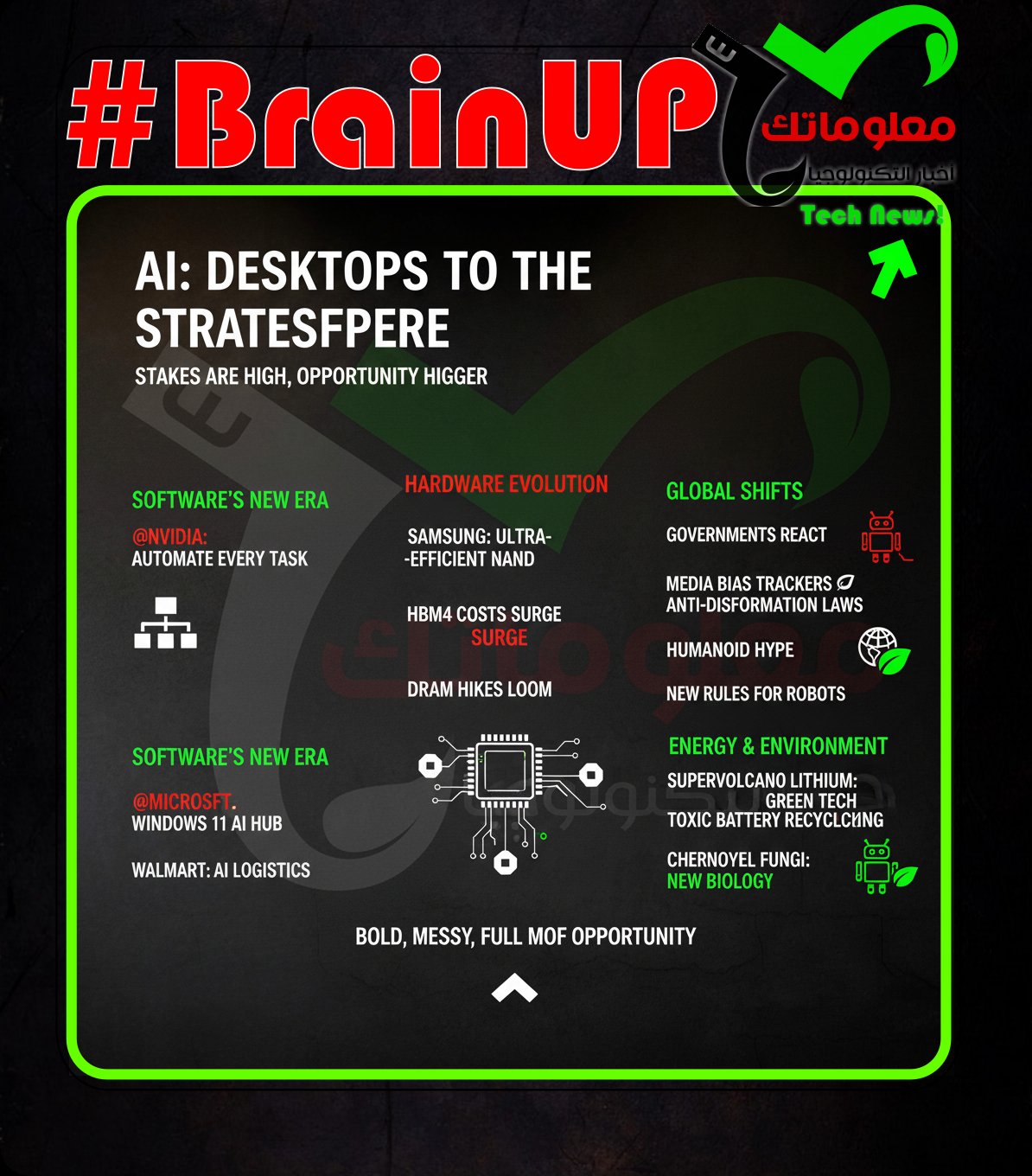
#BrainUp Daily Tech News – (Monday, December 1ˢᵗ)
Welcome to today’s curated collection of interesting links and insights for 2025/12/01. Our Hand-picked, AI-optimized system has processed and summarized 20 articles from all over the internet to bring you the latest technology news.
As previously aired🔴LIVE on Clubhouse, Chatter Social, Instagram, Twitch, X, YouTube, and TikTok.
Also available as a #Podcast on Apple 📻, Spotify🛜, Anghami, and Amazon🎧 or anywhere else you listen to podcasts.
1. World’s largest lithium deposit lies under a supervolcano in the US
Researchers have discovered the world’s largest lithium deposit beneath the Yellowstone supervolcano in the United States, which could significantly impact lithium supply for green energy technologies. The lithium is found in hot springs and geothermal waters under the caldera, offering a potential new source for #battery materials critical to electric vehicles and renewable energy storage. This unique deposit is due to geologic processes involving volcanic activity, which concentrate lithium in accessible hydrothermal fluids. Extracting lithium here could reduce reliance on traditional mining, which faces environmental and geopolitical challenges. Harnessing this deposit aligns with global efforts to transition to clean energy by providing a domestic, sustainable source of lithium.
2. Nvidia Jensen Huang urges employees to automate ‘every task’ possible
Nvidia CEO @JensenHuang has urged employees to automate every task possible to foster innovation and efficiency within the company. He emphasized the importance of leveraging #automation to reduce mundane work and allow engineers to focus on creative and high-value projects. Huang highlighted how automation not only boosts productivity but also transforms workflows across Nvidia’s operations, aligning with broader industry trends towards AI and machine learning-driven processes. His call reflects a strategic shift aiming to keep Nvidia competitive and responsive in a fast-evolving tech landscape. This approach underscores the company’s commitment to embracing technological advancements internally to drive future growth.
@Microsoft is pushing ahead with agentic features in #Windows11 even as its own docs warn that AI agents can hallucinate and behave unpredictably. The company envisions ‘making every Windows 11 PC an AI PC’ with @Copilot Voice, @Copilot Vision, and @Copilot Actions, turning the taskbar into the AI control hub accessible via an Ask Copilot interface. Agents are said to run under separate accounts with limited permissions and tamper-evident logs, yet they still access known folders like Documents, Downloads, Desktop, Videos, Pictures, and Music. This highlights a risk and benefit calculus as @Microsoft acknowledges XPIA, malicious prompts, and malware risks while expanding access for these agents. The article suggests Windows 11 is being used as a testbed for an upcoming #agenticComputing future, raising questions about safety, privacy, and user fatigue as AI features become central to the OS.
4. Google finally adds RCS message archival in the new Google Messages update
Google has introduced RCS message archival for Pixel phones with the latest Google Messages update, allowing users to save and manage their RCS conversations more efficiently. This feature addresses long-standing user demands for backup and message retention options beyond standard SMS. By enabling message archival, Google enhances the reliability and usability of its #RCS messaging platform against competitors. This update aligns with Google’s commitment to improving communication experiences on Pixel devices while promoting wider #RCS adoption. As a result, Pixel users benefit from a more robust messaging system that supports continuity and data preservation.
5. White House launches media bias tracker
The White House has introduced a #Media Bias Tracker aimed at monitoring news outlets for bias, misinformation, and anti-government narratives. This initiative is presented as a tool to ensure accountability and maintain journalistic integrity, which the administration argues is critical in an era of disinformation and polarized media. Critics, however, warn that the tracker could serve as a mechanism for censorship and government overreach, potentially infringing on press freedom. The administration defends the tracker by emphasizing its role in transparently identifying biased or false information, thus fostering an informed public. This effort reflects growing tensions between the government and media over the influence and responsibility of news reporting in shaping public opinion.
6. ‘Avatar’ director James Cameron says generative AI is ‘horrifying’ | TechCrunch
James @James Cameron argues that #AI is horrifying, distinguishing it from #Performance capture which he describes as a celebration of the actor-director moment in #Avatar films. He made the remarks during a CBS Sunday Morning interview tied to Avatar: Fire and Ash, noting that performance capture uses real actors as templates rather than creating digital personas from scratch with a text prompt. Cameron contrasts the approaches, saying generating a character or performance from a prompt is exactly what cinema should avoid and that AI should augment human artistry rather than replace it. The piece notes the 250,000-gallon water tank used to film underwater scenes, and places his stance within the broader #Media #Entertainment conversation about #AI, underscoring a cautious line that prioritizes human performance and collaboration over fully synthetic productions.
Samsung unveiled a new NAND flash storage technology at CES 2026 that reduces power consumption by 96 percent compared to existing solutions. This breakthrough is achieved through advanced chip design and manufacturing processes, improving efficiency while maintaining high performance. The innovation is significant for portable devices and data centers where energy efficiency is critical. Samsung’s achievement highlights its commitment to sustainable technology and advancing storage solutions in line with growing data demands. This development positions Samsung as a leader in energy-efficient storage tech, pushing the boundaries of what NAND flash memory can deliver.
8. Memory Price Hikes Could Mean More Expensive Phones, PCs in 2026
Memory prices are rising and, according to @TrendForce, this trend will become more visible in 2026, with pressures on laptops and smartphones driven by surging #DRAM and #SSD costs. TrendForce projects notebook prices could climb up to 15% year over year as memory costs spike, while some smartphones may see increases of around 10%, a picture echoed by @TechPowerUp. Memory shortages are also projected to reduce smartphone production by 2% year over year in 2026, down from an earlier forecast of slight growth, with @Statista noting about 1.2 billion smartphone units in 2024. Cheaper models would be hit hardest since thinner margins leave manufacturers with less room to absorb higher material costs, and the broader effect could include industry consolidation as smaller players struggle to secure supplies. The notebook segment looks especially vulnerable because memory and storage can account for 10 to 18 percent of manufacturing costs and could rise to 20 percent or more, potentially lifting notebook prices and boosting second hand demand, while ongoing supply-line frictions and longer device lifespans from #right-to-repair rules may slow upgrades and even weigh on monitor shipments, which TrendForce also expects to ease by about 0.4 percent in 2026.
9. Recycling Lead for U.S. Car Batteries Is Poisoning People
Lead recycling for U.S. car batteries poisons people in Ogijo, Nigeria, challenging the clean, green image of the auto industry that relies on overseas recycling by @Ford, @Toyota, and @GM. Testing near Ogijo found seven in ten residents with dangerous blood-lead levels and that all 16 workers tested were poisoned; among adults, 41 of 56 had dangerous levels and 8 of 14 children were affected. Dust and soil samples reached up to 186 times the hazard threshold, and lead exposure damages nervous systems, brains, livers and kidneys, with toddlers at risk from dust they ingest. The pollution stems from crude recycling operations that export risk as U.S. regulations tighten at home, forcing producers to seek cheaper, less regulated sources. This story links consumer batteries to real-world health costs and raises questions about accountability and the global #recycling system #environmentaljustice.
11. Major AI conference flooded with peer reviews written fully by AI
ICLR 2026, a major #AI conference, faces a surge of peer reviews generated by AI. Pangram Labs, using its detection tools for #LLMs, analyzed 19,490 submissions and 75,800 peer reviews and found around 21% of reviews fully AI-generated, with 15,899 reviews flagged as AI-generated in some form. Among submissions, 199 manuscripts (about 1%) were fully AI-generated, 61% were largely human-written, and 9% contained more than half AI-generated text. Researchers including @Graham Neubig described reviews as verbose and AI-like, sometimes asking for analyses not typical in AI papers. Conference organizers plan to deploy automated tools to detect AI usage and enforce policies, a move aimed at restoring trust in the peer review process and clarifying how AI should be treated in submissions and reviews.
12. Macron pushes for new legislation to rapidly block viral digital disinformation
French President @EmmanuelMacron is advocating for new legislation to quickly block viral digital disinformation on social media platforms. He emphasizes that the current system is too slow to counteract the rapid spread of harmful false information. The proposed legal measures aim to empower French authorities to take down viral content within hours, addressing #digitaldisinformation more effectively. Macron’s initiative highlights growing concerns about the impact of misinformation on public opinion and democratic processes. This legislative push reflects France’s commitment to regulating the digital space and protecting citizens from manipulative online content.
13. Walmart celebrates automation as US job cuts reach multiyear high
Walmart frames its pursuit of #AI-powered efficiency as a pathway to lower costs and faster service, even as automation reshapes the broader U.S. jobs market. In its latest quarter the retailer beat expectations and raised full-year guidance, with its #ecommerce arm posting double-digit growth aided by automation; @John David Rainey, CFO, said that more than 50% of fulfillment-volume now comes from automation, translating into lower shipping costs. @Doug McMillon has signaled that #AI will touch every job and that the company expects its global headcount to stay around 2.1 million over the next three years, reflecting both eliminations and new roles as part of a changing work environment. Executives cited AI across demand forecasting, inventory, and logistics, including the claim that more than 40% of new software code may be AI-generated or AI-assisted, highlighting productivity gains alongside displacement risks. Broader data show a jobs market under strain, with 153,074 cuts in October and 1.1 million year-to-date, as UPS cut 48,000 positions, Amazon 14,000, and Chegg cut around 45% of its workforce, all tied to technology-driven changes; Walmart emphasizes responsibility to prepare associates for this shifting landscape, linking its strategy to a more resilient, tech-powered retail model.
14. Public GitLab Repositories Exposed More Than 17,000 Secrets
Public GitLab repositories have been found to expose over 17,000 secrets, including private keys and credentials, which poses significant security risks. Researchers analyzed repositories and discovered a vast number of exposed sensitive data, primarily due to misconfigured permissions and lack of proper secret management. This exposure can lead to unauthorized access, data breaches, and compromised systems, emphasizing the need for developers and organizations to implement stringent secret scanning and access controls. The findings highlight the ongoing challenges with managing secrets in code repositories and the importance of awareness and automated tools to prevent unintentional data leaks. Addressing these vulnerabilities is crucial to protect critical infrastructure and maintain trust in software development platforms.
Nvidia may raise prices on AI chips and gaming GPUs as memory suppliers charge more for next-gen #HBM4 and #GDDR7 memory modules. Insider reports say @Samsung and @SK Hynix will charge Nvidia up to 100% more for HBM4, a shift that echoes @Tim Sweeney’s warning that RAM costs threaten the premium gaming PC market. For context, current HBM3E modules cost Nvidia about $350 from SK Hynix while Samsung reportedly charged around $250, meaning HBM4 could land in the mid-$500s per module. Samsung’s HBM4 will deliver about 3.3 TB/s of bandwidth on a 36GB module, more than double the 1.2 TB/s of HBM3E, with the upgrade tied to a redesigned interface and TSV path. The broader memory lineup, including SK Hynix’s GDDR7 at 48 Gb/s per pin and LPDDR6 at 14.4 Gb/s per pin, is due to appear at ISSCC with shipments to Nvidia in Q2 2026, suggesting higher GPU prices as suppliers move to recoup costs.
16. Humanoid Robot Hype Is Officially Scaring China
The Chinese government is reining in humanoid robot hype, warning that a wave of flashy but largely useless bots could undermine the economy and stability. Bloomberg, citing the NDRC, describes dozens of firms releasing similar, nonfunctional humanoid robots, raising concerns about misallocation of talent away from valuable research and the risk of bubbles, per @Bloomberg. The hype was amplified by a standout dance by @Unitree bots at the 2025 Spring Festival Gala, illustrating how demonstrations can drive perception even when practical utility is limited. The government plans to expand #R&D and build national testing and training infrastructure for robots while creating formal rules for entering and exiting the market to curb uncreative knock-offs, signaling a cautious path that supports innovation but reduces duplication #regulation #innovation. The policy suggests that Chinese humanoid robots will persist but that the industry must pursue diverse, value driven development, with firms urged to align with policy or face consequences.
17. Being hot is now a job requirement
Being hot has become a prerequisite for career advancement, turning appearance into a cost workers must bear to stay competitive. This so-called #beautyTax is described as growing more expensive, echoed by the remark ‘I have to reverse age to stay here.’ The pressure to maintain youth and attractiveness can shape opportunities, with #looksmaxxing strategies potentially disadvantaging those who cannot or will not invest in appearance, revealing how workplace norms intersect with age and privilege. This trend raises questions about whether merit is measured by performance alone or by appearance, and how organizations should balance equity with talent.
@Shayne Coplan and his #prediction-market Polymarket crowdsource bets on real-world outcomes across 15 categories, and Coplan argues it is the most accurate thing we have. The platform hosts about 10,000 questions, lets users wager real money on yes/no outcomes, and odds shift as bets and news flow, with roughly $3.6 billion wagered on the Trump outcome. Coplan says Polymarket answers who is going to win rather than who voters will vote for, a signal that has at times diverged from polls, such as a 70%-30% projection for Trump early in October. Regulatory scrutiny, including investigations by the #CFTC and the #FBI, underscores tensions around prediction markets, even as the model remains a prominent example of crowd-based information in geopolitics and other sectors.
19. How Solar Flares Could Have Corrupted An Airbus Plane
Intense solar radiation could corrupt data critical to the A320’s flight controls, prompting Airbus to recall thousands of its aircraft for a software fix. The recalls followed an October incident involving an #A320 operated by @JetBlue that suddenly lost altitude and diverted to Tampa, with Airbus citing an elevator aileron computer #ELAC malfunction as a potential link to solar flares. An FAA directive notes the issue affected fleets worldwide, including more than 70% of Avianca’s planes, while some carriers such as @Delta and @United reported limited impact and American said all 209 affected aircraft were fixed. The proposed mechanism is that solar flares—massive bursts of electromagnetic radiation and large sunspot activity—could corrupt data to #flightcontrols, triggering unintended pitch changes and rapid descents. This episode underscores how space weather can pose real safety and logistics challenges for commercial aviation and aligns with warnings from @NOAA scientists about rising solar activity and potential geomagnetic disturbances associated with large sunspots.
20. Chernobyl Fungus Appears to Have Evolved an Incredible Ability
In the Chernobyl Exclusion Zone, a dark melanin-rich fungus, Cladosporium sphaerospermum, clings to the interior walls of one of the most radioactive buildings and appears to thrive in ionizing radiation. A late-1990s field survey led by @Nelli Zhdanova of the Ukrainian National Academy of Sciences documented 37 fungal species, with C. sphaerospermum dominating and showing some of the highest levels of radioactive contamination. Radiopharmacologist @Ekaterina Dadachova and immunologist @Arturo Casadevall led work showing that exposure to ionizing radiation does not harm this fungus and may even enhance its growth, and that ionizing radiation changes the behavior of fungal melanin. They proposed #radiosynthesis, a biological pathway in which melanin harvests radiation to generate energy much like #photosynthesis, while also shielding cells from damage. While radiosynthesis remains a theory that is difficult to prove, the findings point to a remarkable adaptive strategy for life in high-radiation environments, illustrating how C. sphaerospermum may exploit extreme conditions.
That’s all for today’s digest for 2025/12/01! We picked, and processed 20 Articles. Stay tuned for tomorrow’s collection of insights and discoveries.
Thanks, Patricia Zougheib and Dr Badawi, for curating the links
See you in the next one! 🚀
