
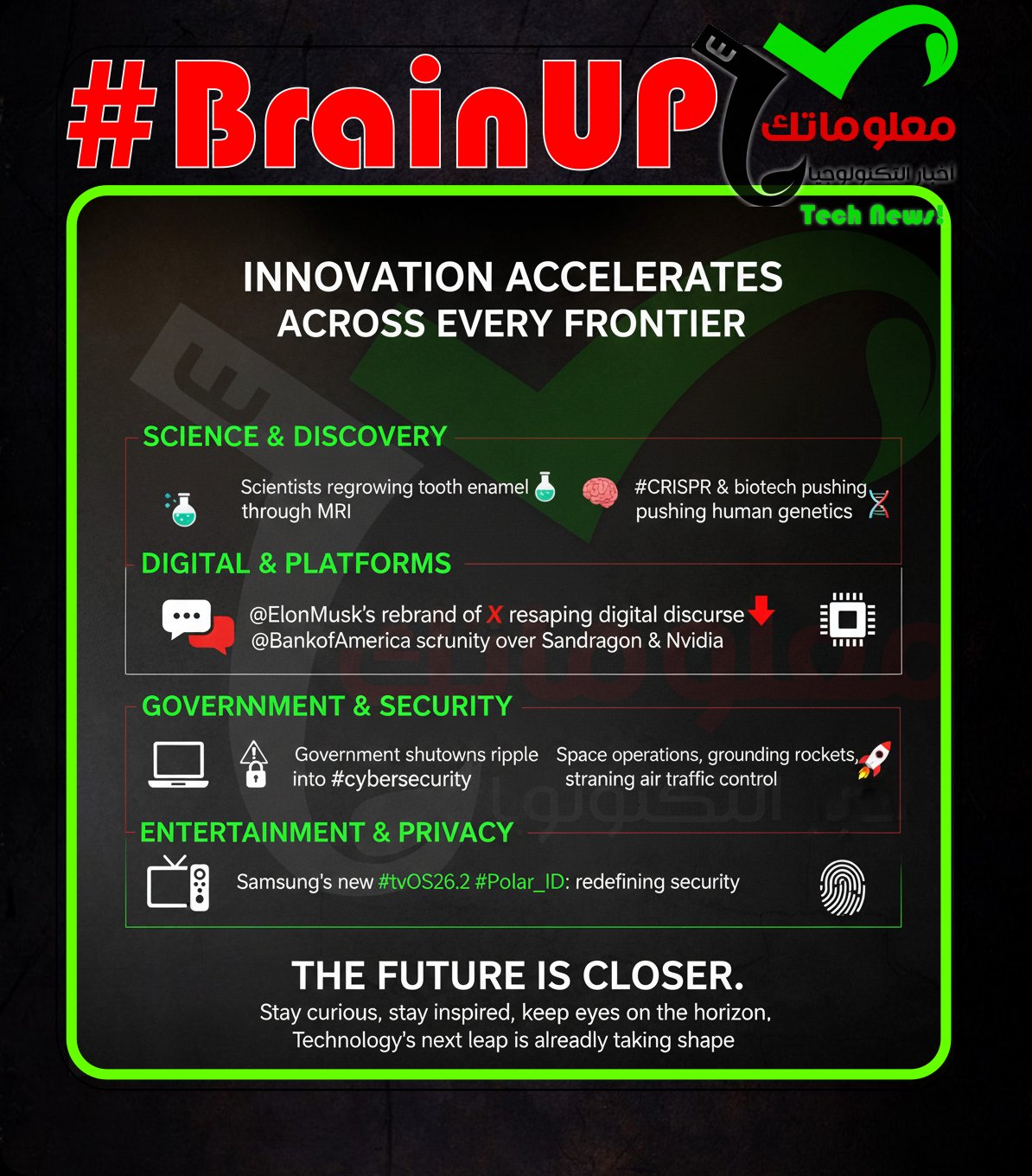
#BrainUp Daily Tech News – (Tuesday, November 11ᵗʰ)
Welcome to today’s curated collection of interesting links and insights for 2025/11/11. Our Hand-picked, AI-optimized system has processed and summarized 22 articles from all over the internet to bring you the latest technology news.
As previously aired🔴LIVE on Clubhouse, Chatter Social, and TikTok.
Also available as a #Podcast on Apple 📻, Spotify🛜, Anghami, and Amazon🎧 or anywhere else you listen to podcasts.
1. Google issues security alert: Your VPN app could be spyware in disguise
@Google’s fraud advisory warns that malicious VPN apps masquerading as legitimate services are a growing threat to digital privacy and security. These fake VPNs can be listed in official stores and use fake reviews, yet they exfiltrate sensitive data such as browsing history, private messages, financial credentials, and cryptocurrency wallet details, with payloads including info-stealers, banking trojans, and remote access tools. Past incidents underscore the risk, such as a Chrome VPN extension with 100,000 downloads that captured screenshots of every site visited. The appeal of free or cheap VPNs drives user adoption, which criminals exploit by offering ‘just work’ solutions that covertly turn devices into crime nodes. To protect privacy, Google recommends downloading VPNs only from official sources like the Google Play Store and checking for an official ‘VPN’ badge, while scrutinizing permissions and avoiding offers that seem too good to be true #officialSources #privacy #VPN #Chrome #fakeReviews.
2. Nearly a third of companies plan to replace HR with AI
A sizeable share of companies plans to replace parts of their workforce with AI in 2026, and even HR and recruiting roles are not immune to automation. In a survey by AI Resume Builder, 30% say they will replace employees with AI next year, while 49% estimate 10% to 45% of their current workforce could be affected and 7% expect 65% or more. The roles most at risk include #customerService, #administrative, and #IT, with HR/recruiting also cited by about 30% of respondents. As AI tools expand in data analysis, meeting summaries, and research, human oversight remains essential, per @Rachel_Serwetz of @AIResumeBuilder. Moreover, 67% of business leaders say employees with #AI skills will have greater job security, underscoring the value of upskilling or pivoting to AI‑relevant roles to stay employable, as advised by industry experts.
3. Mozilla fellow Esra’a Al Shafei watches the watchers
@Esra’a Al Shafei, a Mozilla fellow, has turned Surveillance Watch into a map that exposes who makes, buys, and funds #surveillance software, framing surveillance as a global trade. The map has grown from 220 to 695 entities, cataloging providers such as @NSO Group’s Pegasus and @Cytrox’s Predator, their customers including politicians, journalists, and activists. It also tracks funders and contracts, noting Paragon’s Graphite spyware and the backing of groups such as @AEIndustrialPartners, @In-Q-Tel, @AndreessenHorowitz, and @BlackRock. The article shows surveillance is a global ecosystem, not limited to a few regimes, with public and private actors deploying cameras, facial recognition, and location tracking in daily life, even in ordinary spaces like hotel lobbies. Knowledge of these networks helps people protect themselves and resist the normalization of mass surveillance.
4. Europe deciding whether 6 GHz is Wi-Fi or cellular space
Europe is weighing whether the upper 6 GHz band (6425-7125 MHz) should be shared between #WiFi and cellular networks or reserved for exclusive #mobile use. The @Radio Spectrum Policy Group within the EC is exploring shared access, while regulators such as @Ofcom in the UK push licensing models consistent with lower band being license-exempt. The @WiFiAlliance and @DSA warn that blocking the upper 6 GHz from #WiFi would hurt Europe’s digital development, arguing Wi‑Fi is a primary internet access method and that a compromise would sustain the next generation of #digital #innovation. Mobile operators, backed by statements from Germany’s government, contend exclusive use is needed to meet future #6G demands and note Wi-Fi currently has access to less spectrum. Proponents cite tests and pilots, with @Vodafone reporting up to 5 Gbps and @Nokia and @Telia demonstrating capacity gains in built-up areas, signaling the band’s potential to boost capacity where needed.
5. How Artificial Intelligence Is Reinventing Perfume
Artificial intelligence is transforming the perfume industry by enabling the creation of scents through data analysis and machine learning instead of traditional trial-and-error methods. Startups and established brands are using AI algorithms to analyze consumer preferences, chemical properties, and historic fragrance formulas to develop new perfumes that appeal to modern tastes. This approach provides greater precision and innovation in scent creation while reducing development time and costs. The integration of #AI highlights a broader trend in fashion technology where digital tools enhance creativity and personalization. As a result, the fragrance industry is embracing AI as a powerful tool to reconnect with consumers in a data-driven way.
6. Four-day weeks don’t work – we work 9am to 9pm six days
The idea of a four-day workweek faces skepticism as many experience working 9am to 9pm, six days a week, making reduced schedules seem unrealistic. Evidence from individuals balancing multiple jobs or engagements reveals that longer hours are often necessary to meet financial and professional demands. This highlights the challenges of implementing #worklife balance reforms ubiquitously, especially where economic pressures dictate longer work hours. The reality of extended workdays contrasts with idealistic views of shorter weeks, indicating a disconnect between policy proposals and lived experiences. Understanding these constraints is crucial when considering the feasibility of reduced-hour work arrangements across diverse sectors.
7. iPhone Air Sales Are So Bad That Apple’s Delaying the Next-Generation Version
Apple’s thin, light #iPhoneAir has underperformed, prompting Apple to delay the next-generation version that was slated to ship alongside the #iPhone18Pro. Since its September launch, reports of weak demand and manufacturing cuts have echoed through the supply chain, with Foxconn dismantling most production lines for the device and Luxshare halting output. Apple priced the #iPhoneAir at $999, roughly $100 cheaper than the $1,099 #iPhone17Pro, underscoring that customers were not convinced by style alone to pay near-Pro prices. The company has struggled to land a fourth model that sells well alongside the standard and Pro lines, after earlier misses with the smaller 5.4-inch #iPhoneMini and the larger #iPhonePlus that also underperformed. Apple has been planning a split launch for the #iPhone18 lineup, with the next-gen #iPhoneAir potentially arriving in spring alongside the #iPhone18, while continuing to explore a lighter weight, vapor chamber cooling, and bigger battery, though the design could be reconsidered.
8. Robotic kitchen in a box cooks, cleans and serves 120 meals an hour
A compact, AI-powered kitchen is changing retail food service, with @Circus CA-1 robot cooking, serving, and cleaning at @REWE’s new ‘Fresh & Smart’ outlet. The system is described as a ‘kitchen in a box’ capable of delivering up to 120 meals per hour. This demonstrates a broader shift toward #robot #AI #automation in hospitality, reducing labor needs while speeding service. This development underscores how automated #kitchen tech is being deployed in mainstream retail, signaling a trend toward scalable, AI-driven dining experiences.
9. Saudi Arabia’s Dystopian Futuristic City Project Is Crashing and Burning
Saudi Arabia’s ambitious #NEOM city project, envisioned as a futuristic urban hub powered by renewable energy and advanced technologies, is facing significant challenges and setbacks. Originally planned as a $500 billion investment to showcase the kingdom’s diversification away from oil, NEOM has struggled with logistical, financial, and management issues, causing delays and questioning its viability. Reports highlight the project’s dystopian aspects, including forced evictions of local tribes and concerns over surveillance and authoritarian controls, which have sparked international criticism. These obstacles reflect the difficulties of implementing a top-down, ultra-modern city in a traditionally structured society amid regional and economic complexities. The NEOM project exemplifies the clash between high-tech visionary ambitions and real-world socio-political realities in Saudi Arabia’s drive for modernization.
11. Toyota’s Walk-Me robotic chair
Toyota has developed the Walk-Me robotic chair to assist elderly individuals and those with mobility challenges by autonomously following the user and carrying their belongings. The chair integrates advanced AI and sensor technologies to navigate safely and adapt to various environments. This innovation aims to enhance independence and comfort for users while reducing physical strain during travel or errands. The Walk-Me chair embodies Toyota’s commitment to combining robotics and practical daily support, reflecting broader trends in assistive #technology. Such developments may significantly impact mobility solutions and quality of life for aging populations.
12. EU Explores Banning Huawei, ZTE from Mobile Networks – Bloomberg
The European Union is considering a ban on Chinese companies Huawei and ZTE in member countries’ 5G mobile networks due to security concerns, according to Bloomberg. EU officials view these companies as potential risks because of alleged ties to the Chinese government, which raises fears of espionage. The move would reflect a shift toward stricter controls on foreign technology suppliers amid increasing geopolitical tensions involving China. This reconsideration could impact the telecom industry and supply chains across Europe, affecting the rollout of 5G infrastructure. The exploration of such a ban underscores the EU’s focus on securing critical digital infrastructure from perceived vulnerabilities.
13. Here’s How Much Cash OpenAI Is Burning On AI Video App Sora. What It Means
OpenAI’s AI video app Sora is burning cash at a scale that dwarfs its early revenue. Forbes estimates generating a 10-second Sora video costs about $1.3, and with Sora’s user base and activity, annualized costs could exceed $5 billion ($15 million per day), while the company projects $20 billion in ARR and has posted losses over $12 billion in the last quarter. Sora debuted on iOS with 1 million downloads in a week and 4 million by Halloween, producing millions of 10-second videos daily. The pricing and compute demands are high: Sora 2 costs $1 per 10-second video, Sora 2 Pro $3, and the cost estimates depend on GPU time (about 40 minutes per video, 8–10 minutes on four GPUs, GPU rental just under $2/hour). With ~4.5 million app users and 25% posting an average of 10 videos a day, the scale magnifies the burn rate and underscores the tension between rapid expansion and monetization in the #AIvideo space, as @OpenAI navigates investments in #Sora while pursuing profitability.
14. What we lose when we surrender care to algorithms | Eric Reinhart
The piece argues that a dangerous faith in #AI is sweeping American healthcare, turning care into a data-driven, efficiency- and profit-oriented system that threatens the essential human bond between patients and clinicians. It opens with Pamela’s story of an AI scribe that transcribes and highlights possibilities while failing to capture the nuance of her voice and trauma, and notes that two-thirds of American physicians (a 78% rise) and 86% of health systems used AI in 2024. Voices like @RobertPearl and @EricTopol are cited as predicting AI will be as common as the stethoscope and warning that not using AI could soon be seen as malpractice. The author argues that in a system driven by efficiency, surveillance, and profit, AI becomes another instrument for commodifying human life rather than restoring humanity to clinical practice, even as it promises to ease burnout and expand access #AI #healthcare #empathy. The piece calls for critical reflection on AI’s role to preserve patient voice and relational care, urging a careful balance between access and compassion, and a continued commitment to #patient-centered medicine.
16. Wikipedia urges AI companies to use its paid API and stop scraping
Wikipedia is urging AI companies to stop scraping its content and instead use its paid API to access information. The Wikimedia Foundation, which operates Wikipedia, has highlighted the strain that unauthorized scraping places on its resources and infrastructure. To address this, it has introduced a commercial API that provides reliable access to Wikipedia’s data while ensuring sustainable support for the platform. This move aims to establish a fair usage model that compensates Wikipedia for its content, helping to safeguard its open knowledge mission. Ultimately, the Wikimedia Foundation seeks to balance accessibility with resource management by encouraging AI developers to adopt the official API.
17. The Costs of Instant Translation
Live Translation in #AirPods promises instant, borderless conversation, yet the piece argues this convenience risks erasing the friction, vulnerability, and improvisation that redefine language and identity in cross-cultural encounters. The author recalls a Berlin night where German conversation required improvisation, where mispronunciations and tone relied on gestures and context, experiences that would be flattened by seamless translation. A contrast is drawn between @Bad Bunny’s Spanish-language performance and the backlash around it, and the promise of bypassing effort entirely, illustrating two models of cross-linguistic encounter. The tech relies on #LLMs to realize a Babel fish fantasy—instant understanding with anyone, anywhere—and as such tools spread, they might erode the capacities that such encounters cultivate. Ultimately, the piece links these threads to question whether convenience should trump the growth and nuance of multilingual communication, urging readers to consider the costs and benefits of translation tech.
18. CISA’s new cybersecurity approach risks undermining election integrity
The Cybersecurity and Infrastructure Security Agency (#CISA) has been considering shutting down its Election Infrastructure Information Sharing and Analysis Center (EI-ISAC), which plays a crucial role in sharing cybersecurity information with election officials. This move comes as concerns arise about the agency’s shifting priorities and potential reduction in election security efforts. Experts warn that without the EI-ISAC, election systems could become more vulnerable to cyber threats and disinformation, jeopardizing the integrity of US elections. The proposal reflects tensions between national security, public trust, and political pressures following recent election cycles. Ensuring robust and transparent cybersecurity collaboration remains vital to protecting democratic processes.
19. CISA orders federal agencies to patch Samsung zero-day exploited in spyware attacks
The #Cybersecurity and #Infrastructure Security Agency (CISA) has mandated federal agencies to urgently patch a Samsung zero-day vulnerability exploited in spyware attacks, highlighting the ongoing risks posed by unpatched mobile device flaws. This vulnerability, actively used in sophisticated spyware campaigns, affects Samsung mobile devices, enabling attackers to compromise sensitive data remotely. The directive stresses the importance of timely updates and patches to safeguard federal networks against espionage and unauthorized access. CISA’s action reflects a broader effort to strengthen the security posture of government systems by addressing critical vulnerabilities in widely used technology. The initiative underscores the need for proactive vulnerability management to prevent exploitation by threat actors and protect national security interests.
20. Turning Real-Time Satellite Data into a Competitive Advantage
Real-time satellite data is becoming a real competitive differentiator across industries as the active satellite fleet has tripled in five years and could reach about 60,000 by 2030, while #AI-enabled edge computing turns satellites into smart tools for predictive logistics, environmental monitoring, and rapid disaster response. Three forces are making data more accessible: lower launch and hardware costs, easier data access through cloud platforms, and smarter, autonomous satellites, enabling platforms like #CLEOS and #PlanetLabs Insight to deliver insights without owning satellites. Yet adoption remains slow, with only 18% of surveyed executives expecting to scale these tools soon, often because space technology is perceived as complex or experimental for daily business. Illustrative deployments show value: @SwissRe streams near-real-time flood maps for catastrophe-risk services, @Cargill uses satellite monitoring to track land use and forest loss across its supply chains, and @Maersk has equipped 330+ vessels with SpaceX #Starlink to improve communications and cloud-enabled operations. Taken together, the growth of constellations, accessible platforms, and smarter satellites offers a practical path for organizations to leverage real-time satellite data to optimize operations, manage risks, and respond faster to changing conditions.
21. Samsung Galaxy S26 Plus reappears in renders with a new camera island
The Samsung Galaxy S26 Plus reappears in renders with a redesigned camera island, moving away from a full-width module and positioning a smaller island beneath the three lenses. The leak, attributed to @OnLeaks via @AndroidHeadlines, shows a configuration consistent with designs seen for the S26 Ultra and S26 Pro rather than the rumored full-width camera for the S26 Edge. The piece notes ongoing turmoil in the S26 lineup, with earlier talk of Ultra, Edge, and Pro variants, but now the Pro is swapped for the regular S26 and the Edge for the Plus, suggesting a reassessment of the lineup. The S26 Plus is reported to be about 7.35mm thick, roughly the same as the S25 Plus and thicker than the 5.8mm S25 Edge, implying it may not pursue the thin-phone branding. Launch is expected in early 2026, with speculation about an Edge under development under codename “More Slim,” hinting that more details may surface at the S26 unveiling.
22. Android 16 is rolling out to a bunch of OnePlus and Oppo devices
@Oppo and @OnePlus are expanding Android 16 updates across multiple devices with stable, global rollouts underway. Oppo has confirmed updates for the Find N5, Find X8, and Find X8 Pro, which began on November 6, with the Find N3, Find N3 Flip, and Pad 3 Pro slated to start on November 11 and continue rolling out globally. @OnePlus devices currently getting Android 16 include the #OnePlus 12, #OnePlus Open, #OnePlus Pad 3, and #OnePlus Pad 2, with these updates initially in India and expected to reach other markets within a few weeks. The pattern shows both brands moving from targeted releases to broader deployments, signaling wider access to Android 16 for users soon.
23. Five Years of Apple Silicon: M1 to M5 Performance Comparison
Five years after the M1, Apple Silicon has evolved from M1 to M5, delivering multi-fold improvements in CPU, GPU, AI, and graphics across @Apple devices, with a complete shift away from Intel. The M5 is dramatically faster, with claims of 6× faster CPU/GPU performance, 6× faster AI, 7.7× faster AI video processing, 6.8× faster 3D rendering, 2.6× faster gaming, and 2.1× faster code compiling, and Geekbench and Metal scores showing substantial gains. The gains stem from the M5’s 3nm process (N3P) vs the M1’s 5nm (N5), a move to 10-core CPU and GPU, higher clock speeds (4.61 GHz vs 3.2 GHz), an integrated Neural Engine in every GPU core, a third-generation #ray tracing engine, and memory bandwidth up to 153 GB/s with up to 32GB unified memory. Apple also ended Intel Mac software updates, reinforcing the transition to @Apple silicon, while @TSMC is developing 2nm chips for 2026 and 1.4nm by 2028 for further speed and power reductions.
24. First Ever View of the Sun’s Polar Magnetic Field Reveals Major Surprise
Scientists have obtained the first detailed observations of the Sun’s polar magnetic field using the NASA’s Parker Solar Probe, revealing unexpected magnetic structures. Measurements show unusually strong and complex magnetic fields near the solar poles, contradicting previous models that predicted smoother and weaker fields. This discovery indicates that the Sun’s magnetic dynamics are more turbulent and intricate than understood, affecting solar wind generation and space weather models. The findings help refine theories about solar magnetic cycles and their influence on the heliosphere. Understanding these magnetic patterns is crucial for predicting solar activity and protecting satellites and technology on Earth from solar storms.
That’s all for today’s digest for 2025/11/11! We picked, and processed 22 Articles. Stay tuned for tomorrow’s collection of insights and discoveries.
Thanks, Patricia Zougheib and Dr Badawi, for curating the links
See you in the next one! 🚀
