
Paraparticles Slipped Through the Fine Print of a No-Go Theorem
Key points
- The decades-old case against paraparticles was never a proof that they cannot exist: it rested on no-go results such as the Doplicher-Haag-Roberts theorem that hold only under assumptions like strict locality and superselection rules, which emergent excitations created by nonlocal string operators can evade (Toppan, 2025; Wang & Hazzard, 2025a).
- The Wang-Hazzard theory published in Nature in 2025 gives parastatistics a hard numerical fingerprint: for one family of paraparticles a single mode has the partition function 1 + mx, which no combination of free fermions and bosons can reproduce once m is 2 or more (Rice, 2025; Wang & Hazzard, 2025a; Wang & Hazzard, 2025b).
- An MIT team emulated m = 2 paraparticles on a 4×4 lattice of superconducting transmon qubits and measured an exchange phase of (1.00 ± 0.01)π, antibunching at a beamsplitter even for particles of different internal 'color', and a thermal occupation of 2x/(1 + 2x) that matches neither Bose-Einstein nor Fermi-Dirac statistics (Kim et al., n.d.; New Scientist, 2026).
- Those results meet the bar a 2025 review set for genuine detection, signatures that ordinary bosons and fermions cannot reproduce, but they come from an analog simulation of emergent quasiparticles whose behavior the experimenters can equally describe as qubit physics driven by a strong ZZ interaction (Kim et al., n.d.; Toppan, 2025).
- The cost of treating the equivalence thesis as settled was real: color Lie superalgebras introduced by Rittenberg and Wyler in 1978 drew little attention from physicists for decades because they lead unavoidably to parastatistics (Toppan, 2025).
- Elementary paraparticles in nature remain explicitly speculative, and proposed uses such as trace-free secret communication are early ideas, while the concrete next steps are interacting paraparticles, richer geometries and a fuller mathematical classification (mpq.mpg.de, 2025; New Scientist, 2026; Rice, 2025; Wang & Hazzard, 2025a).
What Is a Paraparticle?
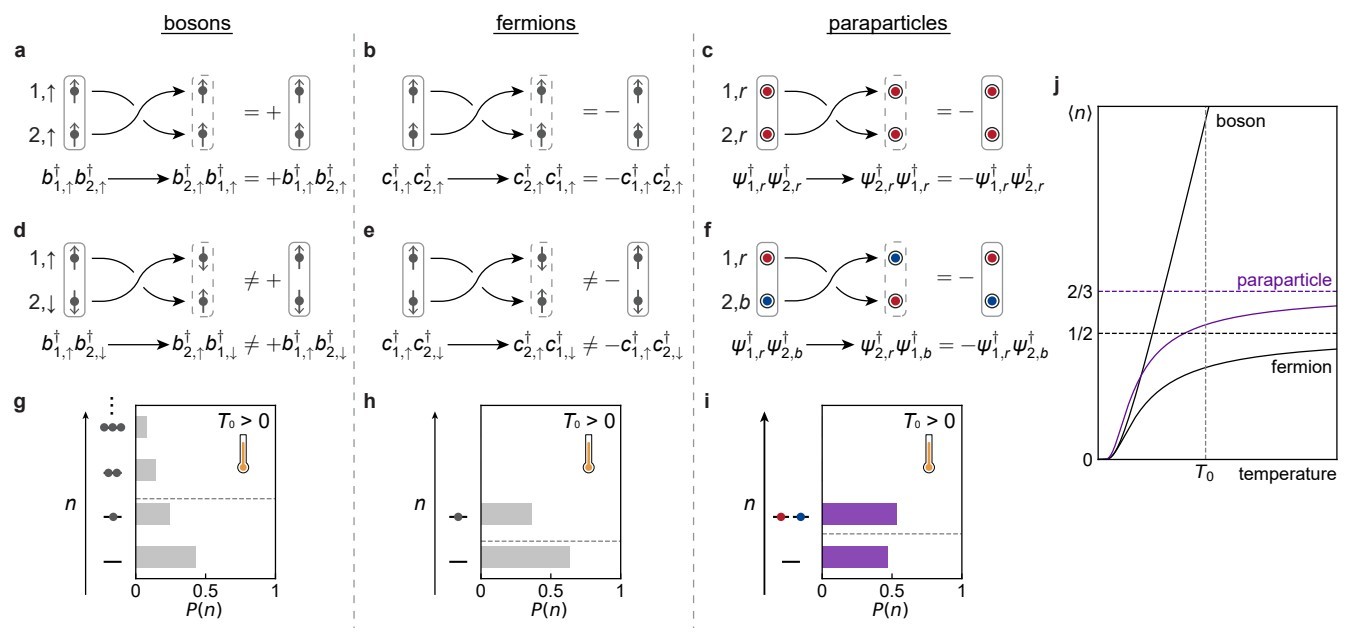
Every quantum particle is sorted by two questions: what happens to the system when two identical particles swap places, and how many of them can share a single quantum state. Bosons can be swapped at no cost and pile into the same state without limit. Fermions pick up a sign change when swapped and refuse to share a state at all (New Scientist, 2026). A paraparticle answers those questions differently. Its wavefunction carries extra internal indices, and exchanging two paraparticles rotates those indices by a matrix rather than multiplying the state by a single number. Formally, the exchange matrices form a representation of the symmetric group that is larger than one-dimensional (Wang & Hazzard, 2025a).
The idea travels under several names. Physicists speak of parastatistics; the MIT experimenters call their version R-paraparticles and label the hidden internal degree of freedom ‘color’, noting that others call it flavor or simply internal states (Kim et al., n.d.). A closely related construction reached through quantum-information axioms calls the same broad behavior ‘transtatistics’ (Wang & Hazzard, 2025b), and a parallel research line studies Z2 x Z2-graded paraparticles (Toppan, 2025). In plain language, all of them describe a third class of particle alongside bosons and fermions.
Paraparticles are not anyons. Anyons follow the braid group and are confined to two spatial dimensions, while paraparticles obey the permutation group and can be defined consistently in any dimension, including our three (Toppan, 2025; Wang & Hazzard, 2025a). Two concrete examples show how odd they are. In one family, no two paraparticles can occupy the same mode even if they carry different labels, something fermions with different spins are free to do (Wang & Hazzard, 2025a). In another, swapping two particles that start with labels 1 and 1 leaves them carrying labels 4 and 3, even though the particles stayed arbitrarily far apart throughout (Wang & Hazzard, 2025a).
The Two-Box Rule and Its Footnotes
The textbook case for only two kinds of particle is disarmingly short. Swap two identical particles and the wavefunction can change by at most a constant factor; swap them back and you must return to where you started, so that factor squared equals one. The only options are plus one, bosons, and minus one, fermions (Wang & Hazzard, 2025a). The consequences are enormous. The exclusion rule obeyed by fermions underpins the structure of the periodic table and, in one physicist’s phrase, explains why you do not sink through your chair when you sit down (Rice, 2025).
Yet the argument has always had footnotes. Researchers in the 1930s and 1940s already wondered whether other particle types could exist (Rice, 2025), and the question of parastatistics and their apparent absence in nature dates to the dawn of quantum mechanics (Wang & Hazzard, 2025a). The first concrete theory came from Green in 1953 (Rice, 2025; Wang & Hazzard, 2025a), and the high-energy physics community studied it extensively (mpq.mpg.de, 2025; Rice, 2025). By the 1970s, rigorous work in algebraic quantum field theory had reached a deflating verdict: under certain assumptions, any paraparticle theory makes exactly the same physical predictions as a theory of ordinary bosons and fermions (Wang & Hazzard, 2025a). Paraparticles became, in effect, bosons or fermions in disguise (mpq.mpg.de, 2025; Rice, 2025).
The one accepted exception was the anyon, restricted to two dimensions (mpq.mpg.de, 2025; Rice, 2025). That exception has since been vindicated in the laboratory: anyonic particles have been experimentally detected, settling their existence both theoretically and experimentally (Toppan, 2025). The question this piece turns on is why the second exception, the one that works in any dimension, spent half a century in the reject pile.
A Ban Built on Assumptions
Set the sources side by side and a pattern appears: the case against paraparticles was a conditional result that gradually hardened into folklore. A 2025 review of the field names this the ‘equivalence thesis’, the claim that every paraparticle theory is physically equivalent to some theory of regular bosons or fermions, and argues that none of its supporting arguments is fully satisfactory (Toppan, 2025). One frequently cited mathematical result shows that parafields can be rebuilt from ordinary fields using so-called Klein operators. That is true, but it does not show paraparticles are unobservable: even ordinary fermions can be rebuilt from nonlocal bosonic operators in low dimensions, and nobody concludes fermions are fictional (Toppan, 2025).
The strongest objection, built on the Doplicher-Haag-Roberts no-go theorem, depends on two ingredients: superselection rules and a principle that the relevant operators are localized (Toppan, 2025). That is precisely where the escape hatch lies. The Wang-Hazzard construction states plainly that it poses no contradiction with earlier results because it evades their restrictive assumptions (Wang & Hazzard, 2025a). In their spin models, the operators that create paraparticles are strings that stretch across the system rather than localized objects, and the theorists note that the no-go theorem takes locality as a founding assumption (Wang & Hazzard, 2025b). The review independently identifies the same mechanism: excited states created by non-localized operators of a stringy nature (Toppan, 2025).
The striking thing is how many roads converged on the same gap once people looked. Papers from 2021 onward showed theoretical detectability using first-quantization approaches that never invoke localization at all (Toppan, 2025). A separate group reached a new family of exotic statistics through quantum-information axioms, posting two months before the Wang-Hazzard preprint (Wang & Hazzard, 2025b). When independent methods all slip past the same barrier, the barrier was a convention, not a law of nature.
The convention had a price. Color Lie superalgebras, introduced by Rittenberg and Wyler in 1978 with quarks in mind, interested mathematicians but drew limited attention from physicists precisely because they lead to parastatistics, and serious investigation was delayed by decades (Toppan, 2025).
How the New Theory Works
The Wang-Hazzard framework labels each type of parastatistics with a four-index tensor called an R-matrix, which must solve the constant Yang-Baxter equation, a consistency condition familiar from the mathematics of particle interchange (Rice, 2025; Wang & Hazzard, 2025a). Creation and annihilation operators are defined through commutation relations built on that tensor. Choose the simplest R-matrices and you recover ordinary fermions or bosons with an internal degree of freedom; choose others and you get something new (Wang & Hazzard, 2025a). Getting there required Lie algebra, Hopf algebra, representation theory and pictorial tensor-network diagrams to tame the equations (mpq.mpg.de, 2025; Rice, 2025), which Wang described as cross-disciplinary work spanning theoretical physics and mathematics (Rice, 2025).
The payoff is a testable fingerprint. Each R-matrix fixes how many distinct states a single mode can hold at each occupancy, which in turn fixes the thermodynamics. For one example family, a single mode has the partition function 1 + mx. If the system were secretly p flavors of fermions and q flavors of bosons, that function would have to take the form (1 + x) to the p times (1 – x) to the minus q, which is impossible for m of 2 or more (Wang & Hazzard, 2025a; Wang & Hazzard, 2025b). In other words, paraparticles of this kind behave like a new type of ideal gas (Wang & Hazzard, 2025a).
The theorists are careful about the limits of that test. A matching partition function is not proof of ordinary behavior: their two-dimensional model has the same partition function as four flavors of fermions, yet its exchange statistics are still physically distinct (Wang & Hazzard, 2025a). The thermodynamic fingerprint is sufficient, not necessary.
Crucially, the theory did not stop at abstraction. It constructs exactly solvable quantum spin models in one and two dimensions in which free paraparticles emerge as quasiparticle excitations, solvable for arbitrary couplings even with disorder (Wang & Hazzard, 2025a). The simplest is a nearest-neighbor model realized in three-level Rydberg atom or molecule systems (Wang & Hazzard, 2025a), and the theorists framed magnets and other condensed matter systems as the natural hunting ground (Rice, 2025). Wang himself cautioned that experiments would need more realistic theoretical proposals (Rice, 2025). As it turned out, an experiment arrived faster than that caution implied.
Sixteen Qubits, Three Tests
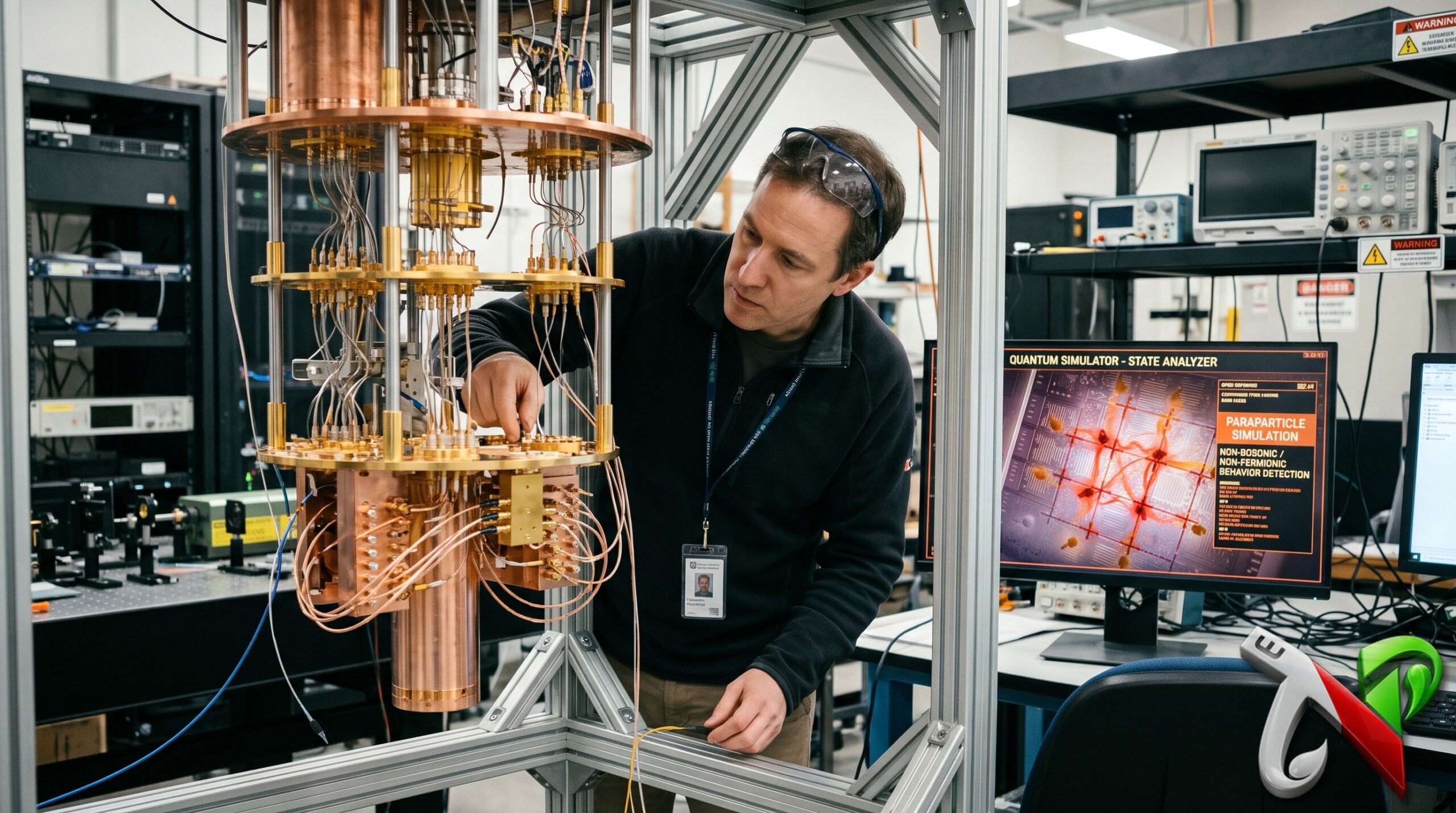
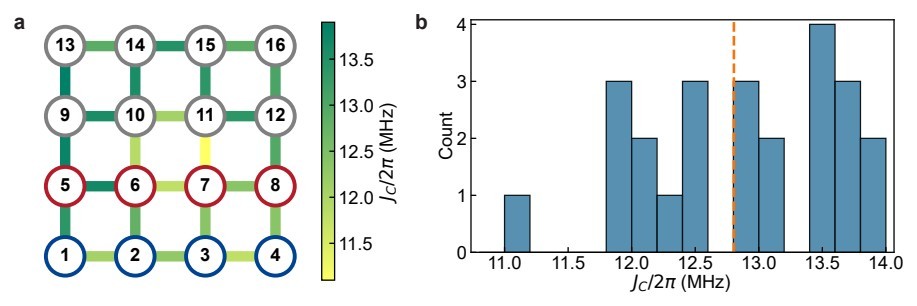
The MIT group built its paraparticles from a 4×4 lattice of superconducting transmon qubits (Kim et al., n.d.; New Scientist, 2026). Each paraparticle site is a pair of coupled transmons with three relevant states: empty, a ‘red’ paraparticle or a ‘blue’ one, depending on which qubit is excited. A strong ZZ interaction between the two qubits, with a level splitting of roughly 2π x 40 MHz, energetically forbids the doubly occupied state (Kim et al., n.d.). A generalization of the Jordan-Wigner transformation, the same mathematical bridge used in the theory, maps this strongly interacting two-dimensional ladder of qubits onto a one-dimensional chain of non-interacting paraparticles (Kim et al., n.d.). Each rung of the ladder behaves like a paraparticle (New Scientist, 2026).
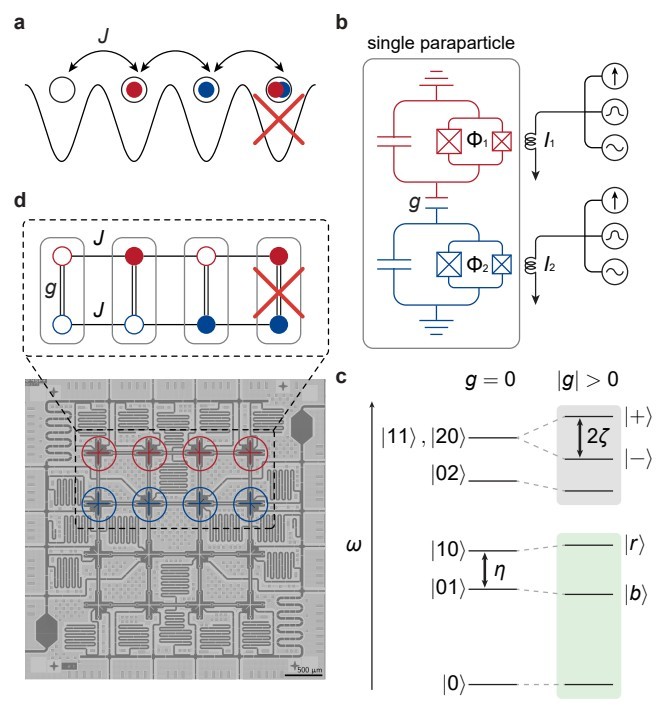
The team ran three complementary tests: swapping two paraparticles, colliding them, and watching how they pile up at thermal equilibrium (New Scientist, 2026). In the exchange test on a three-site chain, the swap completed at about 202 nanoseconds, and a Ramsey interferometry sequence turned the hidden global phase into a measurable one: (1.00 ± 0.01)π, the same for every color combination (Kim et al., n.d.).
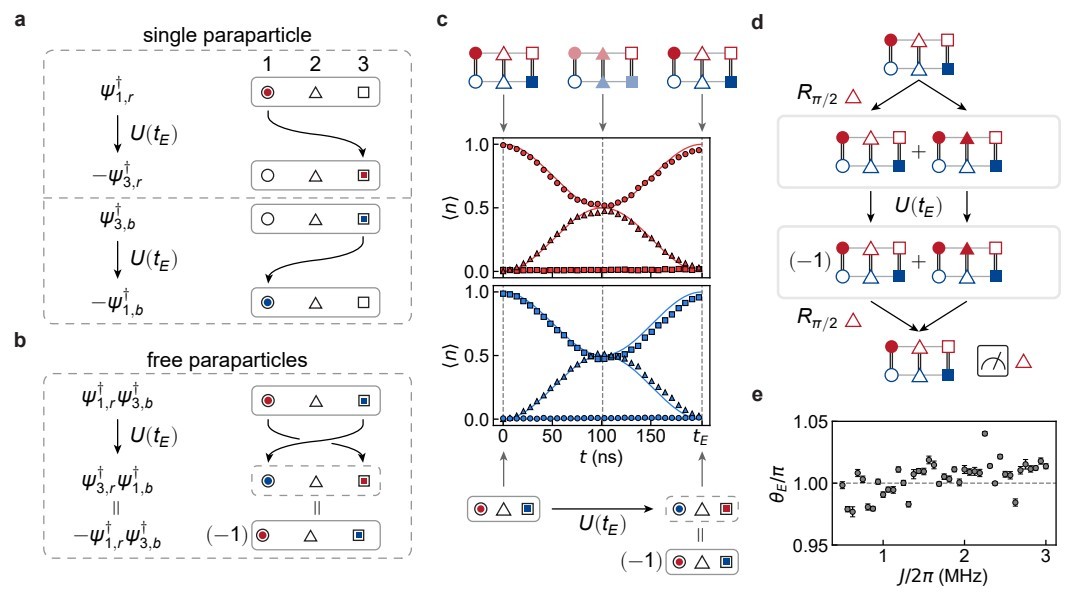
The collision test used a beamsplitter spread across four sites, or eight qubits, with splitting completed at roughly 159 nanoseconds. Two paraparticles of the same color antibunched, as identical fermions would. So did a red and a blue paraparticle, which is the telling result: fermions with different spins are distinguishable and simply scatter independently (Kim et al., n.d.).
The thermal test embedded one paraparticle site among 14 bath qubits, split into two sets of 7, and seeded the bath with anywhere from 1 to 14 excitations. For this m = 2 species, theory predicts an average occupation of 2x/(1 + 2x). The measurements deviated clearly from Bose-Einstein and Fermi-Dirac statistics and matched the paraparticle prediction (Kim et al., n.d.). The work took a year of careful control and calibration (New Scientist, 2026), and Hazzard said he was surprised by how quickly it was completed (New Scientist, 2026).
Detection or Emulation?
Whether this counts as finding paraparticles depends on the standard applied, and the field already had one on record. Writing in March 2025, before the MIT work, the review of the field argued that engineering paraparticles in the lab is not the same as detecting them. An earlier trapped-ion experiment that used an atom’s spin and two motional modes showed paraparticles could be manipulated, the review noted, but genuine detection requires results that ordinary boson or fermion statistics cannot reproduce, and as far as its author knew no such test had yet been performed (Toppan, 2025).
Measured against that bar, the MIT results look like a direct answer. A thermal occupation inconsistent with both standard distributions, and color-agnostic antibunching that spinful fermions would not show, are exactly the kind of statistics-level signatures the review called for (Kim et al., n.d.; Toppan, 2025). The experimenters frame their contribution accordingly: parastatistics are observable on quantum simulation platforms (Kim et al., n.d.).
But the same paper also supplies the strongest caveat. Every result has two equivalent readings. In the paraparticle picture, the π phase comes from exchange statistics; in the qubit picture, it is a geometric phase accumulated over a complete cycle. In the paraparticle picture, antibunching is quantum interference; in the qubit picture, incoming excitations reflect back because of the strong ZZ interaction (Kim et al., n.d.). Hazzard’s own description is precise: the team has a system whose dynamics obey exactly the equations a paraparticle should satisfy, and what they have seen are emergent paraparticles (New Scientist, 2026).
Two further details sharpen the boundary. The chains were short, up to four sites (Kim et al., n.d.). And the theory notes that in one dimension two paraparticles inevitably collide during an exchange; the cleanest demonstration, where particles swap while staying far apart, belongs to the two-dimensional model that has not yet been built (Wang & Hazzard, 2025a). What the experiment proves, then, is that parastatistics is a physically realizable and measurable behavior of engineered matter. That is a real result. It is not the same claim as a new particle in nature.
More Than Code, Less Than Nature
The participants push back on the idea that this is merely a fancy simulation. Hays contrasts it with ordinary computing, where a simulated particle is an abstraction in code; here, he says, one can point to the physical location of the particle on the chip (New Scientist, 2026). Hauser Villegas, who was not on the team, calls the work a proof of concept that paraparticles are not just theoretical curiosities, notes that the qubits’ quantum nature serves as the building material, and suggests a faithful reproduction on a conventional computer may even be impossible (New Scientist, 2026). That last point is hedged, and the sources offer no proof of it.
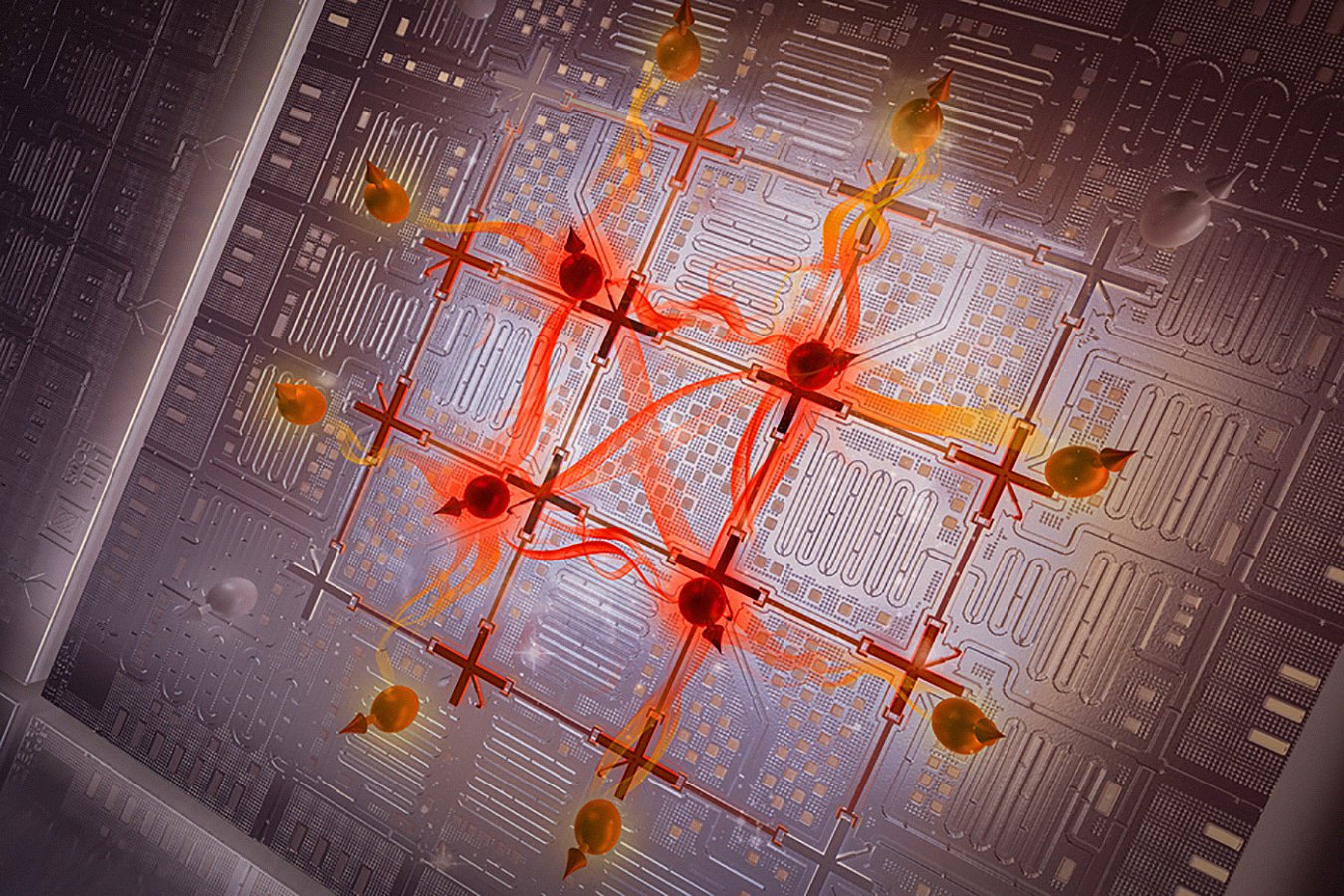
The honest middle ground is that the experiment occupies a category physics already respects: emergent quasiparticles. The MIT paper itself opens by noting that bosonic and fermionic statistics describe all known elementary and emergent particles in three dimensions (Kim et al., n.d.), and quasiparticles in condensed matter routinely acquire statistics different from their microscopic constituents (Kim et al., n.d.). Paraparticles now join that menu as a demonstrated emergent behavior.
Elementary paraparticles are a different matter. The theorists say a fully relativistic quantum field theory of paraparticles is straightforward to write down, but they label the idea of fundamental paraparticles highly speculative (Wang & Hazzard, 2025a). They also concede that superselection rules fundamentally constrain whether parastatistics can be observed, in a way reminiscent of the old no-go theorems, and that their emergent realization works partly because it breaks those rules (Wang & Hazzard, 2025a). The review agrees that paraparticles could in principle appear in extensions of the Standard Model, but concludes only that they are theoretically detectable at least as emergent quasiparticles (Toppan, 2025). The fine print that let paraparticles escape the ban in condensed matter still binds them at the level of fundamental physics.
What Parastatistics Could Be Good For
The most concrete payoff is scientific rather than commercial. Because the theory maps hard interacting spin models onto solvable free-paraparticle problems, it opens routes to phases of matter that existing techniques struggle with. In two dimensions, a paraparticle band with a nonzero Chern number could put the spin model in a new chiral topological phase; a gapless spectrum could produce a phase transition point or a gapless topological phase; and disordered couplings may lead to new localized phases (mpq.mpg.de, 2025; Wang & Hazzard, 2025a). Even at zero Chern number, the theorists expect their models to host non-abelian anyons, where the best-known solvable model, Kitaev’s honeycomb, hosts only abelian ones (Wang & Hazzard, 2025a). The MIT team presents its platform as a way to explore exactly these theorized phases (Kim et al., n.d.).
The more eye-catching proposal is secure communication. The theorists suggest that two parties holding paraparticles could exchange information by swapping positions without ever approaching each other and without leaving a trace a third party could detect (mpq.mpg.de, 2025). The idea follows directly from the 2D exchange result, where internal labels change while particles stay far apart (Wang & Hazzard, 2025a). But the sources are candid that application thinking is in its infancy and still mostly speculation (Rice, 2025).
Other speculative avenues come from the parallel research line. The review points to topological superconductors and insulators, where a classification of graded superdivision algebras over the reals found 13 extra cases beyond the established 10-fold way, and notes that Hamiltonians built from parafermionic oscillators fit that setting (Toppan, 2025). None of these is near a product; all of them are reasons the field is suddenly worth working in.
Lessons From a Long Detour
The roadmap is now fairly clear. The MIT group wants paraparticles that interact with each other and paraparticles in more complicated geometric arrangements (New Scientist, 2026), which is where the two-dimensional, collision-free exchange predicted by theory becomes relevant (Wang & Hazzard, 2025a). Wang calls the current results just the beginning (New Scientist, 2026). On the theory side, the next tasks are a broader classification of paraparticles using tensor categories and more realistic models to guide experiment (mpq.mpg.de, 2025). The review’s author promises a blueprint for a minimal detection scenario and records a suggestion from G. A. Goldin to search for emergent non-abelian anyons that, for suitable parameters, transform under the permutation group rather than the braid group (Toppan, 2025). His summary of the method is apt: theoreticians and experimentalists have to meet halfway, with experiments testing models already known to produce a distinct parastatistical signature (Toppan, 2025).
The larger lesson is about how physics treats its own impossibility results. A no-go theorem is a statement about a set of assumptions, and the paraparticle story shows what happens when a community remembers the conclusion and forgets the premises. Green’s theory was consistent in 1953 (Rice, 2025; Wang & Hazzard, 2025a). The objections that sidelined it were conditional (Toppan, 2025; Wang & Hazzard, 2025a). Once theorists asked which conditions real systems actually satisfy, the gap opened in several places at once (Toppan, 2025; Wang & Hazzard, 2025b), and an experiment exploited it within roughly a year of the 2025 theory (New Scientist, 2026).
What has been settled is narrow but genuine: parastatistics is not a mathematical curiosity, it is a behavior that matter can be engineered to display and that instruments can measure. What remains open is whether nature uses it anywhere on its own, in a material or among the fundamental particles. That question is no longer closed by decree, which may be the most important change of all.
References
- Kim, G., Barrett, C. N., Muschinske, S. E., An, J., Zhang, H., Rosen, I. T., Das, R., Gingras, M. A., Kim, D. K., Niedzielski, B. M., Schuldt, M., Yoder, J. L., Schwartz, M. E., Serniak, K., Grover, J. A., Hays, M., & Oliver, W. D. (n.d.). Analog quantum simulation of paraparticle statistics. https://ranker.salhi.com/media/uploaded-pdf/b74eda010e807daee6f54fec58ea0cfd.pdf
- mpq.mpg.de. (2025, January 17). Beyond fermions and bosons: paraparticles are indeed mathematically possible. https://www.mpq.mpg.de/beyond-fermions-and-bosons-paraparticles-are-indeed-mathematically-possible
- New Scientist. (2026, November 27). Particles not seen before have been observed in a quantum simulator. https://www.newscientist.com/article/2600979-particles-not-seen-before-have-been-observed-in-a-quantum-simulator/
- Rice. (2025, January 8). Mathematical methods point to possibility of particles long thought impossible. https://news.rice.edu/news/2025/mathematical-methods-point-possibility-particles-long-thought-impossible
- Toppan, F. (2025). On the detectability of paraparticles beyond bosons and fermions. International Journal of Geometric Methods in Modern Physics, 23(06). https://doi.org/10.1142/s0219887825400420
- Wang, Z., & Hazzard, K. R. A. (2025a). Particle exchange statistics beyond fermions and bosons. Nature, 637(8045), 314-318. https://doi.org/10.1038/s41586-024-08262-7
- Wang, Z., & Hazzard, K. R. A. (2025b). Particle exchange statistics beyond fermions and bosons. Nature, 637(8045), 314-318. https://doi.org/10.1038/s41586-024-08262-7
 Powered by News Ranker
