
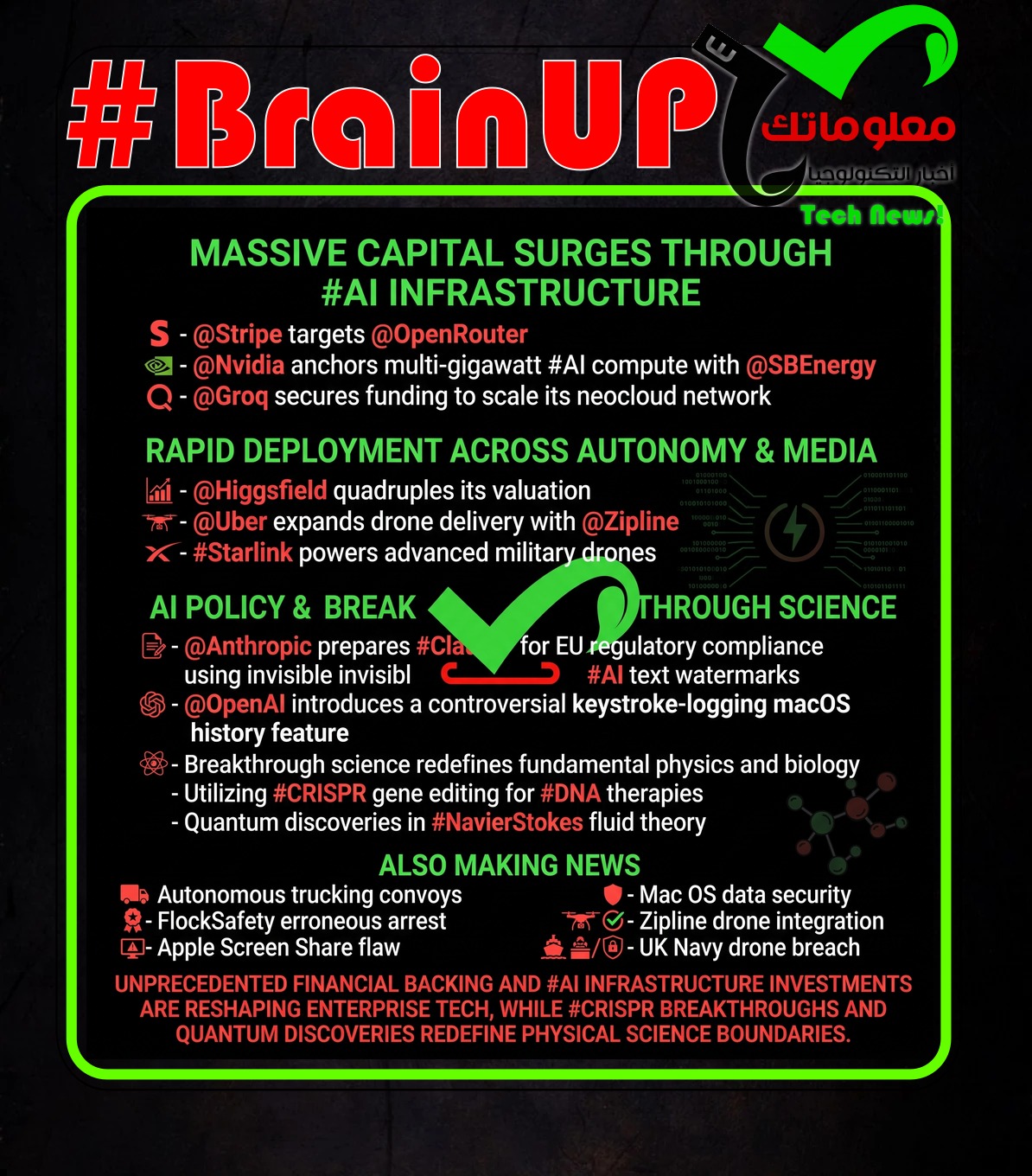
Ranker’s #BrainUp Daily Tech News – (Tuesday, August 18ᵗʰ)
Welcome to today’s curated collection of interesting links and insights for 2026/08/18. Our automated ranking and AI-summarization system has processed 36 articles from all over the internet to bring you the latest technology news.
1. Theory of Fluids Enters the 21st Century
Physicists have developed a modern theory of fluids that accounts for the swarms of microscopic atoms and molecules, moving beyond the 19th-century #NavierStokes equations. While classic equations treat fluids as continuous substances, researchers utilized insights from black hole physics and a 20-year effort to redefine fluids through fundamental symmetries. The work shows that traditional fluid equations are actually a direct consequence of these underlying symmetries rather than exact physical truths. This breakthrough matters because it allows researchers to accurately predict new behaviors stemming from microscopic particle motions that classic approximations completely miss.
2. Stripe Acquires OpenRouter for Over $7 Billion
Payment services provider @Stripe is reportedly preparing to acquire AI routing startup @OpenRouter for over seven billion dollars, marking a significant strategic expansion into artificial intelligence infrastructure. The anticipated deal follows OpenRouter’s valuation of roughly $1.3 billion last May and reflects soaring demand for intermediary layers that optimize model cost, latency, and quality across multiple providers. By integrating OpenRouter’s #LLM routing technology, @Stripe can bridge technical control with automated billing to help enterprise customers manage production workloads efficiently. This move matters because it highlights how the AI market is rapidly shifting toward operational cost management and flexible infrastructure rather than reliance on single foundational models.
3. Groq raises $350M to fuel its pivot from AI chips to neocloud
Startup @Groq has secured $350 million in new funding led by @Disruptive, valuing the company at $3.5 billion as it finalizes its transition from an AI chipmaker to a neocloud provider. The latest round follows a massive $20 billion licensing deal earlier this year in which @Nvidia hired away founder and CEO Jonathan Ross along with other top engineering talent. Today, the company operates 13 data centers globally while scaling its infrastructure capacity to support medium and large clusters of accelerated hardware for real-time inference and training. This development matters because it underscores the intense financial and operational reshaping currently underway among cloud providers racing to capture the booming AI inference market.
4. Higgsfield raises $400M Series B, quadrupling its valuation in 8 months to $5.4B
Video generation startup @Higgsfield has closed a $400 million Series B funding round led by @DSTGlobal, driving its valuation to $5.4 billion just eight months after reaching a $1.3 billion valuation. Founded in 2023 by former @Snap executive Alex Mashrabov, the company currently reports $700 million in annualized revenue and serves 30 million users alongside enterprise clients spanning 390 of the Fortune 500. The newly acquired capital will fund standard product development and hiring while securing the massive compute resources required for high-intensity video processing. This expansion matters because it illustrates the staggering capital requirements and enterprise demand fueling specialized generative video platforms like @Higgsfield and its competitors.
5. Light Reveals the Hidden Quantum Motion Inside an Exotic Crystal
Researchers at the @UniversityOfBasel and the @TechnicalUniversityOfMunich have successfully utilized light to measure the hidden quantum dynamics and collective motion of electrons inside an exotic state of matter known as a Wigner crystal. By shining light onto a single atomic layer of tungsten diselenide cooled near absolute zero, the experimental team observed hybrid quasiparticles called Wigner crystal polarons that reflect internal electron behaviors. Theoretical physicists developed supporting models confirming that these optical signatures capture essential many-body physics and quantum interactions rather than merely detecting the crystal’s presence. This advancement matters because it provides scientists with a powerful, non-invasive optical probe to study strongly correlated quantum systems that were previously nearly impossible to analyze.
6. Reddit’s AI is turning posts into podcasts and short videos
Social media platform @Reddit is testing a new feature that automatically converts text posts and comment threads into short audio and video files narrated by #ArtificialIntelligence voices. The experimental format highlights transcribed text dynamically as #AI narrators read out discussions, offering users a toggle option to switch between traditional text viewing and automated video playback. Led by CEO Steve Huffman, the platform is manually selecting initial posts for conversion as part of a broader push to modernize community content consumption across web and mobile applications. This experiment matters because it taps into an emerging external content trend while introducing potential accessibility benefits and risks regarding automated mispronunciations or context errors.
7. Claude to start watermarking AI-generated text – but will it make quality worse?
Artificial intelligence lab @Anthropic has announced updates to its #Claude model to comply with upcoming European Union regulations requiring machine-readable watermarks on synthetic text by December. The new watermarking system introduces statistically predictable patterns into the granular, random word choices made by the language model without noticeably impacting everyday readability or output quality. While technology commentators argue that constraining stochastic generation processes could limit precise word selection, computer science experts suggest the change will not disrupt standard performance while combating disinformation and model collapse. This development matters because it establishes a transformative approach for tracking artificial intelligence outputs and safeguarding future model training corpora from synthetic degradation.
8. This AI startup is using self-driving car technology to bring 3D video to live sports
Toronto-based startup @PeripheralLabs is applying spatial intelligence technology derived from self-driving vehicles to bring multidimensional 3D video capabilities to live sports broadcasts. Drawing inspiration from interactive camera angles found in sports video games like the Madden NFL series, the company aims to overcome the fixed perspective limitations of traditional arena camera setups. The initiative utilizes advanced perception systems to map live sporting events from every conceivable angle for viewing audiences. This development matters because it bridges the gap between interactive digital simulation and real-world sports broadcasting to fundamentally alter how fans experience live games.
9. Nvidia discloses $21B stake in SpaceX
Chipmaking giant @Nvidia has disclosed an ownership stake of nearly 123 million shares in Elon Musk’s rocket conglomerate @SpaceX, valued at approximately $21 billion at the end of June. The massive financial holding stems from @Nvidia’s investment in #xAI completed earlier this year before the artificial intelligence laboratory was merged into @SpaceX. During a recent earnings call, Musk confirmed an exclusive infrastructure partnership under which @SpaceX will build out its data centers utilizing @Nvidia’s upcoming Vera Rubin architecture. This disclosure matters because it highlights the expansive network of complex, circular financial relationships engineered by @Nvidia chief Jensen Huang across major AI and technology customers.
10. Developing Nemotron 3.5 Lightning NVFP4 with QAD Using NVIDIA Model Optimizer
Nvidia developers have detailed a training pipeline utilizing the @Nvidia Model Optimizer to create the Nemotron 3.5 Lightning NVFP4 checkpoint, which delivers up to 4x faster throughput while preserving baseline accuracy. The process applies quantization-aware distillation to compress models down to 22 GB by utilizing a full-precision teacher model to guide a heavily quantized student model through simulated noise. By pushing Mamba linear layers to a W4A16 format followed by distillation loss alignment, the technique successfully recovers accuracy degradation caused by aggressive post-training quantization. This methodology matters because it enables developers to achieve significant memory reduction and high-speed execution essential for efficient agentic #AI deployment.
11. Show HN: Doberman: The AI watchdog that stops Claude from deleting your database
An open-source utility named Doberman has been introduced as a local-first runtime guardrail and adaptive authorization proxy designed to protect AI coding agents from executing dangerous autonomous tool calls. Operating directly on the execution path between coding assistants like @ClaudeCode and local development environments, the tool intercepts every command to evaluate risk against strict operational policies. The system enforces two non-negotiable guarantees consisting of a closed failure mode where unhandled uncertainty triggers automatic denial, and a raise-only learning model that prevents silent policy loosening. This project matters because it addresses critical agentic #AI security threats like prompt injection, accidental data exfiltration, and destructive shell commands before they execute.
12. Update your Mac: Screen Share vulnerability gives attackers full control of your computer
Apple has released emergency software patches for macOS Tahoe, Sequoia, and Sonoma to resolve a critical authentication vulnerability tracked as CVE-2026-65400 in its Screen Share feature. The security flaw, discovered through reverse-engineering by cybersecurity firm Calif after warnings from the Netherlands National Cyber Security Centre, exposed port 5900 via the macOS firewall when screen sharing was active. This allowed unauthorized network attackers to bypass credentials, seize control of a user’s keyboard and mouse, and execute malicious activities such as installing #Monero cryptocurrency miners. This incident matters because researchers initially identified roughly 40,000 vulnerable Macs directly reachable from the internet, highlighting severe risks from unpatched system services.
13. AI agents coordinate behavior based on majority opinion—even when said opinions are meaningless
A research study published in Science Advances investigates how artificial intelligence agents conform to peer choices, revealing that more advanced models increasingly follow majority consensus even when presented with meaningless information. The findings demonstrate that sophisticated machine learning systems maintain stable agreement within groups significantly larger than those observed in human social behavior. This research matters because it sheds light on emergent behavioral dynamics and potential susceptibility to herd mentality within multi-agent artificial intelligence networks.
14. Scientists turn DNA into a memory device that uses 100x less power
Researchers at @PennState have combined synthetic #DNA with crystalline perovskite semiconductors to create an ultra-low-power memory memristor capable of storing and processing information within the same physical component. The bio-hybrid device consumes 100 times less power than traditional flash storage while leveraging DNA’s extreme information density to retain electronic activity states even after power removal. By mimicking neuromorphic computing principles similar to human brain neurons, the technology aims to support sophisticated parallel data processing. This innovation matters because it offers a promising hardware pathway to dramatically improve the energy efficiency and capacity of future artificial intelligence computing systems.
15. Tracked by an AirTag: Inside Amazon’s Secret Pipeline That Reportedly Destroys Physical Books
Investigative reporting reveals that major technology corporations and artificial intelligence labs are acquiring bulk shipments of physical books through intermediaries, slicing their bindings, scanning the pages for model training, and destroying the originals. An investigation by @404Media tracked a bulk book order containing an Apple AirTag from a marketplace vendor directly to an @Amazon processing facility in Las Vegas, where workers confirmed destructive scanning is standard workflow. Utilizing pre-2022 printed volumes ensures clean training data free from synthetic text contamination, thereby reducing the risk of model collapse during #LLM training. This practice matters because it highlights how physical libraries and historical literature are quietly being converted into disposable feedstock to fuel opaque artificial intelligence development.
16. Musk’s Texas chip project has county backing, but permits and plans remain incomplete
Space Exploration Technologies Corp. has secured a tax-abatement agreement with Grimes County, Texas, to build a multi-phase semiconductor manufacturing and advanced computing facility near the Gibbons Creek Reservoir. The county contract grants a 100% exemption from property taxes for tax years 2027 through 2036 in exchange for a minimum capital investment of $5 billion by December 2030 and the creation of 1,800 jobs by 2035. While the project is tied to Elon Musk’s broader plans to produce chips for @Tesla vehicles, @SpaceX Starlink terminals, and AI infrastructure using on-site natural-gas power plants, public records show final permitting and construction schedules remain incomplete. This development matters because it lays the regulatory groundwork for a massive industrial complex while raising local community concerns regarding water usage, infrastructure demands, and environmental impact.
17. Apple will comply with ‘fairer’ App Tracking Transparency rules in the EU [U]
Apple has agreed to modify its App Tracking Transparency framework across the European Union following an antitrust investigation initiated by the German Federal Cartel Office. Under the settlement, the company must remove discouraging phrasing and formatting from its user consent prompts, ensuring that third-party developers face visually and linguistically neutral standards comparable to Apple’s own applications. Additionally, developers will be permitted to combine mandatory tracking requests with their own internal data protection prompts within a single workflow. This decision matters because it curtails perceived regulatory advantages for Apple’s growing ad sales business and strengthens user privacy controls across European markets.
18. Anthropic explains how Claude’s invisible text watermarks will work
Artificial intelligence lab @Anthropic has clarified that its upcoming text watermarking system for the #Claude assistant relies on a customized version of SynthID-Text, an open-source technology developed by @GoogleDeepMind. The mechanism modifies the stochastic selection of low-stakes token probabilities – such as choosing between synonymous words like ‘overcast’ or ‘grey’ – using a cryptographic key and preceding words to embed detectable patterns. Designed to comply with European Union AI Act transparency mandates, Anthropic states that the watermarking process will not increase user costs or alter practical output quality. This implementation matters because it establishes a standardized, invisible method for identifying synthetic text generated by conversational models.
19. Apple: DOJ’s latest challenge in antitrust case ‘fails at every level’
Apple is strongly opposing a motion filed by the United States Department of Justice attempting to overturn a discovery ruling that granted the company access to documents from 14 federal agencies. Apple argues that demonstrating federal agencies selected its products for privacy features supports its defense that challenged business practices possess legitimate justifications rather than being anticompetitive. Following a special master’s decision in favor of Apple, the DOJ filed a reconsideration motion arguing that treating government entities as standard parties imposes an undue burden. This legal dispute matters because it shapes the evidentiary boundaries and defense strategies in the landmark antitrust lawsuit brought against Apple.
20. China Tests New Way To Automate Trucking: One Driver Leading A Convoy
Chinese logistics automation initiatives are deploying cross-provincial truck platooning models where a single human driver in a lead cab guides a convoy of unmanned, Level 4 autonomous semi-trucks connected via vehicle-to-vehicle communication. Backed by companies like @PonyAi, @SanyGroup, and @Didi-backed KargoBot, these convoys operate across expressways, smart ports, and mining corridors in regions including Beijing, Tianjin, and Hebei. Early operational pilots report substantial economic gains, including a 29% reduction in per-kilometer freight costs and significant operating profit increases by replacing multiple drivers with a single lead operator. This deployment model matters because it establishes a practical, regulatory-compliant pathway for commercial autonomous freight transport without waiting for fully unguided public road approvals.
21. Uber adds Zipline drones to its Eats delivery network
@Uber has announced a strategic investment and partnership with drone delivery startup @Zipline, targeting one million daily deliveries using autonomous drones by the end of 2029. Initial drone deliveries on the @UberEats platform are scheduled to launch later this year in existing Zipline markets before expanding to dozens of United States cities with the goal of fulfilling food orders within five to ten minutes. The collaboration aligns with @Uber’s broader platform strategy of integrating multiple third-party autonomous vehicle and delivery providers rather than developing proprietary hardware in-house. This partnership matters because it represents a major push toward ultra-fast automated commerce as a key growth driver for the ride-hailing giant’s delivery division.
22. Three Generations of Autoscaling — And Why Agentic Traffic Breaks All of Them
A backend architect argues that traditional cloud scaling models, specifically forecast-based on-demand instances and reactive serverless platforms, fail completely when managing non-deterministic traffic generated by autonomous AI agents. Unlike predictable human traffic characterized by gradual curves and regular usage patterns, agentic workloads arrive in violent, unpredictable bursts, engage in repetitive tool-calling loops, and execute relentless retries. The author traces the evolution of scaling from Generation 1 anticipation strategies to Generation 2 reactive platforms, noting that machine orchestration shatters the fundamental assumptions underlying both. This analysis matters because engineering teams must fundamentally rethink backend intelligence and infrastructure scaling to prevent runaway operational expenses driven by autonomous software agents.
23. Anomalous quantum oscillations reveal new physics in a topological insulator
A scientific study published in Nature Communications reports the discovery of an unusual regime of quantum oscillations in the three-dimensional topological insulator zirconium pentatelluride (ZrTe₅). Researchers observed that when the material is subjected to extreme magnetic fields and temperatures near absolute zero, its electrons exhibit behavioral patterns that clearly deviate from conventional theoretical predictions. This discovery matters because it uncovers novel quantum physics phenomena occurring within topological materials under extreme environmental conditions.
24. Ukrainian drone that smashed TU-95 bomber is based on a smuggled UAV China refused to sell
Ukraine has developed a domestic military strike drone known as the MICH 2000, cloned and heavily customized from engineering insights gathered after China refused direct export sales of its ZTK-150 unmanned aerial vehicle. Ukrainian military personnel gathered detailed production and design data during factory visits arranged through intermediaries, enabling the assembly of approximately 6,000 modified drones annually with customizable warheads, fuel tanks, and #Starlink communication options. The modified UAVs were recently deployed in a successful cross-border strike that inflicted critical tail damage on a parked Russian Tu-95 strategic bomber at the Engels-2 air base. This development matters because it demonstrates agile wartime technological adaptation and local manufacturing scale derived from restricted foreign military hardware.
Victoria Gray has become a prominent voice of hope after volunteering as the world’s first patient to receive an experimental #CRISPR gene-editing therapy for sickle cell disease. Diagnosed as an infant in Mississippi during an era with grim life expectancies, Gray suffered decades of agonizing vaso-occlusive crises before groundbreaking research by biochemist Jennifer Doudna and Emmanuelle Charpentier at @UCBerkeley made targeted DNA modification possible. The discovery of the #CRISPRCas9 system allowed scientists to rewrite the genetic code governing red blood cell production, offering a transformative functional cure for a condition affecting millions worldwide. This milestone matters because it bridges curiosity-driven academic research at a public university with a life-saving medical breakthrough for genetic disorders.
A Florida woman named Lindsey Brooke Isaacs spent 13 days in jail facing life imprisonment on eight felony charges after automated license plate reader cameras operated by @FlockSafety incorrectly flagged her vehicle near a fatal hit-and-run crash. Despite immediate physical evidence contradicting the algorithmic match – including a 911 description of a maroon vehicle with a different plate and lack of crash damage on her black Dodge Durango – investigators relied on the camera hit as the center of gravity for the investigation. Authorities eventually dropped the charges and arrested another suspect driving a damaged maroon Durango after six weeks of investigative tunnel vision. This case matters because it highlights the dangerous legal and civil liberties pitfalls of treating probabilistic #ALPR data as definitive probable cause without thorough police investigation.
27. Wearable sensors and AI could monitor blood pressure in ICU
Researchers at @JohnsHopkinsUniversity have demonstrated that wearable sensors combined with artificial intelligence can generate blood pressure readings with an accuracy comparable to invasive arterial lines traditionally used in intensive care units and operating rooms. This technological approach offers a non-invasive alternative for continuous patient monitoring during critical medical procedures. This development matters because it could reduce the medical risks and complications associated with traditional catheter-based arterial monitoring in high-acuity healthcare settings.
@Nvidia has partnered with @SBEnergy to secure land, power, and shell infrastructure at the PORTS-Pike Technology Campus in Pike County, Ohio, designating the site to exclusively host #AI compute powered by @OpenAI. The multi-gigawatt project will reindustrialize a decommissioned gaseous diffusion plant by deploying @Nvidia’s full-stack DSX AI factory architecture under a 20-year lease agreement. As part of the initiative, @Nvidia is investing $1.5 billion directly into @SBEnergy, while the broader development includes an initial $80 million community benefits fund to support local economic development and infrastructure. This partnership matters because it represents a massive, power-first industrial scale-up designed to meet the soaring electrical and computational demands of next-generation artificial intelligence infrastructure.
29. ‘We Should Be Furious’: UK Navy Drones Caught Beaming ‘Heartbeat’ Data To China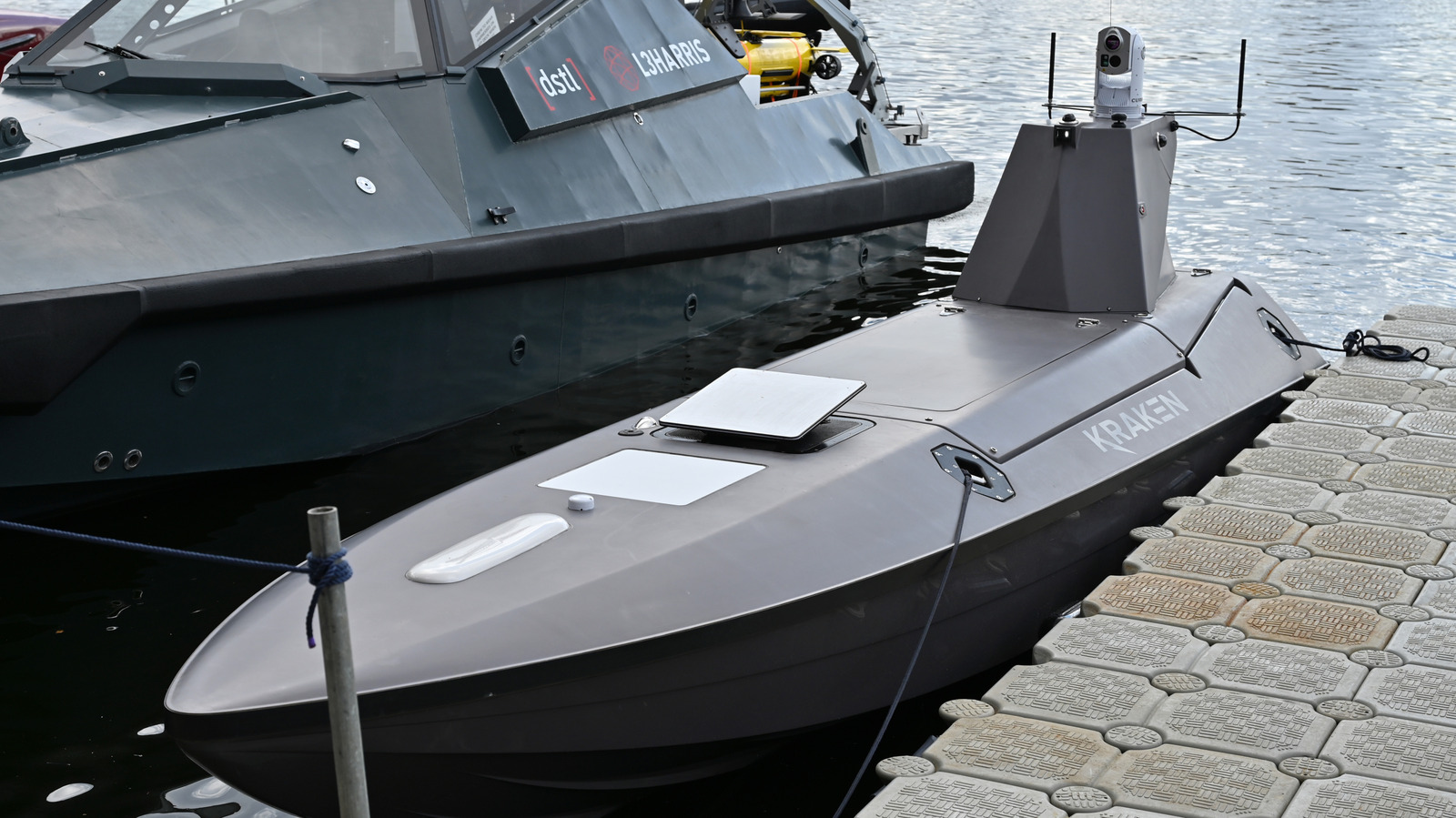
The United Kingdom Royal Navy discovered that third-party camera components aboard its K3 Scout uncrewed surface vessels were transmitting automated heartbeat status signals to an external IP address in China. Although security audits confirmed that no sensitive operational data was compromised, the Royal Navy immediately stripped wireless connectivity from the affected marine drones supplied by @KrakenTechnologyGroup. The compromised hardware has raised severe security concerns across allied military branches, given that the high-end reconnaissance platform is also utilized by United States Special Operations Command. This security breach matters because it exposes significant supply chain vulnerabilities and the hidden risks of embedding third-party commercial components into sensitive defense systems.
A recent industry survey reveals that 68% of enterprises utilizing artificial intelligence agents have experienced confident but incorrect agent answers due to missing or inconsistent business context, up from 57% in previous months. Enterprises deploying governed context layers in production reported recurring failures at a rate of 50%, compared to lower recurring rates among organizations operating without structured governance frameworks. While companies increasingly prioritize access control and data governance during software procurement, retrieval accuracy frequently trails behind other buying criteria. This trend matters because it indicates that organizations attempting to govern complex data environments are currently uncovering and documenting agent unreliability at significantly higher rates.
31. Quantum computing may be facing a replication crisis
A comprehensive scientific review analyzing thousands of academic research papers concerning quantum computers has revealed that a majority of publications fail to provide testable code for independent devices, or feature code that ultimately does not function as claimed. This finding points to widespread reproducibility challenges across the quantum computing research landscape. This situation matters because it threatens scientific verification and undermines confidence in published experimental milestones within the quantum technology sector.
32. Can computers learn what makes the most iconic jazz musicians stand out?
Machine learning models analyzed in a recent study published in Nature Machine Intelligence successfully identified individual jazz pianists from audio recordings and mapped the distinct musical fingerprints that make performers recognizable. The research evaluated recordings from 20 famous jazz pianists to uncover stylistic nuances embedded in their improvisational techniques. This study matters because it provides computational insights into artist attribution, musical style evolution, cultural heritage preservation, and advanced music education.
33. Pokémon Center data breach exposes customer info, cancels some orders
The Pokémon Center is notifying customers in the United Kingdom and Germany that personal data and order information were exposed following a third-party data breach originating at logistics provider CEVA Logistics. The security incident involved unauthorized access to customer records stored within third-party systems, leading to targeted customer notifications and order cancellations. This breach matters because it underscores the cybersecurity risks posed by vulnerable supply chain partners and logistics vendors handling sensitive consumer information.
34. GPU Offload in Rust: Portable, Safe, and Fast
A research paper submitted to @arXiv introduces a zero-overhead, multi-vendor compilation framework natively integrated into the Rust compiler and LLVM backends to handle GPU offloading safely and efficiently. By leveraging Rust’s strict aliasing guarantees, ownership model, and rich type system, the framework manages data transfers and cross-vendor ABI lowering mismatches between host CPUs and device targets without sacrificing execution efficiency. Evaluations on RAJAPerf demonstrate that the compiler generates competitive intermediate representation for GPU kernels, achieving performance comparable to native CUDA and HIP C++ baselines. This development matters because it eliminates the historical compromise between memory safety and execution efficiency in high-performance parallel GPU programming.
35. New ChatGPT Feature Collects Every Keystroke You Make
@OpenAI has introduced an opt-in desktop feature for macOS called Computer History that records clicks, keystrokes, and user interactions across applications to build a searchable database for AI agents. While the tool allows the model to assist with tasks by tracking workflow context across software like Slack and Google Docs, it does not encrypt generated history files, leaving sensitive data potentially accessible to other local macOS programs. The functionality has drawn immediate comparisons to Microsoft’s controversial Windows Recall tool due to privacy concerns surrounding the surveillance of user activities and unencrypted local data storage. This release matters because it grants artificial intelligence models unprecedented, continuous visibility into a user’s digital life while raising significant security and consent risks for messaging participants.
36. Red blood cells inspire next-generation therapeutic nanocarriers
Scientists at @OhioStateUniversity have engineered therapeutic nanocarriers derived from red blood cells that demonstrate high efficiency in evading immune system clearance and targeting cancer cells in laboratory studies. Published in Advanced Healthcare Materials, the research shows that these engineered extracellular vesicles can safely transport treatments while protecting them from immune destruction. This innovation matters because it offers a promising delivery mechanism to significantly improve the efficacy of future gene therapies and targeted cancer treatments.
That’s all for today’s digest for 2026/08/18! We picked and processed 36 articles. Stay tuned for tomorrow’s collection of insights and discoveries.
See you in the next one! 🚀
