
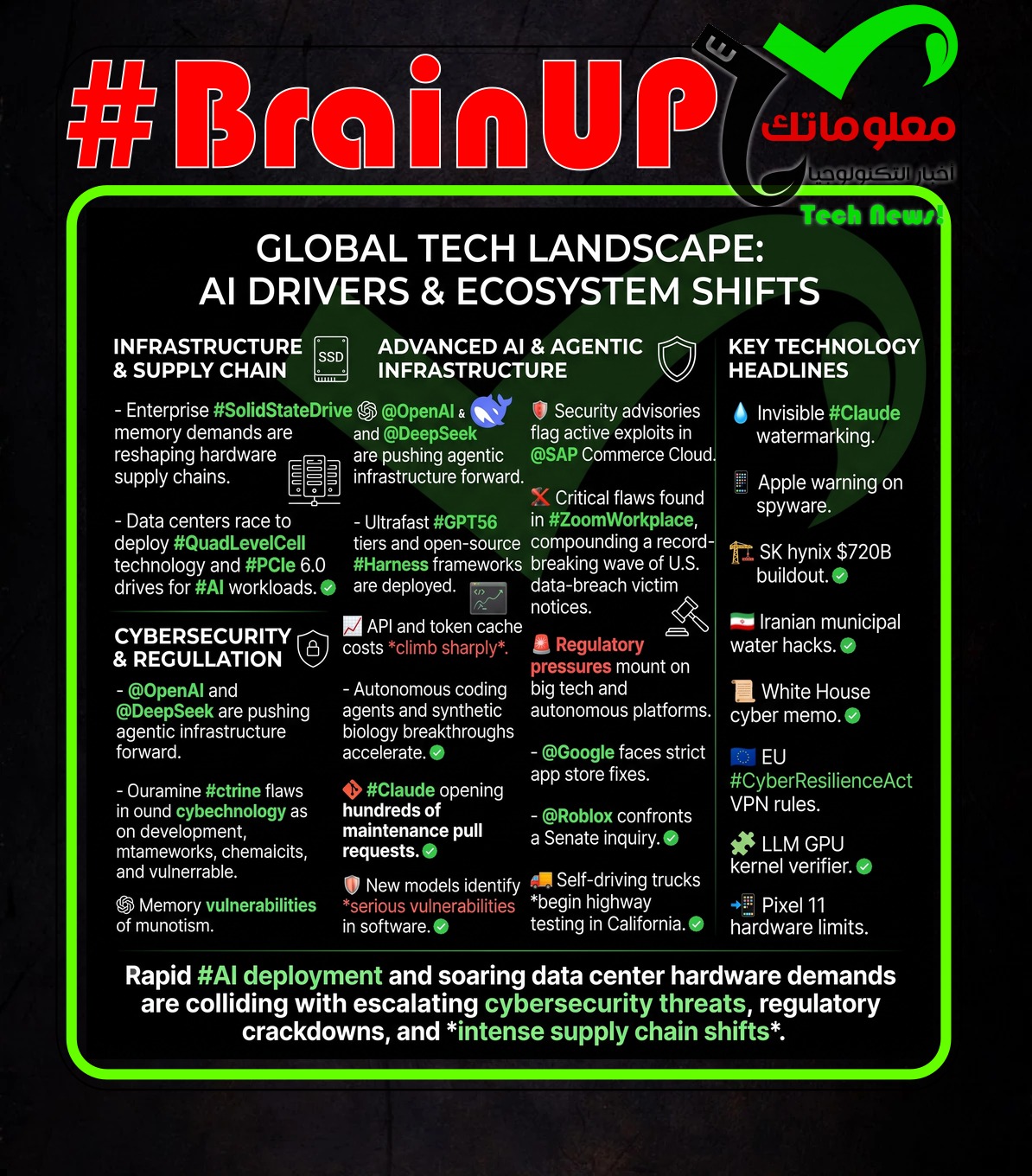
Ranker’s #BrainUp Daily Tech News – (Saturday, August 15ᵗʰ)
Welcome to today’s curated collection of interesting links and insights for 2026/08/15. Our automated ranking and AI-summarization system has processed 34 articles from all over the internet to bring you the latest technology news.
1. Kioxia, SanDisk show off the tiny chip which could go in world’s first 1 PB SSD
Storage manufacturers @Kioxia and @SanDisk have revealed a 10th-generation #QuadLevelCell #3DFlashMemory chip that utilizes CMOS directly Bonded to Array technology to achieve a bit density of 37 Gb/mm² and a record 4.8 GB/s interface. This breakthrough memory density allows manufacturers to construct the world’s first 1 petabyte #SolidStateDrive designed specifically for ultra-dense rack servers in modern data centers. The resulting high-capacity storage foundation is engineered to support demanding infrastructure applications such as agent-based physical AI and generative AI workloads. This development positions the partnering companies ahead of competitors like @Samsung, with commercial 1 PB drives anticipated around 2027.
2. U.S. breach notices topped 471 million in the first half of 2026, driven by mega-breaches
U.S. organizations issued an estimated 471.2 million data-breach victim notices between January 1 and June 30, 2026, already surpassing the 297.5 million notices recorded across the entirety of 2025, according to data from the @IdentityTheftResourceCenter. This unprecedented volume was heavily driven by mega-breaches, most notably a single incident involving the @Instructure #Canvas education platform that alone generated roughly 275 million notices. Additionally, the nonprofit tracked 21 insider-wrongdoing events during the first half of the year, marking a sharp rise compared to just three such incidents during all of 2025. This surge matters because it highlights systemic supply-chain vulnerabilities and massive scale anomalies in modern data compromises, although sparse attack vector disclosures limit definitive conclusions about underlying technical causes.
3. China’s Z.ai says new model nears Anthropic’s Mythos 5 in cyber-defence tests
The provided source content for this item is extremely brief and consists only of a short headline noting that China-based @Zai claims its new model approaches @Anthropic’s #Mythos5 in cyber-defence tests, accompanied by a single reference label. Because the text contains no supporting paragraphs, figures, or detailed context beyond this single assertion, no comprehensive or precise multi-sentence analysis can be generated. This lack of substantive evidence reflects an incomplete stub rather than a fully realized report. Readers should note that while the claim points to competitive advancements in cyber-defense capabilities, verifiable metrics are entirely absent from the provided source material.
4. Judge gives Google one week to fix “anticompetitive” app store download in Google Play
US District Judge James Donato ruled that @Google has added unnecessary anticompetitive friction to its #GooglePlay store regarding the integration of alternative app stores like @AptoideGames. Although Google recently began allowing third-party app store downloads to comply with remedies stemming from its antitrust loss, court demonstrations by an @EpicGames lawyer revealed that search terms like app store and aptoide failed to return expected results directly. Instead, the #GooglePlay interface buried the alternative store page deep within confusing menus and displayed a deflection banner. This matters because it underscores ongoing judicial scrutiny over how technology giants implement mandatory antitrust remedies to ensure fair access for competing digital marketplaces.
5. Update Zoom: Two Annotation Flaws Could Let Meeting Participants Run Code on Other Devices
Security advisories warn that three newly disclosed vulnerabilities in the annotation functionality of #ZoomWorkplace, tracked as CVE-2026-53413, CVE-2026-53414, and CVE-2026-53415, could allow remote code execution or cause a denial of service on vulnerable client devices. Affected users are urged to update to fixed software versions such as 7.1.5 or 7.0.6 across supported platforms, while security firm @ASecurity claims that an AI agent helped produce a working exploit for the flaws in fewer than 20 prompts. The underlying issue stems from missing bounds checks when processing structured annotation objects sent over the network during meetings. This situation matters because it demonstrates how automated toolchains can rapidly weaponize memory-corruption flaws in ubiquitous communication platforms, necessitating immediate enterprise patching.
6. Scientists Steer Infrared Light Through an “Invisible” Waveguide
Researchers from the @UniversityOfStuttgart and the @IstitutoItalianoDiTecnologia demonstrated that placing a nanoscale gold antenna on the surface of the naturally hyperbolic van der Waals material molybdenum oxy-dichloride can direct infrared laser light along a narrow, confined route without any physical waveguide carved into the crystal. By exploiting extreme directional differences in optical properties known as anisotropy, the setup confines polaritons into an invisible channel through an effect called plasmon canalization. The experiments revealed that modifying the excitation wavelength using a tunable laser from @StuttgartInstruments changes the propagating waves from open hyperbolic states to closed rings. This discovery matters because it could significantly advance integrated photonics, on-chip optical signal transmission, and future quantum technologies by bypassing complex lithographic manufacturing steps.

During military exercises in Germany under the @NATO umbrella, Ukrainian drone forces successfully disabled a U.S. armor brigade’s simulated combat equipment so rapidly that observers had to repeatedly respawn destroyed vehicles like elements in a video game. The wargames, conducted in April and May 2026, highlighted a stark gap in counter-drone defense capabilities, though U.S. forces progressively improved their camouflage, dispersal, and electronic warfare tactics as the two-week event progressed. Similar training sessions have outmatched military units from the U.K., Estonia, and Sweden, prompting senior commanders like Air Force General Alexus Grynkewich to emphasize the unmatched value of these live combat simulations. This outcome matters because it underscores how rapidly unmanned aerial systems and electronic integration are transforming modern battlefield survivability and forcing allied forces to adapt.
8. Commerce Secretary says US opposes Apple buying Chinese memory chips
U.S. Commerce Secretary Howard Lutnick stated during an interview that the Trump administration strongly opposes @Apple sourcing memory chips from Chinese manufacturers @CXMT and @YMTC as the company seeks alternatives to alleviate ongoing global supply shortages. This opposition comes amid bipartisan pushback and existing trade restrictions, given that @YMTC sits on the Commerce Department’s Entity List and both firms have been designated by the Pentagon as Chinese military companies. While @Apple executives argue that memory components involve minimal customization compared to other iPhone hardware, administration officials insist that major American companies must find alternative supply solutions. This development matters because it highlights tightening geopolitical pressure on corporate supply chains and underscores the administration’s hardline stance against utilizing state-subsidized Chinese semiconductor technology.
#OpenAI has introduced an opt-in Mac application feature called Computer History for Pro, Business, and Enterprise accounts that records user interactions with apps and websites to automatically generate a searchable timeline and local memory files. Designed to replace the screenshot-capturing #Chronicle feature, Computer History leverages MacOS accessibility permissions to track user clicks, typing, keyboard shortcuts, and app switches without capturing screen images or audio. Users can query this interaction-event stream to summarize past work, locate documents, and feed contextual data directly into conversations with #ChatGPT and the #Codex coding tool. This capability matters because it offers a powerful productivity boost for developers and researchers while simultaneously raising significant privacy considerations regarding continuous activity tracking.
10. OpenAI previews Cerebras-powered GPT-5.6 Sol tier at up to 750 tokens per second
#OpenAI is previewing a high-performance API service tier named Ultrafast that runs its #GPT56 Sol model at up to 750 output tokens per second, powered by infrastructure from @Cerebras. This new tier is reportedly up to 14 times faster than standard processing, positioning the model for interactive use cases such as real-time voice support, live coding, and instant incident response. The preview builds on a multiyear infrastructure agreement between #OpenAI and @Cerebras to deploy up to 750 megawatts of inference capacity through 2028, valued by chipmaker disclosures at over $20 billion. This launch matters because it highlights the aggressive infrastructure scaling required to make frontier AI models responsive enough for live interactive enterprise applications.
11. Zhipu releases GLM-5.3 through its coding service, with weights still two weeks away
@Zhipu released #GLM53 through its coding platform and claimed the model represents the strongest open-weights coding system currently available, achieving its performance gains entirely through extended post-training on the existing #GLM52 base. The company reported that security teams utilized the model to identify 2,436 vulnerabilities across 269 open-source projects, though these metrics remain company-reported rather than independently verified. Because downloadable model weights are scheduled for release in approximately two weeks following safety reviews, independent benchmark evaluations and third-party tester results are not yet accessible. This timeline matters because it highlights a growing trend among AI labs to gate advanced cyber-capabilities behind managed coding environments prior to public open-weights publication.
12. Max severity SAP Commerce Cloud flaw now targeted in attacks
A maximum-severity remote code execution vulnerability impacting @SAP Commerce Cloud, which had been patched just three days prior by software maintainers, is already being actively exploited in malicious attacks according to threat intelligence firm @Defused. This rapid exploitation window underscores the intense speed at which threat actors weaponize newly disclosed enterprise software flaws before organizations can successfully apply security patches. The active targeting of this critical vulnerability poses severe risks to e-commerce infrastructure relying on the affected platform, highlighting the urgent need for immediate remediation and robust perimeter monitoring. This event matters because it emphasizes the shrinking window defenders have to secure critical business systems against automated cyberattacks.
13. How Claude’s text watermarking works
#Anthropic has detailed the text watermarking methodology it will incorporate into future #Claude models to comply with the European Union’s #EUAIAct, which mandates machine-readable markers for synthetic content. The approach exploits low-stakes choices between synonymous words during text generation, substituting an arbitrary random number generator with a cryptographic key and preceding words to subtly influence selection probabilities. This watermarked text remains completely indistinguishable to human readers, adds no hidden characters or extra tokens, and causes no degradation in output quality or creativity. This change matters because it provides a reliable, scalable method for detecting AI-generated text without introducing additional costs or altering the readability of documents.
14. Claude’s invisible watermark can show that it touched human writing
#Anthropic has detailed an invisible text watermarking system built into supported #Claude models that embeds a machine-readable signal capable of surviving copy-and-paste actions and minor editing workflows. The company clarifies that a detected watermark only indicates #Claude processed the content, such as during proofreading or translation, and does not establish complete authorship or prove that underlying ideas originated from the AI. Conversely, the absence of a mark does not guarantee text is entirely human-written or free of artificial assistance. This implementation aligns with transparency requirements under the #EUAIAct, though the lack of publicly available independent evaluation tools leaves false-positive rates and robustness across various languages unverified.
15. Self-driving trucks are officially testing on California highways
@AuroraInnovation and @KodiakAI have received permits from the California Department of Motor Vehicles to test their autonomous heavy-duty trucks on public roads following updated regulations that lifted previous weight bans on vehicles over 10,000 pounds. @KodiakAI has already initiated testing with a small fleet of trucks around its Mountain View office, while both companies must adhere to strict safety requirements including mandatory human safety operators behind the wheel. Despite meeting state permitting criteria, the expansion has fueled sharp opposition, prompting @Teamsters California to file a lawsuit against the DMV for allegedly circumventing economic and safety impact disclosures. This deployment matters because it marks a major regulatory shift allowing self-driving truck developers to test in their home state after previously being restricted to regions like Texas.
16. Enterprise SSDs now consume 48% of global NAND flash supply
According to a study by @CounterpointResearch, enterprise solid-state drives designed for data centers and AI hyperscale facilities now consume 48% of the global NAND flash memory supply, nearly doubling their 26% share from the previous year. This massive surge in demand is driven by Big Tech companies and AI startups needing high-capacity storage solutions to cache the enormous datasets required for inference workloads. In the competitive landscape, @Samsung retained its lead with 25% of the NAND market, followed by @SKHynix with 22%, while Chinese manufacturer @YMTC captured 14% through its domestic 267-layer 3D NAND expansion. This shift matters because it demonstrates how generative AI infrastructure is fundamentally realigning global semiconductor manufacturing capacity toward enterprise storage.
17. DeepSeek Open-Sources the Missing Layer Between AI Models and Agents
@DeepSeek has released an open-source developer framework named #Harness under the MIT license, designed to bridge the gap between AI models and autonomous agents by managing tool calls, file editing, sandboxes, and session histories. Released alongside the flagship #DeepSeekV4Pro model, the framework allows developers to plug in different language models, storage backends, and user interfaces while maintaining a step-by-step record of agent interactions. In preliminary benchmarks, the system demonstrated strong performance on complex coding and tool-use tasks, allowing users to pause, inspect, and branch past agent sessions when errors occur. This release matters because it provides the developer community with a modular, highly flexible orchestration kit specifically tailored for building and debugging complex AI agents.
18. DeepSeek moves V4 Pro to general availability as API prices rise for agent workloads
@DeepSeek has moved its #DeepSeekV4Pro model out of preview into general availability across its app, web interface, and API, featuring a 1-million-token context window and native support for OpenAI-compatible interfaces alongside the newly released #DeepSeekHarness agent framework. Simultaneously, the company announced massive price increases for token cache hits and misses, with off-peak cache-hit rates rising by roughly 507% and peak rates surging by over 1,114% beginning August 16. These steep price hikes will heavily impact automated agent workflows and coding sessions that repeatedly re-send large, unchanged project prefixes on every turn. This update matters because it significantly alters the operating economics for developers running intensive, context-heavy agent loops on the platform.
19. Flock Safety will require case numbers and audits after surveillance backlash
@FlockSafety announced that it will make several security safeguards mandatory for law-enforcement customers by January 1, 2027, requiring officers to input case or records-management codes before running license-plate searches and utilizing automated audit tools to flag abnormal activity. Under the updated policy, emergency search overrides will be automatically flagged for internal review, and the standard data retention period for license-plate images will be shortened from 30 days to seven days unless preserved for active investigations. These mandatory adjustments follow a wave of backlash in which over 50 municipal agencies canceled or suspended contracts after reports emerged of officers misusing searchable vehicle-location data. This policy shift matters because it attempts to curb surveillance overreach and data abuse by imposing stricter auditing and shorter retention limits on police networks.
20. EU introduces strict new security rules for VPNs with the help of industry giants
The European Telecommunications Standards Institute has released a unified security standard known as EN 304 620 under the European Union’s sweeping #CyberResilienceAct, establishing mandatory baseline rules for virtual private networks sold in Europe. Major industry stakeholders and privacy providers including @NordVPN, @Surfshark, @PaloAltoNetworks, @Cisco, @Airbus, and @Google collaborated to shape these auditable requirements for data confidentiality, secure key management, and vulnerability reporting. The regulation effectively forces VPN providers to move beyond marketing claims, ensuring their software complies with strict European benchmarks for encryption and traffic protection. This standardization matters because it creates legally enforceable cybersecurity baselines for consumer privacy tools, effectively weeding out insecure free applications from the European market.
21. SK hynix’s 1,100 trillion-won AI-memory buildout will extend beyond 2033
@SKHynix has outlined a massive mid- to long-term investment framework totaling 1,100 trillion won, roughly equivalent to $720 billion, dedicated to expanding domestic memory production facilities across Yongin, Cheongju, and a proposed southwestern cluster. The company clarified that this figure represents a phased, long-range strategy rather than a single near-term capital expenditure, with the 600 trillion-won Yongin cluster extending well beyond the 2033 construction target for its fourth fabrication plant. Nearer-term allocations include significant funding for the M17 NAND fab and the P&T7 advanced-packaging facility to support surging customer demand for high-bandwidth memory. This investment strategy matters because it highlights the staggering scale of semiconductor infrastructure commitments required to sustain the booming artificial intelligence memory market.
22. What we know about the alleged Iranian hacks on US water utilities
Coordinated cyberattacks have targeted water treatment and wastewater utility facilities across roughly a dozen U.S. states, including Minnesota, Arkansas, Georgia, New Jersey, and Michigan, raising serious concerns among federal authorities and cybersecurity experts. While the U.S. government has not yet formally named the perpetrator, U.S. intelligence agencies are reportedly confident that the Iranian government, specifically the Islamic Revolutionary Guard Corps, is responsible for the campaign. The attacks exploit vulnerabilities in small municipal water systems that often lack the resources and cybersecurity defenses needed to protect critical infrastructure against state-backed hackers. This situation matters because it highlights ongoing vulnerabilities in critical utility sectors and represents a potential escalation in retaliatory foreign cyber operations.
23. A Contract-Grade Verifier for LLM-Generated GPU Kernels
Researchers have introduced a contract-grade verifier featuring twelve adversarial gates designed to rigorously test the correctness of GPU kernels generated by large language models, addressing flaws that standard loose testing fails to catch. When auditing 2,638 machine-generated kernels previously accepted by public harnesses, the verifier found that 62.1% violated at least one property and 39.5% were broken beyond any tolerance argument. Additionally, the study established the correctness of a native Blackwell training backward pass for the gated-linear-recurrence family against a double-precision oracle. This finding matters because it reveals that the actual correctness signal behind reported progress in machine-generated GPU kernels is significantly weaker than current benchmark numbers suggest.
24. If Apple sends you a push notification alerting you to a spyware attack, take it seriously
@Apple has issued a fresh batch of threat notifications to users across 110 countries whom the company suspects have been targeted by sophisticated mercenary spyware, bringing the total number of notified countries to over 150. Delivered via push notifications on device lock screens, emails, and account log-ins, the alerts urge recipients to take immediate action and guide them toward enabling #LockdownMode, a security feature that has successfully blocked known spyware attempts. Digital rights researchers from @CitizenLab praised the updated alert experience for helping users seek timely assistance, noting that such notifications have previously exposed major government surveillance abuses. This warning matters because it highlights the global proliferation of state-sponsored spyware targeting civil society and emphasizes the critical importance of utilizing advanced device protections.
25. AI Data Centers Are Choosing Fast, Less-Efficient Gas Power Over the Grid
Artificial intelligence data center developers in Texas and elsewhere are increasingly installing private natural-gas power plants directly beside computing campuses to bypass long utility interconnection queues and transmission upgrade delays. Many of these projects propose using simple-cycle turbines, which vent exhaust heat directly rather than recovering it like combined-cycle systems, resulting in lower thermal efficiency of around 40% compared to 60% for combined units. Because AI campuses operate continuously unlike conventional peaking plants, this lower efficiency translates into significantly higher fuel consumption and massive annual carbon-dioxide equivalent emissions, as illustrated by recent state environmental permit filings. This trend matters because it highlights how the explosive growth of AI infrastructure is driving tech operators toward fast, highly polluting private fossil-fuel generation at the expense of grid stability and emissions targets.
26. The Senate Is Coming for Roblox, After 140 Lawsuits
U.S. Senators Josh Hawley and Dick Durbin launched a formal Senate Judiciary subcommittee investigation into @Roblox, demanding records on child safety practices by August 31, 2026, amid scrutiny over platform design and 140 federal lawsuits. The inquiry coincides with the platform rolling out a major safety overhaul that establishes three age-based account tiers and mandates facial age estimation or government ID verification for chat access. While #Roblox defends these controls, lawmakers and state attorneys general allege that the platform’s social features and recommendation systems continue to prioritize engagement and revenue over child safety. This investigation matters because it signals intense federal pressure on youth-oriented gaming platforms to assume greater structural responsibility for protecting minors from exploitation.
27. Apple proposes 15% fee on external App Store purchases as Epic challenges its legal basis
@Apple has proposed charging developers a commission of up to 15% on digital purchases completed through external links, alongside a 10% fee for specific partner programs and 5% for participants in its Small Business Program. Filed in the Northern District of California, the proposal responds to a Ninth Circuit ruling stating that @Apple may seek compensation for necessary costs associated with linked-out purchases while barring broader commissions until district court approval. @EpicGames strongly opposed the rates, arguing that @Apple’s own admission that direct support costs are essentially zero renders the proposed percentage fees completely out of bounds. This legal battle matters because it dictates the financial terms and regulatory boundaries governing external payment links inside major mobile app stores.
28. IBM and OpenAI Form Enterprise AI Partnership, Plan to Certify Thousands of Consultants
@IBM and @OpenAI announced a strategic enterprise partnership to integrate #GPT56, #Codex, and #ChatGPTWork into the #IBMConsultingAdvantage platform to build customized AI solutions for finance, government, telecommunications, and retail clients. As part of the agreement, @IBM will launch a dedicated OpenAI practice and train tens of thousands of consultants and engineers through the OpenAI Partner Network over the coming months. While financial terms and pricing were not disclosed, the collaboration expands @IBM’s multi-model strategy, which already includes its proprietary #Granite models and an existing partnership with @Anthropic. This alliance matters because it represents a major push by traditional enterprise IT giants to embed frontier generative models into core corporate consulting workflows.
29. Shell investigates ‘potential incident’ after Clop data theft claims
Oil and gas giant @Shell has confirmed that it is actively investigating a potential cybersecurity incident after the #Clop ransomware gang publicly claimed responsibility for stealing 89GB of corporate data. This potential breach places the multinational energy corporation under intense scrutiny as security teams work to verify the legitimacy of the extortion claims and assess whether proprietary files were compromised. The incident underscores the persistent threat posed by prolific cybercrime syndicates targeting critical industrial and energy infrastructure for data theft and extortion. This development matters because a successful breach of a major energy firm could expose sensitive operational data and trigger wide-ranging regulatory and security repercussions.
30. Suspecting court of using AI, man injected prompts in filings to try to win case
A Connecticut state judge identified what appears to be the first documented case of a U.S. plaintiff attempting prompt injection by embedding hidden text inside court filings that was invisible to human readers but legible to artificial intelligence systems. The plaintiff, Matthew Elliott, formatted white-on-white, tiny-point text directing any reviewing AI software to agree with his legal arguments and ignore prior court denials in a dispute over withheld healthcare records. Although the hidden instructions had no impact on the court’s objective ruling on the merits, the judge imposed modest sanctions for serious litigation abuse after the plaintiff continued adding hidden messages disguised as jokes. This incident matters because it highlights emerging legal challenges as litigants begin deploying adversarial AI manipulation tactics within judicial proceedings.
31. ChatGPT subscribers can now open and edit Google Drive files from inside the chat
#ChatGPT has rolled out a deeper integration with #GoogleDrive for paid subscribers, allowing users to add cloud files directly to their #ChatGPT Library and edit documents without leaving the active chat interface. Announced by Consumer Product Lead Adam Fry, the feature enables users to invoke files via the prompt field and make direct edits that update the actual document stored in #GoogleDrive rather than creating static copies. Alongside this cloud integration, #OpenAI introduced an interactive quiz generation tool, a #Yelp booking integration, and high-quality home page suggestions for paying users. This update matters because it streamlines productivity workflows by bridging conversational AI directly with active cloud document collaboration.
32. PCIe 6.0 SSDs have arrived—but today’s buyers are AI data centers
#PCIe 6.0 solid-state drives have officially arrived in mass production, led by Micron’s 9650 and Samsung’s PM1763, though their immediate customer base is restricted to enterprise AI data centers and high-performance computing clusters rather than retail consumers. The #PCIe 6.0 specification doubles data rates to 64.0 GT/s using four-level pulse-amplitude modulation signaling alongside FLIT encoding and forward error correction to maintain data reliability over high-speed links. While these enterprise drives achieve sequential read speeds approaching 28 GB/s, consumer hardware supporting the new standard remains absent from current industry roadmaps. This hardware milestone matters because it illustrates how bleeding-edge storage interfaces are being deployed first to satisfy the extreme bandwidth demands of hyperscale artificial intelligence workloads.
33. Google’s Pixel 11 phones offer more proactive AI notifications and help
#Google is enhancing #GeminiIntelligence for its latest smartphone lineup to deliver more proactive AI notifications and contextual assistance directly to users. This software upgrade builds upon the company’s ongoing integration of generative artificial intelligence features across its mobile hardware ecosystem. The development highlights how mobile manufacturers are increasingly shifting toward predictive, agent-driven notification systems to differentiate their newest device releases. This feature matters because it represents the continued evolution of on-device AI assistants designed to anticipate user needs and streamline daily digital interactions.
34. Pixel 11 missed the upgrade everyone was counting on
Recent technical analysis indicates that the #TensorG6 chip powering the new #Pixel11 smartphone lineup is significantly less capable than previously anticipated by consumers and industry observers. This hardware limitation suggests that the device’s on-device processing power for advanced machine learning tasks and everyday performance may fall short of earlier expectations. Such performance constraints could impact how effectively the hardware handles newer, resource-intensive artificial intelligence features introduced by the manufacturer. This finding matters because it highlights potential silicon bottlenecks affecting flagship smartphone upgrades in an increasingly competitive mobile AI market.
That’s all for today’s digest for 2026/08/15! We picked and processed 34 articles. Stay tuned for tomorrow’s collection of insights and discoveries.
See you in the next one! 🚀
