

Breaking the Petabyte Barrier: How New Flash Technology and Massive SSDs Are Redefining Data Centers
Key points
- SanDisk and Kioxia's 10th-generation QLC 3D flash memory achieves a bit density of 37 Gb/mm² using advanced CMOS directly Bonded to Array (CBA) technology 1.
- The new chip reaches a 4.8 GB/s interface under test conditions, establishing a benchmark for data transfer speed and power efficiency 1.
- Deploying these chips in dense multi-die stacks inside specialized EDSFF form factor enclosures could yield the industry's first 1 petabyte SSDs by 2027 1.
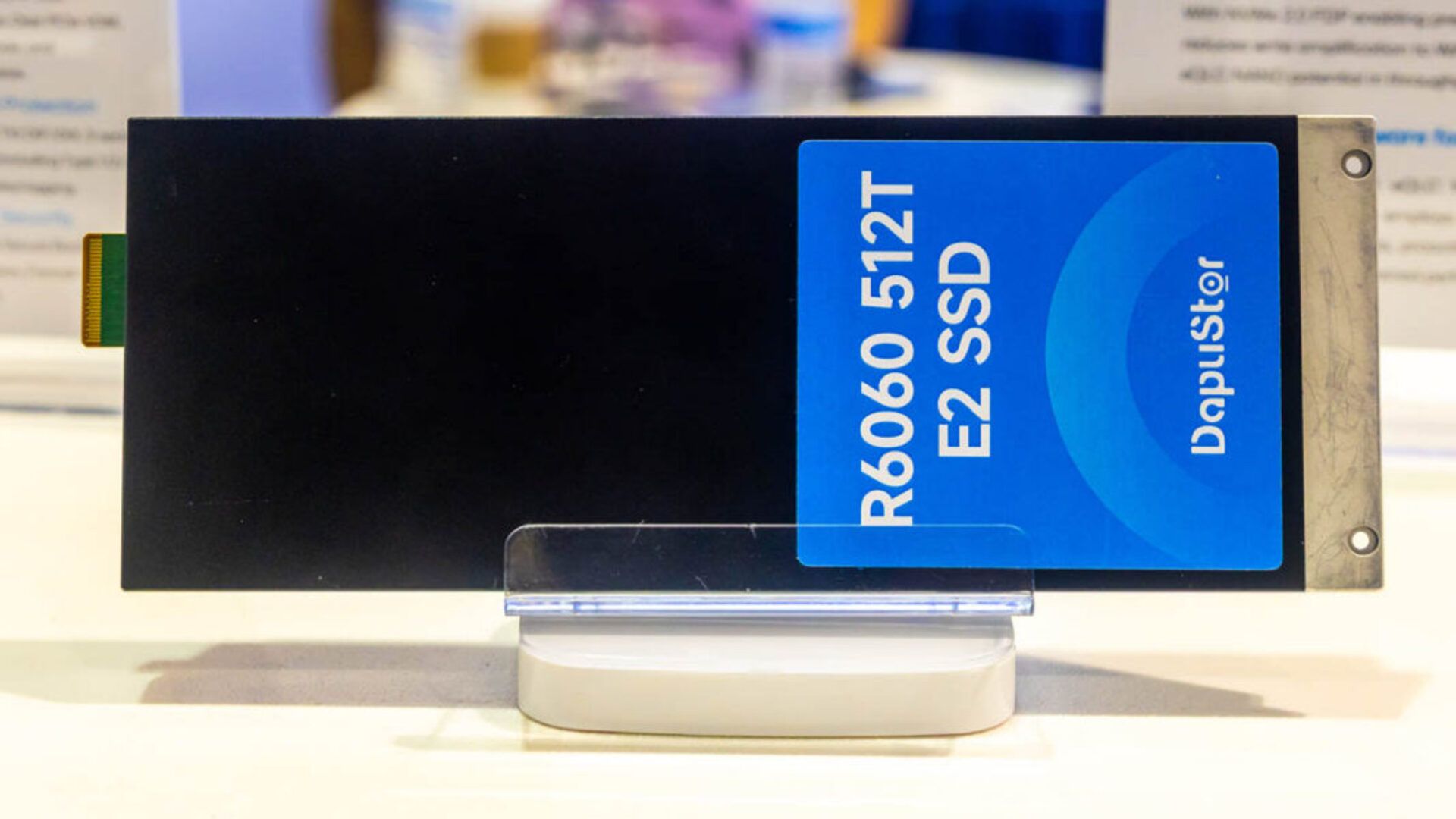
- Separately, DapuStor has unveiled its R6060 NVMe SSD at the FMS 2026 trade show, packing 512TB into a single E2 form-factor drive 2.
The 1-Petabyte Flash Breakthrough
Enterprise data centers face mounting pressure to support heavy artificial intelligence workloads, agent-based systems, and massive generative AI models. To meet these demands, SanDisk and Kioxia have introduced a 10th-generation Quad-Level-Cell (QLC) 3D flash memory architecture that achieves a 60% boost in bit density over their previous 8th-generation designs 1. By leveraging CMOS directly Bonded to Array (CBA) technology – where CMOS wafers and cell array wafers are manufactured separately and then joined via high-precision alignment – the companies have created a foundation for ultra-dense storage 1.
This engineering milestone yields a remarkable density of 37 gigabits per square millimeter (Gb/mm²), making it possible to build solid-state drives with a staggering 1 petabyte of capacity 1. The resulting memory architecture also delivers a 4.8 GB/s interface under test conditions, ensuring that ultra-fast data transfer speeds keep pace with modern processor demands 1. According to SanDisk CTO Alper Ilkbahar, this technological leap redefines the performance and efficiency envelope of QLC NAND, providing a scalable foundation for next-generation digital infrastructure 1.
Form Factors and Market Timeline
Achieving a 1-petabyte solid-state drive requires more than just dense silicon chips; it demands specialized physical engineering. Because these high-capacity dies require advanced 3D packaging in stacks of 64 or 128 dies, they are impractical for consumer home systems 1. Instead, they are tailored for ultra-dense 1U and 2U rack servers in modern data centers, utilizing ruler-like EDSFF form factors such as the E1.L, E3.L, and the specific E2 format measuring 200 mm by 76 mm 1.
This hardware evolution positions SanDisk and Kioxia ahead of key competitors like Samsung, which has pursued ultra-tall stacks exceeding 1,000 layers 1. Industry analysts suggest that SanDisk and Kioxia could bring their 1-petabyte SSDs to market by 2027 1. This timeline places them ahead of competing 1-petabyte commercial product rollouts and provides cloud providers with a long-awaited tool for managing expanding data volumes 1.
Pushing Half-Petabyte Territory Today
While 1-petabyte drives loom on the horizon, hardware manufacturers are already pushing massive capacities into enterprise server environments. In a related development, DapuStor showcased its R6060 NVMe SSD at the FMS 2026 storage trade show, delivering 512TB of capacity in a single E2 form-factor drive 2. This device doubles the storage ceiling previously established by standard E3.S and U.2 alternatives 2.
Powered by PCIe 5.0 connectivity, the NVMe 2.0 protocol, and DapuStor’s in-house DP800 controller, the R6060 is designed to handle sprawling AI training datasets and high-capacity cache workloads 2. A standard server equipped with 36 E2 drive bays could theoretically accommodate 16 petabytes of raw storage using these units 2. Such density dramatically reduces the number of physical servers, processors, and network components required for storage-heavy deployments, pointing toward a leaner, more energy-efficient future for enterprise data centers 2.
Companies mentioned: Samsung
Primary sources
 Kioxia, SanDisk show off the tiny chip which could go in world's first 1 PB SSD (techradar.com) – SanDisk and Kioxia jointly unveiled a 10th-generation QLC 3D flash memory chip utilizing CMOS directly Bonded to Array technology, achieving a 4.8 GB/s interface and setting the technical foundation for the world's first 1 PB SSD.
 The world's largest SSD is here: DapuStor unveils massive 512TB drive (techradar.com) – DapuStor introduced the R6060 at the FMS 2026 trade show, a 512TB NVMe SSD utilizing the E2 form factor and PCIe 5.0 to push enterprise storage densities into half-petabyte territory.
 Powered by News Ranker