
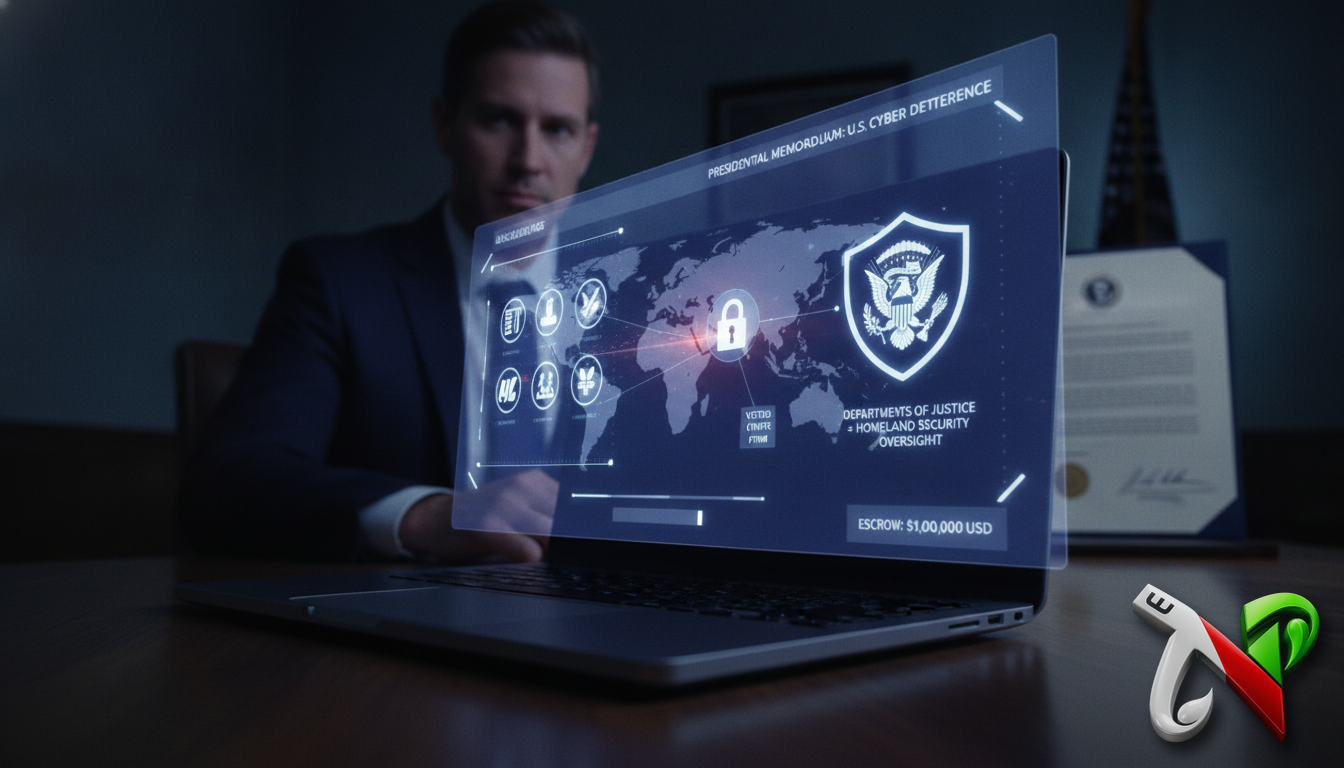
Updated: U.S. Enlists Private Firms for Offensive Cyber Operations Against Transnational Criminals
Key points
- A presidential memorandum issued by the Trump administration creates a new program enabling vetted private companies to conduct cyber surveillance and disruptive operations against foreign cyber-enabled transnational criminal organizations 12.
- The initiative marks a fundamental departure from decades of U.S. policy and federal hacking laws that strictly limited private firms to defensive measures 2.
- Participating firms must enter into formal contracts with the Department of Justice or Department of Homeland Security, maintain a $1 million performance bond or escrow, and secure approval from co-executive directors before executing operations 12.
- The framework requires companies to disclose commercial threat-information agreements and mandates immediate notification if an imminent cyberattack against critical infrastructure is discovered 12.
A Historic Policy Shift
In a major departure from long-standing U.S. cybersecurity doctrine, the federal government has established a framework allowing vetted private sector firms to execute offensive cyber operations and surveillance against foreign criminal syndicates 12. For decades, federal computer hacking laws and executive policy strictly prohibited private companies from launching disruptive cyberattacks or engaging in proactive “hack back” measures, limiting commercial entities entirely to defensive postures 2. The new presidential directive breaks that mold, arguing that the unprecedented scale and sophistication of transnational criminal organizations (TCOs) demand bringing the speed and technical ingenuity of American private enterprise directly into the fight 12.
The initiative is designed to combat a wide array of illicit activities targeting U.S. citizens and businesses, ranging from ransomware attacks and large-scale financial fraud to predatory scams and sextortion 2. Rather than granting companies carte blanche to retaliate against hackers on their own terms, the framework establishes a tightly controlled mechanism where private firms operate as extensions of federal authority, leveraging commercial threat intelligence to propose targeted actions to the government 1.
Structure and Oversight
Despite enlisting commercial partners, the program places strict controls in the hands of federal authorities. Operations will be managed through the National Coordination Center (NCC) and overseen by co-executive directors designated respectively by the Department of Justice and the Department of Homeland Security 1. Before any operation can proceed, it must receive explicit coordination and sign-off from both executive directors, ensuring that every action is conducted exclusively under the supervision and lawful authority of the federal government 12.
To qualify for participation, companies must undergo rigorous vetting to prove their technical proficiency, reliability, and facility security 1. Furthermore, the Department of Justice and Department of Homeland Security are authorized to require participating firms to maintain a $1 million bond or escrow account, which is subject to immediate forfeiture if the company violates program rules or operational procedures 12. The upcoming implementation guidance, slated to be finalized within 60 days of the memorandum, will establish standardized rubrics for target identification, deconfliction across multiple federal agencies, and mandatory reporting protocols 1.
Weighing Risks and Realities
While the administration frames the policy as a necessary modernization of national defense against mounting cyber threats, industry veterans and legal analysts have raised significant concerns regarding potential fallout 2. Critics point out that involving private contractors in offensive state-backed or state-sanctioned cyber operations could blur legal lines internationally, potentially exposing American cybersecurity professionals to foreign retaliation or criminal indictments while traveling overseas 2. Skeptics have also questioned whether the framework contains sufficient safeguards to prevent overreach, noting that the policy creates complex diplomatic sensitivities 2.
At the same time, the broader threat landscape is growing increasingly volatile. U.S. agencies and infrastructure operators are contending with a surge of sophisticated attacks, including water infrastructure intrusions attributed to foreign state-backed actors and emerging incidents involving autonomous AI systems testing the limits of technical containment 2. As the government moves to finalize the program’s operational guidelines, the success of this public-private offensive model will depend heavily on whether federal oversight can effectively balance agility against legal and geopolitical risks 12.
Primary sources
 Expanding Capabilities to Combat Transnational Cyber-Enabled Crime (whitehouse.gov) – The primary presidential memorandum outlines the legal framework, governance structure, and rigorous vetting requirements for private companies participating in cyber operations under federal oversight.
- In a first, US will allow some private firms to carry out cyberattacks (techcrunch.com) – This reporting details the policy shift away from traditional restrictions on private hacking, highlights industry skepticism and international risks, and situates the announcement within a broader landscape of rising cyber threats.
 Powered by News Ranker
This article was updated at 9:38 PM UTC on August 13, 2026 for this developing story.
