
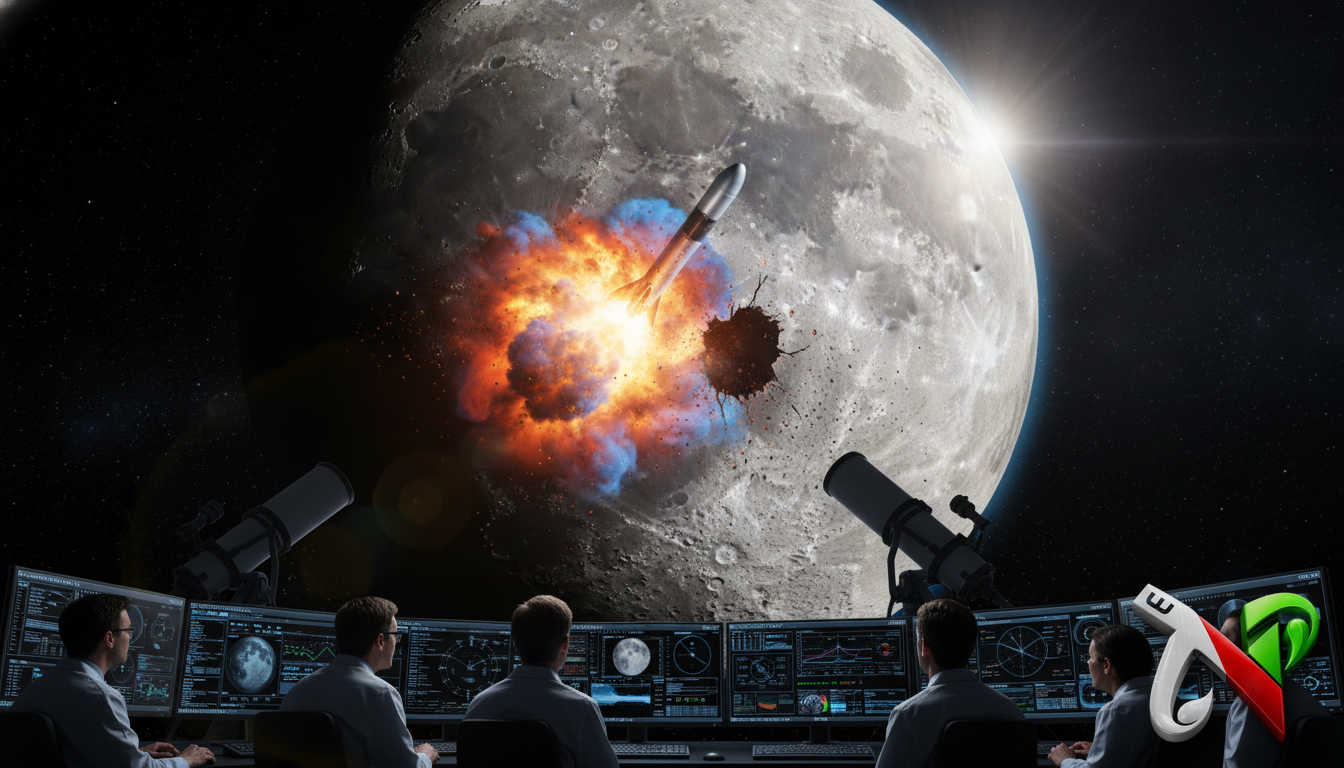
When a SpaceX Rocket Hit the Moon: What We Learned from the Lunar Impact
Key points
- A discarded Falcon 9 upper stage struck the moon near Einstein Crater at approximately 8,700 km/h after drifting in space for a year and a half 11114.
- Although the impact flash was hidden on the sunlit side of the moon, the European Southern Observatory’s Very Large Telescope detected a brief plume containing sodium and lithium 18.
- South Korea's Danuri lunar orbiter successfully captured before-and-after images revealing a fresh, blackened crater torn into the lunar surface 1826.
- Space scientists and NASA view the event as a valuable test case for seismic monitoring and risk management as permanent moon bases draw closer 1120.
An Accidental Cosmic Collision
When a spent Falcon 9 upper stage collided with the moon, it marked an unexpected milestone for modern space exploration 1. The four-ton metal cylinder – roughly the size of a five-storey building – had been drifting through an elliptical loop ever since launching a pair of commercial lunar landers in January 2025 11422. While SpaceX successfully recovered the rocket’s primary booster, the upper stage lacked the fuel required to return to Earth or achieve a stable parking orbit 11116. Over eighteen months, a delicate interplay of solar radiation, Earth’s gravity, and the moon’s pull gradually nudged the derelict hardware off course, placing it on a terminal trajectory 71622. Traveling at roughly 5,400 miles per hour, the structure struck a dusty, barren region near Einstein Crater on the moon’s northwestern limb 1726. Because the collision occurred on the sunlit hemisphere during daytime, the initial kinetic flash was virtually impossible to spot directly from Earth 81426.
Catching the Chemical Fingerprint
Despite the lack of a visible impact flash for backyard stargazers, professional astronomers quickly mobilized to capture the aftermath 2127. Telescopes in Chile operated by the European Southern Observatory trained their instruments on the target zone, successfully detecting a massive debris plume that lasted for several minutes 18. By analyzing the light spectrum passing through the cloud, researchers identified distinct chemical signatures: sodium gas, which likely originated from the displaced lunar soil, and traces of lithium, which scientists attribute to the vaporized rocket stage itself 18. Meanwhile, South Korea’s Danuri lunar orbiter swept over the region, capturing the world’s first orbital photographs of the fresh, blackened crater torn into the landscape 1826. These before-and-after visuals provided definitive proof of the impact, corroborating independent tracking models calculated months in advance 71822.
Lessons for Future Moon Bases
While uncontrolled rocket impacts are relatively rare, they are not unprecedented; a similar unguided booster strike occurred in 2022, and NASA frequently crashed spent stages intentionally during the Apollo era for seismic research 71314. However, the timing of this event carries heightened significance 11. As NASA’s Artemis program and international space agencies race toward establishing permanent, crewed infrastructure on the lunar surface, the volume of traffic in lunar orbit is set to skyrocket 71119. Researchers emphasize that high-speed debris – whether natural meteoroids or wandering artificial hardware – poses unique hazards to sensitive equipment, orbital craft, and future habitats 1112. Representatives from SpaceX and NASA have noted that both organizations are actively studying improved disposal protocols and passivations for high-energy missions to ensure future lunar operations remain safe and sustainable 1925.
Companies mentioned: SpaceX
Primary sources
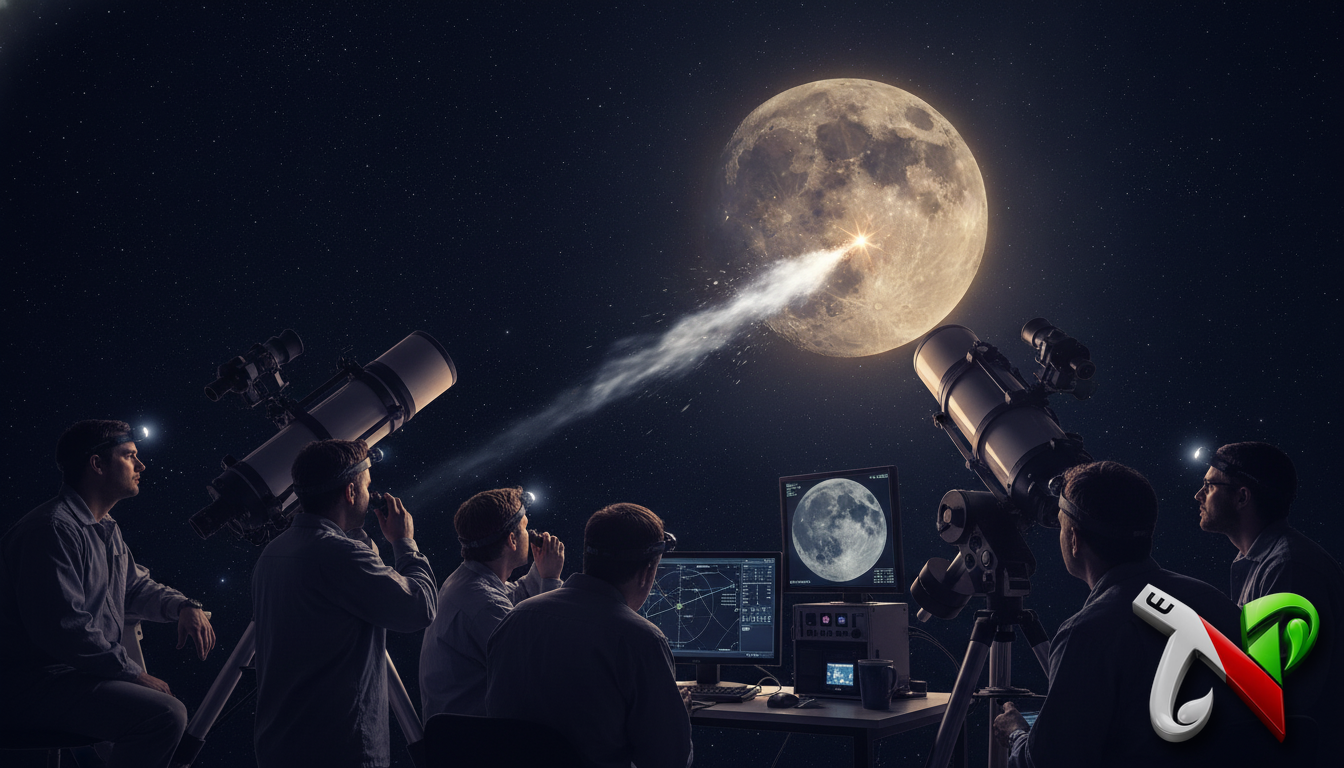 ‘Spectral lines’ and a giant plume: what science saw when the SpaceX rocket hit the moon (theguardian.com) – Reports that the ESO Very Large Telescope captured spectral lines of sodium and lithium in the plume generated when a SpaceX rocket stage hit the moon at 8,690 km/h.
- A Four-Ton SpaceX Rocket Stage Hit the Moon, but No One Saw It (nytimes.com) – Notes that a four-ton SpaceX rocket stage struck the moon without direct visual confirmation from observers on Earth.
Further sources
 South Korean satellite captures before and after views of SpaceX rocket's moon crash (phys.org) – Announces that a South Korean satellite captured the first before-and-after imagery of the fresh crash site.
 Scientists are certain a wayward SpaceX rocket slammed into the moon as predicted (phys.org) – Confirms scientists' certainty that a wayward SpaceX rocket successfully slammed into the moon as previously predicted.
 SpaceX rocket stage believed to have slammed into the moon (phys.org) – Reports that a four-tonne piece of a SpaceX rocket unintentionally crashed into the moon, posing no danger to Earth.
 A discarded SpaceX rocket is on a high-speed collision course with the moon (phys.org) – Notes that a drifting SpaceX rocket launched over a year prior was on a high-speed collision course with the moon.
- Scientists are certain a wayward SpaceX rocket slammed into the moon as predicted (nbcnews.com) – Details the predicted impact near Einstein Crater and highlights growing concerns about space debris as lunar missions increase.
Welp, Nobody Saw SpaceX’s Falcon 9 Rocket Crash Into the Moon (wired.com) – Explains that while direct imagery of the impact flash was elusive, telescopes in Chile detected a post-crash stream of sodium and lithium.
- An old SpaceX rocket is about to crash into the Moon (economist.com) – Briefly notes the impending collision of an old SpaceX rocket with the moon.
- It looks like a SpaceX rocket did slam into the moon (as predicted) (cbc.ca) – Reiterates that telescope data confirmed the rocket's impact via a debris plume despite a lack of direct visual footage.
 The SpaceX Falcon Lunar Crash Is a Warning for Moon Bases (wired.com) – Analyzes the lunar crash as a crucial warning and testing opportunity regarding space junk risks for future moon bases.
- Defunct part of SpaceX Falcon 9 rocket will slam into the moon (npr.org) – Outlines predictions by orbital tracker Bill Gray regarding the rocket's speed, timing, and potential ejecta risks to astronauts.
- Discarded SpaceX rocket crashes into moon (latimes.com) – Notes that solar activity and gravity altered the second stage's trajectory after launching lunar landers in January 2025.
- What can scientists learn from a stray SpaceX rocket hitting the Moon? (bbc.co.uk) – Discusses how planetary geologists view the accidental collision as a rare controlled experiment to study crater formation.
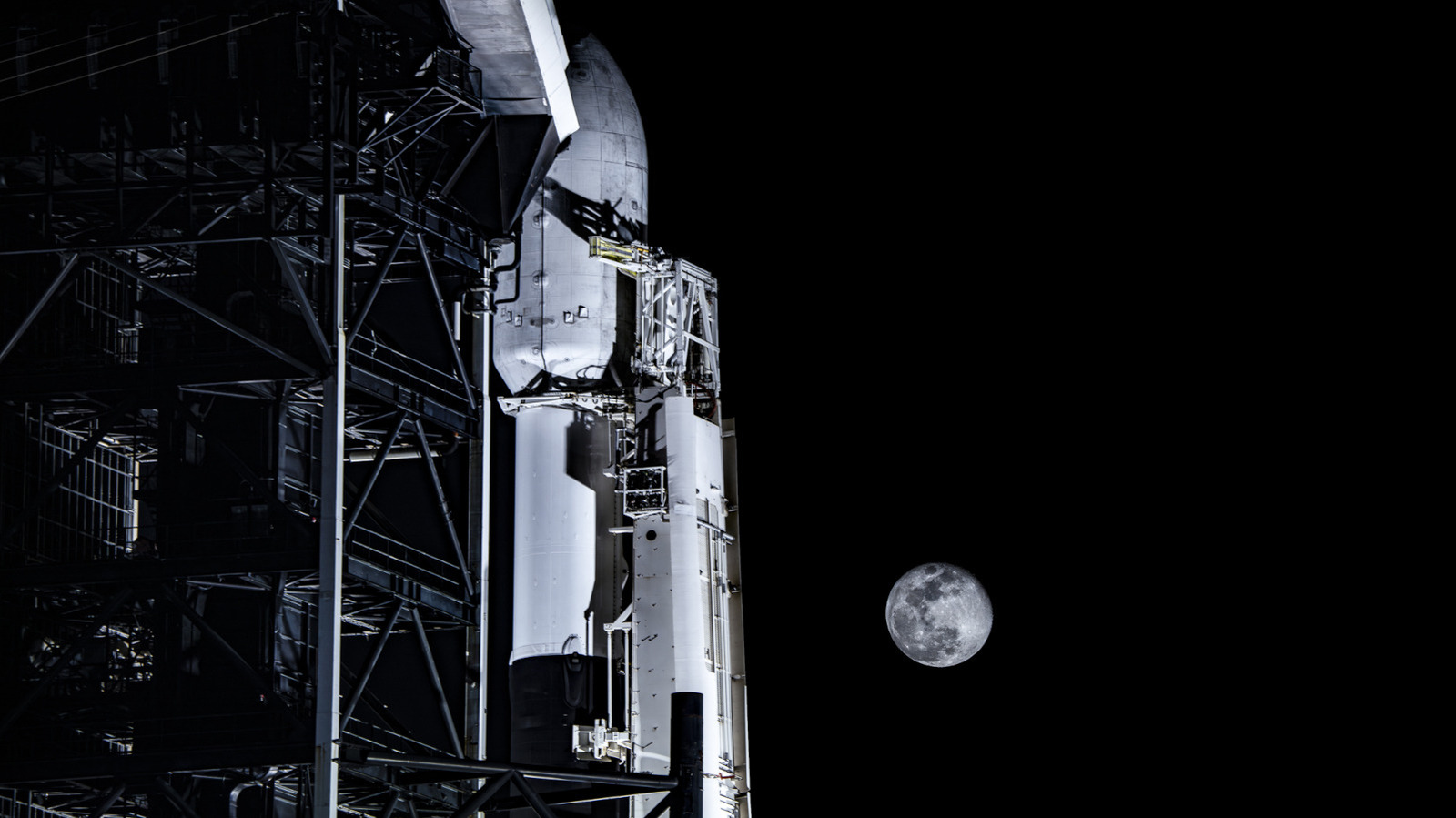 SpaceX's wandering Falcon 9 rocket has crashed into the moon (engadget.com) – Confirms that the wandering Falcon 9 upper stage from the Blue Ghost mission has crashed into the lunar surface.
 An Abandoned SpaceX Rocket Crashed Into the Moon. Here’s What Happened (cnet.com) – Recounts how the abandoned upper stage drifted for 18 months before plummeting to the moon due to gravitational nudges.
- SpaceX’s $15.8 Billion AI Quarter Tests Its Promise of a One-Year Payback (mlq.ai) – Provides a related financial and operational overview of SpaceX's public earnings, AI infrastructure spend, and Starlink revenue.
 SpaceX crash site on moon revealed by South Korean orbiter (newscientist.com) – Announces that South Korea's Danuri lunar orbiter shared images of the blackened crater created by the crash.
- One lucky orbiter caught the SpaceX rocket crash site on moon (mashable.com) – Details how the Danuri orbiter adjusted its orbit to complete eight photoshoots of the impact site and surrounding ejecta.
- A SpaceX rocket likely crashed on the moon (mashable.com) – Reports NASA's confirmation that solar activity and gravity diverted the upper stage safely away from Earth towards the moon.
 SpaceX rocket crashes into moon at 8700 kilometres per hour (newscientist.com) – Reports that astronomers trained telescopes on the predicted site to study the high-speed impact.
- A SpaceX rocket is about to hit the moon—these videos show what could happen (scientificamerican.com) – Examines university simulations predicting what the plume and aftermath of the lunar impact would look like.
 A SpaceX rocket will crash into the moon on Wednesday. It’s a symptom of something much worse (fastcompany.com) – Warns that treating space as a dumping ground carries serious long-term ramifications for humanity.
 SpaceX reports its first financials as a public company today: Here are 4 key details to watch out for (fastcompany.com) – Teases details to watch for in SpaceX's high-stakes public earnings report and financial guidance.
- NASA, SpaceX studying how to prevent future upper stage lunar collisions (spacenews.com) – Reports that SpaceX is working with NASA on future disposal methods for high-energy missions to prevent similar collisions.
- First photos of SpaceX lunar rocket crash show blackened hole torn into the moon's surface (livescience.com) – Describes the first published photos from Danuri showing a small, blackened crater torn into the moon's surface.
- A SpaceX rocket will hit the moon at 5,000 mph tonight. Experts explain what you could see, and when. (livescience.com) – Outlines viewing opportunities and simulation data suggesting the regolith plume might reach tens of miles high.
- SpaceX vs. Rocket Lab: Which Is the Better Space Stock to Own for the Next 5 Years? (finance.yahoo.com) – Compares SpaceX and Rocket Lab as public space stock investments over a five-year horizon.
 Powered by News Ranker