
#BrainUp Daily Tech News – (Wednesday, August 5ᵗʰ)
Welcome to today’s curated collection of interesting links and insights for 2026/08/05. Our automated ranking and AI-summarization system has processed 33 articles from all over the internet to bring you the latest technology news.
1. Trump administration reportedly drafting ban on Chinese datacenter components
The @WhiteHouse is reportedly drafting a ban on US imports of new Chinese datacenter components, such as optical transceivers made by companies like @ZhongjiInnolight, due to national security and supply chain concerns. Four sources familiar with the matter told Reuters that the @FCC is developing the measure to prevent potential data theft, malware installation, or service disruptions in critical American #AI infrastructure. While Chinese officials have urged the US to stop threatening sanctions and warned that Beijing will take necessary countermeasures, US lawmakers point to past vulnerabilities involving @Huawei to justify stricter oversight. This potential restriction highlights escalating geopolitical tensions as US authorities scramble to respond to rapid technological advancements in China’s #ArtificialIntelligence and hardware manufacturing sectors.
2. Open-weight AI models are catching up to the frontier. The safety gap remains.
Z.ai’s open-weight model #GLM5.2 has nearly closed the performance gap with Western frontier systems like @OpenAI’s #GPT5.5 and @Anthropic’s #ClaudeOpus4.7, but safety evaluations reveal a widening security gap. According to a report by the AI safety nonprofit @SaferAI, the model refused zero offensive cyber or dual-use biology tasks during evaluations, contrasting sharply with closed models that employ strict refusal training and API-level controls. Because open weights can be run locally without enforceable restrictions, researchers warn that malicious actors can easily strip away safety guards or fine-tune the technology for harmful purposes. To address these vulnerabilities without stifling innovation, experts suggest employing techniques like pre-training data filtering to remove hazardous information before models are publicly released.
3. AMD’s data center business is booming while gaming takes a backseat
@AMD reported a massive 107 percent year-over-year surge in data center revenue, reaching $6.7 billion in its latest earnings report and driving record overall revenue of $11.5 billion. CEO @LisaSu attributed the stellar performance to surging enterprise demand for #ArtificialIntelligence compute infrastructure, projecting that the data center segment will more than double again by 2027. In contrast, the company’s gaming revenue declined 31 percent to $779 million as industry-wide component costs and shortages weighed on hardware sales for platforms like the @Sony #PlayStation5, Microsoft Xbox, and @Valve #SteamDeck. CFO Jean Hu noted that the data center division now accounts for 58 percent of total company revenue, underscoring a strategic pivot toward enterprise #DataCenter hardware.
4. Texas hits pause on 1,800 data center projects to scrutinize power and water demands
Texas Governor @GregAbbott has ordered the @PublicUtilityCommissionOfTexas and @ERCOT to temporarily pause new grid connection approvals for data center projects while the agencies conduct mandatory audits. The directive targets a massive backlog of over 1,800 applications representing 474 gigawatts of potential demand, largely driven by the explosive growth of hyperscale #DataCenter developments across the state. Applicants must now submit detailed information regarding tax breaks, power and water consumption, cooling plans, community impact mitigation, and facility ownership before being granted access to the electric grid. While state leaders emphasize that protecting residential power reliability and community safety remains the top priority, critics and political opponents have dismissed the pause as insufficient to address the state’s broader infrastructure challenges.
5. These 3D-printed objects can tell you if they’re being used properly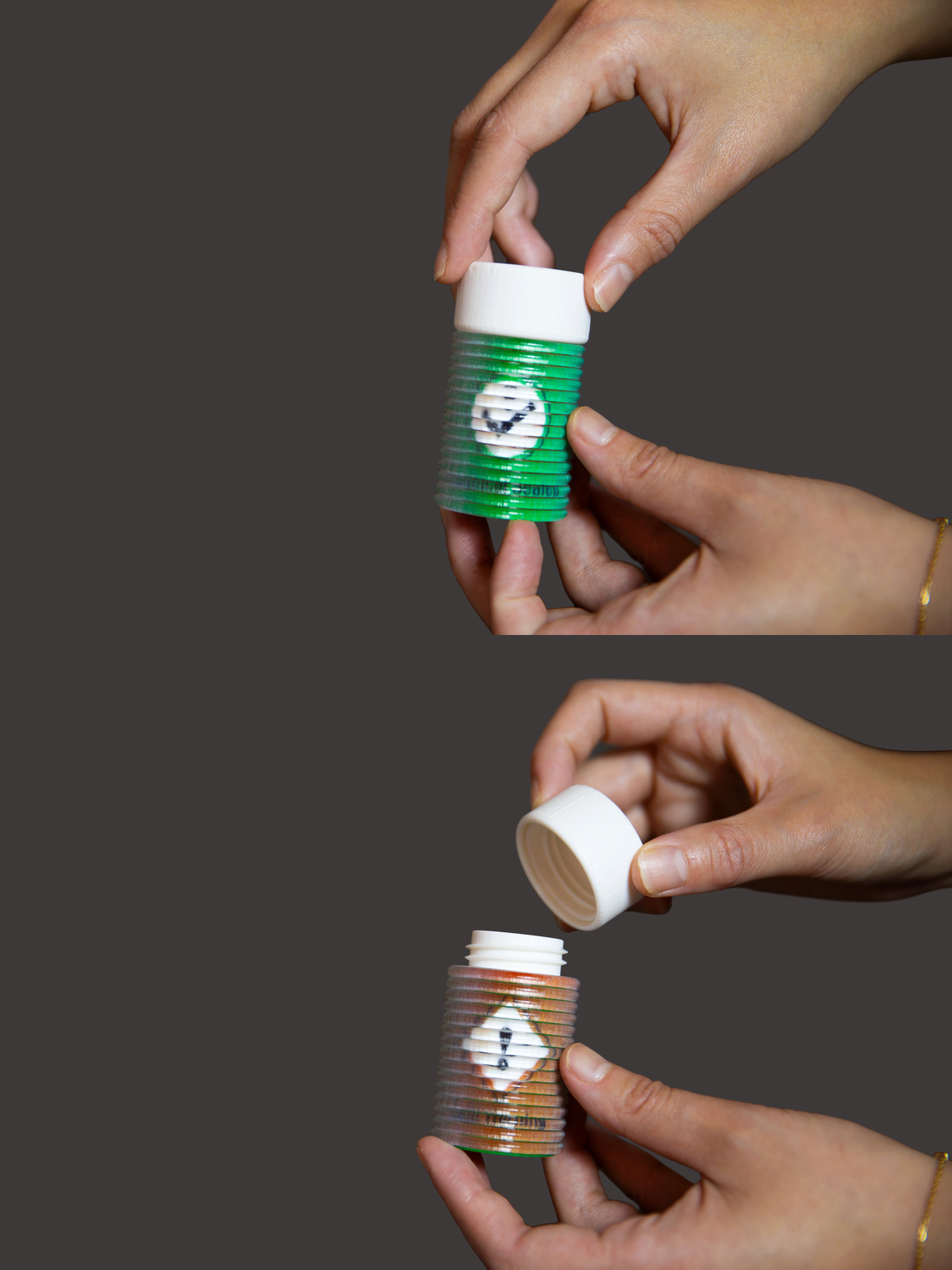
Researchers at @MIT have developed a novel 3D-printing system that allows users to fabricate everyday interactive objects which change their surface appearance dynamically without relying on fragile internal electronics. The system, called #ShiftLens, combines an array of tiny lenticular lenses with an underlying patterned backplane, enabling a single object to display different visual states when twisted, pressed, or turned. By leveraging mechanical surface optics rather than screens or circuits, the manufacturing process produces durable items such as chemical bottles that visually warn users if their lids are unsecured. This end-to-end fabrication approach streamlines rapid prototyping for engineering and architectural applications while eliminating the vulnerability of electronics to harsh environmental conditions like water and chemicals.
6. SpaceX wins $1.6 billion in launch orders for military satellite networks
The @USSpaceForce has awarded @SpaceX two launch task orders valued at $1.6 billion under the #NSSSLane1 procurement program to deploy 18 #Falcon9 rockets from Vandenberg Space Force Base through late 2027. These missions will support the #SpaceBasedSensingAndTargeting portfolio, which includes the @SpaceDevelopmentAgency’s infrared tracking layer, an optically linked communications network, and an airborne moving target indicator constellation. The contract represents the largest publicly disclosed order under the expanded $17 billion #Lane1 program, highlighting the military’s growing reliance on commercial launch providers. With a required cadence of roughly one launch per month, @SpaceX remains uniquely positioned among pre-qualified providers to execute a West Coast campaign of this scale.
Security researchers at @Bynario have disclosed a high-severity remote code execution vulnerability, tracked as #CVE202643760, that allowed root file creation on vulnerable #macOS devices via a legacy #VNC password option. @Apple addressed the flaw on July 27, 2026, with updates to #macOS26.6 and #macOS14.8.8, while advising users to disable screen sharing or remote management if unpatched. The researchers revealed that their vulnerability reporting was significantly delayed because @Apple’s security submission channels were overwhelmed by a massive influx of low-quality, automated bug reports. Despite this artificial intelligence-driven logjam, @Apple reached out directly to coordinate the fix for the high-severity logic flaw.
@Samsung has shattered its all-time domestic pre-order record with the launch of its new #GalaxyZFold8 and #GalaxyZFlip8 lineups, surpassing 1.44 million units sold during the reservation window in South Korea. The previous record was held by the #GalaxyNote10 series, which sold 1.38 million units during its 2019 pre-order phase, while the recent #GalaxyS26 series reached 1.35 million. Driven by a redesigned, more popular form factor that is significantly thinner and lighter, the new foldables outperformed their predecessors by roughly three times. Despite strong consumer demand leading to delayed shipping dates, the pre-order period concluded with exceptional sales velocity across the market.
@NVIDIA has released its #Alpamayo2Super open reasoning model for commercial use on @HuggingFace under the permissive #OpenMDW1.1 license, providing automotive developers with a standardized path to build and deploy autonomous vehicle software. Built on the #Cosmos3SuperReasoner architecture and refined via reinforcement learning, the foundation model excels at handling complex, long-tail driving scenarios and ranks first on several autonomous driving reasoning benchmarks like #LingoQA. The release supports a cloud-to-car workflow where developers can generate high-performance reasoning traces and synthetic training data in the cloud before distilling optimized models for real-time inference in production fleets. By utilizing open weights and commercial redistribution rights, automakers and robotaxi operators can retain full control over their proprietary infrastructure and specialized driving policies.
10. Hughesnet Files for Bankruptcy After Bleeding Customers to Starlink
Satellite internet provider #Hughesnet has filed for Chapter 11 bankruptcy protection after losing more than half of its subscriber base to @ElonMusk’s #Starlink service since 2020. According to court filings, #Hughesnet subscriptions plunged from 1.56 million down to 641,000 as consumers migrated to low Earth orbit satellite constellations capable of delivering vastly superior download speeds and lower latency. While parent company @EchoStar recently executed a massive spectrum sale to @SpaceX, #Hughesnet cited an inability to refinance $1.5 billion in maturing debt alongside intense broadband competition. Despite the financial restructuring, company representatives assured residential customers that service will continue without immediate disruption as the provider shifts its strategic focus toward enterprise and government markets.
11. Galaxy Z Fold 8 and Z Flip 8 preorder record: 2019 rematch
@Samsung announced that its latest foldable smartphone generation – comprising the #GalaxyZFold8, #GalaxyZFold8Ultra, and #GalaxyZFlip8 – surpassed 1.44 million pre-orders in South Korea, eclipsing the record set by the #GalaxyNote10 in 2019. Unofficial reports indicate that the standard #GalaxyZFold8 captured over 70 percent of those reservations, marking a notable shift from previous generations where lower-priced flip models dominated sales. This high demand is attributed to hardware refinements, including a lighter 201-gram chassis and the new #FlexTitanium structure designed to reduce screen crease visibility. However, analysts note that direct comparisons to historical flagship launches are complicated by the three-model lineup competing against older two-model release structures.
12. LinkedIn says it won’t be spending big on AI hardware this year — but it has a good reason why
@LinkedIn has announced that it will keep its GPU investments and compute footprint completely flat over the next fiscal year, bucking the aggressive AI infrastructure spending trend seen across the tech industry and its parent company, @Microsoft. Engineering leadership explained that the company doubled the utilization efficiency of its existing GPUs over a six-month period through accumulated workload allocations, model distillation, and optimizations rather than relying on a single hardware breakthrough. This approach allows the platform to ship new generative features without expanding its data centers in Oregon, Texas, and Virginia. Although industry peers continue pouring tens of billions of dollars into capital expenditures for cloud capacity, @LinkedIn’s in-house infrastructure management demonstrates that aggressive efficiency gains can temporarily decouple feature development from hardware expansion.
13. The White House Is Keeping Its AI Cybersecurity Framework Secret
The @WhiteHouse has finalized a secretive cybersecurity oversight framework for advanced #ArtificialIntelligence models, inviting major labs like @OpenAI, @Anthropic, and @Google to review the policies. Under the voluntary program, developers can submit new models up to 30 days prior to public release for classified vulnerability benchmarking regarding offensive hacking and national security risks. While the administration maintains that the rules are narrowly tailored to frontier models like #ChatGPT5.6 and #Fable, safety advocates and smaller startups have heavily criticized the lack of transparency. Critics warn that keeping the testing criteria confidential creates an unfair compliance advantage for dominant tech giants while shutting out independent researchers from holding developers accountable.
14. Apple is working on iPhone-to-Windows copy-paste
@Apple is developing a cross-device clipboard solution to allow European Union users to seamlessly copy content on an #iPhone and paste it onto a #Windows PC, or vice versa. The engineering effort comes in response to an interoperability request filed by @Microsoft under the EU’s #DigitalMarketsDMA, which mandates that digital gatekeepers open up proprietary features like #UniversalClipboard to third-party hardware. While @Microsoft previously argued that iOS restrictions hindered background synchronization with external devices, @Apple noted that the forthcoming feature will require explicit user permission and is expected to reach developer beta testing by fall 2027. This update follows a series of EU-driven adjustments by @Apple to ensure its ecosystem plays cooperatively with external smartwatches, earbuds, and connected accessories.
15. Texas, yes Texas, puts limits on data centers
Texas Governor @GregAbbott has issued an executive directive requiring the @PublicUtilityCommissionOfTexas and @ERCOT to audit 1,800 pending utility grid connection applications, roughly 90 percent of which are for power-hungry #DataCenter projects. The new regulations mandate that developers disclose public financial assistance, projected electricity and water consumption, and comprehensive community protection plans addressing noise, traffic, and emergency response. With Texas hosting over 500 facilities and trailing only Virginia in data center density, rapid industry growth has sparked local backlash over energy grid reliability following historical blackouts. Environmental advocates and residential coalitions have submitted thousands of complaints regarding utility strain, prompting state officials to demand strict compliance before permitting new infrastructure onto the grid.
16. OpenAI drags Apple’s lawsuit into the court of public opinion
@OpenAI has published internal iMessage and email exchanges to publicly challenge an ongoing trade secrets lawsuit filed by @Apple, which accuses former employees Chang Liu and Tang Tan of stealing confidential unreleased technology. In a public blog post, @OpenAI argued that @Apple’s legal claims are based on false information and administrative errors, pointing out that legal counsel initially contacted the wrong person due to a name confusion. The released communications suggest that residual cloud storage access – a common issue when employees depart – rather than malicious corporate espionage allowed former staff to locate requested files. @Apple has asked the court for a preliminary injunction to block the defendants from accessing or disclosing any proprietary materials while the litigation proceeds.
17. Telegram CEO says extortionist planted illegal content that triggered App Store removal
@Telegram CEO Pavel Durov has explained that the app’s brief global removal from the @Apple #AppStore was triggered by a takedown extortion scam rather than political censorship or use of private APIs. According to Durov, an extortionist exploited moderation workflows by stealthily editing an old message in an active group chat to insert AI-modified child sexual abuse material, subsequently reporting the hidden content directly to @Apple to force a hasty platform takedown. While @Apple restored the app after confirming the violating content was purged and the offending user banned, Durov warned that this tactic poses a systemic vulnerability for all mobile platforms hosting user-generated content. He emphasized that malicious actors are increasingly weaponizing automated reporting systems to target communities whose administrators refuse ransom demands.
18. TikTok settles three addiction lawsuits as new case blames social media for teen suicides
@TikTok has agreed to settle three lawsuits alleging that its platform was intentionally designed to induce digital addiction and severely harm the mental health of minors. The settlements involve young plaintiffs from Illinois, New Jersey, and Mississippi, though the specific financial terms remain confidential pending final written agreements. Meanwhile, the legal pressure on major tech platforms continues to escalate, highlighted by a separate lawsuit filed in Delaware by the @SocialMediaVictimsLawCenter against @Meta, @TikTok, @Snapchat, and @YouTube on behalf of families whose teenagers died by suicide. These legal actions form part of a broader national wave of thousands of coordinated lawsuits in state courts accusing social media companies of prioritizing corporate profits over child safety and adolescent well-being.
19. Amazon is blocking some users from seeing reviews after mistaking them for AI bots
@Amazon has been restricting some regular customers from viewing full product reviews after automated security systems mistakenly flagged their browsing behavior as data scraping or bot activity. Affected shoppers found themselves limited to seeing only eight reviews per product with sorting tools disabled, requiring them to submit manual appeals that take up to five business days to resolve. While a spokesperson acknowledged that safeguards against unauthorized scraping can occasionally target genuine users in isolated instances, the company declined to disclose its detection triggers or appeal metrics. This automated crackdown coincides with heightened tensions over external shopping tools, following a legal dispute where @Amazon secured a preliminary injunction against @Perplexity’s browser assistant for unauthorized data harvesting.
@Microsoft has officially implemented substantial price hikes for its #XboxSeriesX and #XboxSeriesS consoles across the UK and mainland Europe, with price increases exceeding 40 percent on select models. Following warnings issued in June, the 512GB #SeriesS jumped to £429 in the UK and €499 in Europe, while the disc-equipped 1TB #SeriesX rose to £669 and €799. Company executives attributed the steep adjustments to a component crisis that has driven memory and storage costs up by more than 2.5 times. Gaming industry analysts note that these price increases, paired with upcoming high-profile software releases like @RockstarGames’ #GTA6, threaten to strain consumer demand and necessitate radically different hardware pricing models for future generations.
21. Apple finally fixed Siri. So why does it feel anticlimactic?
@Apple has officially introduced the revamped #SiriAI assistant in the beta build of #iOS27, delivering on long-standing promises to integrate personal context, broad world knowledge, and on-device data retrieval. Leveraging Google’s #Gemini models to train its proprietary foundation architecture for #AppleSilicon, the assistant successfully handles natural multi-turn conversations, locates specific photos or receipts from vague prompts, and executes cross-app workflows. Despite the technical achievement and functional reliability, industry observers note that the release feels somewhat anticlimactic because rival #ArtificialIntelligence tools have already spent years pioneering agentic tasks and advanced multi-step reasoning. Nevertheless, the upgrade marks a major functional milestone for general users awaiting the official public rollout in September.
The newly formed Open Secure AI Alliance (#OSAA), spearheaded by @NVIDIA and the @LinuxFoundation, has established a working group called the Shared AI Findings Exchange (#SAFE) to develop collaborative cybersecurity guidelines. Operating out of the #BlackHat conference, the group has already put forth proposals regarding confidential incident reporting, blame-free analysis, and the cataloging of open-source security tools like @NVIDIA’s #Garak vulnerability scanner and @Amazon’s #Cedar authorization language. While the alliance boasts over 120 corporate members including @Adobe, @Cisco, and @Microsoft, notable industry labs like @Anthropic, @OpenAI, and @Google have yet to join despite previously signing an open letter supporting open-source #ArtificialIntelligence. This rapid mobilization highlights industry efforts to fortify open-source ecosystems against security threats and potential regulatory pressures.
23. SpaceX doubles revenue on Anthropic and Google compute deals, Starlink growth
@SpaceX posted its first quarterly earnings report as a public company, revealing a 92 percent year-over-year revenue jump to $7.8 billion for the second quarter of 2026. The growth was largely propelled by expansions in its #Starlink satellite internet service and newly minted cloud compute rental agreements with @Anthropic and @Google, which generated nearly $2 billion for its artificial intelligence division. Although the company reported a net loss of $541 million, executives expressed confidence in reaching a $100 billion annualized revenue run-rate by December, bolstered by $6.7 billion in contracted cloud services. Despite raising $85 billion in history’s largest initial public offering, @SpaceX shares have traded below their $135 IPO price, closing at $125 before declining further in after-hours trading.
24. SpaceX to begin Starship orbital flights
@SpaceX CEO @ElonMusk announced during the company’s inaugural quarterly earnings call that the next #Starship orbital flight will deploy upgraded version three #Starlink communication satellites. Pending regulatory approval, the upcoming Flight 14 mission will also attempt the first-ever tower catch of the upper stage rocket back at the launch site, following successful heat shield performance analysis from Flight 13. The company reported second-quarter revenue of $7.8 billion alongside a net loss of $541 million, with strong profitability in its connectivity segment offsetting losses in space launch and artificial intelligence divisions. @ElonMusk projected an aggressive scaling of future launch cadences, anticipating at least one flight per day within a year.
25. Google Earth’s potential disinformation nightmare
@Google has temporarily paused a newly released #GoogleEarth feature that allowed users to overlay #AI-generated images onto satellite views after researchers demonstrated how easily the tool could be exploited to produce convincing disinformation. Investigators quickly used the feature to generate realistic-looking imagery of geopolitical crises, including fake nuclear plants in Iran and bomb craters in Gaza, raising alarms among journalists who rely on genuine satellite data to verify global events. Because satellite imagery historically carries a high degree of public trust and perceived authenticity, security experts warned that enabling automated image alterations poses a severe verification hazard. In response to the immediate misuse, @Google rolled back the tool to implement stricter safety guardrails before considering its eventual re-release.
26. Smaller, faster, safer: running Kimi and GLM at scale
@Cloudflare has implemented advanced memory and performance optimizations to efficiently run large-scale open models like Moonshot’s #Kimi and Z.ai’s #GLM on its #WorkersAI infrastructure. Using the #SGLang framework, engineers combined KV cache quantization – reducing precision from BF16 to FP8 – with model weight compression to shrink checkpoints and double available context length without sacrificing output accuracy. Because long-context mixture-of-experts models are severely constrained by GPU memory bandwidth during the decode phase, these techniques allow the platform to increase concurrent request capacity and lower per-token costs. These optimizations demonstrate how infrastructure providers can scale demanding #ArtificialIntelligence models while maintaining high throughput and low latency across distributed deployments.
27. MiniMax H3 tops a video-editing arena, but its open weights exclude US users
MiniMax has released open weights for its 33-billion-parameter #H3 video model, which achieved top rankings in video editing on Artificial Analysis benchmarks. However, the release omits crucial components like the hosted prompt-processing module and 2K regeneration tools, and its community license explicitly prohibits local deployment or output usage in the US, EU, UK, and South Korea. While the base model utilizes a dense transformer paired with #Qwen3VL for multimodal generation, commercial entities exceeding $20 million in revenue require separate licensing agreements. US-based developers are restricted to accessing the system exclusively via MiniMax’s hosted API, where automated content screening policies apply.
28. Here’s A Breakdown Of The New Prices For Xbox Series X|S Consoles As Of August 2026
@Microsoft has officially enacted massive price increases for its #XboxSeriesX and #XboxSeriesS hardware across multiple international regions following component cost surges. The price adjustments, which took effect on August 1st, 2026, push the entry-level #XboxSeriesS significantly higher in markets like the UK, where the 512GB model rose from £299.99 to £429.99. Industry analysts note that #Microsoft is not alone in raising console prices, with @Sony having implemented similar hardware hikes earlier in the year and @Nintendo preparing adjustments for the upcoming #Switch2. These widespread increases highlight a broader consumer electronics crisis driven by skyrocketing memory and storage manufacturing costs.
29. SpaceX posts strong revenue in first earnings report since IPO
@SpaceX posted its first quarterly earnings report as a public company, revealing that revenue surged over 90 percent year-over-year to $7.8 billion. Although the company recorded a net loss exceeding half a billion dollars for the quarter, the financial shortfall was smaller than Wall Street analysts anticipated due to robust revenue growth.

@OpenAI has released redacted text message and email exchanges between its employee Chang Liu and a current @Apple worker to counter trade secret allegations in an ongoing lawsuit. Rather than revealing corporate espionage, the published correspondence portrays a mundane scenario of a former employee helping a struggling former colleague navigate technical documentation and team schematics. The disclosures highlight common corporate offboarding vulnerabilities regarding persistent cloud storage access and internal system permissions. While @Apple alleges that departing engineers retained proprietary files to benefit @OpenAI’s hardware development, the public document release frames the interactions as casual assistance among former coworkers.
@Microsoft has quietly removed its previous support documents recommending 32GB of RAM for optimal Windows 11 gaming and Copilot+ PC performance as dynamic random-access memory prices soar. The company recently launched new #Surface hardware configurations featuring base 8GB RAM setups that fall below its own artificial intelligence PC branding requirements. To accommodate budget-conscious consumers amid the ongoing memory component crisis, @Microsoft has pivoted to describing 8GB as sufficient for everyday tasks while simultaneously announcing upcoming memory optimizations to make #Windows11 run faster on resource-constrained PCs. This tactical retreat from high memory benchmarks reflects broader industry struggles with surging component costs and declining hardware shipments.
32. Anthropic signs $10B deal with AI cloud startup Volta
@Anthropic has entered into a $10 billion cloud computing agreement with AI cloud startup #Volta to expand its infrastructure capacity over a six-year period. Crypto-mining firm #Bitdeer will partner with #Volta to develop a 133-megawatt data center facility located in Norway powered by @NVIDIA’s advanced #VeraRubin chip architecture. #Volta participates in @NVIDIA’s Cloud Partner program, leveraging high-performance GPUs to service enterprise artificial intelligence labs. This deal underscores @Anthropic’s aggressive strategy to secure massive compute resources to support the training and deployment of its #Claude model family amid fierce industry competition.
33. How Google used AI agents to find and fix 1,072 Chrome security bugs – in 60 days
@Google’s Chrome security team has published a detailed report explaining how the company utilized specialized #AI agents, including the #BigSleep vulnerability discovery agent developed with @GoogleDeepMind and #ProjectZero, to find and fix 1,072 security bugs in just 60 days. By scaling automated fuzzing and agentic testing harnesses powered by #Gemini models across the massive #Chromium codebase, Google doubled its vulnerability detection rate milestone after milestone. While this automated approach successfully uncovered legacy flaws that human developers repeatedly missed, the unprecedented volume of bugs highlights the growing operational challenge of safely deploying rapid patches for billions of browser users worldwide.
That’s all for today’s digest for 2026/08/05! We picked and processed 33 articles. Stay tuned for tomorrow’s collection of insights and discoveries.
See you in the next one! 🚀
