
#BrainUp Daily Tech News – (Saturday, July 11ᵗʰ)
Welcome to today’s curated collection of interesting links and insights for 2026/07/11. Our Hand-picked, AI-optimized system has processed and summarized 21 articles from all over the internet to bring you the latest technology news.
As previously aired🔴LIVE on Clubhouse, Chatter Social, Instagram, Twitch, X, YouTube, and TikTok.
Also available as a #Podcast on Apple 📻, Spotify🛜, Anghami, and Amazon🎧 or anywhere else you listen to podcasts.
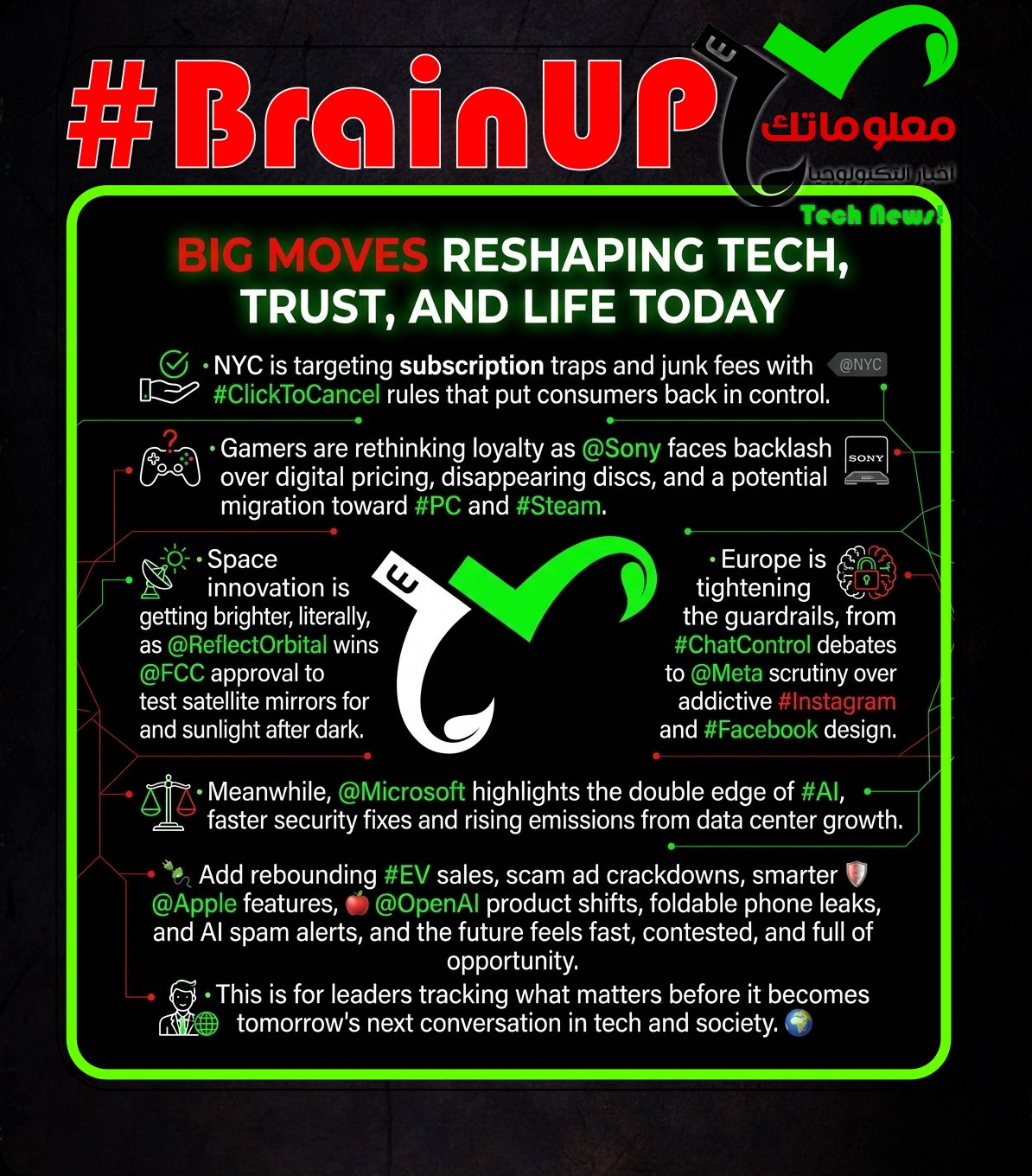
@Zohran Kwame Mamdani and the NYC Department of Consumer and Worker Protection announced new #consumer protection rules targeting #junk fees and #subscription traps to make pricing clearer and cancellations simpler. Following Executive Orders 9 and 10, the city proposed an #all-in pricing rule to ban hidden fees and finalized a #ClickToCancel rule requiring that subscriptions be as easy to cancel as they are to sign up for, framed as a first-in-the-nation municipal approach. The administration says these measures strengthen New York City’s affordability agenda and build on prior action banning hidden hotel fees, with the Click-to-Cancel rule estimated to save New Yorkers up to $162.5 million per year and the broader problem described as costing families about $3,200 annually. Officials argued that hidden charges and hard-to-cancel subscriptions drain both money and time, and that forcing businesses to compete on transparent prices will lower costs and level the playing field for honest companies. The rules are positioned as a major municipal step to curb corporate “ripoffs” and put consumers back in control of what they pay and for what services they continue.
A Push Square reader poll suggests a sizable portion of #PlayStation enthusiasts are considering switching to #PC gaming, with 45% saying they are “seriously considering” moving to storefronts like #Steam after what the article describes as a “sticky” PS5 generation. In the survey of 6,500+ readers, 23% said they would stick with PlayStation, 7% said they have thought about changing but do not expect to, 15% said they have already transitioned, and 10% said they play on both. Among respondents, 41% cited #Sony signalling it intends to stop manufacturing disc-based games as their reason for leaving, and commenters argued that if gaming is going all-digital anyway, they would prefer a best-in-class storefront like Steam while criticizing the #PlayStationStore, including its refund policies. On a separate question about a potential $1,000 #PS6 price, 29% said they would build or buy a gaming PC, 29% would stick with current consoles like PS5, 14% would buy at launch, and 15% would wait for a price drop, with the article framing the results as sobering for Sony but noting fan anger may cool and that Sony has not yet made its next-gen case.
3. Data shows physical PlayStation games can be up to 90% cheaper than their digital versions
Data from Dutch price tracker Tweakers indicates that physical PlayStation game copies are often far cheaper than their digital equivalents on the PlayStation Store, raising concerns that Sony ending new physical disc production in 2028 could push players into higher average prices. Comparing retailer price histories since 2022 with Dutch PlayStation Store pricing from psprices.com, Tweakers found new physical copies frequently more than 30 euros cheaper, sometimes by 50 euros, while Store discounts that approach retail pricing are too infrequent to match the sustained retail price drops. It reports physical editions of titles like Resident Evil, Kingdom Come: Deliverance II, and Final Fantasy VII Rebirth are usually at least 70% cheaper than digital, and the gap can exceed 90% for games such as Elden Ring, Horizon: Forbidden West, Black Myth: Wukong, and Death Stranding 2, with larger discrepancies for Sony in-house titles due to fewer price cuts. The article argues that post-2027 releases will often leave buyers with digital-only, often full-price purchases, and suggests Sony may accept losing disc-only customers to gain higher-margin digital revenue, though precise physical vs digital splits for comparable titles are unclear. It notes Sony’s FY2025 statement reported nearly 70 million physical discs shipped, and that while newer reports say over 80% of Sony game-sales revenue is digital, that figure includes many PlayStation Store titles not available at retail, with little data on second-hand sales.
4. FCC approves giant mirror satellite designed to beam sunlight to Earth after dark
The #FCC has approved California startup Reflect Orbital to operate the radio equipment for Eärendil-1, a demonstration satellite meant to test redirecting sunlight from orbit onto specific locations on Earth after dark. The regulator declined to block the project over its large reflective surface, saying the mirror itself is outside the FCC’s authority because it primarily regulates communications spectrum. Eärendil-1 is planned for a near-polar orbit about 625 km up and will deploy an 18 x 18 m aluminized Mylar reflector, which the company says can steer a moving sunlight beam about 5 km wide to validate deployment, control, and pointing. Reflect Orbital ultimately wants to sell “sunlight on demand” for solar farms, and has mentioned other uses, while astronomers and other critics warn a large constellation could create extremely bright objects, disrupt ground-based astronomy, increase sky glow, and raise concerns for wildlife, sleep, aviation, and #orbitalDebris. The approval does not authorize the full constellation, Reflect Orbital must meet disposal rules requiring deorbiting within 25 years, claims beams will be tightly controlled and mirrors can be angled away, and plans initial launches on @SpaceX Falcon 9 rockets.
The European Parliament has revived a 2021 measure, nicknamed #ChatControl1.0, that lets providers like @Google and @Meta voluntarily scan messages, emails, photos, and other files for #CSAM. The law had lapsed after an April vote failed by one vote, but a July vote restored it until 2028, even though 314 MPs voted against, 276 voted in favor, and 17 abstained, and blocking it required 361 votes. End-to-end encrypted services such as Signal and WhatsApp are exempt under the current version, but many supporters view it as a step toward a stricter #ChatControl2.0 that would require scanning even for end-to-end encrypted communications via client-side checks. Opponent @PatrickBreyer argues the approach amounts to warrantless mass surveillance by mostly US tech giants, can overwhelm authorities with low-quality data, risks needless criminalization of minors, and may generate false positives when AI-based scanning is used, while supporters say automated scan reports have already saved children. The debate remains active in EU institutions, amid member-state pushback such as Germany signaling opposition to the stricter proposal and the Danish EU Council presidency withdrawing support.
6. Microsoft emissions surge 27% as AI buildout crimps climate goals
Microsoft reported a sharp rise in greenhouse gas emissions as its #AI infrastructure expansion outpaced its decarbonisation efforts. Total emissions increased 27% to 21.1 million mtCO2e in the fiscal year ending June 30, 2025, up from 16.7 million the year before, and emissions intensity rose to 75.0 mtCO2e per million dollars of revenue from 68.1 even as revenue grew 15% to $281.7 billion. The increase was driven largely by a tenfold jump in Scope 2 market-based emissions from purchased electricity, from 259,090 mtCO2e to 2.7 million mtCO2e, which Microsoft partly attributed to its February 2025 decision to stop buying “spot” energy attribute certificates and carbon removal credits, a shift it said reflected a commitment to “high-integrity climate action” but would temporarily end its carbon-neutral position. Water consumption also climbed 22% to 8,170 megaliters, with half of withdrawals coming from high or extremely high water-stress areas. The disclosure follows similar emissions increases reported by Google and Amazon and aligns with @UN Secretary-General Antonio Guterres’s call for major AI companies to power all data centers with renewable energy by 2030 under an AI Environmental Transparency Initiative.
8. Meta found to breach EU laws with ‘addictive’ Instagram, Facebook designs
The @European Commission said @Meta breached the EU #DigitalServicesAct because “addictive” design features on Instagram and Facebook were not adequately assessed or mitigated for risks to users’ physical well-being, including minors and vulnerable adults. The Commission cited features such as infinite scroll, autoplay, push notifications, and highly personalized recommendation systems, and said Meta ignored information about late-night use by young people and how formats like reels and stories can drive excessive use. Regulators said Meta needs to change defaults, including disabling autoplay and infinite scroll by default and enforcing screen-time breaks, and Meta could face a fine of up to 6% of annual turnover if the findings are confirmed. Meta said it disagrees with the preliminary findings and pointed to steps such as Teen Accounts that allow parents to block access at night and cap daily screen time at 15 minutes. The report adds to broader scrutiny of Meta’s safety practices this year, including a prior EU finding in April about under-13 access and two U.S. court rulings in March related to addiction harms and alleged misrepresentations about children’s safety.
9. Disable autoplay and infinite scroll or risk massive fines, EU tells Meta
The @European Commission is escalating pressure on @Meta to change #Facebook and #Instagram after preliminarily finding that autoplay, infinite scroll, and highly personalized recommendations create addictive use patterns, particularly harming minors and vulnerable adults. The commission said Meta did not adequately assess risks to users’ physical and mental wellbeing, argued that existing mitigations like teen time-management tools and parental controls are insufficient, and suggested disabling autoplay and infinite scroll by default, adding effective screen-time breaks, and making recommender systems less engagement-oriented. Meta disputes the preliminary findings, citing new Teen Accounts with parent controls and limits such as blocking nighttime access and capping daily screen time at 15 minutes, but the EU countered that such measures depend on parents’ technical expertise and sustained effort. Under the #DigitalServicesAct, Meta could face fines of up to 6 percent of global annual turnover if it does not comply when a final decision is issued in coming months. The EU’s tech chief @HennaVirkkunen said the design appears too addictive, the EU will enforce its rules, and upcoming expert findings may also inform potential Europe-wide restrictions on teen social media use.
10. Meta removes feature that let users generate AI images from public Instagram posts – 9to5Mac
#Meta removed a newly launched #MetaAI image generation feature after backlash over how it used public #Instagram content by default. The tool let anyone create AI-generated images by @-mentioning public Instagram accounts as references, and Instagram users had to proactively opt out to prevent their posts from being tagged and used. According to a statement shared by @DylanByers, Meta said it intended to provide a creative tool while giving people control, but it pulled the feature based on user feedback. The change reverses a controversial default that made it easy to leverage public posts for AI image creation.
11. PlayStation ‘No Disc, No Buy’ Boycott Breaks Down For Black Ops
@Sony’s recent backlash over ending physical PlayStation game discs in 2028 appears to be weakening after the platform promoted surprise PS4 and PS5 ports of #CallOfDuty: Black Ops 1 and 2. The official PlayStation X post about the ports drew 34,000 likes and 9,000 comments, breaking a streak of heavily ratio’d posts tied to the #NoDiscNoBuy boycott, and prompting observers to argue that many fans are already “folding.” Critics note the ports are not remasters, add minimal features versus the PS3 versions, cost $40 each plus separate DLC purchases, and still require a #PSPlus subscription for online play, even though canceling PS Plus has been a key boycott tactic. While some players are sticking to the boycott by canceling subscriptions, buying physical copies elsewhere, or even trading in a PS5 and moving to Switch 2 and PC, the reaction to a major blockbuster suggests casual demand can overwhelm attempts at coordinated resistance. The episode highlights the limits of online calls for #boycotts when high profile releases and entrenched digital trends collide with consumer follow through.
12. Russia’s new rifle caliber bullets aim to enhance combat effectiveness
Russia is developing new rifle caliber bullets intended to improve battlefield performance by increasing penetration and range. These new rounds are designed to defeat advanced body armor and better suit the evolving needs of modern warfare. This advancement reflects Russia’s focus on modernizing its small arms to maintain competitiveness in military capabilities. Enhancing bullet technology aligns with broader trends in military innovation, emphasizing lethality and survivability for infantry soldiers. Overall, the development signifies Russia’s strategic emphasis on upgrading individual soldier firepower to match contemporary combat challenges.
13. U.S. EV Sales Rebound To Their Highest Level Since The Tax Credit Ended
U.S. #EV sales rebounded in Q2 2026 to their strongest level since the federal #EVTaxCredit ended last September, indicating the post-incentive slump may be easing. @Cox Automotive reported 247,226 EVs sold from April to June, up 14.2% quarter over quarter but down 20.5% year over year versus when the credit was still available. Cox said the market appears to be stabilizing as new model launches, state-level incentives, and continued consumer interest support demand, even as high gas prices are boosting hybrids. @Tesla remained the clear leader with 124,800 Q2 sales, and its Model Y and Model 3 were the top two EVs, while brands like Chevrolet, Hyundai, and Toyota posted sequential gains, with Toyota highlighted for strong growth tied to a refreshed lineup. Overall, the data suggests EV demand is adjusting to a new policy environment in which the U.S. has removed the tax credit and rolled back fuel-economy standards that previously pushed automakers toward higher EV volumes.
14. Electricity-Free Fridge Could Change Millions of Lives
A new type of electricity-free refrigerator has the potential to transform lives by providing affordable refrigeration in areas without reliable power. This innovation, developed using #biomimicry principles, uses evaporation and insulation to keep food fresh for extended periods, which could significantly reduce food spoilage and waste in developing regions. By mimicking natural cooling processes found in certain animals and plants, it offers an eco-friendly, low-cost alternative to conventional refrigerators. The technology can improve food security and health outcomes by enabling safer food storage, particularly in remote or off-grid communities. This invention highlights how combining nature-inspired design with practical solutions can address crucial global challenges.
15. LinkedIn and X Are Flooded With AI Spam, Browsing Data Suggests
Browsing data from Pangram suggests users are routinely encountering large amounts of #AI-generated writing on major social platforms, especially in longer posts. Using a Pangram Chrome extension that passively scans only the posts its opted-in users actually see, the company analyzed about a million posts scrolled across LinkedIn, Medium, X, Reddit, and Substack over two months and estimated that around 40 to 41 percent of longform LinkedIn posts were fully AI-written, about a quarter of X articles were fully AI-written, and another 23 percent were AI-assisted, with roughly one-third of longer posts on X and about one-in-ten longer posts on Reddit and Substack flagged as AI. The results indicate longform content is more likely to be AI-generated than shortform, aligning with the idea that #AI tends to be verbose and is more often used for extended writing than for brief replies. Pangram also reports that top-level posts on LinkedIn and Reddit are more likely to be AI-generated than their comment threads, and that people may be more willing to use AI under real-identity, professional contexts than on casual or anonymous platforms. The findings are presented as evidence that #AI_slop is not confined to low-traffic spam sites but is increasingly part of what humans read on mainstream social networks.
16. Big tech platforms will have to ban scam ads under UK plans to tackle fraud
Under proposals from UK regulator @Ofcom to implement the #OnlineSafetyAct, major online platforms would be legally required to ban #scam ads and stop repeat offenders from creating new accounts. The plans would cover large social media services including Facebook, Instagram, Snapchat, X and YouTube, with Google and #ChatGPT placed in a secondary category that still must follow the scam ad rules, and would also push measures such as reducing account hijacking, requiring legal clearance for banking or financial services ads, and improving routes for law enforcement to identify fraudulent ads. @Ofcom said scam ads cost UK victims about £200m a year and argued platforms have not done enough, warning that once requirements are binding, noncompliance could bring fines of up to 10% of global revenue. A consultation launched Friday runs until October, with final decisions expected next year, prompting Which? to welcome the direction but criticize the delay as #AI advances make scams more sophisticated, while the Bank of England and @MartinLewis were cited in the context of AI driven impersonation and scam advertising. The scam ad proposals sit within a wider OSA consultation for “category 1” firms that also includes draft protections for journalistic and democratically important content, such as limiting arbitrary restriction of news, allowing publishers to make representations before removals or downranking, and offering an expedited complaints process.
17. 9 new features Apple added to iPhones
The article outlines several additions coming with @Apple’s iOS 27 for iPhone, due to launch in the fall and available on any device that can run iOS 26, with some advanced #AI features limited to newer models. The biggest change is #Siri AI, a revamped Siri that becomes a standalone app with synced chats across iPhone, iPad, and Mac, improved web-informed responses, and better audio and image understanding, with the most advanced version restricted to iPhone Air, iPhone 17 Pro, and iPhone 17 Pro Max due to on-device AI requirements and help from @Google’s AI models. iOS 27 also adds more user control over #Liquid Glass transparency via an Appearance slider, upgrades child safety tools with a parent-focused Setup Assistant, “ask to browse” website permission prompts, and more flexible #Screen Time controls like Time Allowance by app category and day-by-day scheduling. Practical quality-of-life updates include the ability to set alarm volume separately from ringtones and alerts in Sounds & Haptics, plus a custom equalizer for supported #AirPods models that lets users tweak bass, midrange, and treble from the AirPods settings page. The article also notes new drawing tools in #Messages, indicating broader app-level improvements alongside system settings changes.
18. OpenAI is shutting down its Atlas web browser
@OpenAI is sunsetting its Atlas web browser as it rolls out new products, including #ChatGPT 5.6 and a desktop app called #ChatGPT Work. Product staff member @James Sun said Atlas is being shut down after the company learned from user behavior, and that those insights are being applied to newer offerings. Atlas was designed as an AI built in browser with #ChatGPT integration, letting users prompt ChatGPT to interact directly with the webpage they were viewing. ChatGPT Work is positioned as essentially Atlas plus, emphasizing #AI agents that can handle document and file tasks in the background, including both local and online work through a built in web browser. Because ChatGPT Work brings Atlas like functionality to users’ computers, OpenAI says a standalone Atlas browser is no longer necessary, with a target shutdown date of August 9.
19. OpenAI’s browser isn’t dead, it just moved to the ChatGPT app – Engadget
@OpenAI is deprecating its Atlas browser on August 9, but the move signals a strategy shift rather than an exit from the browser market. The company rolled Atlas-like capabilities into a redesigned #ChatGPT desktop app that combines ChatGPT, #Codex, and #ChatGPTWork, including web browsing via a built-in browser shortcut, and it also updated its #Chrome extension to act more like a direct competitor to @Google’s #Gemini in Chrome by letting users ask questions about the current page after granting context permissions. OpenAI further introduced a Sites feature that can generate small web apps such as dashboards, project trackers, and internal portals, indicating the browsing experience is being redistributed across products rather than abandoned. Citing commentary from @TechCrunch’s Rebecca Bellan and OpenAI’s James Sun, the article argues the company now treats the browser as a feature, not the destination, using lessons from Atlas users to improve these new tools. In that framing, Atlas is going away, but its core functions persist inside the broader #superApp direction centered on the ChatGPT app and extension.
20. Foldable iPhone Ultra Battery Capacity Allegedly Registered by Supplier
A rumor claims Apple’s battery supplier has registered two new cells likely intended for Apple’s first book-style foldable, potentially branded as the iPhone Ultra. Weibo leaker @DigitalChatStation says the cells are rated at 1,921mAh and 2,962mAh, totaling a minimum of 4,883mAh, and adds that supply chain expectations are roughly 4,800 to 5,000mAh pending confirmation. If true, the #dual-cell layout matches common foldable designs and would place the device near rivals like the Google Pixel 10 Pro Fold at 5,015mAh and above the Samsung Galaxy Z Fold 7 at 4,400mAh, while earlier talk of 5,400 to 5,800mAh may have reflected an engineering test setup or be incorrect. The report aligns with prior claims that Apple is prioritizing battery life through #power-efficiency and high-density cells, alongside rumored specs like a 7.8-inch inner display, 5.5-inch cover display, Touch ID, an A20 chip, and a C2 modem in some countries. The foldable is expected to debut with the iPhone 18 Pro lineup in September, with IDC projecting an average price around $2,500 and high-end configurations potentially reaching $3,000.
21. Microsoft expects more Windows security updates from AI-discovered flaws
@Microsoft says Windows users should expect a higher volume of security updates as AI accelerates vulnerability discovery across its codebase. The company says advances in AI help engineers find more issues faster, reducing the window for #zero-day exploitation, and it is using Microsoft Security’s multi-model agentic scanning harness, #MDASH, to scan critical Windows binaries and validate candidates with multiple AI models plus a Windows-specific pipeline to reduce false positives. AI is also being used to speed failure analysis, suggest potential fixes, and locate similar bugs elsewhere, while human engineers still review all code changes and validate fixes before release. Microsoft expects the expanded AI-driven discovery to translate into more fixes included in each monthly #PatchTuesday security release. Because attackers also use AI, @Microsoft is updating its #SecureDevelopmentLifecycle practices to address AI-enabled attack techniques and to apply AI earlier in development to catch issues before features ship.
22. The Galaxy Z Fold 8 just broke cover in a Samsung store — and the US price has leaked too
A leak suggests #Samsung’s upcoming #GalaxyZFold8 lineup may get pricier in the U.S., and one model may already be appearing in South Korean retail ahead of its official debut. Korean outlet SE Daily reports the Galaxy Z Fold 7 successor, reportedly named the Galaxy Z Fold 8 Ultra, will likely cost $2,099 for the 256GB base model, while the wider Galaxy Z Fold 8 is rumored to start at $1,899. The article notes this would make the Ultra model $100 more expensive than last year’s $2,000 starting price for the #GalaxyZFold7, with higher storage options expected to cost more. Separately, a Reddit user claims a Samsung store employee in South Korea confirmed a device on display was the wider Z Fold 8, and the photographed retail unit aligns with prior leaks despite lacking the name on the display. #Samsung has confirmed its next Unpacked event for July 22 in London, where the Z Fold 8 series is expected to be made official.
That’s all for today’s digest for 2026/07/11! We picked, and processed 21 Articles. Stay tuned for tomorrow’s collection of insights and discoveries.
Thanks, Patricia Zougheib and Dr Badawi, for curating the links
See you in the next one! 🚀
