
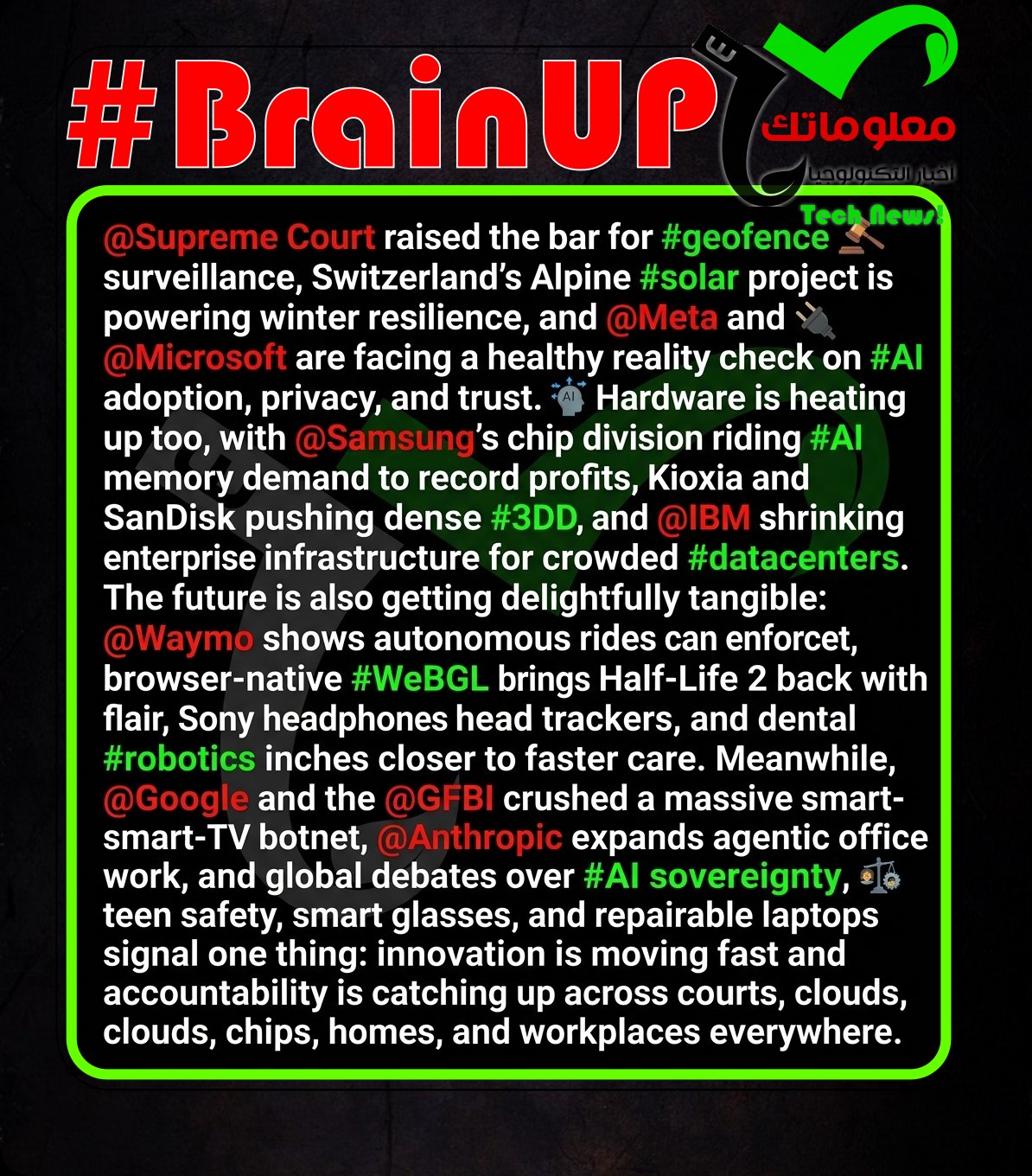
#BrainUp Daily Tech News – (Wednesday, July 8ᵗʰ)
Welcome to today’s curated collection of interesting links and insights for 2026/07/08. Our Hand-picked, AI-optimized system has processed and summarized 38 articles from all over the internet to bring you the latest technology news.
As previously aired🔴LIVE on Clubhouse, Chatter Social, Instagram, Twitch, X, YouTube, and TikTok.
Also available as a #Podcast on Apple 📻, Spotify🛜, Anghami, and Amazon🎧 or anywhere else you listen to podcasts.
1. The Supreme Court just ruled that police need a warrant to use phone location data
In @Chatrie v. United States, the @Supreme Court ruled 6-3 that using a #geofence warrant to obtain smartphone location data is a #FourthAmendment search, placing it under constitutional limits and judicial oversight. The case arose from a 2019 Virginia credit union robbery where police sought from #Google location data for devices within about 500 feet during a one-hour window, received anonymized data for 19 users, then obtained identifying details for three people including Okello Chatrie, whose location history was used against him. Building on @Carpenter v. United States (2018), the Court emphasized that modern phones generate highly precise, continuously collected, long-retained location records via GPS, Wi-Fi, Bluetooth, and cellular signals, enabling investigators to reconstruct movements before and after an event at low cost and large scale. The ruling does not ban geofence warrants, but allows them only with a warrant supported by probable cause, and it leaves to a lower court whether the specific warrant here was valid. The decision signals potential spillover to other large-scale surveillance tools, such as camera networks and real-time crime centers, that similarly enable mass reconstruction and analysis of people’s movements.
2. Switzerland 5000 Alpine Solar Muttsee Dam Winter Power
Switzerland has implemented a large-scale solar power installation at the Muttsee Dam, called the 5000 Alpine Solar, to enhance winter energy supply. This project addresses the challenge of reduced solar energy availability in alpine regions during winter by utilizing high-altitude solar panels that capture sunlight efficiently even under snow and cold conditions. The installation integrates advanced #photovoltaic technology tailored for alpine environments, ensuring power generation in the colder months when energy demand is high. The system contributes to Switzerland’s renewable energy goals by providing a reliable and sustainable energy source, reducing dependency on fossil fuels and enhancing grid stability. This development showcases how innovation in renewable technology can adapt to geographic and climatic challenges, supporting broader clean energy transitions.
3. Zuckerberg Admits That AI Is Not Working Out the Way He Imagined
@Mark Zuckerberg acknowledged that Meta’s push toward #AI, especially #AI agents, is falling short of his expectations as the company struggles with low morale and relies on competitors’ models to build in-house tools. In a town hall cited by Reuters, he said the “trajectory” of #agentic development has not accelerated over the past four months, and he admitted the timing of Meta’s reorganization was miscalculated and the layoffs were not “clean,” even as the plan has not yet “come to fruition.” The comments land amid chaos following layoffs that eliminated thousands of roles, despite Meta planning to spend about $145 billion on AI infrastructure this year, underscoring how difficult it has been to translate spending into rapid progress or worker replacement. Leaders also addressed a paused employee tracking program meant to collect work-computer activity data for AI after an internal leak, with @Andrew Bosworth saying it would be opt-in if revived. Zuckerberg still predicted meaningful payoff from the AI investments within three to six months, but the article frames that optimism against ongoing setbacks and skepticism.
#Microsoft 365 Copilot’s paid add-on has seen limited uptake despite being integrated across Windows 11 and core Office apps, and customers faced higher costs as more AI features were bundled in. An industry report says fewer than 4.5% of Microsoft 365’s roughly 450 million commercial customers pay for #Copilot, and only 20% to 30% of those users open it weekly, implying about 1% weekly active usage across the total base; an internal memo from Copilot chief @Jacob Andreou reportedly said Copilot must “earn the right to exist.” The article distinguishes between free #Copilot options, including copilot.microsoft.com and #Copilot Chat included with eligible business plans, versus the paid Microsoft 365 Copilot license that enables work-data reasoning via #Microsoft Graph and access to agents like Researcher and Analyst. Pricing is described as substantial, with enterprise customers paying $30 per user per month on top of their Microsoft 365 license, and smaller businesses paying around $21 after promotional pricing ended, while Microsoft also raised Business Standard from $12.50 to $14. These details support the article’s argument that paid adoption has not matched Microsoft’s pervasive branding and integration, even as competitors like #Gemini and #Claude pressure Microsoft to restructure its Copilot lineup.
5. New York to ban smart glasses from all courthouses
New York’s Unified Court System will ban #smart glasses and other camera-equipped eyewear or headwear from all courthouses to stop secret recordings of proceedings. A memo from the Office of Court Administration says that starting July 20, any eyewear or headwear containing cameras, microphones, or other recording technology, including prescription versions, will be prohibited in more than 1,240 state, county, city, town, and village courts. The rule applies to everyone entering court buildings, including court staff and attorneys, and people who arrive wearing such devices must leave them with uniformed court officers for safekeeping. The memo cites enforcement of state law and court regulations that prohibit unauthorized recording, aligning with similar bans in states like Wisconsin and Pennsylvania and broader rules limiting recording technology in courtrooms. The policy is intended to protect the integrity of court proceedings by preventing covert filming inside court facilities.
6. ‘Catastrophe’: Gaming world in utter chaos as Microsoft’s axes 4800 jobs, Sony makes huge call
The gaming industry is described as being in turmoil after major recent decisions by @Microsoft and @Sony triggered anger about the state of the sector. The article frames this as a “catastrophe,” highlighting that @Microsoft has cut 4800 jobs and that @Sony has made a major call in the same week. This combination is presented as evidence of instability and growing dissatisfaction within the gaming world. The overall message is that high profile corporate moves are intensifying concerns about the industry’s health and direction.
Samsung Electronics reported a sharp surge in profitability, and @Kim Yong-Kwan said the Device Solutions chip unit expects its 2026 operating profit to exceed the division’s cumulative operating profit across roughly 40 years in semiconductors. Preliminary results posted July 7 showed $58.5 billion in quarterly operating profit, a 19x increase, beating a brokerage consensus of about $55.1 billion and topping @Nvidia’s most recent quarterly operating profit of $53.54 billion, while DS contributed 53.7 trillion won of Samsung’s 57.2 trillion won first-quarter 2026 operating profit. The report ties the projection to #AI-driven demand that has pushed up contract prices for #DRAM and #NAND, helped by supply tightness, with memory makers seeing 40% to 50% operating margins on NAND in the first half of 2026 and Samsung signaling tight supply through at least 2027. The article notes the claim applies to Samsung’s chip business, not the wider conglomerate, and cites estimates that DS cumulative operating profit from 1985 to 2025 was under 300 trillion won, alongside a profit-sharing plan that allocates 10.5% of DS operating profit to chip workers as stock. Overall, the piece argues that rising memory and storage prices tied to AI server demand are driving outsized DS profits that could eclipse decades of prior chip earnings and briefly make Samsung the most profitable tech company for the period.
8. Waymo car delivers misbehaving teen passengers to San Mateo police
Two 15-year-olds were detained in San Mateo after a #Waymo driverless car they were riding in stopped and alerted police about their behavior. Police said the teens were allegedly drinking alcohol and shooting water beads from a toy gun during the ride, and the vehicle pulled into a parking lot where officers surrounded it and detained them. The incident highlights how #autonomous vehicles can involve human oversight, since Waymo cars have interior cameras and the company notes its support team may access live video in more urgent situations. San Mateo police called the teens’ plan “ingenious” but warned that underage drinking and brandishing even toy guns at strangers are bad ideas. The episode shows how monitoring and reporting features in #driverless ride services can quickly route misconduct to law enforcement.
9. Mark Zuckerberg’s biggest legal nightmare yet could cost Meta $1.4 trillion
@Meta says it could face up to $1.4 trillion in penalties after four states accuse it of designing #Facebook and #Instagram to addict young users and misleading the public about safety. The figure, disclosed in a court filing, reflects California, Colorado, Kentucky, and New Jersey’s proposed calculations under state consumer protection laws, reportedly multiplying alleged violations by per-violation fines tied to estimated numbers of affected children and teens. An August trial in Oakland before U.S. District Judge Yvonne Gonzalez Rogers will also address claims by 29 states that @Meta violated the federal #Children’s Online Privacy Protection Act by collecting children’s data without proper parental consent. @Meta denies the allegations as unsupported, argues “social media addiction” is not an established psychiatric diagnosis, and says a penalty of that scale would be unprecedented in consumer protection enforcement. The case is part of wider litigation pressure on social media firms, with additional state cases against @Meta set for a separate February trial and similar suits targeting @Snap, @YouTube, and @TikTok.
10. LG and Alienware monitors caught auto-installing Windows adware
Some users report that certain #LG and #Alienware monitors can trigger Windows to auto-install unwanted software that leads to #McAfee pop-up ads, despite the user never installing the antivirus suite. A Reddit user traced the issue to an “LG Monitor App Installer” installed via the #MicrosoftStore and #WindowsUpdate after connecting LG UltraGear monitors, with the package appearing in Reliability Monitor as “9PM9N6F47JB8-LGElectronics.LGMonitorApp” and confirmed by Event Viewer. Others in the discussion said they found the same behavior on their systems, and comparisons were made to #Asus motherboards that auto-install Armory Crate. The LG app reportedly cannot be uninstalled through the Microsoft Store, and mitigation includes disabling its startup entry, or more permanently changing a local #GroupPolicy setting to block automatic download of apps tied to device metadata, with a more drastic option to disable the Microsoft Store entirely. The incident is presented as another example of unwanted advertising and app installs becoming common across consumer tech, even from legitimate hardware.
11. The FBI and Google just took down a botnet that hijacked 2 million smart TVs
A joint action by the @FBI and @Google’s Threat Intelligence Group disrupted NetNut, a commercial residential proxy service also tracked as the Popa botnet, which covertly turned consumer devices into proxy exit nodes. @Google said the network co-opted over two million devices worldwide by using a malicious #SDK embedded in low-cost Android-based smart TVs, streaming boxes, and unofficial apps like SmartTube, letting attackers route traffic through residential IPs to evade detection. In one week in June 2026, Google observed at least 316 distinct threat clusters using the network for password spraying, credential stuffing, ad fraud, and sensitive data scraping, and researchers also described a reseller model that enabled other proxy brands to run on the same infrastructure. Reporting by journalist @Brian Krebs linked the operation to Alarum Technologies Ltd., which has described its platform as consensual bandwidth sharing, while independent reviews said users were not clearly informed or meaningfully consented, and Alarum stated it would cooperate with law enforcement after related domains were seized. Authorities seized hundreds of domains, Google disabled command-and-control accounts, pushed #PlayProtect detections, and shut down apps containing the compromised SDK, aiming to degrade proxy infrastructure at scale as part of a broader campaign following the January 2026 IPIDEA disruption.
12. Meta Now Lets Anyone Use Your Instagram Photos in AI Images—Unless You Opt Out
#Meta has launched its Muse Image model from Meta Superintelligence Labs and integrated it into #Instagram so that public accounts are automatically opted in to letting others generate AI images using their photos and likeness by tagging a username in a prompt. Meta frames the feature as a way to create personalized visuals such as invitations or collaborative concepts, but users who want to block this must manually change settings under Sharing and reuse, with separate toggles for Posts and Reels, or switch their accounts to private. Instagram’s help documentation says people may be able to create content with your Instagram content using Meta’s AI features by default, and users will not be notified when someone generates content using their media. Opting out stops future generations but does not delete AI images already created with your content. The rollout highlights an opt-out default for #AI reuse, and the article urges turning off the new toggle if you do not want additional AI remixes of your Instagram photos and videos.
Retail parking lots in Ohio are using #ALPR systems from Flock Safety to capture detailed vehicle data and, in many cases, share it with law enforcement, sometimes for immigration enforcement. The article describes how Flock’s #AI-powered cameras record license plate numbers plus vehicle make, model, color, and identifying markers like dents or bumper stickers, storing sightings in a centralized, searchable database that can identify cars even when plates are obscured. Investigations cited report that retailers including Home Depot and Lowe’s share data from hundreds of cameras, while police search logs often list vague reasons such as “investigation” or “other,” providing little transparency; the Atlas of Surveillance is cited as estimating about a 30-day search window for sightings. In Dayton, the city suspended 72 Flock cameras after outside agencies ran thousands of immigration-related searches that officials called egregious violations, highlighting how opt-in retailer sharing can create a blended private public surveillance network with unclear safeguards. Retailers publicly emphasize loss prevention, but the reporting says corporate statements often omit key details such as retention timelines, the scope of sharing, and limits on immigration enforcement use, raising civil liberties concerns noted by the ACLU of Ohio.
14. Discord Banned 8,000 Users for Posting Chessboards and Minecraft Screenshots
In May 2026, Discord mistakenly permanently banned about 8,200 users after its image safety pipeline wrongly flagged harmless grid-like pictures such as chessboards and #Minecraft inventory screenshots as child safety violations. Discord’s moderation relies on hash-based similarity matching against known harmful material, which is supposed to pause uploads and require review by the Trust & Safety team, but two stacked bugs bypassed the pause and review step and then kept bans in place even after staff cleared accounts. CTO @Stanislav Vishnevskiy confirmed both failures, and a developer (“advaith”) said the trigger was a single faulty hash that matched innocent grid patterns, not an autonomous #AI moderation system. Reported trigger images included game texture patterns, Google Drive or spreadsheet tables, standard UI grid layouts, and other grid screenshots, leading users to warn others not to share grid-like images until the issue was resolved. The incident is presented as a pipeline and hash-entry failure that broke Discord’s intended human-supervised safeguards.
An unofficial browser port of @Valve’s Half-Life 2, including both episodic DLCs, is now publicly playable with no download, built in about three months by Slqnt and 98006. It runs locally rather than via cloud streaming, using #WebGL 2 for GPU-accelerated rendering and #WebAssembly to translate #Source Engine C++ code for the browser, while a virtual file system streams compressed assets and stores save files in the browser cache or IndexedDB. The port includes Source console support for classic commands, cheats, and engine-variable tweaks, and while it lacks Steam achievements, the game’s built-in achievements remain accessible in menus. Testing on a desktop PC achieved over 100 FPS at max settings, while mobile results were inconsistent and users report lingering glitches such as incorrect head rendering and some cutscene animation failures. Despite the technical achievement, the project is unofficial and could face a DMCA takedown, though the article notes @Valve is often community-friendly and the port’s continued availability suggests it may persist.
16. People training new AI models admit they just get chatbots to do it
Whistleblowers told New Scientist that people paid to generate high-quality conversations and tests to train new #AI models are often cheating by using chatbots such as #ChatGPT to produce the required outputs, a practice experts warn could contribute to “collapse” in future models through #AI_inbreeding. As #LLMs have scaled and need more data beyond internet scraping, companies have relied on precarious, low-paid contractors via third parties, which workers say encourages shortcuts despite policies banning AI assistance. A worker identified as Alice says the practice is widespread and easy to evade if you instruct chatbots to avoid common AI hallmarks, and argues that better contracts are needed if firms want better data. Another worker, Bob, says he used AI while doing training tasks at Outlier and later, in a leadership role, was expected to detect others using AI via the Hubstaff screenshot monitoring tool by spotting open tabs or other on-screen clues. Outlier, owned by Scale AI, did not respond to comment requests, and companies Scale AI cites as clients, along with Google projects Bob says he worked on, also did not respond, leaving the account centered on worker testimony and the risk that synthetic training data undermines the very improvements these human feedback pipelines are meant to deliver.
17. Pentagon launches ‘War Force’ campaign in push for software engineers
The #DepartmentOfDefense and the #OfficeOfPersonnelManagement launched the “#WarForce” campaign to recruit hundreds of software engineers for voluntary, temporary assignments as the Pentagon rebuilds technical capacity after workforce losses. In a joint statement, DoD said it wants “exceptional software engineers” for critical national security missions, and DoD chief technology officer @EmilMichael framed it as a call for “patriotic forward-deployed engineers” to support the #AIAccelerationStrategy and other enterprise modernization projects. The Forward Deployed Engineer role is capped at no more than two years and starts at GS-14, with salaries beginning at $125,776, as DoD’s civilian workforce fell from 778,188 in December 2024 to 695,248 in January 2026, with additional reported losses in technical and IT roles. The effort aligns with @PeteHegseth’s March 2025 memo emphasizing automation to remove bureaucracy and shift resources, even if it reduces civilian full-time equivalents. War Force sits within the broader #USTechForce fellowship aimed at hiring over 1,000 people governmentwide and building a private-sector pipeline, with applications for these positions closing July 17 and interviews expected later in July and into August.
SpaceX’s #Starlink is imposing large “demand surcharges” on customers in “high demand” areas as the satellite internet network shows signs of congestion and strain. TechDirt’s Karl Bode reports surcharges ranging roughly from $750 to $1,500, and claims users who dispute the fees face poor or ineffective customer service. Multiple users on Reddit describe being charged $500 to $1,500 after verifying an address or traveling with service, with at least one case attributed to an automated system error related to latitude and longitude that mistakenly triggered the surcharge and was later refunded. The episode is framed as evidence of satellite broadband’s scaling limitations versus terrestrial options like fiber, occurring alongside claims that @Elon Musk’s close relationship with FCC chair Brendan Carr coincides with regulatory and contract wins for SpaceX, including the FCC seeking to accelerate approvals for next generation satellite broadband launches. The article ties these customer charges and service constraints to broader concerns about reliance on satellite internet and the policy environment enabling rapid Starlink expansion.
19. Meta’s glasses will turn off the camera if you tamper with the privacy light
@Meta is rolling out an update to its smart glasses that disables the camera if the device detects the #privacy LED has been tampered with or destroyed. The change targets modders who have used methods like drilling into the LED, after earlier deterrents such as prompts triggered by covering the light with tape proved easy to work around. Meta wearables VP @Alex Himel said the privacy-focused update had been in progress and comes as the company sees increasing misuse alongside wider adoption, including after launching cheaper Meta Glasses without Ray-Ban branding. The move lands amid heightened scrutiny tied to reported plans to add #facial recognition, reports of harassment by bad actors, and growing institutional responses such as venues considering bans and New York State banning camera glasses from courtrooms later this month, following similar restrictions in Philadelphia courts and on cruise lines.
The UK is letting eligible data center developments opt into the #Nationally Significant Infrastructure Projects (#NSIP) regime so they can bypass local council pre-application consultation and seek approval directly from the national government. Data centers were added to the NSIP list earlier this year, but they are not automatically covered, developers must apply and the Secretary of State must deem the project nationally significant under the #Planning Act 2008, and a law firm cited by The Register says clear qualification guidelines are not yet available. The Ministry of Housing, Communities, and Local Government says the change could cut planning and application time by up to one year and save developers up to $1.3 billion, and applicants can receive technical support and advice from the Planning Inspectorate before submitting. The article frames the move as a response to escalating #NIMBY opposition seen in the U.S., including widespread resistance, local bans, and more than 75 projects worth $130 billion delayed in Q1 2026. Concerns that vague criteria could let many #AI data centers qualify are expected to be addressed via a forthcoming #National Policy Statement from the Department for Science, Innovation, and Technology, while over 80 projects have already sought Planning Inspectorate pre-application services.
21. Framework proved repairable laptops can work, but almost nobody is willing to buy one
Framework has demonstrated that #repairable and #modular laptops can be premium and high performance, but mainstream buyers and the wider PC industry have largely not adopted the idea. Since launching the Framework Laptop 13 in 2021 and expanding to multiple sizes and newer configurations, the company has kept modularity, repairability, and sustainability central, offering systems with modern Intel and AMD chips, high RAM and storage ceilings, and even discrete graphics in some models. Its machines are designed for user assembly and straightforward upgrades, with replaceable and upgradable parts like memory, storage, motherboards, displays, batteries, speakers, and ports, and on the Laptop 16 even GPUs and input components. Even with hundreds of thousands of enthusiasts buying in and a clear proof-of-concept that counters the industry trend toward soldered parts, Framework remains a niche startup with only a thin sliver of global market share. The article attributes the slow uptake to typical laptop purchasing priorities favoring price, simplicity, and compact designs over long-term upgradeability, leaving Framework influential in the #right-to-repair conversation but not yet a major market force.
Developer @Nicholas Slattery has released “Sony Head Tracker,” an open-source app that turns certain Sony headphones and earbuds into a free, real-time head tracker for PC games by feeding their built-in sensor data into #OpenTrack. The app taps Sony’s Android Head Tracker protocol in headphone firmware, reads rotation vectors, gyroscope fields, and Euler angles, then repackages the raw packets into a UDP stream that OpenTrack can use across its 200+ supported games. Official compatibility includes Sony WH/WF-1000XM6, WH/WF-1000XM5, and ULT WEAR (WH-ULT900N), while older WH-1000XM4/XM3 lack required sensors and @Apple AirPods are excluded due to a proprietary protocol. In use, the in-game camera responds to head movements for added immersion in race and flight simulators, though it is not a VR replacement because the display remains stationary. Slattery reports flawless tests with Microsoft Flight Simulator, Elite Dangerous, and Assetto Corsa, positioning it as a free middle ground between full 6DoF setups and basic in-game camera options that can improve and expand over time due to being open-source.
A follow-up study by software testers who advised Australia’s rollout of a world-first under-16 social media ban found major platforms are failing at the initial step of #age-checks, undermining the law’s effectiveness. After the law took effect in December, the team opened 50 test accounts declaring an age of 16 across nine of the 10 covered platforms, including Meta’s Instagram, Snap’s Snapchat, TikTok, and Alphabet’s YouTube, and reported that none were asked for proof of age or to use #age-assurance measures, with all accounts remaining active. Researchers said the overlooked weakness is the first-stage screening that is meant to infer a user’s likely age range from general online activity and trigger additional checks, which did not appear to flag the test accounts, even as some received youth banking ads and one account on @Elon Musk’s X was served pornographic content. While platforms blocked sign-ups that explicitly declared an age under 16, only Australia-based Kick required age proof to create an account, according to the study. Meta said the shadow trial seemed inconsistent with regulator guidance to escalate to formal verification when behavioral indicators suggest underage use or when reported, arguing the dummy accounts were set above the minimum age and may not have behaved like true under-16 users, linking the findings to disputes over how “reasonable steps” should be implemented under the #teen-social-media-ban.
24. Discord admits AI moderation bug wrongfully banned users over harmless images | TechCrunch
Discord says a bug in its #AI moderation system wrongly banned more than 8,000 users over the past two months after harmless images, including spreadsheets, chessboards, game textures, and white or gray transparent backgrounds, were flagged as harmful. The company said the issue had been affecting accounts since May, with about 200 additional bans over a recent weekend before the team identified and fixed the problem, and affected accounts are now being restored. In a thread on X, Discord explained its automated safety system uses similarity matching against databases of known harmful material and can produce false positives, and although a human moderator is supposed to review flagged content, the bug triggered immediate bans. Users on X and Reddit reported permanent suspensions for images with square grid patterns, and some speculated the system may have become more sensitive to grids because such patterns have been used to disguise NSFW or child exploitation content from detectors. The incident underscores broader challenges with #AI-assisted moderation, echoing past complaints about unexplained suspensions on Instagram, Facebook Groups, and Tumblr, and renewed calls for transparency such as efforts by @Meta’s Oversight Board.
25. New Dental Robot Attaches to Patient’s Teeth for Drilling
Researchers at the University of Basel are developing the #MIR (Miniature Intraoral Robot), a small dental robot designed to drill teeth and potentially reduce the number of appointments needed to fit a crown. The approach would let a dentist scan a patient’s mouth and order a new crown during the first visit, instead of requiring multiple follow-ups and a temporary crown. The robot’s motor and controls remain outside the mouth and connect via cables and a drive shaft, while the device itself mounts to a custom dental splint that attaches to the patient’s teeth so it moves with the head. So far, it has only been tested on fake ceramic teeth in a simulated mouth, and the team plans to add sensors and a camera to track position even during a power outage. The project links robotics to routine dentistry by aiming to make crown preparation faster and more streamlined, and the article includes a video showing the robot in action.
26. Nobel-winning scientist Omar Yaghi joins China’s Tsinghua University from the US
@Omar Yaghi, winner of the 2025 #NobelPrize in chemistry, has joined China’s Tsinghua University to lead a new #AI-driven research centre focused on materials science. Tsinghua said the centre will explore how #artificialIntelligence can transform the design and synthesis of new materials and cut development cycles by orders of magnitude, and @Yaghi said he aims to develop materials addressing water shortages, #carbonNeutrality, and sustainable development while training young scientists in AI-driven chemistry. Previously a professor at the University of California, Berkeley, he shared the Nobel with @Richard Robson and @Susumu Kitagawa for work on #metalOrganicFrameworks, ultra-porous materials made by linking metal ions with carbon-based molecules. The article notes these and related materials have exceptionally high surface areas, enabling carbon capture and conversion, harvesting water from desert air, and hydrogen absorption for clean energy. A UC Berkeley postdoctoral researcher said @Yaghi has trained about 200 researchers, nearly half of them Chinese, aligning with his stated goal of talent development at Tsinghua.
27. EXCLUSIVE: Beijing is looking at curbing overseas access to China’s top AI models, sources say
Chinese authorities are considering restricting overseas access to China’s most advanced #AI models, including unreleased ones, as Beijing moves to keep cutting edge AI capabilities at home, sources said. People familiar with the discussions said the Ministry of Commerce held meetings over the past month with firms including Alibaba, ByteDance, and Z.ai, where officials discussed limits on both closed source and more open model versions, and floated making leaks or theft of proprietary AI punishable under China’s national security law. Officials also raised potential new measures that could restrict who is allowed to fund domestic AI startups, though the scope and timing remain uncertain and may apply only to future models. The talks come as Chinese models such as Alibaba’s Qwen, ByteDance’s Doubao, and Z.ai’s GLM-5.2 have gained global traction due to lower costs and improving performance, meaning restrictions could push up AI costs for businesses worldwide. The deliberations mirror #national_security driven controls in the U.S., where @Donald Trump’s administration has limited foreign nationals’ access to some top Anthropic models, reflecting a broader trend of treating frontier AI as a strategic asset requiring export style controls.
28. How AI could enable autonomous robot workers in workplaces—and maybe homes
Researchers and robotics founders argue that modern #AI is shifting robot #autonomy from simple navigation toward general-purpose robots that can carry out sequences of tasks with minimal human supervision in workplaces and potentially homes. @Matt Malchano of @Boston Dynamics contrasts earlier autonomy goals, like moving from point A to point B, with today’s ambition to handle a broad space of tasks, noting robotics milestones such as the 1979 Stanford Cart taking five hours to go 20 meters and the first self-balancing biped arriving in 1996. The article cites the #ISO definition of autonomy as performing intended tasks based on sensing and current state without human intervention, and points to #reinforcement learning in the 2010s and large #foundation models in the 2020s as key enablers. @Sergey Levine of @UC Berkeley and Physical Intelligence describes the frontier as reliable operation in unstructured environments, beyond the repeatable motions of factory robots in controlled settings. The piece frames today’s race among labs and companies, including but not limited to investor-backed humanoids, as an attempt to extend robotics beyond specialized industrial and service roles into more complex, unpredictable real-world work.
29. Lawmakers probe growing use of Chinese AI models in U.S. companies
U.S. lawmakers are weighing ways to curb U.S. companies’ growing adoption of China-built #AI models as competition with China intensifies. Chinese models are gaining traction because they are cheaper to use and have narrowed performance gaps with U.S. rivals, prompting a joint investigation launched in April by the House Committee on Homeland Security and the House Select Committee on China. The committees’ chairmen sent letters to Cursor and @Airbnb over potential exposure to risks tied to China-origin AI, while Rep. Andrew Garbarino warned that Chinese open-weight models matching leading U.S. systems in vulnerability discovery and #cybersecurity tasks is alarming. A State Department spokesperson said such models advance Beijing’s narratives, censor dissent, and reflect #CCP ideology, while China’s embassy rejected what it called baseless smears and defended its AI sector as self-reliant. Although some U.S. government departments have banned models like #DeepSeek, U.S. companies are not broadly prohibited from using them, and firms cite cost savings, with Airbnb saying most of its AI runs on U.S.-origin models and any limited use of China-origin open-source models is kept separate via approved U.S.-based providers.
30. Ukraine to pick AI models operated without provider control, official says
Ukraine plans to favor #AI systems it can run on its own servers to avoid dependence on remote tools that providers could restrict or switch off, according to Roman Kyslyi, Chief AI Officer at the Ministry of Digital Transformation. The push for #AI sovereignty was reinforced after the U.S. government ordered @Anthropic to cut access to powerful models, and it steers Ukraine toward self-hosted, on-premise deployments rather than provider-controlled systems such as @Anthropic and @OpenAI flagship models. Kyslyi said model nationality is not decisive, Ukraine will work with any vendor that allows on-premise deployment under Ukrainian control, treating the model as a commodity. Ukraine’s Diia app assistant currently uses @Google’s remote-only Gemini via EU servers with free tokens, but Ukraine strips personal data before sending queries and views Gemini as an interim solution. Ukraine is developing its own model with Kyivstar based on @Google’s open Gemma for release in autumn, and said Gemma and Mistral performed comparably to remote-only alternatives in many tests after comparisons that also included OpenAI’s GPT-OSS.
31. IBM Launches Compact z17 and LinuxONE Systems to Address Data Center Space and Cost Constraints
@IBM announced new #IBM z17 and #IBM LinuxONE 5 configurations that add rack-mount options alongside single-frame systems across the full Z and LinuxONE portfolio, aiming to help enterprises deal with tight data center space and cost pressures. The company cites CBRE data showing record-low data center vacancy and rental rates above $400 per kW per month, and positions the new systems as a way to optimize footprint while maintaining resilience for sensitive, mission-critical workloads. IBM says the new configurations scale up to 82 cores and 18 TB of memory across two processor drawers, about a 20% increase in core count and 12% more memory, and notes that the z17 ME2 can deliver 10% greater throughput per core than the z16 A02 depending on workload and configuration. The systems are designed to support flexible deployment and co-location of IBM and non-IBM equipment, with offerings including an IBM-racked, enclosed z17 single-frame package with intelligent power distribution and a z17 rack-mount option for installing components into industry-standard racks. Overall, the release frames these updates as expanding deployment choices while keeping the portfolio’s performance, security, and ecosystem standards to improve operational efficiency and make the platforms accessible to more organizations.
32. A Study Says Gray Hair May Be Reversible
A mouse study suggests gray hair could be reversible in principle if #melanocyte stem cells regain the ability to move within hair follicles, but there is no proven treatment that reverses ordinary age-related graying in humans. Researchers at NYU found that #melanocyte stem cells (McSCs) normally shuttle between follicle compartments, where signals such as #WNT proteins help them regenerate pigment-producing melanocytes, but some McSCs become stranded in the follicle bulge and stop receiving cues needed to make pigment. @Mayumi Ito and colleagues propose that losing this “chameleon-like” motility and reversible differentiation may drive graying, and keeping McSCs mobile, or nudging stalled cells out of the bulge, might restart pigment production. A 2026 review from the same team adds that human hair graying involves broader factors like DNA-repair decline, oxidative stress, senescence-related processes, altered signaling, and changes in the follicle niche, and it cautions that mice and humans differ in key biological features. Human single-cell studies show some overlap, such as loss of melanocytes and matrix progenitors in gray hairs, but this does not yet prove the mouse mechanism can be reversed in aging human scalps.
33. South Korea’s SK Hynix plans $28 billion US listing to capitalize on AI chip demand
South Korea’s SK Hynix is preparing a $28 billion initial public offering (IPO) in the United States to expand its presence in the global artificial intelligence (#AI) chip market. The company aims to leverage the growing demand for high-performance memory and semiconductor components driven by AI applications. By listing in the US, SK Hynix intends to raise capital to invest in advanced technologies and production facilities that support AI workloads. This strategic move aligns with SK Hynix’s ambition to strengthen its competitive edge amid a global push towards AI innovation. The IPO is expected to enhance SK Hynix’s access to international investors and accelerate its growth in the dynamic semiconductor sector.
34. China launches new satellite group for commercial constellation
China launched a new group of satellites to expand the #Spacesail Constellation using a #LongMarch-8 carrier rocket from Hainan. The rocket lifted off at 2:34 p.m. from the Hainan commercial spacecraft launch site, carrying the 12th batch of satellites for the constellation. The satellites successfully entered their preset orbit, according to @Xinhua News Agency. The launch advances the buildup of the commercial satellite constellation by adding another batch of satellites into operational positioning. This event underscores continued progress in China’s commercial space launch activities centered in Hainan.
35. Stock News – GuruFocus.com
The provided text is a GuruFocus Stock News landing page description and a list of recent market headlines across sectors, not the contents of the specific article referenced by the URL. It describes the page as offering stock market news, trends, insights, and coverage of stocks, investment strategies, and financial forecasts, then shows navigation categories and a feed of items such as board updates, licensing agreements, public offerings, investor notices, earnings-related announcements, and multiple securities class action investigations. No information is included about #AI rules in China or any actions by @ByteDance or @Alibaba regarding companion features. As a result, only the page-level purpose and example headline list can be summarized from the provided text, and the URL-specific article details are not present.
37. Kioxia and Sandisk sample world’s densest 3D NAND, new 332-Layer beats Samsung’s 400-Layer NAND
Kioxia and Sandisk have begun sampling their 10th Generation BiCS (BiCS10) #3D_NAND, a 332 active-layer #TLC design positioned for data center SSDs where density and performance matter more than cost. The company cites over 29 Gb/mm² areal density, up to 4,800 MT/s I/O to support #PCIe_5.0 and #PCIe_6.0 enterprise drives, and claims it surpasses @Samsung’s V10-class NAND in storage density despite Samsung having higher layer counts. Kioxia also reports enterprise-focused efficiency gains, including about a 4 microsecond (around 10%) reduction in read latency and a 25% cut in read energy from roughly 100 mJ/GB to about 75 mJ/GB. These improvements are attributed to a redesigned read scheme that avoids fully discharging unselected word lines to VSS between consecutive reads, instead lowering them to an intermediate voltage and restoring to VREAD, reducing the voltage swing and speeding repeated reads. Kioxia does not position BiCS10 for client devices, and instead plans BiCS9 for client applications, leaving consumer availability dependent on market supply and demand.
38. ‘Humanizer’ Tool Can Erase Signs of AI-Written Text, Alarming Scientists | Nature
Researchers are raising concerns over a new generation of AI “humanizer” tools designed to rewrite #AI-generated text so it evades detection by academic integrity systems and AI-content classifiers. Rather than improving writing quality, these services deliberately remove linguistic patterns that reveal machine authorship, fueling fears of widespread academic cheating, misinformation, and erosion of trust in digital content. Scientists warn the technology is accelerating an arms race between AI detectors and evasion tools, with both sides becoming increasingly sophisticated while reliable attribution grows harder. The trend underscores a broader shift where distinguishing human and machine-produced writing may soon become practically impossible, forcing educators, publishers, and employers to rethink how authenticity is verified in the age of generative #AI.
39. Claude Cowork expands to mobile and web | TechCrunch
@Anthropic is expanding Claude Cowork from a desktop app into web and mobile access for Max subscribers, positioning it as an agentic administrative coworker that can run tasks in the background across devices and request human input when needed. The company says users can start work on a desktop, receive status updates on a phone, and later pick up completed output even if a laptop is closed, with the desktop app remaining the hub for deeper work that uses local files and the browser. Anthropic is also unifying chat and Cowork on web and desktop, with shared projects and artifacts, and frames the move as part of broader #coding-agent competition expanding beyond developers into everyday office workflows, similar to how @OpenAI’s #Codex is increasingly used for reports, spreadsheets, presentations, research, and analysis. Early usage data from 1.2 million anonymized Cowork sessions across more than 600,000 organizations found the largest use case was “work around the work,” led by business process operating tasks at 33.4% and content creation and copywriting at 16.4%, while software development accounted for 8.7%. Taken together, the rollout and metrics underline Anthropic’s bet that value will come from owning the surfaces where work gets done, not just building the best chatbot, alongside related efforts like Claude Tag in #Slack.
That’s all for today’s digest for 2026/07/08! We picked, and processed 38 Articles. Stay tuned for tomorrow’s collection of insights and discoveries.
Thanks, Patricia Zougheib and Dr Badawi, for curating the links
See you in the next one! 🚀
