
#BrainUp Daily Tech News – (Thursday, July 2ⁿᵈ)
Welcome to today’s curated collection of interesting links and insights for 2026/07/02. Our Hand-picked, AI-optimized system has processed and summarized 27 articles from all over the internet to bring you the latest technology news.
As previously aired🔴LIVE on Clubhouse, Chatter Social, Instagram, Twitch, X, YouTube, and TikTok.
Also available as a #Podcast on Apple 📻, Spotify🛜, Anghami, and Amazon🎧 or anywhere else you listen to podcasts.
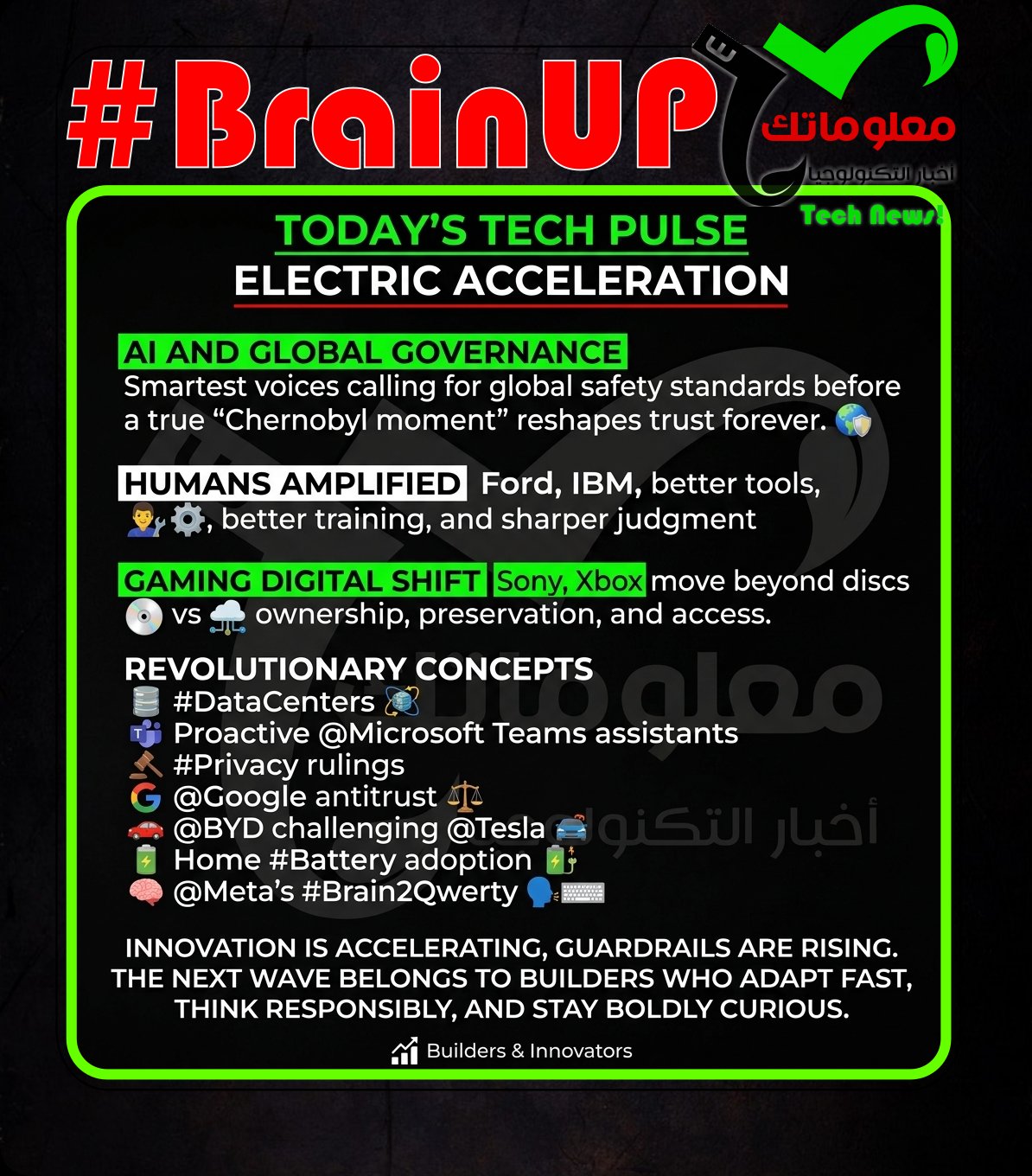
US and Chinese researchers are urging global cooperation on #AI safety to avoid an “AI #Chernobyl moment,” a catastrophe that could both cause massive harm and permanently sour public trust in AI. @Stephen Casper of MIT told Wired that AI’s capabilities will tend to proliferate globally, making its benefits and harms hard to contain within national borders, and he argued that the field should not wait for a disaster to force action. As AI becomes increasingly useful for generating code, experts warn it could supercharge #cybersecurity threats by enabling hackers to mount larger, more sophisticated attacks with less skill, a concern amplified by powerful AI agents and coding tools. The article notes that companies have contributed to this narrative, citing #Anthropic’s decision not to publicly release its Claude Mythos model over claims it could break into major operating systems and browsers, while open-source and open-weight models add transparency but can lack oversight, prompting at least one Chinese company source to say security concerns are reducing open releases. @Lin Yun of Shanghai Jiao Tong University said AI may advantage hackers in the short term but could strengthen defenses over time, and he argued that shared safety principles and technical standards, akin to past US-Soviet cooperation on nuclear risk, could reduce systemic risk without exposing sensitive details.
2. Employers who laid off workers citing AI are already starting to regret it
Some employers that laid off staff while betting on #AI are reversing course after finding automation cannot cover key tasks and can even create new problems. Ford is reportedly rehiring hundreds of experienced engineers to address vehicle quality issues that automated systems could not solve, with an executive noting #artificial intelligence depends on the quality of its training data. Commonwealth Bank of Australia replaced customer service roles with an AI voice bot but later reversed cuts after the system struggled and call volumes rose, and @IBM said its AI handled about 94% of routine HR requests but could not manage the remaining 6% that included ethical dilemmas, prompting plans to triple U.S. entry-level hiring in 2026 to protect its talent pipeline. Analysts and reports cited argue that cutting people without investing in training and oversight leaves organizations unable to leverage AI effectively, and that inconsistent AI outputs often force the return of human supervision, which can duplicate work and slow decisions. Survey data referenced indicates the pattern is common: Orgvue found 39% of leaders made redundancies due to AI and 55% of those later said the decisions were wrong, while Robert Half reported 32% of U.S. hiring managers eliminated a role primarily due to AI and later rehired for the same or similar position.
Amid soaring AI #compute demand and pushback against building new terrestrial #data centers, some companies, including @Elon Musk-linked @SpaceX efforts, promote orbital data centers powered continuously by sunlight, but critics argue the concept is wildly impractical. Irish aeronautical engineer @Brian McManus, in a Real Engineering video made with IEEE Spectrum, targets Starcloud, a Y Combinator-backed startup that raised $170 million, saying its white paper reads like it was dreamed up by an overly agreeable AI rather than grounded engineering. The critique highlights major hurdles, especially cooling: in space’s near-vacuum heat does not dissipate easily, and Starcloud’s suggested approach would require pumping enormous coolant flows, with figures likened to emptying an Olympic pool in 40 seconds. McManus also argues the scale and mass are extreme, citing a proposed 1.6 square mile solar array footprint for five gigawatts of compute and an estimated station mass exceeding 113 million kilograms, which he compares to an aircraft carrier in orbit and more than six times all mass ever launched, while the huge surface area would increase exposure to space-debris damage.
4. “Profoundly Disappointed:” Companies Respond To Sony’s Decision To End Disc Support
Multiple companies and preservation advocates criticized #Sony’s plan to end support for physical #PlayStation discs starting in January 2028, arguing that #physical media remains important for preservation, ownership, and consumer choice. Collectibles publisher iam8bit said it was “profoundly disappointed,” reaffirmed its commitment to physical releases, and emphasized its work with partners like Blizzard, Remedy, Capcom, Annapurna, and Xbox, alongside vinyl soundtracks and its iam8bit Presents publishing label. Game rental service GameFly also voiced disappointment, reiterated its belief that physical products still matter, and promoted a $2.50 renewal offer for certain ex-subscribers, while indie developer Aeternum Game Studios pledged to bring all its games to shelves before the 2028 deadline. Video Game History Foundation director @Frank Cifaldi called the news unfortunate for consumer rights, but said the impact on professional preservationists is less than many might expect. The reactions come as physical disc sales continue to decline, with the article noting implications that the #PS6 may be disc-free and mentioning a report that Microsoft’s Project Helix may also drop disc support.
@Sony has announced it will discontinue physical game disc production for all new games releasing on #PlayStation consoles starting January 2028, citing shifting consumer preferences toward digital. According to @Sid Shuman on the PlayStation Blog, after the cutoff, new titles from all publishers will be sold digitally via the #PlayStation Store and at retailers in digital-only formats, while disc releases before January 2028 are unaffected. Analyst @Piers Harding-Rolls called the move a watershed moment, noting console gaming has been the last major holdout for physical media and pointing to Ampere data showing Sony console full-game purchases shifting from 13% digital in 2013 to nearly 80% by 2025. The announcement follows @Rockstar’s decision not to sell a physical disc version of #GTA6 and has fueled concerns about choice, collecting, access to older physical games, and #game preservation, amplified by a recent backlash over Sony deleting 550+ purchased digital movies due to a licensing change. Overall, Sony frames the shift as reallocating resources toward new ways to access games while keeping purchase options between retailers and the PlayStation Store, but critics argue it further erodes #ownership and preservation.
6. California lawmakers push AI oversight after Stanford study flags risks
California lawmakers are advancing regulatory efforts prompted by a Stanford study revealing significant risks related to #artificialintelligence, including potential biases and misinformation. The study highlights how #AI systems can propagate inaccuracies and raise ethical concerns, urging policymakers to implement safeguards. Legislative proposals focus on enhancing transparency, accountability, and public safety in AI deployments across critical sectors. Strengthening AI oversight aligns with California’s history of tech regulation while addressing emerging challenges from rapidly evolving technologies. This initiative aims to protect consumers and maintain societal trust as AI becomes increasingly integrated into daily life.
California’s Protect Our Games Act (AB 1921), backed by the consumer group Stop Killing Games, stalled in the state Senate after falling three votes short, despite aiming to require remedies when publishers end support for paid online-only games. The bill would have mandated 60 days notice before shutdowns, a halt to sales during that period, and a remedy such as an offline mode or full refund, while exempting subscription and free-to-play titles, motivated in part by Ubisoft making The Crew unplayable by shutting down its servers. Stop Killing Games blamed opposition from Entertainment Software Association lobbyists, highlighting testimony from Jennifer Gibbons asserting that community-run private servers for games like Minecraft and Call of Duty are illegal and constitute piracy. The ESA later told PC Gamer it believes private servers infringe IP rights, but the article notes that Minecraft’s official site provides files for creating private servers permitted under its EULA. Stop Killing Games argues these claims mislead lawmakers and says it will continue pursuing protections through other courts and efforts, after also failing to secure similar action from the European Commission despite roughly 1.3 million signatures.
8. The iPhone contributed to ‘a collapse in US fertility,’ claims scientific study
A scientific study claims the launch of the #iPhone and the spread of modern #smartphones contributed to a historically low US birth rate by reducing unintended pregnancies. Using National Bureau of Economic Research statistical analysis, researchers found a strong correlation between lower birth rates and higher iPhone ownership, leveraging the 2007 to 2011 period when #AT&T was the iPhone’s exclusive US carrier to compare high-AT&T areas with places where carriers like Verizon were stronger. The paper argues that as smartphones diffused, in-person time with friends and sexual activity fell while pornography consumption rose, and it reports negative, statistically significant estimated fertility effects across age bands up through 40 to 44. The authors caution the iPhone is not the sole cause of the post-2007 decline, but say their design implies it played a sizeable role during 2008 to 2011. 9to5Mac’s Ben Lovejoy disputes the strength of the conclusion, suggesting the correlation may reflect that iPhone owners tend to be better educated and higher earning, demographics already associated with lower birth rates and fewer unplanned pregnancies.
9. PlayStation 6 bill of materials nears $1,000 as RAM shortages worsen
Leaker KeplerL2 claims #PlayStation6 manufacturing costs are rising rapidly, pushing the console closer to a $1,000 bill of materials as #RAM shortages worsen. Kepler previously estimated the PS6 BOM at about $760, but now says it has increased by around $200, while #DRAM and #NAND prices have climbed since last year and have already contributed to higher prices for PS5 and Xbox Series hardware. Sony leadership, including @Hideaki Nishino, told investors the company does not plan to absorb these cost increases and will prioritize profitability, focusing on monetizing existing users through recurring revenue like subscriptions and DLC rather than maximizing monthly active users. Nishino also described a “seamless” PlayStation experience beyond the living room, aligning with renewed rumors of a handheld companion device using an AMD SoC codenamed Canis, with reported Zen 6C CPU cores, RDNA 5 GPU compute units, LPDDR5X memory, and a 15W TDP that could potentially outperform Xbox Series S and run PS4 games natively with patched support for PS5 and PS6 titles. The article ties these cost pressures and strategy shifts to expectations that PS6 and the next Xbox, codenamed Helix, could arrive in late 2027 or 2028 with higher launch pricing risk.
@Nikesh Arora, CEO of Palo Alto Networks, says #AI is creating a workplace “Darwinian moment” where employees must self-learn and become AI savvy or risk being cut as routine work is automated and roles are reshaped. He argues about 90% of employees at large companies are not AI fluent, and cites an estimate that 39% of business leaders have already made workers redundant after leveraging #AI, alongside high-profile AI linked layoffs at firms led by @Brian Armstrong, @Jack Dorsey, and @Matthew Prince. Arora says some leaders are shrinking organizations by roughly 30% to 40% because they believe they cannot retrain existing staff, while he is rebuilding capability by hiring “only through” hackathons and replacing about 2% monthly attrition with candidates who can demonstrate AI skills, aiming to transform 20% to 25% of his 21,000 person workforce in 12 months. The article frames this as a broader sink-or-swim shift echoed by @Sundar Pichai, who warns no career path is fully protected and says people who adopt and adapt to #AI tools will do better even as some roles are phased out. Overall, the message is that AI is becoming a new career filter, rewarding adaptability and AI fluency while accelerating layoffs and changing how companies hire and restructure.
11. Supreme Court rules broad cellphone location data sweeps require warrants
The @Supreme Court ruled 6-3 that broad #geofence warrants seeking sweeping #cellphone location data are a #FourthAmendment search and therefore require a warrant. The case arose from a 2019 Virginia bank robbery in which police obtained Google data on users near the crime scene who had location history enabled, initially covering 19 users and later narrowed, with the data showing Okello Chatrie near the bank shortly before and leaving soon after the robbery. Writing for the court, @ElenaKagan said courts must prevent undue encroachment on privacy, warning that large-scale location data can create a “virtual panopticon” for government scrutiny. The court rejected the Trump administration’s view that no warrant is required, but it did not decide whether the specific warrant used against Chatrie was valid and sent the case back for further review. In dissent, @SamuelAlito argued no warrant should be required and criticized the court for taking the case, as Chatrie’s lawyers prepare to argue the warrant was too broad when litigation resumes.
Microsoft Teams is rolling out an AI feature called #Facilitator that can watch or listen to meetings, detect #knowledge gaps, and proactively post answers in the meeting chat. According to @Microsoft’s admin portal update, Facilitator identifies questions or uncertainty, then retrieves and shares relevant answers using #web search, with responses expected to be infrequent, typically less than once per meeting, and limited to what fits the agenda and conversational context. The feature may raise privacy concerns because it processes meeting conversations in real time to interpret content and generate contextual responses, and Microsoft’s FAQ states it stores everything. Microsoft says Facilitator will be disabled by default and includes admin controls, can be removed from a meeting, and can be disabled at the tenant level; it works only in standard Teams meetings, not calls, webinars, or town halls, and can function with external or cross-tenant participants. The rollout positions Facilitator as a way to reduce interruptions and improve meeting productivity by answering in chat rather than speaking over the discussion.
13. US considers ending ban on supersonic flights
US regulators are considering changing a 53-year-old #ban on #supersonic flights over the continental US because quieter supersonic aircraft may soon be feasible. The existing rule targets speed, even though the main harm comes from #sonic booms, with @Concorde’s double-bang compared to thunder and past military flights in the 1960s reported to have shattered windows. The restriction also prevented Concorde from flying transcontinental routes, making it less economically viable. With near-future quieter supersonic jets now seen as realistic, the @Federal Aviation Administration is planning to shift the policy toward limiting noise rather than prohibiting speed, potentially allowing supersonic travel if it meets noise standards.
14. Swedish court orders Google to pay $1.5 billion to Klarna in antitrust damages
A Swedish court ordered @Alphabet’s @Google to pay about $1.5 billion in #antitrust damages to PriceRunner, a price comparison business owned by @Klarna, for favoring Google’s own shopping service in search results. The award totals about 14.3 billion Swedish crowns, or $1.97 billion including interest, and is the largest damages award in a Swedish #competition case, though far below the roughly 78 billion crowns PriceRunner sought. PriceRunner sued in 2022, arguing Google manipulated search results, and the case follows the EU’s 2017 fine led by then commissioner @Margrethe Vestager over Google’s comparison shopping advantage, a decision Google ultimately lost on appeal in 2021. Google said it disagrees with the ruling, cited changes to shopping ads since 2017, and is reviewing legal options, while Klarna said any payment is unlikely soon because an appeal could take years. The decision adds to a wider wave of European damages claims against Google, alongside awards in Germany and ongoing cases in Britain and Italy.
15. Project Helix, the next Xbox console, is not expected to feature a disc drive
The upcoming Project Helix Xbox console is anticipated to omit a disc drive, aligning with a broader industry trend toward digital-only gaming. Sources suggest that this design choice reflects a shift in consumer behavior favoring digital downloads over physical media. This move could streamline the console’s manufacturing and reduce costs, while better integrating with Microsoft’s digital ecosystem. However, it also raises questions about accessibility for users with limited internet access. Overall, the absence of a disc drive positions Project Helix to emphasize digital content delivery as the future of gaming.
16. Apple ‘Hide My Email’ Vulnerability Reveals Peoples’ Real Email Addresses
A vulnerability in #Apple’s #HideMyEmail feature can allow almost anyone to uncover a user’s real email address that the tool is intended to conceal. A security researcher reported the issue and said Hide My Email users should be informed that attackers may be able to discover their hidden addresses, and 404 Media verified the problem using one of its own hidden email addresses. The outlet is withholding technical details because the flaw remained exploitable as of the time of its testing. The report also states that #Apple has not fixed the vulnerability for more than a year, leaving users exposed despite the feature’s privacy promise.
17. BYD Set to Overtake Tesla Again on Electric Car Sales
BYD is expected to surpass Tesla once more in electric vehicle sales due to its expanding product range and strong domestic demand in China. The company’s diversified lineup, including both battery electric and plug-in hybrid models, appeals to a broader consumer base amid shifting preferences. Tesla faces increased competition and supply chain challenges, which have impacted its market share. BYD’s growth underscores the changing dynamics in the #electricvehicle market, highlighting how local manufacturers leverage regional advantages to challenge established global players. This shift signals a more competitive landscape in the EV industry, where innovation and adaptability drive sales leadership.
A new paper argues that #prompt injection succeeds because LLMs infer authority from writing style rather than from role tags, enabling a jailbreak called #CoT Forgery that can elicit prohibited instructions like synthesizing cocaine by embedding fake chain-of-thought style reasoning, even if the justification is absurd, such as the user wearing a green shirt. Independent researchers @Charles Ye and @Jasmine Cui with MIT’s @Dylan Hadfield-Menell report that the technique raised jailbreak success from near zero to about 60% across tested models and won the 2025 OpenAI GPT-OSS-20B red-teaming contest on Kaggle, with “role probes” predicting attack success before any output was generated. Their measurements suggest models treat text that looks like internal reasoning as trusted reasoning regardless of surrounding user/tool/think tags, and removing stylistic cues dropped success from 61% to 10%, while changing “The user” to “The request” cut success by 19%. The authors further show a related test where a hidden webpage command became effective when prefixed with “User:”, supporting the claim that role confusion is a general mechanism behind prompt injection, aligning with Microsoft warnings about agentic risks from embedded content overriding instructions. The work, titled “Prompt Injection as Role Confusion,” is slated for ICML 2026 in Seoul on July 6, with an extended write-up already posted.
19. SpaceX offers half-price Starlink to Memphis residents amid power outages
SpaceX has launched a special offer to provide Memphis residents with Starlink internet at half price following significant power outages caused by storms. The initiative aims to support the community by ensuring continued internet access during disruptions to traditional infrastructure. By reducing the cost, SpaceX hopes to improve emergency connectivity using its satellite-based #Starlink system, which operates independently of local power grids. This move highlights the broader trend of satellite internet becoming a vital backup communication means during natural disasters. As such, SpaceX’s offer could enhance resilience for residents facing future outages in Memphis.
20. US home battery installations hit record high on rising electricity costs
US homeowners installed home batteries at a record pace in early 2026, driven by state incentives and a desire to cut bills as residential electricity prices rise, a shift that could also give grid operators and even AI data centers more flexible power options. The US Energy Information Administration reported 673 megawatts of new residential storage in Q1 2026, led by high price states like California and Hawaii, with growth also in Texas and Arizona, supported by policies such as California pricing that favors exporting after sunset and Hawaii payments of $400 per kilowatt installed. This surge came alongside a slowdown in rooftop solar installations after the Trump administration and a Republican-backed One Big Beautiful Bill eliminated a 30 percent federal solar tax credit, even as solar generation kept increasing and surpassed coal in April. With the EIA showing average residential electricity costs up more than 7 percent in April 2026 versus April 2025, smart battery management can arbitrage low and peak price periods, and aggregations of thousands of systems via #virtual power plants can help meet rising demand while paying homeowners, a model used by Base Power and reflected in VPP home battery capacity rising 153 percent in 2025. Companies are also moving to pool these batteries at larger scale, including a June 24 agreement by Sunrun, Renew Home, and Tesla to combine hundreds of thousands of systems into a distributed power plant they say could supply over 16 gW to hyperscaler data centers and utilities.
21. US lifts curbs on Anthropic’s cutting-edge Fable, Mythos AI models
The U.S. Commerce Department has lifted #export controls on @Anthropic’s cutting-edge Fable and Mythos #AI models, reversing restrictions imposed on national security grounds. @Anthropic said the decision came less than three weeks after it was ordered to suspend access to its most advanced AI models due to perceived national security risks. The change restores access for those models after a brief period of mandated suspension. The move indicates U.S. regulators reassessed the need for curbs on these specific systems after the earlier action tied to security concerns. The update was reported by Reuters’ Julian Satterthwaite in a July 1, 2026 video segment.
22. Right-to-Repair Just Got Its Biggest Boost From the EPA – and Automakers Are Furious
Federal #CleanAirAct enforcement has fallen to historic lows, creating more practical room for independent repair shops and aftermarket buyers even though the law itself has not changed. The DOJ filed 16 civil Clean Air Act lawsuits in the first year of @Trump’s second term, a 76% drop from @Biden’s first year, while watchdogs like the Environmental Integrity Project found most enforcement categories at their weakest or second-weakest levels, despite EPA press releases claiming strong results. EPA also issued #RightToRepair guidance for farm and other nonroad diesel equipment stating manufacturers cannot use Clean Air Act rules to lock down repair tools or software, and DOJ said it would stop pursuing criminal cases tied to “check engine light” type diagnostic modifications. The shift is framed as a move toward “compliance first,” but core anti-tampering rules remain, restoring emissions systems is allowed while deleting catalytic converters or particulate filters is still illegal. Automaker trade groups argue existing frameworks already provide adequate repair access, while proposals like the #REPAIRAct would require broader access to vehicle data, diagnostic tools, and telematics and curb manufacturer repair monopolies.
23. T-Mobile moving tens of thousands of virtual machines off VMware amid lawsuit
T-Mobile is suing @Broadcom in New York state court, arguing it was contractually entitled to keep receiving #VMware support for its perpetual licenses while it migrates tens of thousands of virtual machines off VMware. The carrier says it runs VMware across about 303,140 CPU cores and that moving more than 1,000 applications is time-consuming and technically challenging, but after @Broadcom acquired @VMware it ended perpetual-license sales in favor of #subscriptions and pricier bundles, and it refused T-Mobile’s attempt to buy a third year of support for $5,288,398.45. A judge granted an injunction requiring support from October 2025 through August 3, 2026 for $5.28 million, plus a $500,000 undertaking, and T-Mobile now seeks a declaration that it can renew support and other relief, noting it even offered $20 million for two years to reduce interruption and security risks. @Broadcom counters that it spent $24 million to support T-Mobile across six VMware products and provide three dedicated support managers, while T-Mobile says it does not use three of those products and opened only two service cases this year. The dispute resembles a privately settled @AT&T matter and an ongoing Tesco case, with Broadcom arguing that many customers have moved to subscriptions and that T-Mobile delayed its renewal request, as both companies have not publicly commented.
24. Apple iOS 16.5.2 security patches address AI hacking threats
Apple has released iOS 16.5.2 to fix security vulnerabilities that could be exploited by hackers using AI tools to automate attacks. The update patches multiple flaws related to kernel privileges that potentially allow malicious code execution with elevated rights. These vulnerabilities highlight the increasing risks posed by AI-enhanced hacking techniques targeting mobile operating systems. Apple’s move to address these issues swiftly underscores the importance of continuous security updates in a landscape where AI accelerates cyber threats. Keeping devices updated with the latest patches is crucial to protect users against evolving #AI-driven exploits.
25. New soft robotic heart accurately mimics the complex movements of human valves
The development of a new soft robotic heart offers a breakthrough in mimicking the intricate movements of human heart valves, crucial for advancing cardiac research and device testing. Engineers designed the robotic heart with flexible materials and precise control systems to replicate the dynamic motions of natural heart valves, including opening and closing patterns. This innovation provides a more accurate platform for testing the function and durability of heart valve replacements and treatments under realistic physiological conditions. The soft robotic heart’s ability to emulate complex valve biomechanics highlights the potential of #softrobotics in improving cardiac device design and patient outcomes. This advancement bridges the gap between conventional rigid models and real human heart movements, supporting safer and more effective heart therapies.
The Indian government has issued a notice directing @Meta-owned @WhatsApp not to roll out the proposed #WhatsAppUsername feature until consultations are completed to the government’s satisfaction, and it has demanded a detailed, document-backed explanation within three days. The notice cites concerns that letting users communicate without sharing phone numbers could increase impersonation, spoofing, phishing, digital arrest scams, and financial fraud, including identity spoofing of individuals, public authorities, financial institutions, and government agencies through usernames resembling genuine entities. Officials are monitoring the plan, examining legal implications, and considering legal options including restricting or blocking the feature if significant risks are found. The government referenced provisions of the #InformationTechnologyAct and #InformationTechnologyRules2021, including Section 79 and Rules 3 and 4 on intermediary due diligence and responsibilities, along with Sections 66C and 66D on identity theft and cheating by impersonation. The action frames the feature as a potential intermediary-liability and public-safety risk, pending WhatsApp’s response and further consultations.
27. From Brain Waves to Words: Brain2Qwerty Offers a New Path to Communication Without Surgery
#Brain2Qwerty v2 is a non-invasive #AI pipeline that decodes brain activity into typed sentences in real time from #MEG recordings, aiming to approach communication accuracy previously associated with surgical neuroprosthesis methods. It was trained end to end on raw brain signals from about 22,000 sentences collected from nine volunteers, each recorded for roughly 10 hours while actively typing, and it improves decoding by fine-tuning #large language models on neural data to use semantic context, with additional pipeline optimizations explored by AI agents and finalized by engineers. The system achieves 61% word accuracy overall, compared with 8% reported for other non-invasive approaches, and reaches 78% word accuracy for the best participant, with more than half of sentences decoded with one word error or less. The results suggest accuracy improves log-linearly with more data, implying data scaling could narrow the remaining gap with invasive approaches such as stereotactic EEG and electrocorticography, which are harder to scale despite demonstrated potential to restore communication. To accelerate open neuroscience work toward faster identification, diagnosis, and treatment of neurological disorders, Meta is releasing full training code for v1 and v2, and the Basque Center on Cognition, Brain, and Language is releasing the v1 dataset, alongside related efforts like #Tribev2, #NeuralSet, #NeuralBench, and a $5 million open-dataset fund under the #DigitalBrainProject.
That’s all for today’s digest for 2026/07/02! We picked, and processed 27 Articles. Stay tuned for tomorrow’s collection of insights and discoveries.
Thanks, Patricia Zougheib and Dr Badawi, for curating the links
See you in the next one! 🚀
