
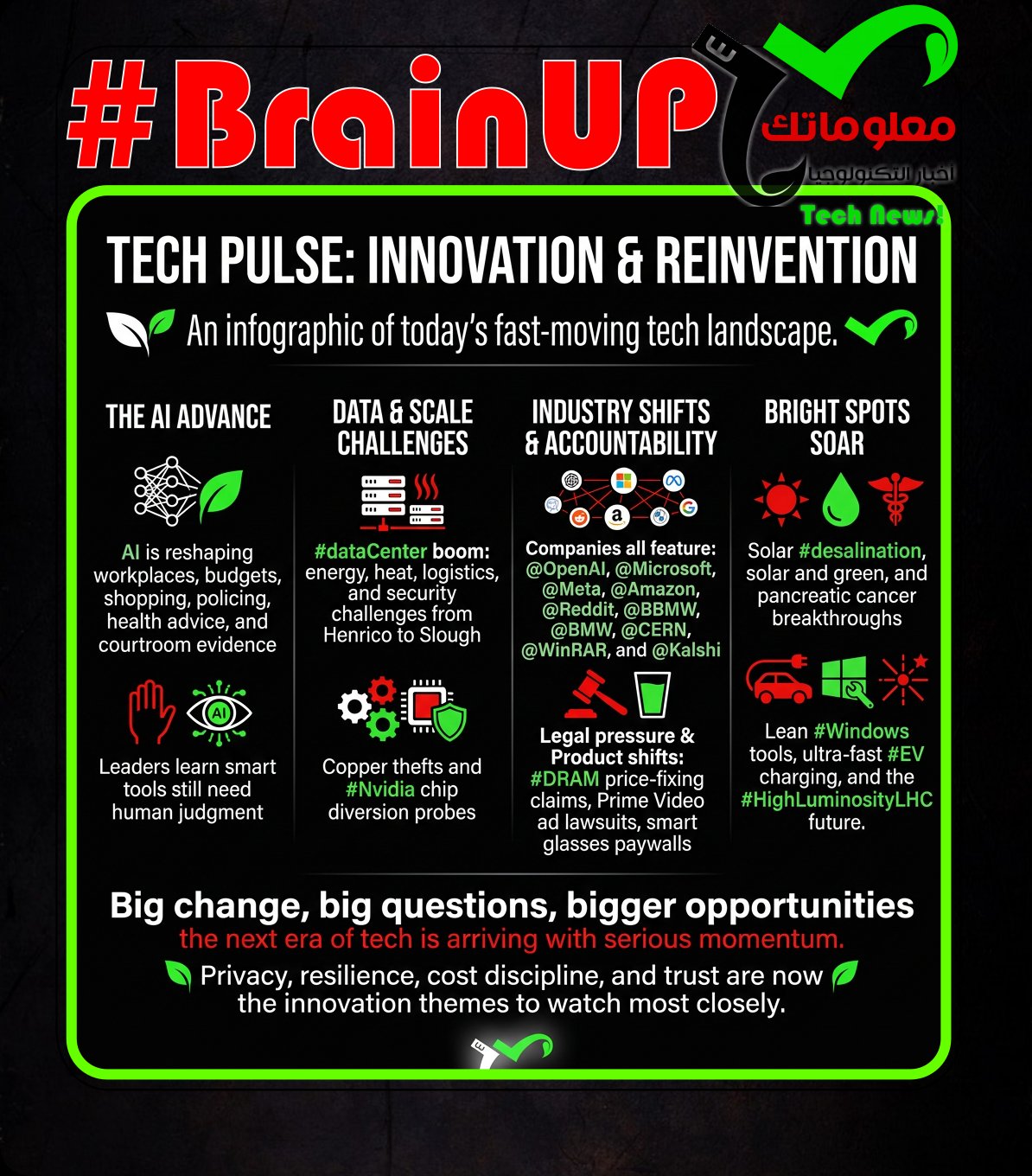
#BrainUp Daily Tech News – (Wednesday, July 1ˢᵗ)
Welcome to today’s curated collection of interesting links and insights for 2026/07/01. Our Hand-picked, AI-optimized system has processed and summarized 31 articles from all over the internet to bring you the latest technology news.
As previously aired🔴LIVE on Clubhouse, Chatter Social, Instagram, Twitch, X, YouTube, and TikTok.
Also available as a #Podcast on Apple 📻, Spotify🛜, Anghami, and Amazon🎧 or anywhere else you listen to podcasts.
A lawyer at a legal tech startup told Futurism her boss became obsessed with #AI, relying on @OpenAI’s #ChatGPT for nearly all communication and decision-making and pressuring staff to consult it before meetings or even before speaking with him. She said he began making major structural choices based solely on chatbot conversations, including asking the system who to hire and fire, while also buying shared paid accounts that let him monitor employees’ prompts and outputs, which in turn led employees to spy on his chats to anticipate promotions and layoffs. The boss’s AI-driven directives caused constant strategic whiplash and frequent changes to employees’ roles, with priorities shifting repeatedly based on what ChatGPT supposedly advised. He also created a continually changing, hundreds-page handbook called “The Bible,” intended to be fed into ChatGPT so workers could ask the bot what to do instead of consulting people. The lawyer said the escalating AI use, surveillance, and instability made her feel her boss was detached from reality and ultimately drove her to quit.
2. Cargo thieves target AI data center supplies in $1.3 million heists
Rising #dataCenter construction is putting millions of dollars of servers, cabling, and components on the road, and cargo thieves are increasingly targeting these high-value shipments. Business Insider reports that the Cook County Sheriff’s Office recovered a trailer with about $300,000 in copper wire spools in a truck yard near Chicago, and the yard owner said the same driver had dropped off another stolen trailer the prior week carrying roughly $1 million in data center equipment, with the thefts reported from Pine Hill, Alabama and Jacksonville, Florida. Investigators found the copper-wire trailer via a GPS tracker, and it reportedly had its tags swapped with Indiana plates, suggesting efforts to conceal its origin and indicating the broader, nationwide scale of theft rings shifting beyond retail goods. While servers and related gear are valuable, the article notes they are specialized, likely serialized, and typically require receipts and warranties, which can make them harder to fence than consumer electronics. The recoveries highlight how the #dataCenter boom is creating attractive logistics targets, even as companies often rely on insurance to limit direct financial impact.
3. County With 37 Data Centers Asks Schools to ‘Conserve Electricity’
Henrico County, Virginia, a fast-growing #data center hub, told county government and school employees to cut electricity use after being warned of sharply higher power costs. County Manager John Vithoulkas emailed thousands of workers saying that starting July 1 the electricity rate for all county government and school facilities would rise by 25%, adding an estimated $5 million in costs next fiscal year, with more increases expected. The email urged practical conservation steps such as closing blinds and turning off computers. The county of more than 350,000 people hosts 37 data centers with plans for 17 more, including proposals affecting Civil War battlefield land, and @Meta built a data center there in 2017. The request to conserve power links the county’s operational budgets and public services to escalating electricity prices amid rapid data center expansion.
4. WinRAR releases new update and says it’s thanks to people finally paying – Dexerto
WinRAR announced version 7.23 and leaned into its long-running meme reputation by joking that the update exists because people finally started paying for licenses. On June 30, the company posted on X thanking users for “recent payments,” prompting thousands of replies that continued the gag, including WinRAR replying with a @Dr. Evil “One Million Dollars” GIF and saying it would “hold a party” if someone buys it. The post also surfaced practical details: an automatic “Check for updates” feature is “in the pipeline,” support for 32 bit Windows ended with version 7.01, discounts are always available, and the software is only available on Windows. The attention highlights how WinRAR’s #40-day trial that keeps working with reminders has fueled decades of unpaid-use jokes, and the developer is now embracing that community humor. Alongside the social media buzz, WinRAR 7.23 is described as delivering bug fixes and improvements.
5. Bombshell lawsuit alleges that RAM manufacturers are colluding to drive up prices
A class action lawsuit, Garciaguirre et al. v. Samsung Electronics Co., Ltd., et al., alleges that Samsung, SK Hynix, and Micron are colluding to restrict supply and fix prices for DDR3 and DDR4 #DRAM, worsening the recent RAM shortage and driving major price increases. The complaint, filed by 14 individuals and three businesses, claims the three firms, which the article says account for more than 90% of global DRAM revenue, engaged in coordinated conduct that pushed conventional DRAM prices up about 700% over four years. It argues that despite rising demand, the companies cut DRAM production while focusing on High Bandwidth Memory used in data centers, behavior the suit says makes little economic sense without collusion and has raised electronics costs. The article notes the defendants previously faced legal scrutiny for alleged or proven RAM price manipulation, including a 1998 to 2002 criminal #price-fixing case prosecuted by the U.S. Department of Justice and a later investigation by China during a 2016 to 2018 price spike. Plaintiffs seek damages and permanent injunctive relief to stop coordinated supply restrictions and restore competitive conditions, as rising RAM costs are described as contributing to higher prices for consumer hardware like consoles and PCs.
6. Price hikes pushing consumers to abandon their favorite brands
Rising prices are weakening #brand loyalty, with many shoppers abandoning longtime favorites, especially in grocery aisles. Research from DOSS found 60% of Americans ditched a brand they were loyal to this year due to price hikes, 70% say they are less loyal than last year, and a 16% price jump is cited as the breaking point; groceries led the switching at 76%, followed by personal care (41%) and household goods (39%). About half of shoppers are trading down to generics, cheaper brands, or private labels, while discount chains like Aldi, dollar stores, and warehouse clubs gained shoppers as traditional supermarkets and mass retailers lost them. Beyond sticker shock, #AI is also pushing consumers to switch: @Accenture reports over a third of AI users would let a digital agent choose a different brand, and 37% say they would move away from historical brands if the tool provides reasoning based on factors like reviews, ratings, return rates, shopping history, and price. Together, higher costs and AI-driven recommendations are accelerating a shift away from habitual brand buying toward value and algorithm-guided choices.
7. Reddit will require you to log in to use old.reddit.com
Reddit says it will start requiring users to be logged in to access old.reddit.com over the next month, aiming to curb #abusiveScraping and automated traffic while keeping the legacy interface available for longtime users and moderators. A Reddit employee, boat-botany, said logged-out Old Reddit is a significant source of abusive activity that violates Reddit rules and its controversial #API policies, and that requiring login provides more signal to detect and block rule-breaking accounts. Another user, Nestramutat, argued this is a cat-and-mouse problem, but login adds friction and ties malicious requests to an account ID, with account creation happening on New Reddit using a more modern security stack. The change is likely to frustrate users who prefer Old Reddit’s layout and want to browse without logging in for convenience or privacy, and it also aligns with ad-driven incentives to associate traffic with identifiable users, similar to recent tests limiting logged-out access on the mobile web. Reddit also left open the possibility that old.reddit.com may not exist forever, with boat-botany citing its lack of a modern security stack and referencing @SteveHuffman’s statements that it will be supported as long as people keep using it.
8. New Florida Law Bans Local Net-Zero Emissions Policies – Inside Climate News
Florida enacted #HB1217 to bar local governments from adopting #net-zero emissions policies and related tools, aiming to curb municipal efforts to offset greenhouse gas pollution tied to worsening climate-fueled disasters like hurricanes. The law applies to at least 10 cities and counties with net-zero goals, including Fort Lauderdale, Miami, Orlando and Leon County, requires annual compliance affidavits to the state Department of Revenue, and takes effect July 1 after @Ron DeSantis signed it on April 22; it also restricts local participation in #carbon-trading programs and limits purchasing decisions based on fuels used or how items are produced. Bradley Marshall of Earthjustice said the measure appears designed to intimidate municipalities, but its precise reach is debatable and adjacent actions like emissions reduction policies may not necessarily violate a ban on adopting a net-zero policy. Supporters such as Rep. @Berny Jacques argue it protects jobs and affordability by rejecting #carbon taxes, fees and what they call #GreenNewDeal policies, while Laura Peterson of the Union of Concerned Scientists contends it is part of a broader push aligned with fossil fuel interests to block accountability as science increasingly links emissions to specific harms. The law fits within DeSantis’ recent energy and environmental approach, including a 2024 statute that removed references to “climate change” from state code, reoriented energy policy around fossil fuels and energy security, and nullified state renewable energy goals that had been prompted by a youth petition seeking 100 percent clean energy by 2050.
9. Former Microsoft engineer shrinks Notepad down to size
@Dave Plummer, a former @Microsoft engineer and creator of Task Manager, argues that piling features onto #Notepad reflects broader #Windows codebase bloat, and he rebuilt the editor as a tiny, back-to-basics alternative. On his YouTube channel Dave’s Garage, he presents TinyRetroPad, a fork of Matt Power’s Dave’s Tiny Editor, written in assembly and built around #WinAPI component RICHEDIT50W to reuse functionality already in Windows. The program aims to resemble Notepad from the Windows XP era while staying extremely small, with Plummer citing a 2,686-byte binary, though The Register’s build produced a slightly larger executable and it still uses more resources at runtime and occupies a 4,096-byte disk cluster. TinyRetroPad includes familiar features like Open and Save As dialogs, font selection, and even printing, which Plummer describes as a surprisingly complex Windows subsystem. The piece contrasts this approach with today’s Notepad.exe, described as more than 100 times larger, and frames TinyRetroPad as an antidote to accumulated “fluff,” emphasizing the appeal of lean code and avoiding telemetry and unnecessary additions like #Copilot-powered suggestions.
10. Meta loses bid to dismiss US states claims that Facebook, Instagram addict children
Meta Platforms failed to dismiss lawsuits from 47 U.S. states alleging that Facebook and Instagram’s design intentionally addicted children, violating consumer protection laws. The evidence included internal documents showing deliberate product designs aimed at increasing user engagement among minors despite known harms. This decision highlights ongoing scrutiny of #BigTech companies’ responsibilities in safeguarding children’s mental health and challenges in regulating social media platforms. The ruling allows states to proceed in examining Meta’s practices, potentially influencing future policy and corporate accountability in digital addiction. It underscores the broader debate about #socialmedia’s impact on youth and the need for stronger protections.
11. Amazon sued in Australia after Prime subscribers were made to pay more to remove ads
Australia’s competition regulator, the #ACCC, is suing Amazon Commercial Services Pty Ltd and also naming Amazon.com Services LLC, alleging breaches of Australian Consumer Law related to Prime Video ads. The #ACCC says Amazon relied on five terms in annual Prime contracts used from November 1, 2023 to August 18, 2025 that allowed materially adverse changes to Prime services or the contracts, without giving annual subscribers a contractual right to a pro rata refund or meaningful redress. Prime Video in Australia was largely ad free before July 2, 2024, but in May 2024 Amazon told subscribers they would need to pay an extra A$2.99 per month to keep watching without ads, even though many annual customers had already paid A$79 upfront, and the #ACCC says more than 850,000 annual subscribers were already paid up when ads arrived. The regulator is seeking declarations, penalties, consumer redress, costs, and other orders, while Amazon Australia says it is reviewing the case and has cooperated with the investigation. The article contrasts this with a US class action that was dismissed, emphasizing Australia’s case centers on whether contracts can permit making paid services worse after customers have prepaid for a year.
12. Meta is adding ridiculous ‘rate limits’ and a soft paywall to its smart glasses
Meta is imposing “rate limits” that effectively create a soft paywall on its AI smart glasses, including limiting the #Conversation Focus hearing enhancement feature unless users pay for a $19.99 #MetaOnePremium subscription. @Meta says glasses will not require a subscription overall, but claims Conversation Focus will be capped at three hours per month for free users and 15 hours per month even for premium subscribers. The article argues the limit is hard to justify because Conversation Focus appears to run fully on-device using the glasses’ chips and works without an internet connection, with the author testing it by disabling connectivity and still using the feature. It suggests the move may be driven by financial pressure as Meta invests in AI, citing recent layoffs and cost cutting like removing the Ray-Ban name to reduce the glasses’ price, and notes the company did not immediately respond to questions about whether other on-device features could be put behind subscriptions. Overall, the change is framed as Meta undermining the value of hardware customers already own by restricting core capabilities through #RateLimits and paid tiers.
13. Chinese tech makes desalinating seawater cheaper than producing bottled water
A Chinese outdoor prototype suggests #solar-powered #desalination can become cheaper than bottled water by using a new #photothermal material that operates with zero utility energy costs and shows year-long stability. Researchers wove nanoparticles into a three-dimensional photothermal evaporation structure to improve solar-to-evaporation efficiency, achieving up to 90.2% solar absorption and reducing the energy required to evaporate the same volume of seawater by 45.7%. In a small trial, the device desalinated seawater to irrigate about 5 square metres of farmland for a full growth cycle using only natural sunlight and no external power grid infrastructure. Based on a projected two years of operation, the team said the water production cost would drop below bottled water, with larger savings if scaled up or run longer. The results point to a pathway for lowering desalination’s traditionally high energy and cost barriers through #nanoparticle-enabled #photothermal-evaporation design.
14. Microsoft plans thousands of job cuts, impacting less than 2.5% of workforce
@Microsoft plans to announce thousands of job cuts soon as it continues #cost-control while increasing #AI spending. People familiar with the situation said the reductions are expected to hit sales and consulting roles and include jobs in the Xbox gaming division, totaling less than 2.5% of its roughly 220,000-person workforce, with an announcement targeted for next week, timing may change, and some employees may be offered new roles immediately. The move follows prior layoffs, including 6,000 roles cut in May last year and about 9,000 more in July, and comes as the stock has fallen about 19% over the past month amid Wall Street concerns about AI disrupting software services. Microsoft also ran a voluntary retirement buyout for eligible US employees (level 67 and below with 70 or more combined years of age and service), with about one-third accepting, which a source said helped reduce the need for larger layoffs, and commission-based sales staff were excluded. The planned cuts reinforce the company’s effort to reshape staffing and spending priorities, including a reported Xbox business “reset” under gaming CEO @Asha Sharma.
15. Scammers Sell Seeds for Exotic AI-Generated Flowers That Don’t Exist
Scammers are selling seeds for plants that do not exist by using spectacular #AI-generated images of technicolor flowers and leaves, and the ease of making these pictures has amplified a scam that predates modern image generators. The article says major marketplaces like eBay, Amazon, and Etsy are struggling to keep up with a flood of these listings, which range from mildly embellished photos to obviously fake “AI slop”. Examples include real “teddy bear” sunflowers being marketed with exaggerated purple, gigantic versions, plus blatantly fake offerings like demon shrimp-like hostas, butterfly-shaped plants, and patriotic red, white, and blue foliage, alongside common bait terms like “rose seeds” and “rainbow seeds”. Public indicators such as reviews and sales counts suggest the scams work at scale, including a case where fake colorful rose seeds sold 37,271 times on eBay before the seller was banned, and another fake teddy bear sunflower listing showing 1,301 sales. A r/mycology moderator argues the economics are attractive because sellers can mail random seeds cheaply, and the problem also appears beyond big retailers on places like Reddit and Facebook.
Renowned economist @Roberto Serrano says #AI-enabled cheating has produced a major academic integrity crisis at Brown University, after he found what he calls conclusive evidence that at least 50 students cheated on a March midterm in ECON 1170. He reports receiving a cold response from senior administrators, including silence from the provost and no comment from the dean until he brought the case to the Academic Code Committee, after which he received a note calling the incident “a wake-up call.” Serrano argues that this reaction is insufficient for a scandal he describes as the largest known at Brown and even within the Ivy League, and he warns that faculty cannot be left alone to confront a problem he sees as decisive for the future of higher education. He urges universities to publicly acknowledge the seriousness of the situation and to open a broad debate about the real extent of #AI cheating so that the prestige and usefulness of university teaching are not undermined. The article also provides background on Serrano’s career and personal history, including his work applying #gameTheory, his long tenure at Brown, and how he adapted to blindness while continuing to teach and research.
17. Stop killing the internet: Inside the global movement that wants to save the open web
The article explores a global movement aimed at preserving the #openweb amidst challenges from increasing regulation, corporate control, and declining internet freedoms. Activists and organizations emphasize the importance of maintaining the internet as a decentralized and accessible platform that fosters innovation and free expression. The piece highlights efforts to push back against policies that threaten net neutrality and digital rights, citing examples of grassroots campaigns and policy discussions worldwide. Experts argue that safeguarding the internet’s openness is crucial for democracy, education, and economic development. The movement underscores the need for collaborative action between governments, civil society, and the tech industry to ensure the internet remains a public good accessible to all.
18. License plate cameras are scanning 20 billion vehicles a month, cities are starting to push back
AI-powered #automatedLicensePlateReaders from @FlockSafety are enabling police to quickly track vehicles across jurisdictions, while intensifying fears of mass surveillance. The Atlanta-based company says its cameras log about 20 billion license plate scans monthly, capturing not just plate numbers but also vehicle color, make, model, and distinguishing features, then storing the data in a cloud system that supports partial-plate and descriptive searches, movement reconstruction, and alerts. Flock says it does not use facial recognition and deletes images after about 30 days by default unless agencies set different retention policies, and CEO Garrett Langley said the system helped lead to about one million arrests last year. Privacy advocates including the @ACLU argue that because the cameras collect information on every passing vehicle, they enable continuous, indiscriminate tracking, a concern echoed by residents in Troy, New York, where a 26-camera network drew angry public testimony, while Mayor Carmella Mantello defended the tools by citing crime solving and missing-person cases. Reflecting a broader backlash, since early last year roughly 50 cities and counties have canceled contracts or deactivated cameras, with opposition coming from both liberals focused on privacy and conservatives wary of government data collection.
19. Kids online safety package clears House, drawing warnings from digital rights and tech groups
The House passed the bipartisan #Kids Internet and Digital Safety (KIDS) Act package 267-117, with supporters saying it would strengthen children’s protections online while critics warn it could harm #privacy and #freeExpression. The bills would require new safety features and parental controls on online platforms, limit the use of minors’ data for targeted advertising, mandate age verification for pornography sites, and set new rules for #AI chatbots and online games, with the House Energy and Commerce Committee saying the package would make safety the default and hold Big Tech accountable. Compared with the Senate-approved #Kids Online Safety Act (#KOSA), House lawmakers took a narrower approach and removed provisions such as a controversial platform “duty of care” requirement. Digital rights groups like the @Electronic Frontier Foundation argue the package’s multiple age-gating schemes add complexity and legal risk, likely pushing companies toward restrictive age checks across entire platforms, and warn that ID-based or biometric age estimation could chill anonymous speech, especially amid reduced trust after data breaches. Tech trade group @NetChoice called the measures a threat to privacy, security, and #FirstAmendment protections, and the article notes the legislation is expected to face hurdles in the Senate.
20. ‘Slough is like an experiment’: Europe’s largest datacentre hub leaves town sweltering
Residents and workers near Slough’s dense datacentre park say summer heat has become unbearable, raising the question of whether the town’s rapid datacentre buildout is intensifying local temperatures beyond broader #climate emergency and urbanisation trends. Slough, about 16km west of Heathrow, hosts an estimated 30 to 40 large facilities, including a central campus run by firms such as Equinix and Digital Realty serving clients like @Amazon, @Google, @Oracle, and @Microsoft, with more planned nearby. Emerging research, including a Cambridge-led preprint using decades of satellite data and controls for other drivers, finds datacentres can create a #heat island effect, increasing nearby temperatures by about 2C on average and up to 9C in some cases, due to the #cooling systems needed for electronics such as #AI chips. The researchers note Slough may represent an unprecedented scale compared with older, smaller sites, implying effects could be larger than prior estimates, and local observations include hotter readings at a weather station closest to the tech park compared with other stations in and around Slough. The article links these concerns to policy interest in reusing datacentre waste heat to warm homes, while highlighting that the science is still developing and Slough’s expansion is effectively a live test of next-generation datacentre impacts.
21. Companies Are Making Claude and Codex Talk Like Cavemen to Stop AI’s Soaring Costs
Companies are using a plugin called #caveman to force LLM tools like Claude Code, #Codex, and #Gemini to respond in shorter, blunt “caveman” language to reduce #token usage and control rising AI costs. 404 Media reports this is a direct response to skyrocketing and unpredictable AI spending, with @Accenture previously finding that much of the “soaring token spend” comes from people using AI to convert PDFs into presentations. The tool’s creator says users include developers at @OpenAI, @Nvidia, and @GitHub, and a senior @OpenAI employee contributed code that adds support for OpenAI’s #Codex. By cutting verbose phrasing and encouraging minimal replies, the approach aims to reduce the number of tokens generated per interaction. The trend reflects companies’ broader efforts to rein in AI expenditures by changing how employees and tools produce output.
22. Scientists discover an unexpected way to make pancreatic cancer cells self-destruct
Researchers report that experimental #PCAI compounds can kill #pancreatic cancer cells and markedly curb their ability to spread, offering a potential strategy for difficult-to-treat #KRAS mutation driven tumors. In KRAS-mutant pancreatic cancer cells, two PCAIs showed strong anticancer activity, and the lead compound NSL-YHJ-2-27 reduced cell viability and blocked more than 90% of cancer cell migration at 1 µM. The treatment also lowered levels of monomeric G-proteins tied to movement and invasion, altered tumor-progression gene activity, and disrupted the actin cytoskeleton so cells became rounded and lost mobility. Unexpectedly, instead of suppressing cancer signaling, PCAIs hyperactivated the #MAPK and #PI3K/#AKT pathways, pushing signaling beyond tolerable levels until cells effectively self-destructed. Published in Oncotarget by Kweku Ofosu-Asante and Nazarius S. Lamango, the study suggests forcing overactivation of key pathways may both kill pancreatic cancer cells and reduce metastatic potential.
23. BMW iX5 Blows Away The Competition With 460-kW Charging, 435-Mile Range
The new BMW iX5 is positioned as one of the longest-range and fastest-charging electric SUVs in the U.S., and BMW’s first fully electric model to be manufactured in the country. It is slated to go on sale in Q1 2027, will be part of a fifth-generation X5 lineup spanning gas, diesel, plug-in hybrid, battery-electric, and hydrogen fuel-cell options, and will use locally assembled batteries from BMW’s Woodruff facility near its South Carolina production site amid shifting U.S. tariffs. Built on BMW’s #Gen6 800-volt architecture, it uses taller 120 mm cylindrical cells and a #cell-to-pack design, which BMW says enables 30% more usable energy than the iX3’s cells, contributing to its largest-ever EV battery at 144 kWh usable. BMW estimates 435 miles of range and a 460 kW peak charging rate, claiming 10% to 80% in 22 minutes and 170 miles added in 10 minutes on compatible chargers. These specifications are presented as putting the iX5 in the top tier of fast-charging EVs in America and making it BMW’s third EV above 400 miles of range, reinforcing the company’s continued EV push despite softer U.S. plug-in sales.
24. Grim New Prediction Market Lets Gamblers Bet on Raging Wildfires
Wyldfyre is presented as the first standalone prediction market focused on #wildfire risk, letting users trade on the likelihood of fires in California and potentially beyond, with prices updated in real time. According to the site and reporting cited by High Country News, it blends satellite data, live inputs from first responders, and crowd trading activity to generate risk pricing, and it currently offers only simulated bets, while advertising that real-money trading is coming. The article argues that turning specific wildfire outcomes into wagers can create #perverseIncentives, because financial gain tied to a particular blaze could motivate harmful actions. A @USForestService spokesperson warns that systems linking profit to wildfire outcomes risk misuse, including arson, and conflict with the agency’s mission. Set against a summer described as hot and dry and an expanding prediction-market industry, the piece frames Wyldfyre less as a public-service forecasting tool and more as a troubling extension of gambling into disasters.
25. Police use of AI grows as privacy experts issue warnings
Law enforcement agencies are expanding the use of #AI to process growing troves of digital evidence, prompting privacy and legal experts to warn it could intensify surveillance, embed bias, and make evidence harder to contest in court. The article describes how data from drones, cameras, body cameras, license plate readers, social media, jail calls, and case files can be analyzed far faster with #AI, potentially enabling police to identify and track people long after events like protests. @Rachel Levinson-Waldman of the Brennan Center for Justice and @Andrew Guthrie Ferguson argue that these tools can “supercharge” surveillance and give government greater power over individuals, while computer scientist @Cris Moore says adoption is outpacing regulators and courts, raising concerns about transparency and accountability. Although AI in policing has existed for decades through #facialRecognition, #predictivePolicing, and video analytics, the speed, scope, and complexity are accelerating without a consistent national framework, and state and department rules remain limited and uneven. AI vendors and some agencies say the technology is intended to assist with administrative tasks rather than replace human judgment, but critics fear its expanding role could reshape policing with insufficient oversight.
26. Frequent AI chatbot users more likely to believe anti-vaccine myths, poll finds
A KFF poll finds that US adults who frequently use #AI chatbots for health advice are more likely to believe common anti-vaccine falsehoods than those who do not. In a May survey of 2,480 adults, weekly #AI health users were more likely to say it is definitely or probably true that the #MMR vaccine causes autism (35% vs 20% for non-users, 29% for occasional users), that #mRNA vaccines can change your DNA (29% vs 20%), and that the measles vaccine is more dangerous than the measles virus (22% vs 15%), with the correlations persisting after controlling for age, race, education, and partisanship. The findings add to ongoing concern that #AI and other information channels can amplify #misinformation, especially as many Americans increasingly seek medical guidance from chatbots and companies like @OpenAI report heavy health-related usage. The article notes that the autism claim traces back to a retracted 1990s Lancet study and remains a central pillar of the anti-vaccine movement, which has gained influence after Covid-19 and the appointment of @Robert F Kennedy Jr as US health secretary. Similar patterns appear for #socialMedia, where weekly users seeking health information were more than twice as likely as non-users to endorse the MMR-autism myth (37% vs 16%), underscoring how reliance on digital sources for health advice can coincide with vaccine misconceptions.
27. CERN bids farewell to the LHC and enters Long Shutdown 3 – Home | CERN
CERN has switched off the Large Hadron Collider after its final physics run to start #LongShutdown3, a multi year programme of maintenance, consolidation, upgrades and installations to prepare for the #HighLuminosityLHC. Since first beams in 2008 and first proton collisions in 2009, the LHC’s Runs 1 to 3 delivered unprecedented data, highlighted by the 2012 @ATLAS and @CMS discovery of the Higgs boson and followed by advances such as the discovery of more than 85 hadrons, studies of matter antimatter imbalance, quark gluon plasma investigations and measurements with astrophysical implications. LS3 is described as the most extensive intervention on CERN’s accelerator complex since the LHC was built, including dismantling 1.2 km of the accelerator to install new HiLumi equipment and broader work across the injectors, experiments and facilities such as SPS North Area consolidation, ECN3 conversion into a high intensity fixed target facility, ISOLDE renovation and safety and electrical infrastructure consolidation. According to @OliverBruning, the LHC exceeded expectations and inspired a global community, while the HiLumi LHC, planned to start in 2030, aims to raise luminosity by up to a factor of ten to enable more precise Higgs studies and increase sensitivity to phenomena beyond the Standard Model. The shutdown links the LHC’s landmark scientific legacy to a major rebuild intended to extend CERN’s exploration of fundamental physics into the next decade.
28. Amazon blames piracy apps with malware for killing new Fire Stick sideloading
Amazon says #VegaOS on new Fire Stick models drops #sideloading to reduce security and privacy risks from apps installed outside Amazon’s Appstore, with Fire TV VP Aidan Marcuss arguing that piracy-facilitating apps and other sideloaded apps can carry malware and unwanted code. The shift also marks a move from #FireOS, an Android-based fork that supported sideloading, to a proprietary Linux-based platform, a change that arrives amid long-standing complaints from groups such as Sky Sports, the Premier League, and DAZN that Fire Sticks fuel streaming piracy, and a 2025 Enders Analysis report estimating billions of dollars in piracy enabled by the devices. Marcuss did not cite specific incidents of users being harmed, but the article notes Amazon’s 2025 blacklisting of four streaming apps for alleged malicious behavior, plus earlier reports of crypto-mining malware affecting some Fire Sticks. The stated security rationale is portrayed as somewhat ironic because #VegaOS also blocks third-party launchers and tools that helped users avoid @Amazon tracking and ads, and the company benefits from greater control over ads, subscriptions, Alexa+, and app support. Overall, Amazon frames the end of sideloading as a malware prevention measure, while the surrounding context highlights piracy pressure and tighter platform control as key consequences of adopting #VegaOS.
California prosecutors tried to use #ChatGPT logs alongside other evidence to connect Jonathan Rinderknecht to the 2025 Pacific Palisades fire, but the effort did not secure a conviction. The case cited iPhone location data, security camera footage, witness testimony, and prompts in which he generated an image of a city on fire, asked why he was angry, and wrote about resentment toward the rich, plus a question about liability if a fallen cigarette caused a fire. Prosecutors argued these entries showed revenge, anger, and loneliness as a motive, while defense attorney Steve Haney said Rinderknecht did not start the blaze and instead called authorities after seeing it. After two days of deliberation the jury split 10-2 for the defense, leading to a hung jury and mistrial, and a juror said the logs did not prove anything and disliked their portrayal as a character flaw. The case is not over, a retrial is scheduled for October and Rinderknecht remains in custody, as the article notes other criminal investigations have also sought to involve #ChatGPT, including remarks by @JamesUthmeier about a separate case.
Taiwan’s Keelung District Prosecutors’ Office widened its first criminal probe into diversion of #Nvidia #AI chips to China by raiding Supermicro’s Taiwan office, six homes, and three affiliated company sites, and summoning six people for questioning. Investigators also searched Supermicro distributor Albatron Technology and data center operator Chief Telecom, after which Supermicro shares fell 8% in U.S. trading, Albatron fell 10% in Taipei, and Chief Telecom slid more than 2%, while the companies said they were cooperating and operations remained normal. Because Taiwanese law does not currently make unauthorized export of AI chips to China a crime, prosecutors are relying on alleged document offenses, similar to last month’s actions that led to charges for falsifying shipping documents after authorities seized about 50 Supermicro servers bound for China, Hong Kong, and Macau. Taipei is considering legislation that would restrict AI chip sales to all customers in China and would allow smuggling to be charged as an export crime, but it is still under discussion in trade talks with the United States and not finalized. In parallel, the U.S. is pursuing the scheme under #export-control law, indicting Supermicro co-founder @Yih-Shyan “Wally” Liaw for allegedly conspiring to divert about $2.5 billion in Nvidia-equipped servers to China via a Southeast Asian front company, an irony highlighted by the article given Taiwan’s role in making advanced chips via @TSMC yet its comparatively weak legal tools to stop diversion.
31. Meta considered buying Kalshi before developing its own prediction market app
@Mark Zuckerberg explored acquiring @Kalshi as interest in #prediction markets surged, but the talks stalled and @Meta instead moved ahead to build its own standalone app. People familiar with the discussions say Zuckerberg met with @Tarek Mansour last year, yet negotiations did not advance, with differing accounts that Mansour did not want to sell or that Meta saw Kalshi’s legal and ethical complications as too messy. Internal documents reviewed by NPR say Meta’s planned app, called Arena, will let users make forecasts on news and trending topics using “play money” rather than real-money betting, with Meta’s #AI generating questions and deciding outcomes. The story places Meta’s push in the context of rapid industry growth, citing data that monthly trading on Kalshi and Polymarket rose from about $28 billion in June 2025 to nearly $220 billion a year later, and noting Kalshi’s valuation jumped to $22 billion in a May funding round. Meta declined to comment on the acquisition talks, and the report frames Arena as Meta’s bid to capitalize on the booming prediction market trend while avoiding real-money wagering.
That’s all for today’s digest for 2026/07/01! We picked, and processed 31 Articles. Stay tuned for tomorrow’s collection of insights and discoveries.
Thanks, Patricia Zougheib and Dr Badawi, for curating the links
See you in the next one! 🚀
