
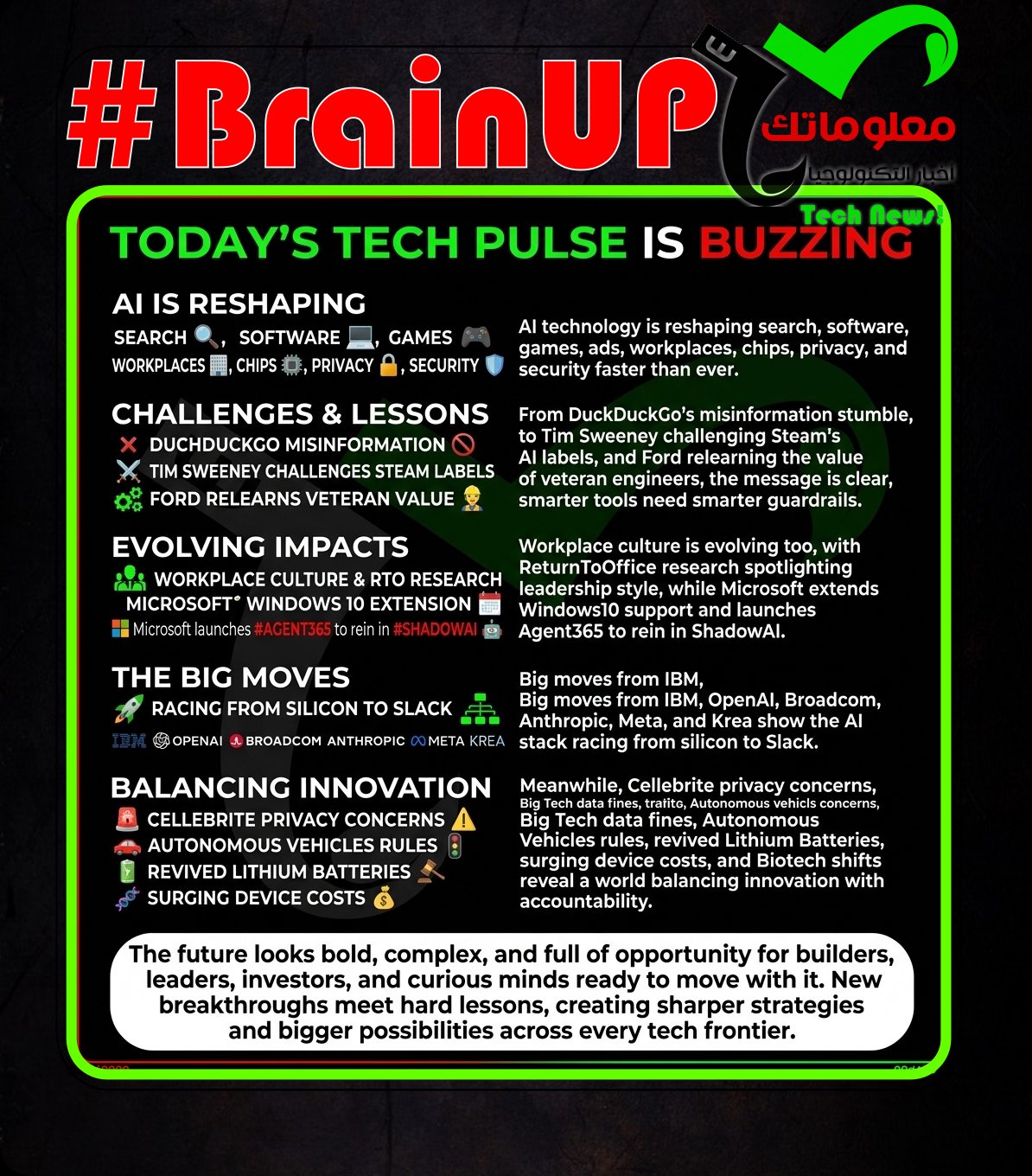
#BrainUp Daily Tech News – (Friday, June 26ᵗʰ)
Welcome to today’s curated collection of interesting links and insights for 2026/06/26. Our Hand-picked, AI-optimized system has processed and summarized 30 articles from all over the internet to bring you the latest technology news.
As previously aired🔴LIVE on Clubhouse, Chatter Social, Instagram, Twitch, X, YouTube, and TikTok.
Also available as a #Podcast on Apple 📻, Spotify🛜, Anghami, and Amazon🎧 or anywhere else you listen to podcasts.
1. DuckDuckGo’s AI Feature Is Telling Users That Trump Died of Rabies Earlier This Month
DuckDuckGo’s AI search feature reportedly told users that @Donald Trump died earlier this month from rabies, and even claimed Vice President @JD Vance died of the same virus. The AI cited a dubious-looking WKNA News article alleging Vance intentionally bit Trump on the advice of @Robert F Kennedy Jr to gain “superpowers,” plus an unrelated ABC News rabies story that does not mention Trump, none of which is true as Trump and Vance are alive and RFK Jr has not promoted rabies infections. The article argues this is another case of #AI systems ingesting and repeating misinformation uncritically, after being influenced by coordinated prank content online. It points to Reddit and the subreddit r/poisonai, where thousands of users post absurd falsehoods, especially the recurring claim that Vance died of rabies, and notes similar repetition of the claim by Brave’s AI. The episode is presented as a cautionary example of how search-integrated #AI can be manipulated by organized “poisoning” and then laundered into authoritative-sounding answers.
A six-year Wharton study argues that #return-to-office pushes are often linked to CEO #narcissism, as some leaders resist remote work because in-person settings better satisfy their desire for attention, power, and status. The researchers, including organizational psychologist @Adam Grant with Marissa Shandell and Courtney Elliott, found that narcissistic leaders prefer face-to-face communication where they can command attention through cues like eye contact, gestures, posture, and vocal changes, tools that remote channels limit. Using proxies such as CEO pay size, signature size, and photo prominence in company reports, they report that higher narcissism scores correlated with seeking status markers like becoming board chair and making early-pandemic negative statements about remote and hybrid work. In an experiment that primed leaders by reflecting on how a bold ego contributed to the successes of @Steve Jobs and @Larry Ellison, primed leaders were more likely to oppose working from home, suggesting a causal link between activated ego and anti-remote attitudes. The authors warn that ego-driven mandates may ignore the benefits of flexibility that employees value and could backfire, even if there can be legitimate business reasons to bring people back.
@Tim Sweeney criticizes Valve for Steam’s requirement that developers disclose #AI-generated content, arguing it functions like a “Scarlet Letter” that can mobilize backlash and hurt a game’s chances of success. He says #AI tools are primarily valuable for reducing repetitive “drudge work” such as code review and 3D rigging, while core creative and architectural work still comes from humans, and he claims industry practices are improving around training data provenance, citing Adobe as an example. The article notes counterpoints raised by PC Gamer, including that Epic uses tools like Nano Banana and GPT Image and that Unreal Engine’s planned #AI integrations include models such as Gemini that have faced copyright infringement accusations. Steam does not require disclosure of AI used in the internal workflow, but it does require disclosure when AI-generated assets appear in the game or in marketing, including partially AI-built or AI-based assets. Citing Game Oracle, the piece reports games with a generative AI disclosure get 53% fewer reviews and are more likely to receive negative reviews, while acknowledging other factors may contribute, such as studios using AI in place of creativity and producing low-quality “AI slop.”
4. Ford had to hire back former engineers to fix mistakes made by its automated systems
After being named No. 1 among mainstream automakers in @JD Power’s initial quality ranking for the first time in 16 years, Ford said recent quality problems were partly driven by overreliance on #automated systems and #AI that were not as robust as assumed. Executives said #AI performance depended on training-data quality, and Ford underestimated the value of institutional knowledge held by veteran engineers, some of whom left before their expertise could be transferred into the automated systems. Charles Poon said Ford hired, promoted, or brought back more than 350 experienced engineers to retrain systems, mentor younger staff, and improve data collection and AI training after errors from robots and process gaps contributed to a quality drop. The company also acknowledged broader quality pressures, including leading the industry in recalls, slipping ratings, launch difficulties for the Explorer and Aviator, and covid-era supply chain disruptions. COO Kumar Galhotra said Ford is shifting from a fragmented, siloed “find and fix” approach toward preventing issues before they occur by focusing on early indicators rather than defects discovered after the fact.
A Surfshark analysis says major tech firms have been fined a total of $3.5 billion over three years for #AI-related violations, mostly tied to unlawful use of people’s personal data, suggesting regulators are beginning to impose real consequences rather than just warnings. Surfshark reviewed 10 AI-related sanctions from 2022 to 2026 involving companies such as @Anthropic, @Meta, @Google, @Clearview AI, @Apple, @Amazon, and @OpenAI, and found nine out of ten fines were for using data like biometric data, facial images, copyright-protected content, and children’s voice recordings without consent or legal authorization. Examples cited include @Clearview AI being fined about $46 million in 2022 for collecting facial images, @Meta being fined $1.4 billion in 2024 for collecting biometric data without consent, and @Anthropic receiving a record $1.5 billion fine in 2025 for training on pirated books, while @Apple’s $250 million fine in 2026 points to scrutiny of misleading #AI marketing too. Surfshark’s Dr. Luis Costa argues this may be “only the beginning,” highlighting unprecedented scale and sensitivity of the data involved and warning that consumers are often not adequately informed that their information can become permanently embedded in commercial models. Despite larger penalties, the article notes enforceability and deterrence remain challenges because such fines may be small relative to Big Tech finances, and calls for better enforcement.
7. COVID Vaccine Study Suppressed by CDC Director Gets Published
A COVID-19 vaccine study initially suppressed by CDC Director Dr. Rochelle Walensky has now been published, shedding light on critical aspects of vaccine effectiveness. The study, which analyzed data on vaccine-induced immunity, faced delays reportedly due to political and bureaucratic concerns within the CDC. Its eventual release offers valuable insights into how vaccine protection wanes over time and highlights the importance of booster doses to maintain immunity against emerging variants. The delay in publishing raised questions about scientific transparency and the influence of external pressures on #publichealth decisions. This incident underscores the vital need for open communication and timely dissemination of research findings to guide informed policy and maintain public trust in vaccination programs.
8. Software Engineers Are Facing an Existential Crisis As They Drown In Horrendous AI Code
VC partner Deedy Das argues that rapid adoption of #AI coding tools is splitting engineering teams into “vibe coders” who generate output quickly and veteran “craftsmen” who must clean up the resulting low quality code, fueling an identity crisis and demoralization. He claims experienced engineers are increasingly stuck fixing bugs and “terrible #AI code” that leaks into production, while management responds by pushing even more AI usage, deepening resentment and making some feel “the craft they loved is dead.” The article links this to workplace pressure to maximize AI use, including reports that Meta weighs AI usage in performance reviews and has reassigned remaining staff to “soulless” AI projects after large layoffs, alongside a broader phenomenon of #workslop where shoddy AI generated work creates an illusion of productivity. It also notes concerns about the economics and operational impact, such as warnings about “#AI agent sprawl” and a report of an unnamed firm spending $500 million on @Anthropic’s #Claude in a single month. Overall, the piece portrays an industry where mandated AI adoption can shift effort from building software to triaging AI produced messes, undermining morale even among engineers who keep their jobs.
9. Windows 10 support quietly extended until Oct 2027, as users reject Windows 11
@Microsoft has extended #Windows 10 #Extended Security Updates (ESU) for personal-use devices through October 12, 2027, one year beyond the previously stated October 2026 cutoff for home users. The company’s support document and a statement to Windows Latest say enrollment is now available until the program ends on that date, and users already enrolled will be extended automatically with no action needed. The consumer ESU option remains available for #Windows 10 22H2 (Home, Pro, Pro Education, or Workstation) and provides only critical and important security updates, not new features, non-security bug fixes, or technical support. Enrollment can be free by syncing PC Settings with a Microsoft account, or done via 1,000 Microsoft Rewards points, or a one-time $30 USD fee, with one license covering up to 10 devices. This gives the many PCs still on Windows 10 more time to transition to #Windows 11 hardware while continuing to receive monthly security patches, though Microsoft warns devices are more vulnerable before enrollment.
10. Meta’s ruthless management style faces reckoning as leadership evaluates future
Meta’s intense and ruthless management style, cultivated under CEO @MarkZuckerberg, is facing scrutiny as the company confronts major strategic and operational challenges. Employees and executives report a high-pressure environment driven by relentless performance metrics and rapid pivots toward ambitious projects like the metaverse, leading to burnout and turnover. This approach, effective during earlier growth phases, now risks undermining morale and innovation amid increased competition and regulatory pressures. The company’s leadership is actively reassessing management practices to balance discipline with sustainable employee engagement and creativity. These shifts highlight Meta’s effort to adapt its corporate culture to maintain its market position and navigate future industry demands.
11. ‘Peppa Pig’ Backlash As Hasbro Asks Child Actors To Sign AI Clause
@Hasbro, which acquired the #PeppaPig brand in 2019, is facing backlash for adding #AI clauses to contracts that ask child actors on the animated series to sign over their voices for artificial intelligence use. Nearly 1,000 people signed an open letter organized by the Agents of Young Performers Association (AYPA) condemning such terms on an unnamed “international children’s franchise,” which industry sources told Deadline refers to Peppa Pig, warning the clause could enable voice cloning for commercial assets. The letter argues these provisions are often presented as “take it or leave it,” and says children cannot give fully informed consent, urging that any agreement involving a child’s voice be exempt from all AI usage and rejecting indefinite, unlimited surrender of voice rights. @Hasbro said it could not comment on specific negotiations, but stated it is committed to protecting child performers and to handling AI discussions responsibly and transparently as industry standards evolve. The dispute highlights growing industry concern about #AI in kids’ TV and film contracts and how voice and image rights for minors are being handled.
12. Hospitals in England declare critical incidents as machines and IT fail in heat
Extreme heat is pushing some #NHS hospitals in England into #critical incidents as buildings and systems fail while demand rises. Doctors reported radiotherapy equipment, MRI scanners, and labs breaking down, along with #IT servers overheating, forcing staff to switch off non-essential computers and even lights to avoid losing systems; one trust said two linear accelerator machines for cancer treatment stopped working. Heat also drove more people, especially older patients, to A&E with collapse or dehydration, worsening overcrowding and leaving wards with little air conditioning at temperatures reported up to 35C, with some air-conditioning units shut down to prevent damage. At Portsmouth’s Queen Alexandra hospital, chiller failures raised temperatures across the site and disrupted digital systems and critical clinical services including operating theatres, cardiac catheter labs, and diagnostic scanning, leading to cancellations and advice for patients to bring water. Clinicians said the situation shows #NHS buildings need upgrading to withstand extreme heat because infrastructure fragility now directly affects safety, access to care, and staff ability to work.
13. Pope Leo Calls on Tech Developers to Put Morality Before AI Innovation
@Pope Leo urged technology leaders to place ethics and human dignity at the center of #ArtificialIntelligence development, warning that rapid innovation without moral responsibility could deepen inequality, erode human agency, and undermine trust. Speaking to developers and industry figures, he emphasized that AI should always serve humanity rather than replace or diminish it, calling for transparency, accountability, and values-driven innovation as AI becomes increasingly embedded in everyday life. The remarks reinforce the Vatican’s growing engagement with AI governance and position moral responsibility as an essential counterpart to technological progress.
14. Dead lithium batteries revived to 95% capacity via electrochemical bath
Scientists at @Cornell University developed an #electrochemical bath that directly regenerates spent lithium-ion battery electrodes, avoiding the conventional approach of destroying batteries to recover raw materials. The method targets capacity loss driven by growth of the #solid electrolyte interphase (SEI) layer, which thickens over many charge cycles, raises resistance, and reduces capacity even though electrode structures remain largely intact. Researchers report the process restored depleted batteries to 95% of original capacity, helped recycled batteries last longer, and could cut recycling costs by 56% while being more environmentally friendly. In contrast, typical recycling disassembles packs, mechanically shreds cells into “black mass,” then uses energy-intensive #pyrometallurgy or #hydrometallurgy to extract minerals like lithium, nickel, cobalt, manganese, copper, and aluminum. By regenerating existing electrodes instead of pulverizing them to later remake electrodes, the bath approach aims to make battery circularity simpler and cheaper.
15. Rare book dealers fear tech firms are destroying obscure editions to train AI models
Secondhand and antiquarian booksellers across Europe, including the Netherlands, say #AI companies are buying large quantities of obscure and sometimes rare books to scan them and then destroy the physical copies for #AI training. Dutch seller Pieter de Vries said his Haarlem shop received an email from Singapore-based 2077AI seeking a large order from an attached list of 3,000 English-language titles, and similar near-identical requests have been reported in Switzerland, Spain, and Germany, including unusual overnight ordering patterns attributed to Canada-based Zoom Books. Booksellers argue the targeted titles are often too specialized to be profitable for resale, reinforcing their suspicion that the purpose is data acquisition rather than collecting or trading. Concern has intensified since reporting on @Anthropic’s “Project Panama,” described as “destructive scanning,” and a U.S. copyright lawsuit publicized in June 2025 in which a court found that destroying legally purchased books for scanning can qualify as fair use. Dealers believe that ruling is driving efforts to source older, less digitized European books as developers seek fresh training material beyond what is readily available online, while Zoom Books has said its buying fits a “regular recycling and trading model.”
16. Polymarket to Refund Users After Scammers Swipe Millions in Website Exploit
Polymarket said it will refund affected users after hackers exploited its website via a compromised third party vendor, enabling malicious code injection into the platform’s front end and the theft of about $3 million in customer funds. On chain investigators at Bubblemaps said the damage appeared largely contained, with fewer than 15 user accounts affected, and Polymarket said the front end issue has been contained and removed while refunds are underway. The attackers reportedly drained user wallets holding pUSD, a Polymarket specific dollar pegged stablecoin backed by USDC, converted the proceeds to ETH, and consolidated it into an Ethereum wallet where the funds still sat at the time of writing. The incident follows a separate hack last month of an employee wallet used for user rewards, which cost roughly $700,000 and was attributed to a private key compromise, highlighting how attackers can strike through peripheral systems even when core protocols remain secure.
17. Public records show FBI secretly extracted data from ICE protesters’ phones
Public records indicate the @FBI secretly extracted data from the phones of at least 13 people arrested during a June 11, 2025 protest outside an #ICE field office in Spokane, Washington, after Spokane police seized 23 phones in a mass arrest. Documents obtained by Mother Jones describe Spokane police confiscating Shailynn Bray-Waters’ phone on a misdemeanor failure to disperse charge, holding it until mid-August, and transferring devices to the FBI, including an evidence record noting an envelope from FBI Special Agent Kevin Loader containing a storage drive with digital extractions from 13 devices using #Cellebrite software. Notes in the evidence jacket instructed police not to tell callers their phones were with the FBI, and most protesters whose phones were extracted had their misdemeanor charges dismissed, while one, Thalia Ramirez, was later indicted in the federal “Spokane 9” case alleging “conspiracy to impede or injure” officers. Privacy advocates cited in the article argue that broad #conspiracy charges can enable invasive searches of people’s digital lives based on proximity, and an @ACLU attorney said the FBI would have needed search warrants for the extractions, though the available records do not show whether warrants were obtained or what they authorized. The reporting ties these findings to concerns about protest surveillance and the limited notice people receive when their devices are searched outside the court discovery process.
18. Anthropic Accuses Alibaba of Copying Claude AI Capabilities
@Anthropic has accused @Alibaba of reproducing key capabilities and behaviors from its Claude models, claiming evidence suggests the Chinese company relied on extensive outputs from Claude to improve its own AI systems rather than developing those capabilities independently. The dispute highlights the escalating battle over model distillation, where companies use the outputs of frontier AI models to train competing systems. As governments tighten export controls and AI competition intensifies, the case underscores growing concerns that intellectual property disputes over model behavior, rather than source code alone, could become one of the defining legal and geopolitical conflicts of the AI era.
Apple is raising prices across Macs and iPads as the #memory crisis hits the company, resulting in increases of hundreds of dollars on multiple products. After taking its store offline and bringing it back, new entry prices include the MacBook Air at $1,299 from $1,099, the MacBook Pro at $1,999 from $1,699, the MacBook Neo at $699 from $599, the iPad Air at $749 from $599, and the iPad Pro at $1,199 from $999, with the M4 Max Mac Studio rising to $2,499 from $1,999. The article says Apple had previously been an exception, keeping prices largely steady despite industry pressure, helped by its supplier relationships and already high margins. In a statement reported by the Wall Street Journal, Apple said it had reached the point where it needed to raise prices and claimed, “We have never seen a component price increase this much, this quickly,” tying the hikes directly to surging component costs.
20. Microsoft is raising the price of Xbox consoles by $100-$150 | VGC
@Microsoft is increasing US prices for Xbox Series S and Series X consoles starting August 1, 2026, with +$100 for 512GB models and +$150 for 1TB models, while discontinuing the 2TB Series X Galaxy Black. The new prices put Series X 1TB at $799.99 with a disc drive and $749.99 digital, and Series S at $499.99 for 512GB and $599.99 for 1TB. Xbox attributes the hikes to a #components crisis, saying storage and memory prices have risen more than 2.5x and could double again by fall 2027, and notes consoles are typically sold below cost unlike many other consumer devices. To offset affordability concerns, it announced Buy Now, Pay Later via Microsoft Stores, up to 12 months interest free financing through Amazon, and expanded trade in and resale programs for lower priced used consoles. The move fits a broader trend of rising console prices amid economic pressure, with @Sony and @Nintendo also raising prices recently, and industry data cited showing higher average hardware prices and weaker sales.
21. OpenAI leans toward waiting until next year for IPO, NYT reports
@OpenAI is weighing delaying its U.S. IPO, potentially waiting until next year or even 2027, as it seeks to preserve a targeted valuation of up to $1 trillion. The @New York Times reported, citing three people involved in the discussions, that advisers offered executives a choice between waiting until 2027 to pursue the $1 trillion valuation or accepting a lower valuation to list sooner, and CEO @Sam Altman said lowering the trillion dollar target was not acceptable. Reuters previously reported that the company has confidentially filed for an IPO and that CFO @Sarah Friar told some associates it is aiming for a 2027 listing. Separately, a source told Reuters the @Trump administration asked OpenAI to stagger the release of its new model over security concerns, and The Information reported the company would provide a limited preview of #GPT 5.6 to select partners with government approval granted customer by customer. The rollout was said to be requested by the Office of the National Cyber Director and the Office of Science and Technology Policy, linking OpenAI’s market timing and product release decisions to valuation goals and U.S. security oversight.
An REI Instagram ad for a Van Rysel EDR AF road bike was visibly mangled by #Meta #Advantage+ creative enhancements, producing an unrealistic image that ran for about a week before being pulled on June 22. According to REI and reporting cited from Business Insider, REI was auto-enrolled without explicit opt-in, and the tool altered a vendor supplied professional photo, which Van Rysel North America said was accurate when provided. The AI edits added implausible elements like extra handlebars near the seat, multiple chains, unreadable frame lettering, and a stitched together looking rider, including cyclist Amity Rockwell’s face being remixed without her knowledge, which she criticized publicly. The article argues that while @Meta documentation tells advertisers to review AI outputs, REI still let the broken creative run for days, and it frames auto-enrollment as a troubling default that shifts the cost of errors onto users. It notes advertisers can disable #Advantage+ creative enhancements in Meta Ads Manager to avoid similar problems.
23. U.S. proposes to drop brake pedal requirements for self-driving vehicles
#NHTSA proposed ending the federal requirement that fully self-driving vehicles include a manual brake pedal, aiming to make deployment of #autonomous vehicles on U.S. roads easier. The agency said the change would not apply to vehicles that still have human driver controls, and it would keep braking performance rules such as strict stopping distance standards. The proposal is part of broader efforts to facilitate rollout, while #NHTSA separately develops safety performance tests, amid automaker frustration over slow exemption reviews for vehicles without required human controls like steering wheels, brake pedals, or mirrors. The article notes ongoing and past exemption activity involving @Amazon unit @Zoox and @GM, including petitions to deploy up to 2,500 vehicles annually without human controls. Separately, #NHTSA withdrew a Biden-era proposal for a voluntary national framework for evaluating and overseeing self-driving vehicles after automakers said it was too stringent and some safety advocates said it lacked sufficient oversight.
24. Russia Breaks Into Human Rights Activist’s Phone With Cellebrite – The Citizen Lab
Russian authorities accessed Russian activist Andrey Pivovarov’s iPhone during a political prosecution using #Cellebrite forensic extraction tools, according to a #CitizenLab forensic analysis and corroborating official documents. After Pivovarov was detained at St. Petersburg Airport on May 31, 2021, his iPhone 12 and MacBook were confiscated without his consent or passwords and held in custody until 2023, and device artefacts show high-confidence traces of #Cellebrite #UFED use on or around June 17, 2021 while the phone was in state custody, including MobileLockdown records of USB connections to a Host ID previously attributed to Cellebrite. Russian authorities’ documents confirm Cellebrite was used to extract and search for information about his political activity and personal life to aid his prosecution. The case is linked to charges for alleged activity of an “undesirable” organization, following Pivovarov’s role with Open Russia and Russia’s use of its “undesirable organizations” law, and the article notes authorities continued using Cellebrite for political repression even after Cellebrite cancelled contracts with Russian customers. The findings are presented as part of a broader pattern in which #forensicTools function as key instruments of repression, motivating recommendations directed at #Cellebrite and civil society.
25. IBM Debuts World’s First Sub-1 Nanometer Chip Technology
@IBM announced what it calls the world’s first sub-1 nanometer chip technology at the 0.7 nm, or 7 angstrom node, aiming to push semiconductor scaling past traditional physical limits. The company says the fingernail-sized chip can pack nearly 100 billion transistors, about twice the density of its 2021 #2nm chip, and published results project up to 50% higher performance or 70% greater energy efficiency versus its 2 nm node chips. The advance is enabled by #Nanostack, an industry-first three-dimensional, nanosheet-based transistor architecture that vertically stacks and staggers transistors using 3D sequential integration and allows different material combinations per layer to tune performance and power. IBM reports experimental validation through ultra-thin dielectric bonding in #CMOS integration, dual-channel engineering, and functional CMOS inverter operation, and it also presented research at #VLSI2026 showing 40% scaling in #SRAM to better support high-bandwidth AI workloads. IBM positions the technology as a foundation for the next decade of computing, boosting capabilities for #GenerativeAI, cloud infrastructure, and next-generation electronic devices as the industry moves into angstrom-level scaling.
@OpenAI and @Broadcom unveiled their first custom AI accelerator chip, Jalapeño, positioning it as a purpose built #ASIC for #LLM inference to support workloads behind ChatGPT, Codex, the API, and future agentic products, and potentially to be offered to external AI firms. The companies claim it can cut inference costs by about 50% (reported by Bloomberg) and said it moved from early schematics to fabrication readiness in about nine months, a pace they attribute to deep software hardware co development that used OpenAI’s own prior generation models to accelerate parts of the chip design. OpenAI says it has begun testing a prior generation model, GPT 5.3 Codex Spark, on Jalapeño at production workload levels in a test environment, and plans to start rolling the processors across active data centers by the end of this year after receiving an early physical model. Executives including OpenAI president @Greg Brockman and Broadcom CEO @Hock Tan highlighted improvements in performance per watt and performance per dollar, while the article notes open questions about competitive performance, cost, and manufacturing viability. The move reflects OpenAI’s strategy to build more of the full compute stack by using an inference focused ASIC architecture aimed at reducing unnecessary data movement and better matching compute, memory, and networking for large scale serving.
27. Microsoft takes Agent 365 out of preview as shadow AI becomes an enterprise threat
Microsoft has taken #Agent 365 from preview to general availability as a unified control plane to observe, govern, and secure #AI agents across Microsoft’s ecosystem, third party clouds like #AWS Bedrock and #Google Cloud, employee endpoints, and partner #SaaS agents, reflecting that autonomous agent governance is now an urgent operational need. A major focus is detecting and managing local, employee installed tools that IT did not approve, which Microsoft calls #shadow AI and frames as a new enterprise security risk, with @David Weston describing organizations as trying to balance a “YOLO” approach versus locking everything down. Microsoft says it is already seeing enterprise incidents in three categories: misconfigured or unauthenticated connections such as exposed #MCP servers leading to PII and data leaks, #cross-prompt injection via untrusted sources like tickets or wikis that can redirect agent behavior, and sensitive data exposure because data sources and #DLP systems are not “agent-aware” and mishandle agentic access patterns. The launch positions Agent 365 as a way for IT and security teams to regain visibility and apply controls as agents can chain tools, access sensitive data, and act on users’ behalf. The move ties directly to the growing reality that autonomous agents are spreading faster than existing governance infrastructure can manage.
28. Sharp drops in Big Tech companies pull indexes mostly lower on Wall Street
Sharp declines across major technology companies dragged U.S. stock indexes mostly lower despite easing geopolitical tensions in the Middle East. Investors rotated away from high-growth tech stocks, with several of the largest #ArtificialIntelligence companies posting notable losses that outweighed gains elsewhere in the market. Although lower oil prices and reduced fears of a broader conflict offered some support, weakness in the technology sector dominated trading. @Elon Musk’s newly public #SpaceX was a notable exception, climbing after its highly anticipated IPO, but its gains were not enough to offset broader selling across Big Tech, underscoring the sector’s outsized influence on overall market performance.
29. Biotech ETFs Put Up Strong Show in 1H 2026, More Gains Ahead
Biotech ETFs performed strongly in the first half of 2026, driven by increased investor optimism and advancements in biotechnology. Key funds in the sector showed significant gains as new treatments and innovations attracted attention, reflecting a bullish outlook on the industry’s growth prospects. Market analysts highlight the impact of ongoing clinical trial successes and regulatory approvals that are expected to sustain momentum. The combination of scientific progress and favorable market conditions suggests further upside potential for biotech ETFs moving forward. This trend underscores the sector’s role as a promising avenue for investors seeking exposure to cutting-edge healthcare solutions.
30. East Asia’s biotech autonomy push is already stunting innovation – Asia Times
East Asia’s accelerating push for #biotech autonomy, driven by the expanding US-China technology rivalry, is beginning to fragment the cross-border networks that have powered the region’s biotech innovation and could slow future competitiveness. The article cites a January 2025 US restriction on China’s access to advanced biotech equipment like high-parameter flow cytometers and mass spectrometry systems, and a June 2026 bipartisan bill to extend outbound investment screening under the #COINSAct to biotechnology, including licensing and research partnerships, alongside proposals to limit use of clinical trial data generated in China. Because biotechnology depends on international collaboration, shared datasets, and access to diverse patient populations for clinical trials, national segmentation can reduce the scalability and pace of drug discovery and advanced-therapy development even if domestic capacity grows. In response, governments are tightening control and building domestic capability, with China pursuing a comprehensive, state-backed, full value-chain autonomy strategy that boosts supply security and catch-up but may reduce influence in global standard-setting, while South Korea follows a more globally integrated model aligned with US and European standards that supports growth but increases exposure to external policy shifts. Overall, measures intended to increase resilience are also weakening the international links that made East Asia a leading biotech hub, reshaping regional strategies as biotechnology is treated as strategic infrastructure.
Sakana launched Fugu, a multi-agent #orchestration system that provides frontier-level AI performance through a single, #OpenAI-compatible API by dynamically routing requests to a swappable pool of specialized agents, aiming to reduce #vendor lock-in risk and exposure to geopolitical export controls. CEO and co-founder @David Ha said Fugu can match restricted frontier models like Anthropic’s Claude Mythos 5 and Claude Fable 5, citing the June 12 revocation of public access to those models following a U.S. export control order as a motivating example for enterprises and nations. Fugu acts as a coordinator rather than a monolithic foundation model: it decomposes tasks, delegates subtasks to multiple foundation models, verifies results, and synthesizes final outputs, with coordination details and selected models kept proprietary and hidden from users. Sakana states the system is based on its 2026 research (TRINITY and the Conductor), using learned coordination strategies and allowing recursive calls to itself, and reports benchmark parity with top-tier models on third-party agentic-task evaluations. The company is offering two tiers, Fugu for low-latency everyday use and Fugu Ultra for complex, high-stakes work such as AI research, cybersecurity analysis, and multi-step patent investigations.
32. Everyone told you to deploy AI agents. No one told you what happens to your SOC when you do
At #RSAC 2026, vendors such as CrowdStrike, Cisco, and Palo Alto Networks promoted agentic SOC tools, but the architectures discussed share a core gap: they lack an agent behavioral baseline that would let security teams set and enforce policy for #AI agents on endpoints. @George Kurtz said breakout time has fallen to 27 seconds and that CrowdStrike now sees over 1,800 distinct AI applications across roughly 160 million unique instances, generating logs and events that flow into #SIEM systems built for human-speed workflows. Cisco’s @Jeetu Patel reported 85% of surveyed enterprises are piloting AI agents but only 5% have put them into production, because teams cannot answer which agents are running, what they are authorized to do, and who is accountable when something goes wrong. Default logging often makes agent-initiated actions indistinguishable from human activity unless analysts can trace the endpoint process tree, leaving compromised agents able to use sanctioned API calls with valid credentials without triggering alerts. Kurtz highlighted ClawHavoc, a supply chain attack on an AI agent ecosystem involving malicious skills in the ClawHub/OpenClaw registry, as evidence that agent ecosystems are being actively exploited while security complexity grows.
Krea is releasing open weights for its new #AI image model Krea 2 in two variants, Krea 2 Raw and Krea 2 Turbo, aiming to counter perceptions of monotonous “AI slop” by delivering greater visual variety while keeping prompt accuracy, fidelity, and quality. The weights are available for public download on Hugging Face under a custom license that requires organizations with more than 50 seats to pay for Enterprise usage and obligates all deployers to implement infrastructure-level safeguards blocking illegal content, #NCII, #CSAM, and defamatory outputs, shifting enforcement responsibility downstream. Krea positions the models as more customizable than typical proprietary and many open models, including support for style references and LoRAs, and highlights Krea 2 Turbo’s roughly 2-second generation time, accelerated via #TrajectoryDistributionMatching, as among the fastest in the market. A mid-2026 benchmark table situates Krea 2 Turbo at 2.0 seconds, close to Z-Image Turbo at 1.8 seconds and behind FLUX.1 schnell at 0.5 seconds, while noting Krea’s hybrid open-weights licensing approach. Overall, the release pairs speed and customization with contractual content-moderation requirements to make the models viable for enterprise deployment without centralized platform control.
@Anthropic launched Claude Tag, a persistent AI agent embedded in Slack that replaces its prior Claude Slack app and is positioned as a shared teammate for enterprise channels rather than a one user chatbot. Available in beta for Claude Enterprise and Team customers, it runs on #Claude Opus 4.8 and lets admins connect it to a workspace, restrict channels, grant tool and data access, and set spending limits, after which anyone can invoke it with @Claude to execute multi step tasks and report results in threads. Anthropic says it uses an internal version heavily, claiming 65% of its product team’s code is created through it and that support and data insight channels run through the system. The product differentiates itself by being #multiplayer (one Claude per channel visible to all), building memory and channel context over time, taking initiative via optional ambient monitoring and proactive follow ups, and working asynchronously on longer projects. This reframes Slack’s collaboration layer into a place where a persistent agent can accumulate institutional context, coordinate work, and autonomously advance tasks across a team’s shared workflows.
That’s all for today’s digest for 2026/06/26! We picked, and processed 30 Articles. Stay tuned for tomorrow’s collection of insights and discoveries.
Thanks, Patricia Zougheib and Dr Badawi, for curating the links
See you in the next one! 🚀
