
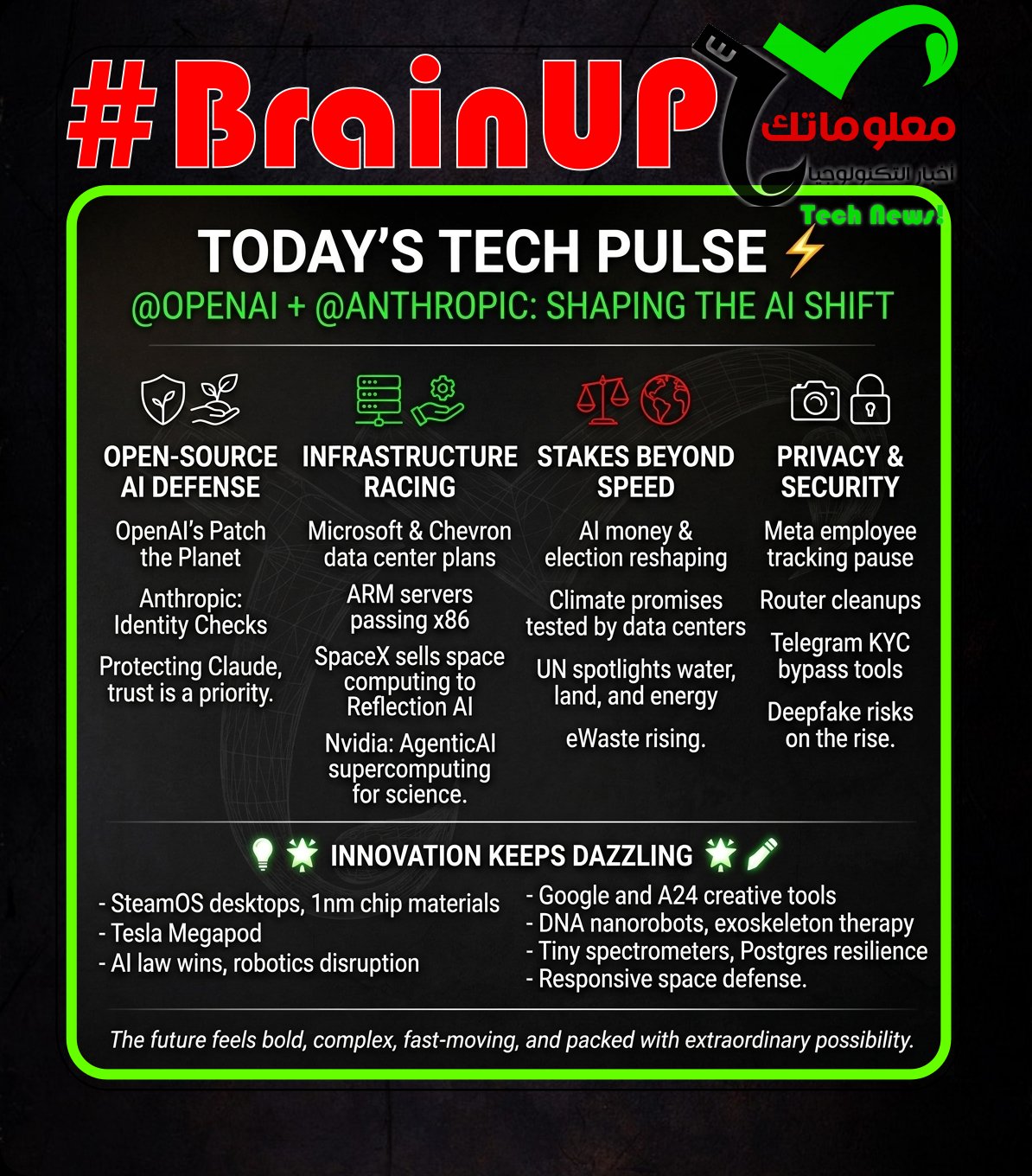
#BrainUp Daily Tech News – (Tuesday, June 23ʳᵈ)
Welcome to today’s curated collection of interesting links and insights for 2026/06/23. Our Hand-picked, AI-optimized system has processed and summarized 30 articles from all over the internet to bring you the latest technology news.
As previously aired🔴LIVE on Clubhouse, Chatter Social, Instagram, Twitch, X, YouTube, and TikTok.
Also available as a #Podcast on Apple 📻, Spotify🛜, Anghami, and Amazon🎧 or anywhere else you listen to podcasts.
1. OpenAI Launches Full-Scale Effort to Patch Open-Source Bugs as It Takes on Anthropic’s Mythos
@OpenAI announced a set of cybersecurity initiatives aimed at improving software security as concerns grow about #AI-driven hacking and #AI bug hunting, including an upgraded limited-access security model, GPT-5.5-Cyber, broader “trusted access” partnerships with governments and institutions, and releasing its #Codex Security scanner as an app plug-in. It also launched #Patch the Planet with security firm @Trail of Bits, working with vulnerability management firms @HackerOne and Calif, to provide free consulting to open-source maintainers to find and patch vulnerabilities, strengthen codebases, and adopt AI security tools. The effort targets a widening gap where volunteer maintainers face overwhelming backlogs and low-quality AI-generated vulnerability reports, with OpenAI’s Fouad Matin saying the program is designed to reduce maintainers’ burden by handling assessments, validation, patch creation, and landing fixes, while subsidizing scanner usage, including 20 trillion tokens. Over 30 open-source projects are participating, and a five-day sprint involving 25 Trail of Bits engineers reportedly found hundreds of bugs and produced dozens of patches in the first week. The initiative positions AI not only as a source of new security pressure on open source, but as a resource to make security improvements more scalable and sustainable for critical projects.
2. Anthropic says Claude may want to see your ID | TechCrunch
@Anthropic updated its privacy policy to allow #Claude to ask some users to verify their age and identity by uploading government ID in certain circumstances, with the change taking effect July 8. The policy says verification may require a scan of a passport or driver’s license plus a selfie photo or video, creating a face geometry template that can be treated as legally protected biometric data in places like Illinois, and it may store the verification result such as whether a user meets an age threshold. A spokesperson said the checks apply to a small subset of accounts flagged for potentially fraudulent activity, intended to support an appeals process rather than automatic bans, and are separate from the Fable or Mythos rollout. The move also sits alongside broader pressures, including age verification requirements in some jurisdictions and heightened scrutiny amid legal, regulatory, and political tensions with the @Trump administration and U.S. government actions that have affected Anthropic’s AI tool access.
3. Oracle cuts 21,000 jobs as AI reshapes its workforce
Oracle disclosed that its workforce shrank by approximately 21,000 employees during fiscal 2026, reducing headcount from about 162,000 to 141,000, a decline of roughly 13%. The company explicitly acknowledged that the adoption of #ArtificialIntelligence across its operations has already resulted in workforce reductions and could continue to do so in the future. Oracle spent nearly $1.84 billion on severance and restructuring costs while redirecting resources toward an aggressive AI and cloud infrastructure expansion, including massive investments in data centers and partnerships with organizations such as @OpenAI and @Meta. The cuts reflect a broader technology industry trend where companies are increasingly replacing routine work with AI-assisted processes while prioritizing employees who can effectively leverage AI tools. As Oracle races against cloud rivals and commits tens of billions of dollars to AI infrastructure, the company is effectively signaling that compute capacity and AI capability are becoming strategic priorities over headcount growth.
4. Microsoft and Chevron plan one of the largest gas-powered data center projects in US | TechCrunch
@Microsoft and @Chevron plan to build a 2.67-gigawatt natural gas power plant in West Texas to supply electricity for @Microsoft #AI and cloud data centers under a 20-year power purchase agreement. The plant, called Project Kilby, would deliver dedicated power to a Microsoft-operated data center, using two large #GEVernova turbines for most generation and additional output from Solar Turbines, a Caterpillar subsidiary. @Chevron said the effort would be among the largest co-located natural gas power and data center developments in the U.S., but it marks a notable shift for a company that has emphasized sustainability and pledged to eliminate its carbon emissions by 2030. The Environmental Integrity Project estimates the facility could emit more than 13 million tons of carbon dioxide, plus 3,200 tons of criteria air pollutants and 278,000 pounds of hazardous air pollutants. The deal underscores how rising data center power demand is driving long-term fossil-fueled generation commitments even as tech firms maintain aggressive climate targets.
ARM-based servers have achieved over 45% of total revenue in the data center market, driven by demand for high-end AI infrastructure and GPU cluster deployments. This shift indicates a significant move away from traditional x86 platforms, as ARM chips offer advantages in power efficiency and scalability for modern workloads. Major players in cloud services and AI applications are increasingly adopting ARM architectures to optimize performance and cost. The rise of ARM servers reflects broader industry trends prioritizing specialized processing capabilities for AI and HPC tasks. This transition highlights the evolving landscape of data center technology and the diminishing dominance of x86 architectures.
6. AI and tech are trying to influence the midterm elections
Groups tied to the #AI industry are pouring money into midterm elections to shape future #AI regulation, even as public unease grows about impacts on jobs, energy bills, and society. AI-focused super PACs have spent $43.3 million on congressional races this cycle, according to OpenSecrets, amid bipartisan agreement that Congress should set more rules but with federal legislation stalled. Michael Beckel of @Issue One says this spending influences who gets a seat at the table when laws are crafted and signals a new playbook for industry influence in Washington and the states. A key early test is a New York City Democratic primary where more than $15 million in AI-backed spending targets New York Assemblyman Alex Bores, a former @Palantir employee who co-sponsored New York’s #RAISE Act to require safety-incident reporting and transparency about safeguards. Super PACs tied to investors in @OpenAI have funded ads against Bores, arguing state laws like the #RAISE Act would create a patchwork of rules that would crush innovation, highlighting Silicon Valley’s political fault lines over how AI should be governed.
7. US Tech Megacaps Slide, SpaceX Extends Slump as AI Expense Concerns Grow
US technology mega-cap stocks fell sharply amid growing concerns over rising expenses related to #ArtificialIntelligence investments. Companies like @Microsoft and @Apple experienced significant share declines after cautious earnings reports highlighted escalating AI-related costs. Meanwhile, @SpaceX extended its recent slump due to broader market volatility and sector-specific pressures. Investors are increasingly wary of the high expenditure needed to develop and integrate AI technologies, tempering enthusiasm despite the potential growth opportunities. This sentiment reflects shifting market dynamics as firms balance innovation investments with profitability expectations.
8. SpaceX signs computing power deal with open-source AI startup Reflection worth up to $6.3 billion
@SpaceX signed a major computing power agreement with open-source AI startup @Reflection AI to use @Elon Musk’s Colossus 2 data center and immediate access to #Nvidia GB300 chips. The contract calls for payments of $150 million per month starting July 1, 2026, potentially totaling about $6.3 billion through 2029, and either party can terminate with 90 days notice after the first three months. The deal underscores how SpaceX is turning its Colossus build-out, originally supporting Musk’s Grok chatbot, into a commercial compute platform, following similar arrangements with @Anthropic, @Google, and Cursor, which SpaceX is acquiring. Reflection positions the added compute as a way to accelerate what it calls “American open intelligence,” amid rising interest in #open-source AI and concerns about dependence on closed-model providers after @Anthropic cut off access to Fable and Mythos. Reflection, last valued at $25 billion, has not released a public frontier open-source model yet but is building traction with government and national security work, including the Department of Energy’s Genesis Mission and broader Pentagon AI efforts, aligning the partnership with its push for greater model control and flexibility for enterprises and governments.
9. Nvidia gets all agentic about supercomputing for scientific research
#Agentic AI is being positioned by @Nvidia as the next major shift in supercomputing for scientific research, requiring a new scientific computing stack that tightly links agents, simulation, and AI into a single workflow. At ISC High Performance 2026, Nvidia executive Dion Harris said systems like Los Alamos National Laboratory’s Mission and Vision will be the first “agentic AI supercomputers,” where AI “co-scientists” can plan experiments, write code, run simulations, and combine simulation, AI, and analytics end to end. Nvidia argues this model demands vast compute, memory, and networking, and it is promoting its #VeraRubin and #GraceBlackwell platforms with #QuantumInfiniBand plus new software: #ALCHEMI for chemical and materials discovery via the BGR microservice, #DAQIRI for real-time instrument data reduction such as a GPU-accelerated trigger pipeline at @CERN’s ATLAS experiment, and #cuPhoton for rapid processing of telescope-scale datasets. The company cites performance claims including cuPhoton testing with 32 Grace Blackwell superchips simulating Rubin Observatory data, reporting 15,000x faster image loading and reading and up to 8,000x faster signal processing and analysis. To support these workloads, Nvidia says the Vera Rubin NVL rack, due in Q4, will pack up to 144 GPUs per rack, deliver 5 petaFLOPS FP64, and boost memory bandwidth 2.8x versus Blackwell with 41 TB of HBM, reinforcing its pitch that agentic supercomputing is best built on Nvidia’s hardware and software stack.
10. Exclusive: NSF slashes research programs to support new tech initiative, insiders say
The National Science Foundation (NSF) is significantly cutting funding for various research programs to prioritize a new technology-focused initiative, according to insiders. This shift in funding reflects a strategic redirection toward emerging technologies that NSF officials believe are critical for future scientific and economic competitiveness. The move has sparked concern among researchers who fear that reduced support for fundamental science could hamper long-term innovation. The prioritization of technology-driven efforts underscores NSF’s aim to align research investments with national priorities, although it may reshape the funding landscape. Overall, this reallocation illustrates NSF’s evolving approach to balancing foundational research with applications in next-generation technology.
11. The structure of an active interfacial catalyst visualized for CO2 reduction
The study reveals the atomic structure of an active catalyst interface during the electrochemical reduction of CO2, providing insight into catalysis mechanisms under working conditions. Using advanced cryo-electron microscopy and spectroscopy, the researchers captured the dynamic rearrangement of catalyst surfaces and intermediates, highlighting the role of surface adsorbates and reaction environment in modulating activity. This structural characterization challenges traditional catalyst models by showing how active sites evolve in situ, influencing selectivity and efficiency in CO2 conversion. This work deepens understanding of #electrocatalysis and informs the design of more effective catalysts for carbon capture and conversion technologies. The findings link nanoscale structural dynamics to macroscopic catalytic performance, advancing the roadmap toward sustainable chemical production.
12. Meta Pauses Employee-Tracking Program Following Internal Data Leak
@Meta has paused its divisive Model Compatibility Initiative (#MCI) employee tracking program after an internal security issue exposed data from the initiative to other workers inside the company. The #MCI tool, rolled out in April to US employees, collects computer inputs such as mouse movements, click locations and keystrokes, as well as screen content, and initially launched without an opt-out, later adding limited opt-out options after employee protest. An internal security notice from a Meta engineer said databases containing #MCI information were accessible to anyone inside the company, prompting widespread internal criticism, while a spokesperson said there was no indication the data was improperly accessed and the company is pausing the program to investigate. @Stephane Kasriel said the issue was discovered June 18 and addressed within four hours, but the initial fix did not hold and access had to be further locked down because some MCI-derived data became accessible to more people than intended. Meta says it will only re-enable #MCI once it is confident in its data protection controls and noted it has gathered enough data to assess the tool’s long-term value.
13. Meta Exposed Data Internally From Its Controversial Employee-Tracking Program
@Meta says an internal misconfiguration exposed sensitive information collected through its controversial employee laptop tracking program, prompting the company to pause the effort indefinitely. An internal security notice described “employee data across 45,000 hive tables” as accessible companywide, and the exposed material is believed to include #keystrokes, mouse clicks, screen content, “full prompts and transcriptions,” private conversations, and people and performance data from US employees. @Andrew Bosworth said the rollout fell short of privacy review standards due to misconfigured #ACLs, and that Meta needs to trace all data access and share findings, while spokesperson Tracy Clayton said there is currently no indication the data was improperly accessed. Employees cited the incident as proof of earlier warnings, including a petition signed by more than 1,600 staffers arguing the #Model Capability Initiative created security and regulatory risks and lacked adequate safeguards. The episode underscores how collecting granular workplace activity data for #AI training can amplify privacy concerns and make internal access controls a critical point of failure.
14. Valve will finally let you build your own Steam Machine with SteamOS for desktop
@Valve says that starting with the #SteamOS 3.8 release, users can build their own Steam Machine style PC and install SteamOS on whatever desktop parts they choose, with SteamOS 3.8.10 already adding improved compatibility for recent Intel and AMD platforms. In an interview with The Verge, @Pierre-Loup Griffais says Valve is rolling out desktop hardware improvements and has a growing team collaborating closely with @Nvidia on driver support, though Nvidia graphics support may not arrive this year. He notes SteamOS has technically been installable before but was largely limited to AMD systems and typically required using a Steam Deck recovery image, making installs on Intel or Nvidia hardware difficult. For now, Valve expects a good experience for console like living room setups that use a single drive and do not dual boot, delivering core features like the SteamOS graphics driver and shader precompilation, but with caveats such as no HDMI CEC support and an installer not yet designed for easy partitioning or coexistence with another OS. The changes position SteamOS as a more general desktop option over time, potentially expanding to support nearly any gaming PC hardware, including Nvidia.
15. Japan’s Toto to invest $495m in chip materials, targeting 1-nm era
Japan’s Toto plans to invest 80 billion yen, about $495 million, over the next five years to expand its semiconductor materials business, aiming to support next-generation chipmaking in the 1-nanometer range. The move is framed as a response to surging demand for advanced semiconductors, with #AI demand cited as a key driver. By expanding materials capacity and capabilities, the bathroom fixtures maker is positioning itself deeper in the semiconductor supply chain as chip technologies advance toward smaller nodes. The investment targets the #1nm era, signaling a focus on enabling future manufacturing technologies rather than Toto’s traditional consumer product lines. This underscores how #AI-led semiconductor growth is pulling new industrial players like @Toto into strategic upstream materials investment.
16. Tesla plans to sell modular AI data center hardware called ‘Megapod’
Tesla filed an intent to use trademark for “Megapod,” signaling plans to sell turnkey, self contained #AI data center hardware systems rather than just chips or batteries. The filing (serial number 99893717) describes modular systems bundling servers, #AI data processing hardware, networking, power distribution units, and cooling, plus downloadable software to monitor, manage, and optimize the platform, effectively a single unit enclosure for AI workloads. The article argues this would put Tesla into a market dominated by @Nvidia, whose GB200 NVL72 and DGX SuperPOD designs, along with similar systems from Dell and Supermicro, already define rack scale, liquid cooled AI compute. It also notes naming and positioning challenges: Submer already sells a “MegaPod” product and holds a related MEGAPOD trademark, and Tesla itself is primarily an @Nvidia customer, running a large H100 equivalent cluster and having discontinued Dojo in 2025 while its AI5 and AI6 chip timelines have slipped. Overall, the filing suggests a new product direction for Tesla, but the article frames Tesla’s stronger existing data center angle as power infrastructure, not compute hardware.
17. Artificial intelligence-based law firm wins in court | Computer Weekly
An AI-based UK law firm, #GarfieldAI, has won its first court trial after becoming the first AI-based law firm to receive UK regulatory approval from the #SolicitorsRegulationAuthority. Freelancer Tamires Camal Taquidir used #GarfieldAI to generate pre-action correspondence, issue proceedings, handle document production, prepare witness statements and trial bundles, and dispute a counterclaim, before the system instructed a junior shortly before trial. After a three-hour hearing at Wandsworth County Court on 14 May 2026, the court awarded £7,000 and dismissed the counterclaim, with the claimant paying about £400 in Garfield AI fees while the defendant instructed both a solicitor and a barrister. Garfield AI co-founder Daniel Long said the result shows regulated #AI-powered legal services can help people and businesses enforce rights when traditional legal routes are too slow, costly, or complex. Lawyer Mark Lewis said the outcome validates the platform when integrated into legal and court processes, highlighting its usefulness for small claims where legal costs are a barrier to justice.
18. Robots Will Replace 700,000 Workers
@Richard Liu, founder and chair of @JD.com, says robots will eventually replace 700,000 delivery workers in China, reflecting a broader shift toward #AI-powered #robotics that could eliminate tens of millions of jobs globally. Early experiments with robot delivery are already underway in China, and @Amazon plans to automate about 75% of its operations, a move The New York Times said could let it grow through 2033 while avoiding more than 600,000 new hires. The piece adds that @Walmart and @UPS could pursue similar automation, while @Elon Musk says he can build billions of #Optimus robots and has redirected a factory from producing Model S and Model X vehicles to manufacturing them. @NVIDIA CEO @Jensen Huang is quoted saying “Physical AI has arrived,” implying industrial firms will increasingly become robotics companies, expanding automation beyond warehouses and delivery into many sectors. The article argues the impact is not limited to blue-collar roles, citing layoffs at @Block where work is being replaced by cheaper AI applications, and concludes that these trends intensify concerns about an “employment apocalypse” and how societies will handle large-scale unemployment.
19. Google Invests $75 Million in A24 to Develop AI-Powered Filmmaking Tools
@Google is investing about $75 million in @A24 as part of an AI research partnership aimed at developing #AI-powered filmmaking tools with @DeepMind. The arrangement gives A24 access to DeepMind research and infrastructure, and places DeepMind researchers alongside A24 to build new workflows, while explicitly not granting Google access to A24’s content library or data. A24 Labs head @Scott Belsky said the effort differs from other studio AI deals by focusing on uses that preserve creative control and support risk-taking, such as applications for AI-generated storyboards, rather than tools marketed as making films cheaper and faster. The deal sits within a broader wave of Hollywood AI partnerships and disputes, alongside moves involving @Disney, @Lionsgate, and @Netflix, as studios test collaboration and enforcement strategies around #copyright and #generativeAI. It also arrives amid public skepticism, with a recent @Pew Research study cited saying roughly half of adults under 30 believe AI will harm society.
20. AI Slop Is Transforming YouTube. Its CEO Wants To Keep It Human
YouTube CEO @Neal Mohan says the platform is entering a profound #AI-driven shift that can both amplify human creativity and overwhelm the site with low-quality, spammy content. He points to how #AI is lowering production costs and enabling new creator formats and faster, cheaper ad creation, contributing to an estimated 29 billion total videos on YouTube and accelerating growth tied to #Shorts and AI-generated video. At the same time, AI enables efficient spam and #deepfakes, including an AI-generated clip of @Jensen Huang promoting a crypto scam that drew more views than the real keynote, and research from Kapwing estimating that over 20% of content shown to new users in Shorts was AI-generated, while Forbes testing found 17.5% of 200 Shorts were AI-generated. YouTube disputes Kapwing’s study as unverified and says new users see a broad mix of content as feeds learn interests, but it also says it terminated channels that violated spam policies. Mohan frames YouTube’s challenge as balancing the benefits of AI creation tools, including avatar features in Shorts, with protecting the platform from deception and “slop” so it remains meaningfully human.
21. A Spy Agency Just Cleaned Your Neighbour’s Router. The Bots Will Be Back.
Canada’s intelligence service, #CSIS, obtained a Federal Court warrant and used its threat reduction powers to access infected Canadian home routers and #IoT devices to remove two foreign-operated #botnets, with the public ruling released June 15, 2026 as a first of its kind precedent. The article argues this matters because the long tail of consumer devices is effectively “unowned”: vendors move on, ISPs avoid liability, and users often cannot detect or remediate compromises, creating a cheap, resilient botnet base that provides valuable residential IP “camouflage.” It explains the warrant is central, since reaching into privately owned endpoints is an intrusion with potential for remediation but also reconfiguration, surveillance, or damage, so democratic legitimacy depends on judicial oversight and public scrutiny rather than technical intent. The precedent both legitimizes national-scale active defense while also normalizing state operations inside endpoints it does not own, inviting debate about boundaries and accountability. It concludes cleanup alone will not solve the problem because it does not fix underlying weaknesses like default credentials, unpatched firmware, and exposed interfaces, so reinfection is likely and product defenders should not assume government interventions will eliminate the enduring pool of compromised devices.
22. Cyberscammers are bypassing banks’ security with illicit tools sold on Telegram
Cyberscammers are increasingly bypassing banks’ and crypto platforms’ #KYC facial checks using illicit services sold on Telegram, enabling them to open mule accounts and launder money. MIT Technology Review describes a demonstration from a Cambodia-based money-laundering operation in which a banking app’s liveness test is defeated by feeding nonmatching images through tools such as a #virtual camera, replacing the live phone camera stream with photos or videos that can depict real people, #deepfake identities, or even objects. Over a two-month investigation, the outlet identified 22 public Telegram channels and groups in Chinese, Vietnamese, and English advertising bypass kits and stolen biometric data, claiming access against institutions including Binance and Spain’s BBVA, and posting videos and service lists to market “KYC verification” and bank-focused laundering help. Telegram said it removed the reviewed accounts for policy violations, but similar marketplaces reappear easily and some remain active, reflecting an ongoing cat-and-mouse dynamic as financial institutions tighten security. The trend coincides with the growth of “pig-butchering” cyberscams and stronger verification and #anti-money-laundering pressure in places like Vietnam and Thailand, alongside estimates from @Chainalysis that crypto scam and fraud theft rose to about $17 billion in 2025 from $13 billion in 2024.
23. WhatsApp to be led by Indian start-up founder as Will Cathcart steps back
@Will Cathcart is stepping back after nearly seven years leading WhatsApp, and @Kunal Shah, founder of Indian fintech start-up Cred, will take over as head while Cathcart remains within Meta’s leadership ranks. Cathcart said WhatsApp is in its strongest position and that it felt like the right moment to step back, after scaling its private chat functions to more than three billion users. @Mark Zuckerberg praised Shah for building Cred and said his builder mindset and global perspective will help run the world’s biggest messaging app, as Meta pursues #revenue growth via ads, paid subscriptions, and #AI tools across its family of apps. Shah said he will stay a shareholder in Cred and noted Meta invested $900m, with Bloomberg reporting this would equate to a 20% stake, while stressing Meta would be a minority investor with no access to member data. The leadership change comes as Meta aims to strengthen WhatsApp’s already large presence in India, where it has about 853 million users, amid scrutiny over #privacy and data sharing practices with its parent company.
24. AI’s environmental costs threaten water, land and climate
A new @UN University study warns that #AI’s environmental footprint is expanding beyond greenhouse gases, with rising demands for electricity, water, land, and materials that could strain natural resources. It projects #data centres powering AI could use 945 terawatt-hours of electricity annually by 2030, while AI-related water use could match the basic annual domestic needs of 1.3 billion people and its land footprint could exceed 14,500 square kilometres. The report argues that focusing mainly on carbon emissions from training large models misses key trade-offs: options that cut emissions, such as some renewable power choices, can increase water consumption and land use, especially in already resource-scarce regions. It finds day-to-day AI use drives most energy demand, about 80 to 90 per cent, with enormous variation by task, and efficiency gains may be offset by a rebound effect that increases overall usage. The study adds that AI’s local environmental burdens are often concentrated where infrastructure is built, including pressures on national grids, heavy water withdrawals during droughts, and a growing #e-waste problem projected to reach up to 2.5 million tonnes annually by 2030, even as AI benefits are distributed globally.
Researchers have developed a modular DNA nanorobot designed to deliver drugs selectively to cancer cells, thereby enhancing therapeutic efficacy and reducing side effects. This nanorobot employs aptamer-based recognition to identify specific cancer cell markers, enabling targeted drug release directly inside tumor cells. Experimental results demonstrate that the nanorobot effectively inhibits tumor growth and improves cell viability in preclinical models. The design strategy leverages the programmability of DNA nanotechnology to construct customizable drug delivery systems with high specificity. This approach promises a new avenue for precise cancer treatment by integrating modularity, targeting capability, and controlled drug release into a single nanostructure.
26. New exoskeleton therapy could redefine how stroke survivors relearn to walk
Researchers at Northwestern University have developed a novel exoskeleton therapy aimed at improving walking ability for stroke survivors. The therapy combines robotic assistive technology with customized training to enhance neuroplasticity and motor function recovery. Clinical trials demonstrated significant improvements in gait speed and balance among participants using the exoskeleton compared to traditional rehabilitation methods. This approach addresses limitations in current stroke rehabilitation by providing precise, repetitive, and intensive movement practice that adapts to individual patient needs. The innovation could transform stroke recovery by offering a more effective and personalized pathway to regaining mobility.
27. AI-powered spectrometer chip shrinks lab technology to the size of a grain of sand
Researchers at UC Davis report a grain-of-sand-sized #spectrometer-on-a-chip that performs lab-style spectral analysis without prisms, gratings, or long optical paths. The device uses 16 uniquely engineered silicon detectors that each respond differently to the same incoming light, producing encoded and noisy signals that a fully connected #neural network learns to invert into the original spectrum. Trained on thousands of examples, the #machine learning model solves the inverse problem to reconstruct spectra at about 8 nm resolution using visible and near-infrared light. A key enabling #technology is photon-trapping surface textures added to standard silicon photodiodes, extending sensitivity toward near-infrared wavelengths up to about 1100 nm, which is important for applications like biomedical imaging where near-infrared penetrates deeper into tissue. By replacing bulky optics with computational reconstruction, the chip aims to make compact chemical and medical scanning possible for tasks such as disease analysis, food quality checks, and pollution detection.
28. The database that refused to die: How Postgres survived its own creators
Postgres became a major database not because of a smooth launch, but because an independent volunteer community rescued and evolved it after its original creator moved on. @Michael Stonebraker, who also created Ingres, described at PGDay how Postgres, originally “Post-Ingres,” was effectively abandoned in the mid-1990s, then revived by open source contributors who added standard SQL while preserving its extensible architecture. The article places this in the broader history of relational databases, tracing #relational theory from @Ted Codd’s 1970 proposal for table-based data and high-level queries through IBM’s System R and #SQL, and Stonebraker’s UC Berkeley work on Ingres using QUEL. Postgres was designed to go beyond basic business data types, aiming to support user-defined types, operators, and functions for complex domains like CAD and GIS, but doing so required teaching the query optimizer about new types and rules. The result is a database that “doesn’t belong to anybody,” and, three decades on, has become foundational for modern cloud infrastructure.
29. SpaceX Stock Has Officially Fallen All the Way Down to the $150s
After a recent IPO, @Elon Musk’s SpaceX shares fell sharply, logging their biggest single-day drop as the stock slid more than 13% to about $158, down from an all-time high above $225 on June 16 and near its $150 opening price. The decline, against a multitrillion-dollar valuation, implies a market-cap loss of well over $200 billion, and a reported $6.3 billion deal with open-source AI startup Reflection did little to revive sentiment as retail investors raised questions about the space-and-AI combination. SpaceX’s SEC filings warned of #volatility, citing heavy cash burn, an uncertain path to profitability, and skepticism about Musk’s ability to deliver plans like an enormous space-based data-center constellation that experts question for financial and physical feasibility. The article argues that buying the stock is largely a bet on Musk rather than business fundamentals, so investor perceptions can swing quickly. It also notes the company reported just over $100 billion in cash, suggesting room to manage near-term obligations and avoid an immediate crisis despite the selloff.
30. A US military exercise in space got underway with barely anyone noticing
A quiet Rocket Lab launch from New Zealand kicked off the US Space Force’s latest #responsive space exercise, Victus Haze, meant to prove it can rapidly field a small satellite to assess an on orbit threat. The mission was barely announced, with no Rocket Lab livestream or official confirmation by Monday, but the US military catalog updated to include a new object, Victus Haze Puma, inserted into a ~97.5 degree polar low Earth orbit. Planned in 2024 with Rocket Lab and True Anomaly, Victus Haze pairs True Anomaly’s Jackal-0004, launched May 3 on a SpaceX rideshare, as a stand in for an adversary satellite, with Rocket Lab’s Puma held on standby to launch on short notice for inspection and proximity operations. Open source tracking cited by @Jonathan McDowell indicates Puma came within about 60 miles of Jackal roughly eight hours after launch, with additional maneuvers expected to bring them closer and eventually swap inspector and target roles. True Anomaly said its Jackal vehicle completed its test objectives for end to end “uncooperative rendezvous and proximity operations,” aligning with the Space Force’s aim to cut satellite response timelines from years to weeks, days, or hours.
That’s all for today’s digest for 2026/06/23! We picked, and processed 30 Articles. Stay tuned for tomorrow’s collection of insights and discoveries.
Thanks, Patricia Zougheib and Dr Badawi, for curating the links
See you in the next one! 🚀
