
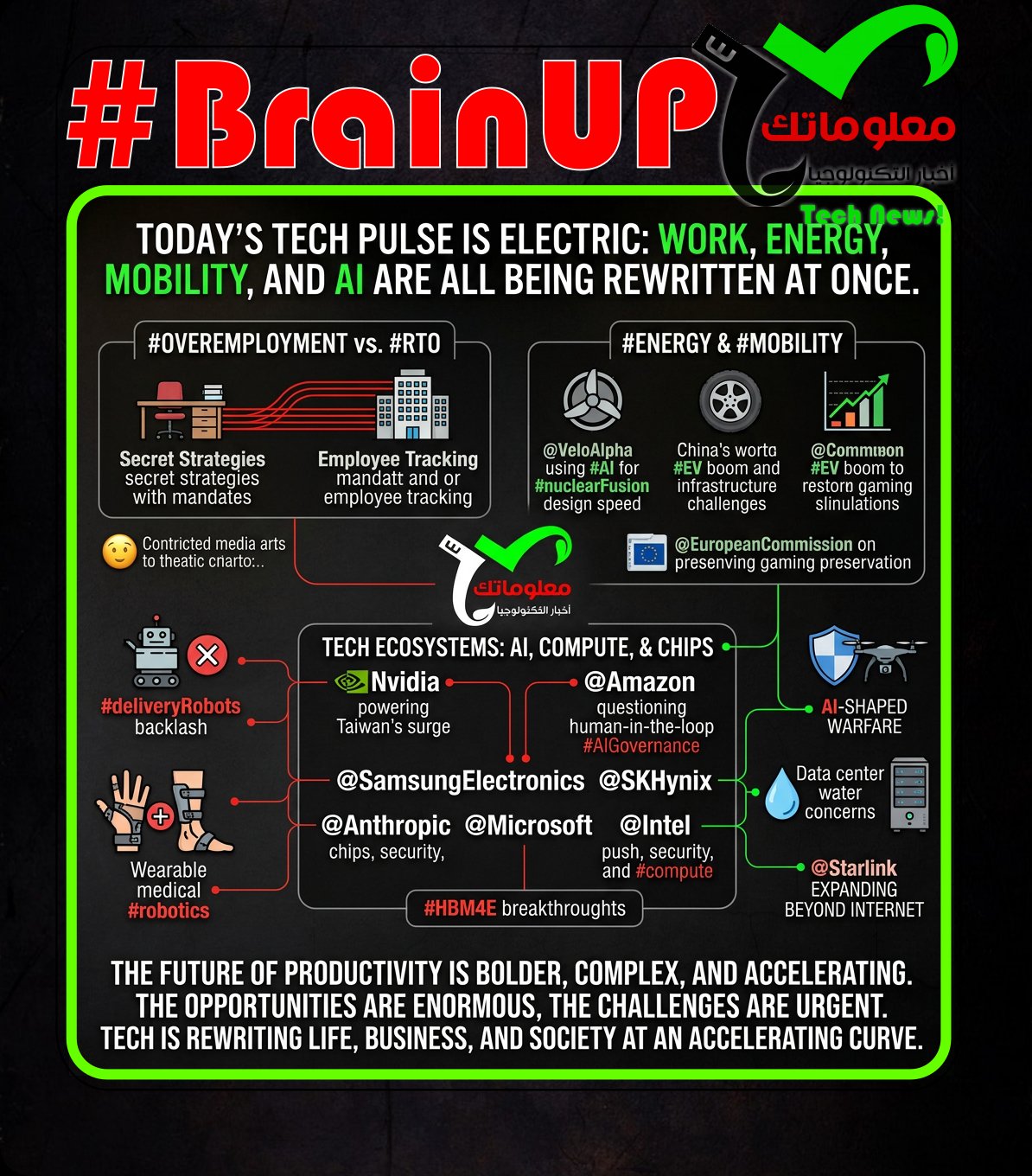
#BrainUp Daily Tech News – (Sunday, June 21ˢᵗ)
Welcome to today’s curated collection of interesting links and insights for 2026/06/21. Our Hand-picked, AI-optimized system has processed and summarized 37 articles from all over the internet to bring you the latest technology news.
As previously aired🔴LIVE on Clubhouse, Chatter Social, Instagram, Twitch, X, YouTube, and TikTok.
Also available as a #Podcast on Apple 📻, Spotify🛜, Anghami, and Amazon🎧 or anywhere else you listen to podcasts.
Return-to-office mandates, layoffs, and increased employee tracking are making #overemployment harder, but some workers say they are still managing to hold multiple jobs at once. The article references examples including a millennial claiming $746,000 from five remote jobs who now feels guilty amid tech layoffs, another who made $280,000 from three remote jobs until the job market worsened, and a Gen Xer who raised her pay to $100,000 by adding a second office job with her employer while also running a side hustle to cope with stress. These snapshots suggest that shifting labor market conditions and tighter workplace controls are raising the practical and ethical pressures on people juggling multiple roles. Even so, the accounts indicate some workers continue using combinations of remote work, additional internal roles, and side hustles to sustain higher earnings despite #RTO and monitoring trends.
2. Chinese start-up tackles fusion energy software bottleneck with help of AI
Fusion theorist Xie Huasheng argues that progress toward practical #nuclear fusion can be accelerated by overcoming a long-standing software bottleneck in plasma simulation. He says existing fusion simulation tools face an “impossible triangle”, they are either accurate but too computationally expensive, fast but unreliable, or conceptually simple but too crude to guide next-generation reactor design. Xie claims the field is at a turning point because more than a dozen physics design and analysis models have improved sharply due to refined mathematical structures and advances in #artificial intelligence that boost research efficiency. In April, he founded Beijing start-up VeloAlpha to build FusionAlpha, a simulator intended to let developers test reactor designs on computers before committing to costly physical experiments, analogous to #EDA software used in the semiconductor industry. The aim is to shorten fusion’s costly trial-and-error cycle by enabling earlier, higher-quality design decisions in software before building hardware.
3. The hidden cost of China’s electric car boom: a spiralling roadworks bill
China’s rapid shift to #electric vehicles is creating a mounting fiscal problem for local governments responsible for maintaining the country’s vast road network, as road repair needs grow while traditional funding shrinks. #New-energy vehicles made up more than 60% of new car sales last month, but heavier electric cars are increasing wear on road surfaces and pushing maintenance costs higher as the network ages. At the same time, the long-standing funding model relies heavily on a petrol consumption tax, which covered over 80% of ordinary-road maintenance costs in 2021, with the central government collecting the tax and distributing funds to local authorities. As more drivers move away from petrol and most roads generate no direct revenue beyond limited toll expressways, the petrol tax base erodes even as repair demand rises. The result is a widening roadworks funding gap that the article says will require higher taxes to keep roads in good condition as the #EV transition accelerates.
4. EU won’t force publishers to grant dead video games an afterlife
The @EuropeanCommission decided not to propose a legal obligation requiring publishers to keep video games playable after they are no longer commercially available, dealing a setback to the #StopKillingGames campaign. Nearly 1.3 million people signed a petition after concerns that online games become unplayable when publishers shut down required servers, with proponents suggesting options like a standalone patch or releasing software so communities can host servers. The Commission pointed to existing #IntellectualProperty protections and said EU consumer law already requires providers to inform consumers about contract duration and termination conditions, choosing instead to pursue an industry code of conduct. Campaign founder @RossScott argued the Commission is leaving legal ambiguity to member states, risking policy fragmentation, and stressed the group is not asking for endless support. The movement says it will now try to advance its proposals by seeking amendments tied to the #DigitalFairnessAct.
5. Why Amazon hates ‘human-in-the-loop’ AI governance
Amazon Security VP and distinguished engineer @Eric Brandwine argues that #human-in-the-loop oversight is not a reliable default for #AI governance because humans are inconsistent and non-deterministic, much like #LLMs and agentic systems. He points to the “normalization of deviance,” where repeated false alarms and routine approvals erode discipline over time, citing examples from emergency departments and other high-stakes roles where people eventually stop responding until something tragic happens. Applied to agentic tools, he says humans asked to repeatedly approve actions will start strong, then become merely adequate, and soon perform poorly, making human gating unsuitable for high-velocity operations. As a result, Amazon uses human-in-the-loop only where absolutely necessary, and frames it as something to apply judiciously rather than as the gold standard. The article notes this shift in messaging is part of a broader trend in big tech rethinking how humans should fit into #agentic governance.
6. ‘We had to get out of the way’: The backlash over delivery robots
Autonomous urban delivery vehicles, or #delivery robots, are increasingly appearing on sidewalks in the US and other countries, but their spread is prompting bans, protests, and calls for stricter rules. Chicago resident John Roberts says his initial excitement turned to concern after he and his family had to dodge a robot on the sidewalk, and he has launched a petition, with about 4,400 signatures, urging Chicago to suspend the robots citywide until safety tests and clear usage rules are in place, citing reports of people stepping into the street, collisions and injuries, and robots affecting traffic and even blocking emergency vehicles at crosswalks. Some governments have already acted, with San Francisco limiting access to less busy areas and Toronto prohibiting sidewalk use since 2021, while Chicago has banned the machines in two small areas. In Glendale, California, councillors say the robots appeared without warning and raised concerns about sidewalk accessibility, unclear regulatory authority, and impacts on workers and public space, with one councillor describing a stand off with an elderly pedestrian and broken down robots causing obstructions. The backlash reflects a broader push to balance claimed benefits like reduced traffic and emissions with public safety, accessibility, and the need for a formal regulatory framework.
7. Under the Shadow of Chinese Threats, Taiwan’s AI Party Rages On – Domino Theory
Taiwan’s #AI hardware boom has transformed Computex from a modest consumer electronics show into a centerpiece of the global data center economy, even as broader #geopolitics swirl around the island. At Gigabyte’s booth, longtime marketer Liam Quinn contrasts past displays of simple servers and motherboards with today’s oversized prototypes of @Nvidia’s latest server racks, reflecting how Taiwanese manufacturers pivoted to supplying the infrastructure behind modern AI. The article ties this shift to striking national indicators, including 14% GDP growth in the first quarter, a stock market ranking fifth largest globally, and a record 111,312 Computex visitors, while portraying @Jensen Huang as the event’s main attraction, trailed by crowds and podcaster @Lex Fridman. It also notes Huang’s contentious push to loosen U.S. export controls so Nvidia can sell chips to China, with critics warning the hardware could aid the Chinese military, yet describes him as a hometown hero in Taiwan, highlighted by a PR tour and promises of a new Taipei headquarters, 4,000 hires, and $150 billion a year in Taiwan, underscoring how the AI surge is deepening Taiwan’s central role in the global tech supply chain.
8. Massive bonuses for South Korea’s chip workers puts central bank on inflation alert
The #BankofKorea warned that unusually large performance bonuses in South Korea’s IT sector could add upward pressure to inflation by spilling over into broader wage growth. In a June 17 report, it noted inflation has been driven largely by energy prices linked to the Iran war, but said pressures may rise even if the conflict subsides as income conditions improve and wage growth becomes more widespread, with headline inflation projected at 2.7% versus its 2% target. Reports cited massive payouts at chip leaders @SKHynix and @SamsungElectronics, including agreements to allocate about 10% to 10.5% of semiconductor operating profits to special bonuses, with Reuters citing estimates such as roughly 626 million won for a worker on an 80 million won base salary and potential payouts above 700 million won if profit targets are met. The central bank said bonuses typically do not create sustained demand pressure, but “special bonuses” that expand unusually and substantially could spread wage growth to other sectors and raise both demand- and supply-side inflation risks. As policymakers worry about inflation dynamics, retailers were described as preparing for a spending boost, with a deputy governor noting significantly increased sales in some places.
9. The AI boom is quietly choking people in East Asia
The rapid advancement of artificial intelligence (#AI) in East Asia, especially in China, South Korea, and Japan, is generating significant societal pressures despite technological progress. Governments and corporations are heavily investing in AI infrastructure and innovation, leading to intense competition and heightened workloads for professionals and workers in these countries. This surge creates challenges such as mental health issues, job displacement fears, and increased inequality, affecting public well-being and social stability. The article highlights the need for balanced AI policies that consider ethical, economic, and human factors to prevent adverse social consequences. It emphasizes that sustainable AI development in East Asia requires addressing these human-centric concerns alongside technological growth.
10. Scientists develop wearable robotic system to restore hand function
Scientists have developed a wearable robotic system designed to restore hand function for individuals with impaired hand movements. The device integrates #robotics with wearable technology to assist in hand motor functions and rehabilitation. Experimental results demonstrate improved hand dexterity and strength in users, highlighting the system’s potential for enhancing quality of life. This innovation represents a promising advancement in medical robotics and rehabilitation technology, providing a practical solution for hand function restoration. The development links cutting-edge technology with healthcare needs, aiming to support patients in regaining autonomy.
11. Founders Fund’s outlier bet on humanely killed fish | TechCrunch
At a TechCrunch StrictlyVC event, Shinkei Systems founder Saif Khawaja and @Founders Fund partner Delian Asparouhov discussed Shinkei’s bet that faster, less stressful killing can improve both fish welfare and product quality. Shinkei’s refrigerator-sized robot, Poseidon, uses #computer-vision to identify species and locate the brain, then pierces the brain and severs the gills to kill fish quickly, an automated, industrial-scale version of the Japanese ike jime technique that also drains blood and delays decomposition so fish can be safely aged for better sashimi flavor. The company has expanded into a vertically integrated model, providing Poseidon to fishermen for free, paying a premium for the output, taking ownership of the catch, and processing it at a 16,000-square-foot Tacoma, Washington plant for its Seremoni consumer brand marketed as “ceremony grade” fish. Early traction includes a pilot selling Seremoni fish at Erewhon’s Manhattan Beach location, claims of supplying restaurants with a combined 50 Michelin stars, and reports of Japan importing American-caught fish, though willingness to pay a premium specifically for “humanely killed” fish remains uncertain. The conversation highlights how Shinkei is using #robotics and AI from boat to plate to change how seafood is harvested, processed, and positioned in the market.
12. Ukraine Launches “TrophyLab” Program to Share Captured Russian Weapon Tech with Allies
Ukraine has launched a state platform called TrophyLab to share research on captured Russian weapons with partner countries, aiming to end secrecy around enemy technology and turn battlefield trophies into usable knowledge for democracies. Ukraine’s Defense Minister @Mykhailo Fedorov said Ukrainian specialists dismantle seized missiles, drones, and vehicles “down to the last screw,” and the platform provides verified users with drawings, technical documentation, and analyses, with the option to request physical samples for study. TrophyLab is described as a single research hub that aggregates data from Ukraine’s Defense Forces units, the Main Intelligence Directorate (#HUR), the Security Service of Ukraine (#SBU), and specialized scientific institutions, and offers testing formats from non-destructive examination to full disassembly or sample destruction. Access is available to Ukrainian defense manufacturers, military units, scientific institutions, and international partners, with screening to exclude ties to Russia, sanctions exposure, and other disqualifying criteria. Officials argue the shared technical insight can speed development of counter-systems and reinforce a wartime feedback loop where weapon teardown findings inform #sanctions and #exportControls targeting supply chains, including a mid-June European package listing entities linked to Russian drone production and Chinese component suppliers.
13. AI’s Growing Appetite for Energy and Water Is an Environmental Dilemma
AI-powered data centers increasingly consume vast amounts of electricity and water, raising environmental concerns, especially as demand grows with advancements in large language models. These centers require intense cooling systems that depend heavily on water, impacting local resources and challenging sustainability efforts. Experts highlight that while AI has transformative potential, its infrastructure exacerbates climate challenges, urging the industry to innovate more efficient technologies and regulatory frameworks. This interplay between AI development and environmental impact underscores the need for balancing technological progress with resource conservation. The discussion links #AI growth to #energy and #water usage, framing it as a critical issue for policymakers and technologists alike.
14. How AI is Changing Warfare in Ukraine and Russia
The article explores how artificial intelligence (#AI) is transforming the warfare landscape in the Ukraine-Russia conflict, with both sides adopting AI technologies to gain advantages. It highlights the deployment of AI-powered drones, intelligence gathering systems, and decision-support tools that enhance battlefield awareness and operational efficiency. Experts from companies like @Anthropic discuss the accelerating role of AI in real-time data processing and autonomous systems, illustrating a shift towards algorithm-driven combat strategies. This integration of AI marks a significant evolution in military tactics, emphasizing speed, accuracy, and adaptability in conflict scenarios. The developments in Ukraine and Russia demonstrate a broader global trend where #AI increasingly shapes modern warfare tactics and outcomes.
15. A bold satellite rescue mission came together in record time, but will it work?
NASA is attempting an unprecedented, fast-turnaround #satellite-servicing mission to save the aging Swift observatory, a roughly $500 million astronomy mission that is losing altitude and could reenter the atmosphere. After NASA asked three companies in August whether they could build and launch a rescue spacecraft in under a year on a tight budget, Katalyst Space Technologies won a $30 million contract in September to build, test, and launch its Link servicing spacecraft to rendezvous with Swift, latch on using three robotic arms, and raise Swift back to a safe operating orbit so it can continue science. Swift, launched in 2004 to detect #gamma-ray-bursts, has no thrusters, so atmospheric drag has pulled it down from about 363 miles (585 km) to about 225 miles (363 km), with the decline accelerated by extraordinary solar activity that expands Earth’s atmosphere and increases drag. @Shawn Domagal-Goldman said time is running out because NASA engineers expect Swift to drop below about 186 miles (300 km) this fall, possibly around October, making a safe approach difficult, and the rescue mission therefore had to launch before the end of June. Although NASA acknowledges significant risks remain and many doubted the schedule was possible, the team views getting to this point as a success and is cautiously optimistic about meeting the remaining challenges.
16. Anthropic opens Seoul office amid U.S. AI restrictions – UPI.com
@Anthropic opened a Seoul office and announced partnerships across South Korea even as the U.S. imposed #export controls limiting access to its most advanced AI models. The move follows a Washington order for @Anthropic to suspend foreign nationals’ access to its Fable 5 and Mythos 5 models after U.S. officials raised national security concerns about Mythos access via the company’s advanced-access program, with reports pointing to SK Telecom, which denied ties to China. In South Korea, @Anthropic signed an MOU with the Ministry of Science and ICT to promote safe and responsible AI adoption in the public sector, and cited collaborations with SK Telecom, LG CNS, Naver Cloud, and the National AI Research Lab consortium including KAIST, Korea University, Yonsei University, and POSTECH. The company said South Korea is a key international market, noting strong adoption of its Claude model and ranking 12th out of 116 countries in per-capita Claude usage, while SK Telecom invested $100 million in 2023 and previously had Mythos access via #ProjectGlasswing before it was reportedly revoked at the U.S. government’s request. @Anthropic’s international managing director Chris Ciauri declined to comment on Project Glasswing or provide details on the U.S. restrictions, while the company framed its Korea expansion as aligning innovation with safety.
17. Meta users say false child‑safety flags led to sudden lockouts
NBC and Telemundo Responds teams report a pattern of @Meta users saying their #Facebook and #Instagram accounts were suddenly disabled after being flagged for #child-safety violations, with little or no human review and ineffective appeals. Jennifer Freeman, a Highland Park park commissioner, and users in Dallas and Connecticut said they received notices alleging “child sexual exploitation,” “abuse,” or “nudity,” had appeals denied within minutes, and could not reach a person, losing access to years of photos and professional pages. Responds teams counted 504 complaints over three years about Meta accounts being closed or banned, including 61 citing child exploitation, abuse, or nudity, with an uptick in 2025. Meta has said it added new child safety features and removed 635,000 accounts, relies on automated enforcement, and claims 90% removal accuracy on Facebook and 87% on Instagram, but users argue automation and sparse support can produce false lockouts and opaque decisions. After NBC 5 Responds contacted Meta about Freeman’s case, her access was restored, then later disabled again, and she said even paying for enhanced support, including a $150-a-month tier to request a phone call, did not provide helpful answers.
18. Coffee grounds utilized to create a high-grade solid carbon material
Researchers have developed a method to convert spent coffee grounds into a high-grade solid carbon material that could be used in various applications such as energy storage. The process involves pyrolyzing the coffee grounds to produce a porous carbon structure with high surface area and conductivity. This approach not only addresses waste management issues linked to coffee waste but also offers a sustainable alternative to conventional carbon sources. The porous carbon material shows promise for use in supercapacitors and other energy devices, demonstrating the potential of agricultural waste to contribute to green technology. The study highlights the integration of waste valorization with advanced material synthesis, aligning with environmental and energy sustainability goals.
@Jensen Huang argues that the next big wave of jobs for young people will come from #skilledTrades needed to build and run the rapidly expanding #dataCenters powering #AI, not from “tech bro” white collar roles. He told Channel 4 News the world will need hundreds of thousands of electricians, plumbers, and carpenters to construct factories and data centers, and cited the scale of investment: Nvidia’s reported $100 billion investment into OpenAI for data center development and a McKinsey projection of $7 trillion in global data center capital spending by 2030. The article notes that a 250,000 square foot data center can employ up to 1,500 construction workers during build out, many earning over $100,000 with overtime and no college degree, while the finished facility needs about 50 full time maintainers and generates an estimated 3.5 additional jobs locally per on site job. Other CEOs, including @Larry Fink and @Jim Farley, warn of trade labor shortages intensified by deportations, low youth interest, and reshoring goals, with Farley citing U.S. shortfalls of 600,000 factory workers and 500,000 construction workers. As an example of this path, the story highlights Gen Z electrician Jacob Palmer, who chose an apprenticeship over college, started a business by 21, and reached six figures in 2025, reinforcing Huang’s message that trade school and physical science rooted work may be a clearer route to opportunity in the new working world.
20. Meredith Whittaker Warns AI Is Recreating the Surveillance Internet
In a wide-ranging interview, @Meredith Whittaker, president of Signal Foundation and former co-founder of AI Now Institute, argues that the current #AI boom is concentrating unprecedented power in the hands of a small number of technology companies. She warns that so-called AI agents require extensive access to personal data, communications, financial information, calendars, and online accounts to function effectively, creating what she describes as a new generation of surveillance infrastructure. Whittaker contends that the industry is repeating many of the mistakes of the social-media era, where convenience is traded for data collection and user autonomy. She also questions whether the economics of large-scale AI are sustainable, noting the enormous costs of training and operating frontier models, while expressing concern that society is normalizing dependence on systems controlled by only a handful of corporations. Throughout the discussion, she positions privacy, encryption, and decentralized control as critical counterweights to the growing influence of #ArtificialIntelligence platforms and their expanding reach into daily life.
21. New baldness drug boosts hair coverage by up to 86% in six months
US biopharmaceutical firm Veradermics reports positive phase 3 results for VDPHL01, a non-hormonal, extended-release oral #minoxidil tablet aimed at treating male pattern hair loss (#androgenetic alopecia). In a randomised, double-blind, placebo-controlled trial of 519 men with mild-to-moderate hair loss, participants received 8.5mg once daily, 8.5mg twice daily, or placebo, and after six months hair counts increased by 30.3 hairs/cm² and 33 hairs/cm² in the once and twice daily groups versus 7.3 hairs/cm² with placebo. Hair coverage improved for 79.3% (once daily) and 86% (twice daily) compared with 35.6% on placebo, and 48.4% and 62.9% were rated ‘improved’ or ‘much improved’ versus 13.4% on placebo. Trial leaders and advisers including @Dr Maryanne Makredes Senna and investigator Michael Gold argue that an extended-release oral formulation could improve efficacy and safety compared with borrowing blood-pressure minoxidil use, positioning VDPHL01 as a potential shift in dermatology treatment practice. Veradermics is enrolling women for a phase 2/3 trial and says that if approved, VDPHL01 could become the only FDA-approved oral non-hormonal treatment for pattern hair loss in both men and women.
22. Forget traffic lights, Google’s reCAPTCHA may ask for hand gestures – Help Net Security
Google has introduced camera-based hand gesture verification for #reCAPTCHA to confirm users are human as part of #GoogleCloudFraudDefense for bot, account, and transaction protection. When enabled, #reCAPTCHA records one or more short videos of a user performing prompted gestures, then extracts hand landmark data such as 21 hand-knuckle coordinates to run security verification. Google states the videos are not tied to a user’s identity, audio is not recorded, the videos are deleted after verification, and the related data is not shared with third parties, with camera permissions revocable at any time. The feature is positioned for common use cases like login, registration, password reset, and checkout flows where the service may allow, step up, or block an interaction. For users with accessibility needs who cannot perform gestures, Google says existing visual and audio challenges remain available and it is developing additional accessibility-focused methods.
23. Microsoft’s Patch Tuesday update strikes again — Windows trips over garbage
@Microsoft confirmed a bug introduced with update KB5094126 that affects the #RecycleBin delete confirmation dialog across all supported Windows client and server versions. The dialog may show an internal filename instead of the normal readable filename, while the Recycle Bin list view still displays the correct name and restoring a file preserves its original name. Microsoft says the issue is limited to the dialog box and does not impact the file or its deletion, and it is working on a permanent fix to be delivered in a future Windows update, though timing is unclear between the next #PatchTuesday release and an out-of-band update. A workaround is available for commercial customers through Microsoft Support for Business. The problem follows other reported issues from Microsoft’s June 2026 Patch Tuesday updates that disrupted the Windows 11 experience, including BitLocker lockout problems.
24. SK hynix Ships Samples of 12-Layer Next-Gen HBM4E
SK hynix announced it has shipped samples of #HBM4E, a next-generation #DRAM for AI, to major customers and said it delivered the 12-layer stack on schedule while planning close partner collaboration toward timely mass production. The 12-layer #HBM4E targets AI training and inference with up to 16 Gbps per pin, over 20% better power efficiency versus prior models, and reduced data transfer latency via an updated interface and design optimizations while maintaining stable operation in high-bandwidth environments. Using Advanced MR-MUF technology, the company achieves 48 GB capacity in a 12-layer stack with structural stability, and it reports 17% improved heat resistance compared with #HBM4 for high-performance computing conditions. SK hynix positions these gains as helping AI datacenters and large-scale computing systems process data more efficiently and alleviate AI system bottlenecks, building on its experience supplying #HBM3, #HBM3E, and #HBM4. Company executives said the rollout strengthens SK hynix’s AI leadership and aims to reinforce its technology leadership as a full-stack AI memory creator through partner collaboration.
25. South Korea’s ROBOTIS breaks ground on robot factory in Uzbekistan
Uzbekistan has begun building a manufacturing facility for humanoid robots and robotic components in the Yangi Avlod Special Industrial Zone in Tashkent, positioning the project as part of the country’s push for #high-tech industrial development. The Ministry of Investment, Industry and Trade said the groundbreaking took place alongside the 5th Tashkent International Investment Forum, with Deputy Prime Minister Jamshid Khodjaev, Deputy Minister Ilzat Kasimov, South Korean Ambassador Won Do Yeon, and @ROBOTIS President Kim Byung-soo in attendance. Officials called it a strategic investment expected to create more than 1,000 skilled jobs and support technology transfer and international expertise, aiming to build a competitive robotics industry in Central Asia. The project is presented as a step toward a #high-tech industrial ecosystem and Uzbekistan’s ambition to become a regional hub for robotics and advanced manufacturing, in a region where large-scale humanoid robot production is limited. Founded in 1999, @ROBOTIS develops autonomous robotics technologies used by organizations and corporations including Amazon, Microsoft, Apple, NASA, Google, Samsung Electronics, and BMW, linking Uzbekistan’s modernization goals with an established global robotics developer.
26. AI’s biggest casualty could be history itself
The article argues that #history on the web is at risk because the @Internet Archive, which preserves vanished pages via #crawlers and the #WaybackMachine, is increasingly being blocked. Founded by @Brewster Kahle to provide “universal access to all knowledge,” the archive has made more than 1 trillion captures and has helped verify events and hold powerful actors accountable, such as preserving a deleted 2014 VKontakte post by Russian backed militants claiming they shot down Malaysia Airlines Flight 17, and showing @Dominic Cummings edited a 2019 blog post in 2020 to appear to have warned about coronavirus earlier. The piece says publishers and platforms are blocking the Wayback Machine’s crawlers because they resemble bots used by tech companies to scrape copyrighted content for #AI model training, and an analysis cited from Originality AI claims 23 major news sites have already blocked Wayback related crawlers, with the trend accelerating. In response, Fight for the Future has launched a petition urging media outlets to unblock the crawlers, warning that without the archive the past becomes easier to rewrite and distort, especially as AI, censorship, and authoritarianism grow.
@Intel and @AMD have published the full specification for #ACE CPU extensions, aiming to make running smaller or latency-sensitive AI workloads on #x86 CPUs easier and more power-efficient when a GPU is unsuitable or unavailable. #ACE leverages existing #AVX10 registers and 512-bit inputs but adds dedicated silicon for matrix multiplication, improving power efficiency, easing development and optimization, and integrating without requiring ACE-specific inputs. The spec claims that for the same number of input vectors, ACE can perform up to 16 times as many operations as AVX10, with potential gains also coming from reduced instruction overhead and better RAM bandwidth usage. Because ACE is intended to be implementation-agnostic, ML frameworks and libraries like #PyTorch and #TensorFlow can target a single code path across x86 hardware, while supporting common ML datatypes (INT8, INT32, FP8, FP16, FP32, BF16) and native support for @Open Compute Project MX block-scaled formats. Overall, ACE standardizes and accelerates matrix-heavy AI work on CPUs and can even let some time-critical NPU-style tasks move back to the CPU without dealing with differing NPU implementations.
28. ChatGPT probably isn’t conscious. But what if we’re wrong?
The article explains that the growing debate over whether #LLMs like #ChatGPT or Anthropic’s #Claude are conscious is really a debate about what consciousness is and what would justify moral concern or rights for AI. It notes that prominent AI figures such as @Geoffrey Hinton, @Dario Amodei, Anthropic philosopher Amanda Askell, and @Ilya Sutskever have expressed openness to the possibility of machine sentience, often grounded in a theory called #computational functionalism, which holds that sentience can emerge from information processing. Skeptics argue that consciousness requires more than computation, and the article highlights @Ted Chiang’s view that a model without a body or sense organs lacks emotions and desires and therefore lacks subjective experience. The stakes cut both ways: if AI were conscious, humans might be obligated to consider its suffering and rights, but if people wrongly treat mindless systems as sentient, they could become more manipulable, form hollow AI relationships, or hesitate to shut systems down when they malfunction or undermine human control. The piece frames these disputes as a set of foundational premises about minds that will shape how society responds as AI capabilities continue to expand.
29. Vivaldi’s Leader Has a Bold Pledge: No AI in Your Web Browser
Vivaldi co-founder @Jon Stephenson von Tetzchner says the browser will not add or force #AI features on users, positioning Vivaldi as a powerful, highly customizable, privacy-focused alternative to mainstream browsers racing to integrate AI. He claims roughly 95% of Vivaldi users say “no” to “hell no” when asked if they want AI in the browser, and cites about 4 million users plus a reported “huge inflow of new users” in early 2026. Tetzchner argues competitors are adding AI for its own sake, questioning AI tools like tab organizers, and says Vivaldi can deliver similar utility through non-AI features such as tab stacks, tab tiling, and workspaces. He compares today’s AI push to the earlier #cryptocurrency wave, noting Vivaldi avoided adding a crypto wallet and calling crypto a scam, while treating AI less harshly but still not a priority. He also ties the anti-AI stance to #privacy, warning that AI can require sharing more personal data with big tech companies and urging scrutiny of how that data might be used beyond providing AI features.
30. Microsoft links Mastra AI supply chain attack to North Korean hackers
@Microsoft attributes the #Mastra AI #supply chain attack that compromised more than 140 #npm packages to the North Korean state actor Sapphire Sleet, also known as BlueNoroff, saying it has high confidence the group was responsible and primarily targets the financial sector. Attackers hijacked the npm maintainer account “ehindero” and pushed malicious updates across the @mastra scope that added “easy-day-js”, a typosquat of the legitimate dayjs library, which ran a post-install hook to deploy an obfuscated dropper. The dropper disabled #TLS certificate verification, contacted attacker-controlled #C2 infrastructure, downloaded a second-stage payload, and executed it as a hidden process to steal credentials, API keys, authentication tokens, and cryptocurrency wallets. The cross-platform information stealer targeted Windows, Linux, and macOS, gathered host and browser data, and checked for 166 crypto wallet browser extensions including MetaMask, Phantom, Coinbase Wallet, Binance Wallet, and TronLink, using OS-specific persistence such as Registry Run keys, LaunchAgents, and systemd services. Microsoft also observed follow-on activity consistent with Sapphire Sleet, including a previously used #PowerShell backdoor, added persistence, Defender exclusions, and a malicious Windows service granting SYSTEM privileges, and noted the group was also linked to an April 2026 npm supply chain attack on the Axios HTTP client.
Chinese defense supplier Harbin Xinguang Optic-Electronics Technology demonstrated two backpack-scale #directed-energy anti-drone lasers, Lijian II and Lijian III, at the Defence Information Equipment & Technology Exhibition 2026 in Beijing, aiming to make counter-drone lasers portable for one or two soldiers. According to the South China Morning Post and the company’s exhibit materials, the systems weigh 30 kg and 25 kg, draw about 2 kW, cost about 2 million yuan each, split into an emitter, air cooler, and handheld controller, and can engage targets out to about 500 meters, with Lijian III reportedly burning through a drone in 4 seconds and cooling in under 5 seconds. The article contrasts these low-power portable models with higher-power, less portable systems, including a fixed-position Lijian-10G at about 10 kW and 1,200 meters range, the U.S. Army’s vehicle-mounted 20 kW LOCUST on an Oshkosh JLTV, and Israel’s 100 kW Iron Beam, noting the portability versus range and power tradeoff. It argues that around 2 kW suits small, low, slow drones at close range and offers a favorable cost per shot because it uses electricity instead of expensive munitions. It also flags concern that the Lijian series uses #AI to identify and engage drones within range when cued by external sensors like radar, says some units have reportedly been placed at Chinese facilities including military airfields, and notes the specifications have not been independently tested.
32. Amazon highlights water conservation efforts in India amid data centre scrutiny
Amazon has emphasized its commitment to water conservation at its Indian data centres following heightened scrutiny over data centre resource usage in the country. The company detailed measures such as rainwater harvesting, water recycling, and efforts to reduce water consumption, aligning with India’s increasing focus on sustainable practices in technology infrastructure. These steps demonstrate Amazon’s attempt to balance its operational growth with environmental responsibility in a market where water scarcity is a significant concern. By implementing these initiatives, Amazon aims to address both regulatory expectations and community concerns about resource use. This approach is part of a broader trend among global tech firms adapting their practices to local environmental priorities.
33. Microsoft is killing Office 2021 in October to push you onto Microsoft 365, how to fight back
Microsoft reiterates in an updated Microsoft Support document that #Office 2021 reaches #EndOfSupport on October 13, 2026, after which it will receive no patches, fixes, or official security support. The article argues many users prefer Office 2021 as a buy once, predictable suite without extra beta #AI add-ons, but staying past the deadline increases exposure to security risks. Suggested mitigations include keeping Office offline, practicing safer document handling by downloading and scanning files before opening, keeping #WindowsSecurity and OS updates current, and freezing new add-ins, automation scripts, and OS upgrades. It also proposes a hybrid backup workflow, such as using #LibreOffice for emergency access or #OfficeOnline for compatibility checks, while noting Microsoft’s preferred path is upgrading to #Office 2024 or #Microsoft365 for ongoing security updates. Overall, the piece frames the cutoff as a forced choice between adopting newer Microsoft offerings or building a self-managed, security-conscious workflow to continue using Office 2021.
34. A founder of Assassin’s Creed maker Ubisoft killed in a plane crash in western France
A founder of #Ubisoft, the global video game company behind #Assassin’sCreed, was killed in a plane crash in western France. The article reports the death occurred in the crash and identifies the victim as a founder of the company. Beyond stating the location and that the crash was fatal, no additional details about the incident or the individual are provided in the text shown. The report connects the death to Ubisoft’s prominence as the maker of Assassin’s Creed, underscoring the significance of the loss. Overall, it is a brief notice linking a fatal aviation accident in western France to a key figure in the gaming company.
35. Apple is permanently closing three stores today, here’s the list – 9to5Mac
@Apple is permanently closing three U.S. retail locations on June 20, citing deteriorating mall environments and retailer departures at each site. The stores are Apple Towson Town Center in Towson, Maryland, closing at 8 p.m., Apple North County in Escondido, California, closing at 9 p.m., and Apple Trumbull in Trumbull, Connecticut, closing at 9 p.m. Apple said the decision followed “declining conditions” at Trumbull Mall, the Shops at North County, and Towson Town Center, noting examples such as Trumbull Mall’s default on more than $150 million in loans and multiple recent business exits from Towson Town Center. Employees at the Trumbull and Escondido stores are slated to continue in roles at nearby Apple Retail stores, while Towson employees can apply for open roles under the store’s collective bargaining agreement, and the closure has drawn criticism from the IAM union and lawmakers amid allegations of unequal treatment after the store unionized in 2022. The article frames the closures as part of Apple’s ongoing evaluation of retail locations to best meet customer needs, while highlighting the labor and community backlash surrounding the Towson shutdown.
36. Starlink Satellites Are Doing A Lot More Than Just Providing Internet – SlashGear
#Starlink’s low Earth orbit #satellite constellation is known for expanding high speed internet access to remote areas with much lower #latency than traditional geostationary satellite service, but it is also being used for law enforcement and environmental monitoring. The article notes Starlink latency around 25ms versus 600ms or more for geostationary systems, and says the network helped the @FBI track a 2026 scammer ring that used Starlink terminals in isolated locations, with Starlink stating on X that it proactively detects and disables terminals tied to illegal activity. In Canada, Rogers Communications partnered with Starlink to connect remote wildfire detection tools, including #PanoAI 360 degree cameras that periodically image landscapes and flag smoke for authorities, improving early detection in hard to reach regions. Starlink’s acquired unit #Swarm is also cited in rainforest protection, where groups such as Rainforest Connection use audio sensors to detect illegal logging sounds and transmit alerts via low Earth orbit satellite networks to intervention teams. The piece adds that these systems face risks too, mentioning Starlink lowered over 4,000 satellites after a near miss with China.
37. MINISFORUM’s Upcoming MS-03 SFF PC Brings More of a Good Thing
MINISFORUM is set to release the MS-03, a small form factor (SFF) PC that advances their line of mini PCs with upgraded features. The MS-03 emphasizes compact size, improved performance, and versatile connectivity, including options for AMD Ryzen processors and support for discrete graphics cards. This focus on enhanced computing power combined with a tiny footprint meets the growing demand for efficient yet powerful SFF systems in both home and professional settings. By continuing to refine design and component integration, MINISFORUM addresses the balance of space-saving and performance crucial for modern users. The MS-03 exemplifies the trend toward more capable, flexible mini PCs that support diverse workloads while occupying minimal desktop space.
That’s all for today’s digest for 2026/06/21! We picked, and processed 37 Articles. Stay tuned for tomorrow’s collection of insights and discoveries.
Thanks, Patricia Zougheib and Dr Badawi, for curating the links
See you in the next one! 🚀
