
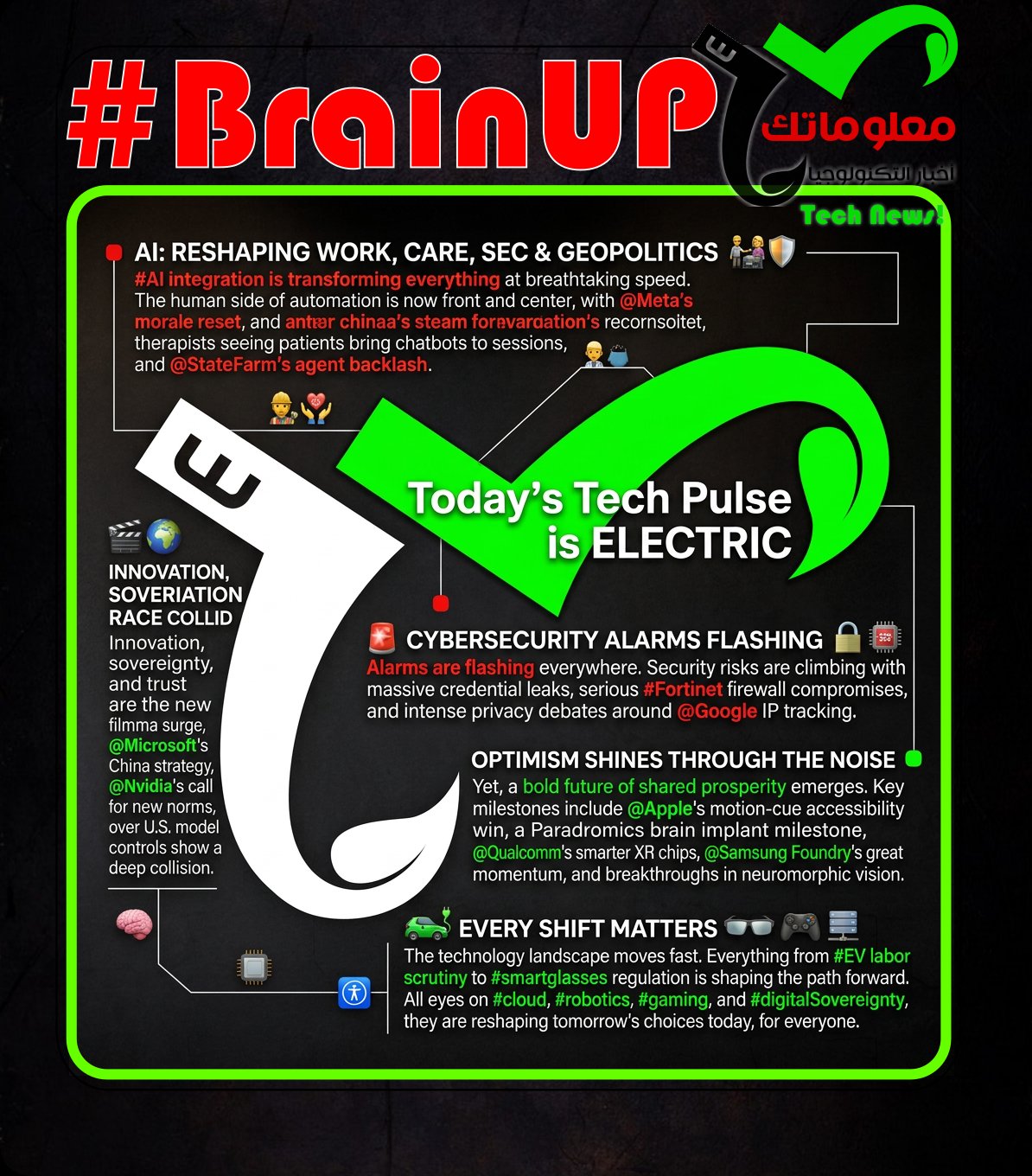
#BrainUp Daily Tech News – (Thursday, June 18ᵗʰ)
Welcome to today’s curated collection of interesting links and insights for 2026/06/18. Our Hand-picked, AI-optimized system has processed and summarized 42 articles from all over the internet to bring you the latest technology news.
As previously aired🔴LIVE on Clubhouse, Chatter Social, Instagram, Twitch, X, YouTube, and TikTok.
Also available as a #Podcast on Apple 📻, Spotify🛜, Anghami, and Amazon🎧 or anywhere else you listen to podcasts.
1. Meta CTO Flags Employee Morale Concerns After Recent Layoffs: Report
@Andrew Bosworth, #Meta’s CTO, warned employees that morale is near a 20 year low as the company absorbs major layoffs and a broad #AI pivot. In internal remarks and a staff memo, he compared the atmosphere to the period around the Cambridge Analytica scandal, said leadership did an “atrocious” job explaining the #AI restructuring, and admitted the process undermined trust in employees’ expertise and career growth. He pledged more transparency, better support for smart risk taking, and efforts to rebuild culture, while the company increased budgets for travel, events, and office perks, and allowed some employees reassigned to #AI teams to apply for other roles. The concerns follow repeated workforce reductions since late 2022, culminating in May 2026 cuts of about 8,000 jobs, roughly 10% of a ~78,000 workforce, alongside scrapped hiring plans, steps described as necessary to fund #AI infrastructure and reallocate resources to #AI development. The report links the morale drop directly to the scale of layoffs and the disruptive reorganization designed to accelerate Meta’s #AI ambitions.
2. Patients are bringing AI to therapy
According to APA’s 2026 Chatbots and Mental Health Survey of more than 1,200 U.S. licensed psychologists involved in patient care, many clinicians are encountering patients who use #AI and chatbots alongside traditional psychotherapy. Psychologists reported that 77% have had patients talk about using AI for support, engagement, or other purposes, including seeking a diagnosis, emotional support, or conversation. Nearly two in five psychologists (39%) said patients reported using AI to self-diagnose, even though common chatbots are not designed to interpret psychological tests or diagnose conditions; 33% said patients use AI to assist therapy or treatment, 34% reported use for self-discipline, affirmations, or reminders, and 35% said patients use AI as an additional mental health professional. The report notes these figures may not represent overall public use because they reflect only psychologists’ current patients, and it suggests some groups, including teens, may use AI for affordability and accessibility. APA cautions that AI is not a safe or effective replacement for qualified mental health providers and says it created guidance for using AI-generated advice thoughtfully and safely, including appropriate and inappropriate uses for mental, emotional, and behavioral health.
3. State Farm’s AI Plan for Sales Agents Sparks Uproar: ‘A Real Slap in the Face’
State Farm’s introduction of AI tools to assist sales agents has provoked significant backlash from its workforce, who view the move as a devaluation of their expertise and a threat to their jobs. Employees express concerns that AI-driven prompts and suggestions could undercut personal relationships and trust built with customers, which are central to insurance sales. Critics argue that while AI aims to enhance efficiency, it risks alienating agents by diminishing their autonomy and unique value. This backlash highlights broader tensions in the insurance industry around automating sales roles and integrating #artificialintelligence without compromising human elements. The controversy at State Farm underscores the challenges companies face when balancing innovation with employee morale and customer experience.
4. China Plans Mechanism to Evaluate AI’s Impact on the Job Market
#China is developing a formal framework to assess how #ArtificialIntelligence affects employment, reflecting growing concerns that automation could disrupt labor markets across multiple sectors. Regulators are reportedly exploring methods to measure job displacement, workforce transformation, and emerging skill requirements before approving or expanding major AI deployments. The initiative highlights Beijing’s attempt to balance rapid AI innovation with social stability, as policymakers seek to identify industries most vulnerable to automation while promoting retraining and workforce adaptation programs. The move signals a broader shift toward evaluating AI not only for technological performance but also for its economic and societal consequences.
5. China leads AI filmmaking revolution – Global Times
While Hollywood argues over adopting generative AI after @Martin Scorsese joined Black Forest Labs, China is rapidly deploying #generativeAI across film production, highlighted by its first full-process AI-generated animated film, The Reunion Journey, made end-to-end with an #AI pipeline from script to compositing. Producer Li Guanyu says AI could push animation toward a “theatrical web series” model with lower costs, faster iteration, multiple annual releases, stronger IP building, and revenue beyond box office through merchandising, licensing, and exports. The trend is widening: Bonna Pictures’ AI-co-created Sanxingdui obtained a public screening permit, dramas used AI to cut virtual scene work from two months to two weeks and reduce preparation time by two-thirds, and micro-dramas report costs falling to one-third or even one-tenth with hundreds of new AI comic dramas launching daily in early 2026; major bases are pairing LED virtual stages with AI scene generation, and China Film Group’s institute can generate storyboards and previews in minutes. Chinese creators also stress limits, with director Liu Jiacheng arguing AI can optimize preferences but not create human resonance or uniqueness, and Feng Yuanzheng noting technically flawless AI images can still lack distinctive, human “happy accidents,” suggesting China’s push is framed as acceleration of production while keeping human artistry central.
6. Microsoft makes big AI inroads in China by selling OpenAI models, Bloomberg
@Microsoft has built a sizable business in China selling #AI models and cloud services, often using @OpenAI models, even as US China rivalry over #artificialIntelligence intensifies. People familiar with the matter say @ByteDance has been Microsoft’s biggest AI customer and is on track to spend more than US$1 billion a year on Microsoft AI and #Azure services, with @AntGroup, @Meituan, and @Tencent also significant spenders via Azure. Microsoft views its China presence as useful for tracking local innovation and serving multinational customers, though the operation is small, about 1.5% of 2024 revenue per president @BradSmith’s congressional testimony. The approach is controversial because US executives and lawmakers warn China’s AI push could threaten the US industry, and @Anthropic and @OpenAI do not sell models to China over concerns such as IP theft or harmful uses, while Microsoft has been more bullish. In an internal July 2025 sales meeting, then chief commercial officer @JudsonAlthoff cited rapid AI growth in China and framed Microsoft as uniquely connecting leading US and Chinese AI hubs.
7. Nvidia CEO Jensen Huang says we need to change our social norms around AI
@Jensen Huang argues that society needs new social norms around #AI, alongside regulation and technology changes, because adoption is happening quickly. Speaking to the Associated Press, he compares AI to early automobiles, where fears about harm led to new norms and rules like warning children not to play in the street and setting speed laws. When pressed for a specific AI norm, he says he would advocate that everyone use AI and engage with it, a response the author criticizes as weak and not truly analogous to car safety limits. The piece also disputes Huang’s claim that AI is free and easy to use, arguing that free tiers are subsidized, raise broader tech costs, and consume large amounts of energy. It concludes that Huang’s push for widespread use may reflect concern about sustaining end user demand for AI, which ultimately affects #Nvidia’s hardware business, even as Nvidia remains highly profitable while many of its customers are not.
The US government has abruptly halted exports of Anthropic’s advanced AI models, including Fable 5, raising concerns among European and Canadian leaders about the sudden export restrictions. This move reflects escalating tensions in global AI leadership and U.S. efforts to control sensitive technologies amid competitive geopolitical pressures. Experts fear the bans may disrupt international AI development collaborations and innovation while possibly fragmenting the global AI ecosystem. The decision underscores the increasing centrality of AI technology in national security and economic strategies, prompting allies to reassess their dependencies on US-controlled AI resources. This event highlights the evolving landscape of AI governance where export controls become critical instruments for technological dominance and alliance diplomacy.
10. How one US Army brigade is learning to sacrifice robots in lieu of humans – Breaking Defense
During an April #JRTC rotation at Fort Polk, the 3rd Mobile Brigade Combat Team, 101st Airborne Division tested a #roboticCombinedArmsBreach to reduce risk to infantry at the most dangerous “breach point” of an assault, according to Col. Ryan Bell. Soldiers held back while dozens of soldier-built purpose-built attritable system drones called Abe-101s and two #UGVs attacked simulated enemy defenses, with some drone waves carrying attack munitions against jammers, bunkers, vehicles, and fighting positions, and other waves dropping smoke to disorient defenders. The UGVs then delivered 28-pound breaching charges to remotely detonate through mined, wired obstacles and open lanes for infantry to enter. Bell said the exercise was successful, arguing the drones and UGVs “absolutely did what we asked” and validated keeping soldiers in reserve until needed, aiming to make the breach effectively uncontested for riflemen. The article notes the effort aligns with lessons observed from Ukraine’s expanding use of drones and UGVs, while the US Army has also shown interest in unmanned systems through solicitations focused on CASEVAC and logistics roles.
11. Apple’s weird anti-nausea dots cured my car sickness
#Vehicle Motion Cues, an @Apple accessibility feature introduced in 2024 for iPhone, iPad, and Mac, can reduce or even eliminate motion sickness when using screens in a moving vehicle. The author says it let him read for hours in Kindle and write a 1,000-word review on mountain roads in a camper van, and his wife now uses it too. The feature uses the device’s accelerometer and gyroscope to animate dots around the edge of the display that move with the car’s turns, braking, and acceleration, addressing the mismatch between a static screen and the inner ear’s sense of motion. It is configurable in iOS, iPadOS, and macOS to be on, off, or automatic, with adjustable dot size, color, and density, though the author notes dots can interfere with maps and content on long straight stretches when they sit still. He recommends quick toggling, including using iOS Back Tap on supported devices, to enable the dots only when needed.
12. Tesco moving 40,000 server workloads off VMware amid Broadcom’s “abusive conduct”
Tesco says it is migrating about 40,000 server workloads away from #VMware after @Broadcom’s post-acquisition actions, described in UK High Court filings as “abusive conduct,” disrupted previously purchased licensing and support arrangements. Tesco alleges it bought perpetual licenses for #vSphere Foundation and #Cloud Foundation, subscribed to #VMware Tanzu, and secured support through 2026, but after @Broadcom acquired VMware in November 2023 it would not honor the deal, required “duplicative” subscription licenses to obtain support, and in January stopped supporting Tesco’s VMware products, pushing Tesco onto third-party support. Court filings reported by The Register say Tesco has incurred material costs and business risk to procure alternative solutions with reduced functionality, faces data-security related migration challenges because its new virtualization software is incompatible with #Veeam and #Zerto, and even at an “exceptional pace” expects to be off VMware no earlier than end of 2027. Tesco also claims @Broadcom proposed pricing that was about 175 percent higher than what Tesco believed it should pay for VMware and 350 percent higher for mainframe offerings, calling the increases “manifestly unfair and excessive,” while @Broadcom denies the hike was unfair and argues it should not owe damages tied to Tesco’s search for alternatives. The dispute, in which Tesco initially sought at least £100 million in damages from @Broadcom, VMware, and reseller Computacenter, frames the migration as a costly, risky response to contested changes in #virtualization and mainframe software licensing and support.
13. Poland Invests $11 Million in ElevenLabs to Build AI Tech Hub
The Polish government has committed approximately $11 million to support @ElevenLabs, one of the world’s leading AI voice technology companies, as part of a broader strategy to position Poland as a major European #AI innovation center. The investment aims to strengthen domestic research, attract international talent, and accelerate commercialization of advanced AI technologies. Officials view the partnership as an opportunity to expand Poland’s presence in the global AI ecosystem while encouraging high-value technology jobs and startup growth. The initiative underscores increasing competition among countries seeking to establish regional leadership in artificial intelligence and advanced computing.
The BYD plant under construction in Szeged, Hungary, billed as Europe’s first Chinese #EV factory and due to open in 2027, is facing scrutiny over alleged abuses affecting Chinese migrant workers hired via subcontractors. China Labor Watch says it interviewed more than 50 migrant workers who described potential breaches of EU labour law, including seven day working weeks, recruitment related debt described as “debt bondage,” excessive overtime, and visa violations. Workers near the site told the Guardian that some people from China choose to work seven days a week, supervisors are very strict, and living conditions are “quite harsh,” while framing such conditions as normal for migrant labour. The European Commission said it was aware of the allegations and had been told a case was pending before the Hungarian labour inspectorate, as rumours about conditions spread after a fatal February accident confirmed by BYD. BYD said the death occurred on 14 February during a loading and crane operation by a subcontractor and that the circumstances were under investigation, underscoring how the rush for major Chinese investment in Hungary has raised unresolved questions about labour standards at the site.
15. SanDisk’s new 8TB PS5 SSD costs more than three times as much as the PS5 Pro – Engadget
@SanDisk has introduced the officially licensed Optimus GX Pro 850P #NVMe SSD lineup for #PS5 and #PS5 Pro, and the pricing, especially at higher capacities, is extremely high compared with consoles themselves. The drive comes in 1TB, 2TB, 4TB, and 8TB versions, with the 8TB model listed at $2,960 on sale (down from $3,700), more than three times the US price of a PS5 Pro that already includes a 2TB SSD, and even the 2TB model costs $760 on sale (down from $950). It is a #PCIe 4.0 drive rated at 7,300/6,300MB/s read/write and includes a heatsink, and the article suggests it closely matches the earlier WD_Black SN850X that it appears to replace, noting that the 8TB SN850X sold for under $600 last year. The launch is framed as part of a global memory crisis and broader gaming hardware inflation, with @Digital Foundry highlighting that returning to the predecessor’s $600 range would imply an 84 percent discount off the new $3,700 list price. The piece ties the SSD sticker shock to wider price hikes across the industry, citing increases from @Sony on PS5 hardware, @Microsoft on Xbox consoles, @Nintendo on Switch 2, and @Valve on Steam Deck models amid economic volatility and AI-driven component scarcity.
At the VivaTech conference in Paris, @Jeff Bezos argued that #AI will not make humans redundant but will instead expand opportunity and create a labor shortage. He said people have an “endless set of things to invent,” and that many ideas never ship because building them is too hard and not worth the effort, so #AI could help turn concepts into reality and raise demand for builders, creators, and entrepreneurs. The article contrasts his view with widespread worries about automation and job displacement, citing a Reuters/Ipsos poll in which about half of Americans fear #AI could threaten jobs and household incomes. Bezos also pointed to space exploration as an area where #AI could help, envisioning reliable and inexpensive space travel and sourcing materials from asteroids, near-Earth objects, and the moon to move heavy industry off Earth and restore the planet closer to its pre-Industrial Revolution state. The piece notes that @Elon Musk has similarly described a future with lunar and Martian cities, #AI data centers in space, and moon vacations.
17. Get ready for Disney’s big AI ads push
@Disney is preparing to launch a beta tool for #AI-generated TV ads in July, expanding its broader push to offer tech-driven advertising features. According to an audio recording of an internal product meeting, @Adam Smith, chief product and technology officer for Disney Entertainment and ESPN, said the tool can generate scripts, video, and music in a single workflow and is improving week by week. The product is aimed especially at small and medium-sized advertisers that lack video assets, and Disney expects it to ultimately be offered through its self-service ad platform so brands can create and customize connected TV spots with human oversight. Industry voices like @Ashwin Navin of Samba TV and @Alicia Weaver of Mediassociates said tools like this could help smaller-budget advertisers and speed up creating multiple ad versions for different audiences, but they also noted growing concerns about quality control and brand safety amid potential consumer backlash to low-quality AI content. Disney’s move aligns it with other major ad sellers like Google, Meta, and TikTok that have rolled out #AI ad-generation tools, while it seeks to make connected TV ad production more accessible and scalable for advertisers.
18. Experts warn “colossal” breach exposes 24 billion records including personal info
Researchers at Cybernews discovered an exposed #Elasticsearch database containing about 24 billion plaintext credential records, including usernames, passwords, and login URLs, posing large-scale account takeover risk, especially for accounts without #MFA. The roughly 8TB archive appears to compile data from 36 sources, including infostealer logs, #Telegram channel leaks, prior breach datasets, and data exported from live target servers, and it was taken offline shortly after discovery, limiting deeper analysis. Cybernews said the danger is amplified by the database’s enormous size, though the number of duplicates and the true age of the data could not be determined. Based on a February 2026 news article found within the leak, the collection was likely being regularly updated, suggesting active monitoring and aggregation by an unknown owner. Sources were mostly English with some Russian, including around 260 million records linked to channels referencing “Darkside,” tying the incident to the broader cybercrime ecosystem.
Mozilla’s open-source Firefox is presented as a reimagined 2026 browser focused on speed, a modern look, and strong privacy you can rely on. The article notes that Firefox and @Google Chrome update frequently, but many users prefer Firefox for privacy, security, user control, good performance on older hardware, and often lower memory use, while acknowledging these advantages can shift by version and that other browsers like @Microsoft Edge and @Apple Safari also compete. It states Firefox does not sell user data, though @Mozilla collects some data for performance and user experience under its privacy policy, and users can limit sharing in Privacy & Security settings; it also explains web push notifications and how to remove unwanted sites. Firefox is described as not based on #Chromium, instead using its own Quantum engine, and it says @Google pays about $500 million per year (2024 to 2025) to be the default search engine, comprising most of Mozilla’s revenue. The redesign emphasizes a research-backed, streamlined toolbar and consolidated menus to reduce clutter, with a glowing shield icon indicating when privacy protections are active.
20. This new neuromorphic vision chip could revolutionize brain-inspired AI
Researchers at RMIT University have developed a new neuromorphic vision chip that mimics the way the human brain processes visual information, aiming to revolutionize brain-inspired AI. The chip integrates a biological retina-inspired photodetector with a memristor-based synaptic array, enabling efficient and low-power image recognition. This design allows for simultaneous sensing and processing, reducing latency and energy consumption compared to traditional systems. The innovation bridges the gap between biological visual processing and artificial intelligence hardware, potentially advancing smart devices and robotics. As AI continues to evolve, this neuromorphic vision chip presents a promising pathway for creating more efficient and adaptive intelligent systems.
21. America’s compact between science and politics is broken, and we’re all going to pay
U.S. science is being destabilized by political and budget turmoil that can abruptly derail long-planned research, breaking the working compact between science and government. The article traces this through the collapse of AXIS, a proposed billion-dollar NASA x-ray space telescope led by astronomer @Christopher Reynolds that aimed to use single-crystal silicon x-ray mirrors, after years of development and an October 2024 $5 million NASA grant. After the Department of Government Efficiency (#DOGE) pushed NASA buyouts that led nearly 4,000 employees to leave, the team lost key engineers and managers, then faced a @Donald Trump budget proposal that zeroed out the program that would have funded AXIS, prompting NASA centers to realign work even before Congress appropriated funds. Delays from staff reassignments, late cost estimates, and an October federal shutdown left the project unable to get back on budget in time, and NASA headquarters offered no leeway, so AXIS was canceled after nearly a decade. The episode illustrates how #federal funding and administrative shocks can interrupt #basic research planning and execution, with costs that extend beyond a single mission to the broader scientific enterprise.
22. Smartphone market to shrink 15 percent this year due to memory crisis
CCS Insight predicts the primary smartphone market will shrink sharply in 2026 because #memory prices have surged, pushing handset prices high enough that many buyers will delay upgrades. It forecasts smartphone shipments will fall 15 percent this year, noting the new-device market contracted 4.4 percent in Q1 even as sales channels stockpiled inventory, and that some entry-level models are already priced more than 50 percent higher than last year. The article attributes the crunch to the #AI boom, where demand from hyperscalers for GPU-heavy servers has led chipmakers to prioritize high-margin memory for servers over the DRAM and NAND used in phones and PCs, creating a “memory supercycle” that CCS says could last until 2028; memory can now exceed 30 percent of some smartphone bills of materials. As new phones get pricier, the organized secondary market for pre-owned devices grew 4 percent in Q1 and CCS expects it to grow 15 percent this year, but supply may tighten because fewer people are buying new phones and replacement cycles have stretched beyond four years. Overall, the #memory crisis is expected to accelerate device price increases through the rest of the year, worsening the outlook for new-phone sales while shifting demand toward used devices.
At the #G7 summit, leaders including @EmmanuelMacron and @NarendraModi warned that heavy reliance on American #AI models leaves other countries exposed if the U.S. can revoke access overnight. Their concern intensified after the @DonaldTrump administration blocked Anthropic from exporting its newest Mythos 5 and Fable 5 models on national security grounds, following Amazon’s warning that safety guardrails could be bypassed, even as some experts noted similar capabilities exist in other widely available models. The incident highlights a broader dependency risk for international companies and governments building on U.S. AI infrastructure, where access could be withdrawn without explanation, undermining economies and even the AI firms’ own markets. Canadian enterprise AI firm Cohere, via CEO @AidanGomez, argued this makes #digitalSovereignty and resilience central issues because control over foundational AI affects long term economic security and national sovereignty. G7 leaders discussed a “trusted partners” scheme to grant non-U.S. nations access to advanced models from firms like Anthropic and @SamAltman’s OpenAI to preserve an open trade network that can bypass U.S. restrictions, but its scope remains uncertain, reinforcing Macron’s point that buyers will hesitate if U.S. AI access can vanish suddenly.
Paradromics, a #brain-computer interface company positioned as a competitor to @Elon Musk’s Neuralink, completed its first human brain implant as it works toward helping people regain communication abilities. The company said its Connexus brain chip was implanted in early June in a Michigan woman with difficulty speaking due to a motor neuron disease as part of an FDA-approved clinical study at University of Michigan Health, and the roughly four-hour surgery went well, with the patient now recovering at home. Connexus is intended to enable computer-based communication by recording brain signals associated with attempted speech and using software to translate them into text or synthesized speech, rather than biologically repairing speech muscles. CEO Matt Angle said testing should begin in the coming weeks, with training and rehabilitation aimed at teaching the participant to “speak” through a computer as the device reads speech representations in her brain. The system includes a dime-sized implant with 421 platinum-iridium microwires on the brain surface, plus leads to a transceiver under the left clavicle that communicates wirelessly with an external receiver, supporting Paradromics’ goal of restoring communication for people with severe motor impairments.
25. After unveiling ridiculously expensive AR glasses, Snap’s stock takes a dive | TechCrunch
After Snap unveiled its long-awaited #AR smart glasses, #Specs, the company’s stock fell, reflecting investor concern about the product’s pricing and potential market fit. Snap shares, already down about 30% over the past year, dropped more than 5% after the launch, sliding from $5.86 on Tuesday to a low of $4.83 Wednesday morning and not returning to pre-announcement levels at the time of writing. The key worry is cost: Snap says Specs will retail for nearly $2,200, a price that seems misaligned with Snap’s core teen user base and raises questions about a clear profitability path. In a CNBC interview, @Evan Spiegel defended the price by positioning Specs as a “computer” comparable to high-end laptops, and as a middle ground between cheaper, less powerful glasses like #Meta Ray-Bans and bulkier, expensive headsets like #Apple Vision Pro. The reaction suggests the market is skeptical that Snap’s “highly wearable” but “incredibly capable” immersive-computing pitch will translate into sufficient demand at that price.
26. Apple Reveals Plans to Raise Prices
Apple announced plans to increase prices on several of its products and services, responding to inflationary pressures and supply chain challenges. The company indicated that price adjustments would affect devices such as iPhones and Macs, as well as digital services. This move reflects broader industry trends where tech companies are balancing rising costs against maintaining profitability and innovation investment. The price hikes are expected to influence consumer purchasing behavior while enabling Apple to manage economic pressures effectively. Overall, Apple’s strategy highlights its adaptation to global economic conditions while sustaining its market position.
27. Massive breach spills credentials for thousands of sensitive networks
Researchers say a Russian-speaking criminal group carried out a massive breach of #Fortinet FortiGate firewalls, exposing plaintext credentials that can provide near-unrestricted access to major organizations such as Oracle, Chevron, Lenovo, FedEx, a NATO defense contractor, and Fortinet itself. Bob Diachenko reported that nearly 74,000 devices across more than 21,000 IP addresses in 194 countries were compromised, with leaked data also listing organization metadata like industry, revenue, and employee count, and Kevin Beaumont said almost all affected devices were still online and that multiple victims confirmed the credentials are real and current. The attackers allegedly mass-scanned remote login endpoints, used a custom 25,000-thread tool to spray logins, then intercepted #SSLVPN authentication hashes and cracked them using a dedicated 45-GPU cluster managed via #Hashtopolis, enabling lateral movement into #ActiveDirectory and #RADIUS-based centralized authentication systems. Hudson Rock linked the operation to confirmed full-network compromises in several countries and said a Turkish NATO defense contractor had classified defense documents exfiltrated. The researchers urged Fortinet users to investigate immediately and Hudson Rock provided a search tool to identify affected domains.
28. “Dangerous” AI models are coming no matter what
After the US government issued an export-control directive barring “any foreign national” from using the services, @Anthropic took its Claude Fable 5 and Mythos 5 models offline while negotiating with the White House, citing concerns that the models’ advanced #cybersecurity capabilities could be misused. Anthropic has described Mythos 5 as able to find software vulnerabilities and also figure out ways to exploit them, and it initially limited access via a consortium called #ProjectGlasswing while releasing Fable 5 more broadly with blocks on biology and cybersecurity queries. The Trump administration reportedly restricted both models because it believes Fable 5’s guardrails can be disabled to access Mythos 5 capabilities, framing this as a national security risk. Security experts argue this conflict only delays an inevitable shift: competitors and open-weight developers will develop similar or equivalent capabilities soon, and some existing models can already be adapted for advanced vulnerability hunting and exploit development with better prompting or tooling. Critics including @BruceSchneier and an open letter from cybersecurity leaders contend the directive is misguided because the issue is the broader technology trend toward smaller, cheaper, and more accessible models that can match Mythos and Fable performance.
29. Google to use UK and EU user IP addresses for ad personalization
From on or shortly after August 3, 2026, @Google will start using UK, EEA, and Switzerland users’ IP addresses not just to route traffic and deliver ads, but to identify devices for ad measurement and personalization, which triggers #GDPR and UK consent requirements because IP addresses are regulated personal data in these regions. Google told advertisers it will register under the #IABEurope #TransparencyAndConsentFramework for Feature 3, “Identify devices based on information transmitted automatically,” and said the compliance burden remains on advertisers under its #EUUserConsentPolicy to obtain valid user consent. Google frames the shift as part of #PrivacyEnhancingTechnologies, citing on device processing, trusted execution environments, and secure multi party computation, and says user facing controls for IP based personalization on its own properties will come later in the rollout. The change is significant because using IP to identify devices is a building block of #Fingerprinting, a practice @Google previously criticized in 2019 via then Chrome engineering director @JustinSchuh, before reversing course in December 2024, a move the UK #ICO called “irresponsible.” The timing also intersects with the ICO’s May 18, 2026 advice on consent rule reform, which would still require consent for cross service tracking and profiling, leaving IP based personalization on the consent required side while current rules remain in force.
30. California says AT&T lied to FCC in attempt to shut off old phone network
California regulators and the California Public Utilities Commission told the #FCC that @AT&T falsely claimed state rules force it to keep its old copper network and #POTS in place, as part of AT&T’s effort to discontinue legacy phone service. The state said it has not prohibited copper-to-#fiber upgrades and cited a 2008 CPUC decision rejecting rules that would delay fiber buildouts, contradicting AT&T’s statements that California regulations keep copper lines “frozen in time.” California argued AT&T is really seeking permission to replace copper lines with wireless service, including LTE-based Advanced Phone, in areas where fiber upgrades may not be profitable. The filing said AT&T has not demonstrated that wireless is an adequate substitute for wireline service, particularly for indoor voice coverage, and noted that the National Broadband Map reflects broadband rather than voice while LTE coverage maps and AT&T’s own maps are explicitly limited to approximate outdoor coverage. Based on these gaps, California urged the FCC not to accept AT&T’s claims that wireless availability justifies shutting off wireline service for affected customers.
31. Russia Backs Down on Roblox Ban After Children’s Complaints – The Moscow Times
Russia lifted restrictions on the children’s gaming platform Roblox, saying the company fully complied with Russian legal requirements focused on #user_safety. The Digital Development, Communications and Mass Media Ministry said Roblox added additional child-protection measures and pledged to keep combating “undesirable content.” The state regulator #Roskomnadzor had blocked the U.S.-owned platform last year, alleging extremist materials, “#LGBT_propaganda,” and risks to children including sexual harassment and coercion. The ban reportedly prompted widespread complaints from children, and censorship advocate @Yekaterina_Mizulina said she received 63,000 letters from ages eight to 16, with half expressing a desire to leave Russia after the block. Roblox said it moderates content using human review and #artificial_intelligence tools, and the article notes its global daily user base and that it was Russia’s most downloaded mobile game in 2023, underscoring why the reversal drew public attention.
32. The White House Wants Anthropic to Block All Jailbreaks. That May Not Be Possible
The Trump administration is pressing @Anthropic to prevent any #jailbreaks of its advanced model Claude Fable 5 before it can be rereleased after being taken offline via export controls, but security experts argue fully blocking such bypasses may be impossible. Officials say they are no longer debating whether the jailbreaks matter after the #NSA concluded Fable 5 guardrails can be disabled, exposing capabilities of the Mythos model tied to cybersecurity, chemistry, and biology. @Anthropic has told the Commerce Department and the Office of the National Cyber Director, @Sean Cairncross, that the government’s concerns are overblown and the jailbreak effects are minimal, yet the administration views fixing the alleged vulnerabilities as the company’s responsibility. With limited staffing at the Commerce Department’s Center for AI Standards and Innovation and the NSA, the government wants Anthropic to proactively and continually test all its frontier models, find potential jailbreaks, and report them. Independent cybersecurity experts increasingly see model guardrails as a stopgap because skilled users and future AI systems can often circumvent constraints, suggesting the White House’s demand may not be achievable.
Two cybersecurity firms report an ongoing campaign dubbed #FortiBleed in which cybercriminals are compromising tens of thousands of #Fortinet firewalls and #VPN gateways worldwide by using previously known or brute forced passwords rather than exploiting a new vulnerability. Hudson Rock and SOCRadar say attackers scan the internet for exposed devices, log in with credential lists, then use compromised appliances as “listening posts” to monitor traffic and harvest additional credentials that are recycled to breach more devices. Hudson Rock claims evidence of over 73,000 unique Fortinet URLs hacked, while SOCRadar estimates more than 30,000 devices, with alleged victims including @Accenture, @Comcast, @Foxconn, @Lenovo, @Oracle, @Samsung, @Siemens, and @PwC, and heavily affected countries including India, the United States, Taiwan, and Mexico. Fortinet said it is aware of a third party credential-harvesting campaign and believes the data reflects reshared information from previous incidents plus credential bruteforcing, not a recent Fortinet vulnerability or advisory. Researchers including Bob Diachenko and Kevin Beaumont are cited, with Beaumont saying the dataset he analyzed appears legitimate, underscoring that weak or unchanged credentials on internet-exposed systems can enable large scale compromise.
34. Digital sovereignty needs an operating model
Europe’s push for #digitalSovereignty is moving from a political aspiration to an operational requirement as sanctions risk, legal divergence, and cyber disruption become board-level concerns that influence procurement, compliance, and technology strategy. The article argues that policymakers face a real resilience problem from over-dependency on foreign technology, highlighted by #cloud concentration where the top three providers hold about 70 percent of the European market while European providers collectively have around 15 percent, making disruptions and geopolitical shocks more likely to cascade. At the same time, business leaders warn that blunt sovereignty measures such as hard #dataLocalization mandates or a “sovereign-only stack” can raise costs, duplicate infrastructure, slow modernization, and prolong reliance on legacy systems. @MarioDraghi is cited to frame security as a precondition for sustainable growth, and a French government restriction on foreign video conferencing tools is used to show how quickly sovereignty can translate into platform constraints; a Zscaler-commissioned survey found 73 percent of respondents delayed or canceled transformations due to sovereignty concerns. The piece concludes that without an effective operating model, sovereignty efforts risk creating a harmful pause that weakens cyber readiness and leaves organizations more exposed to ransomware, supply chain compromise, systemic outages, and abrupt cross-border rule changes.
@Samsung Foundry is gaining momentum as customers diversify beyond @TSMC amid tight advanced-node capacity and global uncertainty. Nikkei Asia reports @Samsung has received orders from or is negotiating with @Google, @Nvidia, @Tesla, @AMD, and @BYD for sub-5nm chips, with @Google considering Samsung for parts of its TPU designs and for next-generation Axion AI accelerators while working with @TSMC and @Intel on advanced chip packaging. @AMD is said to be engaging Samsung because @TSMC’s 2nm and below capacity is already pre-booked by @Apple and @Nvidia, and Samsung may fabricate future Epyc server CPUs on its second-generation 2nm node. The report also says @Qualcomm and @Tesla have new contracts with both foundries, with Tesla’s A15 made by both and the A16 reportedly shifting exclusively to Samsung’s Texas facility, alongside additional potential work such as @Neuralink’s implant chip and Groq’s 4nm LP30 AI inference processor. Collectively, these moves reflect a broader #multi-foundry strategy driven by demand constraints and risk hedging, positioning Samsung as a stronger alternative supplier for leading-edge manufacturing.
36. xAI Faces Lawsuit Over Turbines Powering Grok Data Center
A lawsuit filed by the @NAACP challenges the operation of gas-powered turbines supporting @Elon Musk’s xAI infrastructure in Mississippi, arguing that the project could worsen air pollution and disproportionately affect nearby communities. The case centers on emergency power generation used to support the massive computing demands of #Grok and other AI workloads. Plaintiffs contend that environmental reviews and permitting requirements were insufficient, while supporters argue that reliable energy supplies are essential for large-scale AI development. The dispute highlights a growing tension between the rapid expansion of AI data centers and concerns over energy consumption, emissions, environmental justice, and local community impacts as demand for AI computing continues to surge.
A @Pew Research study reports that most Americans are not optimistic about #AI’s long term societal impact, even as usage rises. Only 16% say AI will have a positive impact over the next 20 years, about 40% expect a negative impact, 67% doubt the U.S. government will meaningfully regulate AI, and 59% do not trust companies to develop it safely, with nearly two thirds also saying AI is developing too quickly. Skepticism is especially strong among people under 30, where just 14% expect a positive impact, and women are more skeptical than men, while men report higher daily chatbot use (27% vs 20%). At the same time, about a quarter of Americans use #AI chatbots daily, mainly for research or work, and @OpenAI’s #ChatGPT is the dominant tool, used by 44% of U.S. adults, followed by #Gemini (24%), #Copilot (17%), #Meta AI (14%), #Grok (8%), #Claude (6%), and #Character.ai (3%). The findings link growing everyday reliance on AI, including widespread reading of AI generated internet summaries, with persistent public doubts about safety, governance, and the speed of adoption.
38. License Plate Cameras Will Soon Track Phones, Wearables, Infotainment, and Even Your Pets
Defense contractor @Leonardo is promoting #SignalTrace, a system that pairs #ALPR license plate cameras with sensors designed to collect unique identifiers from nearby smart devices and provide that data to law enforcement and other government customers. According to a report cited from @404Media, Leonardo markets the tool as a way to correlate plate-camera footage with identifiers from phones, tablets, wearables, AirTags, in-car electronics like 5G hotspots and infotainment, tire pressure monitoring sensors, and even pet microchips. The stated aim is to “bridge the gap between vehicle and occupant,” making it easier to connect individuals to a vehicle in ways people cannot easily opt out of, building on existing ALPR capabilities that groups like the @ElectronicFrontierFoundation say can reveal a person’s “pattern of life” and associations. Leonardo says the technology captures device frequencies emitted into the air and does not decrypt or capture communication contents, but the article argues that collecting identifiers can still enable powerful surveillance outcomes. Overall, the piece warns that integrating device-identifier scraping into #ALPR networks expands routine vehicle tracking into broader occupant and device tracking for authorities.
39. Illinois Could Become the First State to Ban Drivers From Wearing Smart Glasses
Illinois is close to becoming the first U.S. state to explicitly ban drivers from using #smart glasses, after a bill passed and now awaits approval by Gov. @JB Pritzker. The measure would expand the legal definition of an “electronic device” to include #AI smart glasses and, unlike phone rules that allow some hands-free use through a car system, it would prohibit smart glasses in all instances, not distinguishing between display and non-display models. The bill’s text says existing exceptions for hands-free or voice-operated use, or when stopped in traffic with the transmission in neutral or park, do not apply to artificial intelligence smart glasses; penalties start at $75, rise to $150 for repeat offenses, and serious crashes while wearing them could bring misdemeanor or felony charges. The article argues the restriction is aimed at distracted driving risks from screens or features placed in a driver’s field of view, noting examples like @Amazon developing glasses that overlay navigation for drivers and the @Meta Ray-Ban Display offering navigation despite warnings. With other states like New York only proposing similar restrictions and major companies like @Google, @Samsung, and potentially @Apple expected to enter the category, the Illinois bill is presented as a sign that #smart glasses are triggering broader regulatory alarm bells.
40. Microsoft eyes DeepSeek for enterprise AI
@Microsoft is shifting #CopilotCowork to usage-based pricing while expanding access, and it is evaluating a Microsoft-hosted version of #DeepSeek as a cheaper model option for enterprise customers. The company says customers will pay based on compute consumed, and it is exploring a fine-tuned version of #DeepSeekV4 or another open-source model as a lower-cost alternative to the @OpenAI and @Anthropic models currently used, with a decision expected in the coming weeks. The change responds to the economics of agentic tools that can repeatedly call models to complete tasks, where heavy users can generate very high costs that make unlimited-use pricing impractical. If selected, the DeepSeek option would be optional and hosted on #Azure so customer data stays within Microsoft’s cloud under Azure enterprise security, compliance, and data residency controls, and Microsoft says it has added safeguards including bias-reduction changes. The move fits Microsoft’s broader multi-model approach for Copilot, while potentially drawing criticism for incorporating a model from a Chinese AI company.
41. South Korea’s KF-21 jet undergoes comprehensive safety review ahead of production
South Korea is conducting a thorough safety review of its #KF-21 Boramae fighter jet as it nears the production phase, reflecting the country’s commitment to advancing its indigenous defense capabilities safely. The review process involves multiple assessments of the jet’s design, systems, and operational protocols, ensuring compliance with stringent safety standards. This step underscores the government’s focus on minimizing risks and maximizing reliability for the KF-21, destined to replace aging fleets and enhance aerial defense. This deliberative approach highlights South Korea’s strategic priority of integrating advanced technology with safety considerations in its defense industry. By reinforcing safety, the program aims to strengthen national security and foster trust in domestically developed military technology.
42. Qualcomm’s latest chip hints that more powerful smart glasses could be on the way
Qualcomm is introducing the Snapdragon Reality Elite, a new XR chip aimed at enabling more capable #smartglasses and other wearable devices. First arriving in Xreal’s Aura #AndroidXR glasses this fall, it brings broad performance gains, including a 60 percent GPU boost, a 30 percent CPU increase, and up to 160 percent higher NPU performance, plus support for 4.4K resolution at 90fps per eye with lower latency. Qualcomm also claims up to 20 percent better battery life and improved cooling and efficiency, saying the chip can stay up to 12°C cooler than its previous-generation XR chips under heavy workloads. Alongside the earlier Snapdragon Wear Elite, the new chip suggests partners like @Google and @Meta are pushing harder on #AI-centric wearables, with Reality Elite positioned for display-heavy glasses and Wear Elite more likely for audio-only designs. If the battery and thermal improvements hold up, the upgrades could help address current tradeoffs around bulk, all-day power, and overheating, potentially leading to more impressive AI wearables in the near term.
@Kaspersky warns that some Steam Workshop wallpapers distributed through #Wallpaper Engine were infected with #malware and downloaded thousands of times. The firm says attackers abused Wallpaper Engine’s application-based wallpaper feature, which can run executables directly on a user’s #Windows PC, to disguise malicious software as legitimate animated wallpaper packages. According to Kaspersky, the malware was delivered either by bundling malicious executables in the wallpaper package or by hiding malware in password-protected archives whose passwords were embedded in archive names or configuration files. Once installed, these application-based wallpapers could automatically trigger the malicious payload, showing how a popular customization tool can become an effective software distribution channel for attackers.
That’s all for today’s digest for 2026/06/18! We picked, and processed 42 Articles. Stay tuned for tomorrow’s collection of insights and discoveries.
Thanks, Patricia Zougheib and Dr Badawi, for curating the links
See you in the next one! 🚀
