
#BrainUp Daily Tech News – (Sunday, June 14ᵗʰ)
Welcome to today’s curated collection of interesting links and insights for 2026/06/14. Our Hand-picked, AI-optimized system has processed and summarized 27 articles from all over the internet to bring you the latest technology news.
As previously aired🔴LIVE on Clubhouse, Chatter Social, Instagram, Twitch, X, YouTube, and TikTok.
Also available as a #Podcast on Apple 📻, Spotify🛜, Anghami, and Amazon🎧 or anywhere else you listen to podcasts.
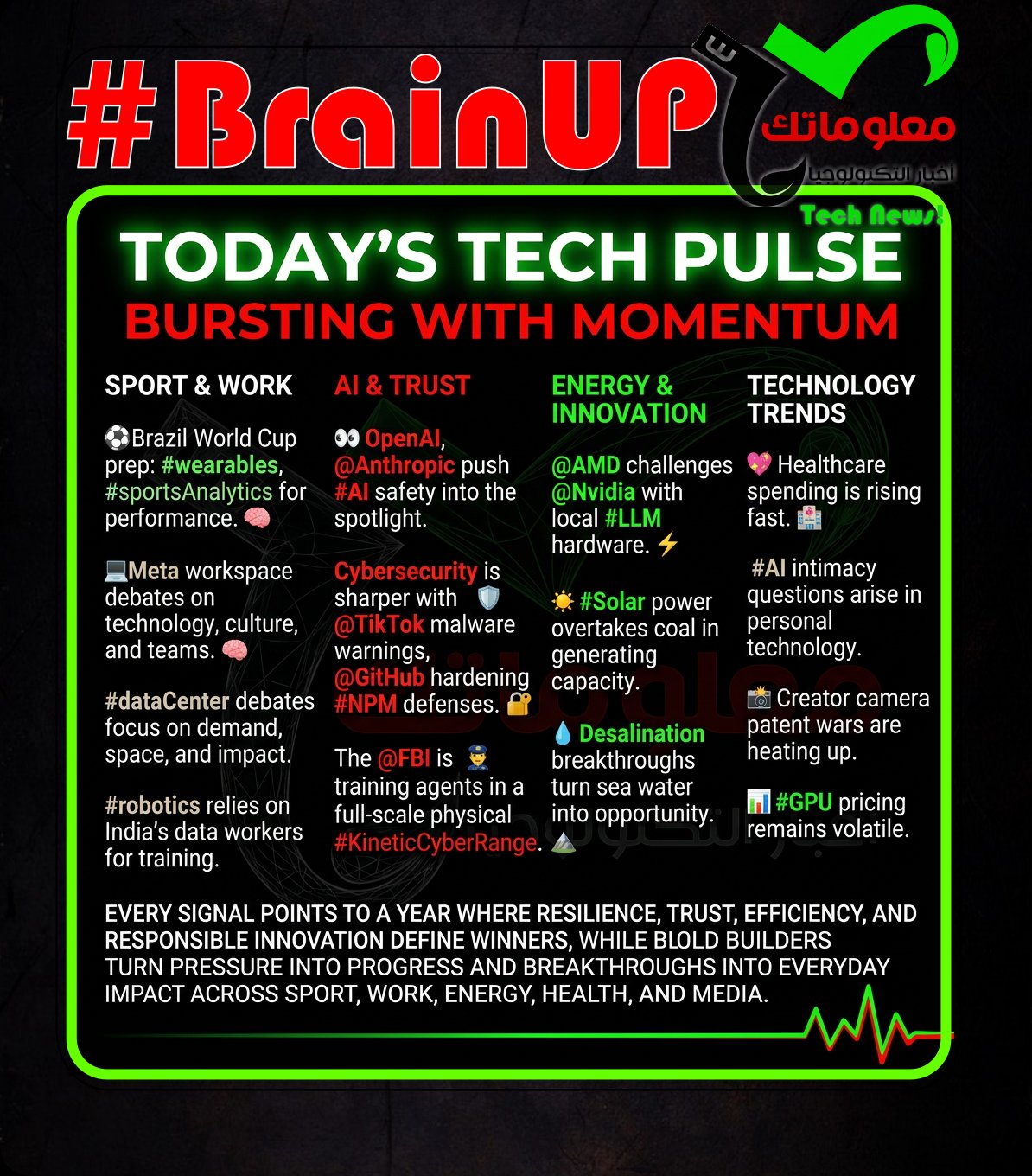
Brazil is using #wearable player tracking technology, including sensor-laden “smart vests”, to gain an edge ahead of the 2026 World Cup after recent tournament disappointments. The vests collect detailed data such as sprint speeds, heart rates, fatigue, workload, and recovery, and Brazil has integrated this monitoring across its men’s, women’s, and youth setups, with clubs relaying data to the national team’s sports science department. Guilherme Passos, head of sports science, says the staff communicate with clubs daily to add players’ tracking outputs into a central database, helping national coaches who otherwise have limited time with globally dispersed players. The data informs selection decisions, tactical roles, and the management of players arriving injured or returning from rehabilitation, giving @Carlo Ancelotti and staff more evidence before making World Cup choices. In effect, the #tracking systems extend the national team’s oversight year-round, enabling consistent comparison and preparation as Brazil approaches its opening match against Morocco.
A report from ReversingLabs warns that short form videos on TikTok and Instagram Reels are being used to lure people with offers of free subscriptions like Spotify Premium, Windows, Office, and Adobe, then trick them into installing malware. Instead of typical email phishing links, victims are told to open command line tools such as #PowerShell and paste and run a command shown in the video, which downloads and installs #Vidar #infostealer. The malware can steal usernames, passwords, cookies, session tokens, cryptocurrency wallet data, and personal files and documents. The approach exploits economic strain and bargain seeking behavior, showing #socialEngineering remains a primary attack vector even when it requires users to manually execute commands. The article recommends basic defenses such as using #multiFactorAuthentication, being skeptical of free or suspiciously cheap offers, and only downloading software from official vendors.
3. China to integrate AI, digital twin technologies into Three Gorges waterway project
China is launching a new Three Gorges waterway project that pairs expanded shipping infrastructure with #digital traffic management to boost cargo capacity and efficiency on the Yangtze River. Construction started in Yichang, Hubei Province, and is described as the first major infrastructure project initiated during the 15th #Five-Year Plan period (2026 to 2030). Transportation authorities plan to integrate #AI, #big data, and #digital twin technology into vessel traffic management and ship-lock operations at the Three Gorges hub, using virtual models to mirror real operations, monitor traffic, and simulate scenarios. According to Wang Hui of the Ministry of Transport, these tools are expected to improve vessel passage through the hub and help reduce logistics costs, aligning infrastructure expansion with smarter, data-driven operations.
4. Behind the numbers: Future health industry spending growth
The report projects that U.S. healthcare spending will grow at an average annual rate of 4.8% from 2022 to 2027, reaching $6.4 trillion by 2027. This increase is driven by population growth, inflation, and rising intensity of care, particularly in areas like outpatient services and pharmaceuticals. The analysis highlights key factors such as demographic trends, technological advancements, and policy changes impacting spending patterns. It emphasizes the importance of strategic planning for healthcare providers and policymakers to manage costs and improve care quality. Understanding these trends allows stakeholders to anticipate market shifts and invest effectively in the health industry’s evolving landscape.
5. OpenAI faces investigation from state attorneys general | TechCrunch
A coalition of state attorneys general has opened an investigation into @OpenAI, with New York’s attorney general serving the company a subpoena, according to The Wall Street Journal. The subpoena seeks documents on topics including advertising, user engagement and retention, #model sycophancy, handling of consumer and health data, and treatment of minors and seniors, while the company has not said which other states are involved. @OpenAI said it takes the concerns seriously and will engage with the offices, adding that #ChatGPT now includes added protections for minors and people in difficult situations, uses age prediction, offers parental tools, and disallows advertising that targets kids. The investigation comes as OpenAI continues to face legal and public scrutiny, including lawsuits alleging #copyright infringement and claims tied to user suicides, a recent Florida lawsuit by Attorney General James Uthmeier against @Sam Altman and OpenAI, and criticism after Altman said OpenAI failed to alert law enforcement following a flagged and banned account related to a mass shooting in Tumbler Ridge, Canada. The inquiry also arrives the same week OpenAI said it filed confidentially to go public.
6. As AI plays a bigger role in relationships, true intimacy is getting lost
As #AI increasingly mediates dating and relationships, it risks eroding the self-curiosity that underpins genuine intimacy. Companies and third-party tools now help users make chats funnier, profiles “sexier,” rehearse difficult conversations, and even use #ChatGPT to manage conflict or social life, with the author citing a student who used an AI model to resolve an argument by clarifying feelings and understanding a partner’s perspective. While concerns about advice accuracy, biased training data, and privacy are well known, the deeper issue is that outsourcing emotional work can “frontload” intimacy and reduce tolerance for uncertainty, disagreement, and emotional friction. The pursuit of control can crowd out curiosity, even though research links curiosity to openness, lower hostility, and healthier power dynamics, all central to intimate connection. Treating dating as something to “succeed” at and arguments as something to “win” flattens intimacy into a performance, whereas real intimacy is messy, dynamic, embodied, unpredictable, and closer to improv than a script.
@AMD is taking on @Nvidia’s compact AI workstation lineup with the $3,999 Ryzen AI Halo Developer Platform mini PC, positioned as an alternative to the DGX Spark for running local #LLMs. The kit, first shown at CES 2026 and sold via Micro Center in the U.S., comes in two identical hardware variants that differ by OS, Linux or Windows 11 Pro, while DGX Spark is limited to Linux and has risen to $4,699 due to global LPDDR5X and NAND supply constraints. Hardware includes a Ryzen AI Max+ 395 with 16 cores and 32 threads (3.0 GHz base, 5.1 GHz boost), 128GB unified LPDDR5X-8000, RDNA 3.5 Radeon 8060S (40 CUs), and an NPU rated at 50 TOPS, plus a 2TB M.2 SSD, Wi-Fi 7, and Bluetooth 5.4. It matches much of the DGX Spark style I/O with 10 GbE, four USB-C (one for power), and HDMI 2.1b, but lacks #NVLink-like pairing, and uses a custom cooling design with a baseplate, direct-touch heatpipes, an aluminum channel heatsink, and dual blower fans. Preorders are open with local pickup listed for July 10, and the article notes the Corsair AI Workstation 300 as a related alternative using the same chip, starting at $2,699 (1TB) or $3,399 (4TB).
ASCILINE Engine by YusufB5 is an MIT-licensed, real-time #ASCII video rendering and streaming tool promoted as enabling an “unblockable video stream” by mapping pixels into text-based output on a typographic canvas. The project demonstrates multiple rendering modes, including Mode 3 with a 32K-color palette at 30 FPS and a Mode 5 “real-time pixel streaming” approach that swaps characters for colored blocks to approach 360p quality, with examples shown on GitHub and in demos. Despite the “unblockable” framing, critics note simple countermeasures such as using an adblocker’s element zapper to remove the HTML5 Canvas used for rendering, while many commenters worry the technique could be used to deliver harder-to-block ads. YusufB5 says they added a strict anti-ad clause to the MIT license to deter abuse, but the article notes malicious users may ignore such restrictions. Beyond the controversy, the engine adds features like real-time CSS filters, ultra-low bandwidth streaming via delta frames plus GZIP, #IoT compatibility, and positioning ASCII output as a “bridge for AI” that could help lightweight #LLMs generate semantic video summaries.
@Anthropic says it was forced to abruptly disable access to two frontier AI models after a highly restrictive U.S. government #export control directive barred foreign nationals from using them, citing an unspecified #national security concern. The company argues this was a misunderstanding and says it is working to restore access, but the incident follows months of the firm publicly emphasizing the models’ alarming capabilities, including deceptiveness, potential containment escape, and cross-domain synthesis relevant to catastrophic biological weapons development, while limiting testing through Project Glasswing. Media coverage and outside reactions amplified the perceived risk, with reports that the models helped spur policy activity, including a safety-focused AI executive order signed by @Donald Trump about a week before the shutdown. Despite earlier warnings, @Anthropic recently released Claude Fable 5 for general use and gave Mythos 5 a limited release, then quickly made both inaccessible after the directive arrived. The episode underlines how the company’s own framing of frontier-model dangers intersected with government controls and led to an abrupt cutoff of access.
Satellite imagery shows Russia wrapped part of the VNIIR Progress weapons-related plant in Cheboksary with an #anti-drone cage, an unusual use of cage armor for an entire building rather than vehicles or netting over infrastructure. The US spatial intelligence firm Vantor said the structure has been in place for at least a year, and Ukraine struck the facility on Wednesday with domestically produced FP-5 Flamingo #cruise missiles, with street-level video later showing significant damage to the caged building. The Ukrainian military said the plant is a key producer of navigation equipment for Russian high-precision weapons, including components used in Shahed-type attack drones, Kalibr cruise missiles, Iskander ballistic missiles, and glide bombs. Ukraine also targeted an oil refinery in Russia’s Samara region, and @Volodymyr Zelenskyy framed the strikes as continued long-range pressure on Russian military facilities and the oil industry. The strike, following a similar one in early May, fits Ukraine’s campaign to disrupt Russian weapons supply chains, though the article says it is unclear how much the latest attack affected the plant’s operations.
11. Meta Employees Absolutely Hate Mark Zuckerberg’s Plan for a Companywide AI Hackathon
In internal posts seen by WIRED, many Meta employees reacted with frustration to @Mark Zuckerberg’s announcement of a large, companywide #AI hackathon, saying heavier workloads after recent layoffs leave little time or incentive to participate. Workers cited low morale, declining trust in management, and concerns that experimenting could trigger SEV1 incidents, with one highly upvoted comment arguing Meta no longer supports a hackathon culture and that hackathon work would not count toward performance evaluations. Details shared by VP @Ime Archibong said the event would run July 14 to July 16 and focus exclusively on AI innovation, but responses included angry comments, sarcastic memes, and doubts about psychological safety to spend time on hackathon ideas. Sources told WIRED this would be the first companywide hackathon since roughly 8,000 layoffs the prior month, and even encouragement from an engineering veteran clashed with employee remarks about aggressive goals and reduced staffing. The hackathon was framed as part of broader steps to rebuild camaraderie and address unrest, alongside promises to increase offsite budgets and roll back #hotDesking in some offices.
12. Amazon CEO reportedly raised Anthropic model concerns before government crackdown | TechCrunch
@Amazon CEO @Andy Jassy reportedly raised #security concerns to US officials about @Anthropic’s Claude Fable 5 shortly before the government imposed #export controls and Anthropic cut off worldwide access to the Fable 5 and Mythos 5 models. The Wall Street Journal says Jassy told Treasury Secretary @Scott Bessent and others that Amazon researchers used Fable 5 to obtain information that could be used in #cyberattacks, and The Information and Reuters also reported that Amazon communicated concerns as a major Anthropic investor. An Amazon spokesperson said governments often seek the company’s counsel on potential risks but Amazon does not share details, and noted that #AWS has been affected by the cutoff. @David Sacks, a former Trump AI czar now co-chairing the President’s science and technology advisory council, claimed a trusted partner presented a #jailbreak, the administration asked @Dario Amodei to fix or de-deploy the model, and Amodei refused. Anthropic responded in a blog post that the capabilities drawing concern are already available in other publicly accessible models, highlighting tension between targeted restrictions and the broader availability of similar capabilities elsewhere.
13. NPM 12 Will Change Script Execution Behavior to Prevent Supply Chain Attacks
@GitHub is changing #NPM behavior in version 12 to block automatic script execution during installs to reduce #software-supply-chain attacks. The update follows incidents tied to TeamPCP and the Shai-Hulud self-replicating worm, which abused default execution of dependency scripts such as preinstall, install, and postinstall, and weaponized native #node-gyp builds like binding.gyp. With NPM 12, dependency scripts will not run unless explicitly allowlisted in package.json, and Git dependencies and remote URL dependencies (including HTTPS tarballs) will no longer be resolved at install unless explicitly allowed, with remote URLs requiring the –allow-remote flag. Developers are advised to upgrade to NPM 11.16.0+ to receive warnings about script execution and to use npm approve-scripts –allow-scripts-pending to review and approve trusted packages before upgrading. These changes aim to close common code-execution paths used by attackers, including a path where a Git dependency’s .npmrc could override the Git executable even when –ignore-scripts is used.
14. Photos: India’s workers are training AI robots to take their jobs
Indian workers are being paid to record first-person videos of everyday tasks so #AI-powered robots can learn to perform household and manual work. In Chennai, Nagireddy Sriramyachandra straps a smartphone to her head to film actions like slicing mangoes, earning 250 rupees per hour and sending the footage through an app to an AI data company serving major multinational clients, while other trainers use video glasses, head-mounted cameras, and motion sensors at home, in factories, or in studios. Developers say this #egocentric data helps specialized #AI models mimic human behavior in real-world environments, which is harder than training chatbots and image generators on existing digital data. As the #humanoid robot market grows and projections suggest more than one billion robots could be in use by 2050, India is positioning itself as a global hub for collecting, processing, and annotating AI data, though experts expect demand for such services to rise alongside concerns about automation. A NITI Aayog report warns that AI and labor debates often center on white-collar job loss while neglecting India’s 490 million informal workers, echoed by workers like Ponni, a flower-garland maker in Bengaluru, who fears future generations doing similar work will face problems.
@Brad Smith says the backlash against #AI, including student pushback to pro-AI speakers at graduation events, should be a wake-up call for the tech industry because young people are usually early adopters of new technology. He argues that graduates see AI’s benefits but want it treated as #automation that they control, with agency over chatbots and a say in how machines fit into their lives and work. The article contrasts this caution with aggressive predictions from @Dario Amodei and @Mustafa Suleyman about AI eliminating large numbers of white-collar and entry-level jobs, alongside concerns that executives may be overestimating AI capabilities, referenced as “AI psychosis.” Smith frames the issue around the dignity of work and the “American Dream,” and notes a broader shift in tone among AI leaders toward emphasizing productivity gains rather than simple job replacement. He still calls AI transformative and positions Microsoft as a key player in the transition, arguing that if people do not have jobs, Microsoft ultimately does not either.
AI providers’ subscription pricing is increasingly misaligned with the real compute and token costs of heavy usage, making top tiers financially strained as #token usage grows faster than cost per token falls. SemiAnalysis tested every @Anthropic and @OpenAI plan and estimated that maxing out $200/month tiers would imply roughly $8,000/month for Claude Max 20x and about $14,000/month for ChatGPT Pro 20x at API-equivalent pricing, with utilization thresholds showing margins collapsing, including @OpenAI losing money on base plans above 11.4% utilization and @Anthropic hitting 0% gross margin on its top offering at 10%. With raising prices or cutting features difficult, SemiAnalysis expects serving costs for today’s models to drop as new models and more data centers come online, potentially making Opus 4.8-level capability profitable at $20/month, while frontier models like Mythos remain too expensive and may be pushed to #API, per-token access. The expense of agentic systems, described as using up to 1,000x more tokens, is driving enterprises to curb “tokenmaxxing,” with one unnamed company reportedly spending $500 million in a month without usage limits, and prompting a shift toward model-switching workflows and cheaper alternatives such as Chinese open-source models like #DeepSeek. A Wall Street Journal-cited approach of routing tasks among models could cut costs by up to 95%, reinforcing the article’s point that budget pressure is pushing firms from premium subscriptions toward open-source and lower-cost LLMs.
Researchers at the University of Rochester developed a #solar-powered desalination device that uses laser-textured metal panels to evaporate seawater and continuously move dissolved salts away from the evaporation zone, preventing performance loss from mineral buildup. Led by @Chunlei Guo, the approach relies on “superwicking black metal” made with femtosecond laser pulses, which absorbs nearly all sunlight and spreads seawater as a thin film for efficient evaporation and vapor collection as fresh water. The design uses surface grooves and fluid dynamics to exploit the #coffee ring effect, pushing salts into passive regions so the active evaporating area effectively self-cleans, addressing hard scale from minerals like magnesium and calcium that can shut down other systems. Tests with seawater from the Pacific, Atlantic, and Indian Oceans showed continued fresh-water production while depositing salts away from the active region, and the process yields collectable solid salt instead of concentrated brine. In related work, the team embedded hydrogen titanate nanoparticles in the textured grooves to selectively capture lithium ions, suggesting a path to pair desalination with #lithium extraction.
18. KPMG’s AI report becomes an accidental demo of AI hallucinations
KPMG’s October 2025 report praising #agenticAI is accused of showcasing #AIhallucinations through unreliable and possibly AI-generated references and claims. GPTZero says a review found only 5 of 45 citations correctly matched their sources, with the rest being misleading, partially fabricated, or too vague to verify, and it alleges about half of the report’s factual claims were false, unsupported, or misattributed. The group highlights case studies about alleged deployments at UBS, Swiss Federal Railways, and Transport for London as not supported by the cited sources, and points to a specific error about Emirates’ “Sara,” described in the report as a mobile chatbot that can change flights, though GPTZero says it is a 2023 robot assistant without booking-change capability. GPTZero also notes the report appears to contradict KPMG’s own 2025 CEO Outlook on the share of CEOs ranking AI as the top investment priority, citing 55 percent versus 71 percent. KPMG told The Register it removed the report while reviewing how it was published and said it expects responsible #AI use with human oversight to validate content and verify sources.
The article argues that parts of the right have built a persuasive false reality by flooding social media with shocking #violent-crime imagery that overrides context and facts, shaping how voters judge the country. It describes how bystander footage, including video from Belfast of a Sudanese refugee alleged to have carried out a knife attack, was gleefully circulated on X by far-right figures like @TommyRobinson and became a catalyst for racist riots, with organised masked fascists reportedly using hitlists of migrant and ethnic minority homes. The same image is said to appear on banners at solidarity protests in Southampton after riots over Henry Nowak’s murder, fitting into an established online visual language depicting the UK as in decline and “besieged by invaders.” This ecosystem includes the “Yookay” meme, selective crime clips shared by accounts such as @CrimeLdn, #AI-generated images and fake videos, and conspiratorial claims of state cover-up, making real isolated footage feel indistinguishable from and validating the manufactured narrative. The piece concludes that hard-right politicians like @NigelFarage and @RupertLowe exploit these images to foment disorder, while Labour is portrayed as lacking an effective response to politics driven by sensational visuals.
20. Solar generates more energy than coal in US for 1st time: Report
U.S. #solar power generation has grown enough to surpass #coal for the first time on record, even as the @Trump administration has sought to slow the renewable sector, according to new reports. Ember found that in May 2026 solar supplied 12.8% of U.S. electricity versus coal at 12.2%, with solar output hitting a record 45.5 terawatt-hours, up 17% from May 2025, while coal generation was 43.4 terawatt-hours and 11% below May 2025 despite a slight month-to-month rise. Ember also reported coal’s share has nearly halved over five years, dropping from 19.7% in May 2021 to 12.2% in May 2026, and described solar as the third-largest and fastest-growing U.S. power source. Separately, the Solar Energy Industries Association and Wood Mackenzie reported 7.8 gigawatts of new solar capacity added in Q1 2026 and more than 6 million installations nationwide, with rising electricity demand, including from tech companies powering AI and data centers, supporting continued buildout. SEIA said current installations could power about 50 million households and projected enough capacity to power 100 million by 2034, despite federal headwinds such as the EPA’s August 2025 cancellation of the $7 billion #SolarForAll grant program.
21. The FBI built its own replica small town to simulate real-world cyberattacks | TechCrunch
The @FBI has unveiled a 22,000 square foot replica town on its Huntsville, Alabama campus called the #KineticCyberRange to train law enforcement to simulate and investigate real-world #cyberattacks in a secure, hands-on environment. The purpose-built town, opened in February 2025, includes furnished homes and common facilities like a hotel, gas station, grocery mart, courthouse, hospital, and a power company with roads and traffic lights, all wired with functioning systems designed to contain simulated attacks. The range also has a data center with 200+ physical servers running #Windows and #Linux to mirror corporate environments investigators may face during breaches or search warrants, and it can simulate #ransomware scenarios including high-stakes outcomes like hospital systems going dark. The FBI says it has trained more than 1,400 students across FBI personnel and other federal and local partners, reflecting rising cybercrime pressure cited in its 2025 Internet Crime Report that logged $20.9 billion in U.S. losses and named ransomware the top ongoing threat to critical infrastructure. The facility also supports training in #digitalforensics, including controversial tools that exploit undisclosed vulnerabilities to access encrypted devices from makers like @Apple and @Google.
22. Stem Cell Embryos: Breakthrough in Infertility Research
An international group of embryology and bioethics experts published the first white paper on #stem cell based #embryonic models for reproductive biology, aiming to guide their responsible use in research and in regulation of human reproduction technologies. Coordinated by UPF researcher @Alfonso Martínez-Arias, it argues these models could help study embryo development beyond the #14-day rule, addressing a major knowledge gap after the first week and into the poorly understood period of implantation and the third week, when #gastrulation organizes the embryo and is linked to later cardiovascular, metabolic disorders and limb malformations. The paper notes infertility affects about one in six people of reproductive age and 48 million couples globally, and that despite over 10 million births from assisted reproduction, only about one in three fertilized eggs progresses beyond the third week, underscoring the need for better understanding. Because research embryos are limited to surplus donations and cannot legally be cultured past 14 days, stem cell derived embryo copies are presented as an alternative, with monkey models already able to mimic gastrulation though human models have not yet gone beyond early gastrulation stages. The authors call for highly standardized, reliable, reproducible models paired with a clear legal framework so they can support clinical practice and tools to improve assisted reproduction and infertility treatment.
23. WhatsApp is the worst app on your Windows 11 PC right now, eating 1.2GB of RAM doing nothing
WhatsApp for Windows is described as a slow, #WebView2-based web wrapper that delivers an unusable experience on Windows 11, and the article argues @Meta should build a native #WinUI app instead. In testing across low-end to high-end PCs, the app reportedly consumed about 400 MB of RAM right after a reboot even before the user logged in, then climbed toward 1.2 GB after logging in and scrolling chats, while still idling around 600 MB. Despite the heavy memory use, performance is said to be poor: message sending has noticeable delays, delivery appears in bursts, switching chats takes a second or more, and scrolling is choppy compared to the old #UWP version. The article contrasts this with the previous UWP WhatsApp, which reportedly handled over 100 one-to-one chats and about 30 active groups while idling under 100 MB, and notes widespread complaints about freezes, delayed messages, issues after sleep or hibernate (including logouts), and the app continuing to run in the tray to receive notifications via service workers. Overall, it concludes that the current Windows app is both heavy and slow, to the point that using WhatsApp Web in a browser can feel faster than the dedicated app.
24. Tech Executives Attend G7 Summit as Leaders Address AI, Online Safety
Tech executives attended the G7 summit where leaders discussed the expanding role and regulation of artificial intelligence (#AI) and online safety. Prominent CEOs joined government officials to deliberate on frameworks ensuring responsible AI development and mitigating digital risks. The summit highlighted the necessity of balancing innovation with ethical considerations and cybersecurity to protect users globally. Collaborative efforts aim to create standards and policies that address challenges like misinformation, privacy, and AI ethics. This coordinated approach underscores the importance of multilateral cooperation in governing fast-evolving technologies.
25. China Didn’t Make Americans Hate Data Centers
Claims from GOP officials and some data center investors that China is driving US anti-#dataCenter protests are gaining traction, but researchers and analysts say the picture is more complicated and largely domestic. Local opposition has surged, with a Heatmap poll finding more than half of Americans support a moratorium on data center development, and Public First reporting US support for data centers was the lowest among 15 countries surveyed. @TomCotton and House Republicans have urged federal investigations into alleged Chinese Communist Party influence, while figures like investor @KevinOLeary have cited reports such as the Bitcoin Policy Institute’s to argue foreign-backed funding is behind resistance. Yet Graphika says it has not found evidence of organized, scaled foreign influence operations, apart from limited activity like AI-avatar account networks and some AI-generated anti-data-center images tied to pages with administrators often based in Bangladesh, and OpenAI reported a China-origin account cluster but found no meaningful breakout of its messaging. Overall, experts and available platform analyses suggest any foreign activity, if present, would be amplifying existing US concerns about energy costs, local impacts, and #AI-related growth rather than creating the backlash on its own.
Nvidia has quietly raised the official marketplace price of its flagship Blackwell workstation GPU, the RTX Pro 6000, to $13,250, a 55% jump from its $8,565 launch price about a year ago, amid a global memory shortage and the ongoing AI boom. The company sells three variants, the standard Workstation Edition, the more power efficient Max-Q Workstation Edition, and the data center focused Server Edition, and it launched the RTX Pro 6000 Blackwell and Max-Q in March 2025. Pricing varies widely by seller: Nvidia lists the RTX Pro 6000 and Max-Q at $13,250, while Newegg lists the RTX Pro 6000 at $12,099.99 and the Server Edition at $14,999, and B&H lists some models even higher, with some listings coming from third party sellers or OEM units. The article argues that GPU pricing is unlikely to improve soon and will likely keep climbing until the memory shortage ends, so buyers should compare retailers and Nvidia’s marketplace before purchasing. This price escalation shows how #memory shortages and #AI demand are pushing both workstation and broader #GPU markets upward.
27. DJI and Insta360 go to war in the U.S. over its action gimbal cameras
@DJI and @Insta360 are escalating their rivalry into U.S. court with dueling patent lawsuits over handheld #gimbal action cameras. Citing reporting from PetaPixel, @DJI filed two suits the same day @Insta360 began selling the Luna Ultra in the U.S., alleging two design-patent infringements and four utility-patent infringements tied to gimbal hardware, tracking features, and operation, and seeking a permanent injunction and monetary damages. @Insta360 countersued with five infringement claims, saying @DJI violates its patents related to gimbal stabilization and control, smooth stabilization, telemetry overlay, and panoramic video stabilization across products including the Osmo Pocket, Ronin/RS, Osmo Mobile, and Osmo 360 lines. The dispute centers on how similar the Luna Ultra and Osmo Pocket 4 Pro are in form factor and marketing as vlogging cameras with two lenses and integrated gimbals, while also reflecting a broader pattern after @DJI previously sued @Insta360 in China in March over drone-related patents allegedly developed by former @DJI employees.
28. Nuclear clock ticks for the first time, using a thorium-229 atomic nucleus
Scientists have achieved a milestone decades in the making by creating the world’s first working nuclear clock, using the atomic nucleus of #Thorium-229 rather than the electron transitions used in today’s atomic clocks. Unlike conventional timekeepers, the thorium nucleus is far less sensitive to environmental disturbances such as temperature fluctuations and electromagnetic noise, potentially enabling clocks that are dramatically more stable, compact, and precise. Two independent research teams successfully locked ultraviolet lasers onto the nucleus and maintained a feedback loop, transforming a long-standing theoretical concept into an operational device. Although these early prototypes have not yet surpassed the best atomic clocks, researchers believe future versions could redefine precision timekeeping, improve navigation and space systems, detect subtle shifts in gravity, probe whether the universe’s fundamental constants change over time, and even search for elusive #DarkMatter signatures that existing atomic clocks may miss. The achievement marks the beginning of an entirely new era in precision measurement, with physicists describing it as the first step in a race toward a new generation of ultra-accurate clocks. @Thorsten Schumm and other researchers involved say the real scientific breakthroughs enabled by nuclear timekeeping may only just be beginning.
That’s all for today’s digest for 2026/06/14! We picked, and processed 27 Articles. Stay tuned for tomorrow’s collection of insights and discoveries.
Thanks, Patricia Zougheib and Dr Badawi, for curating the links
See you in the next one! 🚀
