
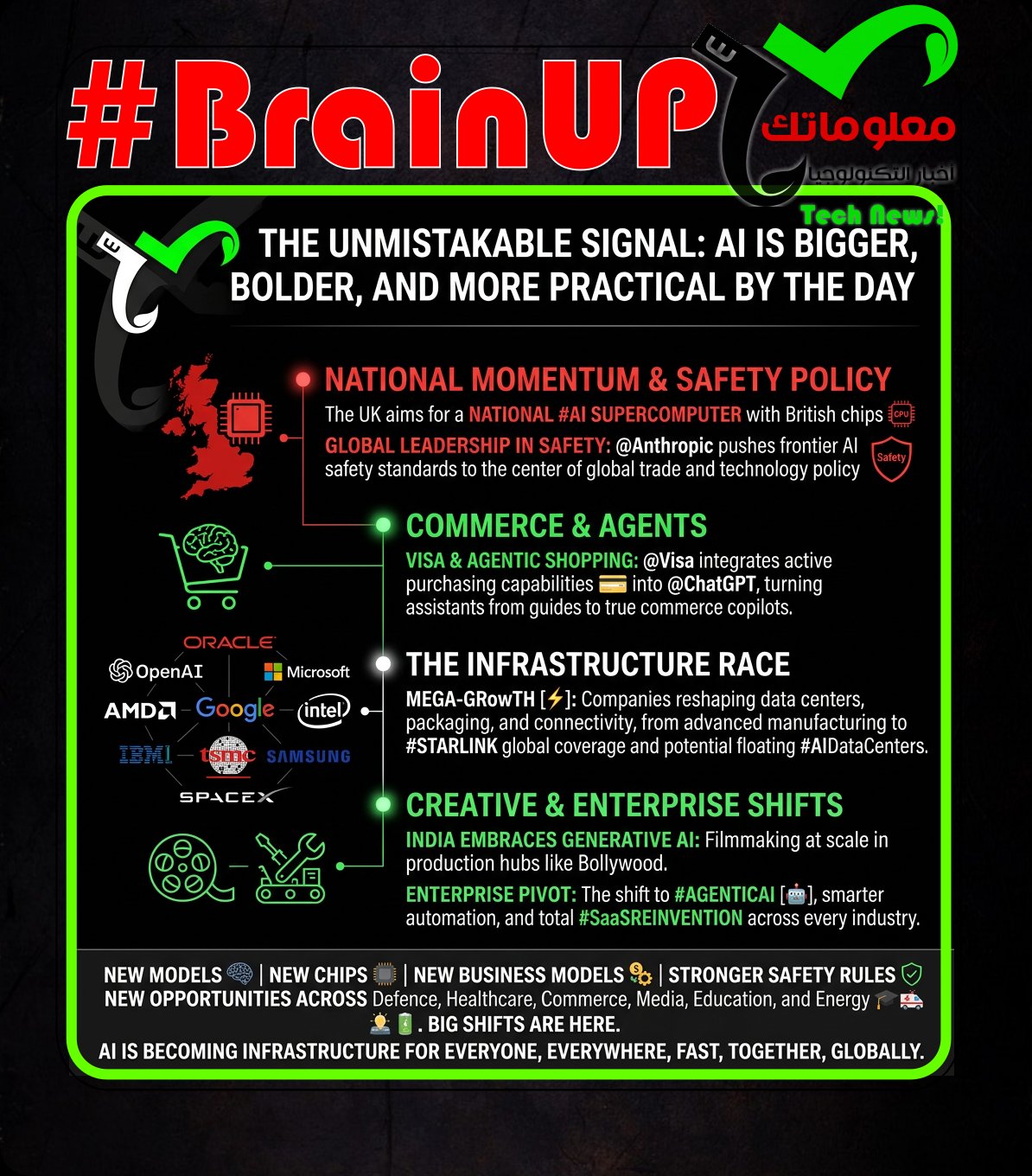
#BrainUp Daily Tech News – (Thursday, June 11ᵗʰ)
Welcome to today’s curated collection of interesting links and insights for 2026/06/11. Our Hand-picked, AI-optimized system has processed and summarized 39 articles from all over the internet to bring you the latest technology news.
As previously aired🔴LIVE on Clubhouse, Chatter Social, Instagram, Twitch, X, YouTube, and TikTok.
Also available as a #Podcast on Apple 📻, Spotify🛜, Anghami, and Amazon🎧 or anywhere else you listen to podcasts.
1. UK Gov’t to deploy new supercomputer by 2030, with British chips (hopefully)
Under the UK government’s new #AI Hardware Plan, the UK aims to deploy a new national AI supercomputer at the University of Edinburgh by 2030, intended to succeed #ARCHER2 and to include British-designed chips as a key part of the system. Announced by @Liz Kendall, the plan allocates £750 million for the supercomputer, including £400 million for next-generation chips, with £150 million specifically for next-generation inference chips and £250 million for other specialized chips, with a tender process due to launch soon. It also commits £120 million to an #AI Hardware Innovation Programme to help UK companies design, develop, and test novel chips, including at least £20 million to expand the Scaling Inference Lab run by #ARIA and CommonAI, where Oriole Networks working with #AMD will deploy what is described as the world’s first large-scale AI system using purely #photonics networking with AMD Instinct GPUs and AMD EPYC CPUs. The plan further funds skills development with £45 million for doctoral training and undergraduate bursaries, including a £12 million Centre for Doctoral Training in Chip Design and an expansion of undergraduate semiconductor bursaries to 400 next year. Separately, a new investment fund led by Playground Global, backed by up to £150 million from the British Business Bank and involving former Intel CEO @Pat Gelsinger, will invest in UK AI hardware companies, with the firm opening its first office outside the US in the UK.
2. Anthropic CEO Warns AI Is Getting Too Powerful, While Releasing Powerful AI
@Dario Amodei argues governments can no longer treat AI rules as something to study and that the U.S. needs binding safety requirements for #frontier AI, because transparency alone is no longer sufficient as capabilities rapidly expand. In his essay “Policy on the AI Exponential,” he says AI has advanced in four years from barely writing coherent code to writing most code at major AI companies, and he proposes an #FAA-like regime requiring technical testing and auditing, third-party evaluations, authority to block or reverse releases that threaten public safety, and obligations to secure model weights, run safety tests, and report serious incidents. The push coincides with Anthropic expanding access to Claude Mythos via Mythos 5 for cybersecurity organizations and government partners, with researchers including the UK’s AI Security Institute finding it can autonomously execute complex cyberattacks, and with the launch of Claude Fable 5 that routes sensitive requests to a less capable model, prompting criticism over higher token usage, mandatory 30-day data retention, and undisclosed capability reductions. Amodei also calls for policy preparation for AI-driven job displacement and drug-development advances, limits on surveillance and autonomous weapons in domestic law enforcement, and stronger cooperation among democratic nations on critical AI technologies. The essay arrives as Anthropic prepares for an IPO after filing with the #SEC following a large reported funding round and valuation, underscoring his framing of a race between accelerating technology and lagging policy.
3. Visa plugs its payment network into ChatGPT, letting AI agents shop and pay for users
Visa is embedding its payment network into @ChatGPT to enable #AI agents to shop and complete transactions on behalf of users. The article says this integration would let the chatbot not only find items but also pay for them through Visa’s network. The move signals an expansion of #generativeAI from answering questions to carrying out real-world commerce tasks that typically require a checkout process. By connecting payments directly to conversational AI, Visa is positioning its network as infrastructure for automated purchasing. This ties back to the article’s focus on letting AI agents shop and pay for users via ChatGPT.
4. The theory taking the rich by storm: China funds data center haters
A theory spreading among Silicon Valley investors and some officials claims China is funding local U.S. opposition to #dataCenters, even though proponents offer little direct evidence. Interior Secretary Doug Burgum told an audience that some resistance is “foreign-sourced dark money,” and on the All-In podcast investor @Gavin Baker suggested it could be a “CCP-funded campaign.” Concrete public detail in the piece centers on @OpenAI, which said it banned a cluster of likely Chinese accounts that used #ChatGPT to generate anti data center social media content about energy demand and electricity costs, but assessed the campaign’s reach as limited and not responsible for creating the debate. The broader backlash is real regardless of foreign meddling, with a Gallup poll finding 71% of Americans somewhat or strongly oppose data center construction in their communities. The suspicion is nonetheless gaining political attention, including a letter from Rep. @Brett Guthrie seeking a briefing on possible Chinese influence from the FBI and members of President Trump’s science and technology advisory circle.
5. OpenAI says China launched influence campaign to shape US attitudes on AI data centers
@OpenAI reported it detected a likely China-backed online influence effort aimed at shaping U.S. views on #AI and the policy debate over #AIDataCenters. The company said operatives used #ChatGPT to generate social media posts and images that were then shared by batches of accounts posing as Americans, pushing narratives such as data center build-outs raising electricity costs and criticizing @DonaldTrump’s tariffs as a bid to dominate technological competition; prompts were submitted in Simplified Chinese and requested avoiding mention of @XiJinping. @BenNimmo said the campaigns drew little authentic engagement and there was no evidence they changed public opinion at scale, but they reveal the intentions and narratives being tested. The operation sought to amplify real U.S. backlash over environmental effects and strain on local energy grids and water supplies, amid dozens of proposed moratoriums on new data centers. The findings are likely to intensify claims by House Republicans and other pro-AI voices that foreign actors are meddling in the politically sensitive debate over data centers.
6. Oracle Reports Higher-Than-Expected Data Center Spending
Oracle reported a surge in data center spending, exceeding market expectations. The company highlighted investments in cloud infrastructure and expansion of its data centers as key drivers of this increase. This growth signals Oracle’s aggressive push to compete with other major cloud service providers like @Amazon and @Microsoft. The rise in spending suggests Oracle is prioritizing scaling its cloud capabilities to meet growing customer demand. This trend reflects the broader industry shift towards enhanced cloud services and infrastructure development.
7. OpenAI Considers Drastic Price Cuts Anticipating War for Users With Anthropic
OpenAI is planning significant price reductions for its AI services as competition intensifies with Anthropic, a rising AI startup backed by major investors. This potential price war reflects the broader battle for AI users amid rapid advances in large language models and generative AI capabilities. By lowering costs, OpenAI aims to attract more customers, pressuring competitors to increase innovation and efficiency. The move highlights how #AI companies are aggressively positioning themselves in a market projected for exponential growth. This competitive dynamic will likely accelerate improvements and accessibility in AI technology, benefiting users and driving further industry disruption.
8. Inside India newsletter: Hollywood is debating AI. India’s filmmakers are embracing it
India’s filmmakers are rapidly adopting #generativeAI to meet surging content demand while managing tighter budgets in the country’s $32 billion media and entertainment market. JioStar, a joint venture of @Mukesh Ambani’s Reliance Industries and @Walt Disney, launched a 100-episode AI-assisted retelling of the Mahabharat that drew 6.5 million views on day one and performed 2.1 times above the platform average, and executives say it is meant as a first step to expand storytelling rather than a one-off. Other projects include Abundantia Entertainment’s planned theatrical release “Chiranjeevi Hanuman – The Eternal,” described locally as India’s first AI-generated feature film, and “Made in India: the Titan story” on Amazon’s MX Player, which used 100-plus AI shots to recreate 1970s Mumbai. AI artist Prasad Gori said AI production work has boomed in the past eight months, with 10 to 15 job offers per week, compared with having to chase work three years ago. With the sector growing about 9% in 2025, researchers argue the key advantage of AI is faster #production timelines and time to market, enabled by tools such as Seedance, Minimax, Google Studio, Midjourney, and Adobe Firefly.
9. Chinese agents caught rebuilding botnets and stirring the pot on AI datacenter debate
Multiple reports say China-linked operators are rebuilding #botnet infrastructure and attempting #influence-operations in the US, including narratives about #AI datacenters and electricity costs. @Lumen Black Lotus Labs reports a “significant resurgence” tied to #VoltTyphoon: after the @FBI said it dismantled the KV-botnet in January 2024, the KV cluster is largely defunct but the JDY cluster remains active and has grown to more than 1,500 compromised routers and #IoT devices, with activity focused on quickly exploiting public vulnerability disclosures and targeting sectors where the US military and related entities are most prominent. The firm urges enterprises to follow #CISA and #NCSC guidance to mitigate Volt Typhoon activity and defend against China-nexus covert networks of compromised devices. Separately, @OpenAI says it banned China-originating #ChatGPT accounts used to generate social posts and images pushing claims that AI and datacenters drive peak electricity demand and higher household costs, but @BenNimmo noted these campaigns drew little authentic engagement, serving mainly to reveal the narratives and intentions being tested.
10. Microsoft doesn’t know what to do about the memory pricing crisis Microsoft is causing
@Microsoft is struggling to price and position its next Xbox, codenamed Helix, because a #memory pricing crisis, driven in part by its own #AI ambitions, makes it hard to deliver a console that feels cutting edge yet affordable. In an interview, Xbox boss @Asha Sharma argued the industry needs “new business models” rather than simply the most premium hardware, and said Microsoft must rethink storage and memory through game compression, flexible storage options, and “new types of games” that fit on-device. The article notes these ideas are vague and that “flexible storage” is not new, while speculating that options like financing or #cloud streaming could be part of the shift, supported by comments from Nvidia’s @Bryan Catanzaro that AI is more efficient in the cloud. Sharma reiterated in an employee letter that Microsoft cannot make as many consoles as demand requires and needs new business models and partnerships while staying committed to Helix, underscoring that the company has no clear plan yet. The piece ties this uncertainty back to rising hardware costs more broadly, warning that affordability is worsening even as gamers still need practical access to RAM and storage.
11. Anthropic’s new model refuses to find smart contract vulnerabilities
@Anthropic’s public Claude Fable 5 release is drawing criticism because its safety #guardrails often prevent cybersecurity and related tasks, including auditing crypto #smart-contracts for vulnerabilities. The model uses “classifiers” that redirect prompts about #cybersecurity, biology, chemistry, or “distillation” to Claude Opus 4.8, leading users like Colossus Pay CEO @Joseph Delong and Yearn developer @Banteg to say it refuses audits and blocks most security prompts, while others like @Taylor Monahan and wallet recovery tool founder Zeng Jiajun report frequent policy-violation blocks that hinder even Ethereum app development. Similar restrictions affect biology queries, with biologist @Olivia H. Scharfman and blogger @Jordan Lasker claiming even basic greetings or questions about mitochondria triggered fallback to Opus, as @Anthropic cites concerns about misuse such as bioweapons and viruses. The distillation guardrails also redirect attempts to train or extract capabilities for rival models, warning such efforts could enable authoritarian countries and spread near-frontier capabilities without safeguards. Overall, the article portrays Fable 5 as a scaled-back model whose broad classifiers prioritize rapid, safe release but leave many legitimate security and research requests unusable by routing them away from Fable 5 itself.
12. Canada announces bill banning social media for anyone under 16 – Engadget
Canada introduced the #SafeSocialMediaAct to ban anyone under 16 from having a social media account and to impose new safety requirements on social media services and certain #AI platforms. Announced by @MarcMiller, the bill would require platforms to design products to be safer for children, remove deepfakes and material that “sexually victimizes a child or revictimizes a survivor,” and add measures like AI-content labels, clear reporting tools, and user-blocking features. Although #AIChatbotServices would not be age-gated, the legislation expects AI platforms to reduce risks of chatbots communicating harmful content or engaging in harmful behavior, and to implement emergency measures for crisis situations, language linked in the article to #OpenAI and the Tumbler Ridge shooting. The specific obligations beyond the under-16 ban would be set and enforced by the newly formed #DigitalSafetyCommissionOfCanada, which can also grant exemptions if a platform demonstrates sufficient safeguards for children. Together, the rules aim to limit youth exposure to harmful online content while expanding regulatory oversight of both social media and chatbot safety practices.
@Dario Amodei, CEO of #Anthropic, is escalating the conversation around the economic consequences of #ArtificialIntelligence by announcing an initial $200 million commitment to study how AI will reshape jobs, wages, and the broader economy. Through a new Economic Futures Research Fund and a national fellowship initiative, Anthropic aims to identify policies that could soften the blow of potential labor disruption. Amodei argues that AI-driven displacement could be more severe and longer-lasting than previous technological revolutions, requiring governments to prepare now rather than react later. His proposals include better tracking of AI-related job losses, incentives that encourage companies to retain workers, retraining programs, wage protections, and, in more extreme scenarios, mechanisms such as universal basic income funded by taxes on AI beneficiaries or capital gains. The announcement places Anthropic alongside growing calls from industry leaders and policymakers to ensure the wealth generated by AI is shared more broadly, reflecting a significant shift in tone from celebrating productivity gains to confronting the social costs of rapid automation.
14. Meta’s Ray-Bans Aren’t the Only Smart Glasses With a ‘Glasshole’ Problem
The article argues that #smart-glasses with cameras, including #Rokid AI glasses and #RayBan #Meta AI glasses, are becoming a recurring privacy problem because they can be used to record people without consent. A report cited from the Xiaoxiang Morning Post says Rokid glasses have allegedly been used in China to film people such as flight attendants on Spring Airlines without their knowledge, and that such videos have appeared publicly on Rokid community forums and trended on Weibo. The same report also describes third party sellers offering stickers that obscure Rokid’s recording light without triggering the glasses’ sensor protections, mirroring similar attempts with Meta’s glasses, while journalist @JoannaStern reported people in the U.S. drilling out the light on Meta glasses for cash. These examples suggest that visual recording indicators and company safeguards are easy to defeat in practice, making enforcement in real world settings like courtrooms, classrooms, and shops difficult. The piece concludes that the unresolved challenge is whether companies can do enough damage control to persuade lawmakers and the public that camera equipped glasses should be socially and legally acceptable to wear.
15. Palantir’s Karp says businesses are ‘unhappy’ with the frontier AI labs
Palantir CEO @Alex Karp said enterprise customers are privately “unhappy” with how frontier #AI labs operate, arguing they do not understand customers’ businesses and focus on “tokenmaxxing,” or burning through #AI tokens to signal productivity. He linked the backlash to rising #LLM costs, which are increasing as companies push more AI into workloads and are triggering Wall Street concerns about efficiency. Karp said large language models are crucial, but that value over the next seven years will come mainly from implementation rather than the models themselves. He made the comments as #OpenAI and #Anthropic take steps toward public listings, and he claimed many of Anthropic’s publicly discussed projects are “running on Palantir.” Karp also criticized the politicization of AI, saying it will shape major U.S. political decisions and should not be reduced to a blue-red debate because the revolution brings both unique American opportunities and serious dangers.
16. Apple dashed my Apple Intelligence dreams
Macworld argues that Apple has undercut the promise that the iPhone 16 Pro was “Built for Apple Intelligence” by reserving a “most powerful on-device model” and its key #AppleIntelligence features for newer, higher-end hardware. The author, who upgraded to an iPhone 16 Pro expecting the 2024 AI vision of a more capable #Siri and context-aware actions, says @Apple’s delays, lawsuits, and WWDC 2026 messaging culminated in a caveat that effectively excludes iPhone 16 Pro owners. @CraigFederighi indicated that features enabled by the top on-device model, including expressive Siri voices and more advanced dictation, require devices like an iPad with M4 or later or a Mac with M3 or later with 12GB RAM, and for iPhones, an iPhone Air or iPhone 17 Pro. The author calls this indefensible, worries the limitation likely extends beyond the two named features, and suspects other capabilities such as Spatial Reframing and heavy “image generation” tools with daily limits may also be unavailable. The piece links this frustration to unclear compatibility communication, leaving recent flagship buyers feeling misled about what #AppleIntelligence they will actually get.
A German court ruled that #Google #AIOverviews are Google’s own content, making Google directly liable for false statements they contain, rather than treating them like neutral search results. The Regional Court of Munich issued a temporary injunction (case no. 26 O 869/26) after an AI overview wrongly linked two Munich publishers to scams, subscription traps, and dubious business practices, including claims and connections not found in any of the linked sources. The court said the overview rewrites, judges, and structures information “in its own words,” and because Google builds and offers the system and controls its algorithms, the resulting assertions are “the defendant’s own statements.” It rejected the idea, raised by Google, that users must fact-check the overview themselves, and it also found that limited-liability reasoning from prior German Federal Court of Justice cases for traditional search engines and autocomplete does not apply because AI overviews generate independent new content rather than merely pointing to third-party pages. The decision positions AI-generated search summaries as publisher-like outputs with greater legal exposure for inaccuracies.
18. Canada’s teen social media ban comes with a Big Tech off-ramp
Canada’s Liberal government introduced the #SafeSocialMediaAct to ban under-16s from creating social media accounts, while offering an “off-ramp” for platforms that can demonstrate effective child-safety safeguards. Identity and Culture Minister @MarcMiller said companies like Instagram, X, and Snapchat would face steep penalties for noncompliance, but could seek exemptions by proving guardrails against bullying and harmful content tied to self-harm or body dysmorphia, and services would be required to remove within 24 hours sexually explicit content that victimizes children and adults, including AI-generated deepfakes. The bill also regulates #AI chatbots, though they are not covered by the under-16 ban, potentially requiring them to direct users to help when prompts involve suicide ideation, self-harm, or criminal activity. The proposal still must pass Parliament, and Ottawa plans to pair it with its AI safety strategy to bolster @MarkCarney’s push for global digital platform rules as Canada and France seek a G7 statement on online harms and child safety amid resistance from the U.S. and U.K. The legislation frames child protection as a baseline requirement while creating a compliance pathway for tech companies that can prove their platforms are safer for minors.
19. macOS 27 beta boots Asahi Linux off Apple Silicon
The macOS 27 beta breaks booting #AsahiLinux on #AppleSilicon by changing how the boot picker and Startup Disk app detect valid OS boot volumes, making the Asahi partition invisible. The Asahi Linux team advises users not to upgrade to macOS 27 until a fix lands, and says anyone who insists should first install a secondary copy of macOS 26 or install macOS 27 on a secondary volume, while the installer has been updated to block installs from macOS 27. For users who already upgraded, the team says the Asahi partition and data are still present, even if not visible, but it will not support beta upgraders who did not ensure at least one stable macOS version is installed. The team suggests the issue may be accidental given macOS 27 is beta and says it has filed a bug report with Apple, framing the problem as a temporary setback rather than the end of Linux on Apple hardware.
20. Ukrainian AI Interceptors Are Now Downing Russian Shahed Drones Autonomously
Ukraine is fielding interceptor drones that can autonomously shoot down Russian Shahed attack UAVs using combat-tested #AI that automates about 95% of the interception process from launch to impact. Developed by MaXon Systems within the Brave1 defense tech cluster, the system integrates with Ukraine’s radar network for real-time tracking, after an operator selects a target and issues a strike command, the software navigates the interceptor without manual piloting, and onboard #ArtificialIntelligence recognizes and locks onto the Shahed. A “human-in-the-loop” safeguard remains, allowing the operator to cancel the attack at any moment. Brave1 reports the technology passed combat trials in the Kharkiv region, and backing helped MaXon Systems move from prototype to battlefield deployment within a year after closing an investment round. The report links this capability to Ukraine’s broader push for autonomous air defense as Russia increases Shahed launches by about 35% per month, with Defense Minister @MykhailoFedorov saying Shaheds downed by specialized interceptor drones has doubled over the past four months.
21. SpaceX pitches Starlink as telecom infrastructure
@SpaceX’s IPO filing frames #Starlink less as consumer satellite broadband and more as a broad telecom-grade #connectivity platform spanning enterprise networking, government communications, and carrier partnerships. It reports the company’s Connectivity segment generated $11.4 billion in 2025 revenue versus $4.1 billion from launches, attributing growth to subscriber gains, rising enterprise adoption, and improved network efficiency. The filing cites enterprise deployments across construction, agriculture, retail, telecom, hospitality, aviation, maritime, and land mobility, naming customers such as @United Airlines, @Carnival, @Maersk, and @John Deere, and says deployments often begin as backup links and then become primary, with no enterprise customer over $750,000 annual revenue voluntarily discontinuing service since 2023. For public-sector demand it highlights #Starshield, a government and national security offering built on the same infrastructure as Starlink, supporting missions including Earth observation, secure communications, and hosted payloads with high-assurance cryptographic capabilities. It also describes scaling via channel partners in select geographies and positioning #StarlinkMobile through partnerships with about 30 mobile network operators across six continents as a complement to terrestrial cellular infrastructure.
22. College Students Are Rapidly Losing the Ability to Read
Literature and writing instructor Tyler Jagt argues college students increasingly cannot sustain reading or writing, describing a measurable, generational collapse in these skills. He recounts that none of his students could finish an assigned 20-page article, with a student saying they kept losing track of what it was about, and he points to 2024 #NAEP results showing 12th grade reading scores at their lowest since 1992, with nearly a third below the “basic” level, plus an Annie E. Casey Foundation report that 70 percent of fourth graders cannot read proficiently. Jagt links the problem to expanding reliance on #generativeAI, including students using it to summarize texts they cannot understand or to generate entire assignments, and he notes research questioning AI’s educational benefits, including a retracted study claiming #ChatGPT improved learning and other findings associating AI use with impaired critical thinking and memory loss. Citing an MIT study, he says students using ChatGPT during writing tasks showed lower brain activity in creativity-related areas, 83 percent could not quote a line they had just written, and their brain activity did not return to normal when later writing without AI. He also implicates smartphones, citing a 2017 study finding that merely having a phone nearby reduces cognitive capacity, and concludes that students’ difficulty maintaining focus may reflect attention pathways that weaken without sustained use.
@AMD released its first official, estimated benchmarks for upcoming EPYC “Venice” CPUs using the #Zen 6 architecture, claiming the flagship 256-core model delivers 3.3x the rack-level performance of @Nvidia Vera under a fixed 100 kW power budget. The comparison is based on modeled 100 kW rack deployments rather than measured rack tests: AMD estimates system power, computes how many dual-socket nodes fit in the power envelope, then multiplies node count by single-node benchmark results. Vera results are also estimated because AMD did not test Vera directly, instead scaling @Nvidia Grace benchmarks by 1.63x using Vera data published by Phoronix, while Venice is modeled as a 1.7x uplift over EPYC 9965 plus internal testing; AMD notes the figures are directional rather than direct measured rack benchmarks and that linear scaling can be limited by interconnect, thermal, and power factors. Although AMD frames the numbers around agentic AI, the benchmarks cited cover general data center workloads such as SPEC CPU 2017 integer throughput, SPECjbb 2015, NGINX load testing, Redis, Memcached, and MySQL TPROC-C, positioning the release as a response to @Nvidia-curated Vera results ahead of AMD’s upcoming Advancing AI event.
@Google reportedly ordered @Intel to package more than 3 million of its #TPUs in 2028 after months of testing Intel’s advanced packaging, while @Nvidia is said to be evaluating Intel for a future multi-die GPU product tied to its Feynman architecture, and @SKhynix is testing #HBM reliability with Intel packaging. The push comes as @TSMC’s #CoWoS capacity remains sold out through 2027, with CEO C.C. Wei stating demand cannot be met for years, and advanced-node capacity running about three times short of demand. With CoWoS demand heavily concentrated, Nvidia is expected to represent about 60% of global CoWoS demand this year, and Broadcom plus AMD another 26%, leaving smaller AI-chip makers and hyperscalers needing a second source. Intel’s #EMIB is positioned as the only realistic volume-qualifiable alternative before decade’s end, using small silicon bridges in an organic substrate rather than a full silicon interposer, which Intel says improves package utilization versus interposer-based approaches. Bernstein estimates EMIB packaging at a few hundred dollars per chip versus $900 to $1,000 for CoWoS on a Rubin-class processor, but notes limited external track record and flags power-delivery trade-offs for higher-current, HBM4-class accelerators, which Intel aims to address with EMIB-T.
Samsung Heavy Industries is moving to commercialize a 50MW floating #AI data center by partnering with Greek shipowner @Capital Clean Energy Carriers, classification society @Lloyd’s Register, and server maker @Supermicro. The plan uses seawater cooling and onboard power from #solid oxide fuel cells running on #LNG, with the option to draw electricity via subsea cables when moored, and it has already received approval in principle from the American Bureau of Shipping and Lloyd’s Register. Responsibilities are split so Samsung Heavy builds the platform and provides technology, Capital finances and sources sites, and Lloyd’s Register handles regulation, certification, feasibility work, and a North American market assessment, with a business model where shipowners buy the platforms and lease capacity to operators on long-term contracts. The Supermicro agreement focuses on validating whether precision AI servers can reliably withstand marine conditions such as vibration, tilt, salt, and humidity over multiple years, while Samsung Heavy develops sealing and positioning control based on its floating LNG facility experience. The article notes other floating or offshore data center efforts and that Samsung Heavy has a letter of intent with @OpenAI, but it has not yet announced a signed customer contract for a named deployment.
@Orlando Bravo of Thoma Bravo says fears of an AI-driven “SaaSpocalypse” for #SaaS are finished, arguing #AI is now an enormous tailwind for software companies. He points to Thoma Bravo portfolio companies, which collectively generate about $35 billion in revenue, saying they are mostly booming because of AI, and that roughly 50% of their new revenue comes from #AI and #agentic tools. Bravo expects software firms and AI tools to merge into new #agentic solutions for corporate customers as software companies keep evolving rather than staying static. He notes software stocks have rebounded since the February sell-off tied to @Anthropic unveiling advanced capabilities for its Claude co-working agent, citing a 21% May rally in the iShares Expanded Tech-Software Sector ETF and more than 9% gains over three months. Still, he says the market is in a discovery phase, with unresolved questions around governance, cybersecurity, and ROI for newer agentic tools.
27. Diabetes org apologizes for ejecting scientists over criticism of Trump
Amid intense backlash, the @American Diabetes Association reversed course after forcefully removing five prominent diabetes scientists from its annual meeting for distributing an editorial critical of the @Trump administration’s impact on biomedical research. The scientists, including @Steven Kahn, editor in chief of Diabetes Care, and former ADA president @Desmond Schatz, were handing out copies of an April Diabetes Care editorial outside an opening talk originally slated for @Jay Bhattacharya, the Trump-era NIH head, who canceled and was replaced by senior NIH official @Rick Woychik. Police in New Orleans reportedly escorted them out within minutes, confiscated badges, threatened arrest if they returned, and the ADA barred them from the rest of the conference, with Louisiana State Police later saying they acted at the ADA’s request. ADA CEO @Charles Henderson apologized in a video to the five scientists, a sharp contrast with earlier ADA statements claiming #code of conduct violations, lack of prior approval to distribute materials, and #501c3 requirements for a “strictly nonpartisan environment,” rationales criticized as “unpersuasive” and “fatuous nonsense” in a letter signed by more than 40 ADA officials. The episode spread rapidly on social media, spiked traffic to the editorial, and prompted resignations by several ADA leaders, highlighting a rift between the organization’s handling of #public policy critique and the research community’s expectations for open debate.
28. US lab discovers new way to build powerful magnets without rare earths
U.S. scientists developed new #AI tools to help discover materials suitable for making permanent magnets without rare earth elements. The article states these tools are designed to identify the right candidate materials for rare earth free permanent magnets. By using #AI to guide materials discovery, the approach aims to reduce reliance on rare earth elements while still enabling powerful magnet performance. This positions the work as a new method for accelerating the search for viable magnet materials. Overall, the research focuses on leveraging #AI driven selection to support the development of rare earth free permanent magnets.
29. Angry bug hunter with Microsoft beef drops new Windows 0-day
Security researcher Nightmare Eclipse, a prolific bug hunter who claims to be an ex-@Microsoft employee, publicly disclosed a new zero-day called RoguePlanet shortly after June Patch Tuesday. RoguePlanet targets #MicrosoftDefender on fully patched #Windows10 and #Windows11, and with a successful race condition can enable local privilege escalation to SYSTEM-level control, with proof-of-concept exploit code released. The disclosure follows a pattern of the researcher publishing seven Microsoft zero-days before fixes, which they frame as retaliation for alleged poor handling of their reports and lack of communication. The article notes that the prior six disclosed zero-days are now patched, and that three previously saw attacks after working exploit code was published before updates were available. A @Microsoft spokesperson told The Register the company is aware of the reported vulnerability and is actively investigating its validity and applicability, stating it is committed to updating impacted products to protect customers.
30. Mississippi Residents Sue Xai Over Near-Constant Noise From Data Centers
Residents in Mississippi have filed a lawsuit against Xai, a data center operator, due to persistent noise pollution caused by the company’s facilities. The complaint highlights how the near-constant noise from the data centers has affected the community’s quality of life and property values. This legal action reflects growing concerns about the environmental and social impacts of expanding #dataCenters in residential areas. Balancing technological infrastructure development with community well-being is increasingly vital as demand for data processing grows. The case underscores the need for stricter regulations and community engagement by tech companies like Xai.
31. Tech layoffs 2026: More than 150,000 jobs cut at Meta, LinkedIn, Salesforce, Intuit and more
Tech layoffs are accelerating in 2026 as companies restructure around #AI, with trackers estimating more than 123,000 to 150,526 tech jobs lost so far this year. In May alone, Challenger, Gray & Christmas reports 38,242 tech layoffs, the biggest monthly reduction in nearly two years, with notable cuts including @Meta beginning 8,000 layoffs announced in April and @Intuit cutting about 3,000, alongside reductions at Wix, @Cisco, @LinkedIn, and GM. The article notes March as the peak month at nearly 50,000 impacted, and references 2025 totals of over 245,000 tech workers let go, suggesting the pace is faster than last year even as hiring plans remain relatively strong in tech according to Andy Challenger. It also highlights policy attention to #AI-driven displacement, citing @Gavin Newsom signing an executive order to explore worker protections. Recent company examples include @Salesforce laying off at least 86 employees in California tied to products like #Agentforce, @Groupon planning to cut roughly 25% of its workforce (about 400 roles) to become AI-native, and Wix reducing about 20% (around 1,000 roles) as it aims to be leaner amid AI shifts and currency pressures.
32. TSMC: World’s largest chipmaker does not rule out price rises as costs increase
In a rare BBC interview, #TSMC said inflation is raising its costs and it does not rule out price increases, which could eventually ripple into the cost of #AI infrastructure and consumer electronics that rely on advanced chips it manufactures for customers like @Nvidia, @AMD and @Apple. Chief financial officer Wendell Huang said the company would not impose sudden “fourfold, fivefold” hikes, arguing pricing should reflect its “technology leadership” and “manufacturing excellence,” while CEO @CC Wei told shareholders he would “like” to raise prices as competitors have done. Huang also rejected claims that the #AI boom is a bubble and denied that TSMC’s overseas expansion is driven by geopolitical pressure, saying capacity moves follow customer demand rather than government requests. With the chip sector at the center of #US-China tensions and Washington pushing more domestic production, Huang said the most cutting-edge manufacturing will remain in Taiwan and that replicating Taiwan’s full manufacturing ecosystem in the US could take five to 10 years or longer, despite TSMC’s $165bn commitment to Arizona. The company says it is trying to expand as fast as possible to meet surging AI-driven demand, even as markets debate whether heavy spending on AI infrastructure can be sustained.
33. Meta reveals over 20,000 Instagram accounts hacked and stolen using AI support bot
@Meta confirmed that 20,225 Instagram accounts were affected after attackers abused a bug tied to its AI assisted customer support and account recovery system, #HighTouchSupport, to take over accounts. In a filing to the Office of the Maine Attorney General, Meta said a flaw discovered on May 31, 2026 allowed password reset links to be sent to email addresses not associated with the targeted account because a separate code path failed to verify the requester’s email against the account’s registered email. Meta said it has no evidence of data exfiltration but acknowledged it was possible because attackers could access account data such as contact details, date of birth, posts and media, direct messages, activity history, profile information, and linked services. Meta disabled HTS, reset passwords for affected accounts, forced targeted users through a mandatory security checkpoint and re authentication, and said it will fix the authentication check before relaunching while also reviewing similar recovery flows across its platforms. A Huntress advisor warned this incident highlights #AI embedded in support and identity workflows can create logical attack surfaces, and systems that can trigger privileged actions like password resets need rigorous verification and access controls.
34. How and Why to Fight Back Against Social Media Bans
Several U.S. states, including Massachusetts, Idaho, Minnesota, North Carolina, South Carolina, Illinois, and California, are advancing #socialMediaBans for young people, framed as “children’s online safety,” and expanding beyond earlier #ageGating efforts that purported to target only adult content. The article argues this shift enables broader #massCensorship and #massSurveillance by building infrastructure to collect and “verify” large amounts of user data, then using it to block lawful speech, with proposals ranging from outright bans like California’s AB 1709 to schemes requiring more data for verifiable parental consent and feature restrictions such as default privacy settings, time limits, or notification changes for accounts that fail an age gate. It describes two common mechanisms: #ageVerification bills that require sensitive data like government ID and biometrics, for example AB 1709’s operating system level age “brackets” starting January 2027 to block users under 16, and Florida’s HB 3 requiring platforms to verify identities, often via third party vendors. It also covers #behavioralAgeEstimation bills like Minnesota’s HF 1438 and South Carolina’s H 4591, which require platforms to infer age from self-attested age, behavior, and account activity using algorithms or #AI. The piece contends that while behavioral estimation is marketed as reducing security risks, it relies on data largely collected for targeted behavioral ads, and forcing platforms to use imperfect signals for access control risks entrenching harmful systems rather than solving the underlying problems these bans claim to address.
Taiwan is considering stricter #export controls that would restrict #AI chip related sales and shipments to all customers in China, not just blacklisted firms like @Huawei, and would make diversion and smuggling of AI server systems a criminal offense under Taiwanese law. Bloomberg reports the proposal is being discussed amid ongoing trade talks with the United States and would likely use a processing power threshold similar to U.S. limits, mirroring the U.S. Total Processing Performance approach in ECCN 3A090. Taiwan currently cannot directly prosecute unauthorized AI chip exports as export control crimes, and recent detentions in Keelung over about 50 @Nvidia equipped servers relied on document forgery allegations instead, even as Taiwan already requires licenses for shipments to @Huawei and #SMIC after blacklisting them. Because Taiwan-based manufacturers like #Foxconn, #Quanta, #Wistron, #Wiwynn, and #Inventec assemble most of the world’s AI servers, a threshold-based rule would target downstream movement of assembled systems that can be diverted to mainland China, rather than relying on other statutes after the fact. The report says Taiwan has agreed to directionally follow U.S. restrictions but has not finalized how far it will go, and any expansion beyond blacklisted firms could prompt a response from Beijing.
36. GM to Develop Sodium-Ion Battery Cells, for Energy Storage, Not EVs
@General Motors plans to develop and build #sodium-ion battery cells with startup @Peak Energy, targeting stationary #battery energy storage systems rather than putting the cells into EVs in the short to medium term. The company says these container or bunker sized systems are in growing demand due to expanding data centers and increasing wind and solar generation on electric grids. GM argues sodium-ion can deliver lower lifetime costs over the 20 to 25 year service life expected from energy storage systems, potentially even lower than #lithium-iron-phosphate, because sodium is abundant, its precursor supply is not controlled by Chinese companies, and the chemistry is more tolerant of cold and heat. Executives including GM battery and sustainability vice president @Kurt Kelty said sodium-ion storage can avoid the liquid cooling required by LFP, needing only minimal heating in very cold conditions, which reduces system complexity and long term cost. Even though the cells are not planned for EV use, GM frames the effort as part of expanding its battery business and accelerating cost reductions that can ultimately help lower EV battery costs.
37. Microsoft patches YellowKey, GreenPlasma, MiniPlasma zero-days
@Microsoft released June 2026 Patch Tuesday fixes for three recently disclosed Windows zero-days: two that enable local #privilege-escalation to SYSTEM on fully patched systems and one that can bypass #BitLocker under specific conditions. The SYSTEM bugs, GreenPlasma (CVE-2026-45586) in the Collaborative Translation Framework (CTFMON) and MiniPlasma (CVE-2020-17103) in the Cloud Files Mini Filter Driver, let local attackers obtain a shell with SYSTEM permissions. The third flaw, YellowKey (CVE-2026-45585), is described as a backdoor in #WinRE that attackers with physical access can use to bypass BitLocker on unpatched Windows 11 and Windows Server 2022/2025 devices, and Microsoft also provided mitigations while criticizing the public PoC release. All three were disclosed by the researcher “Nightmare Eclipse” as a protest over @MSRC disclosure handling, following earlier PoCs and leaks for other zero-days like BlueHammer, RedSun, UnDefend, and a newly disclosed Defender-related exploit dubbed RoguePlanet. The article frames the patch release as Microsoft’s response to these public disclosures and notes Microsoft’s shift from legal threats to saying it would work with law enforcement if researchers break the law and cause harm.
38. Brit workers waste nearly six hours a week ‘botsitting’
A report from the Work AI Institute, a research arm of Glean Technologies, says widespread AI use in the UK is not translating into major productivity gains because employees spend large amounts of time “botsitting,” hand-holding tools and fixing their errors. Surveying 1,500 digital workers for “The Work AI Index: UK 2026,” it found 90 percent are required to use AI at work, 80 percent use multiple tools weekly, and workers estimate automation saves about 12 hours a week, yet only 18 percent say AI has significantly improved organizational performance. The report estimates Brit workers waste 5.8 hours per week on #botsitting, and claims that for every hour spent getting AI output, roughly another hour is spent making it usable, with 36 percent of AI sessions failing outright and requiring restarts or substantial rework. Much of the time goes to reloading context, reviewing and verifying outputs, catching hallucinations, and re-prompting or switching models, effectively making workers the integration layer despite #APIs and the #ModelContextProtocol not solving the context problem. The institute warns this leads to corner-cutting, with 70 percent admitting they pass along the first output that looks “good enough,” which can shift cleanup work onto colleagues and further erode the promised productivity benefits.
39. Prostate Beam Therapy Spares Patients Daily Hospital Trips
A new #beamtherapy for prostate cancer patients reduces the frequency of hospital visits by offering targeted treatment sessions that are fewer yet effective. This advancement is supported by data showing maintained therapeutic outcomes with less disruption to patients’ daily lives. By minimizing the need for daily hospital trips, the therapy improves patient convenience and quality of life. This approach exemplifies progress in cancer treatment technology that balances efficacy with patient-centered care. It highlights the potential to optimize health services while maintaining clinical effectiveness.
That’s all for today’s digest for 2026/06/11! We picked, and processed 39 Articles. Stay tuned for tomorrow’s collection of insights and discoveries.
Thanks, Patricia Zougheib and Dr Badawi, for curating the links
See you in the next one! 🚀
