
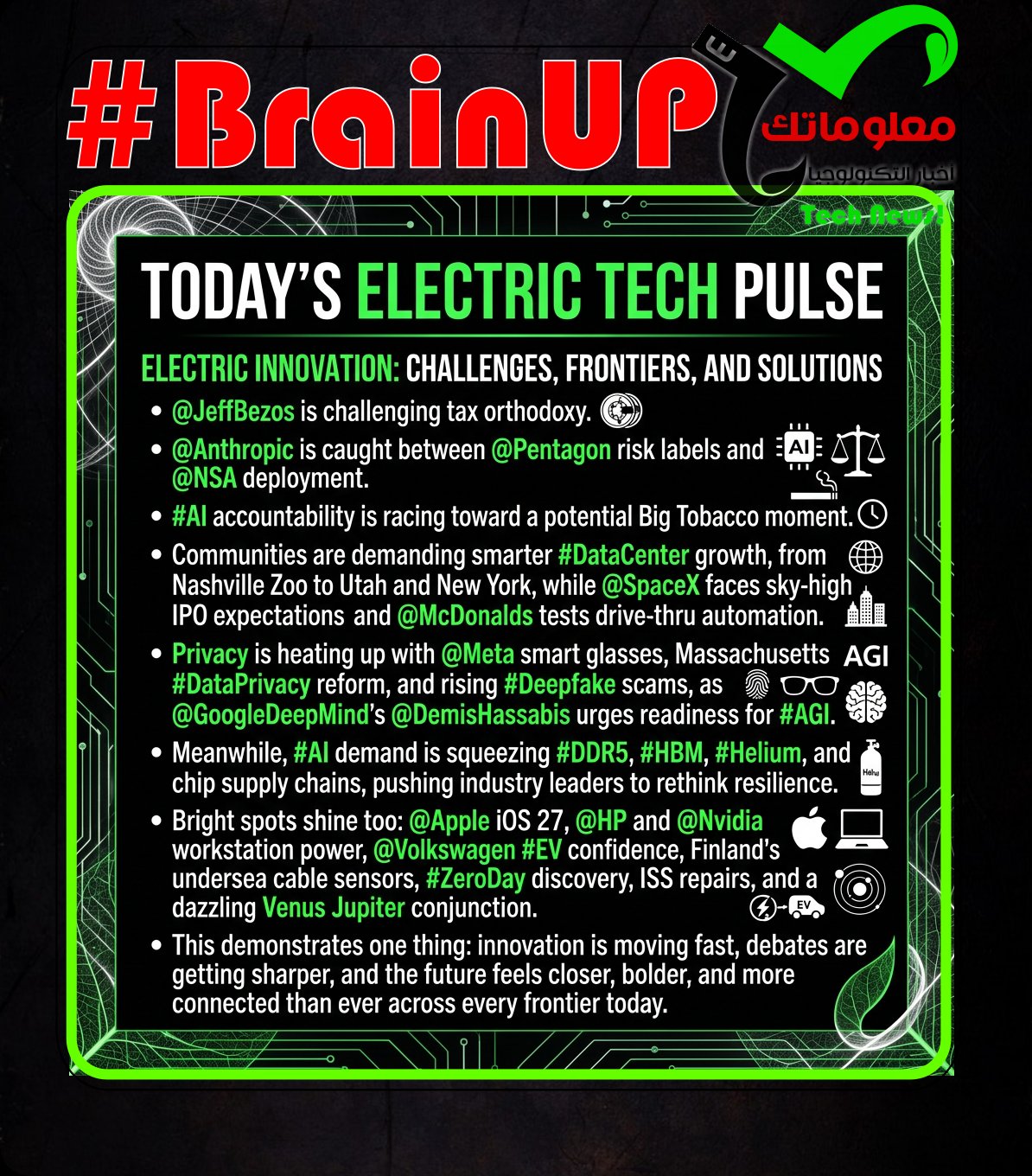
#BrainUp Daily Tech News – (Sunday, June 7ᵗʰ)
Welcome to today’s curated collection of interesting links and insights for 2026/06/07. Our Hand-picked, AI-optimized system has processed and summarized 31 articles from all over the internet to bring you the latest technology news.
As previously aired🔴LIVE on Clubhouse, Chatter Social, Instagram, Twitch, X, YouTube, and TikTok.
Also available as a #Podcast on Apple 📻, Spotify🛜, Anghami, and Amazon🎧 or anywhere else you listen to podcasts.
@Jeff Bezos argued that taxing lower-income workers is “absurd” and proposed eliminating federal income taxes for people under a certain income threshold to ease financial stress in a widening #wealthDivide and #KShapedEconomy. On CNBC’s Squawk Box, he said lower earners contribute little enough in aggregate that removing their tax bills would not be catastrophic, citing examples like an @Amazon employee earning about $50,000 and a New York teacher or nurse making around $75,000. He connected the idea to upward mobility, referencing his parents’ rise from modest beginnings and suggesting that reducing tax burdens could help struggling families or their children get better chances to advance. Bezos also contended that simply increasing taxes on the wealthy is not a straightforward solution, saying that even doubling what he pays would not materially help a teacher in Queens and pointing to cases where #wealthTaxes have produced lower proceeds and broader economic downsides than expected. He instead criticized #corporateSubsidies, corporate and union influence over public policy, and excessive #bureaucracy as additional problems alongside taxes on bottom earners.
2. Anthropic is blacklisted by the Pentagon and being used by the NSA at the same time
Despite being labeled a #supply chain risk and effectively #blacklisted by the @Pentagon, @Anthropic is reportedly supporting the @NSA’s use of its #Claude Mythos model, including for offensive cybersecurity work. The @Financial Times says Anthropic placed about six engineers inside the NSA to guide deployment and customize Mythos, and a person close to the arrangement said it could help infiltrate networks in countries such as China and Iran, though it is unclear whether it is used in live hacking campaigns. This creates a policy contradiction because the NSA sits under the Department of Defense, which has argued in court that Anthropic’s technology poses a national security risk after Anthropic refused demands to loosen restrictions related to mass domestic surveillance and fully autonomous weapons during talks over a reported $200 million contract. Courts have issued mixed rulings, and the Pentagon later signed major AI deals with other firms while excluding Anthropic, yet the report suggests parts of DoD may still view Mythos as too valuable to forego. Anthropic has publicly framed Mythos as a defensive tool via #Project Glasswing with partners like AWS, Google, Microsoft, Nvidia, and CrowdStrike, claiming it helped identify thousands of #zero-day vulnerabilities and that partners have found over 10,000 high or critical severity flaws as access expands.
3. The lawsuits that could give AI its ‘Big Tobacco’ moment
A growing legal strategy that once battered Big Tobacco and now targets social media is emerging as a new threat to #AI companies by framing chatbots as dangerous products under #productLiability law. Florida Republican Attorney General @JamesUthmeier sued @OpenAI and CEO @SamAltman, alleging #ChatGPT harms users’ mental health and endangers public safety, and asserting liability for incidents in which the chatbot is accused of contributing to violence and mental health crises. The article links this approach to recent verdicts against #Meta and #YouTube, including a New Mexico jury finding Meta liable over insufficient safeguards against sexual predators and a California jury finding Meta and YouTube intentionally designed addictive platforms, arguing such outcomes could encourage more AI-focused suits, especially as #Congress has not enacted federal #AISafety regulation. Policy expert Michelle Lopes Maldonado and plaintiffs’ attorney Matthew Bergman say state attorneys general could multiply these cases and complement private lawsuits, while the legal differences between chatbots and social platforms, including questions around #Section230, may shape how courts evaluate liability. Overall, the piece suggests the absence of uniform federal standards may be pushing accountability fights into courts, raising the prospect of a “Big Tobacco” moment for AI.
4. Nashville Zoo tries to halt data center project next door over animal safety concerns
The Nashville Zoo is trying to stop a proposed 69,000 square foot #data center from being built next to its property, saying the facility would sit about 50 yards from some animals and that noise could disrupt their well-being and breeding. Zoo CEO Rick Schwartz said the zoo is especially concerned about clouded leopards, a vulnerable species the zoo is working to conserve, and the zoo launched an online petition that had more than 180,000 signatures and 25,000 Facebook shares as of Friday. Metropolitan Council member Courtney Johnston said residents have flooded her with messages, she filed a zoning appeal, and she plans to seek a council vote on Tuesday for a data center moratorium, arguing the city lacks data center specific zoning or building rules and that the developer moved with little outreach. The project is backed by DC BLOX, which said it understands the concerns and will work with officials, the community, and the zoo to minimize impacts and assure no health risks to residents or animals, though a spokesperson said he did not yet know what the center would be used for or whether #AI customers would be involved. The dispute reflects broader nationwide pushback against data centers tied to #artificial intelligence and tech growth, including calls for regulation, lawsuits, and opposition to tax breaks.
Fortune argues that a pending SpaceX IPO at an expected $1.75 trillion valuation implies growth targets so extreme they are effectively unattainable. Valuation analyst @David Trainer of New Constructs, using a discounted cash flow model and assuming investors seek about a 10% annual return over a decade, estimates SpaceX would need to reach about $1.1 trillion in revenue by 2035, up from $18.7 billion in 2025 when it reported a $4.9 billion loss. Hitting that level would require roughly 50% average annual revenue growth for ten years, including a final year jump from $718 billion to $1.1 trillion, a $360 billion increase with no historical precedent, compared with @Nvidia adding $85 billion from 2024 to 2025 and @Amazon’s total increase over six years matching that magnitude. At $1.1 trillion, SpaceX would represent about 2.4% of projected 2035 U.S. GDP and rival or exceed the scale of major sectors like utilities and entertainment, underscoring how the IPO price sets a towering performance bar even as a nearly $30 trillion #AI total addressable market would invite intense competition from @Alphabet, @Microsoft, @Nvidia, @OpenAI, and others.
6. McDonald’s Introduces AI Drive-Thru System, Sparking Customer Backlash
@McDonald’s announced it will roll out a new AI-powered operating system for drive-thrus under its #McDonaldsNext initiative, reviving automation efforts two years after discontinuing a previous AI ordering system. A franchisee account, @McFranchisee, said the system called #ArchyIQ is being tested in five stores in partnership with @Google, has processed over 1 million transactions, and reportedly completes about 90% without human escalation, with installations of Google Edge Cloud hardware planned for US locations. In a shared demo, Archy IQ took orders in English and Spanish and handled a request for a customer’s “usual,” and it is positioned as a “master brain” to help managers spot bottlenecks and operational issues. The announcement prompted backlash on X, with commenters saying they prefer human interaction, fear job losses, and cite frustrating experiences with similar systems and self-service kiosks. McDonald’s has not clarified when Archy IQ will expand beyond the five test stores, keeping the broader #AI rollout timeline uncertain.
7. Women unknowingly filmed in Brussels with Meta smart glasses raise concerns
Concerns about privacy have arisen after women in Brussels were unknowingly filmed by users wearing #Meta’s smart glasses. The glasses, equipped with cameras, capture footage without clear consent, leading to debates on the ethical use of such #AugmentedReality technology in public spaces. Critics argue that the lack of visible indicators on the glasses creates a risk of covert surveillance and infringes on personal privacy rights. This situation highlights the need for stricter regulations and transparency regarding the deployment of wearable tech in everyday life. Ensuring responsible use of smart glasses will be crucial to balancing innovation with privacy protection.
8. An open-source project bans public pulls, citing AI-generated code security concerns
The Ladybird Browser project is banning all public pull requests for the foreseeable future, citing #security concerns tied to #AI-generated code, while keeping the browser #open-source. As the team approaches its first alpha release, it says it needs stronger assurance that major flaws or malicious changes do not slip in unnoticed, and that the old trust signal of a large, effortful patch no longer works because AI tools can produce substantial code quickly. The developers argue that pull requests now reveal less about a contributor’s good faith or accountability, making it harder to detect hidden malicious code or insecure AI-produced changes. To enforce a ban on unverified AI code, the team is moving development in-house, closing existing open public PRs and asking contributors to participate via bug reports instead. The announcement frames the decision within broader debates about LLM-assisted code in open source, noting that some projects have tentatively accepted it while others have banned it.
9. Anthropic Says We Must Stop Authoritarian AI. But What About Its Authoritarian Investors?
The article argues that #Anthropic promotes itself as a principled opponent of #authoritarianAI, especially warning that the U.S. and allies must stay ahead of the Chinese Communist Party, while downplaying that it has an authoritarian investor. It cites a May policy paper and a 2024 blog post by @Dario Amodei claiming democracies must lead AI to prevent repression, including allegations that the CCP uses AI for censorship, dissident repression, hacking, military strengthening, and biometric and facial recognition surveillance against ethnic minorities. The piece says this framing functions like broader tech-industry China race rhetoric that can be used to resist regulation, and notes the paper does not condemn such uses of AI in principle while the U.S. also deploys similar technologies. It highlights that a portion of Anthropic is owned by Abu Dhabi via its sovereign wealth fund, describing Abu Dhabi as a repressive authoritarian monarchy, and suggests Anthropic’s stance on authoritarianism is selectively applied. Overall, it links Anthropic’s geopolitical messaging about democratic values to a perceived double standard in its own financing and public accountability.
10. Massachusetts House passes strong data privacy bill banning sale of cell phone location data
The Massachusetts House passed the #MassachusettsConsumerDataPrivacyAct, a #dataPrivacy bill that supporters say could be among the strongest in the U.S. if signed into law. The House version includes a complete ban on the sale of precise cell phone #locationData and, despite industry lobbying, a private right of action that would let people sue #BigTech companies for data abuses. The legislation now goes to a conference committee to reconcile differences with a similar bill previously passed by the Massachusetts Senate, as advocates push for the strongest final version. @EvanGreer of Fight for the Future argued companies should not be able to track people everywhere and sell that information, emphasizing that privacy protections are especially critical for LGBTQ+ youth, undocumented people, and other vulnerable communities. Fight for the Future also contrasts this approach with proposed #ageVerification measures, urging lawmakers to pass strong privacy rules and then pursue additional, community informed policies to address harms from surveillance driven social media.
11. Utah residents sue officials over Kevin O’Leary data center plan
A progressive nonprofit and five Box Elder County residents sued Utah officials and the #MilitaryInstallationDevelopmentAuthority (#MIDA) over @Kevin O’Leary’s proposed Stratos Project #data center, arguing the approval process violates residents’ constitutional rights. Filed in Utah’s 3rd District Court, the complaint says MIDA, an unelected body, would hold permanent control over issues like public health, safety, taxation, zoning, and land use across tens of thousands of acres, while limiting public input and voter recourse. The suit also names Utah Senate President @J. Stuart Adams and state Sen. @Jerry Stevenson, alleging their service on the MIDA board while serving as legislators may violate a prohibition on holding more than one office of public trust, which the plaintiffs argue should make the approval null and void. State and local officials said they are reviewing the lawsuit, while Box Elder County said it had not yet been formally served. The lawsuit arrives as political pushback prompts O’Leary to scale back the original 40,000 acre #AI campus plan, with Adams announcing O’Leary agreed to a 75% size reduction plus commitments for water to the Great Salt Lake and land set aside for open space, wildlife protections, and continued agricultural use, and Adams saying the project remains in early stages pending permitting and environmental review.
12. Americans lost nearly $900 million to AI-generated scams last year
Americans lost nearly $900 million in 2025 to scams that incorporated #AI, and experts warn the problem is likely to grow as the technology improves. The @FBI’s first report focused on #AI-enabled fraud logged more than 22,000 complaints to the Internet Crime Complaint Center, including cases where scammers used #voice-cloning to mimic a daughter and stole over $5,000, and where fake #FBI agents persuaded an Ohio woman to drain accounts totaling $1.5 million. Officials say #AI-generated communications can look official even to trained people, while researchers and consumer advocates describe a surge in volume as scam call centers send tens of thousands of messages per minute. Consumer protection agencies in California and New York City report a wide range of grifts, including #deepfakes that impersonate trusted relatives, celebrities, or public figures and #romance-scams that use fake images, videos, or voices to build trust before asking for money. As scammers experiment with tools like Claude, Gemini, Grok, and ChatGPT, the increasing sophistication and scale of #AI scams is expected to drive losses and complaints higher.
13. Google DeepMind CEO says we don’t have much time to prepare for the ‘new human era’
@Demis Hassabis, CEO of Google DeepMind, warned that #AGI could arrive within a few years and force society to prepare quickly for what he called a “new human era.” In a Stanford Graduate School of Business fireside chat, he estimated #AGI, defined as AI performing cognitive tasks at or beyond human levels, might come around 2030 plus or minus a year, and compared its impact to the #singularity, a point of no return after a major technological breakthrough. He cautioned that some industry peers are “way too certain” in their forecasts, even as other frontier AI leaders have recently raised alarms about job losses and then toned down more doomer predictions. Hassabis argued #AGI could also drive medical breakthroughs and major economic transformation, potentially enabling a “post-scarcity world,” and urged humanities and STEM students to adapt and “lean in” to the technology. He said the next few years will be critical in shaping how these impacts unfold, emphasizing that society does not have long to prepare.
14. Let us filter AI slop, you cowards
Online platforms that now label #AI-generated content should also let users filter it out, because labeling alone has not meaningfully changed what people are shown in their feeds. The article notes that services like #YouTube, #Instagram, and #TikTok may add AI disclosures in descriptions or overlay labels, and @Meta applies “AI info” labels on Facebook and Instagram when AI metadata or creator disclosures are present, yet it remains difficult to avoid such posts despite ethical, environmental, and quality concerns. After the author contacted @Google, @Meta, TikTok, and Spotify about AI-content filtering, none committed to offering a user-facing filter, with some not responding and others saying they had nothing to share. Where filters do exist, the piece argues they are limited and revealing: #DeviantArt hides its “AI Content Settings,” offers only “Show AI” or “Suppress AI,” and the author saw little difference, compounded by weak automatic labeling even when metadata indicates AI provenance. #Pinterest similarly lets signed-in users reduce AI content by category via “Refine your recommendations,” but the author reports the results are imperfect, reinforcing the case for clearer, more effective filtering tied to the platforms’ own labeling systems.
15. The ‘AI boomerang’: Why some companies are rehiring employees they laid off due to AI
Some companies that cut jobs because of #AI or automation are now rehiring for the same roles because the technology has not fully replaced human work in practice, a trend described as the “#AI boomerang.” The article cites recent layoffs and AI spending moves by Meta and notes similar actions by Cloudflare, Coinbase, and PayPal, alongside research signals that such cuts can backfire: a @Forrester Research report found 55% of employers regretted AI driven layoffs, and a @Gartner prediction says 50% of companies that replaced customer service or operational staff with AI will need to restaff those roles under new titles by next year. New @Robert Half research reviewed by Fast Company reports that 32% of U.S. hiring managers say their organizations eliminated a role mainly due to AI or automation productivity gains, then later rehired for that exact role. Megan Slabinski of Robert Half attributes the reversals to gaps in quality, oversight, and decision making that appear as business demands rise, leading leaders to rethink jobs so AI complements employees rather than replaces them. The 2,000 manager survey found the most rehiring reports in finance, HR, and tech, with marketing and creative, legal, healthcare, and administrative and customer support close behind, reinforcing that the shift is broad and rooted in recognizing AI’s limits.
Argentine inventor Marco Agustín Secchi has developed #Ironplac, a magnetizable building material intended to turn ordinary walls into “active” surfaces that can hold magnet-backed objects without drilling. The article says #Ironplac is designed for both wet and dry construction, can be applied like a finishing skim coat, and uses a special mix with mineral and ferrous fillers so the surface can receive magnets while keeping the look and feel of a normal wall, it is also presented in 25 kg bags to fit standard construction workflows. Demonstrations described include walls holding tools, knives, panels, and even a shovel using magnets instead of screws, and early pilot tests are mentioned, though the product is still in development. The system is framed as passive rather than powered, meaning it does not create a constant magnetic pull but responds when an object carrying a magnet is placed on it. If it works at scale, the concept could reduce the mess and damage of anchors and patch jobs and make it easier to rearrange storage and decor in homes, offices, workshops, and classrooms.
17. Google Employees Internally Share Memes About How Its AI Sucks
The article says that despite @Sundar Pichai publicly claiming that 75 percent of Google’s new code is #AI-generated, Google employees internally share memes criticizing the AI tools used for coding. It reports that staff who write the code describe the AI as overhyped, bad at the task, and making their jobs harder. The piece frames this as a disconnect between leadership’s promotional messaging about AI-driven productivity and engineers’ day-to-day experience using the technology. It is presented as a paid-members-only post, with limited details available beyond the stated contrast between the CEO’s claim and internal employee sentiment.
18. Helium Crisis Tightens Grip On Global Chip Supply Chain
A sudden #helium shortage is tightening the semiconductor supply chain, risking slower output of the advanced chips and memory underpinning the AI boom. Qatar’s Ras Laffan Industrial City, supplying about one third of global helium, has been largely offline since early March after Iranian strikes and the effective closure of the Strait of Hormuz, removing an estimated 27% to 30% of global supply and driving spot prices up 40% to 100% in weeks, per Bank of America. Ultra high purity helium is hard to replace because it is used for wafer backside cooling during lithography and etching, stabilizing thermal and vacuum conditions in advanced tools, leak detection, purging, and as a carrier gas in plasma enhanced CVD and #EUV lithography, where tiny impurities or temperature swings can cut yields. While @TSMC says it is monitoring and does not expect significant impact yet, supply chain leaders at Semicon China reported early production effects as firms scramble for alternatives. South Korea is most exposed because it sourced about 64.7% of its helium from Qatar in 2025, and with @Samsung and @SKHynix producing roughly 70% of global #DRAM and major #HBM volumes, prolonged disruption could force prioritization of high margin AI memory despite mitigation efforts like Samsung’s Helium Reuse System.
19. 32GB of DDR5 now costs $375 minimum — AI shortage continues to squeeze PC building
Rising #AI-driven demand is consuming manufacturing capacity across the PC hardware supply chain, pushing the entry price for 32GB of #DDR5 to about $375 and tightening pressure on gaming and enthusiast PC builds. Price tracking cited in the article notes 16GB kits that were under $100 a year ago now reaching about $240, while the cheapest 32GB DDR5 listed via PCPartPicker is $374.97, tied to four Silicon Power XPOWER kits with a promo code, and more popular brands or RGB kits commonly exceed $400. The article adds that 64GB can cost $679.99, 16GB “compromise” options sit around $200, and #SSD prices have also surged, with drives once as low as $38 now around $200. It argues that volatile pricing makes averages unreliable, combo deals bundling RAM with other components offer limited relief, and uncertainty persists as vendors avoid firm pricing amid ongoing increases. It also points to @AMD attempting to keep gaming costs down with the return of Ryzen 7 5800X3D and a new Ryzen 7 7700X3D, while @Intel warns memory pricing “has to give” and suggests extending legacy platforms like Raptor Lake with #DDR4 as an alternative.
@Lexar regional manager Chris Xia says consumer #RAM prices are expected to double by the end of the year, and recent apparent price stability or discounts are mostly temporary. He attributes higher pricing to the current #AI build out pulling memory supply from the big three suppliers, @Samsung, @SK hynix, and @Micron, as production capacity is heavily allocated to #HBM, leaving conventional DRAM tighter and more expensive. Xia says retail dips often come from sellers clearing old inventory for liquidity or from distributors importing cheaper unsold stock from other regions, which only lasts until those supplies run out, after which market pricing catches up. He adds that industry cost changes can take eight to nine months to reach consumers and that the market trend has been upward, prompting his recommendation to buy now rather than wait for lower prices that he says will not arrive for years. The article links the memory shortage to broader impacts, including expected PC and laptop shipment contraction of more than 10%, motherboard sales down more than 25%, and potential price increases or reduced memory configurations in smartphones and other devices.
21. Brave is charging $60 to remove features it added in the first place
@Brave has introduced Brave Origin, a paid, slimmed-down version of its browser that focuses on removing features some users consider unwanted. According to a thread the company posted on Twitter and reporting referenced from Digital Trends, Origin for desktop and Android (with iOS planned) disables features like email aliases, #Leo AI, the VPN tool, #Brave Wallet, and Speedreader, and it can be used either as a separate build with removals applied or as a toggleable panel added to the standard browser. The product costs a $60 one-time fee for non-Linux users, includes unlimited activations across devices, and is free on Linux. The article frames this as paying more to get less, arguing it is frustrating to be charged to remove features Brave added and suggesting the feature-toggle panel should have existed from the start. Users can buy Origin via the Brave Premium website or enable it in Brave at brave://settings/system and then use “Refresh Origin” to access the toggles.
New York has moved toward becoming the first US state to impose a temporary statewide moratorium on large #datacenters, as lawmakers advance a one year ban aimed at slowing rapid development tied to the #AI boom. The state legislature approved the measure and sent it to @Kathy Hochul, while sponsor @Kristen Gonzalez said it targets “hyperscale” facilities over 20MW and generally those built by “tech goliaths,” excluding projects that already have required state permits. Gonzalez cited at least 28 large datacenters under state evaluation that could add 9,682MW to an “already constrained and aging” grid, and argued communities should not have to trade water, energy, green space, and neighborhood well being for big tech and #generativeAI. Beyond the pause, the bill would require an environmental impact report detailing water and electricity use and would add labor, energy efficiency, transparency standards, and ratepayer protections intended to limit bill increases. The proposal reflects a broader national backlash, with a Heatmap poll reporting nearly three quarters of Americans oppose a datacenter near their homes and multiple states considering similar moratoria.
@Martin Sander, @Volkswagen’s board member for sales, marketing and aftersales, argues that adoption of #EVs will happen organically, like the historical shift from horses to petrol cars, rather than through forcing consumers via an #ICE ban. He says focusing debate on a ban date makes it harder to win over drivers who are used to combustion cars, and instead calls for removing barriers by improving #charging infrastructure, communicating EV advantages, and addressing energy prices. Sander adds that even if a 2035-style deadline arrives, only a small minority may still want combustion engines by then. He also says VW is using lessons from China to improve scale, efficiency and cost to compete globally with Chinese brands, but does not see a European case for bringing its range-extender technology, preferring a lineup spanning ICE, mild and full hybrids, plug-in hybrids, and battery-electric models. The comments sit alongside VW’s upcoming product push, including the ID. Polo and updates to the ID.3, framing EVs as the better default choice once practical hurdles are reduced.
Finnish telecom Elisa has installed a new monitoring system on its undersea cables to provide early warning of potential threats to this critical infrastructure. Using #DistributedAcousticSensing, the cable is turned into a long vibration sensor that detects seabed disturbances, has been successfully tested, and is being developed to automatically notify the Finnish Border Guard, the Finnish Navy, and cable owners about irregular activity. The deployment is framed as a response to recent cable breaks and broader concerns that undersea cables, which carry about 99% of global internet traffic, can be intentionally damaged, including allegations of “shadow fleets” dragging anchors and reports of Russian vessels operating near major data routes. The approach is described as cost-efficient because it can be retrofitted onto existing cables, mainly requiring signal listening devices about every 100 km, and it resembles a system previously developed by Germany’s AP Sensing, though the article says it is unclear whether Finland used that firm’s technology or patents. Elisa portrays the project as a national effort involving organizations such as Fingrid, Gasgrid Finland, the Geological Survey of Finland, the Naval Academy, and the University of Helsinki’s Institute of Seismology, linking the system to wider international moves to protect undersea infrastructure.
25. Microsoft Office 2019 for Mac will no longer edit documents after July 13
#Microsoft Office 2019 for Mac on outdated #macOS will lose the ability to edit documents after July 13, leaving affected apps limited to opening and printing. @Microsoft says Word, Excel, PowerPoint, Outlook, and OneNote on iPhone, iPad, and Mac will no longer edit, save, or create files unless users update both their operating system and Office, with #Microsoft 365 subscribers needing iOS 17+, iPadOS 17+, or macOS Monterey+ and the latest Office version. Users with the standalone Office 2021 for Mac can keep editing after updating, but Office 2019 Mac users are given no fix besides buying a newer version or subscribing to #Microsoft 365, and some may need new hardware if their devices cannot run the required OS versions. A report citing the JimmyTech blog attributes the change to expiring certificates and notes that Microsoft messaging about continued functionality may have been revised to only promise users will not lose data. The situation follows Office 2019 for Mac support ending in 2023, while it is still unclear whether Windows Office 2016/2019 or Office 2021 will face similar editing restrictions as their lifecycle milestones pass.
A coalition of nine US trade associations is urging the @Trump administration to act quickly on an emerging #memory chip shortage that it says is being driven by rapid #AI data center expansion and is threatening non-AI industries. In a June 3 letter to Commerce Secretary @Howard Lutnick and Treasury Secretary @Scott Bessent, the groups warn that AI infrastructure is consuming an outsized share of global memory output, contributing to supply constraints and price increases that could raise costs for consumer electronics, broadband and telecommunications equipment, and disrupt automotive and medical device production, including federal contractor procurement timelines. They argue the risks are appearing despite billions of dollars invested to strengthen domestic semiconductor supply chains, and ask the administration to coordinate with memory suppliers and major buyers, accelerate memory manufacturing capacity in the US and allied nations, use trade agreements to improve resilience, ensure supply for non-AI sectors, leverage #CHIPS Act programs where possible, and cut regulatory barriers. The backdrop is that memory makers are prioritizing high-margin #HBM for AI accelerators from companies like Nvidia and AMD, with Samsung, SK Hynix, and Micron controlling over 95% of global DRAM and reportedly shifting wafer capacity toward HBM at the expense of commodity DRAM and NAND. Samsung and SK Hynix have warned shortages could last through at least 2027, and IDC has cut its 2026 PC market forecast by up to 9% due to memory scarcity and higher prices, reinforcing the coalition’s claim that AI-driven demand could ripple broadly across the economy.
27. iOS 27: Seven new iPhone features are coming soon – 9to5Mac
Apple is expected to preview iOS 27 at #WWDC with a set of rumored iPhone upgrades led by a major #Siri overhaul and new AI-driven features across core apps. The article reports a revamped Siri with a standalone app, a chatbot-style interface, #LLM-based world knowledge, a new design tied to #DynamicIsland, multi-action requests, deeper third-party AI agent integrations, and systemwide “Ask Siri” entry points, plus delayed personal context and onscreen awareness features. In Photos, new AI editing tools called Extend, Enhance, and Reframe are said to arrive, alongside an improved Clean Up feature aided by a Google #Gemini partnership; the Camera app may also add a dedicated “Siri” mode that expands #VisualIntelligence, including scanning nutrition labels to log dietary info and capturing contact details from what the camera sees. Apple Wallet is rumored to gain “Create a Pass,” letting users convert QR codes into customizable digital tickets with templates for standard, membership, and event passes. The article also notes planned Apple Health upgrades, including physician-made educational videos and AI-powered coaching, framed as features moved into the free Health app rather than a previously considered “Apple Health+” subscription.
HP introduced a Windows-focused, deskside AI supercomputer lineup built around @Nvidia’s GB300 Grace Blackwell Ultra Desktop Superchip, positioning its ZGX Fury GB300 as an enterprise workstation capable of local inference up to one trillion parameters. The article cites @Nvidia’s DGX Station for Windows announcement at GTC Taipei on May 31, 2026, and notes HP’s configuration targets heavy workloads with up to 784GB of coherent #unified memory and up to 20 petaflops of #FP4 compute, plus customized enterprise networking. The systems are framed as a way for enterprises to run and fine-tune large models locally, reducing reliance on the cloud and integrating with existing Windows environments, which HP says account for over 70% of enterprise PCs. Pricing is expected to be very high: HP has not disclosed a price, but reseller listings for DGX Station configurations are referenced from about $94,000 to under $200,000, implying HP’s offering could be similar. Availability is not finalized, but the ZGX Fury GB300 is expected to arrive later in 2026, around Q4 2026, alongside the broader DGX Station ecosystem from partners such as Dell, MSI, and ASUS.
29. AI Agent Uncovers 21 Zero-Days in FFmpeg; Chrome Patches Record 429 Bugs
The article reports that an #AI agent discovered 21 #zero-day vulnerabilities in #FFmpeg and that #Google #Chrome version 149 shipped a record set of fixes totaling 429 bugs. It states some of the FFmpeg zero-days were as old as 20 years, and that Chrome’s patch set included more than 100 flaws rated critical or high severity. The details emphasize how AI-driven discovery is surfacing long-standing software weaknesses at scale while major platforms continue to issue large-volume security updates. Overall, it ties AI-enabled vulnerability finding to the need for organizations to strengthen processes for handling software flaws across widely used components like FFmpeg and Chrome.
30. Astronauts briefly take shelter during repair to fix leak on the International Space Station
NASA temporarily directed the International Space Station crew to take shelter while a fresh leak on the Russian segment was being addressed. Five astronauts moved into a docked #SpaceX capsule as cosmonauts worked on repairs, a step NASA spokesperson @Bethany Stevens said was taken out of an abundance of caution. The crew returned to normal operations after the repair work was paused. NASA said the affected area has experienced cracks and leaks in past years, and #Roscosmos opted for a more extensive repair after new issues were found, while both agencies continue working to determine the cause. The brief shelter order reflects ongoing concern about recurring structural problems on that section of the orbiting lab.
31. Jupiter and Venus conjunction 2026: See two bright planets at the same time this weekend
A close #conjunction of Venus and @Jupiter will be one of 2026’s standout skywatching events, placing the two brightest planets close together in the western sky during twilight from June 9 to 11. The best view is about 45 minutes to two hours after sunset on June 9, when they appear about 1.6 degrees apart, close enough to fit in standard binoculars if you have a clear western horizon. The pairing is an optical illusion because the planets are at very different distances, with @Jupiter about 6 astronomical units from Earth and Venus about 1.2, and their apparent approach is driven by their different orbital speeds and positions as Venus rises in the evening sky while Jupiter sinks toward solar glare. Venus will dominate the scene at about -3.9 magnitude compared with Jupiter at -1.7, roughly 7.5 times brighter, aided by Venus’ reflective cloud layers. Binoculars can frame both planets together and a small telescope may show Jupiter’s four #GalileanMoons, while the next major conjunction follows on Nov. 15 when @Jupiter and Mars come within about 1.2 degrees before sunrise.
That’s all for today’s digest for 2026/06/07! We picked, and processed 31 Articles. Stay tuned for tomorrow’s collection of insights and discoveries.
Thanks, Patricia Zougheib and Dr Badawi, for curating the links
See you in the next one! 🚀
