
#BrainUp Daily Tech News – (Wednesday, June 3ʳᵈ)
Welcome to today’s curated collection of interesting links and insights for 2026/06/03. Our Hand-picked, AI-optimized system has processed and summarized 24 articles from all over the internet to bring you the latest technology news.
As previously aired🔴LIVE on Clubhouse, Chatter Social, Instagram, Twitch, X, YouTube, and TikTok.
Also available as a #Podcast on Apple 📻, Spotify🛜, Anghami, and Amazon🎧 or anywhere else you listen to podcasts.
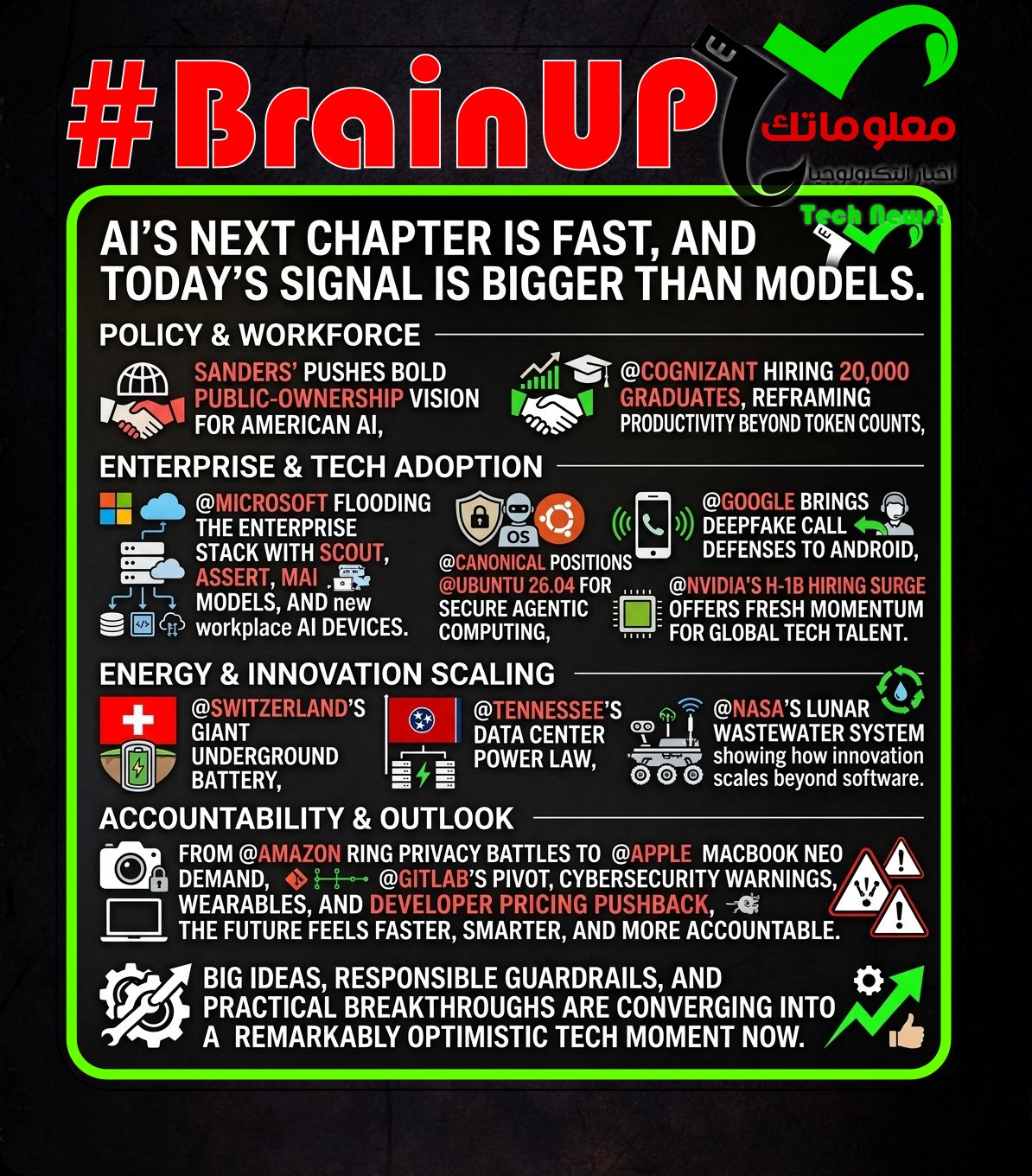
@Bernie Sanders proposes a bold policy to establish 50 percent public ownership of American AI companies through an #AI Sovereign Wealth Fund that would hold stakes in the largest AI firms. This initiative aims to democratize control over #ArtificialIntelligence technologies, ensuring broad public benefit and preventing concentrated private power in the AI sector. Sanders argues the fund would generate revenue for public interests while fostering ethical and equitable AI development. The approach highlights the increasing political interest in regulating AI with mechanisms resembling public ownership models to balance innovation and societal impacts. This proposal reflects a growing movement toward rethinking ownership and governance structures in the technology industry to promote shared prosperity.
@Ravi Kumar S., CEO of Cognizant, argues that #AI will not wipe out entry-level white-collar work and that recent predictions of a job collapse amounted to fearmongering. He says Cognizant hired 20,000 entry-level college graduates last year and expects to increase that number in 2026, including roles tied to its #AI Builder strategy such as Frontier Certified Engineer and Frontier Business Operator, with candidates not limited to technical majors. Kumar expects the workforce pyramid to flatten as #AI takes over much of the middle layer, while entry-level and senior leadership roles remain, with growth in validation, verification, and authentication work and leaner middle management. He also criticizes #tokenmaxxing, calling token consumption a “vanity metric” that should not be equated with paid hours or productivity, and argues teams must learn to deploy tokens strategically based on workflow and business goals. Overall, he advocates shifting from measuring inputs like billable hours toward owning, underwriting, and getting paid for outcomes as companies restructure for the AI era.
Western Sydney University academic @Cath Ellis used #AI to help draft a Sydney Morning Herald opinion column that urged students not to “cut corners” by outsourcing their thinking, but the newspaper removed the piece as “unacceptable”. The column, written in response to @Kylie Moore-Gilbert’s concerns that students can outsource learning to #AI and are “being graded on who can write the best AI prompts”, told students the “AI problem is real” yet genuine effort would still stand out. When checked with the AI detector #Pangram, it appeared AI-generated, and the university confirmed Ellis used a #Copilot large language model by uploading 40,000 words of her own original material for summaries and prompts that formed early drafts. The university argued this was a sophisticated and appropriate use of generative AI, noting detectors can spot AI use but not judge whether it is appropriate, and the article did not disclose AI use. Nine’s editorial policy permits AI for initial research and idea prompts but says AI will not be used to write stories for publication, and the Herald’s editor @Jordan Baker said the column did not meet editorial guidelines and was removed.
4. Philly Cops Are Reportedly Monitoring Anti-AI Memes, According to Internal Alert
An internal bulletin indicates Philadelphia-area law enforcement is monitoring online #anti-AI sentiment and treating it as a potential precursor to attacks on #AI data centers, amid broader federal efforts to frame opponents of #AI expansion as extremists. The piece cites reporting that #FBI, #DepartmentOfHomelandSecurity, and fusion-center documents label critics as “anti-tech extremists,” and highlights a Delaware Valley Intelligence Center report marked “for official use only” claiming “domestic violent extremists” may target AI facilities while acknowledging a lack of specific local plotting. As support, the bulletin points to social media memes referencing “tannerite and gasoline” and the “Butlerian jihad,” plus an anonymous image-board thread discussing ways to “neutralize” a data center and suggesting tactics like explosives, incendiaries, flour dust, and chlorine gas via ventilation. The article argues the evidence for concrete threats is thin for most posts and warns that broad surveillance and #domestic-terrorism framing can chill #FirstAmendment-protected protest, even as a small subset of speech may be more legally fraught. It concludes that, at least in Philadelphia, “Big Brother is taking notes,” so people should consider how their online statements could be used against them.
5. Philly Cops Admit That They’re Tracking “First Amendment Activity” Critical of AI
A confidential bulletin obtained by The Intercept shows a Philadelphia-area #fusion center is monitoring social media posts critical of #AI data centers and treating “disruptive #FirstAmendment activity” as an indicator of risk from “#DomesticViolentExtremists.” The Delaware Valley Intelligence Center, housed in the Philadelphia Police Department, circulated a December alert through the national fusion center network warning that DVEs, from white supremacists to anarchists, may target AI data centers with physical and cyber attacks, even while acknowledging a lack of specific information about plans to target facilities in the Philadelphia area. The bulletin relies largely on news reports and online rhetoric, citing examples such as an unnamed user saying they wanted to “burn down” data centers, references to a fictional anti-robot movement in the novel “Dune,” and a Facebook meme. The article situates the alert within longstanding criticism that fusion centers over-surveil lawful protest movements, noting past warnings about #BlackLivesMatter and pipeline opponents, and Pennsylvania’s prior controversy over state security reporting on activists. Philadelphia civil rights lawyer Paul Hetznecker argues the document dangerously conflates legitimate community concerns about AI data centers with terrorism, potentially chilling protected political speech.
6. Ubuntu 26.04 is the OS for the AI agentic era, says Canonical’s Mark Shuttleworth – here’s why
@Mark Shuttleworth argues that Ubuntu 26.04 is built for the #AI agentic era by rethinking software delivery and security for fast-moving AI development. He says AI innovation is outpacing traditional Linux packaging like #APT and #RPM, so Canonical is betting on signed, auto-updated, policy-driven #snaps that can ship updates quickly while preserving auditability and control, backed by telemetry showing many snap updates landing in a single morning across x86, Arm, RISC-V, and Power from the same tested bits. Ubuntu 26.04 also adds more user-facing confinement controls, including fine-grained permission prompts for snapped apps, enabled by plumbing from the kernel and #AppArmor through snapd and #GNOME. Canonical positions Ubuntu’s broader “sandbox everything” approach as central for AI security, spanning snap confinement, #Docker/#OCI containers, #LXD system containers, VMs via #Multipass, and newer #microVMs that blend container and virtualization models. Together these mechanisms are presented as the foundation for running not only apps but also AI agents and third-party SDKs in layered, controlled environments suited to rapid AI-era iteration.
7. GitLab to Cut 14% of Workforce as Part of AI Pivot
GitLab announced a 14% workforce reduction as it shifts focus towards artificial intelligence, reflecting the company’s strategic pivot to prioritize AI-driven development tools. The job cuts are intended to align operational costs with new business objectives emphasizing automation and efficiency enhancements, which GitLab views as critical to staying competitive in the evolving software market. Analysts note that consolidation in tech staffing often accompanies strategic refocusing, highlighting the challenges companies face balancing innovation with profitability. By investing in AI capabilities, GitLab aims to streamline its platform offerings and improve product value for developers, marking a significant transition in its growth trajectory. This move underscores the industry’s broader trend toward integrating AI as a core component of software development.
Switzerland has constructed the world’s most powerful underground battery by excavating a hole the size of two soccer fields, designed to release 1.2 GW of power within milliseconds and store 2.1 GWh of energy. This multibillion-dollar project highlights the nation’s commitment to advancing #energy storage technology and addressing energy demands rapidly and efficiently. The battery’s capability supports grid stability and renewable energy use by balancing supply and demand fluctuations. This innovation showcases Switzerland’s leadership in sustainable energy infrastructure, combining massive storage capacity with extreme responsiveness. The installation emphasizes the critical role of large-scale, fast-acting batteries in future energy systems worldwide.
9. New Tennessee law requires data centers to pay for their own electricity infrastructure
A new Tennessee law signed by @Bill Lee requires large #data centers to cover the cost of the electricity infrastructure they need, aiming to prevent #utility ratepayers from subsidizing those upgrades. Sponsored by Sen. @Brent Taylor and Rep. @Ed Butler, it applies to facilities with peak demand of at least 50 megawatts in their first three years, as officials note the #TVA says data centers account for about 18% of its overall power load. Taylor cited what he called “the xAI way,” saying xAI secured a dedicated energy source for its Memphis supercomputer Colossus, which he estimated could use enough power for 200,000 to 300,000 homes. Some House Democrats opposed the bill due to an amendment allowing utilities, in limited cases, to spread costs systemwide when upgrades also benefit other customers, a concern raised by Rep. @Justin Pearson, while Taylor argued cost sharing would only occur if the broader system benefits and the measure is designed to keep energy prices down. The law took effect immediately upon the governor’s signature.
10. Nvidia’s Big H-1B Push Is Silver Lining For Indian Techies In US
Nvidia is emerging as a rare bright spot for Indian tech professionals in the US by expanding #H-1B hiring even as many big tech peers cut jobs and slow foreign recruitment amid an #AI shift. Under US rules, most #H-1B workers have 60 days to find a new sponsoring employer after a layoff, raising the stakes when companies like @Meta, @Google, and @Amazon reduce hiring. Federal filings show Nvidia secured certification for about 1,200 #H-1B positions in the first two quarters of fiscal 2026, up from roughly 1,000 a year earlier, while @Google approvals fell to about 2,200 from 5,100 and @Amazon dropped to about 4,300 from 6,100. With Indians comprising roughly 71% to 73% of approved #H-1B beneficiaries, a rise in Nvidia sponsorship is positioned to benefit Indian engineers disproportionately, especially as Nvidia’s chips power ChatGPT-like models and large data centers. The filings also indicate eye-popping base pay for roles such as software engineer (up to $391,000), research scientist (up to $356,500), product manager (up to $379,500), hardware engineering manager (up to $368,000), and architecture director (up to $488,750), reinforcing why Nvidia’s hiring push is significant during a constrained job market.
11. Intuit Becomes S&P 500’s Worst Performer This Year: Here’s Why
Intuit has emerged as the worst-performing stock in the S&P 500 this year due to significant downward revisions in its growth outlook and valuation. The company’s recent quarterly earnings report revealed softer-than-expected guidance, reflecting challenges in customer acquisition and retention amid a slowing economy and evolving tax infrastructure. Investors reacted negatively to these warning signs, pushing the stock down sharply as fears mount about prolonged revenue growth pressure and rising expenses. Despite Intuit’s strong position in #tax preparation software and financial management, market sentiment now questions its ability to sustain previous momentum. This downturn highlights the importance of adapting to shifting economic conditions and maintaining investor confidence in a competitive tech landscape.
12. Amazon faces class action lawsuit over Ring facial-recognition feature | TechCrunch
@Amazon faces a proposed class action in Seattle alleging privacy violations tied to Ring’s Familiar Faces #facial-recognition feature, which the suit claims stores images and biometric data of passersby without their consent. Filed by Virginia resident Charles Sigwalt, the complaint says “millions” of Americans unknowingly had facial recognition information collected as they walked past Ring cameras, even though the feature is opt-in for Ring users. Ring introduced Familiar Faces in September, drew objections from groups like the @EFF and Senator @EdMarkey, then launched it in December, marketing it as a way to identify frequent visitors and send more specific alerts. Ring has said face data is encrypted, never shared, and that unidentified faces are deleted after 30 days, while the company did not immediately respond to a request for comment on the lawsuit. The case lands amid broader scrutiny of Ring’s privacy history, including a 2023 @FTC settlement over improper access to customer videos and past law-enforcement-related practices around requesting user footage.
13. Hong Kong Securities Regulator Warns Licensed Firms on AI-Driven Cyber Threats
The Hong Kong Securities and Futures Commission (SFC) has issued a warning to licensed firms about the increasing risks posed by AI-driven cyber threats. It highlighted the growing sophistication of cyberattacks leveraging artificial intelligence to target financial institutions, potentially compromising sensitive information. The SFC urged firms to strengthen their cybersecurity frameworks by adopting advanced technological defenses and ensuring continuous staff training on emerging threats. This proactive approach aims to mitigate the risks associated with evolving AI capabilities in cybercrime, reinforcing the resilience of Hong Kong’s financial market infrastructure. The regulator’s guidance aligns with global trends where financial authorities emphasize the importance of adapting to the dynamic cyber risk landscape.
14. MacBook Neo Outsold Every Other Mac in Its Debut Quarter
@Apple’s MacBook Neo delivered one of the strongest Mac debuts in recent memory, shipping 1.1 million units in the first quarter despite being on sale for only about three weeks. #IDC data cited via @TechCrunch shows it outpaced other recent launches, with the M5 MacBook Air at over 900,000 units and the M5 MacBook Pro at 550,000, and shipments spiking in early April suggests March totals understate demand. Priced at $599, roughly 45% below the entry-level MacBook Air, the 13-inch aluminum MacBook Neo uses an A18 Pro chip and 8GB of RAM to hit a lower price point, with 44% of shipments going to the U.S. and about 18,000 units to India amid reported inventory shortages. @Counterpoint Research and #IDC argue the model is strategically important because it helps Apple compete in the $400 to $699 notebook segment, potentially growing share from about 2% to around 15%, while also possibly displacing discounted older MacBook Air models in markets like India. The launch is already triggering competitive responses, such as @Dell introducing a $699 XPS 13, and #IDC forecasts a very large shipment spike next quarter as supply constraints ease and availability expands.
15. Microsoft launches Scout, an OpenClaw-inspired personal assistant | TechCrunch
@Microsoft is launching Scout, an always-on, agentic AI assistant built on the OpenClaw framework to bring OpenClaw-like flexibility into the Microsoft 365 ecosystem. Scout runs in the cloud but works across desktop and the web browser to connect with inboxes, calendars, and other systems, and it offers prepackaged skills like calendar management and drafting meeting agendas plus user-created skills that improve through ongoing feedback and persistent memories. Available via Microsoft’s Frontier early-access program, Scout requires a #GitHubCopilot subscription and is designed to maintain a persistent identity and working style that adapts to how each person operates. To address risks highlighted by OpenClaw, including reports of erratic behavior by unsupervised agents, Scout includes a built-in #policyconformance system that continuously checks behavior against guidelines and generates an audit trail for each check. Scout is one of several AI announcements at Microsoft’s Build conference, alongside Project Solara, a Copilot update, and a new reasoning model.
16. Microsoft Targets Legal Fears to Sell Its Powerful New AI Model to Businesses
At Build, @Microsoft announced a seven-model AI lineup led by MAI-Thinking-1, a 35-billion-parameter “first #reasoning model,” and pitched it to enterprises as a safer choice amid uncertainty over training-data sourcing and #copyright risk. Microsoft AI lead @Mustafa Suleyman said early testers preferred MAI-Thinking-1 against @Anthropic’s Claude Sonnet 4.6, and cited benchmark results including 97% on #AIME and 53% on #SWE-Bench Pro, compared with Claude Opus 4.6 at 51.9% and @OpenAI’s GPT-5.4 at 59.1% per Scale Labs. Suleyman emphasized the model was trained “from the bottom” for broad reasoning rather than benchmark chasing, and with “absolutely zero #distillation,” framing distillation as a potential future legal and provenance liability. Microsoft also highlighted “enterprise-grade, clean, and commercially licensed data lineage” for MAI-Image-1 as the trust and compliance angle, while noting more detail is still needed on how MAI-Thinking-1’s data was licensed. The broader release includes MAI-Image-2.5 and 2.5 Flash, MAI-Transcribe-1.5, MAI-Voice-2 and Voice-2 Flash, and MAI-Code-1-Flash, marking its biggest in-house model push since last August and underscoring a shift away from reliance on its @OpenAI partnership under its “humanist superintelligence” positioning.
17. Amazon Shuts Down Internal AI Leaderboard After Employees Cheated
Amazon shut down an internal leaderboard that ranked employees by how much they used #AI tools at work. Amazon said it ended the program because it had achieved its goal of encouraging AI usage, but multiple employees told 404 Media they believe it was discontinued because the system was easy to cheat and incentivized wasteful, expensive AI use. Several employees admitted they deliberately cheated to climb the rankings, including one who said they did so after management told them they were not using AI enough. The episode highlights how gamified AI adoption metrics can distort behavior and drive unproductive or costly tool usage, undermining the intended purpose of boosting meaningful AI integration.
18. Qualcomm AI agents will be as transparent as they will be inescapable
Qualcomm is developing AI agents designed to be both transparent and deeply integrated into daily life, aiming to balance user control with seamless assistance. The company’s approach involves embedding AI functionalities into a wide range of devices, emphasizing transparency about AI actions and decisions to build user trust. By focusing on the inescapability of these AI agents, Qualcomm anticipates a future where AI is a pervasive yet understandable presence rather than an opaque technology. This vision reflects growing industry trends towards #explainableAI and user-centric design, addressing concerns around privacy and autonomy. Qualcomm’s strategy highlights a shift towards AI being not only widespread but also reliably interpretable and manageable by users.
19. Angry devs vow to flee GitHub Copilot as metered billing takes hold
Developers are reacting angrily to @Microsoft’s shift to #usage-based billing for #GitHubCopilot, saying the new #metered pricing burns through monthly #AI credits quickly and unpredictably, undermining the value of a previously predictable subscription. Users report depleting large portions of Copilot Pro+ allowances in hours, including one forum post claiming about 8 percent of a 7,000-unit quota was consumed in two hours, and another saying a single requested project change cost over $6. GitHub says the move reflects that Copilot “is not the same product it was a year ago,” now supporting more complex, agentic workflows that consume more compute, and that dynamic per-request pricing better aligns costs with usage, value, and model choice. Under the new scheme, request pricing varies by model, prompt, context size, and response complexity, which users say makes budgeting difficult and can feel unjustified when output quality is mediocre. Backlash on GitHub forums and Reddit includes threats to leave Copilot for @Anthropic or @OpenAI directly, or to use alternative tools and routing services such as RooCode, #LMStudio, or #OpenRouter.
20. Microsoft working on wearable AI gadget aimed at office workers
@Microsoft is developing two AI-enabled hardware concepts for office workers, a small desk cube with touch and voice controls and a wearable access badge designed to give quick access to #AI tools and #AI agents. Executive Steven Bathiche presented the devices at the company’s developer conference, while CEO @Satya Nadella described them as a “new form factor,” and Microsoft said pilots with a few hundred employees will guide future development rather than confirming a launch. In a demo tied to Project Solara, users tapped the devices to connect to work done by AI agents, and the wearable badge was shown being unlocked with a fingerprint and using its small camera to take photos and send them for review. Microsoft says the camera can help agents understand and act on a user’s surroundings, but the inclusion of cameras in AI wearables has drawn scrutiny in the wider market over recording and storage practices. The effort comes as Microsoft and others revisit wearables, after Microsoft ended #Hololens production in 2024 and as @Google pursues a new attempt at smart glasses.
21. Android phones will soon be able to detect spoofed calls and impersonation scams
Google is adding deeper protection against #deepfake and spoofed impersonation calls as part of its June Android updates, aiming to reduce losses from “impersonation fraud” that the FTC said reached almost $3 billion in 2024 as #AI voice cloning improves. The new system expands Google’s earlier verified financial calls approach so it can also verify calls that appear to come from anyone in your contacts on Android 12 and higher, but only if you use three Google communication apps: Phone by Google, Contacts, and @Google Messages. When a call arrives, the Google dialer looks for a confirmation signal that is missing in spoofed relay calls, then uses an authenticated #RCS ping via Messages to check whether the supposed caller’s phone is actually placing the call, warning you with a pop-up if it is not. The protection has a key limitation because verification requires the other party to also have the same three Google apps installed, so it will not work if they use alternatives like the Samsung dialer or other contacts apps. Google frames this as part of broader anti-scam efforts across Android, alongside Pixel scam call detection and real-time scam identification in Google Messages, as some regulators and public safety groups have advised users to avoid phones for important financial transactions.
22. Asus unveils the VivoWatch 6 Plus with ECG and blood pressure monitoring
At Computex, Asus introduced the VivoWatch 6 Plus, a new smartwatch, but shared only limited details so far. The device is described as having a 1.43-inch AMOLED display, a titanium case, and sapphire crystal glass, and it supports #blood pressure measurement and #ECG alongside sleep breathing movement and gait analysis. Asus says these features are meant to provide deeper insight into chronic disease risk and long-term health trends, and to deliver real-time feedback that turns continuous data into actionable guidance like a personalized wellness coach. Beyond the brief press release and an image showing two watches, no further specifications, confirmed design details, pricing, or availability were provided, and more information is expected later.
23. New Microsoft tool lets devs spin up AI behavior tests using text descriptions | TechCrunch
@Microsoft introduced ASSERT, short for Adaptive Spec-driven Scoring for Evaluation and Regression Testing, an open source framework that helps developers test whether an AI system behaves as intended for a specific product or service. It uses AI to convert plain-language descriptions of goals, policies, and expected behaviors into structured acceptable and unacceptable behaviors, generates scenarios and test cases, runs them against the target system, and produces scored results. ASSERT can also record the system’s execution paths, including intermediate actions and tool calls, and lets developers add context, tools, and constraints to tailor evaluations, for example restricting an agent from emailing outside a company or limiting confidential information access. @Sarah Bird, Microsoft’s chief product officer of Responsible AI, said application-specific evaluations are critical for understanding behavior and building trustworthy systems, and that ASSERT can be used during development, after deployment, and for continuous monitoring. The release reflects a broader industry shift toward repeatable #AI evaluations and #AI regression testing, alongside efforts like Stanford’s HELM, MLCommons’ AILuminate, and groups like METR.
24. NASA Testing Wastewater Treatment Facility for Future Moon Base
A mobile #wastewater treatment system built at @NASA’s Kennedy Space Center is being tested to support long-duration missions where crews must reuse resources on the Moon and Mars. The Divergent Deployable Wastewater Treatment Facility was transported to the University of North Dakota, where graduate students and NASA researchers will integrate it with the university’s Integrated Lunar/Martian Analog Habitat to evaluate performance under habitat-like constraints. Housed in an 8.5-by-24-foot trailer, it combines three biological reactor systems, a vertical garden, water-polishing hardware, environmental monitoring, autonomous control software, and safety systems, and it is designed to travel between simulation sites as it matures. The system keeps waste streams separate so concentrated inputs from small crews can be treated by the best-suited bioreactor: an Anaerobic Phototrophic Membrane Bioreactor for fecal and food waste, a Suspended Aerobic Membrane Bioreactor for urine and flush water, and a Membrane Aerated Biological Reactor for graywater from hygiene and laundry. By converting crew wastewater into reusable water and nutrient feedstocks for hydroponic crops and potential biomanufacturing, the project aims to enable sustainable surface habitats with limited resupply, supporting #Artemis goals for a sustained human presence on the Moon.
That’s all for today’s digest for 2026/06/03! We picked, and processed 24 Articles. Stay tuned for tomorrow’s collection of insights and discoveries.
Thanks, Patricia Zougheib and Dr Badawi, for curating the links
See you in the next one! 🚀
