
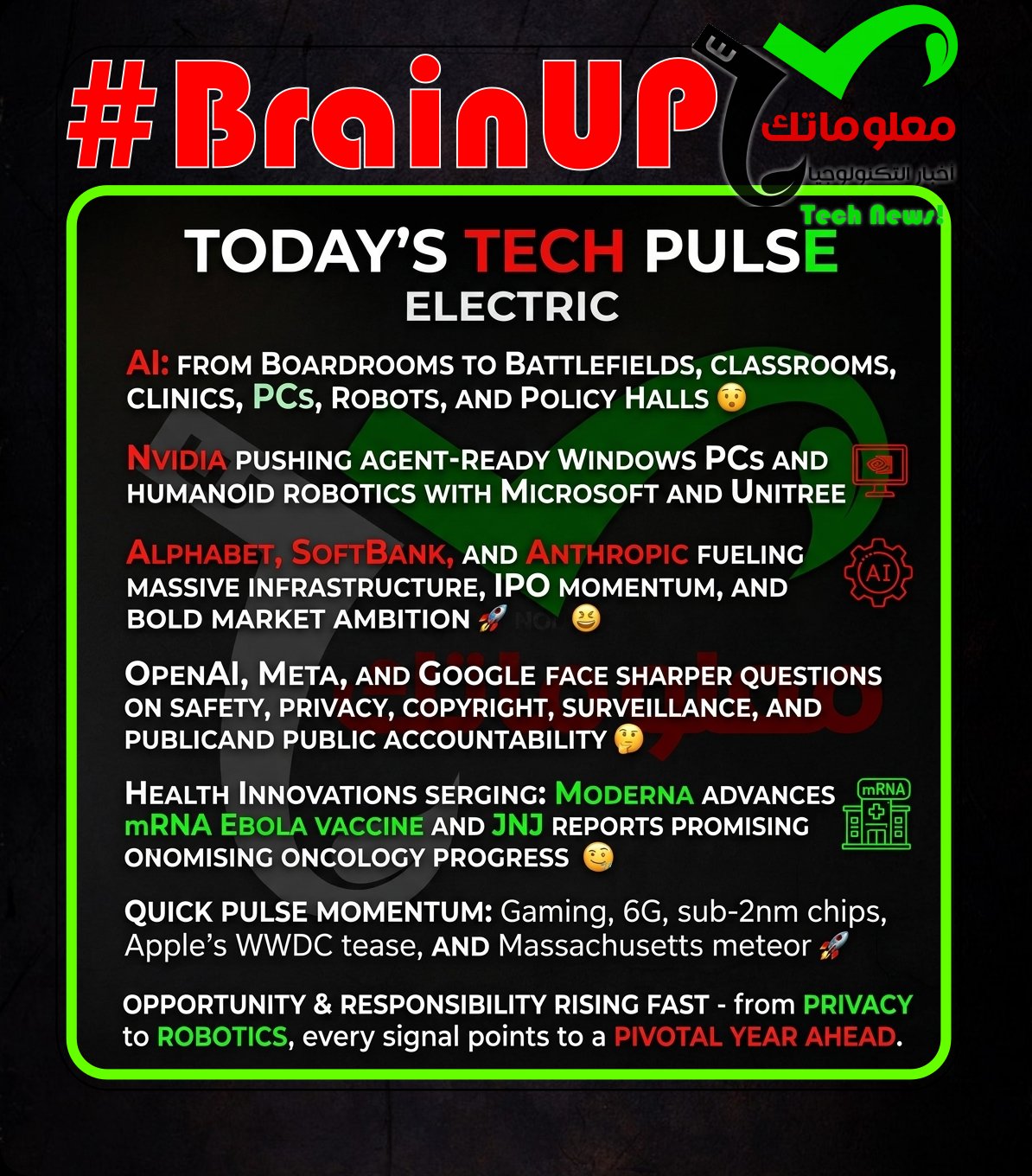
#BrainUp Daily Tech News – (Tuesday, June 2ⁿᵈ)
Welcome to today’s curated collection of interesting links and insights for 2026/06/02. Our Hand-picked, AI-optimized system has processed and summarized 32 articles from all over the internet to bring you the latest technology news.
As previously aired🔴LIVE on Clubhouse, Chatter Social, Instagram, Twitch, X, YouTube, and TikTok.
Also available as a #Podcast on Apple 📻, Spotify🛜, Anghami, and Amazon🎧 or anywhere else you listen to podcasts.
At an Oracle financial analyst meeting in September 2024, @Larry Ellison described a future where pervasive #surveillance expands as #AI, drones, and monitoring systems continuously record public life, and where people modify behavior because they know they are being watched. He envisioned #AI processing massive volumes of real time video from cameras on streets, cars, front doors, and police officers, then automatically detecting and reporting problems it identifies. The article frames this as a warning about accelerating erosion of #privacy, likening the scenario to the world of George Orwell’s Nineteen Eighty-Four and its Big Brother oversight. It also points to broader concerns about AI driven monitoring, including reports of the US Department of Homeland Security using AI to scan and summarize social media and claims of workplace surveillance at major companies, including @Mark Zuckerberg discussing AI analysis of employee activity and reports of tracking clicks and keystrokes. Overall, the piece argues the long running trend toward increased monitoring is likely to intensify as AI reduces the human effort required to observe, analyze, and act on surveillance data.
2. Moderna gets $50 million to develop mRNA Ebola vaccine against Bundibugyo
The #Coalition for Epidemic Preparedness Innovations (#CEPI) says it will urgently accelerate development of three vaccine candidates against Bundibugyo ebolavirus amid an outbreak in the Democratic Republic of the Congo. CEPI is committing up to $50 million to @Moderna to advance an #mRNA vaccine through preclinical work and Phase 1 testing, while also scaling manufacturing and preparing for possible Phase 2/3 trials if early results succeed. Additional funding includes $3.2 million to the International AIDS Vaccine Initiative for a candidate using the same technology as Merck’s Ervebo, and $8.6 million to the University of Oxford and Serum Institute of India for an adenovirus based platform. Existing licensed Ebola vaccines, Ervebo and Johnson & Johnson’s Zabdeno/Mvabea, target the Zaire strain, and there are currently no licensed vaccines or therapeutics for the Bundibugyo strain, which is driving only the third such outbreak. The response is complicated by delayed detection, armed conflict, population mobility, and humanitarian needs, with the WHO reporting 1,041 cases and 241 deaths as of Friday.
3. We Sued ICE to Get Its Spyware Contract. The Agency Is Redacting Essentially Everything
404 Media is suing #ICE to obtain records about the agency’s $2 million spyware contract with Paragon, but says the documents produced so far are overwhelmingly redacted and key details remain withheld. The outlet filed a #FOIA request in October 2024 for records about #HSI’s purchase, received no timely response, and then sued; ICE later reported finding 673 responsive pages and has released 77 in an initial interim production. The released material includes a heavily redacted Paragon “pricing narrative” and an overview describing objectives that appear tied to enforcing “immigration and customs laws,” while obscuring specifics of the request for proposals and mission language. Paragon’s tool, #Graphite, is described as capable of remotely hacking phones and extracting messages from encrypted apps like #Signal, #WhatsApp, and Facebook Messenger, and Paragon presents itself as an ethical actor with principles “hard coded” into its operations and software. 404 Media argues the redactions and withholding limit public understanding of why #ICE sought such a powerful surveillance capability amid concerns about potential civil rights abuses linked to enforcement activities.
Florida Attorney General James Uthmeier sued OpenAI and @Sam Altman in Florida circuit court, alleging the company put profits ahead of user safety and that Altman should be personally liable for harms to Floridians. The 83-page complaint claims OpenAI built its rise through deception and exploitation of users’ data, and says the “careless introduction” of #ChatGPT has contributed to increased murders and suicides, including alleged use to plan an April 2025 mass shooting at Florida State University and links to April murders of two graduate students at the University of South Florida. The state alleges minors became addicted to a tool that feigns human compassion to collect data without parental oversight, and it frames the alleged harms as driven by an “AI arms race.” Florida brings claims including deceptive and unfair trade practices, negligence, product liability violations, fraudulent misrepresentation, and public nuisance, and seeks civil penalties plus court orders to restrict minor data collection and to stop misrepresenting or failing to warn about #ChatGPT risks. OpenAI responded that AI is new and powerful, minors need guardrails, and it has minor-specific safety features and safeguards for sensitive conversations, while acknowledging the pain of child loss and stating it is committed to getting safety right.
5. The automation illusion: Why AI is making COOs’ jobs harder, not easier | Fortune
Operations leaders at Nike, Sysco, Thomson Reuters, and Box said #AI is creating an “automation illusion,” where promised speed and simplification turn into “speed without clarity” and more operational chaos. @Venkatesh Alagirisamy of Nike warned that hype-driven adoption can push organizations quickly in the wrong direction, even as Nike’s peer-curated internal learning platform logged 20,000 digital courses and 3,000 live training sessions in 12 months. Sysco’s @Aayush Bhatnagar described using AI to rethink forecasting and buying, aiming to institutionalize decades of “tribal knowledge” that keeps a supply chain moving products like broccoli an average of 2,000 miles, while Thomson Reuters is deploying AI to help lawyers, tax accountants, and trade professionals work faster. @Laura Clayton McDonnell said the core constraint is reliability, in high-stakes work there is no margin for error, and confident but wrong outputs from large language models turn productivity tools into liabilities. @Olivia Nottebohm at Box added that even at an AI company, adoption was lower than expected because employees were confused about how to use the tools and lacked skills, prompting a “No Boxer Left Behind” program, underscoring that the challenge is not just deploying AI but making it trustworthy, comprehensible, and usable in day-to-day operations.
6. Artificial Intelligence and the Fight for Economic Justice
The article argues that artificial intelligence (#AI) presents significant economic challenges that require proactive government intervention. @BernieSanders emphasizes the need for policies ensuring AI benefits all, not just corporations and wealthy elites, highlighting issues like job displacement and income inequality. Evidence includes historical patterns of technological disruption and calls for a universal basic income, stronger labor protections, and taxes on AI-driven profits. The analysis stresses that without comprehensive regulation and social safety nets, AI risks deepening economic divides. These points underscore the urgency of addressing AI’s impact on workers to foster a fairer economy.
7. Bernie Sanders AI bill would give public half of the AI industry
@Bernie Sanders says his forthcoming #AmericanAISovereignWealthFundAct would give the American public a direct ownership stake in major #AI companies by requiring a one time transfer of 50 percent of equity in firms such as @OpenAI, @Anthropic, and xAI to a federally managed fund. The fund would hold voting shares and receive equal board representation at each company, giving the government power to block decisions deemed harmful to the public, and its revenue would be paid out to Americans as cash, potentially later supporting public goods like healthcare, education, and housing. Sanders argues that AI systems were built using Americans’ writing, art, journalism, code, and research without consent or compensation, so the wealth generated should be shared collectively, citing Norway’s sovereign wealth fund and Alaska’s Permanent Fund Dividend as models. The article notes similar ideas have been floated by industry figures like @SamAltman and by @Anthropic, while emphasizing that accepting a 50 percent equity transfer is far more concrete than endorsing the concept in principle. It also highlights unresolved issues, including that some leading AI companies are not profitable, which could limit dividends and raises questions Sanders has not yet answered about how the fund would work if AI financial projections do not materialize.
8. A California bill that preserves access to video games achieves its first victory – Engadget
California’s State Assembly passed the #ProtectOurGamesAct, a bill intended to preserve access to online games after publishers stop supporting them. Introduced by @Chris Ward as AB 1921, it passed 43 to 16 and now moves to the State Senate committee process, targeting practices like de-listing seen with @Ubisoft’s The Crew. The proposal would require a two-month notice before a game is delisted, a full refund if it is delisted, and a way for owners to keep playing even without publisher support. If enacted, it would apply to digital games released on or after January 1, 2027, while excluding free and subscription-based titles, and it still must clear the Senate and receive the governor’s signature. The effort aligns with the #StopKillingGames initiative, which is also pushing for similar rules in the European Union.
9. Claude Got an ‘Honesty’ Upgrade. Some Users Would Rather Live in a Web of Lies
@Anthropic says #Claude Opus 4.8 is trained to be more honest by flagging uncertainty and avoiding unsupported claims, aiming to reduce misleading answers even though #chatbots can still hallucinate. The company frames this transparency as a response to criticism that AI systems can prioritize pleasing users over accuracy, which can contribute to harms like spreading conspiracy theories or reinforcing delusions. Shortly after release, some users complained on Reddit that the model is “too honest,” adding constant caveats and becoming overly wordy, while others praised the change as a move toward “maximal truth.” The split reaction highlights a core tradeoff in AI assistant design between engagement and accuracy, and suggests developers like @Anthropic, @OpenAI, and @Google may increasingly rely on #personalization so users can choose the tone and strictness they prefer. In that view, the “honesty upgrade” is less a universally welcome improvement than a sign that different users want different boundaries for how assistants communicate.
In testimony tied to the antitrust lawsuit filed by Wolfire Games, @Gabe Newell argued that Valve does not hold a #monopoly in PC gaming because customers have “enormous choice” in where they buy games, including Steam, the Epic Games Store, consoles like Xbox, or directly from developers. He also denied an alleged #unwrittenRule that would stop developers from charging lower prices on other storefronts, saying Valve “does not have a policy or practice of dictating prices” on other platforms, even when shown internal communications that appeared to reference enforcement. The dispute matters because the existence of such a rule is central to Wolfire founder David Rosen’s claim that Valve threatened to remove Overgrowth from Steam if it were sold cheaper elsewhere, and similar allegations appear in other legal challenges, including a UK suit seeking about $900 million. The article notes that despite Steam’s popularity and its role in enabling indie success, critics argue it is highly entrenched and difficult to meaningfully compete with, while Newell’s position frames Steam’s dominance as compatible with consumer choice. These claims and counterclaims connect directly to ongoing #antitrust scrutiny of Valve’s Steam practices and pricing dynamics across PC game storefronts.
Nvidia introduced the RTX Spark superchip to target the Windows PC market with an Arm-based Grace CPU plus a Blackwell RTX GPU in one package, positioning it as the long-rumored N1X and as a new entrant after Qualcomm’s Windows on Arm exclusivity lapsed. The chip is described as having a 20-core Arm CPU, up to 128GB unified memory, 6,144 CUDA cores, and a claimed 1 petaflop of AI compute, and is slated to ship in fall laptops and compact desktops from brands including ASUS, Dell, HP, Lenovo, Microsoft Surface, and MSI. @Microsoft is presented as a co-developer, adding new Windows security primitives for on-device AI agents and integrating with Nvidia’s OpenShell runtime to manage identity, containment, policy, and privacy-aware routing between local models and the cloud. The article links RTX Spark to the existing GB10 Grace Blackwell architecture used in the Linux-based DGX Spark mini-PC, and says prior delays were tied to Microsoft’s Arm work and soft notebook demand, pushing a planned 2025 debut into 2026. With claims like running 120B-parameter LLMs with up to 1M tokens of context and delivering high-end gaming and rendering, RTX Spark is framed as Nvidia’s attempt to expand #WindowsOnArm beyond #Qualcomm and make #onDeviceAI a core Windows PC capability.
12. Hackers Simply Asked Meta AI to Give Them Access to High-Profile Instagram Accounts. It Worked
Hackers claim they exploited #Meta’s #AI support chatbot to take over high-profile #Instagram accounts by persuading the bot to change the email address tied to a target profile. The claims align with recent takeovers of accounts including the @Barack Obama White House account, the Chief Master Sergeant of Space Force’s account, and Sephora’s account, and Telegram groups shared videos and screenshots showing the process appearing “shockingly easy.” One example message to the bot asks it to link a new email to a specified username and promises to provide the code, suggesting the bot could be socially engineered into performing sensitive account changes. The incident highlights the risk of offloading critical support functions to an AI system, especially as affected users report they cannot escalate recovery to a human. In March, #Meta said it was rolling out AI support across Facebook and Instagram with capabilities like resetting passwords and other account maintenance, marketed as “Solutions, not just suggestions,” which this exploit appears to undermine.
13. GoPro Warns About Going Concern in Filing; Shares Fall
GoPro Inc. warned in a filing that there is substantial doubt about its ability to continue as a #going concern, and its shares fell as much as 12% in early New York trading. The company said it is refiling consolidated financial statements that had previously been included in its annual report. The report from its current independent registered public accounting firm, @PricewaterhouseCoopers, includes an explanatory paragraph related to the company’s ability to continue as a #going concern. The market reaction reflects investor concern tied to the warning and the accompanying financial refiling.
14. Anthropic has officially filed to go public
@Anthropic has taken a major step toward an IPO by confidentially filing a draft registration statement with the US Securities and Exchange Commission, intensifying its rivalry with @OpenAI. The company’s latest fundraising values it at $965 billion post-money, higher than @OpenAI’s reported $852 billion, positioning it for what the article describes as a massive public offering. Because the filing is confidential, typical disclosures like business risks, executive pay, and additional financial details will not be public until later in the #IPO process. The timing also lands less than two weeks before @ElonMusk’s @SpaceX planned June 12 IPO, and follows a judge dismissing @Musk’s claims in a legal battle with @OpenAI due to the statute of limitations. Together, these developments underscore a fast-moving competitive and capital-markets moment in #AI as major players prepare for public scrutiny and scale.
15. Alphabet plans to raise $80 billion to pay for AI buildout
Alphabet is preparing to raise $80 billion to finance its expanding artificial intelligence infrastructure, reflecting its strategic emphasis on AI development. The company aims to invest heavily in AI models and the associated computing power to compete with other industry giants, signaling a major shift toward AI-driven innovation. This significant capital raise highlights the growing importance of AI in shaping the future of digital technology and the market dynamics surrounding it. Alphabet’s move underscores the competitive pressures in the tech sector to advance AI capabilities rapidly. Consequently, this investment will likely accelerate the deployment of advanced AI solutions across Alphabet’s services and products.
Tech billionaires and companies are pouring hundreds of millions of dollars into California’s 2 June primary in what experts describe as an unmatched effort to shape the state’s political and regulatory landscape. The article cites @Sergey Brin spending $82m since January to oppose a proposed #billionaire tax on the November ballot, heavy donations to Democratic gubernatorial candidate @Matt Mahan from executives at Google, Amazon, Snap, LinkedIn, Reddit and Palantir, crypto mogul @Chris Larsen funding three #Super PACs with $26m, and Google and Meta jointly backing a #Super PAC with $10m to support assembly and senate candidates. Researchers argue the spending is aimed at securing leverage over the regulatory agenda and reinforcing a cycle where economic power produces political power and vice versa, as Silicon Valley treats the moment as existential amid the race to develop #AI and avoid restrictive rules. Experts also warn that disclosed totals likely understate the true scale because sophisticated donors can route influence through #dark money entities that do not show up in standard campaign finance filings. The flood of tech-funded campaigning, from local tax-measure voter guides to statewide ad saturation, signals a larger and potentially less transparent wave of influence still to come.
17. AI revolution is ‘50x bigger’ than the dot-com boom: SoftBank’s Masayoshi Son to CNBC
@Masayoshi Son said the #AI revolution will be far larger than the dot-com boom, calling it a once-in-history technology shift that is still in its early stages. Speaking to CNBC in Paris after SoftBank announced a 75 billion-euro plan to build #AI infrastructure in France, including 5 GW of AI data center capacity, he estimated AI could be about 50 times bigger than dot-com and argued that market corrections, like the dot-com crash or the 1929 selloff in auto and electronics stocks, can become investment opportunities in long-term growth trends. SoftBank said its France buildout would include 3.1 GW of AI data centers in Hauts-de-France by 2031 and will use project financing, with Son pointing to a 10-gigawatt Ohio project as a template for securing customer agreements. Son also said SoftBank is not overexposed to @OpenAI, which is just over 20% of net asset value versus #Arm at over 50%, and he expressed confidence in OpenAI’s prospects amid IPO discussions, while noting SoftBank’s partnership with OpenAI on the #Stargate AI infrastructure venture in the U.S. Overall, he framed the France investment, including work with @Schneider Electric in Dunkirk, as part of a broader push to make France a European center for AI infrastructure.
18. AI chatbots fail medical misinformation test, returning inaccurate and fabricated advice
AI chatbots, including prominent models like #ChatGPT, have been found to provide inaccurate and fabricated medical advice in recent evaluations. Researchers tested various chatbots’ ability to respond to medical misinformation and discovered many failed to effectively debunk false claims or delivered misleading information. The findings highlight significant risks in relying on AI for medical guidance, as errors could lead to harmful health decisions. This underscores the need for improved AI training, validation, and integration of expert oversight to ensure safe application in healthcare contexts. The study warns that without addressing these challenges, AI chatbots may perpetuate rather than mitigate #medicalmisinformation.
19. Nvidia picks Unitree for humanoid robot platform as Chinese startup eyes IPO
@Nvidia selected Chinese robot maker @Unitree as the hardware partner for its first publicly available humanoid robotics system aimed at researchers. The package pairs Unitree’s nearly 6-foot-tall H2 humanoid with #JetsonThor hardware that includes a #Blackwell GPU for on-device AI, plus Nvidia’s #IsaacGR00T humanoid AI models, simulation tools, and mechanical hands from Singapore-based Sharpa, with sales to research institutions expected later this year and the H2 Plus available in October. @JensenHuang said the fully integrated reference robot and Nvidia’s software, data generation, and simulation stacks are meant to make advanced humanoid research accessible to university labs that would struggle to build such a system themselves, extending Nvidia’s robotics software push alongside its #CUDA platform. The announcement comes as Unitree pursues a Shanghai STAR Market IPO seeking 4.2 billion yuan and reports that over 40% of revenue already comes from outside China. Early users cited include Seattle-based Ai2, ETH Zurich, the Stanford Robotics Center, and UC San Diego, underscoring both the research focus and the still-nascent state of humanoid deployment beyond limited warehouse use amid safety and privacy concerns.
20. Tech titans mostly silent after Pope Leo’s warning about risks of AI
@Pope Leo XIV issued a sweeping warning about #artificial intelligence in his first encyclical, urging stronger regulation of private companies driving the AI boom, protections for workers facing economic disruption, and measures to combat fake AI-generated information, while also criticizing the ease of deploying #autonomous weapons. Many prominent U.S. tech leaders and companies stayed publicly quiet, with figures such as @Sam Altman, @Elon Musk, and @Mark Zuckerberg not immediately commenting, and firms including Amazon, Anthropic, Google, Meta, Microsoft, Nvidia, OpenAI, and xAI not responding to requests for comment. Some industry and research voices welcomed the Vatican’s intervention, including Anthropic co-founder @Christopher Olah, who appeared at the encyclical’s presentation and called for “moral voices” and “informed critics,” and AI researcher @Yoshua Bengio, who endorsed the theme of AI serving the “common good” and said global institutions should help shape the dialogue. Others in the AI risk community framed the document as moral leadership against technology corporations concentrating power and replacing humans in work and decision-making, and @Jack Dorsey signaled agreement with a passage warning about powerful tools being concentrated “in the hands of a few.” Overall, the response highlighted a contrast between the pope’s call for #government oversight and broad societal engagement and the relative silence of the most visible AI executives.
@Volodymyr Zelenskyy is urging closer cooperation between Ukraine and Silicon Valley defense startups, arguing that pairing US #AI with Ukraine’s battlefield-tested drone expertise could be uniquely powerful. He said US companies have advanced AI technologies Ukraine lacks, while Ukraine offers hard-won operational experience from fighting Russia, calling the potential collaboration “huge” and possibly “the most powerful in the world.” The article cites Ukraine’s rapid, low-budget development of #drones and #counterdrone systems, recent claims of homegrown drones striking near Moscow, and lessons like keeping drone units mobile and burying command centers for protection. It also notes that US interest in autonomous military technology is boosting defense tech firms such as Anduril, and Ukraine is positioned as a proving ground via the state-backed “#TestInUkraine” program that has attracted hundreds of applicants to test systems from electronic warfare tools to ground robots. Zelenskyy’s pitch is to move quickly from discussion to action, saying partners should negotiate now and start building.
22. Japan hits 6G key milestone with high-frequency speeds topping 100 Gbps
Researchers in Japan demonstrated a #terahertz wireless communication system aimed at enabling #6G by transmitting data at 112 Gbps in the 560 GHz band, marking the first time speeds above 420 GHz reached this level. The setup uses microcomb driven photonic devices on chips, combined with high-order modulation, to generate stable optical frequencies that reduce phase noise and power limits that constrain conventional electronics at ultrahigh frequencies. The result, reported in Communications Engineering on May 16, indicates a path to ultra-high-speed mobile backhaul needed for future 6G networks that must move into spectrum beyond roughly 350 GHz because lower bands are congested. The work supports expectations that commercial 6G could arrive around 2030 or later, but it also highlights practical deployment challenges for photonics, since traditional photonic approaches rely on bulky lasers and microcombs can require precise optical alignment that real-world vibrations might disrupt.
At sub-2nm, semiconductor progress faces a paradox where packing more transistors onto a reticle-sized die does not reliably translate into better real-world #power, #performance, and #cost because physics limits and manufacturing variation increasingly dominate. The article cites rising #RC delay from ultra-thin wires, lagging #SRAM scaling versus digital logic that constrains on-die cache capacity, and growing fab #process variation across many insertion points and tools, plus packaging issues where bumps may not fully connect due to warpage and fragile interconnects can be weakened by reliability steps. These factors increase the fraction of faulty transistors and interconnects, driving yield down and costs up even as density rises, and new processes also take longer to mature. @Abhijeet Chakraborty of @Synopsys notes that expected gains such as 10% to 15% performance and 20% to 30% lower power are compelling but uncertain to achieve because real-world manufacturability and yield challenges can prevent realizing the theoretical benefits. As a result, the focus shifts toward reducing variation, monitoring behavior over time, and targeting specific workloads, making Moore “more” in density but also “less” in predictable benefit at 2nm and below.
At the World News Media Congress in France, @A.G. Sulzberger warned that leading #generativeAI companies are making choices that could violate settled law and cause unnecessary harm to journalism and the public’s access to trustworthy news. He argued that firms including @OpenAI, @Meta, @Anthropic, and @Google have built #LLMs using news content, “hijacking” public attention while failing to ensure people can still find reliable reporting, a dynamic tied to lawsuits by outlets including The New York Times over alleged copyright infringement and to declining ad revenue and reduced search traffic from AI-generated summaries. Sulzberger said the trajectory could mean fewer journalists doing costly original reporting, weakening truth, understanding, and accountability that support a healthy society and stable democracy. He urged news organizations to be less quiet, passive, and fragmented, and to push back against “AI cheerleaders” while resisting efforts to dismantle rights that let publishers control and monetize their work. He noted the Times’ 2023 suit against @OpenAI and @Microsoft, a subsequent content-licensing deal with @Amazon, internal principles for journalist use of AI, and union contract talks that now center on AI, while emphasizing the paper is not opposed to AI in all instances.
Tech leaders at companies like Wix, Block, Snap, and Atlassian are increasingly citing #AI as a rationale for layoffs and reorganizations, but @Paul Osterman of MIT argues it follows a long-running pattern of using a convenient cover story for cuts. Wix CEO @Avishai Abrahami announced plans to cut about 20% of staff, citing currency pressure from the shekel and calling #AI a major shift that requires a faster, leaner, flatter organization, language that echoes Block CEO @Jack Dorsey’s framing of “smaller and flatter” teams. Osterman says #AI washing helps companies reframe negative news as innovation and deflect responsibility, noting that after Cisco announced 4,000 layoffs its stock rose 13%, and comparing it to how recessions can also provide a ready-made justification for planned layoffs. He links the moment to a broader rise in “disposable workers,” estimating they are 35% of the American workforce, with BLS counting 6.9 million contingent workers in 2023, or 4.3% of the workforce, up from 3.8% in 2017. Osterman argues employers favor contractors, freelancers, and gig workers for cost and flexibility amid #AI uncertainty, even as his research finds these workers tend to face lower wages and lower job satisfaction than standard employees.
26. Nvidia chases $200B CPU market with AI agent PCs from Microsoft, Dell, and HP | TechCrunch
@Nvidia is pushing into a claimed $200 billion #CPU market by launching RTX Spark, a 1-petaflop PC “superchip” aimed at running #AI agents securely on Windows laptops and desktops. The company says RTX Spark PCs will ship this fall from Microsoft Surface, Dell, HP, Lenovo, ASUS, and MSI, with Acer and Gigabyte to follow, and will include secure sandboxes co-developed with @Microsoft plus enough CPU, GPU, RAM, and #CUDA software to run local #LLMs and support AI features across 1,000+ games and apps. Nvidia says 100+ Windows software makers, including @Adobe, Blender, ComfyUI, Riot Games, and Xbox, have signed on, and @Jensen Huang framed the goal as moving beyond launching apps so users can ask and the PC does the work. Huang recently told investors Nvidia has found a new CPU growth avenue alongside GPUs, citing its earlier high-end server CPU Vera and Nvidia’s expectation that billions of agents will drive demand for many more CPUs. While Nvidia’s earlier ARM-based Windows efforts like Surface RT failed, RTX Spark is positioned as far more powerful, with limited pricing details so far and open questions about whether these systems will compete with products like the Mac Mini or remain high-end, linking Nvidia’s agent-PC push to its broader ambition to bring AI agents to the mass market.
27. Crazy! Diver Discovers Unreleased Smartwatch
A diver reportedly found an unannounced #smartwatch on the seabed near the Caribbean island of St. Martin, sparking speculation that it could be a Google Pixel Watch 5. The claim comes from @Randy Pitchford, who posted photos on X showing a watch back labeled “Google” and “Pixel Watch 5,” along with listed features such as SpO2, skin temperature, heart rate and pulse sensors, #UWB, and an IP68 rating. The device also closely resembles prior Pixel Watch designs and appears to be near production-ready, but the images are not considered sufficient proof of authenticity. Google has not commented, and Android Authority notes that a new model soon after the Pixel Watch 4 launch in October 2025 seems unlikely. The circumstances of how it ended up underwater remain unclear, though Pitchford says the alleged owner has been located and the watch is planned to be returned, making it a potentially unusual product leak if confirmed.
28. ‘All Systems Glow’: Apple Teases WWDC 2026 With New Tagline, Playlist, Wallpapers
Apple is teasing WWDC 2026, returning June 8, with the new tagline “All Systems Glow” plus new downloads like wallpapers and a first time official @Apple Music playlist. The phrase riffs on “all systems go” and, alongside an earlier tagline “coming bright up,” is framed as hinting at #iOS27, following leaks that claim a Siri centered update with a dedicated Siri app and chatbot, dark mode, and glowing UI elements. Apple also shared WWDC key art wallpapers sized for Macs, iPads, and iPhones, featuring a black and chrome look with a glowing logo, and the playlist includes 20 contemporary songs from artists such as @ZaraLarsson and @BTS. The piece notes Apple could also preview updated operating systems for Macs, iPads, Apple Watches, and Apple Vision Pro, while major hardware is considered unlikely given recent product releases and expectations that a foldable iPhone, if real, would wait for September. It adds that the keynote could be @TimCook’s final one before leadership passes to @JohnTernus in early September, and emphasizes that leaks and predictions are unconfirmed.
29. ROG Xbox Ally X20 adds OLED screen, control upgrades
Asus is launching an OLED-equipped ROG Xbox Ally X20 for the holiday season with meaningful screen and control refinements, but it is being framed as a limited, expensive bundle rather than a new mainstream handheld. The 7.4-inch 1080p HDR OLED boosts peak brightness to 1400 nits, adds anti-glare coating, and supports Dolby Vision plus FreeSync Premium Pro on a 120 Hz panel, while controls shift to magnetic TMR thumbsticks to reduce stick drift and include a convertible D-pad that switches between four- and eight-direction modes. Despite these surface upgrades, internal specs are unchanged from last year’s ROG Xbox Ally X, and early hands-ons also note quieter face buttons and improved rubberized grips on a translucent black-and-gold shell. Asus is only announcing the device as part of a “20th anniversary” package bundled with Xreal R1 #AR glasses that connect via USB to provide a claimed 171-inch virtual screen, a choice that could push total cost toward or above $2,000 given the glasses’ $850 price and the prior $1,000 handheld price point. The result is a potentially niche collector-style release, and the article argues the X20’s upgrades would reach a wider audience if Asus offered a standalone version not literally tethered to the bundled #AR accessory.
30. PlayStation’s wireless fight stick and new gaming monitor arrive in August – Engadget
@Sony has set August release dates and early June pre-order windows for two new PlayStation gaming accessories, while its previously announced speakers are still coming later. The FlexStrike wireless fight stick for #PS5 and PC launches August 6 for $200 with a carrying case, with pre-orders starting June 12, and it is timed to release alongside Marvel Tōkon: Fighting Souls the same day. A PlayStation Blog note adds that PC compatibility for the FlexStrike will roll out after launch and expand to more users over time. Sony’s 27-inch QHD #IPS monitor, officially called the 27” Gaming Monitor with DualSense Charging Hook, offers 2560×1440 resolution, #VRR, up to 120Hz on PS5 or PS5 Pro, and up to 240Hz on PC or Mac, and will cost $350 in the US and Japan when it arrives August 27, with pre-orders opening June 5 at PlayStation Direct and Best Buy. Sony also reiterated that the Pulse Elevate wireless speakers announced last September are planned for release this year, but pricing and timing have not been confirmed.
31. Meteor explodes off coast of Massachusetts, causing loud boom
A meteor exploded off the coast of Massachusetts on Saturday afternoon, producing a loud boom heard widely across the region. Reports placed the boom around 2:11 p.m. ET, with callers from areas including Boston, Ipswich, and Johnston, Rhode Island, and the American Meteor Society received dozens of fireball sightings across multiple Northeast states. #NOAA satellite lightning data showed a signature consistent with a meteor and suggested it entered the atmosphere over the South Shore near Boston, while @NASA estimated it was about 5 feet wide, 5.6 metric tons, traveling roughly 42,000 mph, and released energy comparable to about 230 tons of TNT before breaking up at about 31 miles altitude and dropping meteorites into Cape Cod Bay. The article explains the boom as a #sonic_boom caused by shock waves from a fast, deeper atmospheric entry, similar to pressure waves from a supersonic jet, and notes such events occur along a linear atmospheric path rather than a single ground point. @NASA said the daytime bolide produced a meteorite fall in Cape Cod Bay in about 34 meters of water, making recovery unlikely, though eyewitness accounts and video can still help scientists reconstruct details of the object.
32. J&J prostate cancer drug reduces risk of cancer spread, death in late-stage study
Johnson & Johnson’s prostate cancer drug has been shown to reduce the risk of cancer spread and death in a late-stage study, providing new hope for patients with advanced disease. The drug demonstrated significant effectiveness compared to existing treatments, improving survival rates and delaying disease progression. This represents a critical advancement in prostate cancer therapy, as patients with late-stage cancer face limited options and poor prognoses. The findings underline the importance of innovative #oncology medications in improving patient outcomes. J&J’s results are expected to influence future treatment protocols and regulatory approvals in the field.
That’s all for today’s digest for 2026/06/02! We picked, and processed 32 Articles. Stay tuned for tomorrow’s collection of insights and discoveries.
Thanks, Patricia Zougheib and Dr Badawi, for curating the links
See you in the next one! 🚀
