
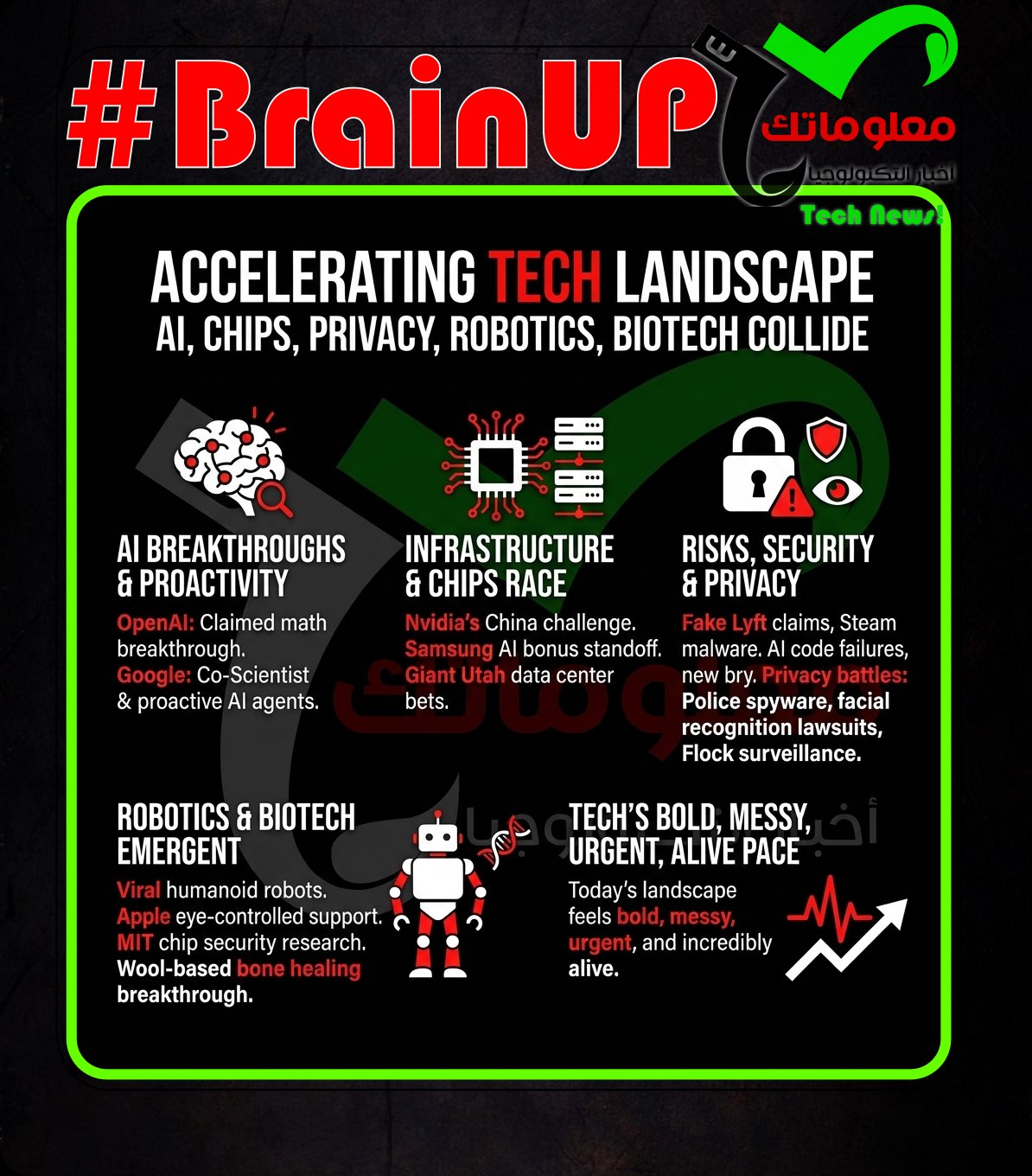
#BrainUp Daily Tech News – (Thursday, May 21ˢᵗ)
Welcome to today’s curated collection of interesting links and insights for 2026/05/21. Our Hand-picked, AI-optimized system has processed and summarized 29 articles from all over the internet to bring you the latest technology news.
As previously aired🔴LIVE on Clubhouse, Chatter Social, Instagram, Twitch, X, YouTube, and TikTok.
Also available as a #Podcast on Apple 📻, Spotify🛜, Anghami, and Amazon🎧 or anywhere else you listen to podcasts.
Cleveland’s use of the #Flock network, a surveillance system purportedly for crime prevention, has been linked to immigration enforcement activities. City records reveal that data from Flock’s license plate readers and drones were accessed for immigration-related searches, prompting public concern over privacy and the system’s scope. The city government attributed these uses to Flock’s technology and drone operators rather than official policy endorsements. This situation raises questions about the balance between community safety technologies and potential misuse for immigration enforcement, highlighting governance challenges for such public surveillance tools. The findings underscore the need for clear regulations and transparency in deploying #drones and surveillance networks to protect civil liberties.
2. After Town Bans Flock, Councilmember Crashes Out, Proposes Internet and Phone Ban
After Bandera, Texas voted 3-2 to end its contract with #Flock Safety, a dissenting councilmember responded by proposing sweeping anti-technology rules framed as a privacy measure. The town had used a state grant to install eight #AI license plate reader cameras, but residents repeatedly protested what they saw as government surveillance, and vandals repeatedly destroyed camera poles, forcing the town to replace them. Councilmember Jeff Flowers, a supporter of the system, argued that opponents were being hypocritical about privacy and announced a package he calls the “Bandera Declaration of Digital Independence,” saying the town should return to “1880.” In a letter cited by the Bandera Bulletin, Flowers said he will propose a total ban on cellular and GPS-capable devices for operations within city limits, a ban on outward-facing cameras, and termination of all internet services and electronic record-keeping in favor of paper ledgers and cash only. The proposals position a broad rollback of #digital technology as the logical extension of the town’s rejection of #license plate recognition surveillance.
3. OpenAI claims it solved an 80-year-old math problem, for real this time | TechCrunch
OpenAI says a new general purpose #reasoning model produced an original proof that disproves a famous geometry conjecture posed by @Paul Erdős in 1946, claiming it is the first time AI has autonomously solved a prominent open problem central to a math field. The company contrasts this with a prior episode in which former OpenAI VP @Kevin Weil said GPT-5 solved multiple Erdős problems, a claim later shown to be recycled results from existing literature, drawing criticism from @Yann LeCun and @Demis Hassabis. This time, OpenAI published companion remarks supporting the disproof from mathematicians including @Noga Alon, @Melanie Wood, and @Thomas Bloom, who had previously called the earlier claim a misrepresentation. OpenAI says the model found a new family of constructions that outperform the long believed near square grid best solutions, and argues the result suggests AI can sustain long chains of reasoning and connect ideas across fields. It frames this as a sign such reasoning capabilities could matter beyond math, including biology, physics, engineering, and medicine.
4. Driver intentionally drove Cybertruck into lake to use vehicle’s ‘Wade Mode,’ police say
Police in Grapevine, Texas say a driver deliberately drove a @Tesla Cybertruck into Grapevine Lake to try using the vehicle’s #Wade Mode, but the truck became disabled and took on water. Officers responded around 8 p.m. at the Katie’s Woods Park boat ramp and found the Cybertruck near the shoreline, after the driver, Jimmy Jack McDaniel, and a passenger abandoned it. The Grapevine Fire Department’s Water Rescue Team helped remove the vehicle, and McDaniel remained in jail as of Tuesday facing charges including operating a vehicle in a closed section of the lake, lacking valid boat registration, and other water safety equipment violations. Tesla’s owner’s manual says #Wade Mode can allow driving through bodies of water but warns drivers to assess depth and conditions, notes a maximum wade depth of about 32 inches, cautions about soft or muddy bottoms and strong currents, and states water damage is not covered by warranty. Police reminded drivers that even if a vehicle can enter shallow freshwater, doing so can raise legal and safety issues under Texas law.
Elon Musk, CEO of SpaceX, predicts that by 2026 the costs of #AI compute will escalate dramatically, making it so expensive that companies like #Anthropic might pay SpaceX to launch floating data centers. This forecast illustrates the rapid growth and demand in AI infrastructure, highlighting SpaceX’s strategic position in satellite and space launch services. The increasing financial burden of AI compute resources could drive innovation in how and where data centers operate, possibly shifting toward offshore and space-based solutions. SpaceX’s capabilities in launching payloads to space may become critical for supporting AI’s expansive computational needs. This expectation positions SpaceX as a key player in the future AI technology ecosystem, linking space technology with digital computation advancements.
6. Lyft responds after driver uses AI to fake damage and charge riders fees – Dexerto
A Florida father, Bert Gor, says a Lyft driver tried to charge his account a $75 damage fee by submitting what appeared to be an AI-generated photo of a backseat mess after his 14 and 15-year-old daughters rode home from the beach. The driver’s images allegedly showed spilled drinks, fries, and a large yellow stain, but Gor said his daughters denied having food or drinks and one daughter noticed a #Gemini logo in the corner of a photo, suggesting it was created with @Google’s #AI image tools. Gor reported this to Lyft, and he said the company agreed the images appeared AI-generated, apologized, reimbursed the fee, and blocked the driver from using the app. Lyft also stated it takes damage disputes seriously, reviews cases based on available information, reimbursed the rider, unpaired the rider and driver, and addressed the issue with the driver. Gor urged rideshare users to closely monitor post-trip charges because small fees can add up.
7. The biggest data center ever is becoming a huge problem in Utah
Box Elder County in Utah has approved the Stratos Project, a proposed 40,000-acre #data center campus backed by @Kevin O’Leary, despite expert warnings and local backlash over environmental impacts and pressure on already strained water supplies. The project is described as more than twice the size of Manhattan, expected to draw about 9GW of power, and its first phase is projected to cost over $4 billion, with supporters framing it as a bid for US #AI dominance and national defense work for the government and contractors. Although it has county approval and support from Gov. Spencer Cox, it still needs environmental and building permits and will take years to build, even as its approval process moved quickly after meetings with state leaders. Reporting says the site is largely on private land but overlaps Department of Defense land tied to MIDA, which could receive about $49 million annually in property taxes to support upgrades and services. The plan includes an on-site methane-fueled power plant supplied by the Ruby Pipeline to avoid the state grid, underscoring how massive data centers can shift costs and risks onto local resources like energy, air quality, and water.
Ontario police have acquired spyware technology that allows them to remotely control smartphones, raising significant privacy and transparency concerns. Law enforcement agencies are actively trying to keep details about this spyware, including when and how it is used, secret from the public, limiting oversight and accountability. This use of spyware marks a substantial expansion in police investigative tools, potentially impacting citizens’ digital privacy rights. Transparency advocates warn that without proper checks, such technology could be misused or over-applied, eroding trust between police and communities. The secrecy surrounding the spyware signals a growing tension between public safety priorities and the protection of individual privacy in the digital age.
9. Samsung strike on hold as workers push for AI bonus
Samsung Electronics’ largest union has suspended a planned strike after reaching a last-minute tentative pay agreement, with members set to vote on it from 22 to 27 May, easing immediate fears of disruption at the world’s largest memory chipmaker amid the #AI data-centre boom. The dispute focuses on how to share profits from surging demand for #AI memory chips, with the union objecting to a plan that would give 27,000 memory-chip staff bonuses far higher than workers in other units, and arguing that 23,000 workers making less advanced chips for companies like @Tesla and @Nvidia should not be left behind. Samsung’s operating profit rose about 750% year on year in January to March, and amid competition from @SK Hynix and @Micron, it proposed bonuses of 607% of annual salary for memory-chip workers while other businesses would receive 50% to 100%, as the union also pushed to remove a bonus cap and set aside 15% of operating profit for a bonus pool. Analysts warned a strike could cut operating profit by 21 to 31 trillion won, though a court injunction required normal staffing for safety and quality, and Samsung said it would pursue a more constructive labour-management relationship. Markets reacted positively, with Samsung shares rising more than 8% and South Korea’s Kospi up over 8%, reflecting reduced near-term risk to #global supply chains and South Korea’s export-driven economy.
10. Nvidia says it has ‘largely conceded’ China’s AI chip market to Huawei
@Nvidia CEO @Jensen Huang said the company has largely ceded China’s advanced #AI chip market to @Huawei as U.S. #export restrictions limit Nvidia’s ability to sell leading chips there. He said demand in China remains large, but Huawei has been very strong, with a record year and a thriving local chip ecosystem that benefited after Nvidia “evacuated” the market, which once contributed at least one fifth of Nvidia’s data center revenue. The comments came alongside a strong quarter in which Nvidia’s revenue rose 85% to $81.62 billion, the company announced an $80 billion share buyback, and it raised its dividend, highlighting that growth elsewhere is offsetting lost access to China. Huang told investors to “expect nothing” on near-term U.S. licensing approvals, while also saying Nvidia would be delighted to return to serve long-standing customers and partners if conditions improve. Reports and officials offered mixed signals, with Reuters citing some Chinese firms receiving U.S. approvals for #H200 chips, but a U.S. trade representative saying chip controls were not discussed in recent China talks, suggesting any broad easing could remain distant.
11. China banned RTX 5090D V2 while Nvidia CEO Jensen Huang was visiting
Beijing added @Nvidia’s China-specific RTX 5090D V2 to a customs blacklist during @Jensen Huang’s trip to China with @Donald Trump, underscoring the intensifying US China contest over #AI and chip supply. A document seen by the FT and sources said the ban list update occurred last Friday, and it targets even “degraded” Nvidia products designed to comply with US #export controls, including a chip marketed to Chinese gamers and 3D animators but also used by AI developers shut out of top-tier Nvidia hardware. The move aligns with China’s push to favor domestic chipmakers like @Huawei and Cambricon, as other Nvidia parts such as the H200 and H20 have also faced blocks in China despite US approval for sales to firms like Alibaba and Tencent. Trump said China declined H200 purchases because it wants to build its own capability, while Huang told Bloomberg TV he expects the market to open over time. The episode comes as forecasts and recent reports point to rapidly rising domestic share in China’s AI chip market, reducing Nvidia’s previous dominance even as the company prepares to report earnings viewed as a barometer for the #AI infrastructure boom.
12. Disney sued over facial recognition technology at California parks
A proposed class action lawsuit alleges @The Walt Disney Co. fails to adequately disclose and obtain meaningful consent for #facial-recognition use at entrances to Disneyland and Disney California Adventure Park in California. Filed on behalf of lead plaintiff Summer Christine Duffield, the suit seeks at least $5 million and claims guests should have an express opt-in with written consent, arguing signage is easy to miss and alternative non-scan entrances are unclear. Disney says on its website the #facial-recognition service is optional, intended to help with re-entry and prevent fraud, provides non-facial-recognition lanes, and deletes collected data within 30 days. The case is framed by the plaintiff’s attorney as a privacy and civil-rights issue tied to collection of biometric information without adequate consent, and it comes amid broader concerns about tracking and mass surveillance and similar litigation involving other companies.
GrammaCrackers, an 81-year-old YouTuber streaming #Minecraft to raise money for her grandson’s cancer treatment, was swatted while her livestream was still running. The article says roughly 20 police cars, five SWAT vehicles with multiple officers, and drones arrived, and officers entered her home with torches and rifles while she was asleep. In a follow-up video, she described being locked out, taken outside barefoot, and riding in a police car for the first time, framing the incident as oddly positive and praising the officers as “so nice.” Her reaction highlights how normalized and dangerous #swatting has become for online creators, even as she remained upbeat and continued her streaming mission.
14. Intuit to lay off over 3,000 employees to refocus on AI | TechCrunch
@Intuit plans to cut about 17% of its workforce, roughly 3,000 employees, to shift resources toward embedding #AI into its products and to simplify its corporate structure, according to a Reuters report citing an internal memo from CEO @Sasan Goodarzi. The company had 18,200 employees worldwide as of July 2025 and did not respond to questions about leadership pay cuts, while Goodarzi’s fiscal 2025 compensation totaled $36.8 million. The move follows broader tech industry layoffs of more than 100,000 jobs this year, with firms like @Amazon, @Meta, and @Microsoft also citing AI-focused restructuring even as many report strong revenue and profits. Intuit’s shares have underperformed the S&P 500 over the past 12 months, reflecting investor concern that traditional software companies may struggle against emerging AI-driven products and shifts in how software is built and used. Despite that, Intuit reported fiscal Q2 revenue of $4.65 billion, up 17%, and net profit of $693 million, up 48%, and expects about 10% revenue growth in Q3.
15. AI Fiction Contest Sparks Literary Backlash Over Suspected Machine-Written Stories
A growing controversy is shaking the literary world after several award-winning short stories tied to the prestigious Commonwealth Foundation prize and published by Granta were accused of being generated or heavily assisted by #AI tools like #ChatGPT and #Claude. The debate exploded online after readers, critics, and researchers pointed to repetitive metaphors, formulaic prose patterns, and stylistic markers commonly associated with generative AI in stories such as “The Serpent in the Grove” by @JamirNazir. AI detection tools reportedly flagged some submissions as highly likely to be machine-generated, while literary communities across Reddit and X argued the stories represented a turning point where #GenerativeAI may now be indistinguishable from award-caliber fiction. Organizers defended the writers and admitted that current AI detectors remain unreliable, emphasizing trust-based judging processes instead of automated verification. The scandal has ignited a broader cultural battle about authorship, originality, and whether literary institutions are prepared for a future where #AI can produce emotionally convincing fiction at scale, potentially reshaping publishing, contests, and the definition of creativity itself.
16. Steam removes ‘Beyond The Dark’ horror game over malware reports
Valve’s Steam removed the free indie horror game Beyond The Dark after reports that it secretly contained #malware that harvested player data and contacted remote #command-and-control infrastructure. YouTuber @Eric Parker investigated user complaints, ran the game in an isolated virtual machine, and observed unusual outbound network traffic, then found a malicious DLL that profiled systems by collecting MAC addresses and enumerating #Chrome extensions, including crypto wallet add-ons like #MetaMask. Parker also reported the implant could fetch follow-on instructions from a remote API and download additional payloads, including ZIP archives, based on what it detected on the victim machine. The incident is presented as part of a broader pattern of malicious Steam titles and the abuse of post-approval updates to inject code after initial review, with examples like PirateFi, Block Blasters, and Sniper: Phantom’s Resolution. Users who installed the game are advised to uninstall it, run antivirus scans, revoke browser sessions, and change passwords for sensitive accounts, especially cryptocurrency wallets.
17. The Internet can’t stop watching Figure AI’s humanoid robots handling packages
Figure AI’s weeklong livestream of its Figure 03 humanoid robots repeatedly scanning package barcodes and placing items onto a conveyor belt has gone viral, prompting viewers to name robots and praise it as a standout product demo while the company leaned in with merchandise and stunts. The demo began May 13 as an eight-hour planned run that CEO Brett Adcock said would be fully autonomous and unsupervised, then expanded to 24/7 operation as robots rotated in and out due to 3 to 4 hour battery limits and occasional hardware or software issues. The robots use the company’s #Helix 02 neural network for whole body control and long horizon autonomy, trained on over 1,000 hours of human motion data and simulation across more than 200,000 parallel environments, with inference running entirely onboard while robots remain networked to coordinate swaps and request help. As the stream continued, Adcock highlighted milestones like 30+ hours of collective work and claimed 48 hours of nonstop autonomous operation without failure, while attention escalated through robot nametags (Bob, Frank, Gary, Rose, Jim) and betting on #Polymarket about runtime and package counts. The spectacle underscores public fascination with humanoid robots, but the article cautions that even impressive demos offer only a narrow view of real world robot capabilities.
18. Google publishes exploit code threatening millions of Chromium users
Google published proof-of-concept exploit code for an unfixed vulnerability in the Chromium codebase, potentially affecting users of Chrome, Microsoft Edge, and other Chromium-based browsers. The exploit abuses the #Browser Fetch API and a persistent #service worker to keep a connection open that can monitor aspects of browser usage and be used as an anonymous proxy, including for proxied #DDoS activity, with some browsers reopening connections even after reboot. Discovered by @Lyra Rebane and privately reported in late 2022, the issue was described by Chromium developers as serious and rated S1, yet it remained unpatched for about 29 months and was briefly exposed on the Chromium bug tracker before being removed, though archives still contain the details and code. Rebane said using the published exploit would be easy, and while it does not cross typical security boundaries like accessing emails or the computer directly, it could still assemble many devices into a limited botnet that could be further compromised if another vulnerability becomes available. The incident highlights long patch delays in Chromium and raises questions about why Google disclosed working exploit code before releasing a fix.
19. To study how chips really work, MIT researchers built their own operating system | MIT CSAIL
MIT CSAIL researchers built #Fractal, a new operating system kernel designed as a clean, reproducible platform for studying modern processor behavior at the level relevant to speculative-execution attacks like #Spectre and #Meltdown. Led by @Joseph Ravichandran, the team made Fractal boot on bare metal and provide “multi-privilege concurrency,” including an “outer kernel thread” that runs with kernel privileges while residing in a user process’s memory, enabling nearly identical experiments to run across user and kernel boundaries with minimal measurement noise. Using these primitives, they conducted a detailed study of #branchPredictors in Apple’s #M1 and report the first evidence that a speculative attack class called #Phantom affects Apple Silicon. They also evaluated Apple’s ARM #CSV2 protection and found it blocks user mode from steering the kernel’s indirect-branch prediction at the execute stage, but observed that the CPU can still fetch the target into the instruction cache before the protection takes effect, creating an observable side channel and enabling cross-privilege influence over cache contents. Overall, Fractal reframes the OS as a measurement instrument, producing cleaner baselines than macOS or Linux and revealing microarchitectural behaviors that prior approaches can miss.
20. Scientists Turn Wool Into Bone-Healing Material in Medical Breakthrough
A study from King’s College London reports that wool-derived keratin membranes can guide #bone regeneration in living animals and may offer an alternative to collagen scaffolds used in regenerative medicine and dentistry. The team chemically treated keratin extracted from wool to create stable, durable membranes, confirmed in lab tests that human bone cells grew well on them, then implanted the membranes into rats with skull defects that would not heal on their own. Although collagen produced more total bone, keratin generated bone that was more organized and structurally stable, with better-aligned fibers that more closely resembled healthy natural bone, and the membranes integrated well with surrounding tissue while remaining stable during healing. The researchers argue these properties address collagen limitations such as weakness, faster degradation under load, and costly extraction, while also leveraging wool as a renewable, scalable resource often discarded as agricultural waste. @Dr. Sherif Elsharkawy said the successful animal demonstration moves keratin beyond an early materials concept and positions it as a potential new class of regenerative biomaterial closer to eventual patient use.
21. Anna’s Archive Hit With $19.5m Default Judgment and Global Domain Takedown Order * TorrentFreak
A coalition of thirteen major publishers won a $19.5 million #default-judgment against shadow library Anna’s Archive, along with a sweeping #injunction aimed at taking its domains offline. The New York federal court, via Judge Jed S. Rakoff, awarded the maximum statutory damages of $150,000 for each of 130 works and ordered the site’s anonymous operators to disclose their identities and contact information within 10 days, though the article notes this is unlikely to be complied with. The injunction targets #technical-intermediaries by ordering all domain registries and registrars to permanently disable access to Anna’s Archive domains, block transfers except to the publishers or related music-industry plaintiffs, and requires hosting providers to stop servicing the site, naming firms such as Cloudflare, Njalla, and DDOS-Guard and registries for .gl, .pk, and .gd. The piece argues the practical impact is likely to come from these enforcement mechanisms rather than collecting damages, but compliance may vary, especially among foreign entities outside U.S. jurisdiction. The order follows publishers’ claims that the site links to pirated books and serves as a training-data source for AI companies like Meta and NVIDIA, and it reflects the publishers obtaining essentially all the relief they requested.
22. Yearslong fight over users’ right to tweak smart TV software heads to trial
The @Software Freedom Conservancy has spent years trying to compel Vizio to provide the complete source code for its Linux based smart TV operating system, arguing that doing so would give owners more control over features like advertising and tracking. After filing suit in 2021 and facing delays, the dispute is headed to an August jury trial in California to decide whether Vizio must provide the code in executable form to the group and to any Vizio TV owner who wants it. The case centers on alleged violations of the #GNU GPLv2 and #LGPLv2.1, with SFC claiming Vizio OS is based on Ubuntu and that while Vizio has released some code, it has not included all files and scripts needed to compile it into an executable. SFC says it bought multiple Vizio TVs after receiving user complaints and is pursuing the case because Vizio sets are popular, while Vizio and its parent @Walmart did not respond to requests for comment and has argued in filings that the licenses do not require the full release SFC seeks. Because many smart TV platforms are Linux based, the verdict could influence how broadly companies must comply with copyleft source sharing requirements and how much modification power consumers can realistically exercise over their TVs.
23. Bound for Mars: Elon Musk’s SpaceX unveils filing for blockbuster IPO
Elon Musk’s aerospace company @SpaceX has submitted a filing for an initial public offering (IPO) anticipated to be one of the largest in recent years, with plans targeting 2026. The company’s vision involves advancing space exploration and eventual Mars colonization, positioning #SpaceX at the forefront of commercial spaceflight. The IPO aims to inject significant capital to accelerate the development of reusable rockets and Starship vehicles critical to interplanetary missions. This move underscores @Musk’s ambition to make space travel more accessible and to realize humanity’s expansion beyond Earth. The filing draws investor attention to the growing private space industry and the potential for transformative technological breakthroughs.
24. OpenAI Is Preparing for an IPO Filing Date as Interest in AI Grows
OpenAI is reportedly preparing for a public offering filing date as the market for #artificialintelligence technologies heats up, reflecting strong investor interest in the sector. The company, co-founded by @SamAltman, has seen rapid growth due to its advancements in AI models, leading to speculation about its valuation and public market debut. Industry experts note that OpenAI’s IPO could set a benchmark for other AI companies, underscoring the importance of transparency and regulatory considerations in this emerging field. This move highlights the accelerating trend of AI firms moving from private to public status, aiming to capitalize on broader investor enthusiasm and fuel further innovation.
25. AI code accelerates production failures and spending, study finds
A CloudBees survey suggests rapid adoption of #AI-generated code is increasing production problems and driving up enterprise software delivery costs because validation and governance are not keeping pace. Among 200+ enterprise technology leaders surveyed, 81 percent reported more production issues linked to AI-generated code, while 92 percent still felt confident code was production-ready before shipment, a mismatch that sources describe as a verification gap affecting functional defects, performance and availability issues, and security and compliance failures. Respondents said 61 percent of their organizations’ code is AI-generated or AI-assisted and 64 percent report AI is widely or fully integrated, contributing to higher output for 52 percent of organizations, yet only 31 percent of AI spending is tied to specific business results and 36 percent do not measure ROI or do not track it. Cost pressures show up in delivery infrastructure, with 54 percent reporting significantly higher #CI/CD spending over 12 months and 53 percent citing rising testing, security, and deployment costs, while only 45 percent say costs are predictable and few use token quotas (27 percent) or automated spend controls (18 percent). The report and commenters argue that scaling #testing, #security scanning, and #governance alongside AI-driven code volume is necessary to reduce post-deployment failures and make spending more accountable.
26. The Hypershell Exoskeleton Is Slimmer, Faster, and Still Not Built for Your Bad Knees
Hypershell has introduced a slimmer, more responsive “S” series of hiking and running #exoskeletons aimed at already athletic users who want extra assist on trails rather than medical rehabilitation. The lineup includes the $1,000 Hypershell X Pro S for lighter activity, plus the $1,500 Max S and $2,000 Ultra S, which can reach up to 1,000W, 22N of torque, and up to 15 mph, with the Ultra S offering the largest battery and a claimed 18-mile range per battery with swappable packs. The device uses a carbon fiber (Ultra) or aluminum (non-Ultra) frame around the tailbone and legs above the knees, and motors that follow leg movement to push or pull and aid each step; Hypershell says improved #AI motion detection reduces delay, and hands-on use felt slightly quicker and subtler than prior models. The Ultra S adds an automatic mode that uses AI to infer activity type and terrain, with an app for manual terrain selection, and it appeared to recognize walking versus inclines reasonably well. Hypershell emphasizes these are not medical devices, it does not claim to fix knee injuries or restore mobility for arthritis, and practical use on long trips requires carrying extra batteries, meaning if power runs out you may be stuck hauling additional weight.
@Apple is previewing new accessibility updates arriving later this year, centered on #AppleIntelligence and a new #AppleVisionPro capability that enables eye-based control of compatible powered wheelchairs. In #VoiceOver, #ImageExplorer will generate more detailed image descriptions across the system, and updated #LiveRecognition lets users press the iPhone Action button to ask questions about what the camera sees and follow up; #Magnifier similarly adds visual descriptions and supports voice requests like “zoom in” and “turn on the flashlight.” #VoiceControl gains natural-language input so users can refer to on-screen elements without memorizing exact labels, including in visually dense apps like Apple Maps or Files, which can also help when interface items are poorly labeled for accessibility. #AccessibilityReader is expanded to handle complex layouts and can provide on-demand article summaries, plus built-in translation that preserves formatting, while generated subtitles add on-device captions for personal and uncaptioned videos across iPhone, iPad, Mac, Apple TV, and Apple Vision Pro. The new Vision Pro wheelchair feature uses the headset’s precision eye tracking for responsive input without frequent recalibration, works in varied lighting, and supports TOLT and LUCI alternative drive systems via Bluetooth and wired accessories, aligning with @TimCook’s stated emphasis on privacy by design.
28. How to use Google’s new AI agents to go beyond your standard searches | TechCrunch
@Google is adding always-on #AI agents to #GoogleSearch that users can create, customize, and manage to monitor topics continuously and deliver proactive updates instead of one-off answers. Announced at #GoogleIO2026, these “information agents” run 24/7 in the background, synthesize information from multiple sources, explain why updates matter, compare perspectives, and provide actionable insights, positioned as an evolution of #GoogleAlerts. Examples include tracking specific stocks and economic trends with summaries of earnings and breaking news, or monitoring flight prices, sports, housing and job trends, weather, and traffic, with push notifications sent by the Google app and management controls available in AI Mode history. Users start by opening AI Mode in Search and prompting a request like “Keep me updated on nearby movie tickets for ‘The Mandalorian and Grogu,’” then refine or turn off tracked topics as needed. The feature launches this summer, first to U.S. #GoogleAI Pro and Ultra subscribers, alongside a redesigned Search experience with a more conversational “intelligent search box” and AI-powered query suggestions to help craft context-aware searches.
29. Co-Scientist: A multi-agent AI partner to accelerate research
#Co-Scientist is a multi-agent AI research partner built with #Gemini that helps scientists generate, refine, and prioritize hypotheses by synthesizing large bodies of scientific literature and data. In biomedical case studies, it highlighted overlooked drug-repurposing candidates for liver fibrosis, including one that blocked 91% of a scarring-linked response in lab tests (published in Advanced Science), helped structure collaboration and propose testable ideas for #ALS including potential RNA-based approaches, and proposed novel genetic leads for reversing cellular aging while reducing analysis time for large screens from months to days. It also supported work on metabolic liver disease by surfacing candidate mechanisms and drug combinations and suggesting why an existing drug benefits only some patients, later supported by lab tests, and aided infectious disease research by narrowing candidate proteins and specific amino acids implicated in severe disease after animal-to-human jumps, potentially cutting years of experiments to months. Across examples from researchers at institutions such as Stanford, MIT, Edinburgh, and Cambridge, the system is presented as augmenting expert reasoning and team collaboration by helping researchers ask better questions and focus lab effort on the most promising leads.
That’s all for today’s digest for 2026/05/21! We picked, and processed 29 Articles. Stay tuned for tomorrow’s collection of insights and discoveries.
Thanks, Patricia Zougheib and Dr Badawi, for curating the links
See you in the next one! 🚀
