
#BrainUp Daily Tech News – (Saturday, May 16ᵗʰ)
Welcome to today’s curated collection of interesting links and insights for 2026/05/16. Our Hand-picked, AI-optimized system has processed and summarized 19 articles from all over the internet to bring you the latest technology news.
As previously aired🔴LIVE on Clubhouse, Chatter Social, Instagram, Twitch, X, YouTube, and TikTok.
Also available as a #Podcast on Apple 📻, Spotify🛜, Anghami, and Amazon🎧 or anywhere else you listen to podcasts.
1. Even GoPro is pivoting to defense | TechCrunch
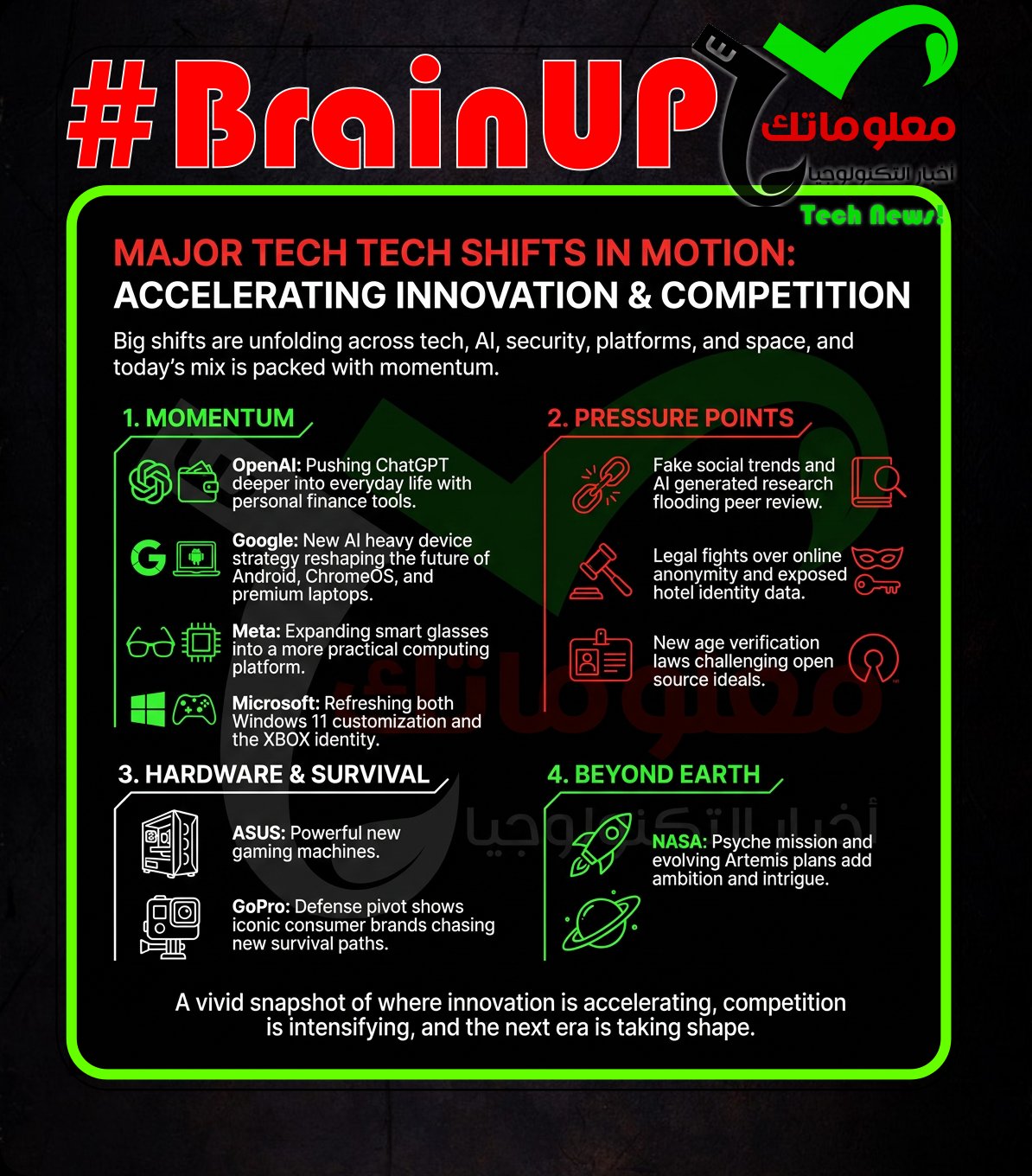
GoPro is trying a #pivot to #defense and aerospace as it struggles with declining sales, rising losses, and a stock that has been stuck around $1, but the move has not provided lasting relief. The company said last month it would explore defense and aerospace opportunities, a strategy investors have favored broadly as money pours into defense startups like @Anduril and as companies chase government contracts. That announcement briefly nearly doubled GoPro’s stock price, but the gains faded, and the company has since hired investment bank Houlihan Lokey to evaluate a potential sale or other strategic alternatives after receiving unsolicited inbound inquiries across defense, consumer, and financial sectors. The shift underscores how GoPro’s durable, high quality cameras could fit defense use cases, yet it also reflects mounting pressure, including layoffs of about a quarter of its workforce and headcount falling to under 600 from a peak around 1,500. In a world where a growing #Pentagon budget is seen as an attractive route to stability, GoPro’s defense exploration and sale talks signal a search for a viable path forward.
2. OpenAI launches ChatGPT for personal finance, will let you connect bank accounts | TechCrunch
@OpenAI has launched preview #personal-finance tools for ChatGPT Pro subscribers in the U.S. that let users connect bank, brokerage, and card accounts and ask questions for spending analysis and future planning. The feature uses #Plaid for linking and supports connections to over 12,000 institutions, then shows a dashboard of portfolio performance, spending, subscriptions, and upcoming payments, with access via the ChatGPT sidebar or an “@Finances” prompt. OpenAI says over 200 million users already ask financial questions monthly, and it highlights the new #GPT-5.5 model’s improved contextual reasoning plus a finance benchmark built with experts to strengthen answers. Users can disconnect accounts in Settings and synced data is removed from ChatGPT within 30 days, and they can view and delete financial memories from the Finances page. The rollout follows OpenAI’s April acquisition of the team behind finance startup Hiro and will be available on web and iOS for Pro users first, with planned Intuit support and potential expansion to Plus after feedback.
Social-media feeds often present #stealthMarketing and manufactured consensus as if it were organic culture. Former Floodify operator Joe Lim says his company ran 65,000 dummy accounts, posting about 50,000 videos a day across TikTok, Instagram, YouTube, and X to promote major-label music, unnamed celebrities, and even political attacks using #AI-generated influencers, including a pitched effort tied to @EricAdams’s reelection campaign. The machinery became more visible after Chaotic Good Projects co-founders Jesse Coren and Andrew Spelman publicly described using sock-puppet accounts for “trend simulation,” sparking backlash and suspicion around the band Geese, amplified by outlets like Wired and Paste before attention shifted to @OliviaRodrigo-related gossip. The larger issue is not one act’s legitimacy but that the same techniques now shape entertainment, politics, consumer products, and celebrity drama, while remaining hard to detect. As these tactics capture the infrastructure of public conversation, trends, backlash, and the sense that “everybody” is talking about something can be fabricated by unseen actors with hidden agendas.
4. Linux devs are fighting the new age-gated internet
Open-source developers are pushing back against a growing wave of state #age-verification laws that would require operating systems to collect users’ ages and share them with app developers, arguing this threatens how open systems like #Linux work and who can learn from them. In Colorado, lawmakers introduced SB26-051 to make operating systems pass age data to developers so they can disable age-inappropriate experiences, and @Carl Richell of System76 warned it would unintentionally sweep small open-source projects into requirements built for #iOS and #Android. He testified that #open-source software enables anyone, regardless of age or background, to learn and build at the most fundamental level, and that age-gating could lead to restrictions like blocking certain apps or denying root access, which he said would break that promise. After weeks of advocacy, SB26-051 passed with an exemption excluding open-source operating systems like Linux, which Richell described as a template he hopes other legislatures adopt. The broader conflict continues as other states consider similar rules, and California’s AB 1043 would require operating systems and app stores to collect ages during device setup starting January 1st, 2027, leaving open-source developers unsure how such mandates would apply to them.
5. AI-generated research papers are overwhelming peer review
AI-generated research papers are increasingly flooding journals, straining a peer-review system that is already short on reviewers and time. Postdoctoral researcher Peter Degen noticed his 2017 paper was suddenly being cited hundreds of times, and traced many of the citing works to a repeatable pattern: mass-produced analyses of the #GlobalBurdenOfDisease dataset generating endless “disease X in population Y” predictions. Following code links led him to tutorials promoted by a Guangzhou-based company on Bilibili that claimed researchers could produce publishable papers in under two hours using software tools and #AI writing assistance, and reviewers of a subset of these studies found them rife with errors and misrepresentations. Because newer #LLM output can look less obviously wrong than earlier AI text, weak or fraudulent papers are harder to detect, turning volume into a crisis point for editors and reviewers. The article links this surge to the longer-running problem of “paper mills,” noting that generative AI helps them evade plagiarism checks by generating new text and images, worsening the cat-and-mouse battle in academic publishing.
6. X is fighting Andrew Tate’s attempt to unmask his critics
X is opposing @Andrew Tate and @Tristan Tate’s effort to force the platform to reveal the identities of pseudonymous critics, arguing that the request threatens users’ right to speak anonymously. The Tates sued more than a dozen social media accounts for an alleged “Conspiratorial Plot” to defame them, then after a Florida court said claims could not proceed against unidentified defendants, they amended their case and separately demanded X disclose anonymous account holders; both X and an attorney for the Doe defendants have objected, with X’s May 11 filing citing First Amendment protections against chilling effects in the “marketplace of ideas.” The disputed accounts focused on tracking legal actions involving @Andrew Tate, who has been accused of rape and human trafficking in the UK and Romania, and his brother, allegations they deny, and the Tates cite posts such as calling Andrew Tate “a compulsive liar” and a “groomer” as defamatory. The fight also highlights tensions among MAGA-aligned figures, since @Elon Musk reinstated Tate’s account in 2022 and brands himself a #freeSpeech advocate while taking a hard line on “doxing,” yet the Tates seek disclosure specifically to pursue and deter critics. One defendant, creator Nathan Pope (Gadget), said he is concerned that unmasking efforts and the Tates’ public talk about using courts against critics could enable harassment and intensify the chilling effect of this litigation.
7. Intel’s NUCs Live On… as an Excessive Asus Mini Gaming PC
@Asus is continuing @Intel’s #NUC concept with the ROG NUC 16, a compact, console-like mini gaming PC that prioritizes high-end laptop-class parts but looks set to be very expensive. The new model keeps the prior chassis, adds an @Intel Core Ultra 9 290HX (#Arrow Lake) CPU, offers up to an @Nvidia GeForce RTX 5080 laptop GPU, up to 128GB of RAM, and includes many HDMI and USB ports but only one Thunderbolt 4 port. Pricing is not confirmed for the U.S., but it starts at 29,999 Chinese yuan (about $4,420) and the “Moonlight” white version is higher, with black shipping this month and white slated for June without exact dates; Asus also has gaps in its store listings, including not clearly specifying GPU options per configuration. Asus claims performance gains over the ROG NUC 15, yet its own 3DMark Time Spy result shows only about a 3% uplift with the RTX 5080, suggesting real-world gains will vary by game, while broader memory price increases are also pushing gaming hardware costs up. The article frames the ROG NUC 16 as a compelling but excessive evolution of the #NUC idea, reflecting how mini PCs aimed at gamers with limited space now come with premium pricing and incomplete buying details.
Google’s #Gemini Intelligence is a new umbrella brand for its most powerful AI features on premium Android devices, including smarter autofill, @Gboard voice to text “Rambler,” and “Create my Widget.” Google says the experience has strict device requirements: a flagship chip, at least 12GB RAM, support for #AI Core, and #Gemini Nano v3 or higher, plus long-term software commitments such as 5 Android OS upgrades, 6 years of at least quarterly security updates, and quality metrics like crash-rate standards. A Google developer page listing devices with Gemini Nano v3 shows mostly 2026 phones (for example Pixel 10 and Galaxy S26 families), while devices like the Pixel 9 series and Samsung Galaxy Z Fold 7 are listed under Nano v2, implying they do not meet the current criteria for Gemini Intelligence. The article notes uncertainty because the list is specifically about Gemini Nano Prompt API support, not necessarily the underlying model, and it is unclear whether devices could gain compliance via future OS updates. The 12GB RAM requirement is also highlighted as notable, especially alongside leaks suggesting the base Pixel 11 could drop to 8GB.
9. Bloomberg – Are you a robot?
Bloomberg.com displays an automated access challenge after detecting unusual activity from the user’s computer network. The page instructs the user to click a verification box to confirm they are not a robot and says the issue may be related to browser settings such as #JavaScript and cookies being unsupported or blocked. It directs readers to review its Terms of Service and Cookie Policy, and to contact support with a provided block reference ID for help. The content shown does not include the requested news article text and instead provides access and subscription prompts.
Reqrea, the Japan-based startup behind the Tabiq hotel check-in system, left more than 1 million customer passports, driver’s licenses, and selfie verification photos publicly accessible on the web due to a cloud storage misconfiguration. Independent security researcher Anurag Sen found that an Amazon-hosted storage bucket used by Tabiq was set to public, letting anyone with a browser access files without a password if they knew the bucket name, “tabiq,” and the bucket contents dated from early 2020 through as recently as this month. After Sen contacted TechCrunch, Reqrea secured the bucket following TechCrunch outreach to the company and Japan’s #JPCERT, and director Masataka Hashimoto said the company is reviewing the incident with external legal counsel, does not yet know how the bucket became public, and plans to notify affected individuals after its investigation. It is unclear whether anyone besides Sen accessed the data, though Reqrea said it is reviewing logs and the bucket was indexed by GrayHatWarfare, highlighting how #personal data exposures often result from basic security lapses rather than sophisticated attacks. The incident fits a broader pattern of exposed government ID documents amid expanding #age verification laws and #know your customer practices that require people to upload sensitive identity information.
11. Meta brings virtual writing to everyone with Meta Ray-Ban Display glasses
@Meta is rolling out new features for its Meta Ray-Ban Display smart glasses, highlighted by making virtual writing, sending messages using hand gestures, available to all users. The gesture writing feature uses the included #neural wristband and now works in WhatsApp, Messenger, Instagram, plus native Android and iOS messaging, after launching in January as an early access option for WhatsApp and Messenger. Meta is also adding #display recording to capture a video that combines what appears on the lens display, what you see in the real world, and surrounding audio. Walking directions are expanding across the US and to major international cities such as London, Paris, and Rome, while live captions are coming to WhatsApp, Facebook Messenger, and voice messages in Instagram DMs. Meta is also opening a developer preview that lets developers build apps for the glasses, including deploying web apps.
12. Googlebook finally delivers a true desktop with app icons and widgets to Google’s laptops
The new Googlebook is positioned as finally bringing a proper, functional #desktop experience to Google’s laptops, moving beyond the historically minimalist #ChromeOS wallpaper-like desktop. Early looks at its Android-based desktop environment show users can place app shortcuts and temporary files on the desktop, right-click to create folders, and drag native #Android apps directly onto the workspace. The biggest addition is desktop widgets, including a “Create My Widget” feature that uses #Gemini to generate custom dashboards such as itinerary countdowns sourced from Gmail or tailored weather views. These changes aim to bridge mobile apps and traditional desktop computing while still allowing users to keep an empty, minimalist desktop if they prefer. Overall, the article frames icons, folders, and #Gemini-powered widgets as a foundational shift that makes Googlebook feel like a more mature operating system and turns the desktop into a personalized command center.
13. Google just helped Apple sell a million more MacBook Neos
Google is launching the Googlebook, a new premium #Chromebook line built around @Google’s #Gemini, but its unclear identity and reliance on familiar AI tricks may make @Apple’s MacBook Neo look like the simpler choice. Google highlights an upgraded #ChromeOS with Magic Pointer that can invoke Gemini to act on on-screen content, such as circling a date to add a calendar event, generating image mashups, or turning numbers into charts, yet the article notes similar capabilities already exist in #macOS and via @Apple’s Apple Intelligence and ChatGPT integration. Because the Googlebook remains essentially ChromeOS with AI, it retains Chromebook limitations like a constrained library of professional desktop tools, while also depending on an internet connection for AI features. The piece argues these AI features could likely have been delivered via an OS update to existing Chromebooks, making the new brand feel like marketing-driven fragmentation rather than a meaningful hardware leap. In trying to rebrand Chromebooks as premium AI laptops, Google may inadvertently push buyers toward the more comprehensive MacBook Neo experience.
14. Googlebooks Just Killed the Original Chromebook Dream
Google’s launch of Android-based, @Gemini-heavy Googlebooks signals a shift away from the original #ChromeOS promise that “the web is the platform,” replacing a simple, web-centric desktop with Android apps and AI-first design. Google says it is not killing #ChromeOS yet, but it presents Googlebooks as the new focus, with Google’s Alex Kuscher arguing laptops should be rethought and that computing is shifting “from an operating system to an intelligence system.” The author argues #ChromeOS faltered because Google stopped believing in the web-first idea, starting in 2016 when it brought Android apps to ChromeOS, creating an awkward mix of browser tabs, #PWAs, and poorly resizing, touch-oriented Android apps. Googlebooks doubles down on this direction by treating apps as “primary citizens” built on Android technologies and by adding pervasive Gemini features like Magic Pointer, which the author expects to be intrusive. Overall, the piece contends that prioritizing Android and AI undermines the lightweight, consistent Chromebook experience and risks finishing the move away from a web-first laptop platform.
15. ASUS Announces ROG Strix SCAR 18, Featuring 240Hz Mini LED Display With ROG Nebula ELMB
@ASUS has launched the ROG Strix SCAR 18 gaming laptop, highlighting it as the first 18-inch laptop with a 240 Hz #MiniLED panel paired with #ROG Nebula ELMB for improved motion clarity. The system is configured with up to @Intel Core Ultra 9 290HX Plus and up to an @NVIDIA GeForce RTX 5090 laptop GPU, targeting 4K gaming on an 18-inch ROG Nebula HDR display. ASUS says the display features over 2000 dimming zones, up to 1600 nits peak brightness, HDR support, 100% DCI-P3 coverage, and #G-SYNC compatibility. Other listed specs include up to 128 GB DDR5-6400, up to 8 TB PCIe Gen 5.0 SSD storage via a 4 TB plus 4 TB setup, dual #Thunderbolt 5 ports, WiFi 7, 2.5G LAN, a 90 Wh battery, and a tool-less bottom panel with a #ROG Q-Latch for easier SSD and RAM upgrades. Pricing was not disclosed, but the article expects the flagship configuration to cost well over $4000.
16. Windows 11 tests an adjustable taskbar and resizable Start menu
#Microsoft is testing new #Windows11 customization options that let users move the taskbar and resize the Start menu. The update, rolling out to Windows 11 Insiders in the Experimental channel, allows placing the taskbar on the bottom, top, left, or right, adjusting icon alignment, and opening the Start menu drawer from the taskbar’s new position, it also adds a shorter taskbar option for smaller displays and “Small” or “Large” Start menu sizing. Additional Start menu controls include toggles to show or hide the “Pinned,” “Recommended,” and “All” sections, renaming “Recommended” to “Recent,” and the ability to hide your name and profile picture for screen sharing or presentations. @Diego Baca says Start and the taskbar are where user trust is tested and frames the changes as part of steady progress to rebuild that trust. The features are expected to roll out over the coming weeks to the Experimental Channel.
@Microsoft appears to be rebranding Xbox as XBOX, starting with changing the name of its X account to all caps. @Asha Sharma, the Xbox CEO, polled fans on X about using Xbox vs XBOX, the results favored XBOX, and Microsoft has pointed inquiries back to Sharma’s post. Other social accounts like Threads and Bluesky have not been renamed yet, but the move aligns with earlier all-caps branding used on the original Xbox and later console logos such as Xbox 360, Xbox One, and Xbox Series X/S. This shift follows Sharma’s recent rollback of the Microsoft Gaming label to Xbox and her broader “return of Xbox” push, which has included fan-focused console updates, a new Xbox logo, #Game Pass pricing changes, organizational restructuring, and a new boot-up animation. Together, the changes suggest a coordinated effort to refresh the brand and platform identity under Sharma’s leadership.
18. NASA’s Psyche Is About to Use Mars as a Slingshot to a Rare Metal Asteroid
NASA’s Psyche spacecraft will fly past Mars to gain a gravity assist on its way to the metal-rich asteroid Psyche in the asteroid belt. During the 15 May 2026 flyby, it will pass within about 2,800 miles of Mars at 12,333 mph, with all science instruments operating and cameras taking thousands of images to practice for the 2029 asteroid encounter. NASA’s two Mars rovers and multiple US and European orbiters will also observe Mars simultaneously for comparison, while mission operators use the changing views of the planet to fine-tune instruments, as noted by @Jim Bell. The target asteroid is a roughly 173 by 144 mile, potato-shaped body believed to be unusually rich in metal, possibly an exposed nickel-iron core of an early planet stripped by collisions, offering clues about the solar system’s formation 4.6 billion years ago and how Earth became habitable. Launched in 2023, the van-sized probe uses #solar electric propulsion with xenon thrusters and is expected to arrive in 2029 to orbit the asteroid for two years of study.
19. NASA Reveals New Details About Artemis 3—and It’s a Bit Weird
#NASA says the preliminary #Artemis3 plan, targeted for no earlier than late 2027, is focused on testing rendezvous and docking between #Orion and commercial lunar landers from @SpaceX and @BlueOrigin rather than going to the Moon. The agency says engineers have been evaluating options since February, when it revamped the #Artemis architecture to reduce risk, increase launch cadence, and support a sustained lunar presence. A notable choice is flying #SLS without the Interim Cryogenic Propulsion Stage, using a non-propulsive “spacer” instead, because Artemis 3 will stay in low-Earth orbit and NASA wants to save its last ICPS for Artemis 4. The mission profile also depends on whether @SpaceX’s #Starship Human Landing System and @BlueOrigin’s Blue Moon MK2 are ready for a crewed demo, with plans that range from docking with and entering both landers, to only one, to possibly not entering either if life support is not ready. These decisions are meant to validate critical docking operations and shape the path toward the Artemis 4 crewed Moon landing.
That’s all for today’s digest for 2026/05/16! We picked, and processed 19 Articles. Stay tuned for tomorrow’s collection of insights and discoveries.
Thanks, Patricia Zougheib and Dr Badawi, for curating the links
See you in the next one! 🚀
