
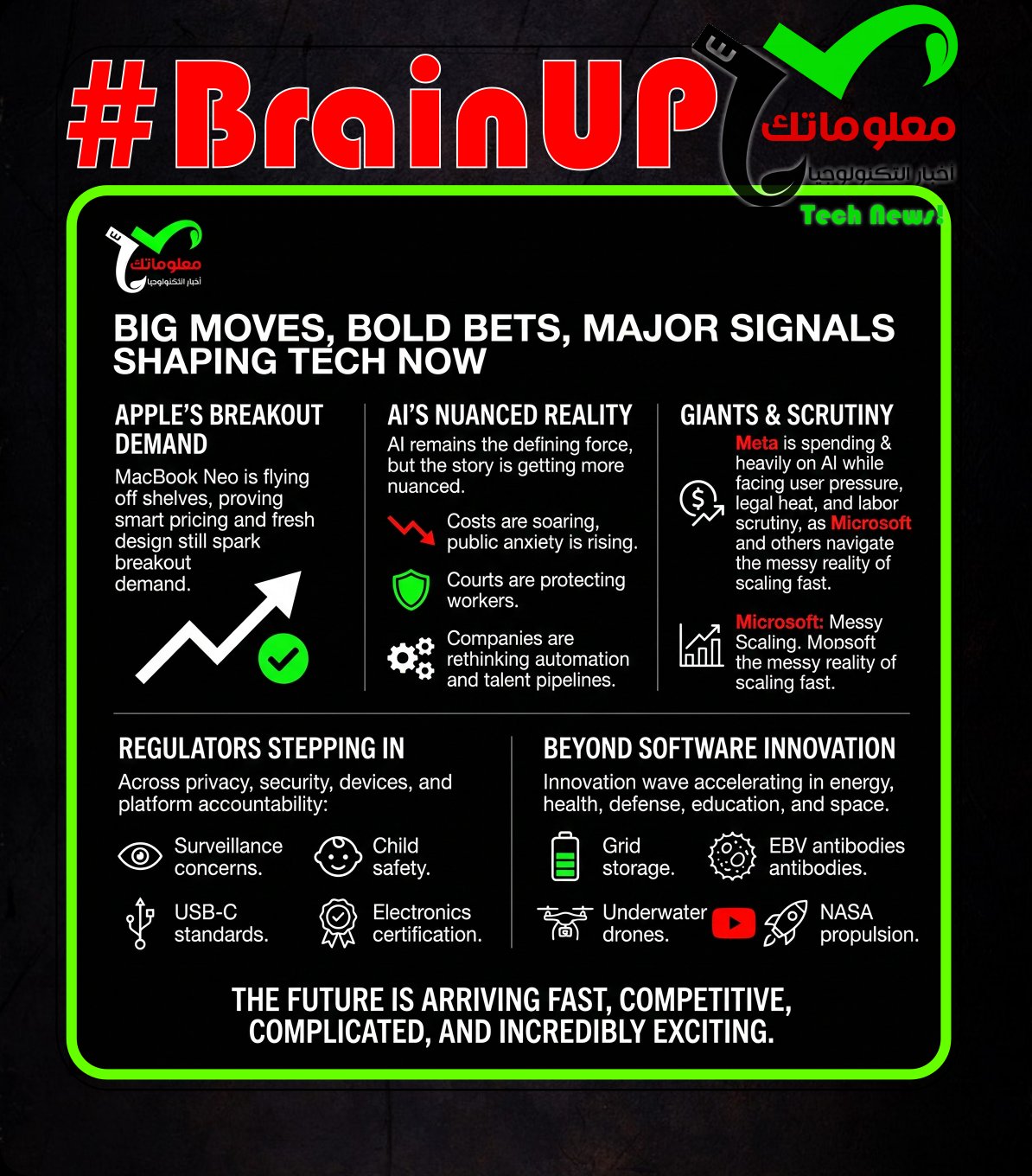
#BrainUp Daily Tech News – (Sunday, May 3ʳᵈ)
Welcome to today’s curated collection of interesting links and insights for 2026/05/03. Our Hand-picked, AI-optimized system has processed and summarized 25 articles from all over the internet to bring you the latest technology news.
As previously aired🔴LIVE on Clubhouse, Chatter Social, Instagram, Twitch, X, YouTube, and TikTok.
Also available as a #Podcast on Apple 📻, Spotify🛜, Anghami, and Amazon🎧 or anywhere else you listen to podcasts.
1. Apple Was Caught Off Guard by MacBook Neo’s ‘Off the Charts’ Demand
@Tim Cook said demand for the MacBook Neo has been “off the charts” since it was unveiled in March, and that #Apple “undercalled” the level of enthusiasm despite being optimistic ahead of launch. He stated that demand exceeded expectations and helped drive a record number of first-time Mac buyers last quarter, while Apple is also targeting customers new to the Mac and those holding on to older Macs for a long time. Cook added the MacBook Neo is currently supply constrained, with the U.S. online store showing 2 to 3 week delivery estimates for all configurations. The MacBook Neo launched March 11 after a week of pre-orders, starts at $599 in the U.S. or $499 with education pricing, uses a version of the iPhone 16 Pro #A18Pro chip, and comes in Citrus, Blush, Indigo, and Silver, underscoring how aggressive pricing and strong demand are shaping availability.
2. Germany says U.S. troop withdrawal ‘anticipated’, Spain and Italy could be next
@Germany is downplaying the impact of a new U.S. pullback while #NATO allies worry about Washington’s long-term commitment to Europe. German Defense Minister @Boris Pistorius called the Pentagon’s plan to withdraw about 5,000 troops from Germany “anticipated,” said Germany is ready to carry more of its defense burden, and argued for strengthening the European pillar within #NATO, while Pentagon spokesman @Sean Parnell said the order came from Defense Secretary @Pete Hegseth after a force-posture review and would be completed in six to twelve months. The move would still leave more than 30,000 U.S. troops in Germany and reverses part of the buildup under @Joe Biden after Russia’s 2022 invasion of Ukraine, amid added political friction after Chancellor @Friedrich Merz criticized U.S. strategy in the Iran war. A NATO spokesperson said the alliance is seeking details and said the announcement highlights the need for European members to invest more, as Germany plans to exceed #NATO’s 2% spending benchmark with defense spending projected above 3% of GDP. @Donald Trump also said he is considering similar reductions in Italy and Spain, criticizing their responses to the Iran conflict, with @Giorgia Meloni and @Pedro Sánchez having opposed U.S. military action in Iran.
Even as Big Tech cuts jobs, #AI is not yet broadly cheaper than human labor because the #cost of compute and related operating expenses remain high. @Bryan Catanzaro of @Nvidia said his team’s compute costs exceed employee costs, and an @MIT 2024 study found AI automation would be economically viable in only 23% of vision-heavy roles, with humans cheaper in the other 77%. Firms are still spending heavily, with $740 billion in 2026 capex announced so far, up 69% from 2025, while tech layoffs have surpassed 92,000 this year, and executives like @Uber CTO Praveen Neppalli Naga say AI tooling budgets are already being blown up. Keith Lee said the situation reflects a short-term mismatch driven by hardware and energy costs, potentially pushing AI spending to $5.2 trillion by 2030, and rising #AI software fees of 20% to 37%, with flat subscription pricing sometimes failing to cover heavy usage. Until costs stabilize, some companies are reconsidering AI less as a cost-saving substitute for labor and more as a complementary tool.
4. Ask.com shuts down after nearly 30 years, marking the end of Ask Jeeves
Ask.com, originally launched as Ask Jeeves in 1997, shut down on May 1, 2026, ending nearly three decades as an early #question-answering search engine. Its parent company, IAC, said the closure was part of a shift away from its search business, and the site posted a farewell message thanking users and staff, saying, “Every great search must come to an end.” Ask Jeeves became known in the late 1990s and early 2000s for letting people type full questions via a #natural-language interface, featuring the Jeeves mascot, and it briefly competed with Yahoo before @Google’s superior indexing took over. After rebranding to Ask.com in 2006 and shutting down its independent web crawler in 2010, it never regained relevance amid @Google’s dominance and the rise of Yahoo Answers and Quora. Online reactions were nostalgic and surprised it lasted so long, with some calling it ahead of its time and noting its conversational approach helped set expectations for modern chatbots like #ChatGPT.
5. Police are using surveillance tech to stalk love interests. Dystopia, here we come | Arwa Mahdawi
@Arwa Mahdawi argues that #Flock’s rapidly expanding #surveillance network and easy access to its data create serious risks of misuse by law enforcement. The company sells #ALPR automated license plate readers and has more than 80,000 cameras across the US, while an @ACLU investigation found Flock’s default police agreement allowed sharing plate data with federal and local agencies for investigative purposes, and some departments reportedly shared data with #ICE amid @DonaldTrump’s deportation push. A separate review by the Institute for Justice identified at least 14 cases where officers allegedly used ALPR data to monitor romantic interests, with some misconduct only uncovered through limited internal checks or after a victim used HaveIbeenflocked.com. Although Flock says democratically authorized bodies should set rules and many officers were charged and fired, an Institute for Justice attorney says the deeper issue is giving every officer access to detailed information about people’s movements over time, which creates broad potential for abuse. The piece frames these examples as warning signs of how scaled, networked vehicle tracking can slide into everyday dystopian policing, especially when data sharing and oversight are weak.
The #FCC voted unanimously to advance a proposal that would remove all testing labs in China and Hong Kong from certifying electronics for U.S. sale, citing #nationalSecurity risks tied to the current reliance on Chinese testing. The agency says about 75% of U.S.-bound electronics are tested in Chinese facilities, and compliance data cited in the article lists 126 of 591 FCC-recognized labs in mainland China or Hong Kong, including a large concentration in Shenzhen and the Pearl River Delta. @BrendanCarr said the commission is pursuing actions to limit interconnection capabilities of entities it views as security threats, and the proposal expands the prior #BadLabs order that already barred 15 state-owned or government-affiliated Chinese labs. The shift could raise certification costs because basic FCC testing is described as $400 to $1,300 at Chinese labs versus $3,000 to $4,000 at U.S. labs, even though some affected sites are subsidiaries of Western firms like Intertek, SGS, TUV Rheinland, and Bureau Veritas that have other labs to absorb work. In a separate 3-0 vote, the FCC also advanced a plan to restrict China Mobile, China Telecom, and China Unicom data center operations in the U.S. and to consider broader interconnection limits involving firms on the #CoveredList or carriers using #Huawei or #ZTE equipment, with a 60 to 90 day public comment period before final rules and a transition.
7. Chinese Courts Rule Companies Cannot Fire Workers Simply to Replace Them With AI – Caixin Global
Chinese courts have ruled that companies cannot legally fire employees simply to replace them with cost-saving #AI, treating AI adoption as a controllable business decision rather than an unavoidable disruption. In a typical case publicized by the Hangzhou Intermediate People’s Court, a tech firm reassigned quality-assurance employee Zhou and sought to cut his pay from 25,000 yuan to 15,000 yuan because his work could be automated, then dismissed him after he refused, and courts found the termination illegal and upheld compensation after arbitration and appeal. The Yuhang District Court held that AI-driven cost savings are not statutory grounds for unilateral termination, such as business closure or poor performance, and do not constitute an “objective major change” that makes the labor contract impossible, also finding the pay-cut offer unreasonable. The ruling reinforces that labor contract changes require mutual consent and that employers must follow strict legal conditions, including notice or severance where applicable, rather than using #AI as a standalone justification. By classifying #AI integration as a strategic choice, the decisions set a precedent that strengthens worker protections amid growing automation in the tech sector.
8. The Oscars Ban AI From Winning Acting and Writing Awards
The Academy of Motion Picture Arts and Sciences has tightened #Oscars eligibility rules to keep #generativeAI from winning in acting and writing categories. Under the new rules, acting roles must be credited in the film’s legal billing and demonstrably performed by humans with their consent, and screenplays must be human-authored to be eligible. The move follows growing controversy around AI-created or AI-assisted performers, including pitches like Tilly Norwood and an upcoming film using a genAI-made performance of @Val Kilmer. The Academy is not banning productions from using genAI, but it is signaling that AI-driven performances or writing will not be rewarded in these categories, and it has not yet set rules for other areas like visual effects, costume design, or music. The update is part of broader Oscars changes, including allowing actors to be nominated for multiple performances in the same category and crediting international movies as the nominee rather than their country or region.
9. San Jose passenger claims a Waymo drove off with his luggage at the airport
A South Bay man says a #Waymo driverless taxi left him at San Jose Mineta Airport and then drove away with his luggage still in the trunk, leaving him to travel without his belongings. Di Jin said his first driverless ride from Sunnyvale to the airport went smoothly, but when he exited he pressed the trunk button and it would not open before the car drove off, and customer service told him the vehicle was already heading back to the depot and could not return. Waymo later emailed that the luggage was secured at its local depot but initially said it would not cover shipping labels or courier fees, offering instead two complimentary rides so he could travel to the depot to retrieve it, options Jin called unfair since he believes the trunk malfunction was not his mistake. After Jin contacted NBC Bay Area, he said a Waymo representative called by Friday afternoon and agreed the company would pay to ship his luggage, which he accepted. Waymo’s lost-and-found page says it is not responsible for items left behind, describes depot pickup hours, and states the trunk can be opened via a car button or the app and should automatically open at the destination, a point Jin disputes based on his experience.
10. A DOGE Affiliate Is Now in Charge of the US Government’s ID Platform
@Greg Hogan, an affiliate of the so-called #DOGE, has been named acting assistant commissioner of the #TechnologyTransformationServices at the #GSA, putting him in charge of #LoginGov as the government aims to expand it into a broader identity platform. An email from federal CIO @Gregory Barbaccia said Hogan will focus on growing Login.gov’s user base so it becomes “a world-class identity platform,” following a period when TTS, previously led by former Tesla engineer @Thomas Shedd, lost about 50 percent of its staff in early 2025. Hogan previously served as CIO at #OPM during DOGE’s early 2025 push, signed a privacy impact assessment tied to a new email server used for government-wide messages like “Fork in the Road” and weekly work reporting later analyzed with #AI, and that server became the subject of a lawsuit alleging OPM failed to publish the assessment before deployment. Login.gov, launched in 2017 as a single secure account for multiple agencies and built in part by the #USDigitalService now called the #USDOGEService, released a December 2025 roadmap to integrate mobile driver’s licenses and use passports for identity confirmation, framed as part of fraud combat priorities. A TTS employee told WIRED there is an internal push to make Login.gov functionally “a national ID” retaining additional data such as income and citizenship status, which they fear could become a centralized surveillance repository, while another employee expressed more optimism about Hogan’s management style, linking the leadership change to rising stakes over how the platform evolves.
11. Anxiety around AI is growing rapidly in the US, research shows
Anxiety about #AI is rising in the US and public enthusiasm is waning, according to Stanford University’s 2026 AI Index Report. The report says more than half of surveyed respondents feel nervous about products using #artificial intelligence, and it notes growing worries that #AI could harm jobs, the economy, elections, and relationships, even as public opinion diverges from expert and industry views. It also finds #AI safety is lagging behind technical progress, with incidents more than tripling since #ChatGPT launched in 2022, and warns that improving one #responsibleAI dimension like safety can degrade another like accuracy. A separate Gallup poll cited in the article reports #GenZ excitement fell from 36% to 22% in a year while anger rose from 22% to 31%, suggesting backlash is driven more by immediate social and economic impacts than fears of hypothetical superintelligence, as behavioural scientist @Caroline Orr Bueno argues. The article links this negative sentiment to escalating direct action, including surging online pause movements and two alleged attacks on @Sam Altman’s California home, one involving a Molotov cocktail and another a firearm.
12. Meta’s historic loss in court could cost a lot more than $375 million
After New Mexico Attorney General @Raúl Torrez won a $375 million jury award against #Meta in a child safety case, the next phase could be more consequential because it seeks court-ordered changes to how Facebook, Instagram, and WhatsApp operate in the state. In a three-week Santa Fe #public_nuisance trial starting Monday, New Mexico will argue Meta created a public health hazard and will push remedies such as age verification for New Mexico users, limits on under-18 #end_to_end_encryption and a 90-hours-per-month cap, curbs on engagement features like infinite scroll and autoplay, and a requirement to detect 99 percent of new #CSAM. Torrez says damages alone may be treated as a cost of doing business, so the goal is to change Meta’s practices, while Meta could respond by applying changes more broadly for simplicity or potentially going dark in New Mexico. The state plans about 15 witnesses on feasibility and harms, and Judge Bryan Biedscheid will decide which proposals are relevant and feasible, a result that will not directly control other lawsuits but could influence settlement negotiations and signal whether courts will alter tech business models after liability findings.
13. Scientists Develop New Antibody For Virus That Infects 95% of People
Researchers report new human-like antibodies that could block #Epstein-Barr virus (EBV), a lifelong infection carried by about 95 percent of adults and linked to cancers, #multiple_sclerosis, and other serious complications. A team at the Fred Hutchinson Cancer Center and the University of Washington generated antibodies against two EBV surface proteins, gp350 and gp42, which the virus uses to gain access to #B_cells, aiming to prevent initial infection and possibly later reactivation. Using specially bred mice that produce genetically human antibodies, they isolated 10 antibodies in the lab, two targeting gp350 and eight targeting gp42, and in mice with human-like immune systems one antibody protected against EBV infection. The approach also addresses a key challenge in EBV antibody discovery, because EBV can bind to nearly all B cells, making naturally occurring, highly specific blocking antibodies hard to find, as noted by @Andrew_McGuire and @Crystal_Chhan. The findings point toward potential uses for protecting immunosuppressed patients, including the hundreds of thousands receiving organ and bone marrow transplants each year who are vulnerable to EBV-related complications such as post-transplant lymphoproliferative disorders.
Independent developer Pawel Jarczak shut down his “OrcaSlicer-BambuLab” fork after #BambuLab threatened legal action, ending an effort to restore OrcaSlicer users’ access to remote printer features blocked by the #BambuConnect middleware. Jarczak said on GitHub that the company warned of a cease and desist and accused him of reverse engineering to impersonate Bambu Studio, violating Terms of Use, and bypassing authorization, while he argued his fork relied only on publicly available source code and on an access path Bambu had not yet disabled in its Linux workflow. He also noted that Bambu Studio is released under the #AGPL-3.0 copyleft license (built on PrusaSlicer), while the key networking plugin that connects printers to Bambu’s cloud is closed source. The dispute sits within Bambu Lab’s broader security rationale, as the firm previously labeled third-party integrations a risk and reported its cloud servers were hit with about 30 million unauthorized requests per day, with Orca Slicer cited as the main culprit. The shutdown highlights how Bambu printers’ advanced capabilities, such as remote monitoring and AMS filament functions, depend on cloud access, and Jarczak says he is pivoting his related Bambu Multi-Color Unit firmware work toward #Klipper-based printers amid fears of further ecosystem lockouts.
15. Microsoft Update Warning: Windows 11 Security Fix Breaks Backups
A recent Microsoft update intended to enhance security in Windows 11 has inadvertently caused issues with backup functionality, leading to failures in some users’ systems. Reports highlight that after installing the patch, certain backup processes either fail to complete or are corrupted, raising concerns about data integrity and protection. While the update aims to address critical vulnerabilities, the unintended consequence undermines user trust and necessitates immediate troubleshooting or rollback measures. This situation underscores the challenges in balancing security improvements with system stability, especially for vital services like backups. Continued monitoring and prompt patches are essential to restore full reliability and maintain user confidence in Windows 11 updates.
16. A giant pit in Switzerland will soon house the world’s most powerful redox flow battery
Swiss energy company FlexBase is building Switzerland’s first #redoxFlowBattery in a massive excavation in northern Switzerland, aiming to stabilize Swiss and European power grids, prevent blackouts, and store excess wind energy at grid scale. Co-founder @MarcelAumer said the system will be able to inject or absorb up to 1.2 GWh of electricity within a few milliseconds, comparable to the regional output of the Leibstadt nuclear power plant. The project, costing over a billion dollars, will deliver 2.1 GWh of capacity, estimated to power about 210,000 households for a day, and it will also help meet high demand from nearby AI data centers housed in a broader technology complex with labs and offices. The article explains that #redoxFlowBatteries store energy in liquid electrolytes pumped through a membrane-separated cell, enabling inert charge cycles, indefinite energy storage, a practically limitless service life, non-flammability, and near-total recyclability, and notes that key components have become cheaper as the industry matures. By deploying an updated form of a technology dating back to 1879 and later advanced via @NASA research, FlexBase positions this installation as the world’s most powerful redox flow battery and a long-duration alternative to more common #lithiumIonBattery systems suited mainly to short-term storage.
MIT researcher @Andrew McAfee warns that aggressively using #automation to remove Gen Z entry-level roles can backfire by breaking the apprenticeship path that trains future leaders and advanced knowledge workers. He argues that people learn difficult work by assisting experts with routine tasks, and automating that rung too quickly removes on the job learning ladder while also cutting off access to Gen Z employees who are often the most enthusiastic #AI users. Citing a Deloitte study, the article notes that 76% of Gen Z report using a standalone AI tool, and McAfee says reducing entry-level hiring sacrifices future opportunities to learn and deprives organizations of power users who can help integrate AI. The warning lands amid a tougher entry-level market, with Handshake postings down 2% year over year and 12% below pre-pandemic levels, and unemployment for college graduates ages 22 to 27 at 5.6%, while nearly nine in 10 Class of 2026 graduates fear AI could replace entry-level jobs, and @Dario Amodei has said AI could eliminate up to half of such roles. A Goldman Sachs analysis is presented as a counterpoint suggesting younger, college-educated workers have historically adjusted more flexibly through occupational mobility and skill upgrading, implying that firms that keep early-career pipelines may protect both near-term capability and long-term workforce development.
18. Berkshire Hathaway’s Warren Buffett to Step Back as Greg Abel Takes Over
At Berkshire Hathaway’s annual meeting, Warren Buffett announced he would transition leadership to Greg Abel, recognizing Abel as his successor to run the conglomerate. Buffett emphasized the company’s culture of decentralized management and long-term investment, which has driven its success, while Abel highlighted his commitment to maintaining these values. This leadership shift marks a pivotal moment for Berkshire as it prepares for the future without its iconic chairman. The change is expected to preserve the company’s investment philosophy and operational approach, reassuring shareholders about continuity. The meeting underscored the strategic planning behind Berkshire’s enduring strength in the business world.
19. NASA’s Lithium-Fed Nuclear Thruster Flares to Life in First of Its Kind Test
@NASA engineers at JPL tested a prototype lithium-fed #magnetoplasmadynamic (MPD) electric thruster that could support future human missions to Mars by providing higher-power, efficient propulsion. In a 26-foot water-cooled vacuum chamber, the thruster reached up to 120 kilowatts, the highest power level achieved in U.S. electric propulsion tests, and during five ignitions it exceeded 5,000°F as its electrodes produced a red plume and bright-white glow. The design uses high currents and magnetic fields to accelerate lithium plasma, and #electric propulsion can use up to 90% less propellant than chemical rockets, with NASA stating lithium-fed MPD systems could deliver greater thrust power than current solar-electric thrusters like those on the 2023 @Psyche mission. Developed over about two and a half years with Princeton University and NASA Glenn and funded through NASA’s #Space Nuclear Propulsion project, the concept is intended to pair with a nuclear power source to reduce launch mass and enable larger payloads. Test data will guide a new series aiming for 500 kilowatts to 1 megawatt per thruster, as a crewed Mars spacecraft may need 2 to 4 megawatts and multiple MPD thrusters running for more than 23,000 hours, requiring proof the hardware can survive sustained high-temperature operation.
20. Meta lost 20 million users last quarter
@Meta reported a 20 million quarter over quarter decline in its combined “Family daily active people” count, even as it plans to boost #AI related spending in 2026. The company said the drop was driven by internet disruptions in Iran and restricted access to WhatsApp in Russia, though its bundled reporting across Facebook, Instagram, WhatsApp, and Messenger makes it unclear which services were most affected. At the same time, Meta raised projected 2026 capital expenditures to $125 to $145 billion, about $10 billion higher than prior estimates, citing higher component pricing and added future data center capacity after CFO @Susan Li said Meta had underestimated compute demand. Financially, revenue grew 33 percent year over year to $56.3 billion, but #RealityLabs posted a $4.03 billion operating loss following two layoff waves since January, and the stock fell more than 7 percent after the earnings release. Overall, the results pair aggressive investment in compute and AI infrastructure with signs of user softness and continued losses in Meta’s hardware and VR unit.
21. Convicted former Harvard scientist rebuilds brain-computer lab in China
Dr. Charles Lieber, a former Harvard scientist convicted in the United States for undisclosed ties to China, has reestablished a laboratory focused on brain-computer interface technology in China. Despite his legal issues, Lieber secured funding and continued research efforts to develop advanced neural devices, highlighting China’s ambition to lead in #neurotechnology. This development raises concerns regarding research ethics and international technology transfers, as China’s investments in brain-computer interfaces grow rapidly. Lieber’s case exemplifies tensions between scientific collaboration and national security, illustrating how individual researchers can impact geopolitical scientific competition. The situation underscores the challenges in balancing technological innovation with legal and ethical oversight in global science.
The U.S. Navy has signed a $99.7 million deal with Domino Data Lab to develop #AI software that helps undersea minesweeping drones learn new or unseen mines in days instead of months, aimed at operations in the #StraitOfHormuz. The system is described as using multiple sensor suites, including side-scan sonar and visual imaging, to monitor deployed detection models so operators can spot failures and push corrections in the field rather than sending data back to a lab for retraining. Domino CEO @ThomasRobinson said this approach would let the Navy train, govern, and field AI fast enough for contested waters, citing an example where unmanned underwater vehicles trained on Russian mines could be adapted to detect Iranian mines in about a week instead of a year. The article places the deal within a broader Pentagon shift toward #AI, noting announced agreements with companies including @SpaceX, @OpenAI, @Google, @Nvidia, Reflection, @Microsoft, and @AmazonWebServices to deploy #LLMs on classified networks, and a DARPA call for proposals for a next-generation deep-sea drone built quickly. With an on-and-off ceasefire described as making mine-clearing high-risk due to potential sudden strikes, the piece argues that deploying AI on undersea drones could reduce danger to sailors by accelerating mine detection and removal.
23. EU now requires USB-C charging for new laptops up to 100 W
The European Union has mandated that all new laptops sold within its member states must support USB-C charging with power delivery up to 100 W starting 2026. This regulation aims to standardize charging ports to reduce electronic waste and improve consumer convenience. Manufacturers will need to comply by equipping laptops, tablets, and certain other devices like e-readers and cameras with USB-C charging capabilities. This policy reflects the EU’s broader effort to promote sustainability and establish uniform technology standards across the market. The USB-C charging requirement is expected to simplify usage and enhance compatibility across devices sold in the EU.
24. YouTube has quietly become the backbone of US classrooms
YouTube has emerged as a critical educational tool in US classrooms, widely used by teachers to supplement traditional teaching methods. The platform offers extensive instructional videos covering diverse subjects, which educators integrate to enhance student engagement and understanding. This trend reflects a shift towards blended learning environments where digital resources play a pivotal role. According to educational experts, YouTube’s accessibility and variety support differentiated instruction and accommodate various learning styles. As a result, YouTube functions not just as entertainment but as an essential educational backbone, reinforcing classroom learning and offering scalable teaching support.
25. Meta contractor fires 1,100 AI trainers after they protested working conditions
Meta’s contractor, LiveOps, fired 1,100 AI trainers after workers protested poor pay and working conditions connected to training Meta’s AI systems. The trainers, who reviewed AI outputs for safety and accuracy, staged a walkout demanding better wages and benefits amid increasing demand for AI moderation jobs. This mass firing highlights the tension between tech giants’ reliance on human labor for AI development and the precarious, underpaid nature of these roles. It raises questions about ethical labor practices in the AI industry and the challenges faced by workers behind advanced technologies. The incident illustrates broader challenges in balancing rapid AI growth with fair treatment of essential human contributors.
That’s all for today’s digest for 2026/05/03! We picked, and processed 25 Articles. Stay tuned for tomorrow’s collection of insights and discoveries.
Thanks, Patricia Zougheib and Dr Badawi, for curating the links
See you in the next one! 🚀
