
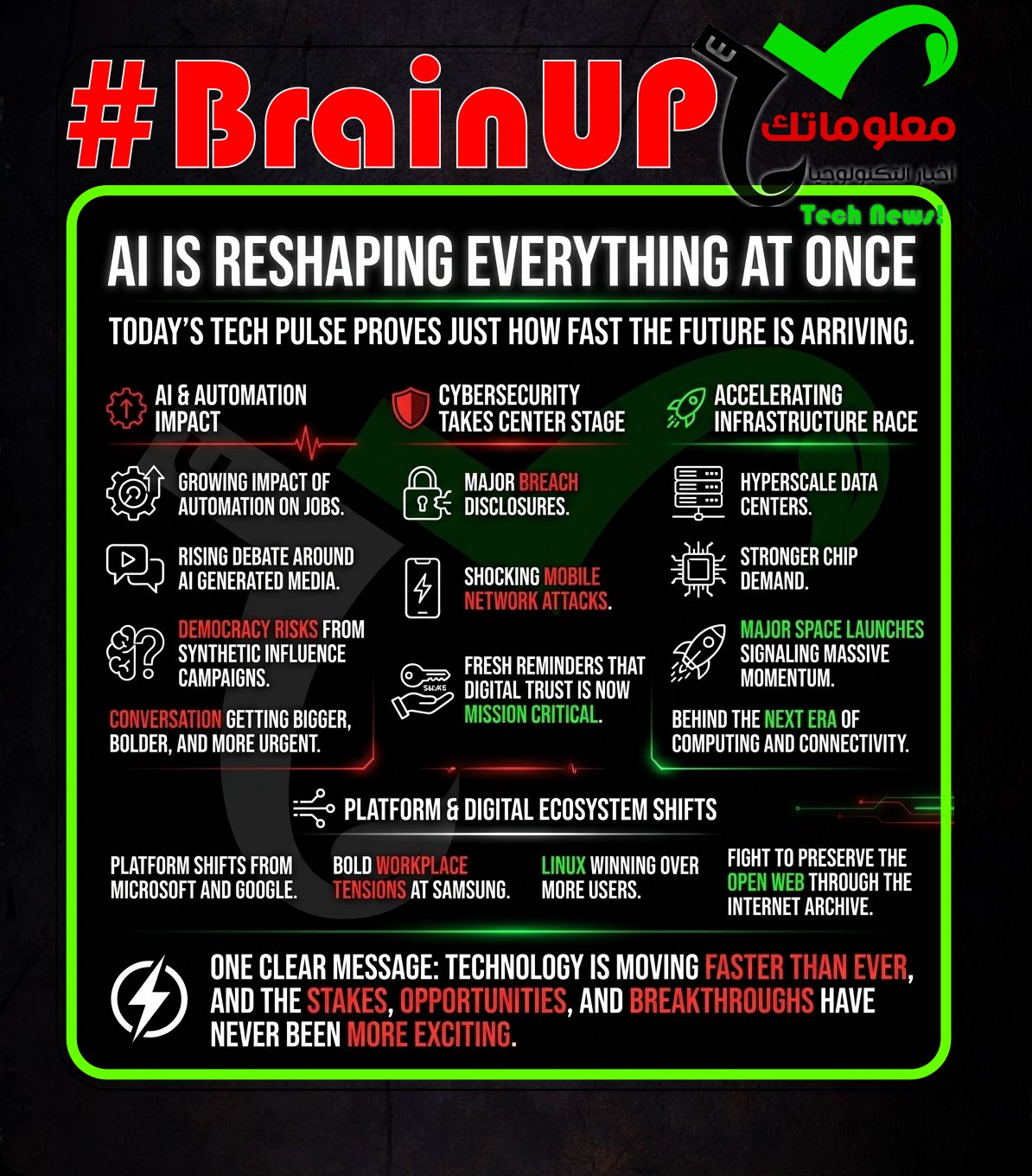
#BrainUp Daily Tech News – (Monday, April 27ᵗʰ)
Welcome to today’s curated collection of interesting links and insights for 2026/04/27. Our Hand-picked, AI-optimized system has processed and summarized 18 articles from all over the internet to bring you the latest technology news.
As previously aired🔴LIVE on Clubhouse, Chatter Social, Instagram, Twitch, X, YouTube, and TikTok.
Also available as a #Podcast on Apple 📻, Spotify🛜, Anghami, and Amazon🎧 or anywhere else you listen to podcasts.
1. AI adoption may displace millions of human workers by 2030
AI technologies are expected to significantly disrupt the labor market, potentially displacing millions of workers by 2030. Studies show that sectors like customer service, transportation, and manufacturing face high risks due to automation and AI advancements, with some estimates suggesting up to 20% job reduction in certain industries. This displacement stresses the need for workforce retraining programs and adaptive policy measures to mitigate income inequality and unemployment. Experts like @AndrewYang argue that universal basic income or similar support systems might become necessary as AI integration accelerates. Consequently, balancing AI innovation with social protections will be crucial to harness the technology’s benefits while minimizing human cost.
2. An OpenAI-linked news outlet appears to be entirely AI-generated
A report cited by Model Republic says the news site The Wire by Acutus appears to rely almost entirely on #AI-generated content while presenting itself as “collaborative journalism” led by an anonymous “editorial team.” The site has operated since late 2025 with nearly 100 articles, no masthead, and no credited editors or journalists, and journalist Tyler Johnston used the Pangram #AI-detection tool to review 94 articles, finding 69% flagged as fully AI-generated, 28% partially AI-generated, and only three classified as human-authored. Johnston also noted the coverage was strongly pro-#artificial_intelligence and dismissive of critics, with headlines like “Escalating Anti-AI Radicalism” and “Will Republicans Let Blue States Set America’s AI Rules?” He further found that about half of the site’s engagement on X came from @Patrick Hynes of Novus Public Affairs, whose client list includes Targeted Victory, described as central to @OpenAI’s lobbying efforts in Washington. If Johnston’s reporting and inferences are correct, the outlet could represent an attempt to mischaracterize #AI-produced advocacy as independent journalism in support of regulatory interests, which Johnston says would conflict with the firm’s own usage policies.
3. Samsung workers threaten strike with demand for $38 billion share
Samsung workers have threatened to strike, demanding a share of $38 billion in profits. The union, representing approximately 30,000 employees, is calling for improved wages and bonuses reflecting the company’s robust financial performance. This labor action highlights growing tensions between employees seeking fairer compensation and Samsung’s management. The workers argue their contributions to Samsung’s success warrant a more significant portion of the company’s earnings. The impending strike underscores broader challenges in balancing corporate profitability with employee satisfaction within major tech firms like Samsung.
Toronto police arrested three people after uncovering a vehicle-based #SMSBlaster scheme, described as a first-of-its-kind operation in Canada, in which devices hidden in cars impersonated cell sites to intercept signals and push fraudulent texts. Investigators said the setup infiltrated tens of thousands of nearby mobile devices and recorded about 13 million network disruptions, with affected phones diverted from legitimate networks and temporarily unable to access services including emergency 911. The blasters worked by acting like a closer, stronger base station so phones auto-connected, letting operators broadcast messages that appeared to come from trusted institutions like banks or local government, enabling large-scale #smishing and directing victims to credential-stealing or payment-fraud websites. Toronto Police Deputy Chief Robert Johnson emphasized the unusual scale and the public-safety risk of interrupting emergency connectivity, even briefly, while police warned people to stay vigilant because fraudulent texts can still arrive through normal channels. Authorities said the threat stopped once the operation was broken up and noted they are not releasing photos of the seized, uniquely built devices for safety reasons.
5. AI swarms could hijack democracy without anyone noticing
#AI-generated swarms of hyper-realistic personas could infiltrate online communities and subtly steer public opinion, potentially tipping elections while remaining hard to detect. A policy forum paper in Science describes how coordinated #multi-agent systems, powered by #large-language-models, can imitate human behavior, join discussions, maintain consistent narratives across thousands of accounts, and rapidly adapt messaging based on feedback. The article cites early warning signs including #deepfakes and fake news outlets affecting election conversations in the United States, Taiwan, Indonesia, and India, and monitoring groups identifying pro-Kremlin content networks that may also try to shape data used to train future AI systems. @Kevin Leyton-Brown warns that as these systems emerge, trust in unknown social media voices may decline, potentially empowering celebrities and making grassroots messages harder to amplify. Without checks, the resulting artificial consensus could erode trust in what is real and reshape how democratic influence operates online.
6. After three months on Linux, I don’t miss Windows at all
@Nathan Edwards describes switching his desktop to #Linux in January to see if it could be his main computer with minimal research and troubleshooting, and says that after three months he has only booted into #Windows twice for a document scanning issue and an urgent photo print. He reports the transition became routine quickly, app installation is sometimes an extra step but often easier than on Windows, and while a few apps are still hard to replace, the overall experience has been calmer and more robust than expected, with troubleshooting often oddly satisfying. He notes the problems so far have been minor or funny, sometimes tied to specific hardware like his HP OfficeJet 8720 printer, and sometimes tied to his choice of a newer rolling distro based on #ArchLinux instead of a mainstream release like #Ubuntu. As an example, he explains fixing #CachyOS #Snapper snapshot storage by resizing partitions to expand an undersized boot partition, calling it silly but doable and satisfying. He also mentions a frustrating networking bug involving ethernet not getting an IP after sleep unless Wi-Fi connected first, which pushed him to investigate while he kept working via Wi-Fi.
Intel reportedly boosted profit margins by improving #yield salvage, selling CPUs that would normally be treated as scrap or low-expectation output. Tech analyst @Ben Bajarin said Intel Investor Relations clarified that lower-quality edge-die chips were binned down into usable SKUs and sold because customers are buying nearly everything amid intense CPU demand. Intel’s Q1 results reflected the surprise lift, including $13.6B revenue versus $12.36B expected and 41% non-GAAP gross margin, 650 basis points above guidance. The article explains that not all dies on a wafer are equal, and chips that miss higher-end specs can still be relabeled as lower-tier products, turning would-be waste into revenue. It links this to industry conditions where an AI-driven infrastructure buildout is straining supply and sustaining strong demand for server processors, including Intel’s #Xeon.
8. American utility firm Itron discloses breach of internal IT network
American utility technology company Itron revealed a breach in its internal IT network, impacting its operations and customer data security. The breach was detected when the company noticed unusual activity within its systems, prompting an investigation that confirmed unauthorized access to IT infrastructure. Itron responded by isolating affected systems, initiating forensic analysis, and notifying law enforcement and impacted customers as part of its commitment to transparency and security. This incident underscores the persistent risks utility firms face from cyberattacks targeting critical infrastructure and highlights the importance of robust #cybersecurity measures. Itron’s disclosure and response efforts aim to mitigate damage and reinforce trust with stakeholders and the energy sector it serves.
9. Google to pay $135M settlement to Android phone users – how to claim your share if you qualify
A class action settlement could pay eligible #Android users from a $135 million fund after Taylor et al. v. @Google LLC alleged Android phones transmitted user data to Google without permission using paid cellular data, even when phones were not in use and apps were closed. The suit claims these transfers could have been limited to #WiFi connections, but allegedly occurred at any time, and @Google has not admitted wrongdoing while agreeing to settle to avoid court proceedings, separate from the $700 million #GooglePlay case. Anyone who used a cellular connection on an Android phone from Nov. 12, 2017, through the date the settlement receives final approval can participate, and claims are filed at https://www.federalcellularclassaction.com using a notice ID and confirmation code, or by contacting info@federalcellularclassaction.com if no notice arrives. Individual payouts are not finalized, but with about 100 million class members and typically low participation, payments could be up to $100, with all members receiving the same amount after costs, taxes, and attorney fees. Payments would come only after final court approval, with a final approval hearing scheduled for June 23, 2026, and eligible users who do not choose a payment method may still be paid if the administrator has correct information.
A multibillion-dollar #hyperscale #dataCenter project led by @KevinOLeary is nearing final approval in rural Box Elder County, with state leaders backing tax and development deals intended to attract major cloud companies. The state’s Military Installation Development Authority, #MIDA, approved resolutions to advance the project and to move quickly while charging much lower taxes than usual to help O’Leary Digital “lure the hyperscalers,” which MIDA officials said are a small, identifiable group that includes Amazon, Microsoft and Google, with Meta and Apple often listed next. Supporters say the project would generate its own power, clean the water it uses so it can be sent to the Great Salt Lake, help fund modern buildings at Hill Air Force Base, and create 2,000 high-paying jobs. The site would span 40,000 acres of private land in unincorporated Box Elder County, plus about 1,200 acres involving the #UTTR Department of Defense area and Utah Trust Lands, and it now awaits a final vote by the Box Elder County Commission after a meeting was postponed to Monday. O’Leary emphasized Utah’s unusually fast pace and said he is seeking incentives because the project requires raising billions to build the power infrastructure and the data centers that follow.
11. Turtle Beach launches $160 wireless mouse with 2.25-inch touchscreen and 10-hour battery life
The article explores a highly unconventional piece of hardware from @Turtle Beach, the #CommandSeries MC7, which pushes the boundaries of peripheral design by embedding a 2.25-inch touchscreen directly into a wireless gaming mouse, effectively transforming it into a hybrid control surface for both gaming and productivity; the screen enables users to manage DPI settings, switch profiles, trigger macros, launch apps, and even control streaming tools like #OBS, positioning the device as a potential replacement for external tools like stream decks, while being powered by high-end specs such as a 30K DPI optical sensor, 8,000 Hz polling rate, and optical switches rated for 150 million clicks ; however, this innovation comes with trade-offs, particularly in battery life and ergonomics, as the mouse offers around 10 hours of usage with the display active and relies on dual hot-swappable batteries to mitigate downtime ; analytically, the MC7 represents a broader trend of #hardware convergence where input devices evolve into multifunction command hubs, but it also raises skepticism around practicality, as critics question whether a touchscreen on a mouse enhances workflow or introduces friction, especially in fast-paced gaming scenarios where tactile feedback and muscle memory are critical.
12. SpeakOn’s dictation device is a good idea marred by platform limitations | TechCrunch
Notta-owned SpeakOn’s $129 MagSafe dictation device aims to improve #transcription across iPhone apps by using its own mic and an iOS companion keyboard, but its usefulness is limited by hardware performance and platform constraints. The 25-gram pebble attaches to an iPhone, starts recording via a button press, and can dictate in any app when the software keyboard is active, filtering filler words and optionally formatting output, plus offering speech #translation into languages including English, Japanese, Korean, Chinese (Simplified and Traditional), Spanish, French, German, Italian, Portuguese, Russian, and Arabic. In testing, the mic often failed to capture audio well unless the phone was within about two feet, and it underperformed in noisy environments, while system limitations prevented quicker keyboard switching or dictating without changing keyboards. The app’s automatic tone and editing (“attune”) sometimes rewrote phrases in unwanted ways, leading the reviewer to disable it, and the device’s claimed 20-day standby did not match experience, which was only a few days. Overall, it suggests promise for dedicated dictation hardware, but better microphones, less intrusive editing, and broader support such as Mac compatibility are needed to make the concept compelling.
13. SpaceX launching powerful Falcon Heavy rocket today for 1st time in 18 months: Watch it live
#SpaceX is set to launch its #FalconHeavy rocket for the first time in about 18 months, carrying the ViaSat-3 F3 communications satellite from NASA’s Kennedy Space Center on April 27 during an 85 minute window opening at 10:21 a.m. EDT, with live coverage starting about 15 minutes before liftoff. Falcon Heavy uses three modified Falcon 9 first stages and produces about 5.1 million pounds of thrust at liftoff, making it the second most powerful operational rocket behind NASA’s #SLS, and it last flew in October 2024 launching NASA’s Europa Clipper. The 6.6 ton ViaSat-3 F3 is bound for geostationary orbit, where it will provide high throughput broadband service across the Asia Pacific region, completing the three satellite ViaSat-3 mini constellation after ViaSat-3 F1 (launched on Falcon Heavy in April 2023) and ViaSat-3 F2 (launched on a ULA Atlas V in November 2025). ViaSat says the mission is a pivotal step toward delivering fast, secure, reliable, high capacity broadband to commercial, defense, and consumer customers, while the rocket’s side boosters are planned to return for landing.
14. We translated the Palantir manifesto for actual human beings
The article mocks and reframes a 22-point “manifesto” that #Palantir published to promote @Alex Karp and Nicholas Zamiska’s book The Technological Republic, portraying it as a push to fuse Silicon Valley with national defense and normalize more militarized, surveillance-focused tech. It highlights points arguing that Silicon Valley has a moral duty to support the state, that “hard power” in this century is built on software, and that #AI weapons are inevitable so the US and its contractors should build them rather than be constrained by “soft power” debates. The authors “translate” these claims as self-interested bids for defense-contract money, a preference for stronger government spying capabilities, and a dismissal of ethics and oversight as impediments to winning. They underscore the ominous symbolism of the company’s name, likening it to a spying device from The Lord of the Rings, to emphasize the unsettling implications of the agenda being sold. Overall, the piece uses satire to argue that the manifesto’s lofty language is cover for expanding state power and profitable defense tech, with Palantir positioned as the indispensable solution.
15. The Internet’s Most Powerful Archiving Tool Is in Peril
Major news organizations are increasingly restricting the @Internet Archive’s #WaybackMachine, threatening a key public resource for preserving and verifying online information. The article cites a @USA Today investigation that relied on archived ICE detention statistics while its owner, USA Today Co., blocks the Wayback Machine from archiving its outlets, and reports that other organizations, including @The New York Times, have also moved to limit access, with Originality AI finding 23 major news sites blocking the Internet Archive’s ia_archiverbot and Reddit doing so as well. Publishers say the moves are tied to broader efforts to block scraping bots or concerns about potential misuse of preserved content by #AI companies, and some, like @The Guardian, restrict access through API and interface filtering rather than crawler blocking. In response, journalists and advocacy groups including the @Electronic Frontier Foundation and Fight for the Future are organizing support, gathering more than 100 journalist signatures, including @Rachel Maddow, to argue that as local papers close and libraries struggle to preserve digital-only reporting, safeguarding journalism’s record increasingly depends on the Internet Archive. Reporters also describe practical impacts, from fact-checking and sourcing audio clips to accessing vanished fan sites and old job listings, reinforcing that limiting archiving undermines the historical record the Wayback Machine is meant to protect.
16. AI is frying our brains — here’s what leaders need to do about It | Fortune
Although #AI was supposed to save time by automating low level tasks, research cited in the article argues it is increasing #cognitive load and contributing to burnout by intensifying work and expanding overall volume. An eight month ethnographic study by @Aruna Ranganathan and @Xingqi Maggie Ye of 200 employees found AI usage made work more intense rather than easier, and research from #BCG describes a “brain fry” effect where using AI on top of existing duties makes work doubly or triply effortful, increasing errors and worsening outcomes. The article explains this through #neuroscience limits: constrained working memory (closer to three to five items, plus a tightly limited “intermediate term memory”), poor multitasking, and the heavy cost of task switching that can require more than 20 minutes to fully regain focus after shifting between disparate tasks such as prompting AI and applying its output. As employees fill any freed time with more AI prompting, the tool consumes additional mental bandwidth so the brain never fully rests, leading even high performers to miss minor details. It adds that creativity and innovation suffer because “Eureka” moments tend to occur when the brain is quiet rather than overloaded.
17. Pascal’s Wager Doomer Challenge
The article discusses the dilemma posed by the #doomer challenge, reflecting on the logic of @BlaisePascal’s wager applied to existential risks and climate change. It argues that dismissing efforts to mitigate catastrophic risks because of pessimism about their success contradicts the rational decision to act only if the expected utility is significant. The text highlights how embracing hope and proactive measures can counter fatalistic attitudes that lead to inaction, emphasizing that rational self-interest supports measures to improve future outcomes regardless of uncertainty. It connects philosophical reasoning with practical urgency, advocating for engagement in climate action as a rational bet to avoid worst-case scenarios. This perspective encourages readers to reconsider defeatism by focusing on probabilistic benefits and moral responsibility.
Microsoft has removed the Copilot branding from the Notepad app in Windows 11, replacing it simply with the term ‘AI assistant.’ This change appears in the latest Windows 11 preview builds and applies to all users, not just insiders. While the branding has shifted, the underlying AI capabilities remain the same, indicating this is primarily a rebranding effort rather than a change in functionality. The adjustment aligns with Microsoft’s broader strategy to simplify and unify how it presents AI features across Windows. This move reflects Microsoft’s evolving approach to integrating AI into its software ecosystem while maintaining a consistent user experience.
That’s all for today’s digest for 2026/04/27! We picked, and processed 18 Articles. Stay tuned for tomorrow’s collection of insights and discoveries.
Thanks, Patricia Zougheib and Dr Badawi, for curating the links
See you in the next one! 🚀
