
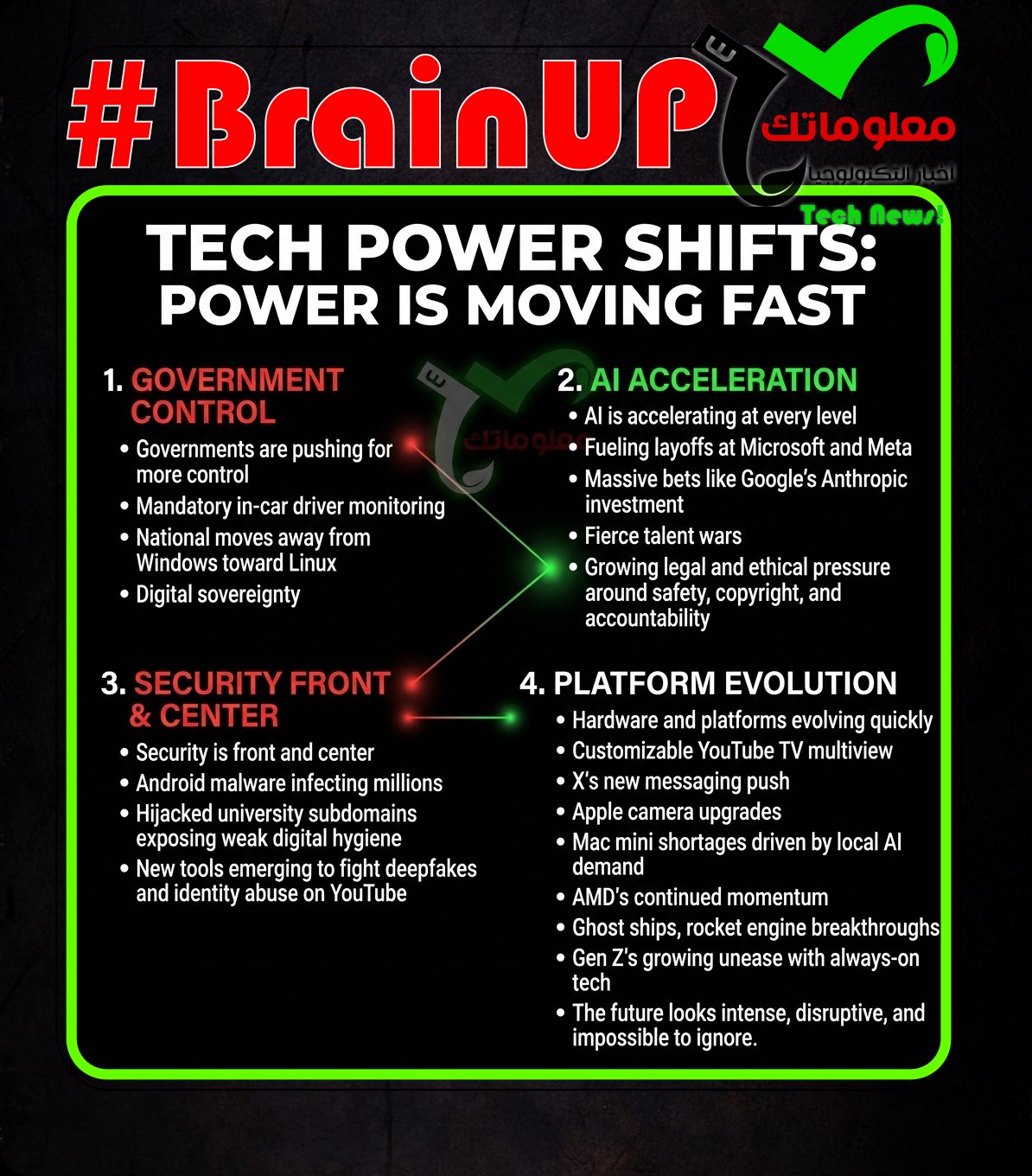
#BrainUp Daily Tech News – (Saturday, April 25ᵗʰ)
Welcome to today’s curated collection of interesting links and insights for 2026/04/25. Our Hand-picked, AI-optimized system has processed and summarized 22 articles from all over the internet to bring you the latest technology news.
As previously aired🔴LIVE on Clubhouse, Chatter Social, Instagram, Twitch, X, YouTube, and TikTok.
Also available as a #Podcast on Apple 📻, Spotify🛜, Anghami, and Amazon🎧 or anywhere else you listen to podcasts.
1. Federal Surveillance Tech Becomes Mandatory in New Cars by 2027
A federal mandate will require all new passenger vehicles to include #advanced impaired driving prevention technology by late 2026 to 2027, pushing in-car monitoring of driver sobriety and alertness. Citing Section 24220 of the 2021 #Infrastructure Investment and Jobs Act, the article says @NHTSA must finalize rules for systems that use #infrared cameras and sensors to track eye movement, pupil dilation, and drowsiness patterns, and that an AI could prevent ignition or limit speed if it detects impairment such as blood alcohol at or above 0.08% or fatigue. It notes the final rule missed a November 2024 deadline but that automakers would have 2 to 3 years to implement after regulations are finalized, with potential over-the-air updates that could expand capabilities post-purchase. The piece highlights privacy and cost concerns, claiming $100 to $500 added per vehicle and warning that while external data sharing is not mandated, manufacturers could upload biometric data and potentially share it with insurers, while automakers argue the tech is unreliable and could create false positives that strand drivers. The government is said to project 9,000 to 10,000 lives saved annually, while the article frames the tradeoff as reduced driving privacy once consumers move beyond their current, unmonitored cars.
France plans to migrate 2.5 million government workstations from @Microsoft Windows to #Linux to reduce dependence on American tools and gain greater control over data, infrastructure, and strategic decisions. French budget minister @David Amiel said France can no longer accept reliance on solutions whose rules, pricing, and risks it does not control, and the rollout will begin with the government’s digital agency, DINUM. The move is framed as part of a broader European push for #digital sovereignty, with examples including France dropping #Zoom and #Teams for a homegrown videoconferencing system, Austria’s military using open-source office software after dropping #Microsoft Office, and Germany’s Schleswig-Holstein shifting 44,000 inboxes from Microsoft to an open-source email program and replacing #SharePoint with #Nextcloud while considering #Windows-to-#Linux migration. The article parallels this with India’s shift toward domestic tools, citing ministers @Amit Shah and @Ashwini Vaishnaw moving to #Zoho services, an education ministry directive mandating #Zoho Office Suite, and migration of over 1.2 million government email accounts with data stored in India, amid concerns over recurring foreign license costs and the #DPDP Act. Together, these cases illustrate how geopolitical tensions and reliance on US technology are driving governments to adopt #open-source and domestic alternatives for greater autonomy.
3. Microsoft and Meta announce large staff reductions as they spend big on AI
@Microsoft and @Meta are cutting thousands of jobs while ramping up spending on #AI, with executives arguing the technology is already improving productivity and reducing the need for some hiring. @Meta told staff it will cut about 10% of its workforce, just under 8,000 people, on 20 May and close roughly 6,000 open roles, with chief people officer @Janelle Gale saying the cuts help “offset the other investments we’re making” and offering severance. @Mark Zuckerberg has been more explicit that #AI can shrink team sizes, and he outlined a “major AI acceleration” with $115bn to $135bn in AI spending, while also saying projects that needed big teams can be done by one very talented person. @Microsoft said it will offer voluntary retirement to about 7% of its US workforce, with eligibility tied to age plus years of service totaling 70 or more, as analysts estimate its AI infrastructure spending could reach $110bn to $120bn, up from a prior $100bn forecast. The moves intensify tech workers’ worries about being replaced as leaders like @Satya Nadella and @Zuckerberg cite rising AI-written code, including Nadella’s claim that AI handled up to 30% of Microsoft’s coding work and Zuckerberg’s view that perhaps half of Meta’s development could be done by AI within a year.
4. How the Tech World Turned Evil
The article argues that parts of Silicon Valley have shifted from countercultural idealism to a technocratic, anti-regulatory worldview that treats government oversight as an existential enemy. It centers on @Peter Thiel, described as Palantir chairman and PayPal co-founder, giving 2025 Commonwealth Club lectures framing the #Antichrist as a “Luddite” who wants to stop science, naming @Greta Thunberg and @Eliezer Yudkowsky, while protesters outside linked him to apocalyptic imagery. The piece contends this religious framing is a blunt version of a broader, secularized faith among tech elites in #AI and #AGI, summarized by critic @Tim Wu as “technology is the godhead” and AGI as a “Second Coming.” It describes a narrative in which a coming war pits “good” AI against “evil” regulation, culminating in the #Singularity, promoted even through paid programs like #SingularityUniversity, and casts attempts to slow or control AGI as aligned with a symbolic “Beast” of government interference. The author links this quasi-millenarian belief to the industry’s resistance to democratic constraints, suggesting it helps justify monopolistic power and hostility to regulation.
5. San Diego developing new generation of ‘ghost ships’ that are vital to the Navy’s future
The U.S. Navy is accelerating development in San Diego of small, fast unmanned sea drones, often called #ghost ships, to adapt to rapidly changing naval warfare by expanding surveillance and combat options while reducing risk to personnel. These vessels are being designed for autonomous or remote operations to stalk submarines, detect mines, scout ahead of aircraft carriers, and in some cases potentially launch missiles and grenades, with control possible nearby, over the horizon via relays, or across thousands of miles by satellite. The Navy recently created the enlisted role of #robotics warfare specialist, and in January established three new drone divisions in San Diego that roughly doubled local research and development, with a focus on reconfigurable 16-foot boats costing under $1 million each, according to Vice Adm. @Brendan McLane. The push was influenced by U.S. military observations in Ukraine of comparatively inexpensive, long-range sea drones used to damage the Russian fleet, and it aligns with a long-term plan projecting about 150 unmanned vessels within a 500-ship fleet by 2045, including some able to operate underwater. San Diego’s selection as a primary hub is tied to its major West Coast Navy presence, history of naval innovation, strategic access to the Indo-Pacific and Middle East, and proximity to institutions like UC San Diego and companies such as Saronic Technologies, as the Navy prepares to integrate operational sea drones into carrier strike groups, including a planned step with the USS Theodore Roosevelt.
6. Utah medical board calls for immediate suspension of state’s AI doctor experiment
A Utah pilot that used a bot to renew prescriptions prompted backlash from the state’s medical board, which called for the experiment to be immediately suspended. The available text indicates the project involved renewing prescriptions through an automated system rather than a human clinician. The board’s response suggests concerns about the appropriateness or safety of using #AI for direct clinical functions like prescription renewals. Beyond noting the pilot, the backlash, and the suspension request, no additional details about the bot, the scope of the pilot, or specific allegations are provided in the excerpt.
7. Discomfort with modern technology shapes Gen Z’s desire to live in the past
A new NBC News Decision Desk poll suggests many #GenZ adults would rather live in the past, reflecting pessimism about the country and discomfort with always-on #technology. Among adults ages 18 to 29, 47% said they would choose to live in the past if given the option, including 33% choosing less than 50 years back and 14% more than 50 years, while 38% preferred the present and only 15% chose any future period; young Black adults were less likely to pick the past (33%) than young white (52%) or young Hispanic adults (47%). The poll also found 62% of Gen Z expect life to be worse for them than for previous generations and 80% said the United States is on the wrong track, aligning with interviews describing anxiety about uncertain technological and geopolitical futures. The article links this sentiment to a broader nostalgia trend for the 1980s through early 2000s, including revived fashion and older media devices, and to a desire for life “right before” social media dominated daily experience, as described by nostalgia researcher @Clay Routledge. Interviewees like Ben Isaacs and Skyler Barnett said #smartphones and the #internet reduce face-to-face connection and add unwanted noise, reinforcing why a recent, pre-social-media era feels more appealing than the present.
8. Microsoft will let you pause Windows Updates indefinitely, 35 days at a time
@Microsoft is updating #WindowsUpdate in #Windows11 to make updates less disruptive, including letting users effectively pause updates indefinitely by renewing a 35-day pause window repeatedly. The changes are rolling out first to users on the Dev and Experimental #WindowsInsider channels, and Microsoft says the pause end date can be extended as many times as needed with no stated limit, though updates will run normally if the pause is not renewed after 35 days. Windows will also show more descriptive driver update titles that include the applicable device class, such as display, audio, or battery. Additional changes include always offering power menu options to restart or shut down without running updates, an option to skip updates during new device setup, and a more unified update process that downloads in the background and coordinates installation and restarts to reduce reboot frequency. Together, these tweaks aim to stop unexpected update interruptions during work or play while giving users more control over when updates install.
9. NoVoice Android malware on Google Play infected 2.3 million devices
NoVoice Android malware was discovered on Google Play, infecting over 2.3 million devices across multiple countries. The malware masqueraded as legitimate apps, using advanced evasion techniques to avoid detection and steal sensitive user information. It operated by silently subscribing victims to premium services, leading to unauthorized charges. Security experts recommend users remove suspicious apps and enable mobile security features to prevent such infections. This incident highlights ongoing challenges in securing app marketplaces like Google Play against sophisticated threats.
10. Altman apologizes after OpenAI failed to alert police before fatal Canada shooting
@Sam Altman apologized to the community of Tumbler Ridge, British Columbia, saying he is “deeply sorry” that #OpenAI did not alert law enforcement about an account later linked to a mass shooting. Police say the 18-year-old alleged shooter, Jesse Van Rootselaar, killed eight people, including family members at home, then five children and an educator at a secondary school before killing herself, with 25 others injured. #OpenAI said it identified the account in June through abuse detection for “furtherance of violent activities” and banned it for violating its usage policy, but decided the activity did not meet its threshold for referral to the Royal Canadian Mounted Police. Altman said he spoke with Mayor Darryl Krakowka and Premier David Eby, who conveyed community anger and grief, and he committed to working with governments to prevent similar tragedies. Eby called the apology necessary but “grossly insufficient” given the devastation to families.
11. Google Plans to Invest up to $40 Billion in Anthropic, Bloomberg Reports
Google is reportedly planning to invest up to $40 billion in Anthropic, an AI startup focused on developing #artificialintelligence models. Bloomberg News revealed that this investment aligns with Google’s strategy to enhance its AI capabilities and compete in the growing AI market, especially against rivals like OpenAI. The infusion of capital will likely help Anthropic accelerate its research and product development, potentially benefiting Google through collaboration or integration of advanced AI technologies. This move underscores Google’s commitment to staying at the forefront of AI innovation by partnering with specialized firms. The investment reflects broader industry trends emphasizing strategic funding to maintain technological leadership.
12. Why are top university websites serving porn? It comes down to shoddy housekeeping.
Websites under prestigious university domains are serving explicit porn and, in at least one case, a fake malware alert scam because scammers hijacked abandoned subdomains left behind by poor DNS housekeeping. Researcher @Alex Shakhov of SH Consulting found hundreds of abused subdomains across at least 34 universities, including berkeley.edu, columbia.edu, and washu.edu, with Google showing thousands of hijacked pages and activity linked by another researcher to a group tracked as Hazy Hawk. The mechanism is #DNS mismanagement: universities create #CNAME records to point subdomains at canonical targets, then decommission the subdomain without removing the CNAME, leaving a “dangling” record that scammers can take over, a problem made worse by decentralized campus IT and lack of subdomain inventories. Shakhov says finding affected sites is easy via searches like site:[university].edu “xxx” or “porn” and recommends maintaining a running inventory of subdomains, regularly auditing for dangling records, and removing CNAMEs for inactive subdomains. Only a handful of universities had removed dangling CNAMEs after his findings went public, and some still had problematic URLs showing in Google results.
13. Databricks Fails to Shake Authors’ AI Training Copyright Lawsuit
Databricks Inc. failed to get a proposed class action dismissed after authors alleged the company trained its #large language AI model on their books without permission. Judge Charles R. Breyer of the US District Court for the Northern District of California ruled the authors presented enough evidence at this early stage to support claims that Databricks made unauthorized copies of their books. The decision follows an earlier dismissal of the copyright suit, after which the court allowed an amended complaint based on additional evidence obtained during discovery. The ruling keeps the authors’ #copyright allegations in play, focusing on whether Databricks copied books without authorization in connection with #AI training.
14. Meta’s loss is Thinking Machines’ gain | TechCrunch
Thinking Machines Lab (TML) is expanding its AI ambitions while trading top talent with Meta, including recently hiring former Meta researcher Weiyao Wang after eight years working on multimodal perception systems and open-world segmentation projects like SAM3D. On the infrastructure side, TML signed a multibillion-dollar cloud deal with Google that provides access to #Nvidia’s latest GB300 chips, following an earlier partnership with #Nvidia, and placing it in a similar infrastructure tier as Anthropic and Meta. The talent flow is bidirectional: Meta reportedly discussed acquiring TML about a year ago and has since poached seven TML founding members, while TML appears, based on LinkedIn reviews, to be hiring more researchers from Meta than any other single employer. Notable hires include CTO @Soumith Chintala, a longtime Meta veteran and co-founder of #PyTorch, plus former Meta leaders like Piotr Dollár and other researchers and engineers from Meta’s FAIR and LLM training efforts, alongside recruits from companies including Apple, Microsoft, Waymo, OpenAI, and Anthropic. Together, the cloud compute access and the steady influx of experienced researchers help explain how Meta’s losses can translate into TML’s gains as the startup grows to around 140 employees.
15. YouTube rolls out celebrity AI likeness detection
@YouTube is expanding its #ContentID system to include celebrity likeness detection to help flag deepfakes, prevent identity scams, and stop other unauthorized uses of a person’s likeness. The feature began last year as a pilot for a small group of creators, then expanded to politicians and journalists, and now also aims to protect celebrities plus management and talent agencies, even if the individual does not have a YouTube account. The system scans videos across the platform for visual matches against an enrolled library and flags suspected unofficial uses, though YouTube says removals so far have been very small. YouTube also says it supports broader celebrity protections through the #NOFAKES and #TakeItDown Acts. Eligible entertainers can apply to enroll via a form, and if a match is detected they can choose to request video removal, file a copyright takedown, or take no action.
16. X launches stand-alone XChat app on iOS | TechCrunch
X has launched XChat, a stand-alone iOS messaging app that connects users with their X contacts for messaging, file sharing, group chats, and audio and video calls. The app adds privacy-oriented features like editing and deleting messages for everyone, disappearing messages, and blocking screenshots, and X says it includes no ads or tracking plus end-to-end encryption and PIN protection, though security experts have previously disputed X’s encryption claims and have said the service appeared less secure than apps like #Signal. XChat reflects a broader strategy shift: instead of a single @ElonMusk “everything app,” xAI is offering a suite of dedicated apps, with payments also being tested separately but not yet public. XChat will also become the new destination for X’s #Communities as X shuts Communities down due to low use and high spam, potentially driving installs. Overall, XChat positions X as a hub that routes users into other services while the company seeks wider consumer touchpoints beyond the core social network.
17. iPhone 18 Pro Max camera thicker, iPhone Ultra dummy unit compared to iPad mini – 9to5Mac
Apple’s iPhone 18 Pro Max is expected to be thicker than the iPhone 17 Pro Max mainly because its #camera system protrudes more. @Vadim Yuryev of Max Tech, citing iPhone 18 Pro Max dummy units, reports thickness from the cameras rising from 12.92mm on iPhone 17 Pro Max to 13.77mm on iPhone 18 Pro Max, and thickness from the camera plateau increasing from 11.23mm to 11.54mm. Apple’s official listed depth for iPhone 17 Pro and 17 Pro Max remains 8.75mm when measuring the body without the camera system, and the article says the extra protrusion is expected to come from an upgraded iPhone 18 Pro camera system this fall, though it may be hard to spot visually. The piece also highlights Yuryev’s comparison of an iPhone Ultra (a rumored foldable model) dummy to iPad mini and iPhone 17 Pro Max, claiming very thin bezels, near iPad mini like display size, and a 56.9% taller open display than iPhone 17 Pro Max while being about the same width. It adds that Apple’s first foldable iPhone is expected to run two iPhone apps side by side, and recent rumors suggest no significant delay even if some earlier reports placed it later than the iPhone 18 Pro launch.
18. iPhone 18 Pro’s Variable Aperture Camera Explained and Its Real Photo Impact
The iPhone 18 Pro introduces a #variableaperture camera, a significant advancement in smartphone photography that adjusts the lens opening like professional cameras, allowing better control over light exposure and depth of field. This innovation is evident in sample photos showcasing improved low-light clarity and enhanced bokeh effects, providing users with more versatile shooting conditions. The integration of this technology in a smartphone reflects Apple’s commitment to bridging the gap between mobile and professional photography through hardware enhancements. By enabling dynamic aperture adjustments, the iPhone 18 Pro offers users creative flexibility previously limited to dedicated cameras. Consequently, this feature elevates the photographic capabilities of the iPhone, making it a competitive choice for both casual users and photography enthusiasts.
19. Astrobotic’s Detonation Engine Fires 4,000 Pounds of Thrust in Wild Test
Astrobotic successfully completed its first hot-fire demonstrations of a #rotatingDetonationRocketEngine (#RDRE), a #rocketPropulsion approach that generates thrust via supersonic combustion. Tested at NASA’s Marshall Space Flight Center, two Chakram engine prototypes each produced over 4,000 pounds of thrust for a combined 470 seconds of runtime, including a single 300-second burn, and the company reported eight hot-fire tests with no evidence of damage. The #RDRE concept uses detonations traveling around a circular channel and shockwave-driven propulsion, which Astrobotic says can be more fuel-efficient and compact than traditional rocket engines. Supported by NASA SBIR awards and a Space Act Agreement, the company aims to mature Chakram through further design iterations for potential use on lunar landers, orbital transfer vehicles, and other cislunar missions tied to NASA’s #CLPS efforts. The test adds to broader RDRE progress in the sector, alongside work by Venus Aerospace and NASA’s own detonating engine program.
21. AMD’s Flagship Ryzen 9 9950X3D2 Outsells Every Intel CPU On Amazon As X3D Chips Dominate Top 10
AMD’s flagship Ryzen 9 9950X3D2 has quickly reached the #Top 10 best-selling CPUs on Amazon US, ranking 10th at about $899 and showing stronger popularity than any listed Intel CPU. The article says the chip delivers only small performance uplifts versus the Ryzen 9 9950X3D, with gaming performance described as largely identical, and argues the extra $200 over the prior flagship is hard to justify despite some professional workload advantages. It notes the #X3D lineup dominates Amazon’s top 10, citing Ryzen 7 9800X3D as still “unbeatable,” alongside 9850X3D, 9950X3D, and 7800X3D, and suggests 9950X3D2 could climb higher soon. By contrast, Intel’s best current entry is reported at 17th, the Core Ultra 7 270K Plus, which is presented as having better price-to-performance and potentially narrowing the gap with software optimizations per @Robert Hallock. Overall, the piece frames the sales chart as further evidence that AMD Ryzen is dominating consumer CPU demand while Intel struggles, with hope placed on Intel’s Nova Lake series expected before the end of 2026.
22. YouTube TV’s best feature just got a game-changing upgrade
YouTube TV is rolling out a major upgrade to its #Multiview feature, making it fully customizable so subscribers can choose and mix up to four channels at once instead of relying only on presets. Multiview previously focused on sports and major events, and users have long asked for more control, which the new update now provides, while still keeping preset Multiview options for those who prefer them. Reports from users online, including on Reddit, indicate the custom Multiview experience is becoming available, and it works on both TVs and mobile devices. The update adds meaningful value as YouTube TV’s price has risen from its original $35/month to a standard $83/month, and the service is trying to strengthen its offering after a difficult 2025 marked by prolonged content contract negotiations and subscriber losses. New and returning customers can trial the service for five days, there is a limited promotion pricing the standard plan at $68/month for the first three months, and YouTube TV also offers different plans so subscribers can pay only for the channels they want.
23. Marked-up Mac minis flood eBay amid shortages driven by AI | TechCrunch
@Apple’s M4 Mac mini has sold out, and the shortage is pushing buyers to eBay where listings are marked up, fueled by demand for compact, power efficient machines used to run #localAI models. The $599 base model with 16GB RAM and 256GB storage shows no delivery or pickup availability on Apple’s site, shortages have spread across base configurations, and higher storage versions are not expected to ship until June. Sellers on eBay are listing the same configuration at about $715 to $795 as new open box, up to $979 refurbished, and around $700 even for lightly used units, including a $925 listing advertised as “Last one.” The article attributes the squeeze to a “perfect storm” of increased AI-driven demand, an industry-wide #memory crunch, and reported plans for a Mac mini refresh, with comparisons suggesting the issue is specific demand for the Mac mini since other Macs remain available sooner. Until supply improves, elevated secondary-market pricing is likely to persist, and the shortage is also spilling over into higher demand and sellouts for the Mac Studio.
That’s all for today’s digest for 2026/04/25! We picked, and processed 22 Articles. Stay tuned for tomorrow’s collection of insights and discoveries.
Thanks, Patricia Zougheib and Dr Badawi, for curating the links
See you in the next one! 🚀
