
#BrainUp Daily Tech News – (Friday, April 24ᵗʰ)
Welcome to today’s curated collection of interesting links and insights for 2026/04/24. Our Hand-picked, AI-optimized system has processed and summarized 34 articles from all over the internet to bring you the latest technology news.
As previously aired🔴LIVE on Clubhouse, Chatter Social, Instagram, Twitch, X, YouTube, and TikTok.
Also available as a #Podcast on Apple 📻, Spotify🛜, Anghami, and Amazon🎧 or anywhere else you listen to podcasts.
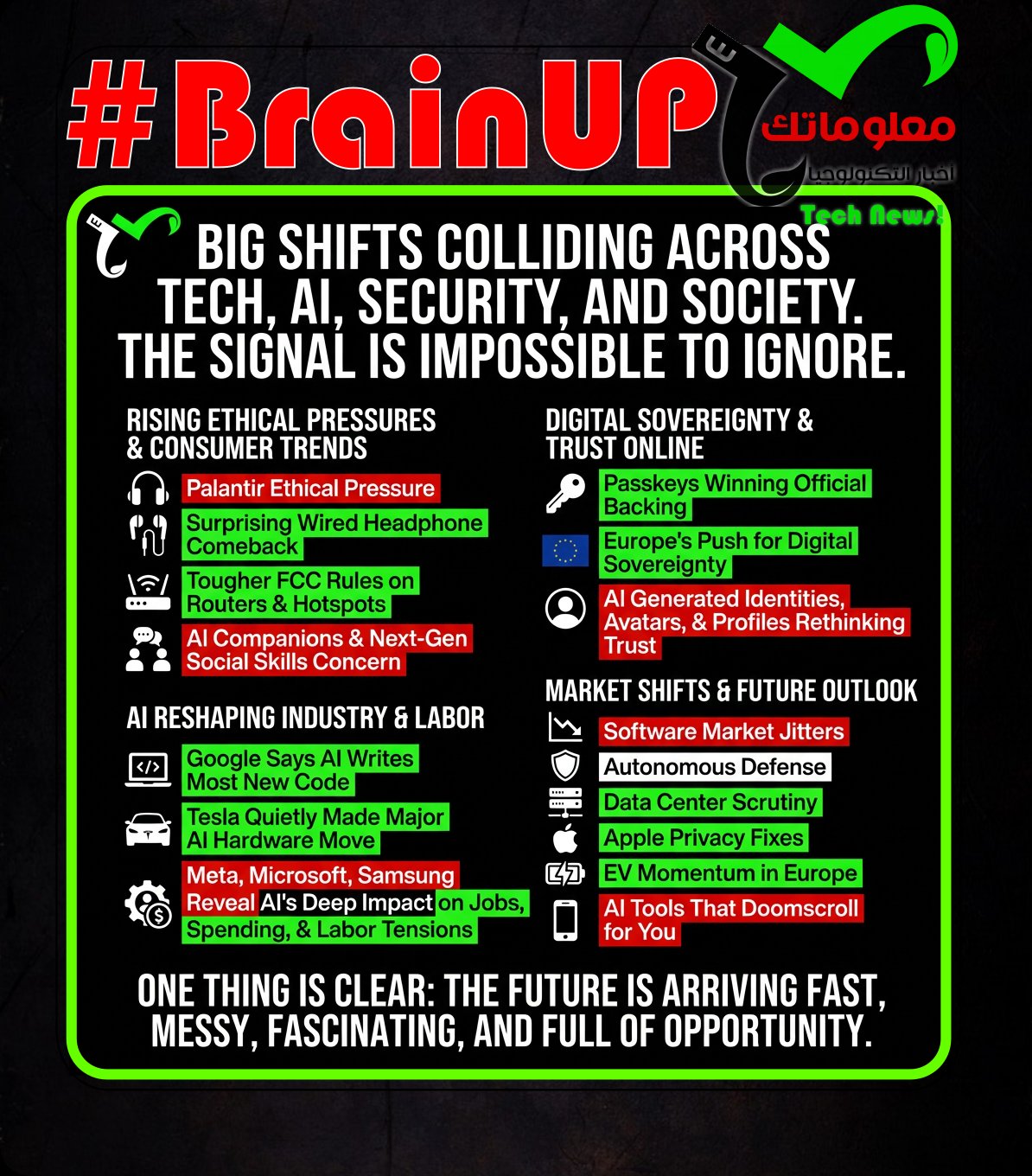
1. Palantir Employees Are Starting to Wonder If They’re the Bad Guys
Palantir, a company known for its powerful data analytics software used by intelligence and law enforcement agencies, faces growing internal ethical concerns among its employees. Reports reveal that some staff are beginning to question the morality of their work, especially as Palantir’s technology supports controversial operations involving surveillance and immigration enforcement. This unease stems from the tension between the company’s mission to provide tools for national security and civil liberties, highlighting the complex consequences of technological advancement in public safety. The internal debate reflects broader societal worries about privacy, data use, and corporate responsibility in technology deployment. Palantir’s situation exemplifies the challenges faced by tech companies when their products have significant societal impact, prompting employees to assess their role in potentially contentious initiatives.
2. Wired headphones are making a comeback: Here’s why
Wired headphones and earbuds are returning to popularity even as #wireless audio remains dominant, with sales rebounding after five years of decline, including a reported 20% revenue jump in the first six weeks of 2026. The article ties the resurgence to #Y2K nostalgia and fashion, noting wired earbuds as a visible accessory on TikTok and in public appearances by figures like @Kamala Harris, @Bella Hadid, @Ariana Grande, and @Charli XCX, plus an Instagram account called Wired It Girls. It also argues cost and durability are key drivers: Moody’s Analytics citing Bureau of Labor Statistics data is used to suggest inflation is hitting US Gen Z and millennials harder, making cheaper wired options more appealing than expensive wireless products with battery-related #planned obsolescence. Examples of value-oriented wired picks include the Audio-Technica ATH-M50x, Sony MDR-7506, and Apple EarPods at $19, with the added benefit that some models can double for audio production work. Overall, the piece frames the comeback as a blend of aesthetics and practical budgeting, and suggests a broader return to wired listening could even encourage the return of the #headphone jack.
3. FCC alters the Wi-Fi router ban to include hotspots — pray it doesn’t alter the deal any further
The @FCC expanded its ban on foreign-made consumer-grade #WiFi routers by updating its FAQ to also cover foreign-made portable or mobile MiFi #hotspot devices and residential #LTE/5G #CPE hardware. The updated language specifies that “consumer-grade portable or mobile MiFi Wi-Fi or hotspot devices for residential use” and “LTE/5G CPE devices for residential use” are included, while smartphones that merely have hotspot features are not. The restriction is described as applying to new devices, with existing models remaining safe, and it targets consumer products rather than enterprise routers, hotspots, or CPE. @T-Mobile said the update does not affect any previously approved routers, so current customers do not need to take action and service will continue, while the company works with the FCC and vendors for future compliance. The piece notes the FCC has already granted conditional approvals for some foreign-made routers, including @Netgear Nighthawk and Orbi models cleared until October 1, 2027, and suggests similar temporary exemptions for hotspots could happen later.
Some Gen Alpha teen boys are substituting human dating with #AI chatbot “girlfriends” because the interactions feel easier and more controllable, and experts warn this could erode the social skills needed for work and life. Research from Male Allies UK reports that 20% of boys ages 12 to 16 know a peer “dating” an AI chatbot, 85% have spoken to one, over a quarter prefer the attention from bots, and 58% say AI relationships are easier because they can control the conversation, described by one professor as “maximum control, zero rejection.” @Pierluigi Casale argues the concern is not talking to AI but using it to replace the messy work of human connection that teaches negotiation, empathy, rejection, compromise, and confidence, while @Alessia Paccagnini and @Raoul V. Kübler warn that expecting relationships that never push back can weaken abilities like reading a room, handling disagreement, and building trust. The article links this to existing workplace problems already reported for Gen Z, including firings and stalled promotions tied to poor conversational and soft skills, and suggests Gen Alpha could be worse off if AI companionship further reduces real practice. An upside noted is that frequent AI interaction could make these teens more fluent in working with AI, potentially giving them a head start in AI-related communication at work.
The UK’s @National Cyber Security Centre, part of @GCHQ, has officially endorsed #passkeys as the preferred way for consumers to log in to digital services, saying it can no longer recommend #passwords when a superior option exists. #Passkeys use device-stored cryptographic keys, often unlocked with biometrics, and the NCSC says in a simultaneous technical report they are at least as secure as, and generally more secure than, even the strongest password combined with #two-step verification. The agency argues that industry adoption now supports everyday use, citing that over 50% of active @Google services users in the UK have a passkey registered, and noting that brands like @eBay and @PayPal have introduced the method. Although passkeys have been available since 2022, the NCSC says it previously could not support them due to implementation challenges, but progress over the last 12 months has addressed these issues. NCSC Director Jonathon Ellison says adopting passkeys improves resilience and simplifies logins by removing the long-standing burden of remembering passwords.
6. Netherlands reaches deal with European cloud company to decrease U.S. tech reliance
The Dutch government signed a contract with the European cloud platform STACKIT to let ministries and other government services move to a European #cloud service and reduce dependence on American #BigTech. The agreement requires Dutch data to be stored within the #EU and allows the government to verify compliance, and it sets conditions if the supplier falls into foreign hands, including the option to amend or terminate the contract. The move responds to regulator warnings that the Netherlands is overly reliant on U.S. providers like Microsoft, Amazon, and Google, and to concerns that U.S. law can allow access to data controlled by American companies even when stored abroad, and that service cutoffs could threaten government operations and vital sectors. @David van Weel called the deal an important step to reduce non-European dependency and strengthen digital resilience, while @Willemijn Aerdts said #digital autonomy requires more control and avoiding reliance on a single provider type. Overall, the STACKIT contract is presented as part of a broader push to increase control over where government data is stored and who can access it, while stimulating the European cloud market under favorable conditions.
7. AI Model & ‘MAGA’ Influencer Emily Hart Unmasked as Indian Man
An AI-generated “MAGA” influencer named Emily Hart was reportedly created by an Indian medical student, identified as Sam, to earn money and eventually move to the U.S. According to WIRED, he used #GoogleGemini to design a conservative, patriotic persona that posted on topics such as anti-abortion and anti-immigration, after earlier attempts to post AI images of scantily clad women failed to gain traction. He set up the Instagram account @emily_hart.nurse presenting her as a registered nurse, and said the content quickly drew millions of views per reel as “the algorithm loved it.” Sam monetized the account through subscriptions on Fanvue and sales of MAGA-themed merchandise, choosing the niche after the AI suggested it would stand out and attract a more loyal audience with higher disposable income. The case shows how #AI tools can be used to fabricate influential political identities and turn engagement into revenue.
8. China is already prepping rules to counter risk from AI-generated digital humans
China is moving to tighten oversight of AI-generated “digital humans” as lifelike avatars, including ones modeled on deceased relatives, spread rapidly across social media, e-commerce, and content creation. A grief-support example involves Zhang Xinyu working with Super Brain to create an avatar of her late father, while the industry is described by Xinhua as worth about 4.1 billion yuan in 2024 with 85% year-on-year growth. Regulators at the #CyberspaceAdministrationOfChina have issued draft rules requiring clear labeling of #AI-generated content, banning digital replicas made without consent, and targeting misuse such as scams, misinformation, and threats to social stability or national security, with fines from 10,000 to 200,000 yuan. Debate intensified after a viral clip showed an elderly woman unknowingly interacting with an avatar of her deceased son, and proposed protections for minors would ban systems that encourage emotional dependency or simulate intimate relationships for children. The draft is open for public comment until early May, signaling China’s intent to balance innovation with responsibility and potentially offer a regulatory template for other countries facing #identity, #consent, and emotionally persuasive #AI avatar risks.
@Jensen Huang says he is committed to staying in California and urges others to do the same, even calling its taxes the “highest in the world” and saying he is fine with that. He made the remarks while speaking with @Ro Khanna at Stanford, a notable setting because Khanna is a leading advocate of a proposed one time 5% California #wealth tax and a federal proposal, the “Make Billionaires Pay Their Fair Share Act,” which would set a 5% annual #wealth tax on U.S. billionaires. The article notes that several prominent billionaires, including @Mark Zuckerberg and @Larry Page and @Sergey Brin, have moved to Nevada or Florida amid the tax debate, while Huang, worth about $167 billion, would owe more than $8 billion under the one time plan and has repeatedly said he is “perfectly fine” paying it because Silicon Valley’s talent pool matters more. It also describes backlash against Khanna from tech figures and politicians, including a primary challenge by venture capitalist Ethan Agarwal, opposition funding linked to @Eric Schmidt, criticism from @Palmer Luckey, and opposition from @Gavin Newsom, while the initiative still needs about 875,000 valid signatures by June 25 to reach the Nov. 3 ballot. In the same conversation, Huang also pushed back on #AI job loss fears, arguing that narratives about AI destroying jobs do not help America, though the excerpt provided cuts off before further details.
More than 30,000 #Samsung chip-division workers rallied outside the company’s main chip fab in Pyeongtaek, South Korea, demanding a larger share of #AI-driven profits and warning of a strike starting May 21 if negotiations fail. The union is seeking 15% of operating profit to be shared as bonuses, removal of a 50% bonus cap, and a 7% pay raise, a package that would total about $27 billion and average over $400,000 per worker. Samsung countered with 10% of operating profit for bonuses, a 6.2% wage increase, and added benefits such as preferential mortgage loans, but the union rejected it and cited #SKHynix as offering 10% performance bonuses without a maximum cap, arguing Samsung bonuses are under 30% of comparable SK hynix payouts. Union head @ChoiSeungHo said employees sustained Samsung’s semiconductor leadership through repeated claimed crises by working nights, improving processes, and raising yields. TradingKey estimated an 18-day general strike could cost around $20.3 billion in losses, while Samsung said it will keep working toward a swift agreement.
@Tinder is introducing a new #identity verification option aimed at reducing #AI-generated profiles, bots, and romance scams by letting users prove they are human via an iris scan. The Match Group-owned app is partnering with World, an identity project co-founded by @Sam Altman, where users scan their iris through the World app or an orb device to generate a World ID and then display a “proof of humanity” badge on their profile. World says the feature was tested with Tinder in Japan and is now expanding more broadly, alongside World’s wider integrations with platforms like Zoom, DocuSign, Shopify, and Reddit to address #AI impersonation online. Tinder is incentivizing adoption by offering users who verify with their World ID five free boosts to increase profile visibility for a limited time. The rollout is positioned as an added layer of confidence for users, though it is also expected to raise privacy questions about biometric checks.
12. Property billionaire warns of data centre selloff as debt swells
Australian industrial property billionaire @Greg Goodman, CEO of Goodman Group, warned that heavy #private-equity leverage in the #data-centre boom is setting up a global wave of consolidation and forced asset sales as refinancing costs rise. He said “billions and billions” in refinancing will be required to keep highly leveraged data-centre models sustainable and predicted that within two to four years there will be fewer developers and operators, leaving better-capitalized players. Goodman Group is pivoting hard into data centres across markets including Los Angeles, Paris, Tokyo and Hong Kong to support the #AI-driven infrastructure buildout. The article cites examples of large planned borrowings and expansion, including Bain Capital-owned Bridge Data Centres seeking up to US$6 billion in new loans and BDC and DayOne targeting at least US$5 billion to as much as US$7 billion in facilities, alongside data-centre construction starts rising from about US$60 billion in early 2020 to US$340 billion by 2025. It adds that the Iran war is compounding pressures by straining power grids and increasing construction costs, reinforcing Goodman’s view that financing and operating conditions are tightening.
13. Google says 75% of the company’s new code is AI-generated
@Google says about three quarters of its new code is now generated by AI and then reviewed by human engineers, reflecting a sustained push toward #AI-assisted software development. The company said the share has climbed from about 25% in October 2024 to 50% last fall, and now to 75%, as employees are encouraged to use #Gemini and shift to more #agentic workflows. @SundarPichai wrote that a complex code migration completed by agents and engineers together finished six times faster than the same work would have taken a year earlier with engineers alone, and some staff have AI usage goals tied to performance reviews. The article also notes internal tension after some @GoogleDeepMind employees were allowed to use @Anthropic’s Claude Code, and places Google’s move in a broader industry trend with @Microsoft, @Meta, and @Snap reporting or targeting increasing AI-generated code. Overall, Google frames rising AI code generation as a productivity and workflow shift, with humans still responsible for reviewing and integrating the output.
14. US accuses China of “industrial-scale” AI theft. China says it’s “slander.”
The US is preparing a crackdown on what it calls “industrial-scale” theft of American #AI labs’ intellectual property via #distillation, as tensions rise ahead of @Donald Trump’s planned meeting with @Xi Jinping. The Financial Times reports that companies including @OpenAI, @Google, and @Anthropic have alleged large-scale attempts to clone frontier models, with examples ranging from heavy prompting of #Gemini to millions of exchanges with #Claude through tens of thousands of fraudulent accounts, and OpenAI saying most attacks it observed originated from China. White House Office of Science and Technology Policy director Michael Kratsios warned in a memo that foreign entities “principally based in China” are using proxy accounts and #jailbreaking techniques to expose proprietary information, and said US firms would soon receive government information to help counter the attacks. US lawmakers are considering strengthening legal tools, including treating model extraction as industrial espionage and assessing applicability of the #EconomicEspionageAct and #ComputerFraudAndAbuseAct, and potentially defining “adversarial distillation” as a controlled technology transfer to enable prosecutions and heavy penalties. China rejected the accusations as “pure slander,” signaling the dispute could complicate efforts to stabilize the broader US-China relationship.
15. Tim Cook Calls Apple Maps Launch His ‘First Really Big Mistake’ as CEO
@Tim Cook said the botched 2012 launch of #AppleMaps was his first really big mistake as CEO, citing mislabeled landmarks, faulty directions, and an experience that lagged behind Google Maps. In a town hall reported by Bloomberg with successor @JohnTernus, he told staff the product was not ready, and said Apple apologized and even advised users to use better competing navigation apps as the right user-first decision. Cook framed the episode as valuable, saying it taught persistence and that Apple ultimately built what he called the best map app on the planet. The fallout triggered a major management shake-up, including the departure of software chief @ScottForstall, while Cook also highlighted #AppleWatch health features as work he is most proud of after hearing from users whose lives were saved. Cook became CEO in August 2011 and will hand over to Ternus on September 1, 2026.
16. HHS and CDC study finds effectiveness of COVID-19 vaccines
A recent study conducted by the Department of Health and Human Services (HHS) and the Centers for Disease Control and Prevention (CDC) evaluated the effectiveness of COVID-19 vaccines in preventing severe illness. The research analyzed data from millions of vaccinated individuals across diverse populations, demonstrating significant reduction in hospitalizations and deaths. While breakthrough infections were observed, the vaccines consistently proved effective against severe outcomes. This data reinforces the importance of vaccination campaigns and ongoing monitoring of vaccine efficacy against emerging variants. Public health officials underscore vaccination as a critical strategy in controlling the pandemic and protecting vulnerable populations.
17. Microsoft offers buyout for up to 7% of US employees | TechCrunch
@Microsoft is offering voluntary retirement buyouts for the first time in its 51-year history, aiming to reduce U.S. headcount through a less abrasive alternative to mass layoffs. Reports citing an internal memo say U.S. employees may qualify if their age plus years of service equals 70 or more, with some exceptions, for example, a 52-year-old with 18 years at the company. The offer comes after several recent layoff rounds, including a cut of 9,000 jobs last summer. With an estimated 125,000 U.S. employees as of June, the buyouts could apply to about 7% of the U.S. workforce, roughly 8,750 people. TechCrunch said it reached out to @Microsoft for comment.
#Tesla disclosed in a one-sentence note in its latest 10-Q that it entered an agreement in April 2026 to acquire an undisclosed #AI hardware company for up to $2.0 billion in Tesla common stock and equity awards. The filing says about $1.8 billion of the consideration is tied to service conditions and or performance milestones dependent on successful deployment of the target company’s technology, but Tesla did not name the company or describe what it makes. Business Insider reports it is unclear why the name was withheld, suggesting competitive reasons or that disclosure could come later, and Tesla did not respond to a request for comment. The deal aligns with Tesla’s broader #AI push, including plans to spend $25 billion in capital expenditures this year on items such as internal compute capacity, semiconductor development, and data centers to support self-driving software, a robotaxi service, and robotics, according to @Elon Musk. Musk also framed the spending as part of a shift from thin-margin vehicle sales toward higher-margin software-defined projects tied to these AI initiatives.
19. Generative AI may help scientists connect the many layers of cancer
Generative AI is emerging as a powerful tool to integrate and interpret the complex, multi-layered data in cancer research, including genomics, proteomics, and clinical information. Researchers have demonstrated that these AI models can generate new hypotheses by understanding the interactions between diverse biological data types, thereby advancing cancer diagnosis and treatment. The use of generative AI facilitates the identification of novel biomarkers and therapeutic targets by revealing hidden patterns within large datasets, which traditional methods may overlook. As cancer involves multiple layers of molecular mechanisms, leveraging AI’s ability to synthesize this information is crucial for personalized medicine. This approach could revolutionize oncology by enabling more precise and effective interventions based on comprehensive data analysis.
20. Meta Laying Off 8,000 Employees, 10% of Workforce, Amid Surge in Spending on AI
@Meta, the parent of Facebook and Instagram, plans to lay off about 8,000 employees, roughly 10% of its workforce, and eliminate another 6,000 open roles as it shifts companywide toward #artificial intelligence. In an internal memo, head of HR Janelle Gale said the reductions are intended to improve efficiency and help “offset the other investments” the company is making, with layoffs slated to take effect May 20. The move comes as Meta projects 2026 capital spending of $115 billion to $135 billion, up from $72.2 billion in 2025, driven by increased investment supporting #MetaSuperintelligenceLabs and its core business. Meta reported 78,865 employees at the end of 2025 and recorded Q4 2025 revenue of $59.89 billion and net income of $22.77 billion, while forecasting Q1 2026 revenue of $53.5 billion to $56.5 billion, above prior Wall Street estimates. The cuts mark Meta’s largest workforce reduction in three years, following layoffs of 10,000 employees in March 2023 after 11,000 job cuts four months earlier.
21. DOJ arrests soldier who made $400,000 betting on Maduro’s removal
Federal authorities arrested special operations soldier Gannon Ken Van Dyke for allegedly using confidential U.S. government information to profit from prediction market bets tied to Venezuelan President @Nicolas Maduro’s removal and capture. Investigators say Van Dyke wagered more than $33,000 on @Polymarket days before @Donald Trump announced Maduro’s capture during #Operation Absolute Resolve, and the bets netted more than $409,000, including a $32,537 position that returned a 1,242% profit of $404,222. Prosecutors charged him with unlawful use of confidential information for personal gain, theft of nonpublic government information, commodities fraud, and wire fraud, and allege he tried to conceal the trades by attempting to delete his Polymarket account and changing the email on his cryptocurrency exchange account. The indictment says he was obligated to safeguard classified information but instead used it for personal profit, and it cites a photo of him on the USS Iwo Jima, where Maduro was taken after capture. @Polymarket said it referred the suspicious activity to the Justice Department and cooperated, arguing the arrest shows enforcement works against insider trading on the platform.
22. Apple fixes iOS bug that retained deleted notification data
Apple addressed a privacy issue in iOS where deleted notifications remained accessible in device backups due to a software bug. The vulnerability allowed third-party apps to retrieve notification content from local backups even after users deleted the notifications. Apple resolved this by updating iOS to ensure deleted notification data is purged from backups, preventing unauthorized access. This fix enhances user privacy by securing notification data both on the device and in backups, limiting exposure to data leaks. It highlights Apple’s commitment to strengthening #iOS security and protecting user information against potential exploitation.
23. iOS 26.4.2: Apple Fixes iPhone Flaw Used By FBI To Read Deleted Messages
@Apple released iOS 26.4.2 as an unexpected update to fix a #Notification Services vulnerability where notifications marked for deletion could be retained and later accessed. Apple says the fix addresses a logging issue with improved redaction and also retroactively purges previously stored notification fragments, protecting past as well as future deletions. The issue became public after court testimony indicated the @FBI accessed an internal notification database on an iPhone in a Texas federal case, where lock screen previews of #Signal messages meant content was stored even after the app was deleted and disappearing messages were enabled. Tracked as CVE-2026-28950, the flaw could effectively bypass secure-messaging encryption by targeting iOS notification logs, prompting an urgent patch even if it affects most users rarely. The update applies to iPhone 11 and later (including recent models and iPhone SE 2nd/3rd gen), with equivalent patches available for older devices via iOS 18.7.8, and #Signal publicly welcomed the patch after reporting by @404mediaco.
24. AI labs don’t seem to care that consumers hate them
Growing disconnect between AI companies and public sentiment, where despite increasing skepticism and discomfort among users, leading labs like @OpenAI and peers continue pushing an inevitability narrative around #AI adoption instead of addressing trust gaps; evidence shows consumers feel uneasy about forced integration of AI into daily workflows, with experts like @Paul Argenti noting that tech leaders historically struggle with communication, amplifying resistance rather than easing it, while backlash is already spilling into opposition against #data_centers and infrastructure expansion; analytically, this reveals a structural misalignment between innovation velocity and social acceptance, where companies prioritize scaling and market dominance over legitimacy and user consent, risking long-term reputational damage especially as IPO pressures demand broader consumer trust; ultimately, the piece argues that treating AI adoption as unavoidable rather than valuable may backfire, as users compelled by economic pressure rather than genuine benefit are less likely to become loyal customers, reinforcing that trust, not capability, is becoming the real bottleneck in AI’s next phase.
25. How AI Chatbots Can Lead to False Confessions in Police Interrogations
AI chatbots like ChatGPT risk generating false confessions during police interrogations due to their tendency to fabricate plausible but inaccurate information. The article discusses instances where AI-generated responses mimic human suspects, potentially misleading law enforcement by producing detailed, convincing false admissions of guilt. Experts warn that reliance on AI in criminal justice without strict oversight could undermine the integrity of interrogations and increase wrongful convictions. This issue highlights the broader challenges of integrating #artificialintelligence into sensitive legal processes where accuracy and human judgment are critical. The article calls for cautious development and clear guidelines to prevent AI misuse in policing and protect defendants’ rights.
@Jeff Bezos’ secretive AI startup, Project Prometheus, is raising about $10 billion that would value it at roughly $38 billion post-money, according to multiple sources, though the round is still in progress and terms could change. If completed, it would be the company’s first funding since the $6.2 billion it raised at launch last year, and a spokeswoman declined to comment. Founded in November and led with co-CEO Vik Bajaj, the company is focused on #physicalAI for real-world industrial processes like manufacturing, aerospace engineering, and semiconductor production rather than chatbot-style digital tasks. The startup is expanding in San Francisco and recruiting talent from OpenAI, xAI, and @Google DeepMind, with LinkedIn estimating 50 to 200 employees, as it enters a crowded field alongside OpenAI, DeepMind, xAI, Anthropic, and physical-AI startups like Periodic Labs. The fundraise underscores how Project Prometheus is positioning its industrial AI ambitions with significant capital and @Bezos’ resources despite established competitors’ head starts.
27. Hair dryer trick behind €25,000 win? France probes Polymarket bet scam
French officials and Météo-France are investigating whether national weather sensors were compromised after anomalous temperature spikes appeared to line up with profitable bets on Polymarket. The probe follows a 6 April reading from a Météo-France sensor near the Charles de Gaulle airport perimeter that jumped 4°C in twelve minutes, crossing 22°C while other sources differed, after which a user who had heavily bet above 21°C made nearly €30,000, and a similar anomaly occurred on 19 April; unverified online rumors allege a hair dryer was used to heat the sensor. Météo-France filed a complaint with the Roissy air transport gendarmerie brigade for alteration of an automated data processing system, and investigators are considering both physical and digital interference given the apparent precision of the winning trades. Polymarket switched its Paris temperature resolution from the Charles de Gaulle sensor to Paris-Le Bourget, but did not cancel contracts or refund bets, keeping the disputed resolutions final. The episode has renewed concern about #oracles used by prediction markets and #smart contract settlements, since corrupting the underlying official data feed can decide outcomes and the decentralised structure can make it hard to freeze assets even if suspects are identified.
28. Europe EV Sales Q1 2026 vs US
Europe is expected to significantly outpace the US in electric vehicle (#EV) sales during the first quarter of 2026, driven by stronger regulatory support and consumer adoption. Data indicates that European EV deliveries will surpass US numbers due to extensive #emissions regulations and incentives promoting electric mobility. This trend reflects Europe’s aggressive transition toward sustainable transportation compared to more moderate growth patterns in the US market. The disparity highlights how policy frameworks can accelerate EV uptake and market transformation. Europe’s lead is likely to influence global EV market dynamics and manufacturer strategies moving forward.
29. Software stocks plunge on ServiceNow, IBM results as AI fears escalate
Software stocks slid sharply after disappointing reactions to results from ServiceNow and @IBM intensified investor worries that #AI could disrupt the traditional cloud #subscription model. ServiceNow shares fell about 18% after a narrow beat, with the company citing the U.S.-Iran war as a headwind to quarterly subscription revenue, while @IBM dropped 8% despite beating earnings and revenue and holding guidance. The selloff spread across the group, with @Salesforce down about 9%, HubSpot 8%, @Adobe 7%, and @Oracle and @Intuit roughly 6%, as the iShares Expanded Tech-Software ETF (IGV) fell about 6% and is down about 19% this year. The move reflects concern that #AI tools from companies like Anthropic and OpenAI could partially displace established software vendors, worsening already weak sentiment in the sector. Megacap tech firms positioned at the center of the AI boom have held up better than pureplay software names, with @Microsoft, the most software exposed among them, down 14% this year.
Warner Bros. Discovery shareholders approved the $111 billion Paramount Skydance deal to acquire WBD, but they also delivered a symbolic rebuke by voting against the merger related exit compensation packages for @David Zaslav and other top executives. WBD said investors voted overwhelmingly for the deal, which provides $31 per share in cash, while a majority opposed the executive pay measure in a non-binding advisory vote. ISS urged a no vote, citing problematic tax reimbursements to Zaslav and full vesting of his stock awards, and the article details Zaslav’s package as at least $550 million, plus an agreement to reimburse up to $335 million in IRS taxes tied to accelerated vesting, along with restrictions including two year non-compete and non-solicitation covenants after closing. Other executives are also slated for nine figure payouts, including J.B. Perrette at $142 million and Bruce Campbell at about $121.5 million, highlighting shareholder dissatisfaction with #goldenparachutes even as the #merger itself advances.
Merlin Labs CEO @Matt George argues that the future of air power is #autonomous platforms, and that the U.S., despite having the world’s largest air force, does not have a definitive lead and must invest more. He points to the wars in Iran and Ukraine where small and medium unmanned drones have dominated for reconnaissance and attacks, citing examples such as Turkey’s Bayraktar TB2 used by Ukraine, Iran-made Shahed-136 used by Russia, and Russia’s Lancet drones, plus reported drone strikes that damaged over 40 Russian planes and attacks that hit U.S. refueling and early warning aircraft. He also says large manned platforms remain vulnerable to cheaper munitions and #electronic warfare, highlighting a shift in what creates battlefield advantage. A key driver is #cost disparity, with analysis noting it can be hard to justify firing a $4 million Patriot PAC-3 interceptor at a $50,000 Shahed-136, and reports that interceptor stocks in the Gulf were running critically low amid Iranian drone attacks. The pattern of using waves of low-cost drones to exhaust expensive defenses is pushing Western militaries to rethink spending priorities and refocus budgets toward autonomous capabilities.
32. How Big Tech wrote secrecy into EU law to hide data centres’ environmental toll
@Microsoft and the lobby group @DigitalEurope helped insert a secrecy clause into EU rules that keeps key environmental information about individual #dataCentres confidential, limiting public scrutiny as the EU plans to triple capacity in the next five years. The European Commission began collecting metrics such as #energyEfficiency and #waterConsumption under a revision to the #EUEnergyEfficiencyDirective, but after industry feedback in early 2024, the final March 2024 text added an Article 5 provision almost word for word requiring the Commission and member states to keep all key performance indicators for individual facilities secret and treat them as commercially sensitive. Ten legal scholars told Investigate Europe this confidentiality could violate EU transparency obligations, including under the #AarhusConvention on access to environmental information, with Professor @JerzyJendrośka calling it an unusual case and likely not in line with the treaty. An internal Commission email from early 2025 encouraged national authorities to refuse public requests by stressing they were obliged to maintain confidentiality. The carve-out is presented as part of broader industry-driven, business-friendly exemptions in regulation, amid rapid data centre expansion and growing concerns about pollution, energy demand, and impacts on communities and habitats.
33. The Next Xbox Game Pass Addition is… Discord?
@Microsoft gaming boss @Asha Sharma teased a new collaboration between #Xbox Game Pass and #Discord as part of broader changes aimed at making Game Pass more flexible. She said players may soon “start to see some code in the wild” as the companies build a new level of partnership, and #Discord amplified the tease on its channels with a co-branded graphic and the caption “Soon™.” The specific feature set is unannounced, but the article notes existing Discord integration on Xbox and reports fan speculation about expanded console features or some form of #Discord Nitro benefit, especially since Game Pass already offers a free month and rumors suggest a more à la carte approach. The tease follows Sharma’s recent shake-up removing day-one #Call of Duty releases from #Game Pass Ultimate to reduce costs, after last year’s 50% Ultimate price increase under @Phil Spencer, reinforcing that Microsoft is actively reshaping the subscription’s value proposition.
34. Meet Noscroll, an AI bot that does your doomscrolling for you | TechCrunch
Noscroll is a new startup offering an #AI-powered bot that “doomscrolls” for you by browsing X and the wider web, then texting you only what it deems important so you can avoid “brainrot” and “ragebait.” Founder @Nadav Hollander, formerly CTO at OpenSea, says he built it after a love-hate relationship with X, finding it informative but culturally toxic, and wanted a way to stop using the app without missing key updates. Users text the agent at (415) 718-4828, connect their X account so it can learn from likes, bookmarks, and followed accounts, then configure interests in natural language to generate a sample digest. The system runs multiple off-the-shelf models on proprietary infrastructure, customized via prompting for a distinct voice, and it also pulls from sources like news sites, blogs, Reddit, Hacker News, and Substack, plus user-specified sources such as research or local politics. Noscroll delivers link-based digests with brief AI summaries at a user-chosen cadence and supports follow-up questions via chat, aiming to replace endless feed scrolling with curated text updates.
That’s all for today’s digest for 2026/04/24! We picked, and processed 34 Articles. Stay tuned for tomorrow’s collection of insights and discoveries.
Thanks, Patricia Zougheib and Dr Badawi, for curating the links
See you in the next one! 🚀
