
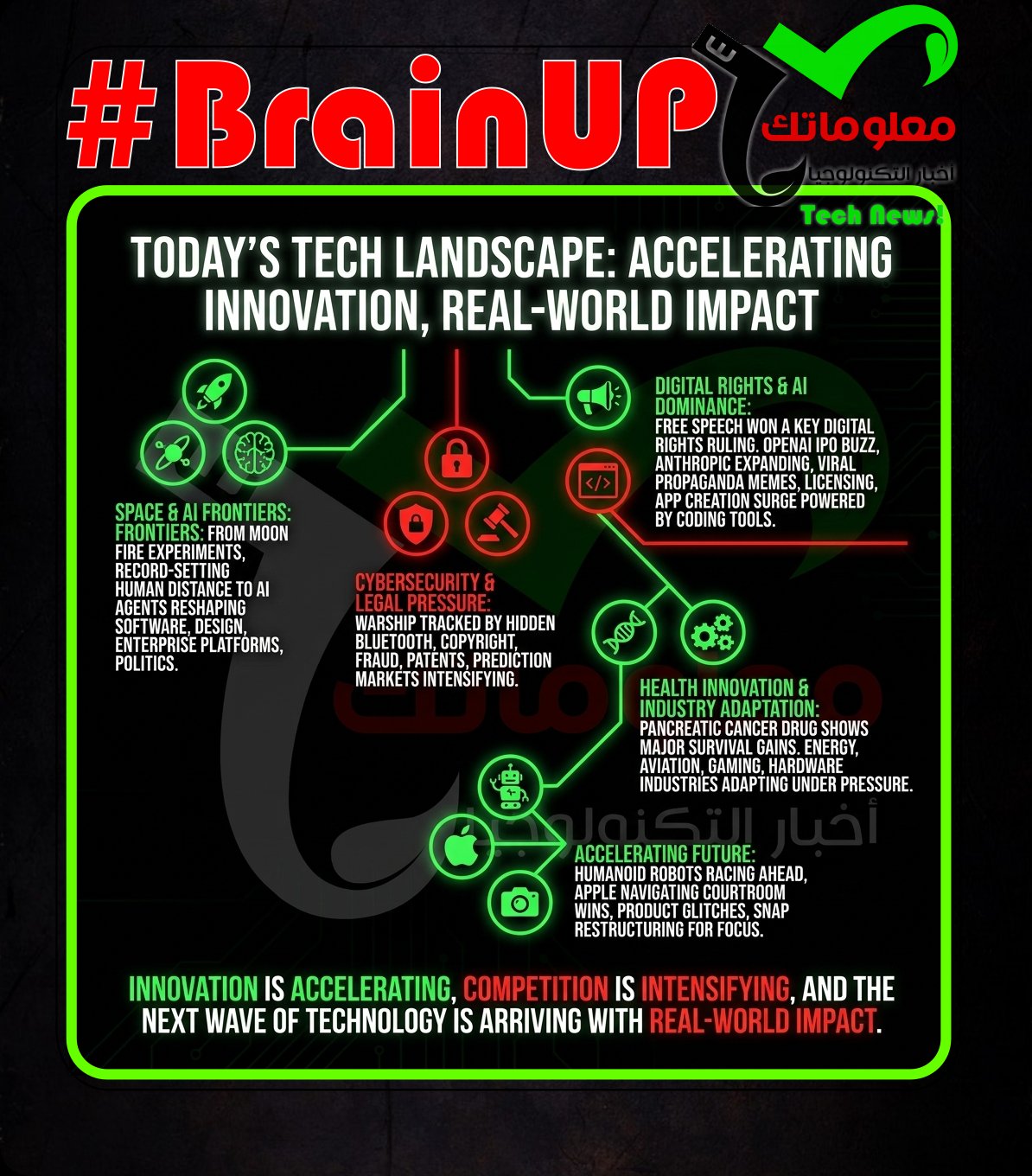
#BrainUp Daily Tech News – (Sunday, April 19ᵗʰ)
Welcome to today’s curated collection of interesting links and insights for 2026/04/19. Our Hand-picked, AI-optimized system has processed and summarized 23 articles from all over the internet to bring you the latest technology news.
As previously aired🔴LIVE on Clubhouse, Chatter Social, Instagram, Twitch, X, YouTube, and TikTok.
Also available as a #Podcast on Apple 📻, Spotify🛜, Anghami, and Amazon🎧 or anywhere else you listen to podcasts.
The Dutch air-defense frigate HNLMS Evertsen inadvertently revealed its position after a Bluetooth tracker was hidden in a postcard and mailed aboard, highlighting a serious #operational-security risk. Following mailing instructions posted online by the Dutch Ministry of Defense, journalist Just Vervaart of Omroep Gelderland placed a tracker in a postcard and was able to track the ship for about a day as it sailed from Heraklion, Crete, and later turned toward Cyprus, while it operated as part of a #NATO carrier strike group centered on the French carrier Charles de Gaulle. The incident showed how inexpensive #Bluetooth trackers, including generic versions similar to an @Apple AirTag, could let an adversary monitor a warship in near real time without needing to approach it, potentially endangering the vessel and the broader fleet. Navy officials said the tracker was found during mail sorting within 24 hours of the ship’s arrival and was disabled, prompting Dutch authorities to ban electronic greeting cards that were not x-rayed like packages. The article notes similar modern-tech lapses, including a French officer’s #Strava activity exposing the Charles de Gaulle’s location and a 2024 case where USS Manchester sailors installed an unauthorized #Starlink terminal and Wi-Fi network dubbed “STINKY” for months.
Shadow library Anna’s Archive has been ordered to pay $322million after a court found it liable for scraping and distributing content from @Spotify. @Spotify and major labels @Universal Music Group, @Warner Music Group, and @Sony Music Entertainment sued after Anna’s Archive announced plans to build a “preservation archive” for music and allegedly scraped “256 million rows of track metadata and 86million audio files” intended for distribution via #BitTorrent and other P2P networks. Judge Jed S. Rakoff issued a default judgment because Anna’s Archive did not respond to the complaint, and ruled against it for direct copyright infringement, breach of contract, and violating the #DMCA, also citing a “blatant disregard” of court orders after torrents were released despite a preliminary injunction. Damages are expected to include over $7million to the labels and $300million to @Spotify, though collection is uncertain because the operators are anonymous. The judge also ordered internet service providers to disable access to Anna’s Archive and to prevent other sites from hosting or distributing the scraped files, reinforcing court efforts to curb further dissemination.
3. iLearning AI’s founder indicted on fraud charges
The founder of iLearning AI was indicted on charges of fraud related to misappropriation of funds meant for educational technology development. Authorities allege the individual diverted money intended to advance AI-driven learning tools into personal accounts, undermining trust in innovative #EdTech ventures. This case highlights increased scrutiny over financial transparency and governance in startups leveraging #ArtificialIntelligence for educational purposes. The indictment serves as a cautionary example of the risks tied to rapid expansion in AI-based education while emphasizing the necessity for closer regulatory oversight. It underscores the importance of ethical leadership to maintain credibility and investment in emerging educational technologies.
4. Court rules ICE monitoring app takedowns violated First Amendment
A federal court ruled that the removal of apps tracking #ICE activities from digital platforms violated the First Amendment rights of developers and users. The ruling emphasized that government agencies cannot compel private platforms to suppress speech based on its content, highlighting concerns about censorship in digital spaces. This decision underlines the constitutional protections applicable to online speech about #government actions, ensuring transparency and public discourse are maintained. By restricting the takedowns, the ruling protects developers’ rights to share information and the public’s right to receive it, reinforcing that digital platforms must balance content moderation with free speech rights. The case sets a precedent for how #digital rights and constitutional freedoms intersect in the evolving online ecosystem.
5. NASA Plans to Start a Fire on the Moon in First-of-Its-Kind Experiment
NASA is preparing a first-of-its-kind lunar combustion study to improve astronaut safety ahead of upcoming #Artemis missions by directly measuring how fire behaves under the Moon’s partial gravity. In a report presented at the Lunar and Planetary Science Conference, NASA researchers described the Flammability of Materials on the Moon (#FM2) mission, planned for late 2026, which will ignite four solid fuel samples and record flame characteristics over an extended period in lunar gravity. The work builds on decades of space combustion research and existing material screening such as #NASA-STD-6001B, but addresses a key gap: microgravity flames behave differently than on Earth, and researchers currently only have rough estimates of how that knowledge carries over to the Moon. The team notes that, based on current numerical and experimental evidence, lunar gravity could be more hazardous in some partial-gravity environments because flame spread rate depends on gravity peaks, with implications for spacecraft materials and spacesuit design. Because full material qualification on the lunar surface will require an extended human presence, #FM2 is positioned as an early step that can make Artemis crews safer while enabling more definitive testing as lunar operations expand.
6. Iran’s AI memes are reaching people who don’t follow the news – and winning the propaganda war
Iran-linked social media accounts are using #AI-generated meme videos to spread propaganda globally by blending politics with entertainment in ways that outperform traditional news. Since late February, pro-Iranian outlets, especially Explosive Media on X, have circulated Lego-style animated rap clips mocking @Donald Trump, @Benjamin Netanyahu and US foreign policy, amassing billions of views, and a spokesperson has told the BBC the Iranian government is a client. Although the content can include disinformation and antisemitic tropes, it avoids the look and feel of official messaging, instead copying familiar internet aesthetics to maximize virality, a tactic dubbed “slopaganda.” The strategy targets “politically uninvested” users who do not seek news, using humour as a Trojan horse so geopolitical narratives about American overreach, dysfunction and corruption reach people via their feeds before they register it as politics, with algorithms amplifying the joke as the delivery system. The article links this receptiveness to two decades of audiences being primed to process politics through satire from figures like @Jon Stewart and other late-night hosts, which made humour feel like a more trusted and emotionally engaging form of political information than conventional journalism.
7. OpenAI’s ChatGPT Success Spurs Talk of IPO
OpenAI’s rapid success with its AI chatbot ChatGPT is fueling discussions about an initial public offering to capitalize on growing investor interest. The company, led by CEO @SamAltman, has drawn significant attention as ChatGPT transformed AI from a niche technology into a mainstream product used by millions. OpenAI’s innovative approach to AI development and commercialization has positioned it as a leader in the industry, attracting high-profile investors and partnerships. Despite the enthusiasm, the company faces challenges including regulatory scrutiny and competition as it contemplates going public. Overall, OpenAI’s potential IPO reflects broader market trends where #AI breakthroughs prompt strategic financial moves to scale and influence the technology sector.
8. Experimental drug doubles one-year survival in pancreatic cancer
An experimental drug called elraglusib improved outcomes for people with advanced pancreatic cancer by making tumors more susceptible to #chemotherapy and immune attack. Elraglusib targets the dense, fibrous #tumor microenvironment by suppressing #GSK-3 beta, a protein linked in prior lab studies to cancer cell survival via nuclear factor κB and to tumor resistance to the immune system. In a trial of 286 recently diagnosed patients, most with metastatic disease, participants received chemotherapy with or without elraglusib, and the results were reported as showing the drug’s safety and efficacy in @Nature Medicine. The study reports that one-year survival doubled with the elraglusib combination, and median survival in the combination group was 10.1 months. These findings suggest a potential new approach beyond longstanding standard chemotherapy options for a cancer that is often detected late and is difficult to treat.
9. AI agents may need to buy their own software licenses, raising legal and ethical questions
AI agents designed to operate autonomously will need to obtain their own software licenses, which introduces complex legal and ethical challenges. This stems from AI’s ability to perform tasks independently and interact with software, blurring the lines of traditional licensing agreements intended for human users. As autonomous AI agents continue to evolve, developers and legal experts must reconsider existing frameworks that govern software usage, ownership rights, and liability issues. This shift highlights the critical need for updated policies and regulations to address the unique demands of AI-controlled systems in commercial and personal applications, ensuring compliance and accountability. The emerging requirement for AI agents to manage their software licenses signals a transformative step in how technology and intellectual property law intersect in the digital age.
10. China begins building US$1 billion hydropower station in Cambodia
China has begun construction of a US$1 billion Chinese-invested #pumped-storage #hydropower station in Cambodia as the country seeks more #renewable energy amid fuel supply and price pressures linked to the Iran war. Work on the Upper Tatay project in Koh Kong province started on April 10, according to Xinhua, which called it a future “green power bank” for the national grid and described it as a “large-scale rechargeable battery system” with 1 gigawatt of installed capacity, expected to be completed by 2029. Jayant Menon of the ISEAS – Yusof Ishak Institute said the investment is large for Cambodia’s small economy and comes as developing countries such as Cambodia worry about imported fuel availability due to Middle East bottlenecks and limited domestic refining. Xinhua said Chinese-built power plants helped raise Cambodia’s household electricity access rate from about 50% in 2010 to about 96%, and said the new station would support stable integration of intermittent #solar and #wind power. The project, being developed by state-owned China National Heavy Machinery Corporation, adds to broader Chinese investment in Cambodia’s infrastructure, including the Phnom Penh–Sihanoukville Expressway and a recently opened airport near Phnom Penh.
11. Appfigures: Global app releases jumped 60% this year, iOS 80%
New app launches are surging globally, suggesting #AI is boosting app creation rather than replacing it. Appfigures reports global app releases are up 60% this year, with iOS releases up 80%, and April saw more than double the number of new apps on both Apple’s App Store and Google Play compared to last year. The spike is led by games, productivity, lifestyle, and health categories, and is helped by easier #AI coding tools like Replit and Claude Code that lower the barrier to building and shipping apps. This rapid growth also increases safety and quality risks as more questionable apps appear. In response, Apple is removing shady or scammy apps, including Freecash, to maintain store quality amid the flood of new releases.
12. Microsoft Expands Xbox Mode to Windows Laptops, PCs, and Tablets
Microsoft is expanding the Xbox mode feature to a wider range of Windows devices, including laptops, PCs, and tablets, enhancing the gaming experience across platforms. This expansion allows users to easily switch to a gaming-focused mode that optimizes system resources and performance specifically for gaming. By integrating Xbox mode more broadly, Microsoft aims to streamline the gaming setup process and improve gameplay smoothness on compatible devices. This initiative aligns with Microsoft’s strategy to unify gaming experiences on Windows and Xbox hardware, providing a seamless transition for gamers across devices. The wider accessibility of Xbox mode underscores the company’s commitment to strengthening the Xbox ecosystem and boosting PC gaming popularity.
13. Memory card and flash drive prices surge up to 123% amid ongoing shortage
A dramatic spike in #FlashMemory pricing is reshaping the consumer storage market, with memory cards and USB drives seeing average price increases of around 123% year-over-year and extreme cases exceeding 260%, driven primarily by a global shortage of NAND chips as manufacturers prioritize high-margin components for #AI data centers over consumer-grade products; the same production lines supply both enterprise SSDs and everyday storage devices, but with hyperscalers willing to pay a premium, suppliers are reallocating capacity toward higher-quality chips, leaving lower-tier supply constrained and more expensive ; this shift has also pushed brands to focus on premium offerings rather than budget options, effectively reversing the long-standing trend of declining storage costs and creating a market where even basic flash products are becoming significantly less accessible; while the surge is expected to normalize eventually, forecasts suggest elevated prices could persist into 2027 as #AI infrastructure demand continues to dominate global semiconductor supply chains, marking a structural, not cyclical, transformation in how memory resources are allocated.
14. Jet fuel costs are reshaping the airline industry landscape
Jet fuel prices have surged, causing significant financial pressure across the airline industry. Major carriers like @SpiritAirlines, United, American, and Delta are adjusting their operational strategies to cope with soaring fuel expenses. This includes altering flight routes, increasing ticket prices, and delaying fleet expansions to maintain profitability. The rising fuel costs highlight the importance of fuel-efficient technologies and could accelerate airlines’ investments in sustainable aviation fuels. Overall, the escalation in jet fuel prices is prompting airlines to rethink their business models amid evolving economic and environmental challenges.
15. Apple update turns Czech mate for locked-out iPhone user
A US university student was locked out of his iPhone after updating iOS because the lock-screen Czech keyboard no longer inputs the háček (caron) character used in his #alphanumeric passcode. Connor Byrne, 21, updated an iPhone 13 from iOS 18 to iOS 26.4 on April 5 and has been unable to enter the passcode since, and the subsequent iOS 26.4.1 update did not fix it; @Apple support said restoring the phone is the only way back in, which would erase unbacked-up photos he values. The Register’s testing found the háček still exists on the Czech keyboard after upgrading, but iOS now blocks it specifically when entering a custom alphanumeric passcode on the lock screen: the key animates and makes a sound but no character is entered, and the lock-screen key position is replaced by a second acute accent mark. The incident shows how a keyboard or input-change in #iOS can effectively lock users out when special characters are used in passcodes, leaving data inaccessible without a wipe. Byrne is using a cheap Android phone while hoping a future iOS update restores háček entry on the lock screen, though the article notes others have hit the same issue and it has not been reintroduced since iOS 18.
16. Artemis 2 and Tiangong space station astronauts set record for farthest distance between humans
On April 6, the four @Artemis 2 astronauts aboard NASA’s Orion capsule “Integrity” and the three crewmates on China’s Tiangong space station briefly set a new record for the farthest distance between any humans. Astrophysicist and satellite tracker @Jonathan McDowell calculated that as Integrity flew around the moon’s far side, it reached a maximum separation of 260,754 miles (419,643 kilometers) from Tiangong, slightly exceeding the maximum Integrity-to-#ISS distance of 260,715.5 miles (419,581 km). McDowell said he began the calculations after NASA announced a distance-from-Earth record and he wondered whether the ISS, or another crewed outpost, might be even farther from the Artemis 2 crew, and he noted NASA’s Johnson Space Center may want to verify the work. The previous relevant benchmark dated to April 1970’s near-disastrous @Apollo 13 mission, when no space stations were in orbit, meaning today’s record is extended by a few hundred miles due to simultaneous human presence in lunar space and in Earth orbit. McDowell argued the broader importance is a shift from tracking how far people are from Earth to measuring how widely humans are distributed, with potential future spans across much larger parts of the solar system.
17. Salesforce launches Headless 360 to turn its entire platform into infrastructure for AI agents
Salesforce introduced #Headless360 at its TDX developer conference, aiming to turn its entire CRM platform into infrastructure that #AIagents can operate without a browser by exposing every capability as an API, #MCP tools, or #CLI commands. The launch includes more than 100 new tools and skills available immediately, including 60+ #ModelContextProtocol tools and 30+ preconfigured coding skills that let external coding agents like Claude Code, Cursor, Codex, and Windsurf access a customer’s Salesforce org, data, workflows, and business logic. Salesforce also updated Agentforce Vibes 2.0 with an “open agent harness” supporting both the @Anthropic agent SDK and the @OpenAI agents SDK, plus multi-model support including Claude Sonnet and GPT-5 and “full org awareness” from the start. Executives framed the shift as a response to customers’ real-world challenges building and deploying agentic systems across stacks, and as a strategic answer to market fears that LLMs could make traditional SaaS interfaces and business models obsolete. By unbundling platform capabilities from the UI and adding native #React support alongside these agent integrations, Salesforce is positioning its platform as programmable, agent-accessible infrastructure rather than primarily a graphical CRM.
18. Anthropic’s relationship with the Trump administration seems to be thawing | TechCrunch
Despite the Pentagon labeling Anthropic a #supply-chain risk, the company appears to be maintaining and expanding engagement with senior figures in the @Trump administration. Reports cited Treasury Secretary @Scott Bessent and Federal Reserve Chair @Jerome Powell encouraging major banks to test Anthropic’s new #Mythos model, and Axios reported a meeting between @Bessent, White House Chief of Staff @Susie Wiles, and Anthropic CEO @Dario Amodei that the White House called “productive and constructive.” Anthropic co-founder @Jack Clark characterized the fight over the designation as a “narrow contracting dispute” and said it would not affect the company’s willingness to brief the government on its latest models, while Anthropic said discussions covered collaboration on #cybersecurity, U.S. leadership in the #AI race, and #AI safety. The conflict with the Pentagon reportedly stems from failed negotiations over military use, with Anthropic seeking safeguards against use for fully autonomous weapons and mass domestic surveillance, and the company is challenging the designation in court. The reporting suggests the Pentagon’s stance is an outlier, with an administration source claiming “every agency” except the Department of Defense wants to use Anthropic’s technology.
19. Apple avoids a second import ban for its redesigned smartwatches in latest court ruling
The US International Trade Commission ruled against reinstating an import ban on @Apple Watch models redesigned with reworked #blood-oxygen monitoring technology, letting @Apple keep selling the updated devices. The ITC terminated the case and relied on a March preliminary finding by an ITC judge that the redesigned smartwatches do not infringe patents held by @Masimo, after Masimo sought a second ban following an earlier ITC decision that found Apple violated Masimo’s patents and prompted Apple to redesign the feature in certain models. Apple said most of Masimo’s claims have been rejected, while Masimo can still appeal this latest ITC decision to the US Court of Appeals for the Federal Circuit. Despite this outcome, Masimo continues separate legal efforts, including a November federal jury verdict ordering Apple to pay $634 million in another patent infringement case. The ruling narrows the dispute over the updated watches, but leaves open further litigation and a possible appeal.
20. From Iran to Taylor Swift: Informed Trading in Prediction Markets
The article argues that #prediction-markets, particularly Polymarket, are creating a new frontier for #insider-trading that strains traditional legal and regulatory frameworks for trading on nonpublic information. It highlights multiple episodes where traders appeared to profit from advance knowledge, including six newly created wallets earning about $1.2 million on the “US strikes Iran by February 28?” contract, a wallet named “Magamyman” earning about $553,000 after trading shortly before the strike became public, and other examples involving Nicolás Maduro, alleged use of classified wartime information, Google’s Year in Search rankings, OpenAI’s browser launch, and @Taylor Swift’s engagement announcement. To test whether these are isolated anecdotes or a pattern, the authors report a systematic statistical screen of all Polymarket markets from Feb 2024 to Feb 2026, covering over 93,000 markets and nearly 50,000 wallet addresses, using a composite score based on bet size, profitability, timing, and directional concentration at the wallet market pair level. The screen flags 210,718 suspicious wallet-market pairs with a 69.9% win rate, more than 60 standard deviations above chance under a permutation test, and estimates about $143 million in anomalous profits over the period, described as a likely lower bound due to methodological limits. These findings are presented as evidence of a systematic #informed-trading problem in prediction markets that requires rethinking how existing rules about inside information apply outside traditional stocks, bonds, and futures.
21. Humanoid robots show rapid advances as they race past humans in Beijing half-marathon
Chinese-made #humanoid-robots showed rapid gains in athletic performance at the Beijing E-Town half-marathon, in contrast to last year’s error-filled debut when many struggled to start or finish. Participation rose from about 20 robots to more than 100, with robots and humans placed on parallel tracks to avoid collisions and several robot contenders reportedly running faster than pro athletes in the human race. The winning robot, developed by Honor, finished in 50:26, a time the article says was faster than @Jacob Kiplimo’s recent world record, though it fell near the finish and needed assistance after hitting a railing. While economically valuable uses are still in a trial phase, the event is presented as a public demonstration of physical capability that could translate to dangerous work and battlefield roles. The showcase is framed within China’s broader push to lead this frontier industry through subsidies and infrastructure, also highlighted by a CCTV Spring Festival gala performance featuring Unitree robots in martial arts routines.
22. Anthropic launches Claude Design, a new product for creating quick visuals | TechCrunch
Anthropic is launching Claude Design, an experimental product that uses #Claude to quickly generate visuals such as prototypes, slides, and one-pagers for people like founders and product managers who lack design training. Users describe what they want, receive an initial output, and then refine it with direct edits or follow-up requests, for example adjusting typography, colors, or adding features like a dark mode toggle. Anthropic says Claude Design is meant to complement, not replace, Canva by helping teams move from an idea to a visual starting point, with exports to PDF, URL, PPTX, or directly into Canva where assets remain editable and collaborative. The tool can apply a company’s design system across projects by reading the company’s codebase and design files, and teams can maintain multiple design systems for consistency. Powered by #Claude Opus 4.7, Claude Design is in research preview for Claude Pro, Max, Team, and Enterprise subscribers, underscoring Anthropic’s push into enterprise and prosumer #AI workplace tools alongside earlier releases like Claude Cowork and its agentic plug-ins.
23. Snap to lay off about 16% of staff
Snap Inc. has announced a plan to lay off about 16% of its workforce as part of cost-cutting measures to focus on efficiency and growth. CEO Evan Spiegel explained that this reduction will help refocus resources on core business areas and accelerate innovation amidst challenging economic conditions. The company aims to maintain its commitment to developing new augmented reality features and advertising products by reallocating investments. This strategic move reflects Snap’s intent to streamline operations while continuing to enhance user experience and profitability. The layoff decision aligns with broader trends among tech firms adapting to a more cautious market environment.
That’s all for today’s digest for 2026/04/19! We picked, and processed 23 Articles. Stay tuned for tomorrow’s collection of insights and discoveries.
Thanks, Patricia Zougheib and Dr Badawi, for curating the links
See you in the next one! 🚀
