
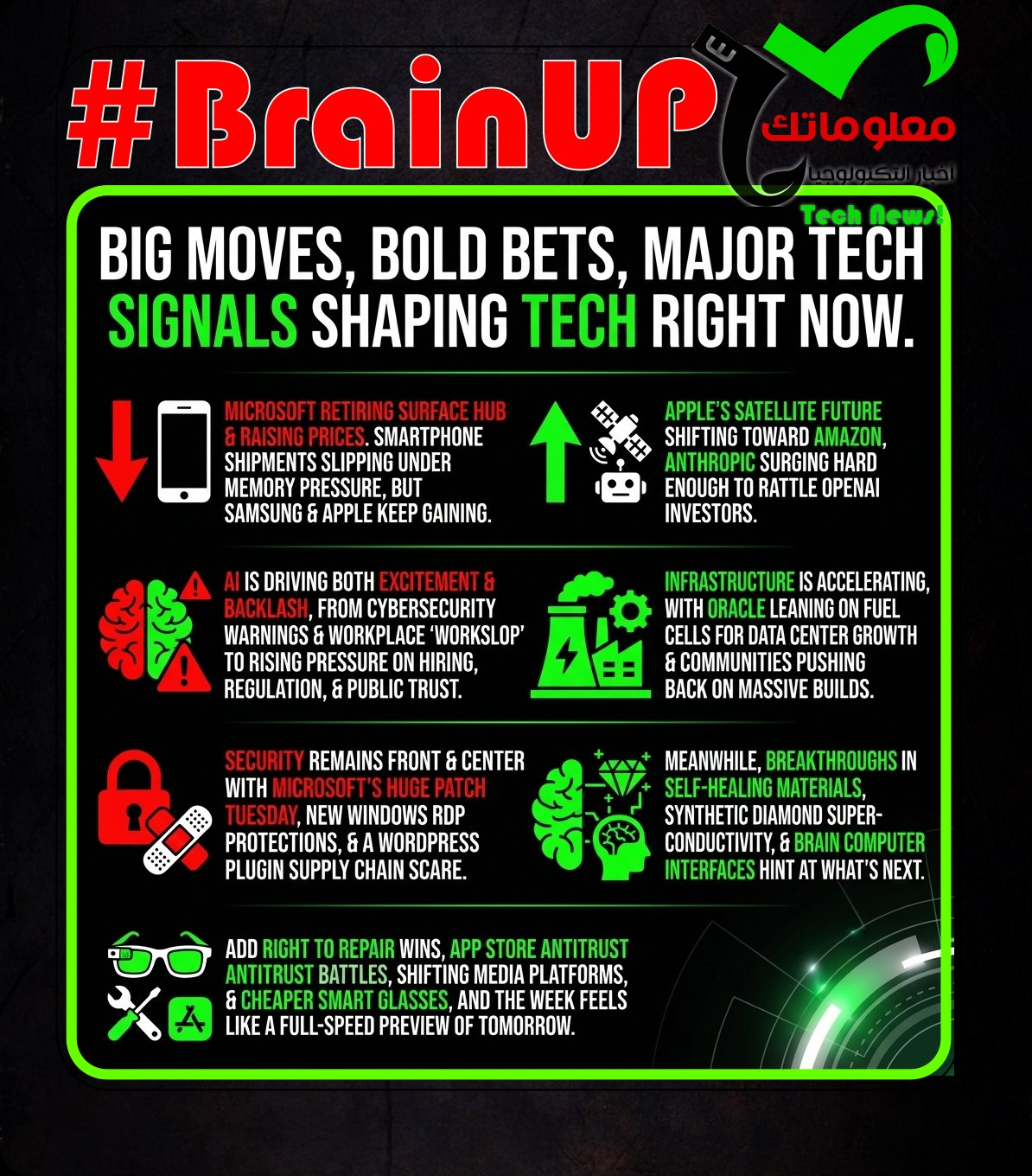
#BrainUp Daily Tech News – (Wednesday, April 15ᵗʰ)
Welcome to today’s curated collection of interesting links and insights for 2026/04/15. Our Hand-picked, AI-optimized system has processed and summarized 32 articles from all over the internet to bring you the latest technology news.
As previously aired🔴LIVE on Clubhouse, Chatter Social, Instagram, Twitch, X, YouTube, and TikTok.
Also available as a #Podcast on Apple 📻, Spotify🛜, Anghami, and Amazon🎧 or anywhere else you listen to podcasts.
1. Microsoft’s finally giving up on its massive Surface Hub touchscreen displays
@Microsoft is reportedly ending production of its Surface Hub 3 collaborative office display and canceling plans for a Surface Hub 4, making the 2023 Surface Hub 3 the last of its 50- and 85-inch touchscreen whiteboard-style displays. According to Windows Central, the Surface Hub began as a built-in PC digital whiteboard announced in 2015 ahead of #Windows 10, with models priced at $8,000 and $20,000. Over roughly a decade, the line received updates including a modular design that let customers replace internal components like the processor and motherboard, but its expensive role as a centerpiece for the “office of the future” never fully materialized, especially as the pandemic accelerated remote and hybrid work. Microsoft and third-party sellers will keep selling remaining Surface Hub 3 inventory, and the Surface Hub 2S and Hub 3 are slated to receive driver and firmware updates until at least 2027, signaling a wind-down rather than an immediate cutoff.
Global smartphone shipments fell 4.1% year over year to 289.7 million units in 1Q26, ending a 10-quarter growth streak, as #memory supply constraints and record high memory prices pressured OEMs to cut shipments and raise prices. @IDC cites limited memory availability, rising bill-of-materials costs, and price hikes that reached 40% to 50% in some emerging markets, prompting tighter cost controls, reduced marketing and channel support, and despecing strategies that also cap growth. The firm expects the Q1 slowdown to be a mild precursor to further weakness in 2026 as component inflation and supply limits continue, compounded by higher energy and logistics costs tied to the recent war in the Middle East. Within the top five vendors, only @Samsung and @Apple posted year-over-year growth, benefiting from premium focus and stronger leverage with memory suppliers, while Xiaomi, OPPO, and vivo largely held positions with marginal share losses. Samsung retook the top spot on demand for the Galaxy S26 Ultra and earlier A-Series timing, while Apple ranked second as the iPhone 17 series grew strongly in China, though supply disruptions and reduced channel support restrained results.
3. Apple chooses Amazon satellites for iPhone, years after rejecting Starlink offer
@Amazon announced it will buy @Globalstar and separately struck a deal with @Apple that makes Amazon Leo the primary satellite service provider for iPhone and Apple Watch, aiming to expand into the #Direct-to-Device market and better compete with @SpaceX #Starlink. Amazon said the merger will cost about $11.6B and that it will keep supporting existing Globalstar-based satellite features on iPhone 14 and later and Apple Watch Ultra 3, including Emergency SOS, Messages, Find My, Roadside Assistance, and location sharing, while collaborating with Apple on future services using a larger Amazon Leo network. Globalstar shareholders can choose $90 cash per share or 0.3210 Amazon shares capped at $90, with reported deal estimates varying around $10.8B to $11.6B depending on Amazon’s stock price. The companies’ scale lags Starlink, with Amazon reporting 241 satellites deployed and a planned 3,000-plus constellation, while Globalstar has 24 LEO satellites and plans 48 more, compared with Starlink’s 10,000-plus satellites and about 650 D2D satellites used for mobile service via partners like T-Mobile. Amazon said the merger should close in 2027 pending regulatory approval and Globalstar satellite replacement deadlines, positioning Apple’s existing satellite features to continue and potentially expand as Amazon Leo grows.
Resistance to #AI that once showed up as open letters, strikes, and policy warnings is escalating into threats and alleged violence targeting @Sam Altman and OpenAI. A 20-year-old, Daniel Moreno-Gama, allegedly threw an incendiary device at the gate of Altman’s San Francisco home, was arrested soon after outside OpenAI’s headquarters while allegedly trying to break in and threatening to burn the facility, and authorities later found a manifesto warning of humanity’s “extinction” from AI; he faces state charges and potential federal charges including domestic terrorism. After Altman posted a public plea for sanity and shared a family photo on X, two more Gen Z-aged individuals were arrested after gunfire near his home, while online reactions in younger social media spaces often cheered the attacks rather than condemning them. Polling cited in the article portrays broad Gen Z unease, with Gallup reporting that over half use AI regularly but fewer than one-fifth feel hopeful, about a third feel angry, and nearly half feel afraid, which researchers partly tie to a weak job market and widespread underemployment among young graduates. The article links these trends into a picture of a growing anti-AI backlash that is moving from critique of the technology and its leaders toward radicalized hostility directed at prominent figures like Altman.
5. How Iran war is rewarding China’s bet on electric cars, solar power
The ongoing conflict in Iran is accelerating China’s dominance in the electric vehicle and solar power markets by disrupting global energy supplies and pushing demand toward cleaner technologies. China has strategically invested in #electricvehicles and #solarenergy, positioning itself as a major supplier of batteries and solar panels worldwide. As Western countries face energy uncertainties and seek alternatives to fossil fuels, China’s early commitment has allowed it to capitalize on this shift, expanding its influence and economic growth in green technology sectors. This situation highlights how geopolitical tensions can reshape global energy landscapes and reinforce the importance of sustainable energy policies. China’s advantage in electric cars and solar power is thus a direct consequence of its foresight and the broader consequences of the Iran conflict.
6. Anthropic’s rise is giving some OpenAI investors second thoughts | TechCrunch
@Anthropic’s rapid growth is prompting some @OpenAI investors to question whether OpenAI’s $852 billion valuation is justified as the company shifts toward enterprise customers and competes more directly with Anthropic, per the @Financial Times. Anthropic’s annualized revenue reportedly rose from $9 billion at the end of 2025 to $30 billion by the end of March, largely due to demand for its #coding tools, and an investor who backed both companies said OpenAI’s recent round would require assuming an IPO valuation of $1.2 trillion or more, making Anthropic’s $380 billion valuation look comparatively attractive. In the secondary market, demand for Anthropic shares is described as nearly insatiable while OpenAI shares are trading at a discount, reinforcing the idea that investors currently view the two companies’ prospects differently. OpenAI CFO @Sarah Friar countered that OpenAI’s $122 billion raise, described as the largest private fundraising in history, signals continued confidence, though skeptics remain, including @Jai Das of @Sapphire Ventures who likened OpenAI to “the Netscape of #AI.” The piece also notes @Sam Altman’s experience with inflated valuations during his time at #YCombinator, and includes an update that an FT investor quote was removed.
7. Jamie Dimon says Anthropic’s Mythos reveals ‘a lot more vulnerabilities’ for cyberattacks
@Jamie Dimon said #AI is a double-edged sword for #cybersecurity, making firms more vulnerable in the near term even if it may eventually strengthen defenses. He said #JPMorgan Chase is testing @Anthropic’s #Mythos model and that it shows “a lot more vulnerabilities need to be fixed,” echoing Anthropic’s warning that the model had already found thousands of weaknesses in corporate software. Dimon noted JPMorgan spends heavily on security, employs top experts, and stays in constant contact with government, but argued the financial system’s interconnected links to exchanges and other parties create additional layers of risk beyond any one bank. CFO Jeremy Barnum added that AI tools can both uncover vulnerabilities and be used by bad actors “in attack mode,” intensifying an existing trend. Dimon stressed that alongside advanced tools, basic security hygiene like protecting data, networks, routers, hardware, and regularly changing passcodes remains crucial to reducing risk.
A team of U.S. engineers developed a fiber reinforced polymer composite that can self repair internal damage more than 1,000 times, potentially extending the service life of components used in airplanes, cars, and wind turbines from decades to centuries. In lab tests it repeatedly fixed #interlaminar delamination, a common failure mode in #FRP composites where internal layers separate and rapidly reduce structural integrity, a problem @Jason Patrick notes has challenged composites since the 1930s and is tied to typical 15 to 40 year design lives. The material adds a 3D printed thermoplastic interlayer of #EMAA, poly(ethylene co methacrylic acid), patterned between laminates to make them about two to four times more resistant to delamination from the start, plus thin carbon based heater layers that warm under electrical current to melt EMAA so it flows into cracks and re bonds the interface. By enabling in place, repeatable repair instead of frequent replacement of large, hard to repair composite parts that are also difficult to recycle, the approach could reduce manufacturing, shipping, and scrapping and improve the environmental math of lightweight materials used in clean energy and low emission technologies.
9. Disney Guts Key Marvel Studios Team With Layoffs
Disney has significantly reduced its Marvel Studios team through layoffs, impacting key personnel involved in the creative and production processes. This decision reflects a strategic shift within the corporation, possibly aimed at restructuring or cost-cutting in response to broader industry and economic challenges. While the layoffs might hinder immediate Marvel projects, Disney appears focused on streamlining operations to ensure long-term sustainability and adaptability. The change signals a reshaping of Marvel Studios’ internal dynamics, potentially affecting upcoming film and series development. This move by Disney underscores the evolving nature of media production amid fluctuating market conditions and corporate priorities.
10. John Deere Pays $99 Million To Settle Right To Repair Class Action
John Deere has agreed to pay $99 million to settle a class action lawsuit involving allegations that the company restricted farmers’ ability to repair their own equipment, highlighting key #RightToRepair issues. The lawsuit claimed Deere’s software and practices made it difficult for farmers to fix tractors and other machinery without going through authorized dealers, increasing costs and reducing control. This settlement reflects growing scrutiny on manufacturers’ control over their products post-sale and the importance of repair accessibility for consumers. The case exemplifies broader debates over #RightToRepair legislation aimed at empowering users and limiting corporate restrictions on repairs. Deere’s settlement illustrates a significant outcome in the movement advocating for consumer rights in equipment maintenance and repair.
11. Microsoft’s massive Patch Tuesday: It’s raining bugs
Microsoft’s April Patch Tuesday shipped fixes for 165 new CVEs, including one #SharePoint Server spoofing flaw, CVE-2026-32201, that was already being exploited in the wild before the patch. The vulnerability stems from improper input validation and can let an unauthenticated attacker spoof information over a network, potentially exposing sensitive data and enabling changes to disclosed information, with Action1’s Mike Walters warning it can scale phishing, social engineering, and falsified content inside trusted SharePoint environments. Microsoft did not share details on who found the SharePoint bug or how it is exploited, but said the release size is not a sign of a major increase in AI-driven discoveries, while noting one issue was credited to an @Anthropic researcher using Claude; @Dustin Childs of Zero Day Initiative called it Microsoft’s second-largest monthly CVE release and suggested AI tools may be boosting submissions. Separately, CVE-2026-33825, an elevation-of-privilege flaw in #Microsoft Defender, was publicly disclosed via GitHub exploit code dubbed BlueHammer posted by a frustrated researcher, and Childs urged Defender users to test and deploy the fix quickly. Together, the release highlights an unusually large set of security updates, with immediate urgency around SharePoint exploitation and a Defender bug already circulating publicly.
12. Tiny synthetic diamond could provide new route to superconductivity
Researchers have developed tiny synthetic diamond films doped with boron that exhibit superconductivity at relatively high temperatures. The team, led by experts in materials science and physics, demonstrated that these diamonds can enter a superconducting state through a controlled doping process. This finding suggests a potential new pathway to create superconductors with improved properties and applications in electronic devices. The study highlights the unique advantages of synthetic diamonds in advancing #quantum materials and next-generation technology. These results open avenues for further exploration of #diamond-based superconductors and their integration into future technological systems.
13. Sony killing features for antenna, set-top box users of Bravia smart TVs in May
@Sony plans to remove and downgrade several antenna and set-top box features on certain Bravia smart TVs in late May 2026, reducing #TVGuide detail and menu functionality. According to a support page, antenna users will get a reduced guide where program information may not appear for some channels, only recently watched channels may be shown, and channel logos and thumbnail images will disappear from program descriptions, while affected models will also lose a dedicated set-top box menu in favor of a simpler “control menu,” and the TV menu will no longer show program thumbnails, including within the integrated #GoogleTV live guide. Sony did not explain the reason, but the article notes the shift toward streaming and suggests these features may depend on licensed metadata and third-party electronic program guide services that cost money to maintain. The changes affect 2025 Bravia 8 II (XR80M2) and Bravia 5 (XR50), 2024 Bravia 9 (XR90), Bravia 8 (XR80), Bravia 7 (XR70), and the 2023 Bravia A95L series, which may frustrate owners of relatively new and expensive TVs, especially those relying on antennas or keeping sets offline to avoid tracking and ads. Overall, the update pares back convenience features for over-the-air and set-top box viewing on Bravia sets, pushing users toward more standardized #GoogleTV handling rather than Sony-specific enhancements.
14. Oracle taps Bloom for fuel cells to support datacenter binge
@Oracle is expanding its use of #fuelCells from @BloomEnergy to supply power for its US datacenter buildout, targeting up to 2.8 GW of systems as grid connections lag and conventional on-site generation gear is in short supply. Bloom says Oracle has already contracted an initial 1.2 GW, with deployments starting this year and likely running into 2027, building on a prior deal in which Bloom claims it delivered an operational system for an Oracle Cloud Infrastructure site in 55 days instead of the contracted 90. The push is framed as part of Oracle’s broader datacenter expansion tied to AI demand, including a reported $300 billion agreement with @OpenAI that is described as equating to about 4.5 GW of compute capacity over five years. The article notes that US grid interconnection waits can stretch to seven years and that gas turbines, used by @ElonMusk’s xAI at its Colossus campus, face high-demand shortages, while fuel cells can be faster to deploy but may be costly and can introduce hydrogen storage and safety challenges. The Register reports it asked Oracle and Bloom for contract value and whether the fuel is hydrogen or natural gas and how it is delivered, but had not received answers, while also noting recent concerns that Oracle’s datacenter spending could drive price hikes and reports of changes to Oracle and OpenAI’s Stargate plans in Texas.
@Alex Karp argues that working at @Palantir is a stronger #credential than an elite university degree, saying that once someone joins the company, “no one cares” whether they attended @Harvard, @Yale, @Princeton, or no school at all. He made the remarks on an August 2025 earnings call, adding that Palantir is building a credential “separate from class or background,” and claiming that “if you come to Palantir, your career is set.” The article links this view to broader shifts in hiring toward #skills over degrees and to Gen Z concerns about job prospects and student debt, citing Great Place to Work CEO @Michael Bush saying top employers are not “even talking about degrees” anymore. Karp and CTO @Shyam Sankar attribute Palantir’s growth, including roughly $1 billion in quarterly revenue and a 2025 stock rise of over 100%, to attracting people motivated by mission rather than prestige. Palantir is hiring and has launched a paid #MeritocracyFellowship for high school graduates as an alternative pathway, though eligibility still requires very high SAT or ACT scores, and the company’s leaders also back the University of Austin as a different model of higher education.
16. Flood of AI-generated job applications straining HR professionals in Metro Vancouver
The surge of #AI-generated job applications is overwhelming HR professionals in Metro Vancouver as they struggle to efficiently sort and evaluate resumes. Many applicants use AI tools like ChatGPT to produce tailored applications rapidly, causing a strain on hiring processes and increasing the workload for recruitment teams. HR experts warn this trend diminishes the authenticity of applications and complicates distinguishing truly qualified candidates from those relying heavily on AI assistance. Some companies respond by implementing new screening methods and emphasizing human judgment to maintain hiring quality and fairness. This situation highlights the growing impact of AI technology on #workplace dynamics and the need for adaptive HR strategies.
@Nvidia denied a report claiming it has spent more than a year in talks to buy a major PC manufacturer, stating the rumor is false and it is not discussing an acquisition of any PC maker. The claim originated from SemiAccurate, and the market reaction briefly lifted #HP and #Dell shares by more than 5%. The article notes that Nvidia’s rapid growth in the #AI boom, plus recent investments and acquisitions and its expected #Arm laptop processors, has made speculation about broader expansion into PCs and servers seem plausible. It also cites a late-2025 @J.P. Morgan view that Nvidia intends to move beyond AI GPUs into complete AI servers, which would raise concerns about competing with its own partners. Nvidia’s denial reduces the likelihood of customer conflict and avoids the heavy regulatory scrutiny such a deal could trigger.
@YouTube says it will automatically hold back ads during livestreams when chat engagement is at its peak, aiming to protect the stream’s “collective vibe” and keep creator momentum from being interrupted. The platform will also give individual viewers an immediate personal ad-free window after they support a creator with #SuperChat, #SuperStickers, or gifts, a shift from the previous situation where avoiding ads required a #YouTubePremium subscription. Alongside the ad changes, YouTube expanded gifting eligibility to more creators globally and made gifts available in Canada, Korea, Indonesia, Thailand, Australia, and New Zealand, added the ability to send GIFs on horizontal livestreams from mobile, and enabled creators to stream in vertical and horizontal formats simultaneously with a shared chat. The company links these updates to serving different screens, noting that over 30% of U.S. live watch time in 2025 came from connected TVs. The announcement comes shortly after YouTube raised U.S. #YouTubePremium prices for individual and family plans.
@Jack Clark, Anthropic’s co-founder and Head of Public Benefit, confirmed the company briefed the Trump administration on #Mythos, a new AI model Anthropic says is too dangerous to release publicly due largely to alleged powerful #cybersecurity capabilities. He said Anthropic remains engaged with the U.S. government even while suing Trump’s Department of Defense after it labeled the company a supply-chain risk, a dispute tied to clashes over potential military uses like mass surveillance of Americans and fully autonomous weapons. Clark framed the situation as a narrow contracting conflict and argued the government must be informed about frontier models, so it can find new ways to partner with private firms whose technology affects national security. His comments follow reports that Trump officials encouraged banks including JPMorgan Chase, Goldman Sachs, Citigroup, Bank of America, and Morgan Stanley to test #Mythos. Clark also discussed AI’s labor and education impacts, noting Anthropic is currently seeing only limited weakness in early graduate employment in select industries and advising students to focus on majors emphasizing cross-domain synthesis and analytical thinking, because the key skill is asking the right questions amid abundant AI-provided expertise.
21. Max Hodak’s Science Corp. is preparing to place its first sensor in a human brain | TechCrunch
Science Corporation, founded by former Neuralink president and co-founder @Max Hodak, is preparing for its first U.S. human trials aimed at surgically placing an initial brain sensor for a future #brain-computer interface that would eventually combine lab-grown neurons with electronics. The company has brought on @Murat Günel, chair of Yale Medical School’s Department of Neurosurgery, as a scientific adviser after two years of discussions to help lead these efforts. Science recently completed a $230 million Series C that valued it at $1.5 billion, and its most advanced product is PRIMA, a vision-restoration device for blindness from macular degeneration that it acquired in 2024 and has advanced through clinical trials, with plans to expand availability in Europe after regulatory approval, potentially as soon as this year. The push toward a biohybrid approach is framed as a response to limitations of conventional metal probes and electrodes, which Günel says can damage brain tissue and degrade performance over time, even as similar implants from Neuralink and others have enabled patients with ALS or spinal injuries to control computers or type by thought. Hodak’s broader goal is to create reliable brain-computer communication links for treating disease and, longer term, human enhancement such as adding new senses.
The provided text contains only an access and licensing notice from People, offering troubleshooting steps for readers experiencing an access issue. It instructs users to contact support@people.inc and optionally include their IP address, which can be found via icanhazip.com or whatismyip.com. It also provides contentlicensing@people.inc for licensing inquiries. No article content about the referenced procedure is included, so no summary of the purported story can be made based on this text.
23. Google sued by rival app store Aptoide over alleged monopoly
The lawsuit filed by Aptoide accuses @Google of monopolistic practices by allegedly prioritizing its own Play Store and restricting third-party app stores on Android devices. Aptoide claims Google’s policies limit competition and harm both consumers and developers by creating unfair barriers to alternative marketplaces. The complaint highlights Google’s dominant control over app distribution and its impact on innovation within the app ecosystem. This case reflects ongoing scrutiny of #bigtech firms regarding antitrust concerns and the dominance of platform gates on digital markets. The outcome could influence future regulatory frameworks and competitive dynamics in the smartphone app industry.
24. Letter from CEO Following FCC Conditional Approval
Netgear’s CEO addresses the recent FCC conditional approval of the company’s products, highlighting the company’s commitment to cybersecurity and regulatory compliance. The letter emphasizes that the approval marks a significant milestone allowing Netgear to continue providing secure and innovative networking solutions to its customers. The CEO reassures stakeholders that Netgear is actively working to meet all regulatory requirements and improve product transparency. This communication reflects Netgear’s dedication to maintaining trust and leadership in the networking industry while aligning with federal standards. The letter encourages continued confidence in Netgear’s products amid ongoing technological advancements.
Russian authorities are reportedly considering easing some #internet blocking, including slowing efforts to block #Telegram, amid concerns about social pressure and @Vladimir Putin’s falling approval ratings. Forbes Russia, citing a source familiar with internal discussions, said the slowdown is meant to reduce tension linked to new tax amendments, price increases, and internet restrictions. Bloomberg reported that the Kremlin may be reconsidering broad blocking because senior officials warned of political and economic risks and feared it could further hurt Putin’s ratings. The state-run Russian Public Opinion Research Center said Putin’s approval rating fell to 67.8%, the lowest since the start of the full-scale war in Ukraine, a level Bloomberg said could complicate preparations for September’s State Duma elections and undermine claims of wartime unity. Kremlin spokesperson @Dmitry Peskov insisted most citizens see blocking as appropriate and necessary, and said restrictions would be lifted when the need disappears.
26. Russia appears to block social media platform Bluesky amid wider internet restrictions
Russia’s internet regulator reportedly blocked access to Bluesky as part of a broader tightening of online controls on foreign services. Russian digital rights group RKS Global said the platform was added to the banned websites registry maintained by Roskomnadzor, though the watchdog has not publicly explained the decision. RKS Global expert Aleksey Kozlyuk said Bluesky had a limited Russian user base largely made up of people seeking alternatives after X was blocked and after successive restrictions affecting services like Discord, Signal, Viber, WhatsApp, and Telegram. Bluesky can still be reached via #VPNs, even as the Kremlin has increasingly sought to restrict VPN use, and the move coincides with intermittent mobile internet shutdowns that Kremlin spokesperson @Dmitry Peskov linked to security considerations. The reported block fits a wider pattern of #internet censorship and periodic connectivity disruptions in Russia since the start of the war in Ukraine.
Dozens of #WordPress plug-ins were taken offline after a backdoor was found that could push malicious code to any site using them, in what appears to be a #supplychain attack tied to a change in ownership. Anchor Hosting founder Austin Ginder reported that a new corporate owner bought the plug-in maker Essential Plugin last year, shortly afterward the backdoor was added to the plug-ins’ source code, and it stayed dormant until earlier this month when it activated and began distributing malware. Essential Plugin claims over 400,000 installs and more than 15,000 customers, and #WordPress listings indicate the affected plug-ins were active on over 20,000 installations. Ginder warned that WordPress users are not notified when a plug-in changes owners, increasing the risk of takeover attacks, and said this was the second plug-in hijack discovered in as many weeks, reflecting a broader pattern researchers have warned about where attackers buy software to compromise many systems. The plug-ins have been removed from the WordPress directory and marked permanently closed, and Ginder urged site owners to check for and remove any of the malicious plug-ins listed in his post.
28. Two-year-old Surface PCs get $300 price hikes as sub-$1,000 models go away
@Microsoft has raised prices across its two-year-old Surface lineup, eliminating any new Surface devices priced under $1,000 and pushing entry points as high as $1,500 for models that were $1,000 in 2024. The 12-inch Surface Pro and 13-inch Surface Laptop increased from $799 and $899 to $1,049 and $1,149, while the 2024 higher-end Surface Laptop and 13-inch Surface Pro, which moved to $1,199 after 256GB base models were dropped, now start at $1,499. Microsoft attributes the hikes to higher memory and component costs, amid industry-wide shortages of RAM and storage that have delayed launches, reduced stock, and driven up prices. The increases come after the 2024 Surface refresh that shifted flagship models from Intel and AMD to #Arm processors and highlighted Windows improvements like the #Prism x86-to-Arm translation layer and more Arm-native apps, but the new pricing makes comparisons with @Apple’s Macs look worse, with an M5 MacBook Air reportedly $400 cheaper than a similarly specced Surface Laptop. The article notes that if a Qualcomm Snapdragon X2 update arrives, buyers are left hoping it does not bring another round of price increases.
29. Bosses say AI boosts productivity – workers say they’re drowning in ‘workslop’
#Workslop, superficially polished but inaccurate #generativeAI output that requires heavy fixing, is creating a growing gap between executives who tout productivity gains and workers who say their jobs are getting harder. A Miami-based cybersecurity copywriter using a pseudonym says after layoffs and a CEO mandate to use #AI chatbots, his team spent more time rewriting errors and resolving conflicts between different bots’ drafts, with quality, output time, and morale all worsening while leadership blamed staff. A survey of 5,000 US white-collar workers found 40% of non-managers said AI saved them no time, while 92% of high-level executives said it made them more productive. @Jeff Hancock of @Stanford, co-author of a not-yet-peer-reviewed study that coined “workslop,” said workers are often told to use AI without guidance or support, and the study’s subset of 1,150 desk workers found 40% encountered workslop in a month and spent an average 3.4 hours monthly dealing with it, estimated at $8.1m lost productivity for a 10,000-person organization. Examples include people pasting bot text directly into emails and chats, leaving recipients confused, which ties the problem back to enterprise AI spending and workplace pressure to produce more with fewer humans.
30. Missouri Town Council Approves Data Center. A Week Later, Voters Fire Half of Council
Festus, Missouri voters delivered a backlash to a proposed #data center after the city council approved the project, ousting all incumbent council members who were up for re-election. Meeting minutes from March 30 say developer CRG Acquisition, LLC plans to invest at least $6 billion and include a buyout program for 11 homes on Glenkee Court plus one other house within 1,000 feet of the nearest planned active building, while residents just outside that boundary would have less recourse. The approved documents also require adherence to EPA Tier 4 generator standards, prioritizing natural gas or low-sulfur diesel, amid broader concerns highlighted by criticism of @Elon Musk’s xAI facility in South Memphis, Tennessee, for alleged nitrogen oxide pollution. The outcome mirrors growing local resistance as data center power demand is expected to triple over about five years, including Port Washington, Wisconsin, where a referendum restricting future data centers passed. New council members like Rick Belleville told Politico the uprising was driven by how the deal was handled and a lack of transparency, arguing the city was not listening to residents.
31. Microsoft adds Windows protections for malicious Remote Desktop files
Microsoft has enhanced Windows with new defenses against malicious Remote Desktop Protocol (RDP) files that could be used to compromise systems. The update introduces checks to detect and block harmful .rdp files that attackers use to deliver malware or bypass security measures. These protections aim to thwart credential theft and unauthorized access attempts exploiting remote desktop connections. By integrating these safeguards directly into Windows, Microsoft reinforces its commitment to secure remote work environments and protect users from evolving cyber threats linked to RDP exploits. This improvement helps maintain system integrity and user trust as remote desktop usage grows in enterprise and personal contexts.
32. Meta’s Ray-Ban smart glasses have plummeted in price
EE has dropped the price of the Ray-Ban Meta Wayfarer AI Glasses from £299 to £179, a £120 saving that makes the #smartglasses category feel more attainable. The deal highlights their classic Wayfarer look alongside specs such as a 12MP camera for 3024×4032 photos and 1440×1920 video at 30fps, five microphones, and 32GB storage for up to 500 photos or 100 thirty-second videos, managed via the @Meta AI app on Android 10 or iOS 14.4+. Battery life is listed as four hours on the glasses, with the charging case extending total use to a claimed 36 hours, plus open-ear speakers for calls, music, and interacting with @Meta AI without blocking ambient sound. They add IPX4 water resistance for light rain, but the charging case is not water resistant and full functionality requires a @Meta account, while some AI features like real-time translation are limited by country and language. Overall, the discount is positioned as a rare chance to buy stylish, practical AI eyewear at a price where delaying the purchase could feel like the more expensive choice.
That’s all for today’s digest for 2026/04/15! We picked, and processed 32 Articles. Stay tuned for tomorrow’s collection of insights and discoveries.
Thanks, Patricia Zougheib and Dr Badawi, for curating the links
See you in the next one! 🚀
