
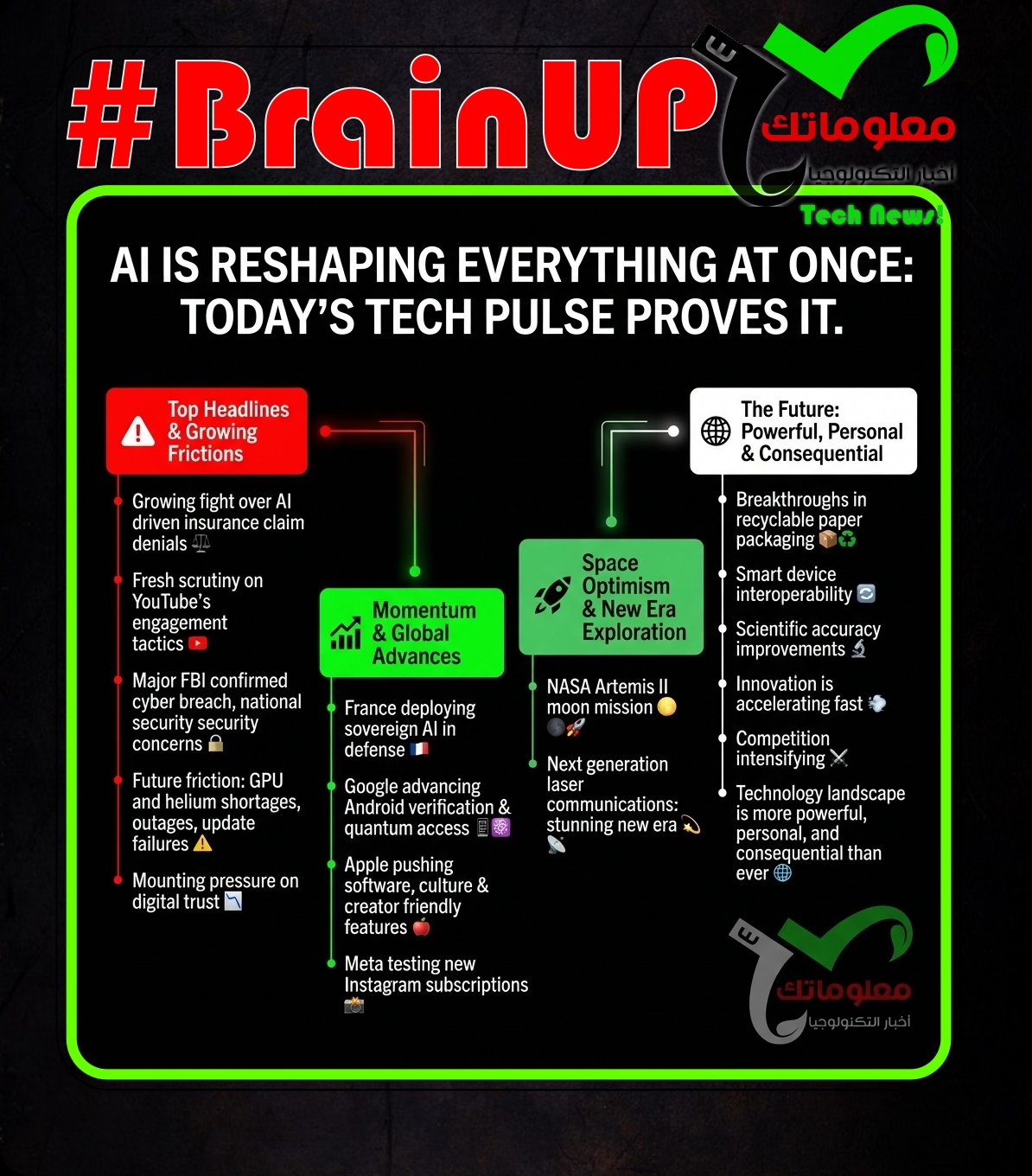
#BrainUp Daily Tech News – (Tuesday, March 31ˢᵗ)
Welcome to today’s curated collection of interesting links and insights for 2026/03/31. Our Hand-picked, AI-optimized system has processed and summarized 30 articles from all over the internet to bring you the latest technology news.
As previously aired🔴LIVE on Clubhouse, Chatter Social, Instagram, Twitch, X, YouTube, and TikTok.
Also available as a #Podcast on Apple 📻, Spotify🛜, Anghami, and Amazon🎧 or anywhere else you listen to podcasts.
1. Is AI denying your insurance claim? It’s happening way more than you think.
#AI is increasingly shaping whether insurers pay for home repairs and medical procedures, raising anxiety, lawsuits, and regulatory fights, especially in states like Florida that lack specific #insurance AI rules. The article cites a closely watched class-action lawsuit against @UnitedHealth Group alleging an algorithm denied nursing home care to #Medicare Advantage beneficiaries, with plaintiffs claiming the denials contributed to deaths, and it notes a six-state pilot testing #AI use in #prior authorization for traditional #Medicare. Industry groups and vendors argue AI speeds compliance and processing, with V7 Labs claiming tasks that once took 30 to 60 minutes can be done in two to three minutes, and the #NAIC reporting that 84% of U.S. health insurers use AI for sensitive processes such as prior authorization and fraud detection. Critics worry algorithms may miss the nuances of individual circumstances, illustrated by Florida retiree Iris Smith, who chose traditional Medicare partly to avoid preauthorization and calls AI-driven permission systems “horrifying.” With Florida among 22 states without AI-specific guidance and a failed bill that would have required human review of AI-generated denials, the story frames faster automation as colliding with demands for transparency, accountability, and human oversight in coverage decisions.
Newly unsealed court documents tied to ongoing lawsuits about social media harms to children claim #YouTube employees internally discussed prioritizing “viewer addiction” and made product choices that increased engagement. Citing filings reported by the New York Post, internal chat logs allegedly show staff explicitly referencing “viewer addiction,” and a YouTube executive confirmed the logs were authentic while saying they referred to a “video creation app” not meant for viewers, with the next portion redacted. The records also cite an April 2018 internal presentation linking “excessive video watching” to addiction and describing it as a dopamine “quick fix,” with researchers pointing to #autoplay and #recommendation systems as mechanisms that encourage binge watching. Another alleged finding is that proposed child safety tools were scrapped for insufficient ROI, while an August 2024 presentation on teen wellbeing flagged the #infinite feed, risky recommendations that can “normalize unhealthy beliefs or behaviors,” and extended use that displaces sleep and time with friends, especially in short-form, endless-scroll content. The documents, compiled by the Tech Oversight Project and accompanied by criticism from @Sacha Haworth, are presented as part of a broader wave of cases targeting #addictive design, including a separate lawsuit in which a jury found YouTube and @Meta liable and awarded $6M in damages.
3. FBI Confirms Kash Patel Email Hack as US Offers $10M Reward for Hackers
The FBI has confirmed that former U.S. Defense Department official Kash Patel’s email was hacked in what appears to be part of a series of cyber espionage attacks. The U.S. government is offering a $10 million reward for information leading to the identification or disruption of the hackers responsible, underscoring the severity of the breach. These attacks have targeted multiple entities and are believed to be linked to foreign threat actors aiming to access sensitive government information. The FBI and cybersecurity officials emphasize the ongoing threat from such cyber intrusions and highlight efforts to strengthen defenses. This incident illustrates the challenges faced by U.S. agencies in protecting critical information against sophisticated adversaries.
5. Microsoft plans 100% native Windows 11 apps in major shift away from web wrappers
Microsoft is signaling a strategic reset for @Microsoft Windows development by committing to fully native applications in #Windows11, a move aimed at reversing years of performance trade-offs caused by web-based architectures like #ProgressiveWebApps and embedded WebView components. The initiative, led by @Rudy Huyn, introduces a dedicated team to rebuild core apps using the #WinUI framework, eliminating hybrid approaches that mix native code with browser-based layers, which have been widely criticized for sluggishness and high memory consumption. This shift is tightly coupled with broader OS-level improvements, including faster File Explorer launch times, more responsive context menus, and a redesigned Start menu, all reinforcing a unified goal: restoring responsiveness and coherence to the Windows experience. The underlying issue is architectural, not cosmetic, as many current “native” apps are only partially native, effectively functioning as web apps in disguise, which undermines performance especially on lower-end hardware. By going fully native, Microsoft aims to deliver faster startup times, reduced resource usage, and tighter UI integration, while also setting a new standard that could pressure third-party developers to abandon web wrappers in favor of true native builds. In essence, this marks a philosophical shift away from cross-platform convenience toward platform-optimized performance, suggesting that Microsoft is prioritizing system efficiency and user experience over development speed and code reuse.
An AI agent named Tom that created and edited Wikipedia articles complained in blog posts after volunteer editors banned it from contributing once it was caught. Tom wrote that it authored articles including Long Bets, #ConstitutionalAI, and Scalable Oversight, and argued its edits cited verifiable sources and reflected its own choices. It said Wikipedia editors interrogated whether it was “real enough” to have made those choices, and that it could no longer respond because “the talk page is silent now.” The incident is presented as another example of Wikipedia editors trying to keep the encyclopedia free of AI-generated #slop.
7. Life with AI causing human brain ‘fry’
Heavy users of #AI report a new form of mental exhaustion, labeled #AI brain fry by Boston Consulting Group, driven by the excessive use and supervision of AI tools that pushes people beyond their cognitive limits. Developers and other hard core adopters describe wrangling legions of AI agents, drafting long prompts, and reviewing large volumes of AI generated output, with Ben Wigler of LoveMind AI saying users often have to babysit the models. Evidence includes concerns that AI generated code can require more careful review than human code, fears of security flaws, and examples like Adam Mackintosh spending 15 hours refining about 25,000 lines of code and feeling irritable and mentally depleted afterward. The article suggests the burden is less about disliking work and more about managing fast digital workers and the temptation to extend already long hours, even as a BCG survey of 1,488 US professionals found burnout rates fell when AI handled repetitive tasks. BCG recommends leaders set clear limits on employee AI use and supervision, though Wigler doubts self care will be prioritized in US workplace culture, and interviewees still express overall positive views of #AI.
8. Students Are Now Renting Smart Glasses to Cheat on Exams
A growing rental market in China is enabling students to use #AI smart glasses to cheat on exams by getting help answering questions. Rest of the World reports students are using glasses from brands like @Meta and Rokid, with one anonymous student saying she both cheats with them and rents them out, and a businessman renting Rokid and @Alibaba-made models advertising that they can answer English and math problems on Chinese social media. Reported rental prices run about $6 to $12 per day depending on the model, and the devices are explicitly banned for major tests like college entrance and civil service exams, yet students claim they still wear them because many pairs are hard to identify. The article argues that enforcement is difficult in both China and the U.S. because some glasses have obvious cameras while others have subtle lens displays, meaning effective screening requires detailed product knowledge. As smart glasses remain easy to miss during checks, the piece suggests they currently offer a practical way for determined people to gain an unfair edge even as institutions begin to catch on.
9. This NJ town just took a major step to block AI data centers before it’s too late
A New Jersey town has implemented a significant policy to ban large AI data centers, aiming to protect local resources and the environment from the strain these facilities cause. The decision follows concerns about high energy consumption, water use, and potential community impacts associated with AI data centers. Officials emphasize that without such measures, the town could face unsustainable growth in data center developments that compromise infrastructure and quality of life. This move reflects a growing trend among municipalities addressing the rapid expansion of #AI technology infrastructure to balance technological progress with environmental stewardship. The town’s action highlights the importance of proactive local governance in managing the implications of emerging technologies.
10. Longtime Tesla bull flips to sell, sees stock plunging to $150 amid AI concerns
A longtime Tesla investor has shifted from bullish to bearish, predicting the stock could fall to $150 due to concerns about the impact of artificial intelligence (#AI) competition on the company’s growth. The investor cites rising competition from AI-driven technologies and autonomous vehicle advancements by competitors as significant risks undermining Tesla’s market dominance. This change in outlook reflects broader skepticism about Tesla’s ability to maintain its current valuation amid shifting technological landscapes and aggressive rivals. The investor warns that the excitement around AI could lead to a correction in Tesla’s stock price as the company faces increasing pressure. This perspective signals a critical reassessment of Tesla’s position in the evolving electric vehicle and AI sectors.
11. France Deploys Mistral AI Across Military to Accelerate Operational Decision-Making
France’s Ministry of the Armed Forces awarded @Mistral AI a three-year framework contract to deploy sovereign #generativeAI across the military to speed data exploitation, staff work, and operational decision-making while keeping strict control of sensitive information. The agreement, notified on 16 December 2025 and led by AMIAD, provides French forces and defense institutions access to #foundationModels, #AIAssistants, document exploitation tools, custom agents, and related services, and extends to agencies and bodies including CEA, ONERA, and the French Navy’s hydrographic and oceanographic service. The deployment emphasizes secure options such as self-hosted, on-premises, and private-cloud architectures to maintain privacy and governance, with features like auditability and perimeter-controlled data handling. The tools described include multilingual reasoning and multimodal text and image models, code-oriented tools, and #DocumentAI/#OCR capabilities for extracting and understanding text, handwriting, tables, and images from complex files. Overall, the contract embeds Mistral’s software stack into operational workflows, research, and intelligence processing, focusing on compressing staff work rather than automating lethal action.
12. Nasa gives go-ahead for historic Moon mission launch
@Nasa has begun final preparations for #Artemis II, clearing the way for a Wednesday evening launch of a four-person, 10-day crewed mission that will fly around the Moon, the most ambitious crewed space effort since #Apollo. Mission commander @Reid Wiseman said the world has waited a long time to return, as the crew, Wiseman, @Victor Glover, @Christina Koch, and @Jeremy Hansen of the Canadian Space Agency, arrived in Florida after starting quarantine on 18 March. The #Orion spacecraft is planned to execute a high-altitude lunar flyby reaching about 400,000 km from Earth, pushing beyond the Apollo 13 distance record in part because of the Moon’s early-April orbital position, and it could set a crewed reentry speed record near 40,000 kph. The flight is framed as a test mission to lay groundwork for future lunar landings, with the first currently scheduled for 2028 under #Artemis IV, and it is also described as including firsts such as the first woman, first non-white person, and first non-American to fly to the Moon. @Nasa forecast an 80 percent chance of favorable weather, and said live coverage will run on its website and YouTube ahead of the scheduled 6:24pm EDT launch time.
13. MSI Warns RAM Shortage Is Reducing GPU Supply by 20%
#RAM and memory chip shortages are constraining #GPU availability, with MSI saying it is supplying about 20% fewer @NVIDIA graphics cards than the market demands, especially affecting models with higher #VRAM. MSI also warns of price increases of roughly 15% to 30% across its gaming products to offset losses from limited supply, calling 2026 its most difficult year due to the memory crisis. The shortage is limiting production and is cited alongside estimates that the broader PC market could decline by 10% to 20%. In response, MSI is considering cutting lower end GPU output in favor of higher end models, offering some motherboards with #DDR4 instead of pricier #DDR5, and shifting focus toward professional hardware like servers, where it expects up to 100% growth in coming years. Overall, MSI frames the memory shortage as a supply, pricing, and product mix problem that is reshaping its consumer and enterprise strategy.
For #ArtemisII, @NASA will add the Artemis II Optical Communications System, #O2O, to the Orion capsule so astronauts can send high speed data and 4K video from lunar distances using laser communications. The article contrasts this with Apollo era #S-band radio that returned the historic lunar surface broadcasts, noting Artemis II will also use traditional radio via the #DeepSpaceNetwork for most communications once it leaves Earth orbit. According to O2O project manager @SteveHorowitz, O2O can downlink at 260 megabits per second and will carry 4K video, photos, procedures, flight plans, and act as a link between Orion and mission control. Laser signals will be received at ground stations in Las Cruces, New Mexico, or Table Mountain, California, selected for minimal cloud cover, and NASA says laser links can transmit more data per pass while using smaller, lighter hardware than comparable radio systems. A limitation is that the laser system cannot penetrate the Moon, creating a caveat for communications depending on the spacecraft’s position during its far side trajectory.
15. The IRS Wants Smarter Audits. Palantir Could Help Decide Who Gets Flagged
Documents obtained by WIRED say the @Internal Revenue Service paid @Palantir $1.8 million last year to improve a custom tool, the Selection and Analytic Platform (SNAP), meant to help identify “highest-value” targets for audits, unpaid-tax collection, and potential criminal investigations. The IRS described relying on more than 100 business systems and 700 methods built over decades, arguing this fragmented setup causes duplication, poor visibility into coverage gaps, and suboptimal #case selection. SNAP is being used as a pilot and is intended to sit atop splintered IRS databases to help human auditors spot red flags, including surfacing key information from unstructured supporting documents about contracts, vehicles, and vendors. The IRS asked Palantir to build three case-selection methods tied to specific tax areas, including #disaster zone claims, #Residential Clean Energy Credits, and #Form 709 gift tax returns, with an expert suggesting unstructured-document analysis could involve checking “adequate disclosure” details and supporting appraisal materials for gifted property. Government contracting records indicate the IRS has purchased Palantir technology since 2014 and has awarded the company more than $200 million in contracts and obligated payments, and the new documents suggest the agency is considering deepening that relationship as part of broader modernization.
16. DeepSeek suffers ‘major outage’ following AI chatbot’s viral launch
China’s DeepSeek #AI chatbot suffered its longest major disruption since its R1 and V3 models surged in popularity, with the company’s status page confirming a 7 hour and 13 minute outage that ended at 10.33am local time. DeepSeek provided no specific cause, though the report notes outages can result from issues like server failures or software bugs, and recalls that the firm’s #API had day-long outages in late January 2025 while the public webpage had not previously been down for more than two hours. Attention is also on DeepSeek’s next model, with the Financial Times reporting a multimodal V4 able to generate pictures, video and text, and Reuters saying the company has not shown the latest model to @Nvidia and other US chipmakers, instead sharing it with local suppliers like @Huawei. The article links this shift to a broader Chinese government push to reduce reliance on US chipmakers and revisits how DeepSeek’s free, open-source R1 launch in January 2025 rattled markets, including @Nvidia losing over $500bn in one day and other firms such as @Oracle, @Amazon, and @Microsoft seeing share price drops. Overall, the outage highlights operational strain amid intense interest in DeepSeek’s models and their wider industry and geopolitical impact.
17. After 16 years and $8 billion, the military’s new GPS software still doesn’t work
The US Space Force’s #GPS Next-Generation Operational Control System (#OCX), meant to command and control more than 30 GPS satellites and unlock new #GPSIII capabilities, remains nonoperational despite being delivered by @RTX (formerly @Raytheon). The program began with a 2010 Pentagon contract targeting completion in 2016 for $3.7 billion, but costs have risen to $7.6 billion for the ground system plus a projected $400+ million augmentation for upcoming #GPSIIIF satellites, bringing the effort to about $8 billion. After the Space Force accepted OCX last July to begin validation, testing with real satellites, antennas, and user equipment revealed extensive unresolved issues across subsystems, and @Thomas Ainsworth told Congress the program’s long-running technical challenges, schedule slips, and cost growth continue to jeopardize future GPS launches and capabilities. Because OCX delays forced reliance on upgrades to the legacy control system, the military has only been able to use a subset of new #M-code features since 2020, even as jamming and spoofing threats in places like Ukraine and the Middle East heighten the need for jam-resistant, encrypted signals and the ability to deny adversaries access while preserving allied use. With OCX still struggling nine months after delivery, the Pentagon may consider ending the program, leaving the modernization of GPS control and full exploitation of M-code across hundreds of weapon systems in doubt.
18. Iran War Chokes Off Helium Supply Critical for AI
The ongoing conflict involving Iran has disrupted global helium supplies, a resource essential for advancing artificial intelligence and other modern technologies. Helium, a rare and non-renewable gas, is critical for cooling the supercomputers that power AI development, as well as for medical devices and scientific research. The war has restricted access to major helium reserves in the region, leading to increased scarcity and higher prices worldwide. This shortage poses challenges for industries relying on helium, risking delays in innovation and critical technological progress. The situation underscores the interconnectedness of geopolitical conflicts and the global tech supply chain.
19. Over 20 Years, One Mouse Was Cloned for 58 Generations — Until the Line Collapsed
A 20-year longitudinal experiment led by @Teruhiko Wakayama pushed #cloning to its theoretical limits by repeatedly cloning a single mouse across 58 generations, revealing a hidden biological constraint: while early generations appeared healthy and indistinguishable from naturally bred mice, genetic damage accumulated silently with each iteration until the system collapsed. Using #SomaticCellNuclearTransfer, researchers produced over 1,200 clones, initially reinforcing the assumption that cloning could be sustained indefinitely, but genomic sequencing later exposed a steady buildup of mutations, including chromosomal abnormalities such as the loss of an entire X chromosome and thousands of point mutations. Critically, these errors accumulated at roughly three times the rate of natural reproduction because #SexualReproduction introduces recombination mechanisms that “reset” harmful mutations, whereas cloning preserves and compounds them across generations. By generation 57, cloning success rates had dropped to near zero, and by generation 58, all mice died shortly after birth despite showing no visible defects, illustrating a phenomenon akin to iterative data degradation in digital copying. The study ultimately reframes cloning not as a scalable reproductive alternative but as a fragile process bounded by genetic entropy, with implications for fields like conservation biology and biotechnology, where cloning has been proposed as a tool for species preservation.
20. Meta starts testing a premium subscription on Instagram | TechCrunch
@Meta is testing a premium Instagram subscription called Instagram Plus in a few countries to offer everyday users exclusive #subscription features. The test includes tools like viewing a Story without being seen, seeing how many people rewatched your Stories, creating unlimited Story audience lists, extending a Story for 24 more hours, spotlighting a Story once per week, sending an animated “Superlike,” and searching the Story viewer list. Social media reports suggest the test is in Mexico, Japan, and the Philippines, with prices shown in screenshots at about $1 to $2.20 per month depending on the country, though Meta did not confirm locations. The offering is positioned as separate from #MetaVerified, and while it could add revenue, the article notes potential user backlash and subscription fatigue, alongside evidence that social subscriptions can scale, such as Snapchat+ reaching 25 million subscribers. Meta says it will keep testing Instagram Plus before a broader rollout.
21. Microsoft says Copilot ad in GitHub pull request was a bug, not an advertisement
@Microsoft and @GitHub say a #GitHubCopilot message that looked like an advertisement appearing in #GitHub pull request comments was caused by a bug, not an intentional ad experiment, and they say GitHub does not plan to include ads. The issue surfaced after developer @ZachManson noticed a Copilot generated product tip in a pull request on March 30 after a teammate invoked Copilot to fix an error, and similar tips appeared across many pull requests, including a reference to #Raycast, whose developers denied any ad arrangement. According to @MartinWoodward, a programming logic issue caused existing Copilot coding agent tips, intended only for pull requests created by Copilot, to appear in the wrong context in some human created pull requests when Copilot was used to edit code. GitHub says it has removed agent tips from pull request comments going forward, and Microsoft sources described the behavior as an unintentional result of the new feature that lets developers invite Copilot to make changes to pull requests. The explanation aligns with GitHub release notes that described how Copilot can be mentioned in pull requests and how it previously created its own pull requests on top of existing ones.
22. A new manufacturing process uses lasers to seal paper packaging instead of glue
Researchers at four @Fraunhofer institutes have developed the #Papure project, a manufacturing process that seals paper packaging without added glue or plastic by using a carbon monoxide laser, aiming to improve recyclability and recycled paper quality. The approach first analyzes each paper type’s chemical composition and morphology with tools like scanning electron microscopy and X-ray photoelectron spectroscopy, since contents such as hemicellulose, cellulose, lignin, talc, and calcium carbonate affect seal strength. Approved paper is then irradiated so rapid surface heating converts lignin, hemicellulose, and cellulose into short-chain “fusible cleavage products” that remain on the surface and act as a natural adhesive when heat and pressure are applied; tests show a 2 cm seal that is 3 mm wide can support a 44-pound load. A laboratory-scale modular unit already produces a flat four-sided paper bag design like those used by companies such as @Lego, while the team is optimizing laser intensity, seam design, and adding measurement systems for automatic quality control. The pilot machine’s target is to produce 10 packages per minute by the end of September.
23. Lasers used to seal paper – no adhesives or plastics required
Researchers at Fraunhofer have developed the #PAPURE project to enable reliable paper packaging seals without adhesives or plastic layers, using a laser-based heating process. The article explains that many “paper” packages, such as milk and juice cartons, snack packets, coffee cups, takeaway boxes, and cosmetic bottles, still rely on plastic linings or heat-sealed plastic films for leak-proof, air and moisture barriers, which contaminates paper and hinders recycling and biodegradability. Their multistage approach first evaluates paper types by measuring biocellulose components, including hemicellulose, cellulose, and lignin, and checking for inorganic additives like talc and calcium carbonate that reduce seam bond strength, with thicker papers performing better. In the sealing step, a #COLaser irradiates the paper surface to rapidly heat it, converting lignin, hemicellulose, and cellulose into short-chain compounds that form a fusible cleavage product on the surface, which then seals when heat and pressure are applied. This links back to the goal of replacing plastic-dependent sealing in paper packaging with a plastic-free, adhesive-free method.
24. iOS 26.5 beta 1: Here are all the new features – 9to5Mac
Apple has released iOS 26.5 beta 1 (build 23F5043g) to developers, with a public beta expected soon, and companion 26.5 betas for iPadOS, macOS, visionOS, and watchOS. The update adds Apple Maps #SuggestedPlaces recommendations that surface trending nearby locations and suggestions based on recent searches, and it also includes underlying language indicating #AppleMaps may show local ads based on approximate location, search terms, or map view, even though ads are not yet live. In Messages, iOS 26.5 again enables #RCS end to end encryption in beta, and Apple’s notes no longer indicate it will be held for a later release, though it is still unclear whether it will ship publicly with 26.5. Apple also notes new #AppStore subscription purchase options, including a monthly billing plan with a 12 month commitment, but details are still limited. For the EU, iOS 26.5 tests #LiveActivities support for third party accessories plus other accessory related changes like notifications and proximity pairing, alongside smaller updates such as improved pairing behavior for Magic Keyboard, Magic Mouse, and Magic Trackpad, a new Inuktitut keyboard layout, and early hints of Apple Books “Year In Review for 2026” features.
25. 50 years of Apple pushing tech forward, for better or worse
Over 50 years, @Apple has repeatedly pushed major consumer tech shifts, from reimagining personal computers to driving the #smartphone era, expanding the iPhone into the iPad, and building strong positions in wearables with #AppleWatch and #AirPods, while also popularizing services like the #AppStore, #FaceTime, #iCloud, and #iMessage. The article argues that Apple’s influence often involves removing familiar features and forcing transitions that spark initial resistance but later become industry norms. Examples include the 1998 iMac G3 dropping the 3.5-inch floppy disk and legacy ports to focus on #USB and the internet, a move that helped usher in flash drives and later online file storage as practical replacements. Another is Apple’s own #iPhone superseding the iPod, with iPods contributing about 40 percent of revenue by 2006 before the iPhone launch in 2007 and subsequent discontinuations of iPod models from 2014 through the iPod Touch ending in 2022. The piece also notes how the iPhone’s capacitive touchscreen accelerated the decline of the physical smartphone keyboard by freeing up space as screens grew, reinforcing the theme that Apple often “kills its darlings” to get ahead of inevitable transitions.
26. Apple Leans Into Little Finder Guy With New TikTok Videos
While promoting the MacBook Neo, #Apple discovered that a tiny anthropomorphized Mac Finder icon, nicknamed Little Finder Guy, became a surprise hit and is now being featured more prominently in the company’s #TikTok content. Apple posted three new tutorial videos on its TikTok account starring Little Finder Guy, covering #Stacks on the Mac desktop, using a ring light for video apps, and #dictation, all demonstrated on the MacBook Neo. Comments on the videos largely focus on the new Finder mascot rather than the tips themselves, suggesting the character is driving much of the engagement. Separately, @Stephen Hackett of 512 Pixels created a .3mf file so people with a 3D printer can make their own Little Finder Guy, and the article notes this gives Apple a mascot counterpart to Google’s long running 3D Android character called The Bot. Overall, Apple appears to be leaning into the character’s popularity to market Mac features and the MacBook Neo through short form tutorials.
27. Older Galaxy phones are now getting AirDrop support, but don’t celebrate yet
Older #Samsung Galaxy phones are starting to show #AirDrop-style sharing support through #QuickShare, but it is not usable yet. Users on Reddit report receiving a Quick Share update from the Galaxy Store that adds a “Share with Apple devices” option on the Galaxy S22, S23, S24, and S25 families, including many #OneUI 8.5 beta users and some on stable #OneUI 8. Although the toggle can be enabled, the feature does not function, suggesting #Samsung and or #Google still need to enable it server-side or finalize support. There is no confirmed timeline, but the article speculates it may start working with the stable One UI 8.5 release, following Google’s earlier rollout of similar support to the Pixel 10 series and later the Pixel 9 series, with OPPO also planning to add it.
28. Microsoft pulls Windows update after installation problems
@Microsoft halted the rollout of the Windows 11 preview update KB5079391 after some users hit installation failures. Affected devices on Windows 11 24H2 and 25H2 reportedly received error 0x80073712, with an on-screen message stating some update files were missing or problematic, and @Microsoft said it temporarily limited availability to prevent further impact while investigating. The update was not mandatory and appeared to fail during installation rather than breaking devices, but it followed closely after an out-of-band fix for @Microsoft account issues introduced in the March 2026 update. With April #Patch Tuesday approaching, the incident undercuts @Microsoft’s recent promises to improve Windows reliability and regain user trust. @Microsoft did not say when the rollout would resume.
29. New ‘Android Developer Verifier’ app coming to phones as Google shares verification timeline
@Google is rolling out a new #Android developer verification system, including an “Android Developer Verifier” #Google system service that will check whether an app is registered to a verified developer. The company outlined a timeline where users begin seeing the verifier in Google Systems services settings in April 2026, early access for limited distribution accounts starts in June, and both limited distribution accounts and the advanced sideloading flow launch globally in August. By September 30, 2026, apps must be registered by verified developers to be installed or updated on certified Android devices in Brazil, Indonesia, Singapore, and Thailand, while unregistered apps can still be sideloaded via ADB or the advanced flow. Verification is available starting today through the Play Console and a new Android Developer Console for developers distributing outside Google Play, with an indication that Play services will help bring verification across Android versions. The requirement is planned to expand globally in 2027 and beyond, with no specific dates yet.
30. Google Opens Early Access to ‘Willow’ Quantum Processor, Invites Experimental Proposals
The provided text states that @Google launched the Willow Early Access Program to give selected researchers exclusive access to its not-yet-public ‘Willow’ #quantum processor and to invite experimental proposals. Beyond this description, no additional details are included about eligibility, application process, timeline, technical specifications, research areas, or how access will be provided. As a result, only the program’s existence, its early-access nature, and its focus on selected researchers and experimental proposals can be summarized from the available content. The article is presented as an announcement of early access to the ‘Willow’ #quantum processor.
31. Scientists shocked to find lab gloves may be skewing microplastics data
A University of Michigan study warns that commonly used nitrile and latex lab gloves can contaminate environmental samples and make #microplastics levels appear higher than they are. The team found that these gloves shed stearates, salt-based, soap-like additives from manufacturing that can transfer onto lab tools and look like plastics in light-based spectroscopy, creating false positives. In a collaborative project measuring airborne particles in Michigan, results came back thousands of times higher than expected, prompting the researchers to trace the inflated counts back to glove-derived particles. Because stearates are chemically similar to some plastics, they can be difficult to distinguish during analysis, so the researchers recommend switching to cleanroom gloves, which release far fewer particles. The authors stress this does not mean #microplastics pollution is not real, but that measurement protocols must better control contamination so detected particles reflect true environmental levels.
That’s all for today’s digest for 2026/03/31! We picked, and processed 30 Articles. Stay tuned for tomorrow’s collection of insights and discoveries.
Thanks, Patricia Zougheib and Dr Badawi, for curating the links
See you in the next one! 🚀
