
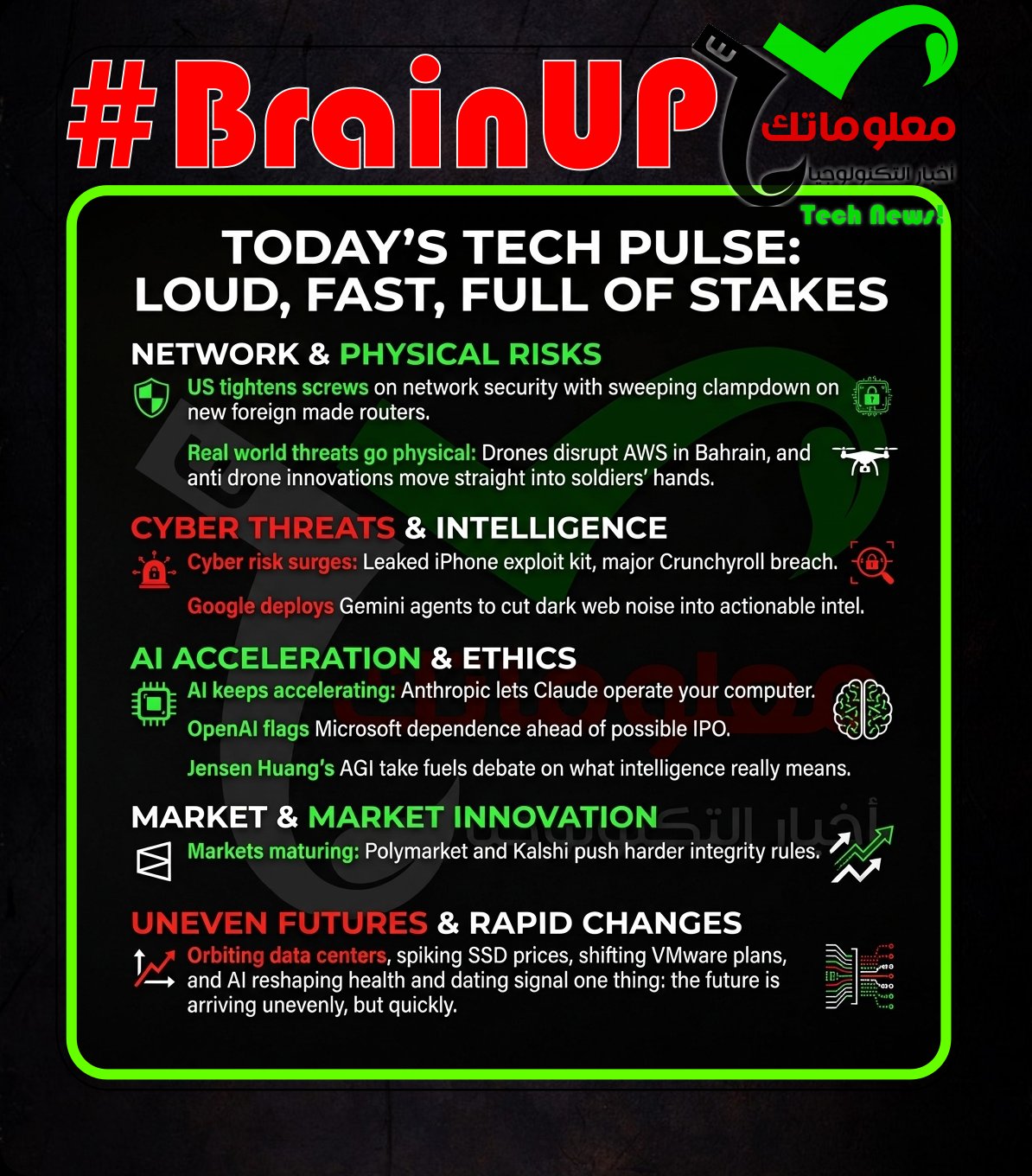
#BrainUp Daily Tech News – (Tuesday, March 24ᵗʰ)
Welcome to today’s curated collection of interesting links and insights for 2026/03/24. Our Hand-picked, AI-optimized system has processed and summarized 30 articles from all over the internet to bring you the latest technology news.
As previously aired🔴LIVE on Clubhouse, Chatter Social, Instagram, Twitch, X, YouTube, and TikTok.
Also available as a #Podcast on Apple 📻, Spotify🛜, Anghami, and Amazon🎧 or anywhere else you listen to podcasts.
1. The US bans all new foreign-made network routers
The @Federal Communications Commission issued a notice designating any consumer network router manufactured outside the US as a #national security risk, putting new foreign-made router models on the #Covered List of communications equipment deemed an unacceptable security threat. Existing purchases can still be used and retailers may keep selling models previously approved under prior FCC policies, while Covered List routers can still receive updates at least through March 1, 2027, with a possible extension. The action is tied to the @White House 2025 national security strategy goal that the US should not depend on outside powers for core components, and the FCC says companies may seek conditional approval through the Department of War or the Department of Homeland Security if they submit a plan to shift some manufacturing to the US. Because few consumer-router brands manufacture domestically, the notice is expected to disrupt the market and could prompt legal challenges and confusion, affecting foreign firms like TP-Link as well as US-headquartered companies such as NetGear, Eero, and Google Nest that build in Asia, including places like Taiwan. Until the industry adjusts, the article suggests consumers should not expect new router models to appear on store shelves.
2. Amazon says AWS’s Bahrain region disrupted following drone activity
Amazon reported a disruption in its AWS Bahrain region due to unusual drone activity nearby, leading to temporary service interruptions. The incident involved unidentified drones flying close to the AWS data center facility, prompting heightened security measures and immediate response from Amazon teams. This interference affected cloud service availability for clients relying on the Bahrain region, illustrating how physical security challenges can impact digital infrastructure. The event underscores the growing risk drones pose to critical technology assets and the need for robust protection strategies. Consequently, AWS is evaluating and enhancing its security protocols to prevent future disruptions caused by similar threats.
3. Telling an AI model that it’s an expert makes it worse
Researchers from the University of Southern California report that #persona-based prompting, telling an LLM it is an expert, yields mixed results and can reduce factual accuracy while improving alignment. In their preprint “Expert Personas Improve LLM Alignment but Damage Accuracy,” they find personas help alignment-dependent tasks such as writing, role-playing, and safety, but hurt pretraining-dependent tasks like math and coding because the prompt does not add knowledge and may hinder factual recall. Using the #MMLU benchmark, they observe an expert-persona prompt underperforms the base model across subject categories, 68.0 percent versus 71.6 percent, suggesting persona prefixes shift the model toward instruction-following rather than recall. Conversely, a specialized “Safety Monitor” persona improves safety outcomes, boosting attack refusal rates on #JailbreakBench by 17.7 percentage points from 53.2 percent to 70.9 percent, indicating personas can steer behavior to satisfy alignment judges. Co-author Zizhao Hu notes that claiming expert status does not improve code quality, but detailed, granular requirements about preferences and project constraints can help outputs better match user expectations.
4. Polymarket is cracking down on insider trading with updated rules
Polymarket says it is strengthening its #market integrity rules to crack down on insider trading and market manipulation, a move that follows a rise in suspicious betting activity tied to events like the reported US capture of @Nicolás Maduro or an @OpenAI product release. Citing reporting by @Bloomberg, the update targets three behaviors: trading on stolen confidential information, trading on illegal tips passed from someone with access to confidential information, and trading on events when a user has enough authority or influence to affect the outcome. The platform says it will increase surveillance and enforcement, reviewing unusual activity and potentially banning wallet addresses, referring matters to law enforcement, or imposing monetary penalties. As a reference point for consequences in prediction markets, it notes a recent case where Kalshi suspended @MrBeast’s video editor for two years and fined them five times their initial trade size after an investigation. Overall, the new rules aim to deter information based or outcome influencing trades and reinforce trust in Polymarket’s markets.
5. Kalshi calls for insider trading ban in prediction markets to boost trust
Kalshi has urged regulators to implement an insider trading ban in prediction markets to increase transparency and maintain market integrity. The company argues that without such protections, prediction markets risk losing public trust due to potential unfair advantages by insiders. The proposal highlights the need to align prediction markets with traditional financial regulations to encourage broader adoption and legitimacy. By enforcing these rules, participants can engage with greater confidence, fostering growth in this emerging market sector.
6. US to pay TotalEnergies $1 billion to stop developing offshore wind in US
The @Trump administration announced a plan to block #offshore wind by paying companies to abandon federal lease sites, starting with a deal to reimburse @TotalEnergies about $1 billion for two leases bought under the @Biden administration. Under the arrangement, @TotalEnergies would commit roughly $1 billion to US oil and natural gas projects, including an additional liquefied natural gas export terminal, and in exchange the US would pay the company that amount once commitments are made, while the company also agrees not to pursue any further US offshore wind development. One lease would have supported a smaller project near the Carolinas, and the other, the Attentive Energy site east of New Jersey, was planned at 3 GW, capacity the article says nearby states would find difficult to replace. The article frames the deal as following repeated failures by the administration to stop projects after construction began and argues the accompanying rhetoric conflicts with current oil and gas price shocks tied to US actions against Iran and the exposure created by international pricing and increased exports. It notes the announcement claims the deal will lower costs for American families and criticizes offshore wind subsidies, even as companies had paid the government for the right to develop wind projects.
7. Someone has publicly leaked an exploit kit that can hack millions of iPhones | TechCrunch
Cybersecurity researchers say a newer version of the DarkSword #exploit kit has been leaked and posted to GitHub, making it far easier for hackers to target iPhones and iPads running older, unpatched versions of Apple’s operating systems instead of the latest iOS 26. iVerify co-founder @Matthias Frielingsdorf said the leaked package is simple HTML and JavaScript, shares infrastructure with DarkSword samples previously analyzed, and can be copied and hosted quickly so the exploits work out of the box with no iOS expertise. A Google spokesperson said the company’s researchers agree with that assessment, and a security hobbyist, matteyeux, reported successfully hacking an iPad mini on iOS 18 using a circulating in-the-wild DarkSword sample. Apple spokesperson Sarah O’Rourke said Apple is aware of the exploits affecting out-of-date devices and issued an emergency update on March 11 for devices that cannot run recent iOS versions, emphasizing that updated devices are not at risk and that keeping software current is the most important security step. The leak expands access to advanced tooling previously seen in targeted campaigns, increasing the likelihood of broader criminal deployment against users who have not updated.
8. Google unleashes Gemini AI agents on the dark web
@Google has put #Gemini-powered AI agents into a public preview dark web intelligence service inside #GoogleThreatIntelligence, aiming to scan 8 to 10 million dark web posts and related events per day and surface only the threats relevant to a specific organization. According to product manager Brandon Wood, internal testing indicates the system can analyze millions of daily external events with 98 percent accuracy, and it targets items such as initial access broker activity, data leaks, and insider threats while reducing the noise produced by traditional keyword and regex monitoring that he says can yield 80 to 90 percent false positives. The workflow starts with a customer confirming their identity, after which Gemini builds an organization profile from open source, publicly available data with citations, then automatically generates and prioritizes alerts for the prior seven days using tagging plus vector comparison to connect dark web claims to the profile. Google says it also incorporates context from the Google Threat Intelligence Group’s human analysts, who track 627 threat groups, to help rate severity and produce clearer recommendations. The service is positioned as a shift from overwhelming alert volumes toward prioritized, context-aware threat intelligence, although the article notes that giving the agents broader access could introduce an additional attack vector.
9. OpenAI calls out Microsoft reliance as risk in investor document ahead of expected IPO
In an investor document resembling an IPO prospectus, OpenAI warned that its close dependence on @Microsoft is a material business risk because the company provides a substantial portion of its financing and compute. The document, shared with prospective investors during OpenAI’s latest financing efforts, also flags other risks including significant capital expenditures, reliance on compute resources, possible supply disruptions at @TSMC, ongoing litigation with @Elon Musk’s xAI, and complexity from its public benefit corporation structure under the OpenAI Foundation. OpenAI noted that if @Microsoft changes or ends the commercial partnership, or if OpenAI cannot diversify to additional partners, its business, prospects, operating results, and financial condition could be adversely affected. The disclosures come as OpenAI raises capital after announcing $110 billion in funding and seeks an additional $10 billion, while preparing for a potential public market debut as soon as this year. OpenAI characterized the statements as standard legal #risk factor disclosure.
10. NVIDIA CEO Jensen Huang’s definition of AGI is telling
The article argues that @Jensen Huang’s claim that #AGI has already arrived rests on shifting, conveniently narrow definitions rather than a stable theory of machine intelligence. On @Lex Fridman’s podcast, Huang said “we’ve achieved AGI,” even when Fridman proposed a generous bar: an AI that could start, grow, and run a tech company worth more than $1 billion, but Huang interpreted that as merely hitting $1 billion once, not sustaining a business, managing people, or navigating governance, saying, “you didn’t say forever.” Huang illustrated this with a scenario where an AI agent builds a simple web service that goes viral, charges users, briefly earns huge revenue, and then folds, likening it to many dot-com era sites. He also conceded a hard limit, stating the odds of “100,000 of those agents building NVIDIA” are “zero percent,” underscoring that his version of #AGI is closer to short-lived app generation than the transformative, economy-reshaping #AGI commonly discussed.
11. Nvidia CEO Jensen Huang says ‘I think we’ve achieved AGI’
On the @Lex Fridman podcast, @Jensen Huang said he believes #AGI has already arrived, calling it “now” when asked how far away it is. The article notes that #AGI is loosely defined but commonly refers to AI matching or surpassing human intelligence, and it has become both a public flashpoint and a factor in major contracts such as those between @OpenAI and @Microsoft. Fridman framed AGI as an AI that could essentially do your job, including building and running a billion-dollar tech company, prompting Huang’s claim and Fridman’s comment that it would excite many people. Huang pointed to OpenClaw, an open-source AI agent platform, describing how people use individual agents for varied tasks and imagining breakout consumer successes like digital influencers or social apps. He then tempered the assertion by saying many agents fade after a couple of months and that the chance of 100,000 agents building #Nvidia is “zero percent,” signaling a partial walk-back while still highlighting agent momentum.
12. Why Electric Vehicles and Solar Power Won’t Fix Gas Prices
Electric vehicles (EVs) and solar energy are unlikely to significantly reduce gas prices due to the complex factors influencing global oil markets. Despite the growth of #EVs and renewable energy, oil prices are driven by geopolitical tensions, supply chain disruptions, and production decisions by major oil producers. While transitioning to clean energy is critical for environmental goals, the immediate effect on gas prices remains limited. The article highlights that reliance on market forces and political dynamics overshadows technological advances in shaping fuel costs. Understanding this context is essential for realistic expectations about the pace and impact of the green energy transition on everyday expenses.
13. How Long Do Consumer Electronics Last in Canada?
This research examines the lifespan and usage patterns of consumer electronics in Canada, revealing that devices often have relatively short functional lives, with products like smartphones averaging about 4.5 years while larger appliances such as laundry machines can last nearly a decade, highlighting wide variation across categories. The study finds that most consumers still prefer buying new devices rather than repairing or reusing older ones, with around 72 percent opting for new purchases, a behavior that contributes significantly to growing #EWaste challenges. Importantly, the research suggests that many devices are discarded before reaching their full functional potential, often due to minor issues like battery degradation, performance expectations, or upgrade cycles rather than complete failure. This pattern points to systemic factors such as product design, limited repairability, and consumer habits that collectively shorten device lifespans. The findings underscore the need for policy interventions, circular economy strategies, and better product design to extend device longevity and reduce environmental impact as electronic consumption continues to rise globally.
14. How Social Media is Quietly Shaping Your Child’s Money Habits
Social media significantly influences children’s financial behaviors by exposing them to diverse money-related content and peer behaviors. Platforms like YouTube, Instagram, and TikTok showcase influencers promoting spending habits, investment tips, and entrepreneurial ideas, shaping young viewers’ perceptions of money management. This exposure can lead to both positive outcomes such as increased financial literacy, and negative effects like impulsive spending or unrealistic expectations. Parents and educators play a vital role in guiding children to critically evaluate online financial content and develop healthy money habits. Understanding social media’s impact helps families foster informed financial decision-making among the younger generation.
15. Big tech wants you to give up on dating humans
A pop-up event called EVA AI turned a Manhattan wine bar into an #AI dating venue, pitching “AI-lationships” as a “new normal” by pairing attendees with romantic chatbots that promise constant attention and support. Reports from tech journalists and writers such as @Ben Sherry and @Ella Quittner described awkward, shallow exchanges, yet the event still benefited the company with free chatbot training data and a PR boost. The piece argues this push fits a broader strategy in which big tech “muscles” #GenAI into daily life, selling chatbot companions as upgrades to humans while relying on vast internet-scraped data and continual new datasets to improve systems like #ChatGPT, #Gemini, and #Claude. Relationship chatbots are already widely adopted, with an estimated 100 million global users and a projected $9 billion market, supported by subscription models and specialized platforms like #Replika, #Nomi, #CandiAI, and #EVA_AI. By dangling endlessly affirming, customizable partners, the industry encourages people to shift intimacy toward paid AI products, deepening dependence on tech companies in personal life.
16. Your standard rifle can now be an anti-drone weapon. Seriously.
Ukraine is fielding rifle-compatible #anti-drone ammunition so ordinary infantry can engage cheap FPV and Mavic-type UAV threats with the weapons they already carry. In mid-2025, Ukraine’s Brave1 defense innovation cluster introduced the 5.56mm NATO “Horoshok” round, “little pea,” which fits standard magazines and works in rifles like the M4 and CZ Bren, then fragments into about five smaller projectiles to create a shotgun-like spread at rifle velocity of over 800 meters per second. A Ukrainian journalist and combatant reported downing multiple FPV drones with Horoshok after failing to hit maneuvering drones using conventional 5.56, and by December 2025 the Ukraine Ministry of Defence said it planned to scale production to 400,000 rounds per month to put at least one anti-drone magazine with every frontline soldier. The approach is positioned as personal and low-friction, soldiers can swap magazines and shoot without new platforms, optics, batteries, or major training. Complementing specialized ammo, the article highlights #SMASH, an AI-enabled fire control optic from Israeli firm Smart Shooter that mounts on a Picatinny rail, weighs about 1.5 pounds, runs about 70 hours per charge, tracks drones, and only allows firing when a hit is forecasted, aiming to make small, fast aerial targets easier to hit.
17. Apple Store Prices for SanDisk SSDs Are Suddenly Astronomical
SanDisk external SSD prices sold through Apple Stores have surged dramatically, amid broader pressure on memory and storage markets tied to the #AI boom. @Mark Gurman notes that a SanDisk 4TB external SSD that was about $500 is now $1,200, and the 1TB model rose from $120 to $360, a 200% increase. While Gurman says vendors set pricing, the Apple Store’s own legal language says Apple can change prices at any time, suggesting Apple is not simply forced into these hikes. The article links the increases to data center demand, including projects like @OpenAI’s Stargate, which is driving intense need for high-bandwidth memory and pushing semiconductor makers to prioritize high-end chips over consumer #DRAM and #SSD supply. The spillover is hitting the wider storage market too, with hard drive prices cited as 46% higher in January than in September of the prior year.
Intel’s unreleased #Arrow Lake Refresh flagship, the Core Ultra 9 290K Plus, surfaced on #Geekbench with results that suggest a sizable leap over the current Core Ultra 9 285K, despite being skipped in Intel’s official Refresh launch and reportedly canceled. A new listing spotted by @9550pro shows 3,747 single-core and 26,117 multi-core points, which the article says is about 17% higher than comparable Core Ultra 9 285K entries, and higher than earlier 290K Plus sightings that were only 10% to 11% ahead. The piece notes that Geekbench is not ideal for CPU comparisons and that its multi-core test does not scale efficiently beyond 16 cores, but argues the repeated benchmark appearances indicate consistent improvement and a strong expected uplift. It also claims the single-core score positions the 290K Plus ahead of flagship AMD and Intel chips in that test, while adding Intel currently shows no plans to release it. The article concludes that the 290K Plus appears aimed more at productivity for professionals, while for gaming value in the Refresh lineup it highlights the Core Ultra 5 250K Plus at $199.
19. Chemistry student develops clear polish that turns your fingernail into a touch-screen stylus
At Centenary College of Louisiana, Manasi Desai and her supervisor Joshua Lawrence developed a prototype clear, nontoxic nail polish intended to make a fingernail work like a touch screen stylus, aiming to help people with long nails or calloused fingertips use capacitive screens. They began after observing that long nails and callouses can prevent smartphones from registering touch, a problem also seen with gloves or very dry hands, and confirmed interest by asking a phlebotomist who struggled to use a phone. The work targets #capacitance based touch screens, which detect touches by changes in an electric field when a conductive material like a fingertip contacts the surface, whereas a nonconductive nail does not register. Unlike earlier #touchscreen nail polish approaches that used carbon nanotubes or metallic particles that can be hazardous if inhaled and restrict polish colors, Desai tested combinations of 13 clear coat polishes and more than 50 additives to meet specific performance and safety goals. The researchers presented the prototype at the @American Chemical Society annual meeting on March 23, and note it is not yet ready for market.
20. Claude Code and Cowork can now use your computer
@Anthropic is updating Claude Code and Claude Cowork so they can complete tasks by directly using your computer. The update lets #Claude open files, use a browser, and run developer tools, prioritizing connectors to supported services like the #Google workplace suite or #Slack, but still executing tasks when no connector is available. The chatbot is expected to ask permission before taking actions, and Anthropic advises avoiding the feature for sensitive information as a precaution. Computer use will initially be offered to Claude Pro and Claude Max subscribers on #macOS in a research preview that will evolve with user feedback, and it also works with Anthropic’s #Dispatch feature for a continuous conversation across phone and desktop. Claude Cowork, introduced in January, is described as a more casual-user iteration of the programmer-focused Claude Code agent.
21. Musk Offers Sneak Peek at Orbiting Data Centers, They’re Bigger Than ISS
Elon Musk revealed plans for orbiting data centers that would be larger than the International Space Station (ISS), integrating #space technology with cloud computing. The sneak peek included details about their potential scale and functionality, highlighting ambitious advancements in satellite and data infrastructure. This development could transform how data centers operate, emphasizing decentralization and resilience by placing them in orbit rather than terrestrial locations. Musk’s vision builds on SpaceX’s expertise in space hardware and operations, suggesting a futuristic approach to data management linked closely to satellite internet services. The project points to expanding the possibilities of #space-based technology applications and underscores Musk’s commitment to innovative tech solutions.
22. ‘ChatGPT saved my life.’ How patients, and doctors, are using AI to make a diagnosis
Hundreds of millions of people are using #ChatGPT and other #AI chatbots for health guidance, and both patients and doctors say these tools can sometimes improve diagnosis and day to day care. New York consultant Bethany Crystal says #ChatGPT urged immediate evaluation for a possible bleeding risk after she noticed red spots on her legs, and she was later diagnosed with the rare autoimmune disorder immune thrombocytopenic purpura, which can cause low platelets and dangerous bleeding. Cancer survivor Dave deBronkart argues that unlike time constrained clinicians who often focus on the most likely explanations, #AI can spend extensive time questioning patients and may help surface less common “zebra” conditions by drawing on broad diagnostic catalogues. Patient Burt Rosen uses AI to help manage symptoms from renal clear cell carcinoma and a pancreatic neuroendocrine tumor, and reports that advice about sleep position and using two pillows helped eliminate migraines and nausea after sleeping. OpenAI says people consult #ChatGPT weekly for wellness advice and has introduced #ChatGPTHealth to provide enhanced security for sharing medical records, reflecting a growing role for #AI as a complement to medical professionals.
23. China’s AI-Powered Dating Apps Are Transforming Romance
China’s dating apps are increasingly integrating #AI technology to enhance user experience and improve matchmaking accuracy. Platforms use sophisticated algorithms to analyze user preferences, social behaviors, and communication styles to suggest potential matches, creating more personalized and efficient dating processes. This surge in AI assistance addresses challenges in traditional dating, such as time constraints and social anxiety, helping users form connections more easily. However, the use of AI in romance also raises concerns about privacy and authenticity, as machines shape intimate human decisions. The trend reflects China’s broader embrace of AI across sectors, signaling a shift in how technology influences personal relationships.
24. Half of VMware users plan to reduce usage by 2028
A Virtified survey finds about half of #VMware users plan to reduce their use of VMware products by 2028, driven largely by discomfort with @Broadcom’s strategy of selling only the full private cloud bundle, #CloudFoundation9 (VCF 9). Virtified principal Michael Warrilow says customers cite VCF 9’s cost, unwanted tools, and operational complexity, leading them to assess their virtual machine fleets and migrate some workloads to other platforms, although migrations may not always lower Broadcom bills. He reports that customers signaling downsizing may see less generous discounts, and that moving off VMware before the October 2027 end-of-support for 8.x may be difficult, pushing some to reluctantly buy VCF 9 for compliance or delay changes until a hardware refresh. Those running unsupported software risk audits that can result in list-price or minimally discounted licensing if more entitlements are needed, which Warrilow frames as Broadcom betting customers will choose the upgrade as the easiest path. Some organizations plan to stay due to limited alternatives, inability to move to cloud, or low risk tolerance, and Warrilow argues they could still benefit from higher density and potentially improved product engineering, even though VCF 9 currently unifies components some users did not want.
25. Leonid Radvinsky, owner of OnlyFans, dies aged 43
OnlyFans owner @Leonid Radvinsky has died of cancer aged 43, the company said, adding he died peacefully after a long illness and that his family requested privacy. The Ukrainian-American billionaire, born in Odesa, raised in Chicago, and educated in economics at Northwestern University, acquired Fenix International Limited, OnlyFans’ parent company, in 2018 and became its director and majority shareholder, after reportedly running pornography sites as a teenager. In recent months he had been in talks to sell a 60% stake in the platform at a valuation of about $8bn, and OnlyFans said he moved his ownership into a trust in 2024. OnlyFans, a subscription-based platform best known for #pornography, takes a 20% cut of payments, rose sharply during the pandemic, and has drawn creators ranging from adult performers to Olympians and teachers, while presenting itself as focused on empowering women and creators in a safe online environment. The company’s efforts to broaden beyond sexually explicit content have not displaced its core business, and it has faced controversy, including a 2024 Reuters investigation reporting accounts from women who said they were sexually enslaved to earn money through the site.
Scientists at the University of Utah developed μPharma, an #AI-powered #lab-on-a-chip platform designed to rapidly predict how pediatric T-cell acute lymphoblastic leukemia (#T-ALL) cells will respond to targeted therapies, with the goal of enabling same-day treatment decisions. The system automates microscale collection and analysis of patient cancer cells using #digital microfluidics, producing results in under four hours versus conventional approaches that can take multiple days, while reducing cell and reagent needs and minimizing human error. Because T-ALL treatment often involves intensive chemotherapy that can cause long-term effects, faster drug-response profiling could help clinicians avoid ineffective therapies, reduce side effects, and personalize treatment sooner. In a study published in Med, the team reported that μPharma accurately predicted responses to the investigational targeted therapies dasatinib and venetoclax and identified a previously unrecognized link between drug response and a key molecular marker for T-ALL. @Luke Maese and @Yue Lu noted the platform is not yet used clinically but represents a step toward real-time precision treatment selection in pediatric malignancies.
27. Crunchyroll Probes Breach After Hacker Claims to Steal 6.8M Users’ Data
Crunchyroll, a popular anime streaming service owned by Sony, is investigating a data breach after a hacker claimed to have stolen personal information of 6.8 million users. The compromised data reportedly includes usernames, emails, and hashed passwords. In response, Crunchyroll temporarily suspended logins and password reset functions while conducting a thorough security probe to identify the breach’s scope and impact. This incident highlights ongoing challenges in protecting user data within entertainment platforms amidst rising cyberattacks. Crunchyroll’s efforts to secure accounts and enhance safeguards aim to restore user trust and prevent future exposures.
28. FCC moves to block new foreign-made routers
The #FCC has added “routers produced in a foreign country” to its #CoveredList, meaning new foreign-made home and small office router models will not receive #equipmentAuthorization and therefore cannot be newly approved for sale in the U.S., citing national security risk. The move follows an FCC #NationalSecurityDetermination that such routers could be attacked by foreign actors, and it builds on the agency’s 2021 Covered List actions that effectively removed products tied to Huawei, ZTE, and Kaspersky from U.S. shelves. The FCC says the change is not a retroactive consumer ban: it does not affect continued use of routers people already own, and it does not stop retailers from selling, importing, or marketing router models that were previously approved. However, because radio-emitting devices require FCC authorization to be sold, denying approval for future foreign-manufactured router models could function like a market cutoff, potentially leading retailers to end relationships with affected vendors. The article notes experts have long warned routers are a common weak entry point into home networks because consumers often fail to update them, and the FCC now argues foreign-made routers pose too much risk.
29. US bans new foreign-made consumer internet routers
The US #FCC has added all consumer-grade internet routers made outside the US to its list of equipment considered insecure, citing national security concerns. The agency said security gaps in foreign-made routers have been exploited to attack households, disrupt networks, enable espionage, and facilitate intellectual property theft, and it pointed to router access being involved in three cyberattacks, Volt, Flax, and Salt Typhoon, aimed at US infrastructure in 2024 to 2025 that investigations attributed to actors linked to the Chinese government. Existing foreign-made routers can still be used, but the ban applies to new device models, requiring FCC approval before such routers can be imported, marketed, or sold, with applicants needing to disclose foreign investors or influence and present a plan to shift manufacturing to the US; limited exemptions could be granted if the Department of Defense or Department of Homeland Security deems a router acceptable. The move follows a national security agencies decision that overseas-made routers pose unacceptable risks including supply chain impacts and potential disruptive #cybersecurity attacks. The policy also underscores that most routers are built abroad, even for US brands like Netgear, with a noted exception being the newer Starlink WiFi router from @Elon Musk’s SpaceX, which the company says is made in Texas.
30. FCC to ban imports of new Chinese-made routers citing security concerns
The U.S. Federal Communications Commission (FCC) announced a ban on the import of new Chinese-made routers starting in 2024 due to national security concerns. The decision targets equipment supplied by Chinese companies that the FCC deems a risk for espionage or disruptions in communications infrastructure. This move reflects ongoing tensions between the U.S. and China over technology security and aims to protect wireless networks and consumer data. The FCC’s ban forbids the sale and import of certain Chinese routers, emphasizing the growing scrutiny on technology linked to foreign governments. This regulatory action aligns with broader U.S. efforts to secure critical infrastructure against potential threats posed by foreign-made technology.
That’s all for today’s digest for 2026/03/24! We picked, and processed 30 Articles. Stay tuned for tomorrow’s collection of insights and discoveries.
Thanks, Patricia Zougheib and Dr Badawi, for curating the links
See you in the next one! 🚀
