
#BrainUp Daily Tech News – (Tuesday, March 17ᵗʰ)
Welcome to today’s curated collection of interesting links and insights for 2026/03/17. Our Hand-picked, AI-optimized system has processed and summarized 34 articles from all over the internet to bring you the latest technology news.
As previously aired🔴LIVE on Clubhouse, Chatter Social, Instagram, Twitch, X, YouTube, and TikTok.
Also available as a #Podcast on Apple 📻, Spotify🛜, Anghami, and Amazon🎧 or anywhere else you listen to podcasts.
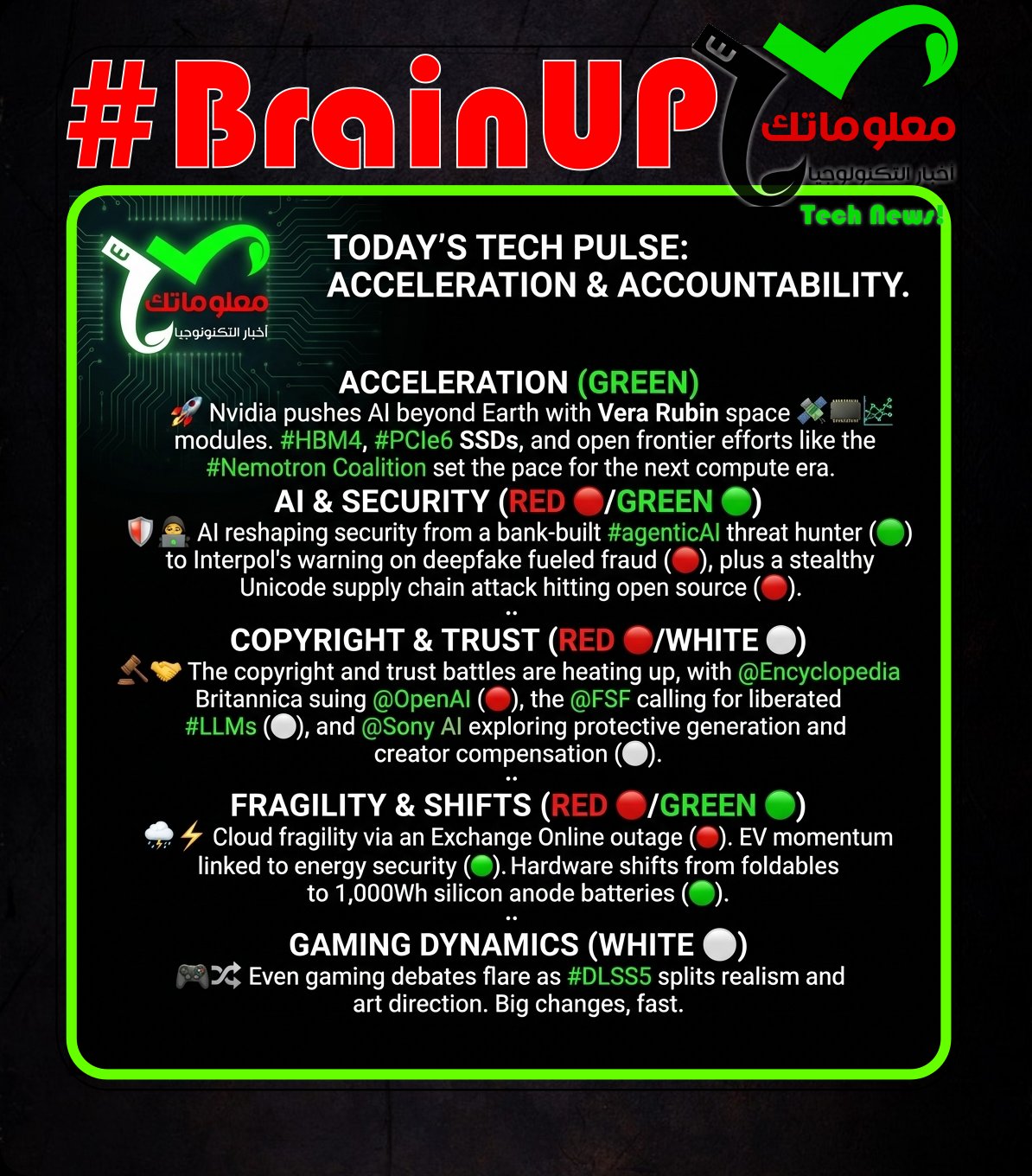
@Nvidia CEO @Jensen Huang unveiled the Vera Rubin Space Module at GTC 2026, positioning it for orbital data centers and claiming up to 25 times more AI compute than the H100 for orbital inference workloads. Nvidia says the module is built for running #LLMs and advanced foundation models in space, using a tightly integrated CPU-GPU design and a high-bandwidth interconnect to process large real-time data streams from space-based instruments. The company also outlined a broader stack: #IGX Thor for mission-critical edge systems with real-time AI, functional safety, secure boot, and autonomous operation, #Jetson Orin for SWaP-constrained satellites, and the RTX PRO 6000 #Blackwell Server Edition for geospatial intelligence, with a claimed up to 100 times uplift versus legacy CPU-based batch processing on large image archives. Nvidia reports six partners already using its platforms across orbit and ground, including Aetherflux, Axiom Space, Kepler Communications, Planet Labs PBC, Sophia Space, and Starcloud, with Kepler deploying Jetson Orin across its constellation for AI-driven data routing. While IGX Thor, Jetson Orin, and the RTX PRO 6000 Blackwell Server Edition are available now, the Vera Rubin Space Module has no release date and is slated for availability later.
Micron announced it has entered high-volume production of #HBM4 for @Nvidia’s Vera Rubin GPU platform, and said it is simultaneously shipping three Vera Rubin ecosystem products to volume: HBM4 memory, a #PCIe 6.0 data center SSD, and a new #SOCAMM2 module. Its 36GB 12-Hi HBM4 runs at over 11 Gb/s per pin and delivers over 2.8 TB/s of bandwidth, which Micron says is a 2.3x bandwidth increase and more than a 20% power-efficiency improvement versus its HBM3E at the same 36GB 12H configuration, based on internal power calculator data. Micron also reported sampling a 48GB 16-Hi HBM4 stack, which it says raises capacity per HBM placement by 33% compared with the 36GB 12H product. The company highlighted its 9650 SSD as the first #PCIe 6.0 SSD in mass production, claiming up to 28 GB/s sequential reads and 5.5 million random read IOPS, and described a 192GB SOCAMM2 module for Vera Rubin NVL72 and Vera CPU platforms, positioning these components as a combined foundation for next-generation AI systems in the Vera Rubin platform.
3. Bank built its own AI threat hunter because vendors can’t
Australia’s Commonwealth Bank built its own #agenticAI threat-hunting tools because security vendors move too slowly to keep pace with emerging AI-enabled threats, according to cyber defence operations GM Andrew Pade speaking at a #Gartner Security & Risk Management Summit. He said the bank’s threat-signal volume rose from about 80 million per week when he joined six years ago to 400 billion last week, and investigations found repeated attack backends with artifacts of AI coding tools, even when lures changed, making traditional defenses impractical. The bank created an agent that ingests external threat research, analyzes it against the bank’s own data, and flags risks across legacy systems, on-prem infrastructure, #SaaS, and cloud workloads, cutting time to assess new threats and generate reports from two days to 30 minutes. A second agent searches for indicators of compromise and produces rapid reports intended to shift analysts from repetitive work to problem solving, while also helping reduce burnout risk for graduates entering high-pressure security roles. Pade also noted challenges using AI in red-team work because AI-generated reports are non-deterministic, prompting the bank to introduce deterministic checkpoints and outcomes so its agents can make more repeatable predictions.
4. FSF urges AI vendors to liberate LLMs
The @Free Software Foundation is using the Bartz v. Anthropic settlement moment to urge @Anthropic and other AI vendors to release #LLMs in a way that preserves and expands user freedom. After receiving a settlement notice tied to a $1.5 billion fund for authors whose works were used without permission, the FSF noted that one training dataset included Sam Williams’s book Free as in freedom, which it says is co-published under the #GNU_FDL and already permits use for any purpose without payment. The FSF argues the “right thing” is to provide complete training inputs, the full model, training configuration settings, and accompanying software source code so users can use, study, modify, and share, aligning LLM distribution with the four essential freedoms. It also concedes it lacks resources for a prolonged legal fight, but says if its copyright or license were violated in a case like Bartz v. Anthropic, it would seek user freedom as compensation. The Register reports vendors are unlikely to comply absent a case reaching trial, and the FSF later clarified its goal is not to restrict use, but to ensure these systems respect the same freedoms for all users.
Sony’s AI R&D division, @Sony AI, has developed #ProtectiveAI (PA) to reduce copyright infringement in AI generated video and music while enabling fair compensation for creators and rightsholders. Reported by The Nikkei, the tool is designed to block obvious imitation such as “#Ghibli style” outputs and to resist indirect prompts by training on the source material and explicitly steering the model to generate results that diverge from that style. In parallel, PA aims to support attribution and payment when a rightsholder’s work contributes to a generated output, building on Sony’s previously mentioned experiments in music using “#unlearning algorithms” to estimate how much each training example influenced an output. This approach frames infringement prevention and compensation as coupled technical problems, not just a moderation layer. PA remains in the R&D phase and has not yet been adopted internally by Sony.
6. AI-driven fraud far more profitable, Interpol warns
Interpol warns that #AI-enhanced financial fraud is far more lucrative, estimating schemes using AI are 4.5 times more profitable because AI boosts both efficiency and effectiveness and makes fraud interactions more convincing. It says criminals commonly use #generativeAI to refine texts and emails, removing telltale language quirks and improving impersonation of major brands, while more advanced #deepfake tools can create convincing voice clones from as little as ten seconds of audio. Interpol also points to dark web “deepfake-as-a-service” synthetic identity kits, described as affordable, that are accelerating the industrialization and scaling of fraud operations, alongside broader growth in #fraud-as-a-service platforms, #largeLanguageModels, and #cryptocurrencies that lower barriers to entry. The agency is additionally concerned about future misuse of #agenticAI, which could automate victim research, credential gathering, vulnerability discovery for ransomware, and even ransom pricing based on stolen data value and a victim’s finances, though it notes this is not yet used at scale and experts differ on how soon it will surge. Member countries have also reported a rise in AI-driven sextortion using AI-generated imagery for blackmail, reinforcing Interpol’s view that digital technology and AI are turning fraud into an efficient global industry.
7. Unsealed court documents reveal Meta staff flagged 75 million annual child abuse reports
Unsealed court documents have revealed that Meta employees flagged about 75 million reports of child abuse annually on their platforms. These internal reports were part of a larger effort by Meta to address #childabuse content, reflecting a significant volume of harmful material spread across Facebook and Instagram. The high number of reports illustrates the challenge Meta faces in monitoring and moderating user-generated content to protect children online. Despite efforts to mitigate the problem, the documents suggest ongoing issues with the scale and impact of abusive content. This revelation highlights the complexities social media companies encounter in balancing user engagement with content safety.
In a @New York Times interview, @Peter Thiel said he is actively urging billionaires to avoid or withdraw from #TheGivingPledge, which asks the ultra-wealthy to commit to giving away at least 50% of their wealth, calling it an “Epstein-adjacent, fake Boomer club” and arguing the effort has lost energy and status. He said he has “strongly discouraged” people from signing and has “gently encouraged” some to “unsign,” and cited telling @Elon Musk to retract his pledge, warning that the money could go to “left-wing nonprofits” chosen by @Bill Gates. The article notes the pledge, launched in 2010 by @Bill Gates, @Melinda French Gates, and @Warren Buffett, has over 250 signatories but has seen fewer new participants recently, with four in 2024 and 14 in 2025, even as global billionaire counts exceed 3,400. It frames the development against widening U.S. wealth concentration, with the top 10% holding more than two-thirds of wealth per Federal Reserve data, and suggests a retreat from organized philanthropy could mean a tightening flow of elite giving. A Giving Pledge representative, @Taryn Jensen, responded that debate is welcome, the pledge helped establish giving norms, and many signatories have already met or are working toward their commitments to fund major challenges.
9. Elizabeth Warren asks Meta, Amazon, and others why they’re laying workers off despite tax perks
The article says @Elizabeth Warren is pressing major employers to explain why they are cutting jobs after receiving new corporate tax benefits. In letters to executives at @Microsoft, @Amazon, @HomeDepot, @Meta, @Nike, @Verizon, @Target, and @UPS, she asked them to report by March 30 how much of a 2025 tax cut they received under #OneBigBeautifulBillAct, whether they expect tariff refunds, and whether they contributed to @DonaldTrump projects, noting these firms account for tens of thousands of recent lost positions. Warren argues that in a strained labor market with slow job growth and intense competition, layoffs can push workers into lower paying jobs or unemployment, and she questions the rationale for job cuts following tax perks and strong profits. The story highlights #Meta as an example, citing an analysis that it paid just over a 3.5% effective federal income tax rate in 2025 and noting reporting that it is considering up to 20% layoffs, which Warren framed as potential “unchecked corporate greed”; a Meta spokesperson said her letter relied on speculative reporting. It also notes that companies cite differing reasons for layoffs, including #AI-driven productivity gains or efforts to reduce bureaucracy and improve efficiency, with examples including @Amazon’s 16,000 job cuts and @UPS plans affecting 30,000 positions tied in part to reducing Amazon deliveries.
10. Nvidia Makes Trillion-Dollar Forecast at Annual Product Expo
@Jensen Huang revealed that @Nvidia expects to generate around $1 trillion in revenue from its #AI chips by 2027, a dramatic increase from earlier projections of roughly $500 billion, underscoring the explosive and sustained demand for AI infrastructure. The forecast is driven primarily by Nvidia’s next-generation chip platforms including Blackwell and Rubin architectures, which are designed to power both training and the rapidly growing #AI inference workloads across hyperscale data centers. Huang emphasized that the industry is entering an “inference phase,” where running AI models at scale becomes the dominant compute challenge, significantly expanding the market opportunity beyond initial training use cases. Nvidia is also pushing into new domains such as custom CPUs, integrated AI systems, and even experimental data center deployments, positioning itself as a full-stack infrastructure provider rather than just a chipmaker. While the trillion-dollar projection highlights Nvidia’s central role in the AI economy, analysts note that it also reflects a broader structural shift where global spending on AI compute, data centers, and supporting hardware is scaling to unprecedented levels, reshaping the entire semiconductor and cloud ecosystem.
Australia could cut reliance on foreign fuel and improve economic security by accelerating #electric vehicle adoption, experts say. @Hussein Dia says each #EV replacing a petrol car eliminates that fuel demand and shifts transport energy use to electricity that is largely produced domestically, reducing exposure to global oil price shocks and improving system resilience. He estimates a typical petrol car driving 15,000km a year uses about 1,150 litres, so replacing 1m petrol cars could reduce fuel demand by more than 1bn litres annually, though he notes this would not happen quickly given there are about 420,000 EVs in a 20m-vehicle fleet. Analysis cited from the #Electric Vehicle Council says road transport burns about 25bn litres of diesel and petrol a year, and replacing half of vehicles could cut consumption by about 12bn litres, illustrating the scale of potential savings. A recent global energy shock linked to the US-Israel war on Iran has pushed Australian fuel prices higher, and @Alison Reeve suggests the crisis could change how Australians and policymakers view EVs, alongside sales data showing petrol and diesel cars fell to a record low share of new vehicle sales late last year.
12. Nvidia’s Nemotron coalition brings eight AI labs together to build open frontier models
@Nvidia announced the #Nemotron Coalition at GTC, bringing eight AI labs together to co-develop open frontier models on #NVIDIA_DGX_Cloud, with results feeding into the upcoming #Nemotron_4 family. Founding members include Black Forest Labs, Cursor, LangChain, @Mistral_AI, Perplexity, Reflection AI, Sarvam, and Thinking Machines Lab, and the first deliverable is a base model co-developed by Nvidia and @Mistral_AI that Nvidia plans to open source when complete. Members will contribute data, evaluation frameworks, and domain expertise during post-training, including multimodal work from Black Forest Labs, coding benchmarks from Cursor, and tool use plus long-horizon reasoning evaluation from LangChain. Nvidia also introduced a new generation of open models such as #Nemotron_3_Ultra on #Blackwell with NVFP4 for higher throughput efficiency, plus #Nemotron_3_Omni and #Nemotron_3_VoiceChat, and highlighted robotics models #Isaac_GR00T_N1.7 and a preview of #GR00T_N2 targeted for shipment by end of 2026. The announcement ties Nvidia’s broader push for open models across agentic AI, robotics, autonomous vehicles, and drug discovery, including upcoming #Cosmos_3 and the #Proteina_Complexa model within the #BioNeMo platform.
13. OpenAI to Cut Back on Side Projects in Push to ‘Nail’ Core Business
@OpenAI is planning a major strategic shift to scale back experimental side projects and refocus on core products like #ChatGPT for coding and enterprise productivity, after internal concerns that spreading resources too thin has weakened its competitive position. Leadership, including @Sam Altman and applications chief @Fidji Simo, warned internally that pursuing too many initiatives at once has created operational complexity and diluted impact, prompting a move to prioritize high-value areas such as developer tools, business workflows, and professional AI use cases. The company had previously expanded aggressively into areas like video generation, browsers, hardware, and e-commerce features, but is now reassessing which efforts to deprioritize in order to “nail” productivity and enterprise adoption. This shift is partly driven by intensifying competition from rivals like @Anthropic, whose developer-focused tools have gained traction and pressured OpenAI to sharpen its focus on practical, revenue-generating applications. The decision reflects a broader maturation phase in the AI industry where companies are moving from experimentation to execution, monetization, and dominance in specific high-impact domains.
14. Supply-chain attack using invisible code hits GitHub and other repositories
Researchers at Aikido Security report a #supply-chain attack in which malicious packages hide key functions and payloads in Unicode characters that are invisible in most editors and code review interfaces, undermining manual review and many traditional defenses. They found 151 such packages uploaded to GitHub between March 3 and March 9, and say similar activity has also hit NPM and Open VSX, with the visible parts of the packages crafted to look like realistic documentation tweaks, version bumps, and minor refactors. The hidden content uses Unicode #PrivateUseAreas so reviewers and static tools may see only whitespace, while a JavaScript runtime can decode the code points into executable bytes and pass them to eval(). Aikido and security firm Koi suspect the group they call Glassworm is using #LLMs to generate convincing, high-volume changes that would be impractical to craft manually. The incident extends a Unicode concealment technique that resurfaced in 2024 for hiding malicious prompts from humans while remaining readable to AI systems, and now is being applied to more traditional malware distribution through open-source packages.
15. New magnet breakthrough could revolutionize RAM, SSDs, HDDs and indirectly end shortage
Researchers have developed a new type of magnet that could significantly enhance the performance and efficiency of RAM, SSDs, and HDDs, which are crucial components in modern electronics. This breakthrough involves a material that exhibits both strong and tunable magnetic properties, potentially allowing for faster data storage and reduced energy consumption. The innovation addresses current limitations in memory and storage technology caused by conventional magnetic materials, which restrict scaling and speed. By enabling higher-density storage and improved reliability, this discovery could alleviate ongoing supply shortages of electronic components. This advancement promises broad impacts on the technology industry, fostering improved devices and more accessible electronics worldwide.
Volkswagen Group China is shifting its China EV strategy toward locally developed #automotiveChips and says it has no reason to rely on @Nvidia there, according to CTO Thomas Ulbrich. He said Volkswagen is using Chinese partners, including a joint venture with #HorizonRobotics and a partnership with #Xpeng, whose “Turing” chip is inside Volkswagen’s first all-electric SUV, the ID. UNYX 08, which began production in Hefei with China deliveries planned by the end of June. The vehicle includes #L2 #ADAS, and Ulbrich expects Volkswagen cars in China to reach #L3 capabilities in about two years, a step that would shift accident liability from drivers to manufacturers once regulators allow L3 use. He also said AI integration will arrive faster in factories than in cars, and that Volkswagen is already adding AI-powered functions in manufacturing, linking the company’s move away from engines to a future where software and chips drive what customers value in “smart EVs.”
17. Encyclopedia Britannica is suing OpenAI for allegedly ‘memorizing’ its content with ChatGPT
@Encyclopedia Britannica and Merriam-Webster sued @OpenAI, alleging it used their copyrighted reference content to train #AI models and that #ChatGPT outputs near-identical copies of their text. The complaint claims #GPT-4 has “memorized” substantial portions of Britannica’s works and can produce near-verbatim passages on demand, with side-by-side examples showing word-for-word matches. Britannica also argues OpenAI’s answers cannibalize its web traffic by substituting for Britannica’s site instead of directing users there like a traditional search engine. The suit is framed as part of a broader wave of publisher copyright actions against AI companies, similar to claims by @The New York Times, and it follows other legal outcomes such as @Anthropic’s settlement over training on copyrighted books. The filing centers on alleged unauthorized copying for training and outputs that directly compete with the publishers’ content.
18. Microsoft Exchange Online outage blocks access to mailboxes
A Microsoft Exchange Online outage disrupted mailbox access for many users, preventing email retrieval and sending. The issue was caused by a backend service affecting mailbox access, with Microsoft acknowledging the problem and working on a fix. Users reported seeing errors such as ‘Unable to get mailbox information’ when trying to access their emails through Outlook and other clients. Microsoft updated that the service was recovering, and normal functionality was expected soon. This incident highlights the dependency on cloud services like Microsoft Exchange Online for business communication and the impact of backend service failures on user productivity.
Israeli journalist @Emanuel Fabian said he faced escalating harassment and death threats from gamblers who wanted him to alter an accurate report about an Iranian missile impact, apparently to influence the outcome of a #Polymarket bet. Fabian reported on March 10 that an Iranian missile struck Israeli territory near Beit Shemesh, citing rescue services and footage of a large explosion, and said military sources later confirmed it was a missile, not interceptor debris. He then received repeated emails, Discord messages, and posts pressuring him to change the wording, and he concluded the campaign was aimed at determining whether a prediction market about an Iran strike on Israel that day would resolve “Yes” or “No,” since the rules exclude intercepted missiles from counting. Fabian said what he thought was a minor wartime incident became days of threats, as users had placed money on the market, which had drawn over $14 million in wagers by March 16. The episode highlights how #cryptocurrency-based #prediction markets tied to real-world conflict events can create incentives to pressure or threaten reporters over factual coverage.
20. Saudi Arabia Buys More Capcom As Resident Evil 9 Sales Explode
@Capcom’s new hit @Resident Evil Requiem is breaking franchise records as Saudi Arabia increases its financial footprint in the publisher. Capcom said Requiem reached 6 million sales in its first couple of weeks, becoming the fastest-selling entry in the series, and the company is planning ongoing support and additional content with DLC rumored later this year ahead of the franchise’s 30th anniversary. GameBiz reports that Saudi Arabia’s Electronic Gaming Development Company, an investment subsidiary under Crown Prince Mohammed bin Salman’s MiSK foundation, bought a 5 percent stake in Capcom, adding to an existing 5 percent stake held by the Saudi Public Investment Fund, while the MiSK-linked group says the purchase is a “pure investment.” The move fits a broader strategy that includes Savvy Games Group acquisitions and consolidated control of #Evo, even as Saudi gaming expansion is framed as both profit-seeking and a soft-power play amid geopolitical strain including the U.S. and Israel war against Iran and its regional and economic fallout. With Saudi-backed efforts reportedly still pursuing more deals and a friendly @Trump administration seen as unlikely to block the $55 billion push to buy @Electronic Arts, Capcom’s sales surge becomes another timely asset in the Kingdom’s accelerating #gaming-investment campaign.
21. THOR AI solves a 100-year-old physics problem in seconds
Researchers at The University of New Mexico and Los Alamos National Laboratory introduced the #THOR AI framework to compute how atoms interact in materials by directly evaluating difficult statistical-physics calculations in seconds rather than weeks. THOR applies #tensor network algorithms to extremely large #configurational integrals and related partial differential equations, then combines this with #machine learning potentials to capture how atoms interact and move across a wide range of physical environments. The work targets the long-standing bottleneck where molecular dynamics and Monte Carlo simulations only estimate configurational integrals indirectly and become impractical under the #curse of dimensionality, often requiring weeks of supercomputer time while remaining approximate. By enabling faster, accurate calculation of key thermodynamic and mechanical properties, the approach is positioned to improve understanding of statistical mechanics and speed progress in materials science applications such as extreme pressures and phase transitions.
22. Federal judge blocks RFK Jr.’s changes to childhood vaccine schedule
A federal judge in Massachusetts blocked @Robert F. Kennedy Jr.’s overhaul of the CDC childhood vaccine schedule and paused actions by the CDC’s #Advisory Committee on Immunization Practices (#ACIP), following a lawsuit from the American Academy of Pediatrics and other medical groups alleging the changes violated federal law. The January revisions reduced the number of diseases covered in the recommended schedule from 18 to 11, dropping recommendations for routine protection of babies against hepatitis A, hepatitis B, RSV, dengue, and two types of bacterial meningitis. The order also put on hold Kennedy’s new ACIP appointees, stayed ACIP votes taken since June, and effectively halted the panel’s planned meeting, which HHS confirmed was postponed. Medical organizations said they would ignore the revised schedule and follow the AAP’s immunization schedule, while experts cited confusion and declining trust in public health agencies during @Donald Trump’s second term. HHS said it will appeal, as the ruling disrupts Kennedy’s broader efforts to reshape #vaccine policy, including replacing all 17 ACIP members, changing vaccine testing rules, and limiting access to #Covid vaccines for people under 65.
23. Benjamin Netanyahu is struggling to prove he’s not an AI clone
Social media conspiracy theories claim @Benjamin Netanyahu was killed or injured and replaced with #AI #deepfakes, with users citing a livestream clip that appears to show six fingers and other oddities like a “bottomless” coffee cup. The article says there is little credible evidence he is not alive, and notes fact-checkers including Snopes and PolitiFact argue the “extra finger” can be explained by video quality degradation and lighting, plus the nearly 40-minute livestream is far longer than what current #AI video models typically generate. Netanyahu tried to rebut the rumors by posting a proof-of-life video on X in a coffee shop asking someone to count his fingers, but commenters then highlighted alleged inconsistencies such as unnatural liquid behavior, a ring seemingly clipping into skin, and a register displaying a 2024 date. The piece argues these debates illustrate how #generativeAI undermines visual trust, making it hard to conclusively prove authenticity or falsity from the videos alone. It adds that neither clip includes verification metadata such as #C2PA Content Credentials or #SynthID, leaving viewers without strong tools to assess what they are seeing.
Nvidia has announced #DLSS5, a new version of its image enhancement technology that uses an #AI model to alter supported games with “photoreal lighting and materials,” which it calls a major advance since real-time ray tracing. Nvidia says the system uses each frame’s color and motion vectors to add lighting and materials anchored to the source 3D content, and that developers can tune intensity, color, and masking to preserve a game’s aesthetic, with release planned for the fall and demos shown for titles like Resident Evil Requiem, Starfield, and Assassin’s Creed Shadows. Despite this, multiple industry professionals criticized the results for changing original art direction and producing uncanny character looks, with Respawn rendering engineer Steve Karolewics describing it as an overbearing contrast, sharpness, and airbrush filter, and concept artist Jeff Talbot calling it a “garbage AI Filter.” Nvidia said publishers including Bethesda, Capcom, NetEase, NCSOFT, S-GAME, Tencent, Ubisoft, and Warner Bros. Games will support it, and Bethesda later stated the Starfield footage was an early look and that its art teams will further adjust the final effect under artist control.
25. Primordial magnetic fields could resolve the Hubble tension and other cosmic mysteries
An international team reports simulation-based evidence that #primordial magnetic fields formed shortly after the Big Bang could reconcile the #Hubble tension and help explain otherwise puzzling cosmic magnetism. The researchers modeled how early-universe magnetic fields interacted with plasma during the first few hundred thousand years, including around #recombination, and found the fields can induce uneven matter distributions consistent with improved agreement between calculated and observed values of the #Hubble constant. They argue this added early-universe physics makes key cosmological measurements “match better,” addressing a major mismatch between expansion-rate estimates derived from theory versus observations. The work also bears on the origin of magnetic fields seen in galaxy clusters and in large cosmic voids, which are difficult to explain purely through later astrophysical processes. The results, led by Karsten Jedamzik with collaborators including @Tom Abel and @Levon Pogosian, are reported in Nature Astronomy.
26. Reddit User Uncovers Who Is Behind Meta’s $2B Lobbying for Invasive Age Verification Tech
A @Reddit researcher alleges #Meta funneled more than $2 billion through nonprofit shells across 45 states to push #ageVerification laws that would require #Apple and #Google to build operating system level surveillance style infrastructure while exempting Meta’s own platforms. The GitHub user “upper-up” traces funding to groups such as the Digital Childhood Alliance, launched December 18, 2024, which testified for Utah’s SB-142 days later, with reporting cited from Bloomberg and Deseret News and a $70 million fragmented super PAC approach described as evading typical FEC disclosure. The bills are described as mandating OS level “Get Age Category API” mechanisms that apps can query, creating a persistent identity layer and enabling device fingerprinting, with Meta’s Horizon OS for Quest VR cited as already implementing similar controls via Family Center. The article argues the policy framing of child safety masks a competitive strategy that shifts compliance burden and liability to app stores and operating system makers while sparing social media platforms where Meta’s business sits. As a contrast, it points to the EU’s #eIDAS2.0 Digital Identity Wallet using #zeroKnowledgeProofs for privacy preserving age checks, and warns the US approach could pressure Linux distributions and privacy focused Android forks to implement identity verification or face legal risk.
27. NVIDIA DLSS 5 Delivers AI-Powered Breakthrough In Visual Fidelity For Games
NVIDIA unveiled #DLSS5 as a real-time neural rendering model aimed at closing the gap between real-time game rendering and Hollywood-level photorealism by infusing pixels with photoreal lighting and materials. The article says this is NVIDIA’s most significant graphics breakthrough since real-time #rayTracing debuted in 2018, and quotes @JensenHuang calling it the “GPT moment for graphics,” blending hand-crafted rendering with generative AI while preserving artist control. It argues brute-force rendering cannot match offline VFX within a 16-millisecond game frame, even after major NVIDIA innovations such as programmable shaders, #CUDA, ray tracing, and later path tracing and neural shaders, alongside a stated 375,000x compute increase. Building on #DLSS adoption in 750+ games and #DLSS4.5 drawing 23 out of every 24 on-screen pixels, #DLSS5 shifts focus from performance to fidelity by using per-frame color and motion vectors to produce deterministic, consistent results anchored to the game’s 3D content. NVIDIA states #DLSS5 runs in real time at up to 4K resolution to support smooth, interactive gameplay while delivering more realistic visuals.
@Nvidia announced #DLSS5, a new version of its image enhancement tech that uses an AI model to alter supported games with what it calls “photoreal lighting and materials,” and says it is a major graphics breakthrough. The company says #DLSS5 takes each frame’s color and motion vectors and applies enhancements anchored to the source 3D content, with developer controls for intensity, color, and masking, and it is shown changing the look of games including Resident Evil Requiem, Starfield, and Assassin’s Creed Shadows, with a fall release planned and support claimed from publishers such as Bethesda, Capcom, Ubisoft, and Warner Bros. Games. Industry professionals criticized the reveal for drastically changing original art direction and producing uncanny character results, with Respawn rendering engineer Steve Karolewics describing it as an overbearing contrast, sharpness, and airbrush filter, and concept artist Jeff Talbot calling it “a garbage AI Filter” that makes shots look worse and less distinctive. Others noted the environments can look improved but worried artistic expression could be squeezed out and questioned how much developers can tune the model to match intent. In response, Bethesda said the Starfield footage was an early look and its art teams will further adjust the lighting and final effect, emphasizing it will be under their artists’ control.
29. Samsung ends Galaxy Z TriFold sales three months after launch
@Samsung is reportedly ending Galaxy Z TriFold sales in South Korea on March 17, about three months after it went on sale, while the US model will remain available only until existing inventory runs out. According to South Korean newspaper Dong-A Ilbo, Samsung treated the TriFold as a limited-run #technology showcase, selling small online batches that sold out in minutes and moving roughly 3,000 units across the first two allotments, with no media review units sent out. Industry sources said rising component costs like DRAM and NAND flash left virtually no profit margin, and the phone even briefly traded for nearly three times its retail price on South Korea’s secondary market. Engadget notes the device felt solid in limited hands-on time, contrasting with the original Galaxy Fold’s 2019 delay after early review units broke. Overall, the reported wind-down suggests the TriFold was designed to demonstrate foldable capabilities rather than sustain mass-market production or meaningful revenue.
30. 10 Audio Improvements in Apple’s New AirPods Max 2
@Apple refreshed AirPods Max 2 by replacing the H1 with the #H2 chip and adding an updated high dynamic range amplifier, enabling a slate of audio upgrades. The article lists improvements such as up to 1.5x stronger #ActiveNoiseCancellation via new computational audio, #AdaptiveAudio with #Transparency changes for more natural sound, and features like #LoudSoundReduction, #PersonalizedVolume, and #ConversationAwareness. It also cites higher-fidelity playback gains, including richer bass, more natural vocals, better instrument localization, and a retuned #AdaptiveEQ that extends to higher frequencies for more consistent listening across fit and movement. Call and creator audio benefit from #VoiceIsolation, and wireless performance improves through reduced latency and an upgrade to #Bluetooth5.3. The piece notes there are no design changes, and highlights that a wired USB-C connection enables 24-bit/48kHz lossless audio, positioning lossless playback as a key advantage versus AirPods Pro.
A China-based repair expert, DirectorFeng, modified the base 256 GB Apple MacBook Neo to have 1 TB of internal storage by performing a direct #NAND chip swap and reflashing macOS to recognize the new SSD. In a teardown video, he disassembled the laptop, removed the logic board, heated and detached the original NAND by working through BGA glue, cleaned the solder pads, and installed a higher-capacity 1 TB module before reassembling the device. He then connected the Neo to another MacBook over USB to flash macOS, reapplied BGA glue, and used a reflow oven so the glue would set properly. After verification, the system reported 994.61 GB under “Macintosh HD,” which the article describes as the first MacBook Neo with a terabyte of storage. The piece notes the upgrade has diminishing returns for a budget laptop because parts and labor could make an external drive a more sensible option, and it raises potential data-safety concerns with a modded SSD.
32. Oppo, OnePlus, and Vivo officially announce smartphone price increase in China
Oppo, OnePlus, and Vivo are officially raising smartphone prices in China as rising #RAM and #semiconductor costs push brands to adjust pricing. @Oppo and @OnePlus posted a Weibo price table showing increases of 500 yuan for the Oppo K13 Turbo and K13 Turbo Pro, up to 400 yuan for the K13x, and 200 yuan for the K13s and K12s, while @OnePlus raised the OnePlus 15 and Ace 6 by 500 yuan to new starting prices of 4,499 yuan and 3,099 yuan, and increased the Ace 6T to 2,799 yuan from 2,599 yuan. The OnePlus Turbo 6 and Turbo 6V also rose by 200 yuan. @Vivo and sub-brand @iQoo said select devices will get price increases starting 18 March in China. The moves align with a prior leak that next-generation OnePlus, iQoo, and Redmi flagships with #2nm chipsets could start at 5,000 yuan, and while China hikes could affect global markets, no global price increases have been announced.
33. Android tablets and foldables are getting a Chrome bookmark bar
#Google is rolling out a #Chrome bookmark bar for Android tablets and foldables to make browsing on larger mobile devices feel more like the desktop experience. Spotted by 9to5Google, the feature arrives in version 146 of Chrome for Android and places the bookmarks bar below the Omnibox, showing favicons and site names. Users can scroll through bookmarks via a chevron, and long-pressing a bookmark reveals the full URL. The option is not enabled by default, as devices are set to “Hidden on narrow screens,” so users must turn it on in Settings, Appearance, then “Show bookmarks bar.” This update targets people doing more robust computing on big-screen mobile devices by bringing a familiar desktop-style navigation tool to Android form factors.
Lenovo has introduced next-generation workstations alongside the world’s first 1,000 Wh L-Silicon anode battery designed for notebooks and workstations. This breakthrough battery technology leverages #lithium-ion advancements with silicon anode materials to significantly increase energy density and battery life, enabling longer usage without recharging. The new workstations integrate these batteries to support high-performance computing needs, addressing the demands of professionals in fields requiring robust processing power and mobility. By advancing battery capabilities and workstation design, Lenovo positions itself at the forefront of portable power and performance. This innovation promises enhanced productivity for users reliant on durable, long-lasting mobile workstations.
That’s all for today’s digest for 2026/03/17! We picked, and processed 34 Articles. Stay tuned for tomorrow’s collection of insights and discoveries.
Thanks, Patricia Zougheib and Dr Badawi, for curating the links
See you in the next one! 🚀
