
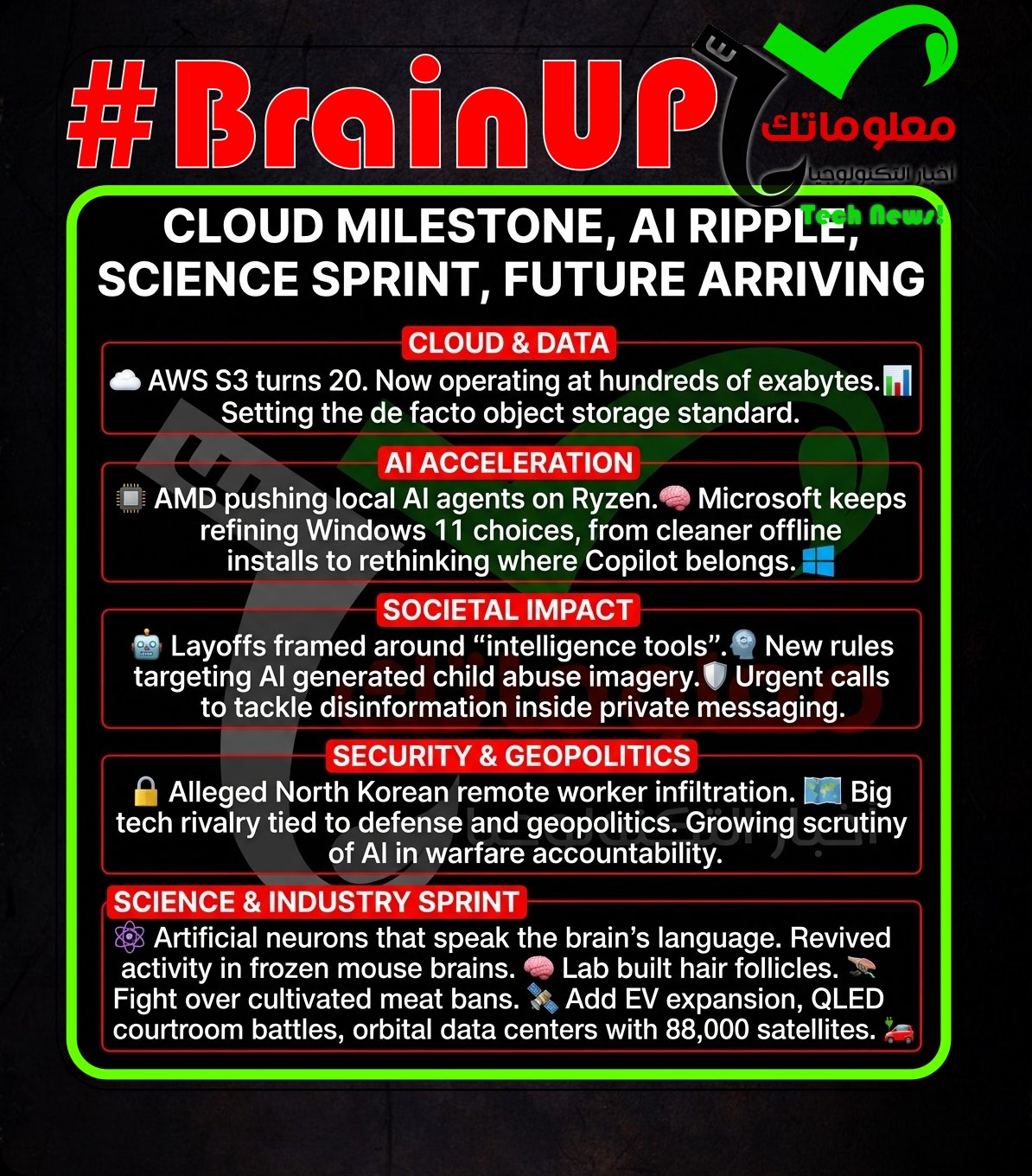
#BrainUp Daily Tech News – (Monday, March 16ᵗʰ)
Welcome to today’s curated collection of interesting links and insights for 2026/03/16. Our Hand-picked, AI-optimized system has processed and summarized 26 articles from all over the internet to bring you the latest technology news.
As previously aired🔴LIVE on Clubhouse, Chatter Social, Instagram, Twitch, X, YouTube, and TikTok.
Also available as a #Podcast on Apple 📻, Spotify🛜, Anghami, and Amazon🎧 or anywhere else you listen to podcasts.
1. AWS S3 turns 20 and reaches ‘hundreds of exabytes’
#AWS S3 marked its 20th anniversary with @Amazon Web Services disclosing how the service has grown from a small 2006 launch to a global platform storing data at massive scale. According to a post by principal developer advocate @Sébastien Stormacq, S3 began on March 14, 2006 with about one petabyte across roughly 400 storage nodes in three data centers, and now stores more than 500 trillion objects, serves over 200 million requests per second, and spans hundreds of exabytes across 123 Availability Zones in 39 regions. Stormacq highlighted long-term #API backward compatibility as a key achievement, stating code written for S3 in 2006 still works, and noted the #S3 API became an industry reference adopted by multiple vendors for S3 compatible storage. The article also describes S3’s broader impact, from enabling startup backup vendors and supporting large-scale users like @Netflix and @Spotify, to security issues from initially public-by-default access and notable outages such as the 2017 US-EAST-1 incident. It ties the anniversary to “Pi Day” context, including rival Backblaze offering a 130TB download of Pi to 314 trillion digits split into 200GB objects, underscoring how cloud storage has normalized handling extremely large datasets.
2. AMD unveils OpenClaw to run AI agents locally on Ryzen
AMD has introduced OpenClaw, a software framework designed to run AI agents locally on Ryzen processors, enhancing privacy and performance by avoiding cloud dependency. OpenClaw supports various AI models and enables developers to deploy autonomous agents for diverse applications right on personal devices. This approach capitalizes on Ryzen’s processing power to deliver real-time AI interactions without latency or data security concerns associated with cloud services. AMD’s move addresses growing demand for on-device AI solutions, aligning with industry trends favoring local computation to enhance user control and reduce bandwidth. By integrating OpenClaw, AMD strengthens its position in the AI ecosystem, offering an alternative to cloud-based AI and expanding Ryzen’s capabilities beyond traditional computing.
The article explains how to do a clean #Windows11 install using the latest monthly refreshed ISO while bypassing several default setup requirements, including installing without an internet connection or a @Microsoft account by using third party media creation steps. It outlines options such as WinRE Cloud Download for existing installs, or creating bootable external media via @Microsoft’s Media Creation Tool or by downloading the x64 ISO and writing it with #Rufus. It notes that Microsoft now updates installation ISOs monthly, reducing post install update downloads, and recommends pre downloading key drivers, especially GPU and possibly chipset drivers, while warning that Windows Update GPU drivers are inferior. Using Rufus with the ISO, the guide says you can select options that remove many security oriented install checks and install on older hardware, while cautioning that systems with under 4GB RAM will be very slow and that disabling #SecureBoot and #TPM2.0 can prevent some applications, such as Riot games, from working. Overall, it positions an ISO plus Rufus workflow as a practical way to perform a fast, fresh Windows 11 install with fewer enforced requirements than the standard setup path.
4. Block & Meta Layoffs Spark Heated Group Chat Debates
In 2026, AI-driven restructuring at major tech companies is reshaping jobs and fueling intense discussion in interest-based group chats on Tribe Chat. Block cut roughly 4,000 roles, described as nearly 40% of its workforce, with @Jack Dorsey attributing the move to productivity gains from “intelligence tools” and predicting other companies will follow, as Block’s stock reportedly jumped about 20 to 24%. Reports from Reuters say Meta is planning layoffs affecting 20% or more of its nearly 79,000 employees, about 15,000 to 16,000 roles, to offset soaring #AI infrastructure spending, including plans for $600 billion in data centers by 2028, though Meta has not officially confirmed the cuts. These stories dominate Tribe Chat rooms where members debate whether #AI replaces job categories or makes workers far more productive, whether leaders are “AI-washing” to justify cuts, and how roles like engineers, PMs, marketers, and creatives should respond. The article positions Tribe Chat as a high-signal, on-topic alternative to traditional social media and large Discord servers for real-time #AITrends discussion and collaboration.
5. Alibaba Creates AI Tool for Companies to Ride China’s AI Agent Craze
@Alibaba is developing a new enterprise platform that allows companies to quickly build and deploy autonomous #AI agents, aiming to capitalize on China’s rapidly growing enthusiasm for software systems that can perform tasks independently rather than simply respond to prompts. The tool is designed to help businesses create AI agents that automate activities such as customer service, workflow management, and digital commerce operations, lowering the technical barrier for companies that want to integrate agentic AI into their operations. The system will rely on Alibaba’s #Qwen large language models and is expected to connect with major services across the company’s ecosystem including Taobao and Alipay, enabling agents to move from understanding user intent to executing transactions and completing tasks automatically. The initiative reflects a broader surge of interest in agent-based AI systems in China, where companies are racing to build assistants that can carry out complex sequences of actions across apps and services rather than just generating text. Analysts see the strategy as part of Alibaba’s effort to strengthen its position in the AI infrastructure market while embedding AI automation directly into the country’s vast digital commerce platforms.
6. Micron plans second chip facility on newly acquired Taiwan site
Micron Technology is planning to build a second semiconductor manufacturing facility at a newly acquired site in Taiwan, aiming to expand its production capacity for memory chips. The company recently purchased the new site to strengthen its position amid growing global demand and intensifying competition in the chip industry. This move highlights Micron’s strategic focus on enhancing supply chain resilience and tapping into the technology ecosystem in Taiwan, a key hub for semiconductor manufacturing. The expansion is expected to support Micron’s long-term growth and contribute to global chip supply stability. By investing in Taiwan, Micron aligns with industry trends of diversifying manufacturing locations to mitigate geopolitical risks and meet evolving market needs.
Apple’s ongoing challenges with its #Siri project have not only hindered the assistant’s performance but also disrupted the release of various physical products. According to a report, internal delays within the Siri development have caused setbacks for devices that rely heavily on voice and AI capabilities, affecting Apple’s schedule and potentially its market competitiveness. These complications reflect broader issues within Apple’s AI initiatives, signaling struggles to integrate advanced voice technology seamlessly. The setbacks underline the critical role of AI and voice recognition in modern device ecosystems and suggest that overcoming these hurdles is essential for Apple to maintain its innovation lead. Overall, Apple’s Siri-related issues exemplify how software difficulties can ripple across hardware launches, emphasizing the intertwined nature of technology development.
8. Microsoft ditches plans to inject Copilot into a key part of Windows 11
Microsoft has abandoned its initial plan to integrate Copilot, its AI assistant, into the Windows 11 taskbar. Originally envisioned as a central feature, Copilot’s role in the taskbar will now be limited or removed. This change reflects a shift in Microsoft’s approach to embedding AI tools within the operating system, possibly responding to user feedback or technical challenges. While Copilot’s broader presence in Windows 11 continues, the modification indicates a more cautious integration strategy. The decision underscores Microsoft’s evolving balance between innovation in AI and user experience within #Windows11.
9. Scientists create the first artificial neuron capable of communicating with the human brain
Researchers led by @Jun Yao at the University of Massachusetts Amherst built an #artificial neuron that operates in the same low-voltage range as living nerve cells, enabling direct electrical communication with biological tissue. In lab tests, the circuit produced neural-like spikes near 0.1 volts and reproduced biological-like voltage levels, timing patterns, and energy use, addressing the prior limitation that artificial neurons typically required much higher voltage and power. The core component was a #memristor tuned with bacterial protein nanowires from Geobacter sulfurreducens, which switched on near 60 millivolts and self-reset to mimic the rise, fall, and refractory period of real neural spikes, allowing outputs to trigger additional artificial neurons. The device also showed #neuromodulation-like behavior: sodium altered reset speed and firing frequency, while dopamine sensed via graphene produced dose-dependent increases or decreases in activity. When linked to beating cardiomyocytes through a soft mesh of graphene sensors, normal rhythms kept the artificial neuron silent, but drug-accelerated cell activity triggered spikes, illustrating how matching biological voltage and chemical context can move bioelectronic interfaces closer to practical networks.
10. BYD’s Brazil plant secures 100,000 vehicle orders from Argentina and Mexico
@BYD says its Brazil plant has secured export orders totaling 100,000 vehicles for Argentina and Mexico, underscoring its push to grow in Latin America. Executive Vice President @Stella Li announced in Rio de Janeiro that the orders are split evenly, 50,000 vehicles for Argentina and 50,000 for Mexico, and noted the Camaçari, Bahia plant began production on July 1, 2025 with 150,000 units of annual capacity and plans to scale to 600,000 in phases. The site will build both #PHEV and #EV models including the Dolphin Mini, BYD King, and Song Pro, as Brazil has become BYD’s largest market outside China with about 113,000 vehicles sold last year. Li also said BYD will invest 300 million reais (about 53 million USD) in a Rio de Janeiro research center starting this year and targeted for completion by 2028 to test performance and collect tropical climate data for local product and technology adaptation. The article links these moves to rising reliance on exports amid domestic pressure, citing a January year on year sales drop in China and export volumes near or above 100,000 units, alongside initiatives like the Linghui ride hailing brand and #BladeBattery 2.0.
11. He was a perfect hire — until a U.S. company exposed him as a likely North Korean operative
Nisos, a Virginia-based corporate security and investigations firm, used a job interview and subsequent controlled “hire” to expose “Jo” as a likely participant in a North Korean remote-worker scheme with U.S. national security implications. Jo presented himself as a Florida-based applicant for an #AI role, but raised immediate red flags, including referencing a hurricane that had not occurred and abruptly logging off when asked to share his screen, prompting Nisos to ship him a laptop to observe his behavior and collect technical and open-source intelligence. U.S. agencies have warned that North Korea has spent a decade placing remote workers at U.S. companies to funnel salaries back to the regime, evade sanctions, and in some cases steal sensitive information tied to illicit programs like weapons of mass destruction and ballistic missiles, with the @FBI calling the activity increasingly malicious and the @Department of Justice labeling it a “code red.” Over roughly three months, Nisos says it identified an apparent network of at least 20 suspected North Korean operatives, with evidence suggesting some were based in China, who collectively applied to at least 160,000 roles and were employed by five U.S.-based companies. The case illustrates how professional-seeming remote candidates can be part of a large-scale, financially and strategically motivated operation, and how private-sector investigations can provide rare real-time visibility into the scheme’s methods and scale.
12. How Iranians are evading internet blocks to contact family abroad
Iranians are using improvised, often costly methods to get around wartime restrictions that block international phone calls and limit internet access, so they can contact family abroad. At the Iran Turkey border, a man relays calls by holding two phones together, one on the Iranian network and one on the Turkish, so people can connect via #WhatsApp, but calls are patchy, often drop after two or three minutes, and can cost about £28 for four or five minutes once transfer fees are included. Inside Iran, people like Hamid rely on a #VPN to bypass restrictions for messaging and calls, yet he says prices have surged to about £15 per gigabyte, connections are extremely unstable, and purchased data is lost if the link drops. Individuals abroad, including Negar in Toronto and Shadi in Melbourne, describe receiving brief, reassuring calls while fearing for relatives under bombardment and near sensitive sites, with families sharing phone numbers and gathered updates whenever connectivity briefly returns. These workarounds show both the demand to maintain human contact during crisis and how network controls push communication into fragile, expensive channels.
13. It’s not just a game. Your Pokemon Go player data is training AI map models.
@Niantic says player-submitted scans from #PokemonGo and other games are being used to build a “large geospatial model” aimed at #spatialIntelligence and AI mapping of the physical world. The company says the model trains on geolocation information from optional scans of specific publicly accessible locations, and that merely walking around playing does not train the model. Over the past five years, Niantic has built a #visualPositioningSystem that uses a phone image and a 3D map created from scans, and it says it has about 10 million scanned locations with roughly 1 million new scans each week. The company argues its data is distinctive because it captures places from a pedestrian perspective, including areas vehicles cannot reach, while a privacy expert at @JohnsHopkinsUniversity warns that accumulating large troves of personal and location data can create risks even with good intentions. Niantic’s privacy policy says it collects location and other personal data, provides a separate children’s policy and parent portal, and a spokesperson says it does not sell players’ personal information, underscoring the need for users to be mindful about what they share.
14. Amazon and Google Embroiled in Persian Gulf War Tech Rivalry
Amazon and Google are competing fiercely in the Persian Gulf technological sector, aiming to dominate markets driven by governmental and military contracts. Amazon’s cloud computing division has secured several high-profile defense deals, leveraging its strong infrastructure and experience in large-scale data management. Meanwhile, Google has invested heavily in AI and cybersecurity solutions tailored for the complex requirements of the Gulf states, focusing on innovation in threat detection and response. This competition highlights how #tech giants are influencing geopolitical dynamics by aligning with national security priorities, impacting regional technological advancement and economic power balances. The rivalry between these corporations illustrates a broader trend of tech firms shaping future conflicts and alliances through digital capabilities.
A Munich court has ordered TCL to stop advertising and selling certain TV models as #QLED in Germany, ruling that the sets did not provide the color reproduction consumers would expect from #QLED and that this breached Germany’s unfair competition law. The case was brought by @Samsung, and similar legal actions are expected in other countries, including the US, with the core allegation being deceptive marketing of what counts as #QLED. The dispute also echoes late-2024 reporting about commissioned tests (by SGS and Intertek for Hansol Chemical) that said key #quantum dot materials like indium and cadmium were not detected in several TCL QD TV models, while TCL disputed those findings and published its own tests using a different methodology. The article notes that TCL’s reviewed picture performance has generally aligned with its stated specs and typical marketing-to-real-world variance, but the court decision still restricts the company’s ability to market specific models as #QLED in Germany, and further litigation is developing elsewhere.
17. Europe takes first step to banning AI-generated child sexual abuse images
Europe is moving to ban AI-generated child sexual abuse images by 2026 through new regulations proposed by the European Commission aimed at combating online child exploitation. The initiative targets #AI and #machinelearning technologies that can create realistic but illegal images, filling a critical legal gap. Advocacy groups and officials emphasize the risk these synthetic images pose, as they can circumvent traditional detection methods and contribute to abuse material circulation. This regulatory step reflects Europe’s leadership in digital safety and child protection frameworks, intending to hold tech companies accountable for AI misuse. It sets a precedent for balancing AI innovation with ethical boundaries and safeguarding vulnerable populations from emerging online harms.
18. Disinformation on private messaging platforms requires a new regulatory approach
Disinformation has proliferated on private messaging platforms like WhatsApp and Telegram due to their encrypted, closed environments that complicate traditional fact-checking and moderation. Research highlights that these platforms enable rapid spread of misleading content, often exploiting trust networks and limiting oversight. Current regulatory frameworks, primarily designed for public social media, fail to address the unique challenges posed by encrypted private messaging apps. Experts argue for innovative regulatory strategies that balance preserving privacy rights with the need for effective disinformation mitigation. Addressing this gap is crucial to protect public discourse while respecting user confidentiality on private messaging platforms.
19. Man uses ChatGPT to sell his Cooper City home: ‘It exceeded our expectations’
After 15 years in his Cooper City home, Robert Levine sold the property by relying on #ArtificialIntelligence, using #ChatGPT to manage nearly the entire process instead of hiring a real estate agent. He said the tool created a sale timeline, advised which rooms to repaint for better return on investment, helped set pricing and marketing, produced an open house handout and online listing, guided him on getting onto the #MLS, scheduled showings, and even recommended the best day to list. Levine reported that listing on a Tuesday led to five offers within 72 hours, an open house that weekend, and a signed contract by Sunday morning, with the contract also generated with ChatGPT. He hired a lawyer to review the contract and legal documents, and estimated the approach saved about 3% of the total sale price that would have gone to a realtor. Levine said AI will not replace agents but is becoming part of the evolving real estate landscape, adding that comfort and confidence increase as people learn to use these tools.
20. These aren’t AI firms, they’re defense contractors. We can’t let them hide behind their models
The article argues that so-called #AI firms supplying targeting systems function as defense contractors and use algorithmic opacity to create chosen blindness, deniability, and weakened accountability for civilian deaths. It links Israel’s “fog procedure”, shooting into darkness on the assumption of hidden threats, to #algorithmic targeting in Gaza, described as a first major “AI war” where systems processed billions of data points to rank people by probability of being militants. It describes a strike on the Shajareh Tayyebeh elementary school in Minab, Iran, killing at least 168 people, mostly girls aged seven to 12, where munitions experts called the strikes highly precise but the intelligence appeared outdated, since the school had been separated from an adjacent Revolutionary Guard base and repurposed nearly a decade earlier. While the specific role of AI in Minab is unconfirmed, the piece says US targeting infrastructure lacks reliable mechanisms to flag stale intelligence and that the US relied on AI to generate and prioritize targets rapidly, including striking 1,000 targets in the first 24 hours of the Iran campaign. It concludes that the core problem is not isolated errors by a model but a broader #AIwarfare system, built for speed and scale by unaccountable suppliers, that makes lethal decisions hard to explain and harder to contest, and therefore demands regulation rather than allowing firms to hide behind their models.
Austin briefly became a showcase for #cell-cultivated meat when chef Yoshi Okai served #cell-cultivated salmon from Wildtype at OTOKO, but Texas soon banned the sale of cultivated meat even though OTOKO was the only restaurant offering it. Wildtype, founded by Aryé Elfenbein, grows salmon flesh in vats from salmon cell lines, aiming to provide a product that does not require killing animals or polluting oceans, and potentially could be produced locally in Texas in brewery-like facilities rather than shipping salmon from the Pacific Northwest or Canada. After the FDA approved Wildtype’s cultivated seafood as safe, the company and another FDA-approved cultivated meat company sued Texas, arguing SB 261 is unconstitutional and designed to stifle innovative competition to protect the state’s conventional agricultural industry because it still permits distribution as long as it is not sold. Supporters of the ban, including rancher groups such as the Texas and Southwestern Cattle Raisers Association, testified that the product is too untested for Texas, noting only a handful of countries allow sales and pointing to unresolved concerns in places like the European Union. The dispute centers on whether Texans should have the #consumer choice to try cultivated seafood at restaurants versus the state restricting a nascent #cultivated meat industry.
22. Lawsuit Alleges DOGE Cancelled $349,000 HVAC Grant to Museum after ChatGPT Flagged It As DEI
A federal lawsuit alleges that the Trump administration’s Department of Government Efficiency, or DOGE, used #ChatGPT to identify federal humanities grants it viewed as tied to #DEI and then canceled them, including a $349,247 National Endowment for the Humanities award to the High Point Museum for an HVAC replacement. In a deposition cited in the suit, DOGE staffer Justin Fox said employees had the chatbot analyze grant descriptions, recorded its answers and explanations in a spreadsheet, and used that document to guide which grants to cut, replacing a list previously compiled by NEH staff. #ChatGPT reportedly labeled the museum’s climate control project as DEI-related because improved preservation would support “greater access to diverse audiences,” and the museum director, Edith Brady, said work had begun before termination, though about 70 percent of the award was recovered via a termination clause. The lawsuit, brought by the American Council of Learned Societies and the American Historical Association, argues the cancellations were unlawful and violated the First Amendment, and attorneys say the process substituted expert review with a rushed AI-driven system. The case is framed as part of a broader challenge to humanities grant cancellations initiated after DOGE was created by executive order in January 2025 to review federal spending, including NEH grants.
23. Scientists Built Working Hair Follicles in a Lab. They Could Cure Baldness Forever.
Japanese researchers reported a method to create functional #hair follicles in the lab that can implant, grow, and regenerate, potentially advancing treatments for common hair loss conditions like alopecia. In a study in Biochemical and Biophysical Research Communications, they combined epithelial stem cells and dermal papilla cells with a previously overlooked third cell type, mesenchymal cells, which enabled the critical downgrowth of the hair bulb into the dermis needed to form a new follicle. Using an organ germ method, they built a bioengineered hair follicle seed layered with papilla, supporting, and stem cells, and after two weeks observed downward growth and a visible hair shaft. After transplantation onto mice, the lab-grown follicles reportedly integrated with nerve and muscle systems and cycled through loss and regrowth for 68 days. The work frames #epithelial and #mesenchymal interactions as a foundational configuration for stable tissue reconstruction, suggesting a path toward eventual human hair restoration and a platform for testing therapies with reduced animal use.
Techtuber Tech Tangents shows that the analog video stored on an #RCA #CED, a vinyl-like disc video format from the VHS and #BetaMax era, can be seen directly on the disc surface under a microscope. After buying a new microscope with a built-in screen and HDMI out, he zooms in on CED samples and observes how different disc types present distinct patterns, with CAV showing a consistent geometric pattern and CLV appearing colorfully streaky. While examining the grooves, he finds recognizable imagery, first catching text during a slow pan and later capturing much clearer on-disc text around the 25-minute mark after adjusting zoom, focus, and lighting. The demonstration highlights that because CED stores standard-definition analog video in grooves read by a needle-loaded cartridge, extreme magnification can reveal meaningful frame-like details embedded in the physical medium.
25. Starcloud files plans for 88,000-satellite constellation
Starcloud, an orbital #data center startup based in Redmond, Washington, filed with the #FCC for authority to operate up to 88,000 low Earth orbit satellites intended to provide in-space computing for #AI and other applications. In its application accepted March 13, the company argues space datacenters can scale more cost effectively than terrestrial facilities constrained by power and deployment limits, but it offers few spacecraft specifics beyond operating in narrow orbital shells 600 to 850 kilometers high in dusk-dawn sun-synchronous orbits for near-continuous solar power. The system would use optical intersatellite links and rely largely on broadband constellations such as SpaceX Starlink, Amazon Project Kuiper, and Blue Origin Tera Wave for communications, while requesting some #Ka-band spectrum for non-interference telemetry, tracking, and control. Starcloud says it will pursue safe and sustainable operations through coordination, initial checkout in lower orbits to ensure quick reentry for failures, full demisability on reentry, and brightness mitigation in consultation with the astronomy community. The company, previously Lumen Orbit, has flown one 60-kilogram satellite, Starcloud-1, which ran an @Nvidia H100 in orbit to run a version of @Google’s Gemini model, and it outlines future Starcloud-2 (planned for 2027) and larger Starcloud-3 and Starcloud-4 concepts, including very large spacecraft potentially launched on SpaceX Starship.
26. Scientists Revive Activity in Frozen Mouse Brains for the First Time
Scientists have successfully restored some cellular activity in mouse brains that had been frozen for nearly a day, marking a groundbreaking step in neuroscience research. The research team used a specialized perfusion technique called BrainEx to pump a protective fluid through the frozen brain tissue, enabling the restoration of certain cellular functions despite the brains being disconnected from the body. This approach prevented extensive damage typically caused by freezing and lack of oxygen, allowing neurons and other brain cells to remain viable and show some electrophysiological activity. While the brains did not regain consciousness or global brain function, the study challenges the long-held belief that brain activity cannot be revived after bioliquefaction, opening new pathways to study preserved brain tissue and potential medical applications. These findings, led by researchers aiming to explore brain preservation and repair, advance our understanding of brain resilience and may impact future treatments for brain injuries.
That’s all for today’s digest for 2026/03/16! We picked, and processed 26 Articles. Stay tuned for tomorrow’s collection of insights and discoveries.
Thanks, Patricia Zougheib and Dr Badawi, for curating the links
See you in the next one! 🚀
