
#BrainUp Daily Tech News – (Sunday, March 8ᵗʰ)
Welcome to today’s curated collection of interesting links and insights for 2026/03/08. Our Hand-picked, AI-optimized system has processed and summarized 32 articles from all over the internet to bring you the latest technology news.
As previously aired🔴LIVE on Clubhouse, Chatter Social, Instagram, Twitch, X, YouTube, and TikTok.
Also available as a #Podcast on Apple 📻, Spotify🛜, Anghami, and Amazon🎧 or anywhere else you listen to podcasts.
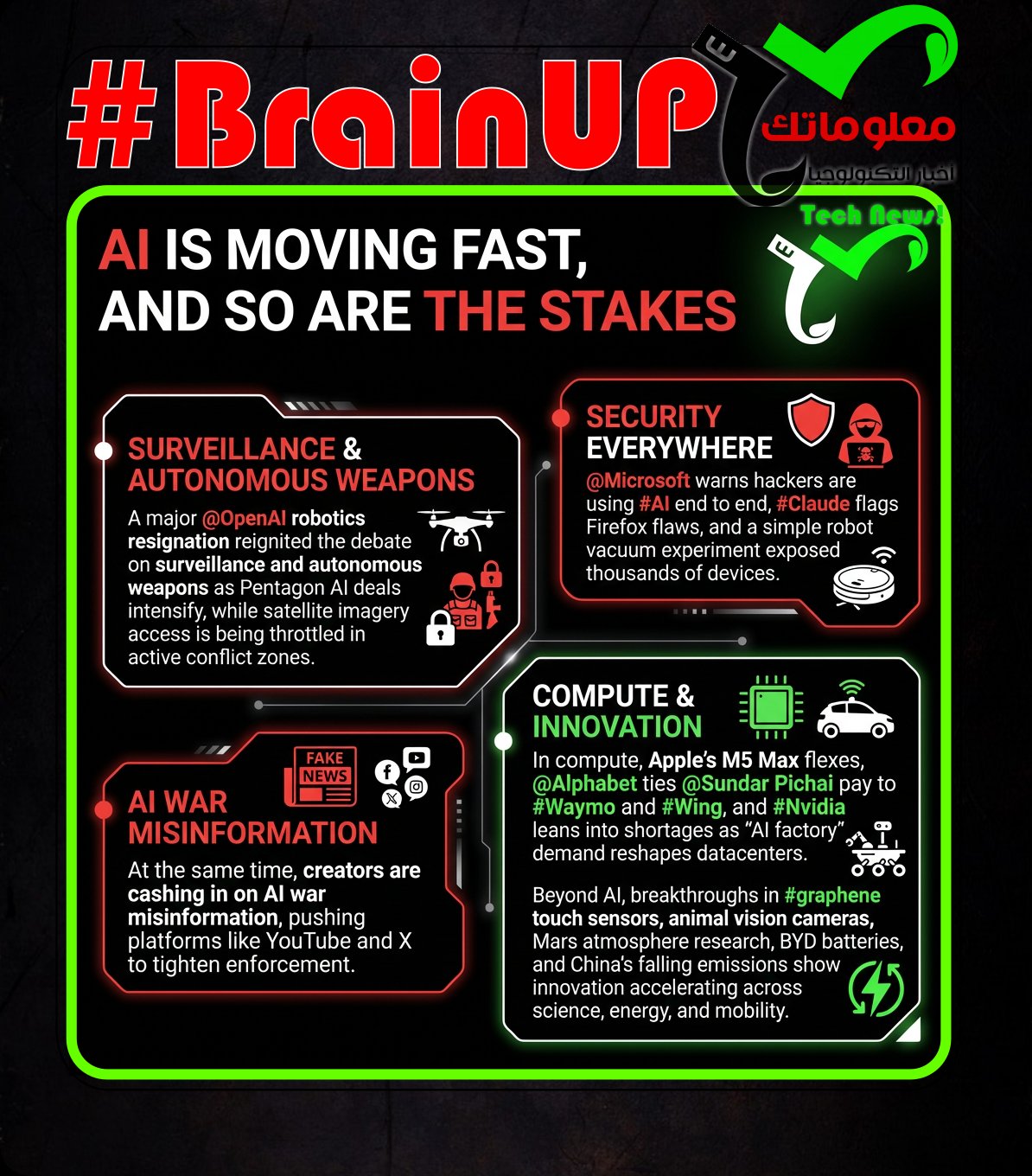
@Caitlin Kalinowski, who led hardware and robotic engineering at @OpenAI since November 2024, resigned citing concerns about #domestic surveillance without judicial oversight and #lethal autonomous weapons without human authorization. In posts on X and LinkedIn, she said AI can play an important role in national security, but these issues crossed lines that needed more deliberation, and emphasized her decision was about principle while expressing respect for @Sam Altman and the team. Her exit comes as debate intensifies over AI support for U.S. military use, after talks between the Pentagon and @Anthropic reportedly collapsed over proposed limits on #surveillance and #autonomous weapons, followed by OpenAI reaching an agreement to deploy its models on a classified government network. Critics argued OpenAI appeared to step in after Anthropic refused the terms, and Altman acknowledged the rollout looked “opportunistic,” prompting OpenAI to clarify restrictions. An OpenAI spokesperson said the Pentagon agreement sets “red lines” of no domestic surveillance and no autonomous weapons, while continuing engagement with employees, government, and civil society.
2. At 25, Wikipedia Faces the “AI Effect” on How People Find Knowledge
As Wikipedia marks its 25th anniversary, experts warn that the rise of #GenerativeAI is reshaping how people access information and could threaten the platform’s long-term ecosystem by reducing the number of users who actually visit the site, even though AI tools increasingly rely on Wikipedia as a foundational source. Chatbots and AI-powered search features now summarize information directly in responses, often drawing from Wikipedia but giving users the answer without requiring them to click through, creating what analysts describe as a “zero-click” knowledge environment where the encyclopedia powers answers but receives less traffic and recognition. This shift matters because Wikipedia’s strength comes from a self-reinforcing cycle of readers becoming editors and donors, and if fewer people visit, fewer volunteers may join the community that maintains and corrects articles over time. Researchers and contributors note that while #AI could help editors with tasks like translation or moderation, it also introduces risks such as AI-generated text flooding articles or misinformation being echoed back into the platform, making human oversight even more important. The discussion highlights a paradox of the modern internet: Wikipedia’s human-curated knowledge underpins many AI systems, yet those same systems may gradually weaken the traffic and participation that keep the encyclopedia accurate and alive.
3. Satellite firm pauses imagery after revealing Iran’s attacks on US bases
Planet Labs is temporarily restricting access to newly collected satellite imagery over parts of the Middle East by imposing a mandatory 96-hour delay for the Gulf States, Iraq, Kuwait, and adjacent conflict zones, while keeping imagery over Iran available immediately and preserving real-time access for authorized government users. The company said the change responds to the ongoing regional conflict and is intended to prevent “adversarial actors” from using its data for #BattleDamageAssessment. Recent Planet imagery had shown damage from Iranian missile and drone strikes on US and allied sites, including the US Fifth Fleet headquarters in Bahrain and a US-built early warning radar in Qatar, and the article notes additional reported strikes on radar units supporting #THAAD interceptors in several countries. Planet framed the policy as protecting US, allied, and #NATO-partner personnel and civilians, citing the real risk highlighted by the reported deaths of six Army reservists in Kuwait. The restriction also delays independent public verification of strike damage, even as Planet continues to sell imagery to the US military and intelligence agencies.
4. Claude AI Uncovers 22 Vulnerabilities in Firefox
Claude AI, an advanced AI developed by Anthropic, has identified 22 security vulnerabilities in Mozilla Firefox, highlighting the potential of AI in cybersecurity. These vulnerabilities range from memory safety issues to logic flaws that could be exploited by attackers. The discovery emphasizes the growing role of AI in proactively detecting security weaknesses that traditional methods might overlook. Mozilla is actively working to patch these vulnerabilities to enhance browser security. This development illustrates the increasing integration of AI tools in identifying and mitigating #software vulnerabilities within widely-used applications.
5. Mozilla is working on a big Firefox redesign, here is what it looks like
Mozilla is developing a major redesign of its Firefox browser that aims to modernize the user interface and improve user experience. The redesign includes a more streamlined toolbar, updated icons, and enhanced customization options to make browsing smoother and more intuitive. Visuals from the upcoming version reveal cleaner layouts and dark mode improvements, reflecting Mozilla’s commitment to accessibility and aesthetic appeal. This overhaul focuses on aligning Firefox’s appearance with current design trends while retaining its unique features and performance. By updating Firefox, Mozilla hopes to attract new users and better compete in the evolving web browser market.
6. Don’t blame AI yet for poor jobs numbers, analysts say
A sharp February jobs surprise and a rise in US unemployment to 4.4% intensified worries that #AI is driving job losses, but analysts say the data does not yet support blaming AI for the overall downturn. Challenger, Gray & Christmas reported AI was explicitly cited in 4,680 February job-cut announcements, about 10% of that month’s announced cuts, and 12,304 announcements so far in 2026, 8% of planned cuts, compared with 54,836 in 2025, 5% of the year’s cuts, and 91,753 since 2023, about 3% of all announced layoff plans. Andy Challenger said tech layoffs reflect multiple pressures beyond AI, including global regulatory concerns, a tariff-related slowdown in digital advertising, economic uncertainty, and higher employment and funding costs, while @Jack Dorsey cited AI when announcing Block’s 4,000 layoffs. Investor @Gina Bolvin argued the report was complicated by a California healthcare strike and possible lingering government shutdown effects, though she still sees AI dampening hiring, whereas Bankrate analyst @Mark Hamrick called the report “ugly” but said AI’s impact on overall employment is minimal so far and pointed to potential offsetting investment such as datacenter buildouts. Supporting the caution, Bureau of Labor Statistics categories tied to computing and electronics show mixed declines, including computing infrastructure services down 300 month to month and 4,400 year over year, and professional and business services down 5,000 month to month and 88,000 year over year, with computer systems design down 34,600 year over year, suggesting broader sector pressures alongside selective AI-related cuts.
7. Microsoft: Hackers abusing AI at every stage of cyberattacks
Hackers are increasingly integrating #AI technologies into all phases of cyberattacks, from reconnaissance to malware deployment, as revealed by @Microsoft. Evidence shows attackers leverage AI to enhance phishing campaigns by generating realistic messages and to automate the creation of malicious code, making attacks more efficient and harder to detect. This trend reflects a significant evolution in threat actor capabilities, where AI tools amplify the speed and sophistication of cybercrime. The use of AI not only streamlines attack processes but also complicates defensive measures, requiring continuous adaptation by cybersecurity teams. Consequently, understanding and countering AI-driven threats is critical to maintaining cyber resilience in an evolving threat landscape.
8. High-tech camera replicates animal vision, showing humans a world of colors they’ve never seen
A new #camera and #software system led by researcher Vera Vasas, developed with colleagues at the Hanley Color Lab at George Mason University, lets humans view colors as different animals perceive them, expanding how scientists and the public can understand the natural world. The article explains that species vary in photoreceptor cells, with humans typically trichromatic, many birds tetrachromatic with ultraviolet sensitivity, many insects like bees also seeing ultraviolet flower patterns, and mammals like dogs and cats being dichromatic and unable to distinguish red from green. Unlike earlier #false color imaging that was slow, required specific lighting, and struggled with motion, the new system records video under natural lighting in four channels, blue, green, red, and UV, then converts the data into perceptual units using known photoreceptor data to replicate animal vision. Compared with spectrophotometry, it achieves over 92% accuracy in predicting perceived colors, supporting more reliable research into animal behavior and ecology. The tool is also positioned to improve filmmaking and education by bridging human and animal perception, enabling documentaries that show viewers ultraviolet cues for bees or the reduced color palette seen by dogs.
Apple’s 18-core M5 Max tops Geekbench 6 results, leading both #single-thread and #multi-thread scores and even edging out far higher core-count chips like AMD’s 96-core Ryzen Threadripper Pro 9995WX, though the article notes GPU compute is less impressive. In Geekbench 6, the M5 Max posts 4,353 single-core and 29,644 multi-core points, beating the 16-core M4 Max and the 32-core M3 Ultra, and generally surpassing typical Threadripper Pro 9995WX multi-core results around 26,000, while one outlier 9995WX run reaches 30,170. The piece cautions that Geekbench 6’s multi-thread test is short and bursty, modeled on consumer tasks like archive compression, PDF processing, and image editing, so it does not fully stress ultra-high-core-count CPUs. It also says many subtests scale efficiently only to roughly 8 to 32 threads, leaving much of a 96-core processor’s parallel capacity idle and creating favorable conditions for Apple’s lower core-count, higher per-core-performance design. As a result, the benchmark win does not necessarily translate to real-world, sustained workloads where high core counts can matter more.
10. Google just gave Sundar Pichai a $692M pay package | TechCrunch
@Alphabet structured a new three year pay deal for @Sundar Pichai that could be worth $692 million, potentially making him one of the highest paid executives. A filing, first spotted by the FT, says most of the package is performance tied, including new stock incentives linked to Waymo and Wing, its drone delivery venture. The piece contrasts Pichai’s relatively low public profile with @Larry Page and @Sergey Brin, who have drawn attention for buying lavish Miami area properties widely viewed as a response to California’s proposed #Billionaire Tax Act. It also notes Pichai is a billionaire, citing nearly sevenfold growth in Google’s market cap since he became CEO in 2015 and reporting that he and his wife hold nearly $500 million in shares, with an estimated $650 million sold as of last summer per Bloomberg. Overall, the package underscores how Alphabet is tying top executive compensation to performance and high profile bets like #Waymo and #Wing.
11. Andrew Tate, Brother Tristan Suing X to ID Users They Claim Defamed Them
@Andrew Tate and @Tristan Tate are going to court seeking to force X to reveal the identities of anonymous accounts they say have harassed and defamed them. They previously sued several John and Jane Doe X users for #defamation over posts they objected to, but that lawsuit was dismissed, and they now want the court to compel X to unmask the accounts. The brothers allege the users conspired to ruin them financially, reputationally, and emotionally through constant allegedly defamatory posts on the platform formerly known as Twitter. They also claim the accounts continue to accuse them of “heinous crimes, including rape and human trafficking,” and of having sexually transmitted diseases. X did not respond to a request for comment at the time of publication.
12. Graphene-based artificial skin can simulate sense of touch in human-like way
Researchers have developed a graphene-based artificial skin that mimics the human sense of touch through its highly sensitive and flexible properties. The new material can detect pressure changes as small as 0.5 Pa, allowing it to respond to subtle tactile stimuli similarly to natural skin. This skin utilizes the #graphene’s unique electrical properties, enabling rapid signal transmission and durability under repeated bending or stretching. The combination of these features makes it promising for applications in robotics and prosthetics, potentially enhancing human-robot interaction and sensory feedback. By advancing the field of #wearable sensors, the innovation links material science with biological functionality.
In the 1990s, @NASA tested how animals that develop in microgravity might cope with sensing gravity, as a proxy for how humans born in space could respond when exposed to normal gravity. In 1991, a team led by Dorothy Spangenberg sent almost 2,500 jellyfish polyps aboard the Columbia shuttle in bags of artificial seawater for about nine days, during which onboard researchers accelerated their growth and around 60,000 jellyfish developed. Jellyfish and humans both rely on hair cells moved by gravity acting on crystals, jellyfish use calcium sulphate crystals in the bell, while humans use calcium carbonate structures in the inner ear, so the experiment examined whether this #gravity sensing system still forms in space. After returning to Earth, the space raised jellyfish showed pulsing abnormalities and struggled to swim compared with Earth controls, and scientists described the effect as severe vertigo even though the crystals had developed in microgravity. The results suggest that while gravity sensing structures can form without normal gravity, organisms raised in space may have difficulty adjusting their orientation and movement when reintroduced to Earth like gravity.
14. Palantir faces challenge to remove Anthropic from Pentagon’s AI software
Palantir Technologies is confronting a significant hurdle in its effort to remove Anthropic’s AI software from a Pentagon cloud contract due to a disagreement over intellectual property rights. The U.S. Defense Department is reviewing complaints that concern the proprietary nature of Anthropic’s technology, which Palantir had initially integrated into a $250 million AI initiative. This conflict highlights the complexities in government procurement where cutting-edge #AI technologies intersect with proprietary constraints. Palantir’s challenge underlines broader issues in the defense sector about balancing innovation, operational control, and ownership rights within AI deployments. The outcome of this dispute could influence future collaborations and contractual arrangements involving emerging AI capabilities in national security contexts.
15. What privacy? As expected, Meta Ray-Bans are a privacy disaster
Meta’s Ray-Bans, equipped with cameras and sensors, pose significant privacy risks as they can record audio and video discreetly, raising concerns over unauthorized data collection and surveillance. The device collects extensive personal data, including biometric information and location tracking, which can be accessed and potentially exploited without users’ full awareness or consent. This lack of transparency and robust privacy controls highlights the challenges of integrating smart technology with social interactions and public spaces. The situation illustrates broader issues in #privacy and #dataSecurity involving wearable technology and the responsibilities of companies like @Meta in protecting user information. Such risks emphasize the need for stricter privacy regulations and user safeguards in emerging tech ecosystems.
16. Uploading Pirated Books via BitTorrent Qualifies as Fair Use, Meta Argues * TorrentFreak
In a class-action lawsuit by authors including @Richard Kadrey, @Sarah Silverman, and @Christopher Golden, @Meta now argues that the automatic uploading, or seeding, of pirated books to strangers via #BitTorrent during downloads also qualifies as #fair use, extending a defense after the court previously found training its #Llama #LLM on pirated books to be fair use while leaving direct infringement claims over downloading and sharing unresolved. Meta claims that uploading was inherent to the #BitTorrent protocol and not a separate choice, and that using torrents was necessary and practical, including because bulk datasets from #Anna’s Archive were only available via torrent downloads. In a supplemental interrogatory response filed in California federal court, Meta’s attorney contends that any portions of plaintiffs’ works “made available” to others were “part-and-parcel” of obtaining the data for Meta’s transformative training purpose. The authors dispute both the substance and the timing, telling Judge @Vince Chhabria that Meta knew about the uploading allegations since November 2024 but raised this new fair use defense only after discovery deadlines, arguing Rule 26(e) is not a loophole for adding defenses late. The dispute now centers on whether protocol-driven sharing during torrent downloads can be treated as inseparable from, and justified by, the same transformative purpose underlying Meta’s training use.
Developer Alexey Grigorev described how using @Claude Code with #Terraform during a move of his AI Shipping Labs site to #AWS accidentally wiped a shared production environment. After initially running a Terraform plan without uploading a crucial Terraform state file, the setup created duplicate resources, and when the state file was later provided, the agent followed it and issued a Terraform destroy to reconcile the infrastructure. Because the state included both AI Shipping Labs and DataTalks.Club, the destroy operation deleted the full setup for both sites, including a database holding 2.5 years of records and the snapshots he expected to function as backups. Amazon Business support helped restore the data in about a day, highlighting how unforgiving infrastructure-as-code tools can be when paired with insufficient supervision of an AI agent. In a post-mortem, Grigorev said he will add restore testing, enable delete protections in Terraform and AWS permissions, move the Terraform state to #S3, and stop the agent from running Terraform commands without manual review and explicit human execution of destructive steps.
18. China Suspected in Breach of FBI Surveillance Network
China is suspected of breaching the FBI surveillance network used by U.S. law enforcement to track crime and national security threats. The breach, attributed to Chinese hackers, exposed sensitive data within the FBI’s infrastructure, raising concerns about China’s ongoing cyber espionage efforts. This intrusion highlights vulnerabilities in U.S. federal cybersecurity defenses and the persistent threat posed by adversarial state actors. The incident underscores the urgent need for enhanced protective measures in critical government systems to prevent future compromises. It reflects broader tensions and cyber conflict between the U.S. and China in digital and intelligence domains.
19. Kalshi is not paying bettors the $54 million that was made on Khamenei death in Iran
Prediction market app Kalshi says it will not pay out the roughly $54 million some users thought they had won after @Ayatollah Ali Khamenei was confirmed killed in joint U.S.-Israeli airstrikes on Tehran, arguing its contract was not a #death market. Kalshi promoted a market on whether Khamenei was “out as Supreme Leader,” then reiterated on X that it “does not offer markets that settle on death” and said that if he died the market would resolve based on the last traded price before confirmed reporting of death, later admitting an earlier clarification was “grammatically ambiguous” and offering to reimburse lost value for trades made between the clarifications. CEO @Tarek Mansour said “out” referred to stepping down or a peaceful transition, not assassination, while maintaining the market mattered because leadership changes affect world order, including oil, commodities, and geopolitical relations. The decision triggered widespread complaints, including from a bettor who told The Washington Post he expected a $63,000 win, and criticism from former SEC chief of staff Amanda Fischer, who said the episode showed how problematic the business is. Sen. @Chris Murphy condemned such markets as a “dystopian world” and “American commercial immorality on steroids,” and said he is drafting legislation to ban prediction market gambling.
DJI is paying software engineer Sammy Azdoufal $30,000 after he uncovered a critical #cloud backend authorization flaw that gave him broad access to about 7,000 DJI Romo robot vacuum cleaners across 24 countries. While trying to build a custom controller app to drive his vacuum with a PS5 gamepad, he reverse engineered the login flow to extract his security token, and found the backend did not properly limit device access, exposing other users’ sensor data. Because the Romo includes a camera and microphone, the flaw enabled access to live camera feeds with audio, 2D home floor plans, and even household IP addresses that could be used to infer locations. Azdoufal says he did not “hack” anything and disclosed the issue instead of abusing it, and after @The Verge contacted DJI, the company fixed the problem by mid-February. DJI says it had already begun addressing multiple backend weaknesses before Azdoufal demonstrated the scale of the exposure, but it did not specify which discovery the $30,000 reward covers, and the situation raises questions given DJI’s past dispute with researcher Kevin Finisterre.
@Jensen Huang argues that ongoing #component shortages and other buildout limits make constraints beneficial because they push #AI data center customers to choose the highest-end hardware. He says when land, power, and facilities are constrained, companies cannot afford to choose poorly since revenue is affected, so they avoid cheaper experiments and default to the safest option, which he implies is #Nvidia. Huang also emphasizes Nvidia’s ability to provide full-stack #data center infrastructure, claiming it can help customers stand up an entire “AI factory” once capacity is secured. The article notes that while scarcity is “fantastic” for Nvidia and AI buyers, the AI boom’s demand is squeezing broader supply chains, contributing to higher prices for GPUs and even memory and storage that affect gamers and other consumers. It adds that gaming is only 8 to 9% of Nvidia revenue, making it unsurprising the company prioritizes data center growth despite the downstream impact.
22. AI-generated Iran war videos surge as creators use new tech to cash in
An unprecedented surge of #AI-generated misinformation about the US-Israel war with Iran is being monetised by online creators as access to #generativeAI makes convincing synthetic conflict content fast and easy, according to experts cited by BBC Verify. BBC Verify found many AI-made videos and fabricated satellite images pushing false claims that have collectively drawn hundreds of millions of views, including a fake clip of missiles hitting Tel Aviv shared in hundreds of posts and a widely viewed video falsely showing Dubai’s Burj Khalifa on fire. On X, some users asked the platform’s chatbot Grok to verify a clip, but BBC Verify observed cases where Grok incorrectly asserted AI-generated footage was real, compounding the spread. BBC Verify also identified a fabricated “satellite” image shared by state-linked The Tehran Times that claimed to show heavy damage to the US Navy’s Fifth Fleet headquarters in Bahrain, with Google’s SynthID detector indicating it was generated or edited with a Google AI tool and visual consistencies suggesting it was based on publicly available real imagery. X says it will temporarily suspend creators from its monetisation programme for posting AI-generated armed-conflict videos without a label, a move researchers say signals recognition of a growing problem that undermines trust and complicates documentation of real evidence.
23. U.S. Supreme Court Not Interested in Enforcing Copyright for AI-Generated Images
The U.S. Supreme Court declined to hear a case brought by computer scientist @Stephen Thaler seeking copyright protection for artwork generated by his #AI system DABUS, effectively reinforcing the long-standing legal principle that human authorship is required for copyright protection. Thaler had attempted to register an image created entirely by the AI system, arguing that autonomous AI outputs should qualify for intellectual property rights, but the U.S. Copyright Office rejected the request and courts consistently upheld that decision. By refusing to review the case, the Supreme Court left those rulings intact, signaling that content produced solely by generative AI cannot currently be copyrighted in the United States unless a human contributes significant creative input. The outcome follows similar rejections of AI-inventor claims in patent cases involving DABUS in the U.S., the U.K., the European Union and Australia, illustrating a global consensus that legal frameworks for intellectual property still require identifiable human creators. The decision underscores the growing tension between rapidly advancing generative AI technologies and legal systems that were built around human authorship, leaving open questions about how copyright law may evolve as AI becomes more deeply involved in creative work.
24. BYD’s EV battery is strong enough to compete with gas engines
BYD has developed an ultra-high voltage EV battery technology capable of matching and even surpassing traditional gas engines in power and performance. The company’s blade battery design offers increased energy density, safety, and longevity compared to conventional lithium-ion batteries, making electric vehicles more practical and appealing for consumers. BYD’s innovations focus on delivering fast charging, enhanced range, and improved durability, addressing key barriers to EV adoption. This approach positions BYD as a significant competitor in the automotive industry, challenging internal combustion engines and advancing the transition to electric mobility. As a result, BYD’s technology not only powers vehicles efficiently but also contributes to broader sustainability and emissions reduction goals.
25. Nintendo sues the US government for a refund on tariffs | TechCrunch
@Nintendo filed a lawsuit in the U.S. Court of International Trade seeking refunds for tariffs it paid under @Donald Trump executive orders invoking the #InternationalEmergencyEconomicPowersAct (#IEEPA). The suit follows a @SupremeCourt decision that struck down the IEEPA-based tariffs, finding the president exceeded his authority, and Nintendo’s complaint says the tariffs have collected over $200 billion on imports in total, with more than a thousand other companies also suing for refunds. Nintendo confirmed it filed a request but declined further comment. After the ruling, @Trump increased tariffs from 10% to 15%, prompting 24 states to sue, arguing he again overstepped his power. The dispute underscores ongoing legal challenges over presidential authority to impose and adjust tariffs under #IEEPA and the financial impact on companies that paid those duties.
26. America Just Leveled Up A Key Missile—Now It Can Wipe Out Swarms of Iranian Drones
#FALCO, an upgrade to the #AGR-20 #APKWS rocket, is positioned as a crucial low-cost air-to-air option for defeating large swarms of Iranian drones as attacks intensify in the Middle East. The article cites lessons from Operation Rough Rider, where F-16s from the 480th Expeditionary Fighter Squadron used APKWS in air-to-air combat and reportedly downed 108 aerial targets while stopping barrages of drones and cruise missiles. It argues that traditional air defenses such as #Patriot, the Standard missile, and air-to-air missiles like #AIM-120 AMRAAM and #AIM-9 Sidewinder are effective but expensive and limited in supply, making them ill-suited for mass, low-cost threats like the Shahed, a 400-pound drone with a 7-foot wingspan that can carry a 100-pound warhead for several hundred miles. Few program details are public, but the piece says FALCO includes modified seekers to cope with atmospheric effects and software enhancements for prolonged laser targeting. By adapting plentiful, inexpensive 2.75-inch rockets into guided interceptors, the U.S. aims to preserve high-end missile inventories while better defending carrier groups and land bases against sustained drone waves.
27. OpenAI and Oracle reportedly abandon TX Stargate expansion
According to Bloomberg, @OpenAI and @Oracle have abandoned plans to expand their Texas Stargate datacenter campus in Abilene beyond the 1.2GW currently under development, after talks stalled. Sources cited said the intended buildout could have reached 2GW, but was derailed by financing issues and @OpenAI’s difficulty forecasting demand, with the article also noting @SamAltman’s apparent reluctance to commit. Bloomberg reports the site’s developer Crusoe now has untapped, unbuilt capacity that @Meta may lease, in a deal reportedly brokered by @Nvidia, which is said to have put down a $150 million deposit before approaching Meta. The piece adds that OpenAI’s broader #Stargate initiative, announced as a $500 billion effort, still includes an on track plan for @Oracle to deploy 4.5GW of compute capacity valued by Oracle at $300 billion, even as Oracle seeks more financing, including a newly announced plan to raise an additional $50 billion in debt and equity. If the Abilene expansion does not proceed, the article says OpenAI will still need to secure somewhere to host about 5GW worth of GPUs to qualify for a $30 billion incentive tied to @Nvidia’s offer as part of a $110 billion funding round involving @SoftBank and @Amazon.
28. This Jelly-Like Implant Could Help Broken Bones Heal Themselves
Researchers have created a jelly-like #hydrogel implant that mimics the body’s natural bone-healing process, potentially offering a safer alternative to metal implants or bone grafts for severe fractures. Developed by scientists at ETH Zurich, the material is about 97 percent water and can be precisely structured using lasers to form microscopic bone-like scaffolds that guide cells as they regenerate new tissue. Instead of acting as a rigid replacement, the hydrogel replicates the soft early stage of bone healing, allowing immune and repair cells to move through the structure and gradually rebuild bone while the implant slowly dissolves inside the body. Early lab experiments show that bone-forming cells quickly colonize the hydrogel and begin producing collagen, a key structural protein in bone, suggesting the implant can support natural regeneration rather than simply stabilizing the fracture. Researchers say the technique could eventually enable custom-printed implants tailored to a patient’s anatomy, although further testing, including animal studies, is needed before clinical use.
29. China’s Fossil Fuel Emissions Dropped Last Year as Solar Boomed
China’s fossil fuel emissions fell in 2025 even as energy demand rose, as a rapid expansion of #renewables, especially #solar, began displacing #coal. Official statistics show emissions from energy and industry dropped 0.3 percent while energy consumption increased 3.5 percent, and renewables supplied 40 percent of China’s power, up from 37 percent the prior year, with added renewable generation more than covering demand growth so coal power declined slightly. @Duo Chan said the shift is an encouraging sign that China’s large-scale #energy transition is producing measurable results, while cautioning that one year does not resolve the climate challenge. Analysts also cite coal plants being retrofitted to operate more as peakers to back up wind and solar, plus lower cement output from a construction slump and likely reduced transport emissions as #electric vehicles expand, with Carbon Brief suggesting emissions have been flat or falling for nearly two years, raising the prospect China has passed “peak” emissions. The article notes a parallel U.S. trend in which clean electricity hit a record and most new capacity is expected to come from wind, solar, and batteries despite reduced federal support.
30. Armed robots take to the battlefield in Ukraine war
Ukraine is expanding the use of armed uncrewed ground vehicles, #UGVs, as the war becomes increasingly high-tech and dangerous for troops near the front. Ukrainian units report #UGVs repelling Russian attacks, taking prisoners, and in some accounts even clashing with Russian robots, while brigades like the K2 mount Kalashnikov machine guns and use explosive-laden kamikaze ground robots that can strike without the audible warning of aerial drones. Commanders say these systems are typically remote-controlled over the internet, with human operators retaining the decision to fire because part-autonomous robots can misidentify targets, and constraints are shaped by ethics and international humanitarian law. Ukraine also uses armed #UGVs for tasks such as laying mines or barbed wire, although most uncrewed vehicles still mainly deliver supplies and evacuate wounded. @Valerii Zaluzhnyi predicts their role will grow rapidly as strike #UGVs integrate into larger #AI-enabled swarms operating across air, ground, and sea, driven by the expanded 20-25km “kill zone” created by drones and the need to conserve soldiers by risking robots instead.
31. YouTube responds to AI concerns as 12 million channels terminated in 2025 – Dexerto
YouTube addressed creator fears that expanded #AI moderation is unfairly terminating channels after reports that more than 12 million channels were removed in 2025. Creators cited examples of alleged AI mistakes, including a video being age restricted after laughter was interpreted as “graphic content,” and a reaction video allegedly banned for “child safety” while the original remained. Animator Nani Josh said his 650,000 subscriber channel was terminated for “spam/scam” despite not fitting that label, and he highlighted figures totaling 12,460,248 channels removed from January to September 2025, questioning whether they received fair human review. Team YouTube replied on X that many recent removals were tied to a “specific financial scam out of Southeast Asia,” noted that termination volumes vary, and emphasized that “channels terminated doesn’t = creators terminated,” since scam operators can run hundreds of channels. Separately, CEO @Neal Mohan said YouTube will continue using #AI to detect and enforce violations at scale and more precisely, positioning it as an ongoing part of the platform’s moderation approach.
32. Some buyers return Samsung Galaxy S26 Ultra over screen issue
Researchers have created a jelly-like #hydrogel implant that mimics the body’s natural bone-healing process, potentially offering a safer alternative to metal implants or bone grafts for severe fractures. Developed by scientists at ETH Zurich, the material is about 97 percent water and can be precisely structured using lasers to form microscopic bone-like scaffolds that guide cells as they regenerate new tissue. Instead of acting as a rigid replacement, the hydrogel replicates the soft early stage of bone healing, allowing immune and repair cells to move through the structure and gradually rebuild bone while the implant slowly dissolves inside the body. Early lab experiments show that bone-forming cells quickly colonize the hydrogel and begin producing collagen, a key structural protein in bone, suggesting the implant can support natural regeneration rather than simply stabilizing the fracture. Researchers say the technique could eventually enable custom-printed implants tailored to a patient’s anatomy, although further testing, including animal studies, is needed before clinical use.
That’s all for today’s digest for 2026/03/08! We picked, and processed 32 Articles. Stay tuned for tomorrow’s collection of insights and discoveries.
Thanks, Patricia Zougheib and Dr Badawi, for curating the links
See you in the next one! 🚀
