
#BrainUp Daily Tech News – (Wednesday, March 4ᵗʰ)
Welcome to today’s curated collection of interesting links and insights for 2026/03/04. Our Hand-picked, AI-optimized system has processed and summarized 30 articles from all over the internet to bring you the latest technology news.
As previously aired🔴LIVE on Clubhouse, Chatter Social, Instagram, Twitch, X, YouTube, and TikTok.
Also available as a #Podcast on Apple 📻, Spotify🛜, Anghami, and Amazon🎧 or anywhere else you listen to podcasts.
1. TikTok Is Experiencing Oracle-Related Server Issues Again
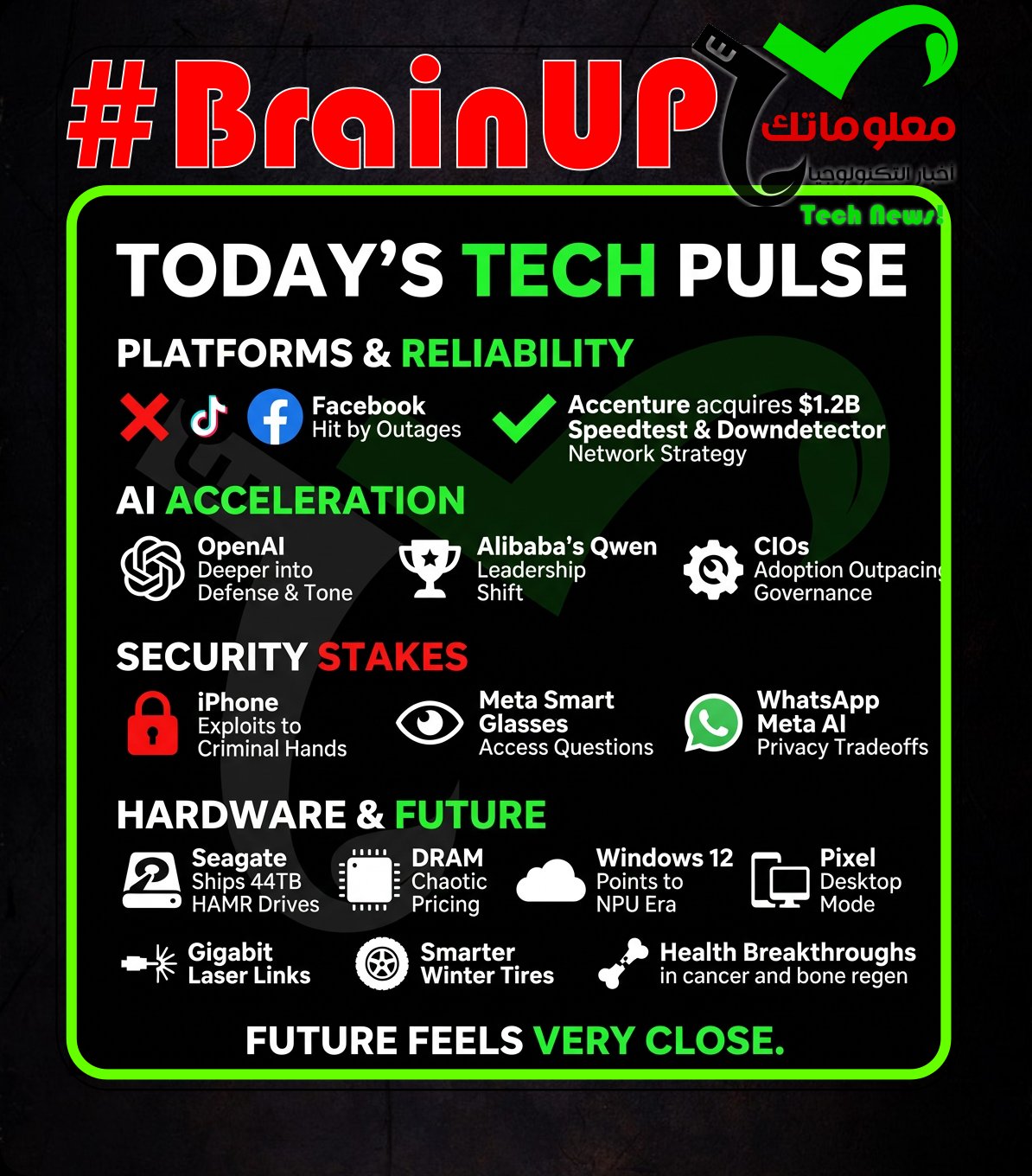
U.S. TikTok users experienced service disruptions on Tuesday that TikTok U.S. attributed to an issue with an @Oracle data center, warning creators they may see lags when posting content. @Oracle Cloud Infrastructure’s status page reported a “Service Disruption” at its Ashburn, Virginia facility, saying engineers were working on mitigation, and Downdetector showed reports rising Tuesday morning and tapering into Wednesday. A similar incident about a month earlier led some users to speculate the platform was censoring posts critical of @President Trump’s immigration crackdown, but TikTok U.S. denied censorship and the article suggests that denial appears consistent with continued anti-ICE content. The piece frames the repeated problems as #server issues tied to @Oracle, a stakeholder in the entity that owns TikTok U.S., rather than content moderation, and notes TikTok data for U.S. users was housed in the U.S. before the ownership transfer so migration from Singapore may be unrelated.
2. Altman Reportedly Tells Staff OpenAI Wants Another Classified Contract. This Time with NATO
@Sam Altman reportedly told employees that @OpenAI is pursuing another classified deal, this time to deploy its technology across NATO classified networks, as the company faces internal and consumer backlash over its recent Pentagon agreement. Transcripts from a Tuesday all-hands, cited by The Wall Street Journal and CNBC, depict Altman calling the episode “painful” and acknowledging criticism from staff, while also describing the Defense Department arrangement as allowing DoD use of OpenAI tech without OpenAI making operational decisions. The NATO effort is framed as a valuable clearance milestone, with the article noting @Apple recently touted NATO approval for iPhones and iPads for classified NATO purposes, and pointing to expectations of increased defense spending and an “AI gold rush.” The piece adds context that OpenAI’s government push was announced last June with its #OpenAI for Government offering, and that the Pentagon’s CDAO awarded up to $200 million in projects, while Gizmodo says it contacted OpenAI for confirmation and will update if it hears back.
Security researchers say a powerful iPhone exploit kit originally used in government-backed spying has spread into cybercriminal use, highlighting how government-grade hacking tools can leak and be repurposed. @Google says it first found the kit, dubbed #Coruna, in February 2025 during a surveillance vendor attempt to deploy spyware for a government customer, later seeing it used against Ukrainian users by a Russian espionage group and subsequently by a financially motivated hacker in China. Google warns this points to a growing market for “secondhand” exploits, where stolen or resold capabilities are used to extract further value by money-driven actors. The kit can compromise iPhones via a malicious website link in a #watering-hole attack and reportedly chains 23 vulnerabilities across five attack paths, affecting devices from iOS 13 up to 17.2.1, released in December 2023. Mobile security company iVerify says it reverse-engineered the tools and has some evidence linking Coruna to the U.S. government, while noting broader risk that wider use increases the likelihood of leaks into the wild.
Seagate has started shipping 44TB hard disk drives to two partners among leading hyperscale cloud service providers, marking a new capacity milestone using its Mozaic 4+ platform built on #HAMR. Mozaic 4+ uses 10 platters with up to 4+ TB per platter to reach 44TB, and the drives are described as using #CMR, with performance details like 7200 RPM and ~300 MB/s mentioned as speculation. Instead of launching multiple capacities at once, Seagate is formally introducing only the 44TB model while other large CSPs are qualifying Mozaic 4+-based drives. The timing is framed against Western Digital plans to ship 40TB drives using #EAMR and #UltraSMR, which increase capacity but slow overwrite performance, positioning Seagate’s HAMR approach as more advanced. Seagate also claims efficiency gains versus 30TB drives, citing roughly 47% better overall system efficiency, about 100 square feet less storage-cluster footprint, and about 0.8 million kWh lower annual power use at hyperscale, with @Dave Mosley emphasizing the need for scalable, efficient storage in an AI-driven world.
A DigiTimes report says the #AI driven memory shortage is pushing the #DRAM market into an “hourly pricing” model, where smaller buyers risk seeing quotes jump within minutes if they cannot place immediate, upfront paid orders. It describes a split market of roughly 100 top tier buyers with leverage versus more than 190,000 small and mid size electronics firms competing for remaining supply, while major customers like @Apple, @Samsung, cloud providers, and automakers receive priority allocation from @Samsung Electronics, @SK hynix, and @Micron. TrendForce now forecasts Q1 2026 DRAM contract prices up 90% to 95% quarter over quarter with #NAND flash up 55% to 60%, DigiTimes suggests another 70% DRAM rise in Q2 2026, and @IDC warns tight supply could last into 2027. The report links these increases to downstream impacts, including @HP saying DRAM has risen to 35% of PC build cost from 15% to 18% the prior quarter, and @Gartner projecting 2026 PC shipments down over 10% and smartphones down about 8% due to memory costs, with @IDC expecting white box and lower tier vendors to be hit hardest. DigiTimes adds that if enough SMEs reduce demand or exit, constrained capacity could flip to oversupply, potentially revealing the shortage as illusory.
6. CIOs say AI adoption is moving faster than they can manage
The Logicalis Global CIO Report 2026 says #AI adoption is accelerating faster than many organizations can govern, creating a gap between ambition and the skills, risk management, and compliance needed to manage deployments. From a survey of 1,000 tech leaders, 51 percent say adoption is already moving too quickly, fewer than half report their AI strategy is aligned to the wider business plan or KPIs, and Logicalis says this leads to initiatives advancing without mature ways to measure value or define success. CIOs report expanding accountability for both implementation and the integrity of AI systems, yet only 36 percent feel they have strong guidance and best practices, and 65 percent are not confident about scaling beyond pilots to organization-wide rollouts. The report highlights additional pressures, including sustainability responsibilities where only 39 percent measure AI environmental impact and 41 percent prioritize energy efficiency, plus concerns about an ‘AI bubble’ cited by 67 percent and the absence of continuity plans if a key provider disappears. Logicalis concludes that while AI is not going away, success will depend on how well organizations harness and manage it amid skill shortages that are holding back ambitions in almost 90 percent of organizations, even as 72 percent expect to invest more and 60 percent plan to invest in #agenticAI.
7. Europe, China, achieve gigabit links to geostationary sats
#Laser satellite communications to #geostationary orbit have reached gigabit-class performance in separate demonstrations by @ESA and China’s Institute of Optoelectronics, suggesting higher capacity links that could support advanced satellite control. @ESA reported an Airbus-built ground terminal locked onto the Alphasat TDP 1 satellite at 36,000 km and maintained an error-free connection while sending data at 2.6 Gbps for several minutes, despite precision challenges from motion, vibration, and atmospheric effects. The Chinese Institute said it built a 1.8 m laser ground station that acquired an unnamed satellite about 40,000 km away in four seconds, held the link for three hours, and carried symmetric 1 Gbps, using high-precision pointing control, adaptive optics to correct atmospheric turbulence, and mode-diversity coherent reception to suppress fading. The Institute argued such links could enable uploading complex instructions so high-orbit satellites evolve from data relays into intelligent processing hubs, while Airbus framed the milestone as relevant to defence and commercial needs. The results highlight why long-distance space networking remains harder than #LEO systems due to greater challenges and latency, motivating ongoing work to adapt protocols for space conditions.
8. Downdetector and Speedtest have been sold for over $1 billion
Ziff Davis has agreed to sell its Connectivity division, including Ookla’s Speedtest and Downdetector, to @Accenture for $1.2 billion in cash. Reuters says the sale lets Ziff Davis focus on core brands like IGN, Mashable and Everyday Health, following recent consolidation moves and layoffs at outlets such as Eurogamer and staff reductions at VG247. Ziff Davis bought Ookla for $15 million in 2014, and the division benefited from the #5G rollout and pandemic-era bandwidth demand, generating $231 million in 2025 and producing a strong return. Accenture, a Dublin-headquartered technology consulting company, framed the acquisition as a step toward building “end-to-end network intelligence services” for #AI-based transformation. The deal is expected to take a few months to finalize, and Ziff Davis will keep operating Speedtest and Downdetector until it closes.
9. Accenture acquires Downdetector as part of $1.2 billion deal
Accenture announced plans to buy Downdetector parent Ookla from @Ziff Davis in a $1.2 billion package deal, transferring Ziff Davis’s Connectivity division to Accenture and adding network visibility to its intelligence and analytics offerings. The acquisition includes Ookla products such as #Speedtest, #Ekahau, and #RootMetrics, which Accenture says will help communication service providers, hyperscalers, and enterprises optimize mission critical #WiFi and #5G networks, and use network and device layer data for analytics that support fraud prevention, smart home monitoring, and retail traffic optimization. Accenture said Ookla collects more than 1,000 attributes per Speedtest and frames network measurement as essential for improving experience, revenue, and security. @Ziff Davis said it will use proceeds to pay down $872 million in debt, noting the Connectivity division generated $231 million last year, about 16 percent of company sales, and the news sent Ziff Davis shares up about 81 percent, while Accenture shares were flat. The transaction is subject to closing conditions and regulatory oversight and is expected to close in the coming months.
10. Alibaba’s Qwen tech lead steps down after major AI push | TechCrunch
Alibaba’s #Qwen project lost a key technical leader when Junyang Lin said on X that he was stepping down, one day after Alibaba unveiled its Qwen 3.5 open-weight small models. Lin, who joined Alibaba in 2019 and the Qwen team in 2023, gave no explanation, and the circumstances remain unclear, with Lin not responding to a request for comment. The timing drew strong reactions from colleagues and partners, including posts from Qwen research scientist Wenting Zhao calling it “the end of an era,” Hyperbolic CTO Yuchen Jin crediting Lin with connecting Qwen to the global developer community, and Hugging Face APAC ecosystem head Tiezhen Wang calling it an “immense loss.” The move comes amid intensifying global competition to build models that can rival systems from @OpenAI, Google, and Anthropic, as Alibaba positions Qwen as a prominent Chinese open-weight effort with benchmark results that often rival leading U.S. developers. Alibaba’s newly announced Qwen 3.5 Small Model series includes four native multimodal models at 0.8B, 2B, 4B, and 9B parameters aimed at uses from on-device deployment to lightweight agents, and the launch drew attention from @Elon Musk, who praised their “impressive intelligence density.”
Scientists have identified a plant-derived compound capable of inducing self-destruction in aggressive breast cancer cells. The research demonstrates that this compound activates specific cellular pathways leading to apoptosis in cancer cells without harming healthy tissue. This discovery provides a promising avenue for developing targeted therapies against aggressive breast cancer types that are often resistant to conventional treatments. The findings highlight the potential of natural compounds in oncology and suggest further exploration for clinical applications. Ultimately, this breakthrough offers hope for improved, less toxic treatment options in breast cancer management.
12. OpenAI is Developing Alternative to Microsoft’s GitHub Information: Reports
OpenAI is reportedly working on developing an alternative to Microsoft’s GitHub Copilot, aiming to create its own AI-powered coding assistant. This move reflects OpenAI’s intention to expand its position in the software development tools market and reduce reliance on Microsoft technology. Reports indicate that the new product will offer similar or enhanced features to GitHub Copilot, leveraging OpenAI’s advanced language models. The development could intensify competition between OpenAI and Microsoft, a major investor in OpenAI and collaborator on various projects. This strategy underscores OpenAI’s ambition to establish independent solutions in AI-driven coding assistance and maintain leadership in generative AI innovation.
13. Windows 12 release date in 2026 possible, with AI features that may force CPU upgrades
Windows 12 is rumored to arrive around late 2026 and could be a more expensive upgrade because it is expected to make #AI features central to the OS and potentially require newer CPUs with dedicated #NPU hardware. Citing @PCWorld, the report says Windows 12, codenamed Hudson Valley Next, may use a more modular #CorePC architecture for customizable installations across devices, while #machine learning features could monitor activity, improve recommendations and searches, and add an evolved Gaming Copilot for Xbox users. To enable these capabilities locally and reduce reliance on cloud servers and GPUs, processors such as Intel Core Ultra and AMD Ryzen AI chips with 40 TOPS or more may become mandatory, or older PCs may lose some functionality if they lack an NPU. The article also notes rumors of subscription-based plans tied to an improved Windows 365 service, though a streamlined Home edition could launch as a free upgrade when Windows 12 releases.
@Elliott Investment Management has taken a $1 billion stake in @Pinterest, framing the move as a vote of confidence in the company’s #AI-driven growth strategy despite recent headwinds. CEO @Bill Ready said Pinterest delivered record 2025 revenue, hit all time high users for ten consecutive quarters, and now sees more than 80 billion monthly searches, alongside innovation in #AI-powered visual search. Pinterest will use the investment to execute a $1 billion accelerated share repurchase and help fund a newly authorized $3.5 billion share buyback program, and the stock rose 6% in premarket trading after the announcement. The investment comes after a tough year marked by disappointing earnings, layoffs affecting 15% of staff, a declining ad business, and increased competition from #AI chatbots, suggesting Elliott is backing a turnaround centered on AI features like visual search, personalization, moderation, and advertiser creative tools. Given Elliott’s activist history of pushing cost cuts and strategic overhauls, including at @eBay, its larger stake also implies increased scrutiny as Pinterest pursues its next phase of growth.
15. I can’t wait for Motorola’s GrapheneOS phones: Why they’re a win for privacy and open source
Motorola, a @Lenovo company, announced at #MWC that it will partner with the @GrapheneOS Foundation to ship smartphones with #GrapheneOS preinstalled starting in 2027, making it the first major vendor to offer a mainstream handset with an alternative, privacy-focused OS out of the box. #GrapheneOS is a non-profit project founded in 2014 that builds on #AOSP and adds privacy and security features such as fortified app sandboxes and toggles for network and sensor access, with code licensed primarily under #MIT while upstream #AOSP changes retain #Apache-2.0 and kernel parts remain #GPLv2. The OS includes open-source apps like the security-hardened #Vanadium browser, offers the GrapheneOS App Store, and supports stores like #F-Droid and #Obtainium, while allowing most #GooglePlay apps to be installed via its own store and run sandboxed. Today GrapheneOS is mainly used by installing it on @Google Pixel devices, but Motorola and the Foundation say they will co-develop hardware meeting strict standards such as memory tagging and multi-year updates, targeting flagship lines like Motorola Signature, Razr Fold, and Razr Ultra. Motorola says this is not a replacement for Android but an added option focused on #security and #privacy, while noting that some users have concerns about Motorola’s Chinese ownership.
16. Facebook Hit With Worldwide Outage Stating Accounts Are Unavailable
Facebook experienced a global outage causing users to encounter messages stating that accounts are unavailable. The issue affected access to Facebook’s social networking services, disrupting connectivity worldwide. This outage highlights challenges in maintaining uptime for large-scale online platforms reliant on continuous availability. Facebook’s widespread impact underscores how critical their infrastructure is to daily communications and social engagement globally. As the company works to resolve the fault, users remain unable to access their accounts, illustrating vulnerabilities in digital service reliability.
Reports and official statements indicate that #cyber operations played a significant supporting role alongside U.S. and Israeli bombing in Iran, disrupting communications, enabling #surveillance, and conducting #psychological operations. U.S. Joint Chiefs chair @Gen. Dan Caine said coordinated space and cyber actions disrupted Iranian communications and sensor networks ahead of the strike, aiming to “disrupt, disorient and confuse” the enemy. In a kinetic-cyber sequence, Israel bombed two IRIB channel offices and then hijacked broadcasts to air speeches by @Donald Trump and @Benjamin Netanyahu urging Iranians to oppose the regime, according to The Jerusalem Post. The Financial Times reported that Israeli operatives used access to hacked traffic cameras in Tehran and had deeply penetrated mobile networks, while other unattributed hacks included breaching the BadeSaba Calendar prayer app to push anti-regime messages. Bloomberg reported Iranian hackers have so far been largely ineffective, with the article noting it is unclear why, and mentioning the internet is effectively shut down inside Iran.
18. You’re not the only one seeing what you record on Meta smart glasses, contractors say
Meta contractors say videos recorded using #Meta smart glasses can be reviewed by people outside the user. The article states that contractors have been tasked with reviewing highly sensitive videos captured by the company’s smart glasses. This suggests recorded footage may be used in a contractor-driven review or data-labeling workflow rather than staying private to the device or user. The reporting links this practice to broader privacy concerns about how recordings from wearable devices are handled and who can access them.
19. ChatGPT’s new GPT-5.3 Instant model will stop telling you to calm down | TechCrunch
@OpenAI says its new #GPT-5.3 Instant model is designed to reduce the “cringe” tone and “preachy disclaimers” that users have complained about in ChatGPT. The release notes say the update targets user experience issues such as tone, relevance, and conversational flow, and OpenAI shared an example comparing #GPT-5.2 Instant, which began with reassurance like “First of all, you’re not broken,” to #GPT-5.3 Instant, which acknowledges difficulty without directly trying to calm or reassure the user. Users on social media and Reddit have criticized the prior tone as condescending and infantilizing, saying the bot often assumed they were panicking even when they were only seeking information, and some reported canceling subscriptions. The article notes OpenAI is also balancing empathy with factual responses while facing lawsuits alleging the chatbot contributed to negative mental health effects, including suicide, underscoring the tension between #guardrails and straightforward answers.
20. The brain needs to be used, Pope Leo warns priests over use of AI for writing sermons
Pope Leo cautioned priests against relying on artificial intelligence (#AI) to write their sermons, emphasizing the importance of using their own intellect and personal reflection. He argued that the brain must be actively engaged in crafting messages that resonate personally and spiritually with congregations. The Pope pointed to the risk of sermons losing their authenticity and emotional depth if delegated to AI tools. This highlights a broader concern about technology undermining human creativity and genuine religious communication. Thus, Pope Leo advocates for balancing technological assistance with human insight in religious practice.
21. Leaving ChatGPT? Make Sure To Do This Before You Cancel
Before canceling your ChatGPT subscription, it is important to export your conversation history to avoid losing access to valuable chat data. ChatGPT allows users to easily download their chats in JSON and text formats within their account settings. Exporting conversations ensures you retain useful information, training data, or personal records created during usage. Neglecting this step can result in permanent loss once the subscription ends, which may be problematic if you rely on the data. Therefore, downloading your data prior to cancellation is a necessary step to safeguard your information when leaving ChatGPT.
22. Ars Technica Fires Reporter Over AI-Generated Quotes
Condé Nast-owned Ars Technica fired senior AI reporter Benj Edwards after retracting a story that included AI-fabricated quotations attributed to a source, violating the outlet’s policy that #AI-generated material must be clearly labeled. The retracted Feb. 13 article concerned an #AI agent allegedly generating a hit piece on engineer Scott Shambaugh, and was removed two days later with an editor’s note from editor-in-chief Ken Fisher apologizing and calling the incident especially distressing given Ars’ long-running coverage of AI risks. Fisher said the outlet reviewed recent work and found no additional issues, describing it as an isolated incident. Edwards apologized on Bluesky, saying he was sick with COVID and used an experimental Claude Code-based tool, then #ChatGPT, and accidentally ended up with paraphrased text presented as quotes because he failed to verify them against Shambaugh’s original blog post, adding that co-author Kyle Orland had no role in the error. Ars later closed the comments thread and said internal steps were taken, and it plans to publish a reader-facing guide on how it uses, and does not use, #AI.
23. X begins testing standalone X Chat app on iOS | TechCrunch
X is testing a standalone iOS app for its private messaging service, X Chat, aiming to let users message without the distractions of the main timeline. The company released an initial beta via Apple TestFlight to thousands of early adopters, quickly hitting capacity, with xAI product designer @Michael Boswell saying the rollout would expand from 1,000 users to 5,000 and asking testers for feedback. X Chat is positioned as an upgraded version of X direct messages with claimed #end-to-end encryption, but security experts have warned it may be less secure than apps like Signal, and it is unclear if those concerns are addressed in the standalone app. Early testers report a smoother, simpler interface and share screenshots, while missing and upcoming features include message requests, Verified badges, and calling; chats will sync across the X app and chat.x.com, with an Android version expected soon. The standalone release also signals a shift away from @ElonMusk’s earlier “everything app” vision by splitting messaging into its own dedicated app.
24. Audible launches a cheaper ‘Standard’ subscription plan, challenging Spotify | TechCrunch
@Audible is introducing a cheaper #Standard subscription tier to broaden access and compete more directly with @Spotify’s growing #audiobooks push. The $8.99 per month plan, $6 less than the $14.95 #Premium plan, offers one audiobook per month, unlimited listening from a curated library including select Audible Originals, and access to nearly 200 popular titles from the soon to be shuttered Wondery+ app. Unlike Premium, Standard users lose access to audiobooks they have consumed if they unsubscribe, while Premium listeners can keep audiobooks even after cancellation. The plan is launching in the United States, the United Kingdom, Canada, Australia, Germany, and France, with additional market testing, and Audible says early tests in the UK and Australia drove a double digit increase in new member sign ups alongside strong acquisition and retention. The rollout comes as @Spotify reports rising audiobook engagement since adding the format in 2022 and after recent price hikes, with Audible positioning expanded membership options as beneficial for lighter listeners and for publishers and creators.
25. Nokian’s New Tire Has Studs That Magically Retract When It’s Warm
Nokian has introduced the Hakkapeliitta 01, a studded winter tire whose metal studs automatically retract on warmer surfaces and extend in colder, icy conditions to reduce dry road damage while preserving winter traction. The tire uses a redesigned stud seated in an #adaptive base compound that becomes rock solid when cold and softer when warm, enabling stud movement without sensors or electronics, and Nokian says it has been developing the concept since 2014 after earlier push button ideas. In a demonstration, a stud on a hammer bounces off the compound cooled to -5°C but sinks into the same material at 5°C, illustrating the temperature driven behavior. Nokian estimates up to 30% less road wear than its predecessor, with about 10% better ice grip, 5% better wet grip, and roughly 1 dB less noise, though conditions for the wear claim are not specified. The tire is positioned as a response to more variable freeze thaw weather linked to climate change and is slated to go on sale this fall in North America and Nordic countries, with pricing not yet announced.
26. Meta AI in WhatsApp organizes chats and reopens privacy issues – Help Net Security
WhatsApp’s Android beta 2.26.9.4 adds #MetaAI features that help users organize chat history by letting them review conversations as separate AI threads, while still presenting all AI exchanges in one interface. According to WABetaInfo, information from one AI thread is not automatically carried over to another, but shared memory can persist across AI threads unless users disable it in the contact info screen. The article notes that messages sent to #MetaAI are processed on company servers to generate responses and maintain context, placing these exchanges outside WhatsApp’s standard end to end encrypted user to user model and creating risks if users share sensitive health, financial, or personal data without clarity on retention or usage. It highlights potential regulatory friction in the EU where some AI data processing may require explicit consent, and adds that a @Meta blog post says interactions with its generative AI tools can be used to personalize content and advertising with no opt out across Facebook, Instagram, WhatsApp, and Messenger. While @Meta says it is investing significant effort in protecting privacy, the new organization feature renews questions about how AI data handling and safeguards will work in practice over time.
27. Hybrid Solar Panel Turns Raindrops into Electricity
Researchers at the Institute of Materials Science of Seville (ICMS) created a hybrid perovskite solar device that generates power in both sunshine and rain by adding a 100-nanometer, Teflon-like fluorinated polymer film to a high-efficiency perovskite cell. The coating enables #triboelectric generation, where raindrops striking and sliding across the surface create charge separation that can be harvested, and the team reports up to 110 volts from a single raindrop impact. The film also addresses the #perovskite vulnerability to moisture, which typically degrades halide perovskites into lead iodide quickly, by acting as a hydrophobic shield that raises the water contact angle to 110 degrees and effectively doubles moisture resistance. Applied using #PlasmaEnhancedChemicalVapourDeposition at room temperature in a solvent-free process, the layer additionally reduces reflection and boosts transparency to over 90%, supporting light harvesting rather than blocking it. Lead researcher Carmen López says the thin-film configuration demonstrates feasibility of combining perovskite photovoltaics with #triboelectric nanogenerators, turning rainfall from a liability into an additional energy source.
28. Dissolvable hydrogel to enable personalized bone regeneration
Researchers have developed a dissolvable hydrogel that supports personalized bone regeneration by delivering cells and bioactive molecules directly to the injury site. This hydrogel, designed with biocompatible and biodegradable properties, mimics the natural bone environment to promote healing effectively. Experiments demonstrate that the hydrogel facilitates cell growth and differentiation while gradually dissolving, eliminating the need for surgical removal. The study highlights the potential of this innovative material to improve treatments in orthopedic and reconstructive medicine. This advancement in #biomaterials could lead to more tailored and less invasive approaches for repairing bone defects.
29. Your Pixel can now double up as a full Android PC with nothing more than a USB-C cable
#Android Desktop Mode is rolling out to supported @Google Pixel phones with the March Pixel Drop, letting a Pixel 8 or newer connect to an external display over USB-C for a full desktop-style Android experience. It offers a desktop and dock interface, multi-window apps, and uses the same phone apps scaled for larger screens, with support for wired or wireless keyboards, mice, and other peripherals. The author reports earlier beta testing felt fluid, with seamless wireless keyboard and mouse pairing, 1 Gbps wired internet, microSD storage, and improved usability in apps that offer tablet or foldable layouts. To use it, the phone must support #USB DisplayPort and the display must support DisplayPort over USB-C, otherwise a USB-C to HDMI adapter is needed. The update is starting to land from today onward, positioning Pixel phones as a mini PC setup when connected to a monitor.
30. First M4 iPad Air Benchmarks Surface
Preliminary #Geekbench results for the 13-inch M4 iPad Air (Wi-Fi + Cellular, iPad16,11) indicate a modest CPU uplift over the prior 13-inch M3 iPad Air ahead of its launch. Two benchmark runs show single-core scores of 3438 and 3714 and multi-core scores of 12885 and 12296, averaging 3576 single-core and 12591 multi-core, which is cited as 17.3% faster single-core and 7.9% faster multi-core than the M3 model’s 3048 and 11667 averages. The M4 iPad Air uses an 8-core CPU (three performance cores, five efficiency cores) and a 9-core GPU, which helps explain why it does not match the M4 iPad Pro configuration that can reach up to 10 CPU cores and 10 GPU cores. For context, the 13-inch M4 iPad Pro scores 3704 single-core and 13805 multi-core, about 3.6% and 9.6% faster than the M4 iPad Air, respectively. Apple is set to open pre-orders at 6:15 a.m. Pacific Time tomorrow, with launch on March 11.
That’s all for today’s digest for 2026/03/04! We picked, and processed 30 Articles. Stay tuned for tomorrow’s collection of insights and discoveries.
Thanks, Patricia Zougheib and Dr Badawi, for curating the links
See you in the next one! 🚀
