
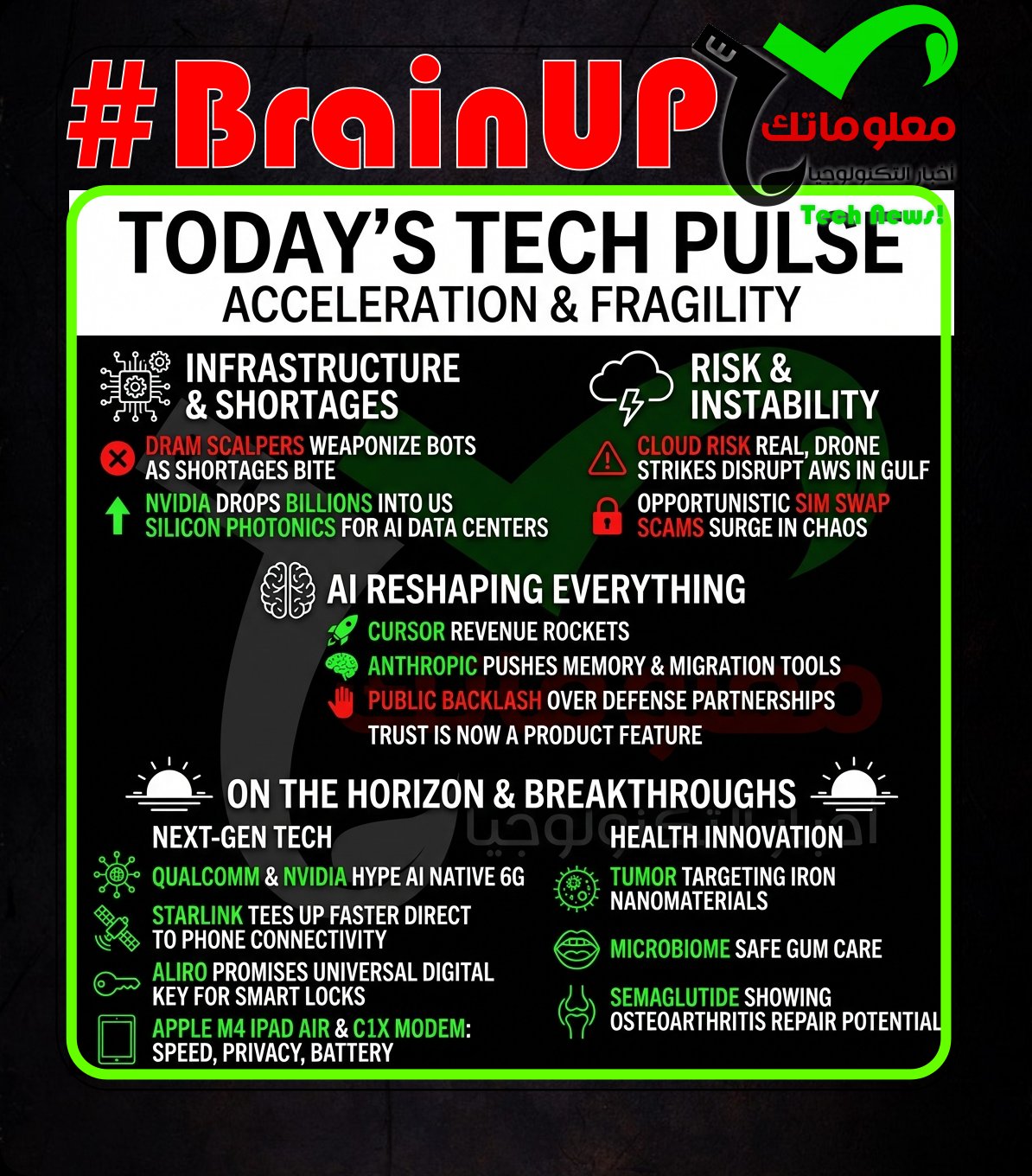
#BrainUp Daily Tech News – (Tuesday, March 3ʳᵈ)
Welcome to today’s curated collection of interesting links and insights for 2026/03/03. Our Hand-picked, AI-optimized system has processed and summarized 25 articles from all over the internet to bring you the latest technology news.
As previously aired🔴LIVE on Clubhouse, Chatter Social, Instagram, Twitch, X, YouTube, and TikTok.
Also available as a #Podcast on Apple 📻, Spotify🛜, Anghami, and Amazon🎧 or anywhere else you listen to podcasts.
1. Memory scalpers hunt scarce DRAM with bot blitz
Web scraping bots are intensifying the #DRAM shortage by repeatedly probing e-commerce inventory so operators can target scarce parts for resale at higher prices. DataDome says its Galileo team observed a large operation making more than 10 million scraping requests, hitting selected sites about every 6.5 seconds, querying DDR5 pages and related components, and using #cache_busting plus throttling to avoid rate limits, with signs that #AI tools are used to improve scraping and bypass anti-bot defenses. The activity is described as focused on identifying available stock rather than automated purchasing, but it is intended to help scalpers quickly buy limited supply, crowding out legitimate buyers and pushing prices up. The broader context is a DDR5 shortfall since last November driven by hyperscalers and AI infrastructure demand, with expectations of DRAM prices doubling in Q1 2026 and NAND costs rising, prompting providers like @Hetzner to raise prices and potentially constraining entry-level PC and phone shipments.
2. US: DARPA-backed X-ray aims to detect threats from 3,280-ft away
BBN Technologies is developing long-range #X-ray tools under a @DARPA program to detect hidden objects from nearly 0.6 miles away. The article states the system aims to spot concealed threats at about 3,280 feet. It describes the effort as a DARPA-backed approach to seeing hidden objects at long distances. This suggests a surveillance and threat-detection capability intended to identify weapons or similar concealed items without close-range inspection. The work is presented as a military-relevant detection technology advancing standoff sensing of hidden threats.
3. Drone Strikes Damage Amazon Data Centers in the UAE and Bahrain
@Amazon’s @Amazon Web Services warned of prolonged service disruptions after drone strikes damaged three Middle East data center sites, including two facilities in the UAE that were directly struck and infrastructure damage near another facility in Bahrain. AWS reported elevated error rates and degraded availability, saying two of its three regional data center hubs remain significantly impaired, while a third zone is operating normally but has some indirect impacts due to dependencies. The company said recovery is expected to take time because of the physical damage and advised customers in the region to back up data and consider migrating workloads to alternative AWS regions. AWS tied the incident to a widening regional conflict that has also affected #global energy markets, with oil prices spiking and tanker traffic through the #Strait of Hormuz nearly halting. The episode highlights how #physical attacks on #cloud infrastructure can ripple into broader operational risk and customer continuity concerns, especially in an unpredictable security environment.
4. Qualcomm, Nvidia push ‘AI-native’ 6G – definition pending
@Qualcomm and @Nvidia are using #AI as the rationale to accelerate talk of commercial #6G at Mobile World Congress even though binding 6G standards are not finalized and the meaning of “AI-native” remains vague. @Nvidia says it has a partner commitment to build next generation wireless networks on “AI-native, open, secure and trustworthy” platforms and frames its approach around #AI-RAN and AI-powered #software-defined networking so 6G systems can evolve via software updates rather than continual hardware redesign. @Qualcomm is promoting an “AI-native” 6G system built on three pillars: connectivity, wide-area sensing, and high-performance compute, and it is also pushing for essential 6G standards, early validation, and spec-compliant pre-commercial devices and networks by 2028, aiming for interoperable commercial rollout in 2029. Both initiatives share many partners including BT Group, Cisco, Deutsche Telekom, T-Mobile, Nokia, SK Telecom, and Ericsson, and they argue 6G will need lower latency, better traffic management, and real-time analytics to support large volumes of future physical AI systems. However, standards bodies like the @International Telecommunication Union, which published the #IMT-2030 framework in 2023, and the #3GPP are still developing requirements and evaluation criteria, leaving technical specifications for commercial 6G incomplete.
5. Cursor has reportedly surpassed $2B in annualized revenue | TechCrunch
The #AI coding assistant Cursor has reportedly surpassed $2 billion in annualized revenue, as its revenue run rate doubled over the past three months, according to a Bloomberg source. The timing appears aimed at countering recent skepticism after viral tweets claimed Cursor’s momentum was slowing and highlighted developer defections to @Anthropic’s Claude Code. Founded in 2022, Cursor shifted from primarily selling to individual developers to focusing on large corporate buyers, which Bloomberg says now generate about 60% of revenue. While some individuals and smaller startups have switched to Claude Code for pricing reasons, the report suggests higher-spending corporate customers are stickier, even as competitors like @OpenAI’s Codex and startups such as Replit, Cognition, and Lovable vie for share. Cursor was last valued at $29.3 billion in a $2.3 billion round co-led by Accel and Coatue in November, and the company did not immediately respond to TechCrunch’s request for comment.
6. Geopolitical drama reportedly stalls IPO of SoftBank-backed PayPay | TechCrunch
Japan’s leading mobile payments app PayPay has reportedly postponed its planned U.S. #IPO as market volatility intensified amid conflict in the Middle East. The company was set to publish an IPO price range on March 2 and was targeting a valuation of at least ¥1.5 trillion, about $10 billion, according to Bloomberg. PayPay, founded in 2018 as a joint venture between @SoftBank and Yahoo Japan with technical collaboration from Paytm, has also seen ownership changes, with Paytm selling its remaining stake to @SoftBank in late 2024 for about $279 million. The delay fits a broader pullback in tech listings in 2026 after a sell-off in software stocks tied to fears that #AI could make traditional software obsolete, compounded by shocks from U.S. strikes on Iran and regional upheaval, with other firms like Motive Technologies and Clear Street also delaying or scrapping plans. The report underscores that while smaller offerings are stalled, investors are still watching for potential “mega-IPOs” in 2026 such as @SpaceX, @OpenAI, and @Anthropic.
7. BYD February vehicle sales fall at steepest pace since pandemic
BYD, a leading Chinese electric vehicle manufacturer, reported a significant drop in vehicle sales in February, marking the steepest decline since the COVID-19 pandemic began. The company sold approximately 113,000 vehicles, down 34% from the previous month due to seasonal factors and a slowdown in consumer demand. Despite this slump, BYD remains a dominant player in the EV market supported by strong domestic incentives and expansion efforts. The sales decline reflects broader challenges in China’s auto sector, including tightening government policies and cautious buyer sentiment post-pandemic. BYD’s situation highlights the volatile nature of the EV industry, emphasizing the importance of adaptability in response to shifting market dynamics.
8. Anthropic Tries to Win Users From ChatGPT With Memory Feature
@Anthropic is expanding #memory for its @Claude chatbot to free users and adding an easier way to import chat histories from other AI chatbots like @ChatGPT, aiming to retain and attract consumers amid a surge in demand. The memory feature was previously limited to paid subscribers and now mirrors a capability @OpenAI already offers on ChatGPT’s free plan, while the new import option uses a simple copy-and-paste method. Anthropic said Claude’s free active users have grown more than 60% and daily signups have quadrupled since January, and the company reported an hourslong outage on Monday due to “unprecedented demand” that was resolved by midmorning New York time. The consumer spike comes as Anthropic faces escalating US government backlash tied to its dispute with the US Defense Department over potential mass surveillance and autonomous weaponry uses, including an order by President @Donald_Trump to remove Claude from agency systems and a Pentagon designation of Anthropic as a supply-chain risk. The changes position Claude to capture users reconsidering ChatGPT after OpenAI said it will deploy its models inside the Defense Department’s classified network, prompting some calls for a boycott.
9. Here’s How SpaceX Will Pay Hughesnet for Referring Its Customers to Starlink
@SpaceX will pay rival Hughesnet, via parent @EchoStar, a commission for referring customers to #Starlink that effectively equals up to two months of Starlink service revenue per converted user, according to regulatory filings. The filing describes a “fee-based referral program” in which EchoStar receives (i) one month of Starlink #ARPU at customer enrollment and (ii) another month of ARPU at the one-year anniversary, meaning the full payout depends on the customer staying at least a year. The arrangement also covers new and existing customers across Hughesnet and EchoStar’s carrier business #BoostMobile, and switching Hughesnet customers can receive a Starlink dish for free during a one-year period starting Dec. 1, 2025, after which hardware is $100 per standard kit for each existing customer. EchoStar’s Dish Network and Boost Mobile have already begun promoting Starlink sales and installations, while Hughesnet has not yet publicized the program and did not comment on timing. The deal comes as Hughesnet faces cash and debt pressures and has lost subscribers to Starlink, positioning the referral fees as a way to monetize customer transitions while SpaceX handles delivery and service for switchers.
10. New iron nanomaterial wipes out cancer cells without harming healthy tissue
Scientists at Oregon State University developed an iron-based #metal-organic framework nanoagent for #chemodynamic therapy that targets tumors by exploiting their acidity and elevated hydrogen peroxide. Unlike many existing CDT agents that mainly generate either hydroxyl radicals or singlet oxygen, this material triggers two reactions inside tumor cells to produce both #hydroxyl radicals and #singlet oxygen, driving high #reactive oxygen species levels and oxidative stress. The MOF showed strong toxicity across multiple cancer cell lines while causing minimal harm to noncancerous cells. In mice bearing human breast cancer cells, systemic administration led to tumor accumulation, robust reactive oxygen species generation, and complete tumor regression without observed adverse effects. The results suggest dual-reactive-oxygen production can overcome key limitations of prior CDT approaches and improve tumor eradication while sparing healthy tissue.
11. Nvidia burns $4B to light up US photonics manufacturing
@Nvidia is investing $4 billion to secure supply of #siliconPhotonics for AI datacenter networking, putting $2 billion each into Coherent and Lumentum alongside nonexclusive multibillion-dollar purchase commitments for advanced laser components and optical networking products. The two suppliers make datacenter optical components such as pluggable transceivers, laser sources, and optical circuit switches, and say they will expand US manufacturing capacity as part of the announcement. Nvidia says it has avoided photonics for scale-up #NVSwitch fabrics in rack-scale systems like the GB200 NVL72 due to power, with @JensenHuang citing a 20kW savings by using copper in a 120kW system, but it is adopting photonics for scale-out networks to reduce power. Nvidia has already announced next-gen Spectrum and Quantum switches using #coPackagedOptics that integrate transceivers into the switch to reduce pluggables and power, while still relying on laser modules and using pluggables on the NIC side. The move underscores how central photonics has become to the AI datacenter supply chain as Nvidia grows its networking business and builds longer-reach products such as Spectrum-XGS for multi-datacenter connectivity.
12. Motorola partners with GrapheneOS for future phones
Motorola has partnered with #GrapheneOS to bring the privacy and security focused Android fork to future Motorola phones, but compatible hardware is not expected until 2027. Announced at Mobile World Congress on March 2, Motorola said the companies will collaborate on devices engineered for GrapheneOS compatibility, while GrapheneOS noted it will start with 2027 flagships similar to Motorola Signature and the Motorola razr fold and razr ultra models, assuming they meet requirements such as expected updates and #hardwareMemoryTagging. GrapheneOS, which already supports Google Pixel 6 through 10, said Motorola is actively working on next generation devices and also plans to integrate some GrapheneOS features and concepts into Motorola’s regular OS separately from full GrapheneOS builds. The move echoes earlier Android aftermarket OS partnerships like OnePlus and CyanogenMod, though the article notes the circumstances differ and the relationship will be closely watched.
13. ChatGPT uninstalls surged by 295% after DoD deal | TechCrunch
U.S. users sharply reacted to @OpenAI’s reported deal with the #DepartmentOfDefense, rebranded under the @Trump administration as the Department of War, driving a sudden drop in #ChatGPT app sentiment and usage. Sensor Tower data shows ChatGPT mobile uninstalls jumped 295% day over day on Feb. 28 versus a typical 9% daily uninstall rate, while U.S. downloads fell 13% that Saturday and another 5% on Sunday after having risen 14% on Friday before the news. At the same time, @Anthropic’s #Claude benefited after saying it would not partner with the U.S. defense department, citing concerns about AI being used for surveillance of Americans and fully autonomous weaponry, with U.S. downloads up 37% on Feb. 27 and 51% on Feb. 28, and the app reaching No. 1 on the U.S. App Store. Ratings reflected the backlash, with 1-star reviews for ChatGPT surging 775% on Saturday and rising another 100% Sunday as 5-star reviews fell 50%. Other firms corroborated the shift: Appfigures said Claude’s U.S. daily downloads surpassed ChatGPT’s for the first time and estimated an 88% Saturday increase, while Similarweb reported Claude’s weekly U.S. downloads were about 20x January levels, though it cautioned other factors could be involved.
14. Age verification for social media, chatbots go viral with regulators globally | Biometric Update
Governments are increasingly exploring #ageAssurance and restrictions on social media use by minors, with added urgency driven by concerns about AI chatbots producing nonconsensual pornography and encouraging violence. In the UK, the Department for Science, Innovation and Technology has launched a three month public consultation, described as highly ambitious, including real world family and teen pilots to test how potential restrictions could work. The consultation asks what minimum age should apply, whether to curb addictive design features like infinite scroll and autoplay, whether to impose overnight curfews, how to address AI chatbots, and how #ageVerification enforcement should be strengthened, with input welcomed from parents, young people, civil society, academics, and industry including #biometrics and #digitalIdentity providers for facial age estimation. Political momentum is described as being driven largely by parental pressure, with Technology Secretary @LizKendall framing the effort as helping young people thrive amid rapid technological change, and the government planning to respond in summer using new legislative powers. The UK process explicitly draws on international experience, including Australia’s move to keep under 16s off major platforms, as policymakers weigh how to translate online harms concerns into enforceable #ageAssurance rules.
15. AWS says drones hit two of its datacenters in UAE
Multiple @Amazon Web Services availability zones in the Middle East region have suffered outages or degraded connectivity after objects struck an AWS data center in the UAE amid Iranian retaliatory missile and drone attacks across the Gulf following US and Israeli strikes on Iran. AWS began investigating a disruption in mec1-az2, later reporting the facility was hit by objects that caused sparks and fire, and local authorities cut power to contain the blaze, then impacts spread to mec1-az3, leaving two of three zones impaired and causing high failure rates for S3 ingest and egress because #S3 is designed to tolerate the loss of only one zone in a region. AWS also reported a separate outage in Bahrain at mes1-az2 due to a localized power issue with restoration expected to take at least a day, and the article links this broader instability to regional strikes including reported hits in Bahrain. AWS said restoration could take at least a day due to repairs to facilities, cooling, and power systems plus coordination with authorities and safety checks, and the outages created knock-on disruptions for regional SaaS providers such as Snowflake. The incident underscores how regional conflict can directly disrupt #cloud infrastructure in the Middle East, where countries like Saudi Arabia and the UAE have been expanding #datacenter capacity and #AI-related investments.
16. Scammers target Dubai bank accounts amid Iran missile salvo
Dubai Police warned that financially motivated cybercriminals are exploiting the aftermath of Iranian missile strikes by targeting vulnerable Dubai residents for #SIM-swapping aimed at draining bank accounts. Scammers posing as a fake “Dubai Crisis Management” unit linked to Dubai Police are trying to collect sensitive data such as #UAEPass credentials and Emirates ID details, which could enable SIM swap takeovers and interception of one-time passcodes used for mobile banking. Police stated they never request confidential information or verification codes by phone or text, and urged the public to avoid sharing personal or banking details with unverified parties and to report suspected fraud via 901 or the eCrime platform. The alert comes amid escalating conflict after US and Israeli strikes on Iran and subsequent Iranian retaliation that included missile attacks in Dubai and bombings affecting airports and other sites, creating conditions scammers are using to pressure victims.
@Starlink says its rebranded Starlink Mobile service, previously called #DirectToCell, is set to improve substantially as @SpaceX launches next generation #V2 satellites into low Earth orbit. Starlink claims V2 will deliver 100x the data density of V1, about 20x more throughput per satellite, and enable “5G from space” for streaming, browsing, high speed apps, and voice calls, while still working with hundreds of existing #LTE phones. The article notes the current V1 based offering is generally limited to light data and texts, so the stated V2 uplift would meaningfully change real world usability, especially for connectivity and emergency coverage where terrestrial networks are weak. Starlink also expects partners like @TMobile to provide seamless handoff between satellite and terrestrial networks, and prior statements point to peak speeds up to 150 Mbps per user as V2 rolls out. With plans for up to 15,000 new satellites and reliance on #Starship to deploy larger V2 craft, the piece suggests initial V2 testing is most likely in early 2027, with some V2 Mini satellites already launching to bridge the gap.
18. New Toothpaste Stops Gum Disease Without Harming Healthy Bacteria
A new toothpaste formulation effectively combats gum disease by targeting harmful bacteria while preserving beneficial oral microbes. Traditional toothpastes and mouthwashes often disrupt the oral microbiome balance, leading to negative long-term effects, but this innovative product selectively inhibits #Porphyromonas gingivalis, a key pathogen in periodontitis. In lab and clinical trials, the toothpaste reduced gum inflammation and prevented disease progression without damaging the overall bacterial community. This approach offers a promising alternative to broad-spectrum antimicrobials, supporting oral health by maintaining microbial equilibrium. The development aligns with advancing treatments that prioritize microbiome-friendly strategies for disease management.
19. Apple introduces the new iPad Air, powered by M4
Apple announced a new iPad Air powered by #M4, positioned as a major performance upgrade with more memory at the same starting price, plus enhanced connectivity and new #iPadOS 26 capabilities. The device uses an 8-core CPU and 9-core GPU and is described as up to 30 percent faster than iPad Air with M3 and up to 2.3x faster than iPad Air with M1, with a faster #NeuralEngine, higher memory bandwidth, and 50 percent more unified system memory than the previous generation for stronger #AI workloads. For graphics, M4 adds support for second-generation hardware-accelerated mesh shading and ray tracing, and Apple says it delivers over 4x faster 3D pro rendering with ray tracing performance versus iPad Air with M1, improving lighting, reflections, and shadows in games and pro apps like Pixelmator Pro and Final Cut Pro. Connectivity is updated with Apple silicon connectivity chips N1 and C1X, including support for #WiFi7, and the lineup comes in 11-inch and 13-inch sizes with support for Apple Pencil Pro and Magic Keyboard, all-day battery life, advanced cameras, and a broad app ecosystem. Pricing starts at $599 for 11-inch and $799 for 13-inch, with education pricing at $549 and $749, pre-orders open March 4 and availability begins March 11, according to @BobBorchers.
20. Gartner: Sub-$500 entry-level PCs could disappear by 2027
Gartner predicts that by 2027, entry-level PCs priced under $500 will largely vanish from the market due to rising component costs and evolving consumer demands. The firm highlights how inflation, supply chain challenges, and increased hardware complexity are driving up costs, which manufacturers can no longer offset with basic features. This shift reflects a broader trend towards more powerful devices even at lower price points, reducing the feasibility of very low-cost, barebones PCs. Consequently, consumers may need to adjust expectations around price and performance when purchasing entry-level systems in the near future. Gartner’s forecast underscores the impact of economic and technological pressures on the PC market’s structure and pricing dynamics.
@Anthropic’s AI chatbot Claude suffered an outage and stopped working for many users. Visitors saw a message saying Claude was experiencing a temporary service disruption and that the issue had been identified and was being fixed, with an error page indicating a problem with the web access point. @Down Detector logged a major outage around noon in the UK, affecting users worldwide, while #Claude API access for integrations was reported as still working as expected. The disruption comes during a high-profile period for @Anthropic amid a dispute with the US #Department of Defense over requests for unrestricted Claude access for military missions, which Anthropic has refused on ethical grounds. The incident highlights how service reliability for Claude intersects with broader scrutiny of how #AI systems are accessed and used, particularly in military contexts.
22. Motorola News | Introducing the motorola razr fold
Motorola introduces the motorola razr fold, its first book-style foldable in the razr family, positioned as a large-screen device for productivity, creativity, and entertainment without sacrificing portability. It pairs a 6.6-inch external display with an 8.1-inch 2K LTPO internal display, runs on the #Snapdragon 8 Gen 5 Mobile Platform with AI features for productivity and camera capabilities, and supports #moto pen ultra for note-taking and sketching. The company highlights durability and design with a 4.6mm open and 9.9mm closed profile, a stainless steel teardrop hinge, a titanium inner screen plate, Ultra-Thin Glass with Anti-Shock Film, and the first smartphone use of Corning Gorilla Glass Ceramic 3, with internal testing claiming over 75% better drop performance versus prior generations. Camera is a key claim, with a DXOMARK-rated #1 foldable camera system and #2 smartphone camera system in North America, plus a rear system earning a DXOMARK Gold Label, alongside a large foldable battery and up to seven years of Android OS and security updates. The article frames razr fold as Motorola’s new standard for foldables, blending flexible modes like laptop and tent mode with bright-display viewing and premium audio via Dolby Atmos and Sound by Bose.
23. Semaglutide May Reverse Damage Caused by Osteoarthritis, Study Suggests
A new study suggests semaglutide, the drug behind Ozempic and Wegovy, may protect and repair joint tissues damaged by #osteoarthritis through a mechanism that is not solely due to weight loss. In mouse experiments and a randomized human trial involving people with obesity and osteoarthritis, semaglutide reduced pain and cartilage degeneration, and in mice it also reduced bone spurs and lessened joint membrane lesions. Cartilage comparisons between treated and untreated mice showed changes in expression across nearly 8,300 proteins, and a pair-feeding control group with similar food intake and weight change did not show the same cartilage protection, supporting a weight loss independent effect. The researchers link the benefit to the #GLP-1R-AMPK-PFKFB3 axis, where semaglutide shifts chondrocyte energy metabolism, improving cellular efficiency and survival in cartilage. Because existing osteoarthritis treatments are largely palliative, these findings indicate semaglutide may target underlying metabolic drivers of osteoarthritis progression rather than only easing symptoms by reducing joint load.
25. What is Aliro? Everything you need to know about the new smart home standard for locks
#Aliro is a new #digital key standard that creates a universal system for #smart locks, replacing today’s brand specific credential approaches with a single protocol. It was created by the @Connectivity Standards Alliance, the group behind #Matter, and Aliro 1.0 launched in February 2026. The standard aims to solve common compatibility issues, such as some locks supporting @Apple HomeKey while others do not, and the fragmentation of different credential systems across lock makers. Aliro works by using asymmetric cryptography, a public and private key system, to unlock doors over #NFC, #Bluetooth, or #UWB, which is intended to simplify and standardize how people use phones and smartwatches as keys across homes, apartments, and dorms.
26. Apple’s new products add C1X chip for three unique advantages – 9to5Mac
@Apple says the new iPhone 17e and M4 iPad Air add its in-house #C1X #5G modem to deliver three advantages over non-Apple modems: faster data, improved privacy, and better battery life. Apple claims C1X provides up to 50% faster cellular performance in M4 iPad Air versus the prior M3 model’s Qualcomm modem, and up to 2x faster performance than the earlier C1 modem in iPhone 16e, plus smarter behavior in congestion, with Reuters reporting the processor can prioritize time-sensitive traffic to make the device feel more responsive. In iOS 26.3, devices with Apple-designed modems gain the ‘#LimitPreciseLocation’ feature, which reduces how precisely cellular networks can infer location from cell tower connections without affecting signal quality, though only some carriers currently support it. Apple also highlights efficiency: for active cellular users, C1X can use up to 30% less modem energy in M4 iPad Air than the M3 version, and the same efficiency trend is said to extend to iPhone 17e. Together, the speed, privacy control, and power savings are positioned as practical benefits of Apple’s move to its own modem technology in these new products.
That’s all for today’s digest for 2026/03/03! We picked, and processed 25 Articles. Stay tuned for tomorrow’s collection of insights and discoveries.
Thanks, Patricia Zougheib and Dr Badawi, for curating the links
See you in the next one! 🚀
