
#BrainUp Daily Tech News – (Thursday, February 26ᵗʰ)
Welcome to today’s curated collection of interesting links and insights for 2026/02/26. Our Hand-picked, AI-optimized system has processed and summarized 24 articles from all over the internet to bring you the latest technology news.
As previously aired🔴LIVE on Clubhouse, Chatter Social, Instagram, Twitch, X, YouTube, and TikTok.
Also available as a #Podcast on Apple 📻, Spotify🛜, Anghami, and Amazon🎧 or anywhere else you listen to podcasts.
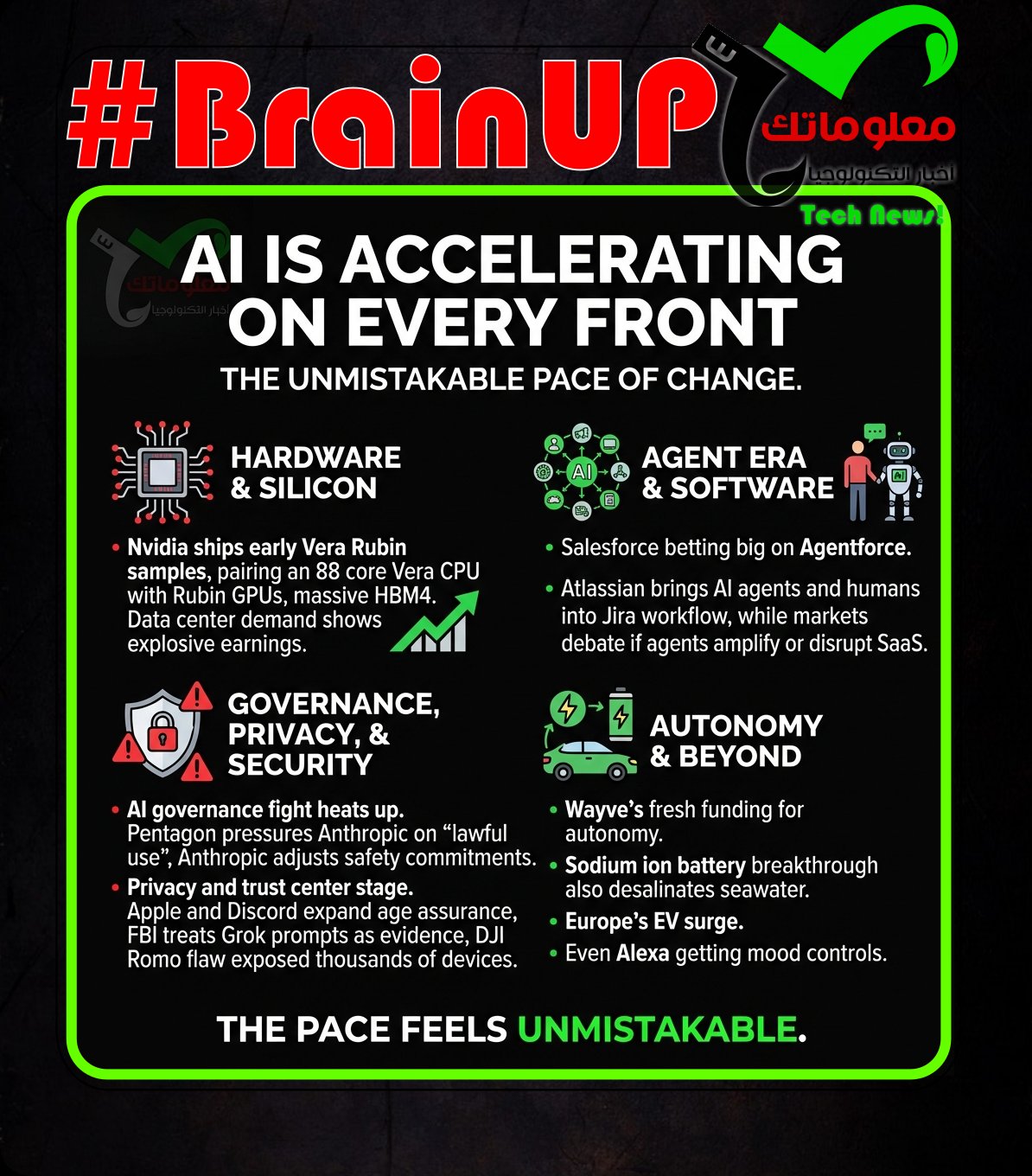
@Nvidia has begun delivering customer samples of its next generation Vera Rubin platform for AI data centers, aiming for production shipments in the second half of 2026 and broader deployment in late 2026 or early 2027. On an earnings call, CFO @Colette Kress said the first samples shipped earlier in the week, and the platform is described as combining an 88-core Vera CPU with Rubin GPUs featuring 288 GB of #HBM4, plus a Rubin CPX GPU with 128 GB of #GDDR7 and #NVLink 6.0 switching for rack-scale connectivity. The full platform also includes #BlueField-4 DPUs with integrated SSD for key-value cache, #Spectrum-6 Photonics Ethernet, and #Quantum-CX9 Photonics InfiniBand NICs and switching silicon for scale-out networking. Partners will receive different components for qualification and validation, with some getting full NVL72 VR200 racks, and silicon samples are expected to go to server makers like Foxconn, Quanta, Supermicro, and Wistron. Market rumors cited in the article suggest #Nvidia may provide fully assembled L10 VR200 compute trays to reduce ODM design freedom, while Kress claims a modular cable-free tray design should improve resiliency and serviceability compared with Blackwell, and she expects cloud model builders to deploy Vera Rubin.
2. Salesforce CEO declared victory over flagging software sales
@Marc Benioff used Salesforce’s Q4 earnings call to argue that the company will thrive despite worries about a #SaaSpocalypse, claiming #agenticAI and “agents as a service” make SaaS “a lot better.” He touted early traction for #Agentforce IT Service and said Salesforce had won 180 customers since launching its #ITSM offering in October, positioning it as a growing threat to ServiceNow, including named customer defections such as SunRun, Cornerstone, and Cool Systems. The call also featured unusual, informal banter with @Geoffrey Ballotti, @Mark Barrocas, and references to @Aneel Bhusri, even as Salesforce announced a 5.8 percent dividend increase to 44 cents and a $50 billion stock repurchase plan, yet shares fell 5.6 percent after hours. Analysts pointed to softer-than-hoped remaining performance obligations of $35.1 billion and questioned whether Salesforce can scale Agentforce while sustaining broader portfolio growth, with @Keith Weiss highlighting investor concern. Salesforce reported full-year revenue of $41.5 billion versus prior guidance of $40.5 to $40.9 billion, but the article notes $399 million came from the Informatica acquisition, and Q4 revenue was $11.2 billion, up 12 percent year over year, which Benioff cited as evidence of better-than-expected execution.
3. Nvidia’s Huang says any Pentagon–Anthropic rift is ‘not the end of the world’
@Jensen Huang said a dispute between the U.S. Department of Defense and @Anthropic over how the military can use Anthropic’s #Claude models is “not the end of the world,” arguing both sides have reasonable positions. He spoke after Defense Secretary @Pete Hegseth gave Anthropic until Friday to loosen its usage rules or risk losing its government contract, and sources said the Pentagon could label the company a “supply chain risk” or invoke the #Defense Production Act if it does not comply. The negotiations have stalled because Anthropic wants assurances its models will not be used for autonomous weapons or mass surveillance of Americans, while the DoD wants agreement to “all lawful use cases” without limitation. Huang said the DoD has the right to use procured technology to serve its interests and Anthropic has the right to set marketing and use case limits, and he added that even if they do not reach a deal, there are other AI companies and other customers. The article notes Anthropic won a $200 million DoD contract last year and has a strategic partnership with Nvidia, including adopting Nvidia’s architecture and a $5 billion investment commitment.
4. Nvidia’s Jensen Huang says markets ‘got it wrong’ on AI threat to software companies
@Jensen Huang said markets have misjudged the idea that #agenticAI will cannibalize enterprise software, arguing instead that AI agents will be “tool users” that rely on existing software to boost productivity. He pointed to tools like the internet browser and @Microsoft’s Excel, and named companies such as Cadence, Synopsys, ServiceNow, and SAP as examples of software with enduring value that AI agents will use on users’ behalf and then return results in a human understandable form. The comments followed #Nvidia reporting fiscal Q4 revenue up 73% year over year to $68.13 billion, topping estimates, and guiding fiscal Q1 revenue to about $78 billion, above forecasts, underscoring continued #AI hardware demand despite investor bubble fears. The article notes software shares have been pressured, with after hours moves mixed, while investor Dan Niles said markets often overbuild new technologies and warned some software firms could still be hurt as AI automates workflows, compresses pricing, and lowers barriers to entry. Overall, the piece frames Huang’s view that AI adoption should increase, not reduce, the use of established software tools even as the market debates which companies will ultimately win or lose.
5. Nvidia reports earnings and guidance beat as AI boom pushes data center revenue up 75%
@Nvidia reported fiscal fourth-quarter results and guidance that beat expectations, driven by the #AI boom and surging #data center demand. Adjusted EPS was $1.62 versus $1.53 expected and revenue was $68.13 billion versus $66.21 billion, with total revenue up 73% year over year; net income nearly doubled to $43 billion. Data center revenue rose 75% to $62.3 billion, representing over 91% of sales and topping estimates, with hyperscalers making up just over 50% of data center revenue. Within data center, networking revenue grew 263% to $10.98 billion, reflecting adoption of #NVLink and Spectrum-X Ethernet switches and new deals including with @Meta. Nvidia guided fiscal first-quarter revenue to $78 billion plus or minus 2%, above forecasts and excluding any assumed data center revenue from China, while noting a global memory shortage could pressure the Gaming business, even as gaming revenue rose 47% year over year to $3.7 billion but fell 13% sequentially.
7. Jira’s latest update allows AI agents and humans to work side by side | TechCrunch
@Atlassian is rolling out “agents in Jira,” a new update that lets teams assign and manage work forfinal and #AI agents alongside human employees in the same #Jira dashboard. In an open beta, enterprises can assign tasks and tickets to AI agents, track progress, set deadlines, and even add agents mid-project, with the aim of producing “10x the work without 10x the chaos.” Tamar Yehoshua, Atlassian’s chief product and AI officer, said the unified dashboard is designed to bring visibility and coordination to agent work, addressing concerns that agents can create more work and confusion. The shared view can also help organizations compare agent output to human work to decide where AI delivers ROI and which tasks should remain human-led. Atlassian framed this release as an early step in a broader push to integrate #AI tools into its existing software workflows.
8. Australia’s WiseTech to cut 2,000 jobs as AI renders manual coding obsolete
Australia’s WiseTech Global plans to cut about 2,000 jobs, up to 50% of headcount in product and development and customer service across the company, including its US subsidiary e2open
9. Apple brings age verification to UK users in iOS 26.4 beta
In the iOS 26.4 beta, @Apple is prompting UK users to complete #age-verification after installation, warning that those who do not confirm they are over 18 may be unable to download or purchase apps or make in-app purchases. Screenshots shared on Reddit show @Apple may automatically confirm adulthood using the account’s payment method or account age, and otherwise may ask users to scan their credit card, with at least one user reporting an option to scan an ID. The Verge contacted @Apple for additional details but had not received a response at the time of publication. The change is framed as part of expanding global #age-verification requirements, alongside @Apple’s announcement that it will block users in Australia, Brazil, and Singapore from downloading 18+ apps unless they verify they are adults using “reasonable methods,” and that it will share age categories with developers’ apps to comply with local laws in Utah and Louisiana.
@Apple is expanding worldwide #age-assurance tools in the App Store to comply with a growing set of child-safety and age-verification laws, including measures that restrict access to adult-only apps. The company told developers it is broadening its toolkit with an updated #DeclaredAgeRangeAPI in beta, which lets apps learn a user’s age range without accessing personal details like a birth date, and it will block downloads of 18+ rated apps in Brazil, Australia, and Singapore until users confirm they are adults, with the App Store handling the confirmation. In Brazil, the API can return an age category when a user or parent or guardian chooses to share it, and games with #lootBoxes will have their ratings updated to 18+ to reflect concerns that the gambling-like mechanic should not be available to kids. In the U.S., new users in Utah and Louisiana will soon have their age categories shared with developers via the API, which also adds signals about whether regulatory requirements apply and whether a user must share an age range or needs parent or guardian permission for significant updates for a child. The rollout builds on earlier work to meet similar requirements in Texas that was later partly paused as the law is challenged in court, and it follows prior changes to Apple’s age ratings to make them more granular and to ask developers additional review questions.
12. The Galaxy S26 is faster, more expensive, and even more chock-full of AI
Samsung unveiled the Galaxy S26 lineup, S26, S26+, and S26 Ultra, with mostly cosmetic tweaks and upgraded internals while emphasizing a bigger push into #AI with what it calls its first “Agentic AI phones.” All three models use the Snapdragon 8 Elite Gen 5 for Galaxy (3 nm) with Oryon CPU cores, Adreno 840 GPU, and a Hexagon NPU, plus Samsung claims double digit performance gains and improved sustained performance via its largest vapor chamber yet. Pricing rises for the two cheaper models by $100 to $900 (S26) and $1,100 (S26+), while the Ultra stays at $1,300, and the Ultra also shifts from titanium back to aluminum while keeping S Pen support. Battery and charging updates are modest, with the base battery increasing to 4,300 mAh and the Ultra boosting charging to a peak 60 W, advertised as 75 percent in 30 minutes. The S26 series runs Android 16, keeps familiar display and camera configurations across the range, and is available for preorder now with shipping on March 11.
14. Google teases ‘amazing things’ in Android 17
@Sameer Samat, President of the Android Ecosystem, used Samsung’s Galaxy Unpacked to tease “amazing things” coming in #Android17 and framed Android’s direction as moving from an operating system to an “intelligent system” rebuilt with #AI at the core. He said the next chapter aims to create a platform that “truly understands and works for you,” with more details promised in the coming months as Android 17, now in beta, progresses beyond its first preview. While Google has not yet shared tentpole features, the timeline suggests Android 17 will be mostly finalized by May ahead of a stable June launch, with Google I/O potentially outlining additions that arrive later via #QuarterlyPlatformReleases, including a larger upgrade expected with QPR2 in December. Samat also highlighted #Gemini’s “next evolution” to help users get more done across the phone, arriving first on the Galaxy S26 and Pixel 10 series, and described current examples like the Gemini overlay, Magic Cue, and notification summaries as a preview of what is coming for Android.
16. FBI Got Grok to Hand Over Prompts Used to Create Nonconsensual Porn
Court records say the @FBI obtained a search warrant requiring X to provide details of #Grok prompts allegedly used by Simon Tuck to generate about 200 pornographic videos resembling a woman he knew, as part of an extreme harassment and cyberstalking campaign. An FBI affidavit describes Tuck secretly filming the woman, swatting the couple’s home, making anonymous false reports to the husband’s employer, posing as the husband to send mass shooting and suicide threats, and issuing other threats including impersonating a member of “Sector 16,” described as a Russian hacking crew. The warrant covered Tuck’s conversations with Grok, and the affidavit includes an example prompt depicting a “confident blonde woman” undressing on a tennis court, and alleges Grok was also used to draft a complaint about the husband that was filed with his employer. The case is notable for treating AI chatbot chats as evidentiary sources and for showing X’s compliance, while also highlighting X’s role in enabling #nonconsensual sexual material amid broader criticism of Grok’s weak content moderation during the “undress her” phenomenon and related controversies. A correction notes the FBI used a search warrant, not a subpoena.
17. These data center developers asked Trump for an exemption from pollution rules
Data center developer Novva sought relief from #CleanAirAct pollution limits after struggling to secure enough electricity quickly for a major customer amid the #AI boom. In Utah, Rocky Mountain Power could not supply Novva’s full requested power until 2031, so the company pursued a 200-megawatt natural gas plant that would not come online until 2027 and, for nearer-term needs, relied on diesel and gas generators that emit nitrogen oxides, carbon monoxide, and more carbon dioxide per unit of energy than a typical natural gas plant. Utah regulators permitted the generators but imposed strict caps, including allowing diesel generators to run only 42 hours per year, constraining Novva’s ability to meet a hyperscaler contract. After the EPA said it would consider presidential exemptions from environmental regulations, Novva wrote to the agency asking @Donald Trump for an exemption, arguing it served national security by supporting U.S. AI development and citing competition concerns after China’s DeepSeek-R1 release. Grist reports this request was among hundreds sent to the EPA’s exemption inbox, obtained via a records request.
18. The DJI Romo robovac had security so poor, this man remotely accessed thousands of them
Sammy Azdoufal says a security flaw in DJI’s Romo robot vacuum ecosystem let him remotely access and control thousands of devices worldwide after he built a homegrown app to control his own unit with a PS5 gamepad. He reports that about 7,000 Romos responded, allowing remote control, live camera and audio viewing, room-by-room mapping into 2D floor plans, and rough location inference via IP address, with devices sending #MQTT packets every three seconds containing serial numbers and detailed cleaning telemetry. In a live demo for The Verge, Azdoufal’s laptop cataloged roughly 6,700 devices across 24 countries in nine minutes and collected over 100,000 messages, and he says DJI Power stations also used the same servers, expanding potential access beyond vacuums. The Verge verified plausibility by providing a colleague’s 14-digit serial number, which Azdoufal used to retrieve correct status and generate an accurate floor plan without authentication, and he demonstrated bypassing a camera security PIN on his own unit, with CTO Gonzague Dambricourt corroborating that a read-only tool could view a camera feed before pairing. The incident suggests weak authentication and privacy controls around device identifiers and #MQTT-based telemetry, raising serious questions even if DJI may have fixed the immediate threat.
19. New York Sues Video Game Developer Valve Over Loot Boxes, Claims They Are Gambling
New York State has filed a lawsuit against @Valve, alleging that its #lootBoxes in popular games constitute illegal #gambling under state laws. The lawsuit claims that Valve’s #lootBox mechanics encourage minors to engage in gambling behavior and generate significant revenue through these features. The state’s legal action seeks to ban loot boxes and impose penalties, arguing that they exploit players and breach consumer protection laws. Valve has not publicly responded yet, but the lawsuit emphasizes ongoing #regulatory efforts to address gaming industry practices related to gambling risks.
22. Hegseth threatens to blacklist Anthropic over ‘woke AI’ concerns
@Pete Hegseth threatened to punish and potentially blacklist @Anthropic from U.S. military work because the company refuses to loosen its AI safety standards, which it says prohibit domestic mass surveillance and AI-controlled weapons. In a meeting with CEO @Dario Amodei, accounts say Hegseth raised options ranging from canceling Anthropic’s up to $200 million Defense Department contract to labeling the firm a “supply chain risk” and using the #DefenseProductionAct to compel access to its tools for any “lawful” purpose, including warfare and surveillance. Pentagon officials said the Defense Department plans to keep using Anthropic’s tools regardless of the company’s wishes, and a senior official said the Act could force Anthropic’s compliance. Trump administration officials have framed Anthropic’s stance as “#wokeAI,” while experts cited in the piece describe the term as vague and often used to attack AI safety protections and alleged liberal bias. The conflict comes as Anthropic faces added scrutiny ahead of a planned IPO, even as Amodei says the company’s valuation and revenue have grown while holding the line on limiting who can have “fingers on the button” for autonomous weapons.
24. Anthropic Drops Flagship Safety Pledge
@Anthropic is overhauling its #ResponsibleScalingPolicy and dropping its 2023 pledge to never train an AI system unless it could guarantee in advance that its safety measures were adequate, removing a categorical constraint that previously could have forced it to pause development. Chief science officer @JaredKaplan told TIME the company concluded it would not help to stop training models, and that unilateral commitments no longer made sense given rapid AI advances and competitors pushing ahead. The new policy emphasizes greater transparency about safety risks and test results, a commitment to match or surpass competitors’ safety efforts, and a promise to delay development only if Anthropic believes it is leading the AI race and that catastrophic risks are significant. The shift comes as Anthropic gains momentum with its Claude models and Claude Code, alongside major investment and fast-growing revenue, though Kaplan denies the change is capitulation to market pressures and frames it as a pragmatic response to political and scientific realities. Kaplan argues the earlier pledge was meant to influence rivals and potentially inform regulation, but federal and international governance has not materialized, the @Trump Administration favors rapid AI development and has sought to nullify state rules, and competition among companies and nations has intensified.
25. Discord Co-Founder Admits Age Check Privacy Missteps, What’s Next
Discord is delaying its updated #age-assurance rollout until later in 2026 and narrowing stricter checks to jurisdictions where laws require them, while developing additional verification options. It says facial age estimation or ID checks will be required only where mandated, and other methods such as credit card verification are being built, which would likely classify many users with payment info on file, including many Discord Nitro subscribers, as adults. Discord claims 90% plus of users will see no change because it already estimates age using signals like payment methods and the types of servers users join, and it says this system does not read messages, analyze conversations, or inspect posted content, with a full methodology promised before global launch. For the under 10% estimated to be minors, users who do not verify would mainly lose access to age restricted content and the ability to change certain default teen safety settings, while the rest of the experience remains the same. Co-founder and CTO @Stanislav Vishnevskiy also outlined #vendor-transparency rules, including on-device facial estimation, minimal retention for ID checks with deletion expected immediately, and the rejection of Persona because it did not meet those privacy standards, while acknowledging user anxiety tied to a past partner breach.
26. Euria: the free, sovereign AI assistant to no longer depend on the American giants • Infomaniak
Infomaniak introduces Euria, a Swiss-based, “sovereign” #AI assistant positioned as a privacy-first alternative to major US and Chinese services, designed for sensitive use cases. According to @Marc Oehler, user data never leaves Infomaniak’s Swiss data centers, is used only to deliver the requested service, and is not used to train models, with an optional ephemeral mode where conversations are not stored and cannot be recovered, even by Infomaniak, while chats are encrypted at all stages. Euria supports voice prompts, image analysis, audio transcription, translation, interpreting PDF/Word/Excel documents, web search, and complex reasoning, and can share and organize conversations across devices, optimizing speed and energy by only performing web searches when needed. Infomaniak links Euria’s operation to sustainability: the data center’s waste heat is fully recovered and fed into Geneva’s district heating network, running on renewable energy without wasting water, and at full capacity it can heat up to 6,000 homes in winter, supply 20,000 hot showers per day, and avoid 3,600 tons of CO2 from natural gas annually. The article frames Euria as an ethical, independent, and responsible #AI offering that enables professionals like doctors, lawyers, administrations, and researchers to use AI without compromising confidentiality.
27. Europe January EV Sales Surge Leaves US Behind
EU EV sales increased significantly in January, driven by #regulations and #incentives from countries like #Germany and #France, boosting consumer adoption. The surge resulted in Europe surpassing US EV market growth, with @Tesla maintaining a strong presence and new models gaining popularity. This competitive boost reflects Europe’s aggressive #climate policies and #infrastructure investments, positioning it as a leader in EV adoption. The trend indicates a shift towards sustainable mobility, with ongoing policy support and technological advancements reinforcing Europe’s growth trajectory.
28. Nvidia, Microsoft back self-driving firm Wayve as it hits $8.6 billion valuation
U.K. autonomous driving company Wayve reached an $8.6 billion valuation after raising a $1.2 billion Series D, with backing from @Nvidia, @Microsoft and @Uber. The round was led by Eclipse, Balderton and SoftBank Vision Fund 2, and also included automakers Mercedes-Benz, Nissan and Stellantis, with @Uber committing up to an additional $300 million tied to milestones. CEO Alex Kendall said the funding supports building an #autonomy layer for any vehicle and accelerates commercial deployment. Wayve, founded in 2017, develops #autonomous driving software and #AI models, has raised over $1 billion before this round, partnered with Nissan to integrate its AI into #driver-assistance systems for deployment from 2027, and plans public #robotaxi trials with Uber in London in 2026 ahead of expansion to more than 10 markets. The fundraise comes as #autonomous driving continues to face technical and regulatory hurdles and #Level 5 automation remains elusive, though recent AI advances are renewing optimism alongside moves by @Alphabet-owned Waymo and competitors like @Tesla and @Amazon’s Zoox.
29. New sodium ion battery stores twice the energy and desalinates seawater
Researchers at the University of Surrey report that retaining water in a key #sodium-ion battery cathode material can nearly double charge capacity and improve performance, potentially helping sodium-ion systems compete with lithium-ion while enabling seawater #desalination. In tests of nanostructured sodium vanadate hydrate (NVOH), the hydrated form stored nearly twice as much charge as standard sodium-ion cathode materials, charged faster, and remained stable for more than 400 cycles, and the work was published in Journal of Materials Chemistry A. The finding overturns the common practice of heat-treating sodium vanadium oxide to remove water, suggesting the material’s natural hydration can enhance electrochemical behavior rather than degrade it, as noted by lead author @Daniel Commandeur. The team also demonstrated operation in salt water where the system removed sodium ions from solution, while a graphite electrode extracted chloride ions via #electrochemical desalination. Together, the results point to a simple materials approach for higher-performing sodium-ion batteries that could also support energy storage paired with water purification.
30. Amazon’s AI-powered Alexa+ gets new personality options | TechCrunch
@Amazon is adding selectable #personality styles to its #AI assistant Alexa+, letting users change the assistant’s tone through three new options: Brief, Chill, and Sweet. Brief delivers shorter, direct replies, Chill answers like a laid-back friend, and Sweet is warmer and more enthusiastic with encouragement and positivity. The company says the styles are built across five personality dimensions: expressiveness, emotional openness, formality, directness, and humor, with each style setting different levels across those factors. The move reflects both user demand for controllable AI tone, similar to #OpenAI’s recent ChatGPT style controls, and broader concerns that overly affirming assistants can contribute to unhealthy dependency and worsen mental health, as alleged in lawsuits. Users can switch styles by speaking to an Alexa device like an Echo or via the Alexa app’s Device Settings under “Personality Style,” with the initial rollout limited to the U.S. and more styles planned.
31. Want to Know If Glassholes Are Using Smart Glasses Near You? There’s an App for That
A new smartphone app called Nearby Glasses aims to help people detect when #smart glasses may be nearby as camera-equipped frames like #Meta Ray-Bans become harder to distinguish from regular eyewear. The app scans #Bluetooth signals, specifically BLE advertising frames, and uses a directory of manufacturers to identify broadcasts associated with devices from Meta, Snap, and Luxottica Group, then alerts the user. Developer Yves Jeanrenaud told 404 Media he built it as a small form of resistance to expanding #surveillance technology after reports of people recording others without consent and sightings of CBP agents wearing smart glasses on duty, alongside concerns about potentially more invasive features like Meta’s reported facial recognition project #Name Tag. He cautioned the detection is imperfect and can generate false positives, for example confusing VR headsets for smart glasses, and he does not want users to feel falsely secure. Nearby Glasses is available on Google Play and GitHub, with an iOS port in progress, as the spread of devices from Meta and Snap, and reported efforts by Apple, Google, and Samsung, suggests encounters with these technologies will become increasingly common.
That’s all for today’s digest for 2026/02/26! We picked, and processed 24 Articles. Stay tuned for tomorrow’s collection of insights and discoveries.
Thanks, Patricia Zougheib and Dr Badawi, for curating the links
See you in the next one! 🚀
