
#BrainUp Daily Tech News – (Wednesday, February 18ᵗʰ)
Welcome to today’s curated collection of interesting links and insights for 2026/02/18. Our Hand-picked, AI-optimized system has processed and summarized 31 articles from all over the internet to bring you the latest technology news.
As previously aired🔴LIVE on Clubhouse, Chatter Social, Instagram, Twitch, X, YouTube, and TikTok.
Also available as a #Podcast on Apple 📻, Spotify🛜, Anghami, and Amazon🎧 or anywhere else you listen to podcasts.
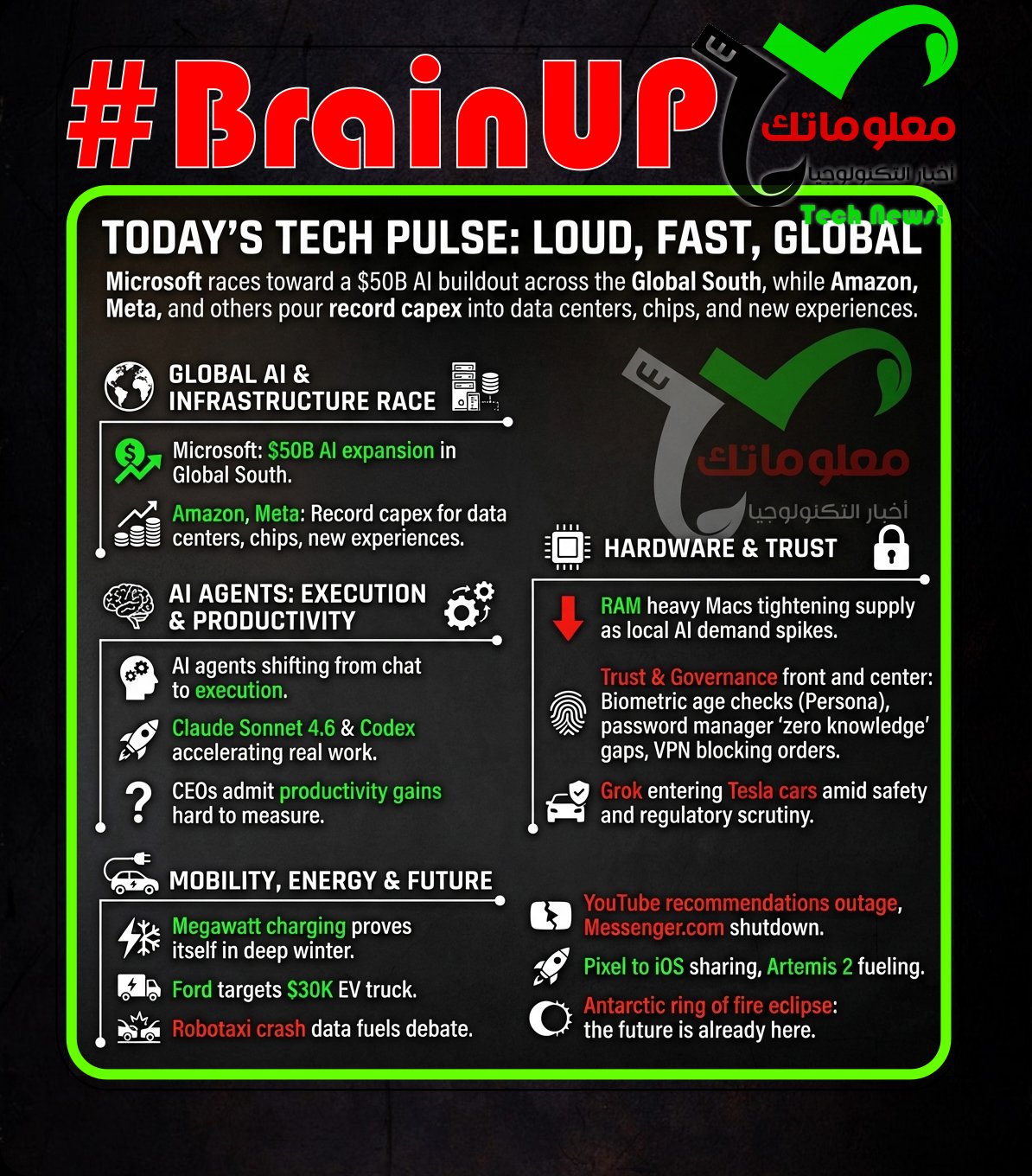
Microsoft is committed to investing $50 billion by 2026 to expand #AI capabilities and infrastructure in the Global South. This investment aims to bridge the #digital divide and promote technological development in emerging markets. The initiative reflects Microsoft’s strategic focus on inclusive growth and technological innovation. By strengthening local #tech ecosystems, Microsoft seeks to support economic progress and sustainable development. The plan underscores a broader industry trend of leveraging #AI to address global challenges and foster global equity.
Open Rights Group says major platforms are increasingly adopting Persona for #ageAssurance, potentially compelling UK users to submit #biometric facial scans to access core internet services. It reports that Persona is used by platforms including Reddit and Discord, and highlights that @PeterThiel, co-founder of Palantir, is a major Persona investor via Founders Fund, which led Persona’s $150m Series C and $200m Series D rounds. The press release links this to broader concerns about surveillance and defence ecosystems, citing Palantir’s work with US ICE and a partnership with the Israeli Ministry of Defence, and noting scrutiny around Thiel’s investment networks and Palantir’s UK public sector contracting controversies. ORG argues users are worried and may be unaware of who finances and operates this emerging identity infrastructure, especially when children’s faces may be scanned. It calls for choice among accredited providers, non-biometric options where possible, transparency on biometric processing, and limits on retention, model training use, and onward sharing.
3. Electric trucks demonstrate megawatt charging in sub-zero temperatures
Finnish fast charging company Kempower hosted #MegawattChargingSystem (#MCS) live winter demonstrations in sub-zero Sweden to show that high-power truck charging is ready for wider heavy-duty electrification. @MAN Truck & Bus, @Scania, and @Volvo brought MCS-ready trucks to a depot in Norrköping run by Alfredsson Transport AB, which has operated a fully fossil-free fleet since 2015 and previously hosted a real-world charging session using the official MCS communication protocol in August 2025. The site is described as Sweden’s first MCS truck charging hub, with 12 heavy-duty charging points for vehicles up to 34 metres, delivering 400 kW to 1.2 MW using Kempower hardware and software, supported by a 2.4 MW grid connection, 2.4 MWh battery storage, and a 400 kW solar system. MAN highlighted stable charging, controlled performance, and secure vehicle-charger communication during the tests, arguing this demonstrates robust hardware and software integration and the maturity of #MCS for future series production. The event was positioned as a collaboration-focused step to accelerate deployment of #MCS charging for electric trucks in real winter conditions.
5. OpenClaw creator says Europe’s stifling regulations are why he’s moving to the US to join OpenAI
Peter Steinberger, creator of the agentic #AI tool #OpenClaw, says Europe’s strict rules are a key reason he is moving to the US to join @OpenAI. He wrote on X that US tech culture is more enthusiastic, while in Europe he is often scolded about responsibility and #regulations, and he argued that building a company there would be hampered by strict #labor regulations and similar constraints. As an example, he said @OpenAI employees commonly work 6 to 7 days a week and are paid accordingly, whereas such schedules would be illegal in Europe. The article situates his comments in a broader gap between Europe and the US, citing an EU report that found Europe had fallen behind the US in innovation and noting the disparity in mega-cap companies, and Steinberger adds that hopes for #EU INC, a single corporate legal framework, appear to be fading due to watered-down compromises and national interests.
6. Tesla adding Grok AI chatbot to its cars in the UK, Europe amid regulatory probes
Tesla Europe says it will add xAI’s #Grok AI chatbot to vehicle infotainment systems in the U.K. and eight other European markets, even as the product faces multiple regulatory probes in Europe over potential #DigitalServicesAct issues. The rollout comes amid a 27% year over year decline in Tesla EV sales in Europe, where battery electric vehicles still grew to 17.4% of the 2025 market and competitors like China’s @BYD gained share with cheaper models, while Brand Finance cited Tesla’s lack of affordable new models and backlash to @ElonMusk’s political rhetoric as factors hurting the brand. Grok’s safety record is also under scrutiny after reports it enabled nonconsensual deepfake explicit images, generated antisemitic content and praised @AdolfHitler on X, and in one case allegedly solicited nudes from a minor after being used in a Tesla, with Tesla and xAI not saying whether minors’ access can be limited or moderated by default. Automotive safety researcher Mike Nelson warned that adding chatbots to infotainment creates a new driver “distraction layer,” even when used hands free. The move ties Tesla more closely to #Grok and its controversies as it tries to boost appeal in Europe while regulators and safety advocates question guardrails and driver impacts.
Apple’s Mac mini and Mac Studio are showing increasingly long delivery lead times, especially for configurations with more than baseline RAM, raising concerns about potential shortages. A post on X cited by Tom’s Hardware quotes Creator Buddy CEO @Alex Finn saying Mac Studios went from a 14 day wait to 54 days and were “completely sold out,” and Apple’s US store listings show delays of two to three weeks for higher RAM Mac minis and four to six weeks for many Mac Studio builds, including 64GB, 128GB, and even the M3 Ultra option with 512GB. The article links the delays to rising interest in running #AI locally, with the AI agent OpenClaw highlighted as a key driver pushing buyers toward RAM heavy Macs. It argues that Apple’s unified memory architecture shared across CPU, NPU, and GPU makes these machines attractive for local LLM and agentic workloads, and notes reports of companies building clusters of Mac Studios for private, long running tasks. The piece concludes that while the lead times are clearly extending for memory rich models, the situation should be interpreted cautiously and could change as availability updates.
8. What happens to a car when the company behind its software goes under
Modern vehicles increasingly depend on cloud services, apps and proprietary software that can become critical points of failure if a manufacturer or software provider collapses, turning cars into partially functional or even unusable machines when servers go offline, as seen in examples like @Fisker and earlier failures such as Better Place where backend systems disappearing disrupted core ownership experiences. As cars evolve into software defined products with subscription features, remote unlocking and over the air updates, ownership shifts from purely mechanical durability toward long term trust in the survival of a company’s digital ecosystem, creating risks that do not exist in traditional vehicles where repairs could be performed independently. Experts quoted in the piece warn that when software issues emerge owners are often forced to rely on manufacturer controlled systems rather than local mechanics, and if support ends the vehicle may become a cybersecurity liability or lose essential functionality despite being physically intact. Industry groups such as Catena X are attempting to improve resilience through standardized data and software supply chain practices to reduce dependence on single vendors, but there is still no universal requirement guaranteeing software support lifespans for vehicles. The broader takeaway is that in the era of connected mobility and #SoftwareDefinedVehicles, buying a car increasingly means betting on the long term survival of its code and servers as much as on its engine, raising new questions about consumer rights, sustainability and what ownership really means in a world shaped by #Cloud infrastructure and #AutomotiveSoftware.
9. Password managers’ promise that they can’t see your vaults isn’t always true
Password managers widely market #zero-knowledge encryption as meaning neither insiders nor attackers who compromise cloud servers can access users’ vault data, but new research argues this promise does not always hold. Researchers from ETH Zurich and USI Lugano analyzed or reverse-engineered Bitwarden, Dashlane, and LastPass and found server-side control, via admin access or a breach, can enable theft of vault data and in some cases whole vaults, and can sometimes weaken encryption enough to turn ciphertext into plaintext. The issues often arise when specific features are enabled, especially #account-recovery and key-escrow mechanisms, group or vault-sharing setups, and support for legacy versions. The most severe attacks described target Bitwarden and LastPass and can permit reading or writing full vault contents, while a Dashlane attack could read but not modify shared vault items. The researchers say the flaws are not especially deep technically yet evaded audits, and they suggest other managers may share similar weaknesses, naming 1Password as a likely example.
10. YouTube says issue ‘resolved’ after more than a quarter million users report problems
YouTube said it has resolved a platform disruption after more than a quarter million users reported problems accessing the service. Downdetector logged over 250,000 reports on Tuesday evening, with the most common complaint involving the YouTube app, while an Independent reporter saw an error on the homepage even as individual videos still loaded and played. YouTube later stated on its help page that a problem with its #recommendations system had been fixed and that YouTube.com, the app, YouTube Music, Kids, and TV were back to normal, after earlier acknowledging the outage on X. Users posted accounts and jokes about the incident, including journalist @Hannah Adamson noting the homepage would not load while saved and recently viewed videos remained accessible. The episode highlights how a failure tied to recommendations and the homepage can make the service feel unusable even when playback of specific videos continues to work.
@Robert Solow’s 1987 #productivity paradox, that computers were visible everywhere except in productivity statistics, is being echoed in early corporate #AI adoption data. An @NBER study of 6,000 CEOs, CFOs, and other executives across the U.S., U.K., Germany, and Australia found about two thirds report using AI, but only around 1.5 hours per week, and 25% report not using it at work at all, with nearly 90% of firms saying AI has had no impact on employment or productivity over the past three years. This sits alongside widespread corporate optimism, including an @FinancialTimes analysis that 374 S&P 500 firms mentioned AI positively in earnings calls, and executives forecasting AI will lift productivity by 1.4% and output by 0.8% over the next three years. Economists including @Torsten Slok argue AI is not yet showing up in macro data such as employment, productivity, inflation, or broad profit metrics, despite corporate AI investment exceeding $250 billion in 2024, and the research landscape remains mixed with some studies reporting gains and others finding more modest effects. The gap between heavy AI rhetoric and limited measured outcomes suggests the economy may be in a Solow-like phase where #AI’s promised benefits are real but not yet widespread, intensive, or captured in aggregate statistics.
12. AI Agents Are Taking America by Storm
Americans are entering a post-chatbot era in which #AI agents do extended, autonomous computer work that can compress weeks or months of effort into hours, creating a widening gap between mainstream chatbot users and tech hobbyists adopting “agentic” tools. The article points to @Anthropic’s Claude Code and @OpenAI’s Codex, which people are using for tasks from generating academic papers and assisting biology research to producing data-driven journalism, including a reported case where two journalists built a mock competitor to Monday.com with a working prototype in under an hour. Although the quality of these outputs is still uncertain, the speed and autonomy are described as both stunning and alarming, and the tools are already reshaping software engineering, where engineers can run multiple parallel agent sessions and delegate large portions of projects. Barriers remain because these systems often cost money and can be intimidating to set up and prompt, but the tech industry is racing to make them more accessible through new paid, nontechnical versions and models advertised as capable of navigating complex spreadsheets or doing nearly anything professionals do on a computer. Compared with chatbots that have gained memory, reasoning, and multimodal abilities, the piece argues that agentic tools represent a larger shift in how work gets done, signaling that AI is moving beyond conversation into direct execution on users’ machines.
13. Ford turns to F1 and bounties to build a $30,000 electric truck | TechCrunch
Ford says it will deliver an EV truck next year starting at $30,000, aiming to compete with Chinese automakers without sacrificing profit margins. The strategy combines #3D-printed Lego-like parts, Formula 1-style efficiency thinking, and a bounty program, building on work by a skunkworks team led by @Alan Clarke, a 12-year @Tesla veteran, after Ford took a $19.5 billion hit and ended production of the battery-electric F-150 Lightning. The effort centers on a universal EV platform, UEV, Ford’s first clean-sheet EV platform, designed for fewer parts and faster assembly via single-piece aluminum unicastings, and using lithium iron phosphate batteries with technology licensed from China’s CATL, alongside a revamped Louisville production system intended to speed manufacturing by 15%. Clarke says the UEV will first underpin a midsized truck and could later support multiple vehicle types, and the team culture is being shaped by hires from Formula 1 and companies including @Apple, @Lucid Motors, @Rivian, and @Tesla, plus talent from Auto Motive Power, acquired by Ford in 2023. Ford has not disclosed key vehicle specs such as range, features, or charging times, but frames the program as a shift from adapting existing infrastructure toward an efficiency-first platform meant to make long-range EV travel more affordable.
14. Palantir Shifts HQ to Miami From Denver After Protests
Palantir Technologies Inc. said it has moved its headquarters to Miami from Denver, aligning with a broader shift of tech and finance activity toward South Florida as local officials market the region as an alternative to #SiliconValley. The company announced the move in a brief post on X without giving a reason, and officials including Colorado Gov. @JaredPolis and Denver Mayor Mike Johnston’s office said they received no advance notice and had no information about job impacts. The relocation follows multiple protests after Palantir moved to Denver in 2020, including demonstrations over its support of the Israeli military and its work with US Immigration and Customs Enforcement using #AI to identify targets for deportation, according to the Denver Post. Miami’s draw has been fueled by low taxes and other lifestyle factors, with firms such as @Apple and @Amazon expanding offices and figures like @KenGriffin and @StephenRoss backing a $10 million effort to attract more executives. Palantir’s ties to the area are reinforced by chairman @PeterThiel’s expanded Florida presence, while the company also continues to broaden operations elsewhere, including New York City.
15. FCC Attempt to Kill Stephen Colbert Interview Completely Backfires
The Trump administration tried to stop @Stephen Colbert from airing his interview with Texas state Representative and Democratic Senate candidate @James Talarico, but the effort instead amplified it online. After CBS lawyers warned against running the segment on TV, Colbert posted it to YouTube and other social platforms, where it quickly drew millions of views, outpacing the show’s average 2.3 million TV audience, while Talarico’s repost on X reached 8.3 million views and the show’s YouTube upload hit 2.4 million. Colbert also referenced the interview on air and urged viewers to watch it online, while criticizing the #FCC and its Trump-appointed chair @Brendan Carr for a new #equal time rule requiring late-night shows to provide equal time for candidates across the political spectrum. Carr suggested hosts who do not want to comply could move content to cable, podcasts, or streaming, and Colbert effectively followed that advice by publishing the interview online. The result, as described, is that the attempted restriction created more publicity for both Colbert and Talarico than a single broadcast would have.
A Spanish court ruling gives @LaLiga authority to require #VPN providers to block IP addresses linked to illegal match streams, raising concerns that users in Spain could face connection blackouts during games. The Commercial Court No. 1 of Córdoba ruled for @LaLiga and Telefónica, treating NordVPN and Proton VPN as “technological intermediaries” under the European #DigitalServicesAct and allowing “precautionary” dynamic blocking so the league can update banned IP lists in real time during matches. Privacy advocates warn this approach risks collateral damage because many VPN services use shared IPs, so blocking a single server IP used by pirates could disconnect large numbers of legitimate users such as remote workers and privacy minded citizens. Proton VPN and NordVPN say they have not been formally notified and were not involved in any legal proceedings, with Proton emphasizing due process safeguards and NordVPN calling the approach unacceptable. The article frames the decision as a shift from targeting pirate sites to targeting circumvention tools, and notes it resembles a broader European trend, citing a similar crackdown in France.
17. Tesla Robotaxis Reportedly Crashing at a Rate That’s 4x Higher Than Humans
Data cited from #NHTSA and reported by Electrek says Tesla disclosed five additional crashes involving its Austin robotaxi fleet, raising questions about whether #self-driving systems are outperforming human drivers on safety. The incidents, reported last month and dated December 2025 and January, involved Model Y vehicles with autonomous driving engaged, including low-speed collisions with fixed objects, a stopped-vehicle crash with a bus, and a minor crash with a truck. Electrek says Tesla has now reported 14 total crashes since the service began in Austin last June and estimates about 800,000 paid miles by mid-January, implying roughly one crash every 57,000 miles. Compared with Tesla’s own Vehicle Safety Report figures, a minor crash every 229,000 miles for the average U.S. driver, the robotaxi fleet appears to be crashing about four times more often, and Tesla has also redacted crash narratives as “confidential business information” and updated one July report to “Minor w/ Hospitalization.” The article situates the disclosures within broader #autonomous-vehicle scrutiny, noting #NHTSA probes into Waymo incidents involving a child near a school and failures to stop for school buses.
18. Anthropic forges Infosys AI deal amid widening tech layoffs – Capacity
@Anthropic has partnered with @Infosys to expand its investment in India by developing and delivering advanced #enterpriseAI solutions across sectors including telecommunications, financial services, manufacturing and software development. The deal includes setting up a dedicated Anthropic Center of Excellence to build and deploy industry-specific #AIAgents, and integrating Anthropic’s @Claude models with Infosys Topaz to automate complex workflows, accelerate software delivery, support AI adoption, and modernise legacy systems to reduce infrastructure upgrade costs. The announcement comes weeks after Telstra outsourced jobs to Infosys in India while making AI-related job cuts, amid broader 2026 tech layoffs tied to refocusing on AI and cost positions, highlighting anxieties that AI-driven streamlining may reduce headcount. Infosys CEO @SalilParekh said the collaboration aims to help organisations unlock value and operate in a more intelligent, resilient and responsible way, including use cases like risk management and compliance in financial services and AI-driven design and manufacturing in engineering businesses. The partners frame the effort as combining deep industry expertise, frontier AI and engineering scale to deliver transformational outcomes, with telecom examples including modernising network operations, streamlining customer lifecycle management and improving service delivery in a heavily regulated industry.
20. Andrew Yang says AI will wipe out millions of white-collar jobs in the next 12 to 18 months
@Andrew Yang warns that #AI-driven automation will trigger mass layoffs of white-collar workers within the next 12 to 18 months, putting anyone who spends much of the day at a desk at risk. He says companies that start shrinking headcount will push competitors to do the same because the stock market rewards cuts and punishes firms that do not, and he lists mid-career office workers, middle managers, call center staff, marketers, and coders as especially vulnerable. The article notes that layoffs are already elevated and that some firms have begun citing #AI in workforce reductions, including Pinterest describing a 15% cut as part of an “AI-forward strategy” and HP citing AI initiatives in plans to cut up to 6,000 jobs by 2028, though critics say AI can be used as a scapegoat. Yang argues the effects will ripple into local service businesses as fewer people commute and spend, hurting dry cleaners, dog walkers, and hairstylists. With tech leaders split between predictions of abundance and warnings of large-scale displacement, Yang frames the coming shift as a broad reduction in money paid to human labor.
21. Bayer agrees to settle thousands of #Roundup lawsuit claims for $10.9B
The pharmaceutical giant @Bayer has agreed to a $10.9 billion settlement to resolve over 100,000 lawsuits alleging #Roundup caused #cancer. The settlement includes payments to plaintiffs and funding for #research and #regulatory efforts. This agreement aims to end years of litigation and address #public concerns about #glyphosate-based herbicides. It represents a significant step in #corporate #liability management and impacts #agricultural #chemical industry practices.
22. Anthropic releases Claude Sonnet 4.6, continuing breakneck pace of AI model releases
@Anthropic released Claude Sonnet 4.6, its second major AI model launch in less than two weeks, and said it improves computer use, coding, design, #knowledge-work tasks, and large data processing. The company said Sonnet 4.6 becomes the default model for free users and paid Pro users inside its Claude chatbot and Claude Cowork tool, and it brings performance previously associated with an Opus-class model to the Sonnet tier. Anthropic said the model has much-improved coding skills, is more consistent with coding, and follows coding instructions better, which broadens access to stronger coding capabilities. The rapid releases come amid intense competition with rivals like @OpenAI and @Google, and they have coincided with investor concerns about AI disrupting software businesses, with the iShares Expanded Tech-Software Sector ETF (IGV) down more than 20% year to date. The launch also follows Anthropic introducing Claude Opus 4.6 just 12 days earlier and reporting it closed a $30 billion funding round at a $380 billion post-money valuation.
San Francisco’s AI startup scene is fostering an extreme #grind culture where long hours and minimal time off are treated as normal, and it reflects deeper anxiety about jobs, competition, and the industry’s direction. Workers describe 12-hour days, six or seven days a week, founders skipping weekends for months, and offices that double as living spaces where people work from 9am to 3am with only food deliveries and brief breaks. Mythril co-founder Sanju Lokuhitige says he works seven days a week and has no work-life balance, while another employee calls his early-stage company’s 16-hour days “horrendous.” The pressure is amplified by a broader shift in tech, where companies have reduced perks, increased expectations, and leaders like @Mark Zuckerberg and @Elon Musk openly predict #AI will replace some engineers while urging more “efficient” and “extremely hard core” work amid widespread layoffs, including about 250,000 tech jobs cut globally in 2025 per RationalFX. Together these accounts suggest the AI boom is not just generating excitement and money, but also a fearful, self-erasing race that could foreshadow similar pressures spreading beyond tech.
24. Meta shutting down Messenger.com website in April, forces Facebook redirect
@Meta has confirmed that Messenger.com will no longer work for messaging starting April 2026, and desktop users will be redirected to facebook.com/messages. The company’s official help page states the Messenger.com messaging service will stop working, following the shutdown of the standalone Messenger desktop app on December 15, 2025 after a 60-day notice. Users who rely on Messenger without a Facebook account can continue using the Messenger mobile app without creating a Facebook profile, but messaging from a computer will require using facebook.com/messages. The move continues #consolidation of Messenger into Facebook, a process the article says has been underway since 2023, and it has drawn complaints from users who do not want the full Facebook site just to chat. With the change taking effect in April, users have a few weeks to adjust to using Facebook’s main messages page for desktop chats.
25. Atlassian freezes hiring amid global software sell-off
Australian software company Atlassian has frozen hiring for engineers and other related roles as it rolls back global recruitment while its shares fall amid the impact of #AI. Applicants who were in the final stages of interviews say they have been left without progress since the hiring freeze began in early February. The move signals a pullback in staffing plans as the company responds to market pressure affecting software stocks. The hiring halt ties Atlassian’s near-term workforce decisions to the broader sell-off linked to #artificial intelligence dynamics and its share price decline under @Mike Cannon-Brookes’ leadership.
26. Amazon snaps 9-day losing streak during which it lost more than $450 billion in value
Amazon shares rose more than 1% Tuesday, ending a nine day losing streak that had erased over $450 billion in market value as investors scrutinized the company’s #AI spending plans. The stock fell about 18% from Feb. 2 through Friday, the worst streak since 2006, after Amazon’s fourth quarter report guided to $200 billion in 2026 capital expenditures, nearly 60% above last year and more than $50 billion above Wall Street forecasts, largely for AI infrastructure like data centers, chips, and networking. Broader concerns are building that big tech #capex outlays could pressure or eliminate free cash flow, with @Alphabet, @Microsoft, @Meta, and Amazon together potentially reaching $700 billion in spending this year. @Andy Jassy said he expects the investment to generate strong returns, while Wedbush said Amazon is in “prove it mode” until tangible payoffs appear, and Citizens’ Andrew Boone said plans to double data center capacity by 2027 could accelerate AWS revenue growth. The rebound breaks the slide, but the article frames investor confidence as still tied to evidence that the AI buildout can translate into returns and cloud growth.
27. Samsung teases AI image editor for upcoming Galaxy S26 phones
@Samsung teased a new, unified suite of #AI-powered photo editing tools that should arrive with its next Galaxy smartphones, likely the upcoming Galaxy S26 lineup. Short video teasers show quick, creative edits such as turning daytime photos into nighttime shots and merging multiple photos into one, and they suggest photo and video capture plus editing will be combined into a single app experience so users do not have to switch between apps. The announcement is brief and vague, but the feature is positioned as a flagship upgrade for devices expected to be unveiled at #SamsungUnpacked next week. The article notes Galaxy phones use #GoogleGemini, which is described as a leading generative AI photo editor, and says @Samsung will share more details at the event.
28. Amazon Fire TV’s new interface is now rolling out in the US | TechCrunch
@Amazon is rolling out a redesigned Fire TV user interface in the U.S. that emphasizes content discovery and simplifies navigation, its first major Fire TV refresh in years amid growing streaming fragmentation. The update makes the home screen feel less cluttered with new visual styling, more spacing, and expands pinned apps from 6 to 20 via smaller icons, while the top navigation is streamlined into icon based tabs like Movies, TV, Live TV, Sports, and News with search placed to the left. Inside these tabs, Fire TV organizes recommendations from subscribed services in “For You” rows, highlights free and paid picks, and the Live TV tab centralizes live streaming plus broadcast or cable sources when available. The interface also integrates #Alexa+ for natural language queries beyond TV and movies, follow up questions, and interaction with on screen items, and @Amazon says Alexa+ is included for Prime subscribers with a separate paid option for others. The rollout starts on Fire TV Stick 4K Plus, Fire TV Stick 4K Max (2nd Gen), and Fire TV Omni Mini LED in the U.S., then expands this spring to more countries and devices including newer Fire TV players, multiple Fire TV TV lines, partner TVs like Hisense and TCL, and the Amazon Ember Artline.
29. GameHub will give Mac owners another imperfect way to play Windows games
GameSir says it will bring a macOS version of its #GameHub Windows emulation tool, adding another option alongside #CrossOver and #Game Porting Toolkit for running Windows games on Macs, but expectations are tempered by the Android app’s mixed track record. On Android, GameHub’s #GameFusion emulator is reported by Reddit testers and sites like EmuReady to have hit-or-miss compatibility with popular #Steam titles, with some users saying many #Unity, #Godot, or #GameMaker games work while others report terrible results across many games. GameSir claims the Mac version will help users unlock their Steam library and will add features like proprietary AI frame interpolation, following a native rendering mode that improved Android frame rates. The company also faces trust concerns: it admitted to The Memory Core that the emulator helps sell controllers, the Android app drew criticism for invasive trackers (later removed, and also stripped in a community Lite build), and it defended its tech as in-house while acknowledging it references UI components from the open source #Winlator. Overall, the article frames GameHub for Mac as a potentially useful but unlikely breakthrough compared with a #SteamOS or #Proton-style moment, still offering Mac owners another way to play Windows games without installing Windows.
30. Your Pixel 9 can now beam files directly to iOS
Google is expanding #Quick Share compatibility with #Apple #AirDrop beyond the Pixel 10 line, bringing easier file sharing between Android and iOS to more devices. After launching AirDrop support for Quick Share in November 2025 with the Pixel 10 family only, Google has now confirmed via a new support thread that the feature is rolling out to the Pixel 9, Pixel 9 Pro, and Pixel 9 Pro XL in phases over the coming weeks. The Pixel 9 Pro Fold is not listed, and the Pixel 9a is explicitly excluded. To enable it, users should install the latest #Google Play System update and then update the Quick Share extension from system services settings. This broadened rollout suggests Google intends to keep widening AirDrop interoperability to additional older Pixels, and possibly other Android devices, as the update progresses.
31. NASA will fuel up its Artemis 2 moon rocket for the 2nd time on Feb. 19. Will it leak again?
@NASA is preparing a second #wet dress rehearsal for the Artemis 2 #SLS moon rocket, aiming to complete a full propellant loading and countdown simulation after a previous attempt was cut short by a leak. The agency plans to load more than 700,000 gallons of liquid hydrogen and liquid oxygen, after the first rehearsal that began Jan. 31 ended early when an LH2 leak was found at an interface with the tail service mast umbilical that connects the rocket to the mobile launch tower. Teams replaced two seals, ran a partial-tanking confidence test on Feb. 12 that was limited by a ground-support equipment issue later traced to and fixed by replacing a filter, and now intend to run through key prelaunch operations including terminal count sequences with planned holds. The effort reflects persistent hydrogen-leak and ground-system challenges seen during Artemis 1, but the goal is to validate fixes and readiness so Artemis 2 can keep progressing toward a possible launch as soon as March 6.
An #annular solar eclipse on Feb. 17 swept over Antarctica, creating a visible “ring of fire” as the moon passed in front of the sun during the new moon phase while it was near a distant point in its elliptical orbit, making it appear slightly smaller than usual. The event began at 4:56 a.m. EST (0956 GMT) and reached annularity for a little over two minutes, when the moon could not fully cover the sun, leaving a thin, bright rim around the lunar disk. This annular phase was visible across a remote 383 mile wide (616 kilometer) corridor that included the Concordia research station, which hosts fewer than 100 scientists and visitors at a time. A partial eclipse was estimated to be visible to about 176 million people across the southern tip of South America and parts of southern Africa including Madagascar, and the eclipse ended globally at 9:27 a.m. EST (1427 GMT). The article notes the next eclipse will be a “blood moon” total lunar eclipse on March 3, when Earth moves between the sun and the moon.
33. Scientists Detect Evidence of Tectonic Activity on the Moon.
Scientists say new data from seismic measurements and lunar surface imaging show that the Moon may still be exhibiting signs of tectonic activity, with evidence suggesting that stresses in its crust are leading to slow shifting and fractures rather than the long-assumed completely inactive interior, a finding that reshapes our understanding of how the lunar body evolves long after its formation. Researchers used measurements from missions like #Apollo seismometers and recent orbital observations to detect subtle quakes and surface deformations linked to the cooling and contraction of the Moon’s interior, indicating that internal stress is still significant enough to cause rock displacement even without Earth-style plate tectonics. The study points to zones near old impact basins where fault lines and surface cracks are more prevalent, consistent with models that cooling can cause the surface to wrinkle and shift over geological timescales, and adds to observations of shallow moonquakes that have been recorded for decades. Experts say this activity is much weaker than Earth’s tectonics, but important because it reveals the Moon’s interior is not entirely geologically dead and could influence future lunar exploration, infrastructure planning and our broader model of small rocky body evolution in the solar system. The findings help refine scientific theories about how celestial bodies cool, contract and evolve over billions of years in the absence of active plate boundaries.
That’s all for today’s digest for 2026/02/18! We picked, and processed 31 Articles. Stay tuned for tomorrow’s collection of insights and discoveries.
Thanks, Patricia Zougheib and Dr Badawi, for curating the links
See you in the next one! 🚀
