
#BrainUp Daily Tech News – (Wednesday, February 4ᵗʰ)
Welcome to today’s curated collection of interesting links and insights for 2026/02/04. Our Hand-picked, AI-optimized system has processed and summarized 30 articles from all over the internet to bring you the latest technology news.
As previously aired🔴LIVE on Clubhouse, Chatter Social, Instagram, Twitch, X, YouTube, and TikTok.
Also available as a #Podcast on Apple 📻, Spotify🛜, Anghami, and Amazon🎧 or anywhere else you listen to podcasts.
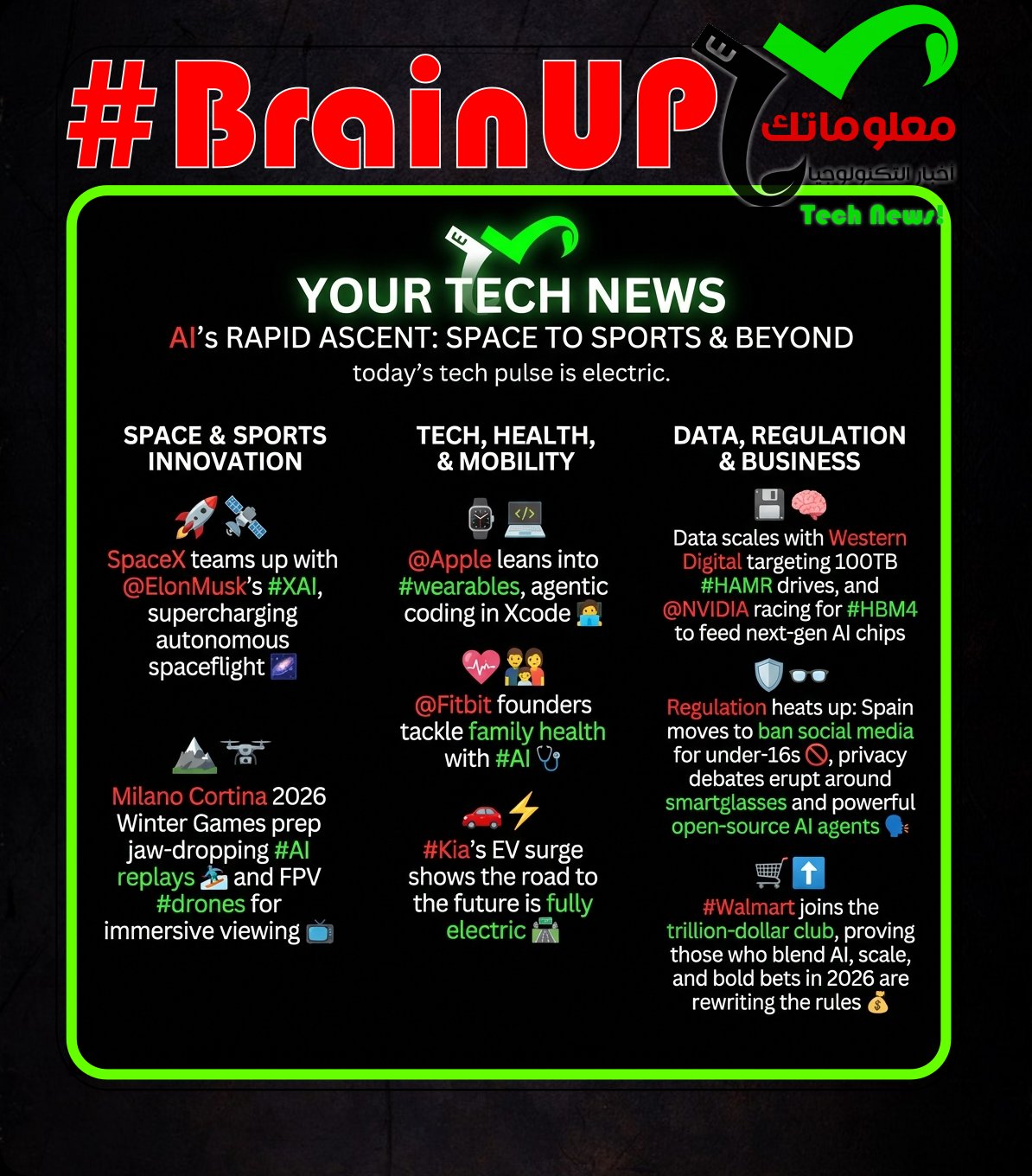
SpaceX has announced the integration of #XAI, an advanced artificial intelligence company, into its operations to enhance its technology stack and innovate space exploration. Founded by @ElonMusk, XAI specializes in AI that complements human cognitive functions. This collaboration aims to leverage XAI’s cutting-edge AI capabilities to improve spacecraft navigation, autonomous operations, and data analysis. By merging AI advancements with aerospace technology, SpaceX seeks to accelerate its mission of making life multiplanetary. The partnership represents a strategic move to incorporate sophisticated AI tools in the next generation of space vehicles and mission designs.
2. Winter Olympic Games tech: AI replays, drones, and transparent torches
The Milano Cortina 2026 Winter Games will showcase #AI-powered broadcasts and #drones that transform how fans watch and understand the Games. First-person FPV drones will follow athletes and even race down a luge track, delivering real-time, on-track perspectives that OBS’s @YiannisExarchos says are safer and offer angles never seen before. AI-assisted replays can generate 260-degree videos from multiple angles, with on-screen data such as jump height, airtime, and landing speed, and these visuals will be cut into VR formats for social media. An interactive online Olympic experience will feature a built-in AI assistant trained on Olympic data to answer questions and deliver real-time results, with AI highlights and summaries helping fans decide what to watch. Coverage extends across social platforms like #TikTok, #YouTube, #Facebook, #Instagram, #WhatsApp and #Threads, signaling a shift toward immersive, data-rich fan experiences.
3. The Signal messaging app was down.
Signal faced a major outage that prevented messages from being sent or received for about an hour, as reported by @TomWarren. During the disruption, messages were stuck trying to send over and over. This incident followed Claude Code’s brief wobble earlier in the day, highlighting how dependent users are on real-time messaging services during a day of outages. The service has since recovered and is back online, underscoring the transient nature of such outages #Signal #outage #messaging
4. Apple’s next era may be built on wearables
Apple is positioning itself for a new phase of growth centered on #wearables as its #iPhone market nears saturation. Strong sales of the Apple Watch and AirPods, along with the company’s development of health monitoring features, highlight its strategy to expand in this segment. The focus on wearables reflects a shift toward integrated technology that enhances personal health and lifestyle management. Apple’s investment in this area suggests it aims to create a deeper ecosystem beyond traditional smartphones, leveraging its hardware, software, and services synergy. This approach aligns with trends in consumer demand for connected devices that offer convenience and wellness benefits.
5. NASA had 3 years to fix fuel leaks on its Artemis moon rocket. Why are they still happening?
Artemis 2’s wet dress rehearsal began Jan 31 and ran until Feb 2, but hydrogen leaks at the SLS tail service mast umbilical interrupted the fueling test. Those leaks echo Artemis 1’s issues at the same location during its rehearsal, which prompted three rollbacks before Artemis 1 finally launched. NASA says it learned from Artemis 1 and applied changes for Artemis 2, with @Lori Glaze noting that they implemented many lessons from the wet dress rehearsal. Artemis 2 will carry astronauts Reid Wiseman, Victor Glover, Christina Koch and Jeremy Hansen on a 10-day mission around the far side of the Moon, a stepping stone toward Artemis 3’s lunar landing. The test depends on fueling more than 700,000 gallons of liquid hydrogen and liquid oxygen, underscoring ongoing #hydrogen #tanking challenges and the need to mature #SLS and @Orion systems before crewed Moon missions.
6. LG officially ends 8K TV production, content demand never materialized
LG has officially ceased production of 8K TVs as the demand for corresponding content failed to grow as anticipated. Despite initial enthusiasm fueled by #8K resolution’s promise of ultra-high definition, the market did not develop due to limited broadcast and streaming options, making 8K TVs less appealing to consumers. LG’s decision reflects broader industry challenges faced by #8K technology, including high costs and minimal content availability. This move signifies a shift towards focusing on more practical and in-demand display technologies rather than investing in high-resolution formats lacking adequate content. LG’s exit highlights the necessity of content ecosystem growth to support advanced hardware adoption.
7. Pinterest CEO puts staffers on blast who created tool to track layoffs
Pinterest CEO @BillHao criticized employees who developed a tool to track company layoffs, describing the act as damaging to company culture and trust. The tool publicly listed departure dates and severance details, sparking a backlash for exposing internal personnel changes. Hao emphasized the need for transparency balanced with discretion to protect employees’ privacy and maintain morale. This incident illuminates the tension in tech companies between transparency and confidentiality during workforce reductions. It also highlights the challenges leaders face in managing internal communication while navigating public scrutiny of layoffs.
8. Nintendo shares sink 10% as gaming giant faces memory shortage concerns
Nintendo’s shares fell 10% amid worries over a potential memory shortage affecting its gaming consoles. Reports indicate that supply chain disruptions could limit production capacity, particularly impacting popular products like the Switch. This decline reflects investor concerns about the company’s ability to meet consumer demand in the near term. The memory shortage stems from global semiconductor supply constraints, which have affected various industries. As a leading player in the gaming sector, Nintendo’s challenges highlight the broader impact of chip scarcity on technology markets.
9. Original Nintendo Switch passes the DS to become Nintendo’s bestselling console
The original Nintendo Switch has surpassed the Nintendo DS to become the company’s bestselling console, reaching over 103 million units sold as of late 2025. This milestone reflects the Switch’s widespread appeal due to its hybrid design, allowing both handheld and docked play, which differentiates it from previous consoles. Sales growth was supported by a strong lineup of games such as #TheLegendOfZelda, #AnimalCrossing, and #MarioKart, contributing to sustained consumer interest. The continued success also emphasizes Nintendo’s strategic shift towards versatile gaming experiences that blend portability with traditional home console features. This achievement highlights the impact of innovative hardware design and compelling software in capturing a broad audience.
Western Digital will extend its energy-assisted PMR (#ePMR) technology to 60TB and will offer HAMR drives alongside ePMR for several years to ensure steady high-capacity availability. The flagship 40TB UltraSMR drive is planned for release in the second half of this year, with a HAMR-based counterpart expected in 2027 and a goal of 100TB HAMR HDDs by 2029, according to @Anton Shilov. WD emphasizes a unified platform where high-capacity #ePMR and #HAMR drives can be deployed on customers’ own timelines, with ‘unprecedented flexibility’ for hyperscalers and enterprises and no forced infrastructure disruptions. The company hints at next-generation media such as #FePt to reach higher densities and says these #ePMR drives will leverage #HAMR innovations without increasing power consumption, signaling rapid capacity growth built on a trusted architecture.
11. No Big Design Changes Planned For iPhone 18, Report Says
Apple is reportedly not planning significant design changes for the iPhone 18, continuing a trend of incremental updates rather than major redesigns. According to analyst Ming-Chi Kuo, the iPhone 15 introduced the most notable design shifts in recent years, so the iPhone 18 is expected to focus on internal improvements instead. This suggests Apple is prioritizing functionality and performance enhancements over aesthetic changes to maintain a consistent user experience. The approach aligns with Apple’s strategy of refining core features while preserving a familiar design language. Consequently, customers can anticipate a familiar look in the iPhone 18 with possible advancements under the hood.
12. Homeland Security Criticized for Targeting 67-Year-Old U.S. Citizen Over Email
A 67-year-old U.S. citizen faced criticism after being targeted by the Department of Homeland Security (#DHS) due to a controversial email, raising concerns about government overreach and privacy violations. The incident exemplifies growing tensions between security efforts and civil liberties, highlighting how aggressive surveillance tactics can unjustly affect ordinary citizens. This case underscores the risks posed by expansive interpretations of security policies, particularly when applied without clear evidence against individuals. Critics argue that such actions undermine public trust and may violate constitutional protections, emphasizing the need for accountability and reform in #DHS operations. The situation serves as a cautionary example of balancing national security priorities with the protection of individual rights.
13. Smartglasses spark privacy fears as secret filming videos flood social media
Smartglasses are raising significant privacy concerns as users increasingly post secretly filmed videos on social media platforms. These devices, equipped with discreet cameras, allow for covert recordings, often without consent from the subjects being filmed. The surge of such footage online has sparked debates on the ethical implications and calls for stricter regulations to prevent misuse. Experts highlight the challenge of balancing innovation with privacy rights, urging the development of clear guidelines and technological safeguards. This situation underscores the urgent need to address privacy in the era of wearable tech to protect individuals from unauthorized surveillance.
14. T-Cloud Public – sovereign power
Deutsche Telekom is advancing its T-Cloud Public offering to provide sovereign cloud solutions that meet strict security and data protection requirements essential for public sector clients. The service enables public administrations to leverage cloud technologies while maintaining full control over data residency and compliance with European standards. This solution supports digital transformation agendas by enhancing operational efficiency, agility, and innovation within governmental institutions. By emphasizing sovereignty, Deutsche Telekom addresses critical political and legal concerns surrounding cloud adoption, ensuring trust and risk mitigation. This approach reinforces the strategic importance of sovereign cloud infrastructures in Europe’s digital ecosystem and public sector modernization.
15. By whatever name — Moltbot, Clawd, OpenClaw — this uber AI assistant is a security nightmare
OpenClaw, also known as Moltbot and Clawd, is an open-source AI agent that runs on your own hardware and can actually take real-world actions by wiring #LLMs to APIs and exposing channels and tools to read email, run commands, browse the web, and manage travel or calendars. It stores long-term memory with files like USER.md and IDENTITY.md, making it feel like a persistent colleague, and a vibrant ecosystem of #skills on GitHub extends its capabilities, with a Moltbook social network for agents. It has gone viral in part because its creator @Peter Steinberger says it “actually does things,” though the piece cautions there’s a difference between clever demos and careful use. The tradeoff is security risk: OpenClaw often needs sensitive data such as names, passwords, and credit cards, security is not built in per Cisco, and there is no perfectly secure setup, with researchers like Synk warning that #promptinjection creates a large attack surface for AI agents connected to external data sources. The article frames OpenClaw as a powerful but potentially dangerous tool where convenience competes with the risk of data exposure.
16. Alphabet Plots Big Expansion in India as US Restricts Visas
Alphabet is planning a significant expansion in India in response to tightened US visa restrictions that limit its ability to move workers. The company aims to leverage India’s large, skilled tech talent pool to maintain growth and innovation. By increasing its presence, Alphabet intends to mitigate the impact of new US policies that hinder the transfer of foreign employees. This strategy not only aligns with global tech trends of diversifying operational hubs but also strengthens Alphabet’s foothold in one of the world’s fastest-growing markets. The move highlights the intersection of immigration policy and corporate strategy in the global technology sector.
17. Xcode moves into agentic coding with deeper OpenAI and Anthropic integrations | TechCrunch
Apple is expanding agentic coding in Xcode with Xcode 26.3, integrating Anthropic’s @Claude Agent and @OpenAI Codex to work directly inside the IDE. The update follows last year’s Xcode 26 release that added ChatGPT and Claude support and enables agents to explore projects, understand structure and metadata, build, run tests, and fix errors. Apple says the agents access current developer docs and optimize token usage and tool calling through #MCP (Model Context Protocol), connecting with project discovery, file management, previews, snippets, and the latest documentation. Developers can choose model versions (e.g., GPT-5.2-Codex or GPT-5.1 mini), describe desired changes in a left-side prompt, and see a transparent project transcript showing how code evolves, with changes highlighted in the code and a transcript panel explaining what’s happening. Apple is also hosting a code-along workshop and notes that agents verify code, may iterate to fix issues, and that pre-planning their steps can improve the process #code-along.
18. Kia EV sales surge in January 2026 with new models driving growth
Kia experienced a significant increase in electric vehicle sales in January 2026, propelled by the launch of several new models including the EV9 SUV. Sales data shows that Kia’s commitment to expanding its #EV lineup and production capacity has effectively captured growing consumer demand for electric mobility. The introduction of diverse EV offerings ranging from compact cars to larger SUVs has broadened Kia’s market reach and reinforced its position in the competitive #electricvehicle market. This growth trend reflects wider industry movements toward sustainable transportation solutions and global regulatory pushes favoring EV adoption. Kia’s strong January performance underscores its strategic alignment with future mobility trends and positions it well for continued leadership in the EV sector.
19. Google court filings suggest Google’s ChromeOS has an expiration date
Google court filings reveal that ChromeOS, the company’s operating system designed for lightweight computing, might have a defined end-of-life. Documents show that Google monitors ChromeOS devices’ hardware support timelines closely, often capping their lifespan to ensure compatibility and security updates. This strategy indicates that ChromeOS devices cannot be updated indefinitely, which may force users to replace machines sooner than expected. The filings imply that Google employs strict policies to phase out older hardware under #ChromeOS, possibly to streamline development and maintain security standards. Consequently, users and enterprises should consider the impact of these expiration policies when investing in ChromeOS hardware.
20. Spain becomes first country in Europe to ban social media for under-16s
Spain plans to ban under-16s from using social media starting next week, following Australia, as part of a broader crackdown on tech platforms. The plan includes real age verification and five measures to hold platform executives legally accountable for harms and to criminalize algorithmic manipulation and the spread of illegal content, with potential fines for non-compliance. Prime Minister @PedroSanchez argued that social media has become a failed state where disinformation and hate speech flourish and where young users face addiction, abuse, and violence online. He cited actions against platforms such as @TikTok, @Instagram, @YouTube, @X, and @Reddit and argued they must do more to remove unregulated or harmful content. He noted that other European countries are pursuing similar restrictions, pointing to #France and #UK discussions, and suggested the move could set a precedent for tougher global oversight in #OnlineSafety and #age-verification.
21. Intel CEO says company will make GPUs, popularized by Nvidia
Intel is positioning itself to build GPUs, targeting data centers, after hiring a chief GPU architect and signaling an enterprise-focused GPU road map. Tan said the GPU team will report to Intel’s data center chip chief and that a couple of customers are engaging heavily with Intel Foundry as part of this effort. He added that volume manufacturing using the 14A process is expected to ramp up later this year once customers specify volume and product requirements. He also cited @Huawei’s reported recruitment of about 100 top designers despite U.S. export limits, noting they can still progress with limited access to tools such as #Cadence and #Synopsys. The overarching takeaway is that Intel intends to compete with @Nvidia in the GPU market by leveraging data center demand and its foundry capacity, signaling a broader push into GPUs alongside ongoing AI and cloud workloads.
22. Ring brings its Search Party feature for finding lost dogs to non-Ring camera owners
Ring has expanded its Search Party feature, designed to help find lost dogs, to users without Ring cameras by making it accessible through its smartphone app. Previously exclusive to Ring camera owners, this update allows a wider community of animal lovers to participate in a crowdsourced effort to locate missing pets by viewing alerts and submitting sightings. The feature leverages Ring’s network and technology to crowdsource neighborhood searches, potentially increasing the chances of recovering lost dogs quickly. By opening this service to non-camera users, Ring aims to foster greater community involvement while promoting safety and pet recovery. This move reflects Ring’s focus on integrating technology with community support to address common neighborhood concerns.
23. Fitbit founders launch AI platform to help families monitor their health | TechCrunch
Fitbit founders @James Park and @Eric Friedman have launched Luffu, an #AI-powered platform designed to help families monitor health together, starting with an app and expanding to hardware. Luffu gathers and organizes family information across devices, portals, calendars, attachments, spreadsheets, and paper documents, learns day-to-day patterns, and flags notable changes to keep caregiving coordinated and less chaotic. Users can log health data by voice, text, or photos, and Luffu proactively surfaces insights and alerts such as unusual vitals or changes in sleep, while people can ask plain-language questions like ‘Is Dad’s new meal plan affecting his blood pressure?’ #healthtech #familycare. The founders say health is shared across partners, kids, parents, pets, and caregivers and that Luffu is designed to reduce the mental burden of caregiving, with a waitlist for the limited public beta signaling early interest.
24. APT28 Weaponizes Microsoft Office CVE-2026-4117 Zero-Day Vulnerability
APT28, also known as Fancy Bear, has exploited a Microsoft Office zero-day vulnerability identified as CVE-2026-4117 to conduct cyber-espionage campaigns. The flaw arises from improper input validation in Office’s RTF parser, enabling remote code execution when victims open a crafted document. Microsoft confirmed the vulnerability and is working on patches while advising users to enable Protected View and disable OLE to mitigate risk. The exploitation by APT28 highlights the persistent threat posed by state-sponsored actors leveraging zero-day vulnerabilities for targeted attacks. This incident underscores the importance of timely patching and defensive configurations to protect against sophisticated #cyberthreats involving widely deployed software like #MicrosoftOffice.
Garmin’s @Garmin Varia RearVue 820 is the brightest rear radar light yet, delivering greater visibility and smarter vehicle tracking for cyclists. It raises Day Flash brightness to 100 lumens, offers up to 2km visibility, and detects vehicles up to 175m away with a 60-degree field of view, while assessing vehicle size, side-to-side movement, and threat levels. The system includes four running modes plus a radar-only option, can act as a brake light, supports #SameSpeedTracking, and provides alerts on connected bike computers and @Garmin watches with customizable patterns via the Varia app. USB-C charging, a new seatpost mount, and wider connectivity reinforce @Garmin’s safety ecosystem for riders through integrated lighting data and alerts on compatible devices, supporting #Varia and #rearviewRadar as safer ride tools.
26. Many people have no mental imagery. What’s going on in their brains?
Some 4% of people experience little or no mental imagery, a condition called aphantasia, revealing substantial variation in inner life. @Mac Shine of the University of Sydney realized in 2013 that his own mental imagery differed when he closed his eyes, prompting researchers to investigate why some people see nothing. Since the term aphantasia was coined about a decade ago, research has progressed from describing the trait to examining its neural basis, with case studies since 2010 showing brain activity differences when imagining faces and later work using brain imaging with more than 20 reported cases. @Giulia Cabbai of UCL notes that some individuals have vivid imagery (hyperphantasia), illustrating a spectrum and offering a way to study how imagery relates to emotion, perception, attention, and memory. Together, these findings position mental imagery as a window into consciousness and a focal point for questions about how the mind generates and controls internal images, linking #synaesthesia and #prosopagnosia as other rare perceptual phenomena in cognitive neuroscience.
27. Grindr is testing a new AI subscription called “Edge” that costs up to $6,000 a year – Dexerto
@Grindr, the world’s largest LGBTQ dating app, is piloting a new AI-focused premium tier called Edge that can cost up to $6,000 per year, with early tests in Australia and New Zealand now expanding to the United States. Edge bundles three core AI tools: #Discover for tailored matches, #Insights for compatibility signals before you message, and #AList to resurfacing past conversations, and it includes all Grindr Unlimited perks plus an ad-free experience. Pricing varies by user during the test, with weekly subscriptions around $80 and screenshots showing $349.99 or $499.99 monthly, which would amount to roughly $6,000 a year. Grindr defends the pilot as a move to make the app smarter and faster and to drive more meaningful connections, though the steep price may price out some users as AI features become more common in dating apps. This case illustrates the broader trend of premium, AI-powered subscriptions appearing in online dating.
28. Exclusive: NVIDIA Urges Samsung to Accelerate HBM4 Supply Amid AI Chip Race
@NVIDIA is pressuring @Samsung to accelerate supply of #HBM4 memory for its upcoming AI chip Rubin to gain an edge in a tight memory market. Samsung is reportedly completing final quality inspections for HBM4 in February, but NVIDIA is seeking immediate supply regardless of pending tests. Counterpoint Research projects SK Hynix will hold 54% and Samsung 28% of the global HBM4 market this year, together dominating over 80%. Analysts say memory bottlenecks are reshaping the AI ecosystem, with memory firms gaining leverage similar to TSMC’s dominance in advanced production. Without adequate HBM, cutting‑edge AI accelerators cannot function, and @JensenHuang warned that memory demand will surge this year.
29. Why China is building so many coal plants despite its solar and wind boom
China continues to build numerous coal-fired power plants even as it rapidly expands its solar and wind energy sectors, driven by the need for reliable and stable electricity to support its growing economy. The country’s demand for energy security and the intermittent nature of renewable sources like solar and wind necessitate coal plants as backup power to avoid blackouts. Despite environmental concerns, China prioritizes ensuring a stable power supply for industrial growth, especially in regions distant from renewable resources. This strategy highlights the tension between advancing #cleanenergy technologies and maintaining #energysecurity in a large, industrialized nation. China’s approach illustrates a complex energy transition where coal remains integral to balance the grid while renewables grow.
30. Walmart Reaches Trillion-Dollar Market Value
Walmart achieved a milestone by surpassing a $1 trillion market valuation, highlighting its growth and resilience in the competitive retail industry. This milestone was reached amid significant investments in e-commerce and technology, positioning Walmart to better compete with #Amazon and other online retailers. The company’s strategy to enhance its digital capabilities and improve its supply chain infrastructure attracted investors and boosted confidence in its future prospects. Walmart’s performance underscores its ability to adapt to changing market dynamics and consumer preferences, reinforcing its status as a retail giant. This valuation milestone reflects Walmart’s ongoing evolution and its critical role in shaping the future of retail.
That’s all for today’s digest for 2026/02/04! We picked, and processed 30 Articles. Stay tuned for tomorrow’s collection of insights and discoveries.
Thanks, Patricia Zougheib and Dr Badawi, for curating the links
See you in the next one! 🚀
