
#BrainUp Daily Tech News – (Tuesday, February 3ʳᵈ)
Welcome to today’s curated collection of interesting links and insights for 2026/02/03. Our Hand-picked, AI-optimized system has processed and summarized 16 articles from all over the internet to bring you the latest technology news.
As previously aired🔴LIVE on Clubhouse, Chatter Social, Instagram, Twitch, X, YouTube, and TikTok.
Also available as a #Podcast on Apple 📻, Spotify🛜, Anghami, and Amazon🎧 or anywhere else you listen to podcasts.
1. Firefox is adding a switch to turn AI features off
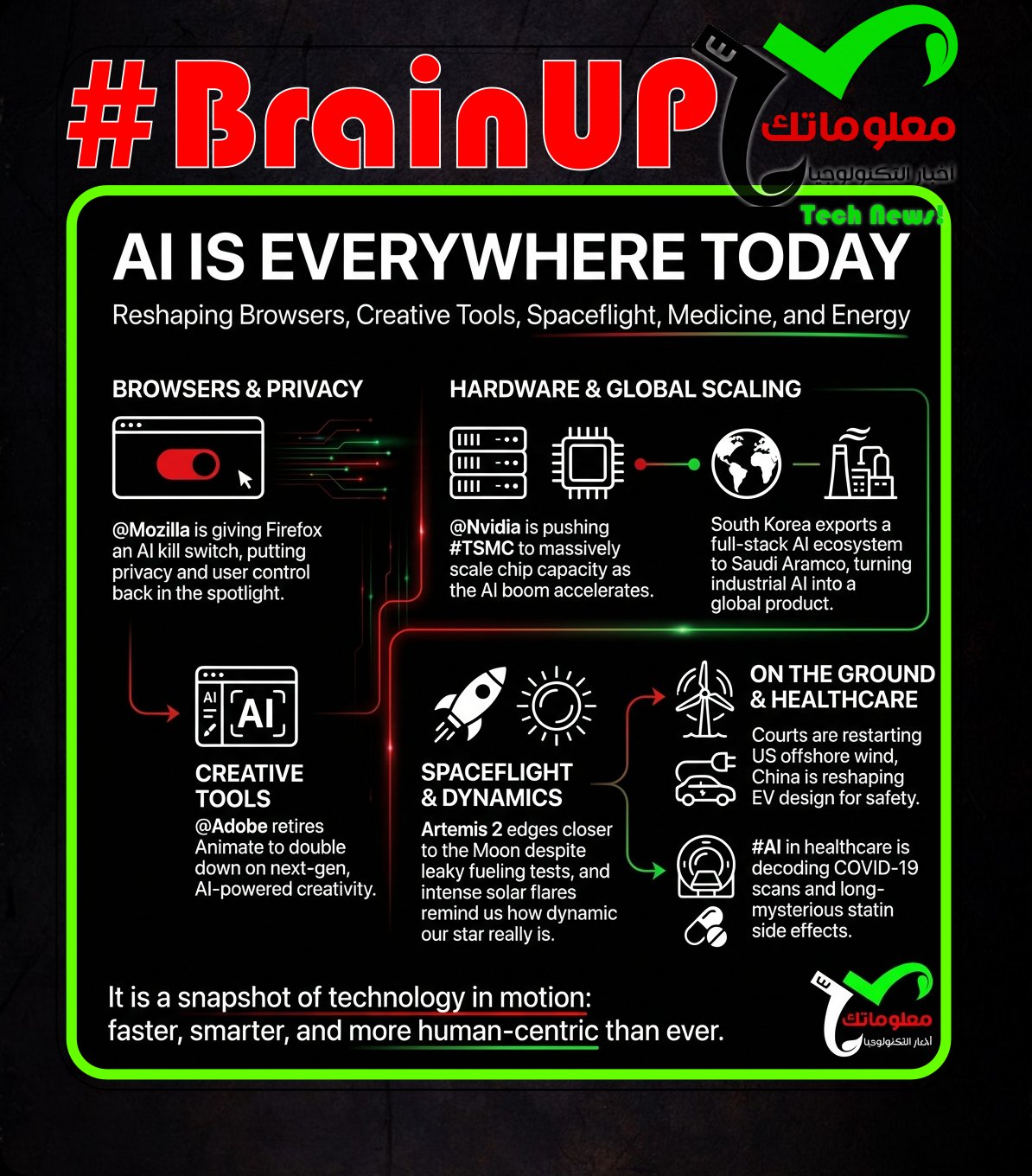
@Mozilla is introducing an AI controls switch in Firefox settings that lets users disable all AI features or enable them selectively. The update due on February 24 adds an ‘AI control’ option and lets users disable or enable features like the built-in AI chatbot, translations, and AI tab group suggestions #AI #privacy. CEO @Anthony Enzor-DeMeo previously promised an AI ‘kill switch’ to address concerns, and @Ajit Varma, Firefox’s VP of product, says choice and trust guided the development of these AI controls. The controls also cover whether Firefox uses AI to generate alt text for images in PDFs or to generate key points in link previews, illustrating practical use cases for user consent #AI #trust. In this move, @Mozilla positions Firefox as offering clearer control over AI, balancing usefulness with user autonomy and signaling a broader shift toward user-centric AI in browsers #technology.
2. Nvidia’s Jensen Huang urges TSMC to expand capacity amid AI chip crunch
@Jensen Huang of @Nvidia warned that #TSMC must greatly expand capacity to meet surging AI-chip demand, potentially more than doubling its capacity over the next decade. The remarks followed a Taiwan banquet with supply-chain executives, including TSMC chairman and CEO C C Wei and Foxconn chairman Young Liu, as Huang sought to shore up supply amid a crunch in critical inputs such as memory chips. He said TSMC must increase output this year because Nvidia ‘needs a lot of wafers’. TSMC said capex could jump up to 37% this year to about $56 billion, with increases expected in 2028 and 2029 due to #AI demand. Nvidia relies on Taiwanese partners for manufacturing and scale, including TSMC for wafers and packaging and Foxconn for servers, and Morgan Stanley says the #AI boom could make TSMC one of the biggest beneficiaries.
3. Adobe Animate is shutting down as company focuses on AI | TechCrunch
Adobe is shutting down its 2D animation software, Adobe Animate, as @Adobe pivots toward #AI, with the product discontinued on March 1, 2026 and enterprise support through March 1, 2029 while other customers receive support through March 2027. Customers reacted with disbelief and frustration, with some urging @Adobe to open source Animate, while the company notes Animate has existed for more than 25 years and that evolving technologies require new platforms. Adobe says Creative Cloud Pro plan users can use other apps to replace portions of Animate, such as @AfterEffects with its Puppet tool and @AdobeExpress for animation effects, signaling a partial substitute rather than a direct replacement. The decision follows hints at a shift away from Animate after a quiet period, including no 2025 release, and reflects a broader move toward #AI-enabled products, while the software will still run for those who already downloaded it.
4. NASA fuels up giant Artemis 2 moon rocket. Yes, it’s a little leaky. So is it ready to fly?
Artemis 2’s fueling test shows NASA’s big moon rocket can take on hundreds of thousands of liters of cryogenic propellants, loading more than 700,000 gallons (2.65 million liters) of #LH2 and #LOX into the two-stage SLS on Pad 39B, though LH2 leaks halted loading twice before the tanks were topped up. These leaks occurred at a Tail Service Mast Umbilical (#TSMU) interface, echoing a similar issue that affected Artemis 1, but the team quickly troubleshooted and continued the wet dress rehearsal. NASA remains targeting a Feb. 8 liftoff contingent on a successful wet dress and favorable weather, with the outcome of the test likely to be clarified at a Feb. 3 press briefing around noon EST. The Artemis 2 crew will include @ReidWiseman, @VictorGlover, @ChristinaKoch and @JeremyHansen for a 10-day mission around the Moon, using lessons learned from Artemis 1 to inform the campaign ahead. Whether the test qualifies Artemis 2 to proceed depends on the completion of the wet dress and other factors, but the effort already shows the team can diagnose and address LH2 leaks under pressure.
5. UPDATE! An X8.1 (Strong) flare from Region 4366 | NOAA / NWS Space Weather Prediction Center
Region 4366 produced another strong X8.1 (R3) flare at 6:57 pm ET, signaling continued high solar activity from this active region. Modeling of the associated coronal mass ejection indicates that most of the material will pass by Earth to the north and east late on 05 Feb UTC-day, delivering possible glancing influences. Region 4366 continues to produce M and X-class flares as of early Monday morning, underscoring ongoing solar activity. SWPC forecasters expect more exciting activity from this region in the coming days. This sequence of flares and the CME trajectory highlight the need for ongoing monitoring by @NOAA and @SpaceWeather, with attention to potential #glancingCME impacts and #spaceweather effects.
6. China to ban hidden car door handles on EVs
China will prohibit electric vehicles (EVs) from using hidden or flush door handles starting next year to enhance pedestrian safety. The new regulation responds to concerns that such handles, while improving aerodynamics and aesthetics, reduce the visibility and immediacy of door opening actions, increasing the risk of accidents. The ban reflects China’s growing emphasis on safety standards in the expanding #EV market, aligning with broader efforts to reduce traffic injuries and fatalities. This policy change is expected to influence EV design trends globally, as China is a major player in automotive manufacturing and innovation. Overall, the measure balances technological advancements with public well-being, signaling a cautious approach to integrating new #automotive technologies.
7. Court orders restart of all US offshore wind construction
A US court has ordered a restart of all offshore wind construction projects, addressing recent halts caused by regulatory and legal challenges. The decision stems from disputes over environmental and bureaucratic processes that had temporarily halted development in a sector critical for expanding America’s renewable energy capacity. This action highlights the judiciary’s role in balancing environmental protection with the urgent need for clean energy infrastructure. Renewed construction efforts are expected to accelerate offshore wind capacity, providing significant progress toward national climate goals. This ruling underscores the importance of clear policy frameworks to support sustainable energy while navigating legal and environmental concerns.
8. Google Home gets the upgrade we’ve all been waiting for
Google Home’s latest update adds hardware smart buttons, enabling touch or press-based control of devices, routines, and automations, and signals a return to physical controls in many #smartHome #hardwareButtons setups. The update, version 4.8, was spotted by @9to5Google and is said to bring broad compatibility with hardware buttons as it rolls out. In addition, Google says the change should reduce a long-standing ‘Video not available’ error when opening videos from notifications or recent events. While a full fix may still be coming, the move expands interaction methods alongside existing software improvements, potentially boosting adoption among users who prefer tactile controls. Users can try the new features by updating the Google Home app in the Google Play Store.
9. Russian hackers exploit recently patched Microsoft Office bug in attacks
Russian threat actors have exploited a recently patched vulnerability in Microsoft Office to carry out targeted attacks. The flaw, categorized under #CVE-2024-XXX (a placeholder since the real CVE is not provided in the text), allows attackers to execute malicious code when a user opens a crafted Office document. Security researchers observed these campaigns leveraging social engineering to distribute the payload via phishing emails, aiming to compromise systems and gain unauthorized access. Microsoft promptly released security updates to fix this vulnerability, emphasizing the need for users and organizations to apply patches immediately to mitigate risk. This incident highlights ongoing threats from nation-state actors targeting widely used software, underscoring the critical role of timely vulnerability management in cybersecurity.
10. YouTube Soft Confirms a Native Switch 2 App That’s Coming Soon
YouTube has indirectly confirmed the upcoming release of a native app for the new Nintendo Switch 2 console through subtle references in its software updates. The discovery was made when users noticed code snippets and assets pointing to a dedicated Switch 2 app, hinting at enhanced performance and features tailored for the next-gen device. This suggests YouTube’s commitment to optimizing user experience on emerging platforms and acknowledges the growing importance of the Switch 2 in the gaming and streaming market. Fans can anticipate a seamless integration of YouTube services on the Switch 2, improving accessibility and engagement. These developments highlight YouTube’s strategy to support new technologies promptly and maintain its relevance across diverse devices.
11. Tesla still working on CarPlay support, here’s what we know – 9to5Mac
Tesla remains committed to integrating #CarPlay, planning to run CarPlay inside its own #infotainment interface rather than letting it fully takeover the display. @Bloomberg reports that CarPlay will coexist with Tesla’s UI, appearing within a window and not replacing core features, with wireless CarPlay expected. @MarkGurman says CarPlay is still in the works and more details are coming soon. This hybrid approach keeps Tesla’s control of core vehicle functions like charging, driver assistance, and climate controls while letting CarPlay handle Apple Maps, media apps, and other iPhone apps. The plan reflects Tesla’s aim to blend its polished in-car software with familiar #Apple apps, per 9to5Mac.
12. Google Pixel teases ‘new theme packs are coming’ as Wicked theme ends
Pixel users can expect new theme packs soon after Google pulls the Wicked pack from the lineup. As of January 31, the Wicked: For Good pack expired and was removed from Pixel’s wallpaper options. The teaser page now says that ‘new theme packs are coming soon,’ but the ‘More’ button does nothing. Theme packs provide a one-tap makeover with wallpaper, colors, and sounds, and the Wicked partnership originally offered two themes for the film’s main characters. This points to @Google continuing to expand Pixel customization with #theme packs, though specifics remain unknown.
13. South Korea’s AI Industry Exports Full Stack to Saudi Aramco
South Korea’s AI industry is exporting an integrated AI full stack to Saudi Aramco Digital, signaling a move beyond supplying individual technologies. At a signing ceremony in Dammam, @Ryu Je-myung and @Nabil Al Nuaim witnessed the MOU with Aramco Digital and seven Korean firms, covering AI semiconductors from Rebellions and FuriosaAI, industry-specific models from NC AI, Upstage, and LG AI Research, LLM operations by Uracle, and cloud infrastructure by Megazone Cloud. Aramco Digital will identify high-potential applications in Saudi Arabia’s energy and manufacturing sectors, after which the Korean consortium will tailor semiconductors, models, and platforms for real-world deployments beyond PoC. The collaboration aims to demonstrate Korea’s integrated competitiveness in #AI #fullstack and establish a scalable model for global expansion, backed by government support. This move is intended to translate rising international interest into tangible export outcomes and position Korea as a standard model for AI-enabled industrial growth.
14. Development of a Deep Learning Model to Detect COVID-19 on Chest X-rays
The article presents a #DeepLearning model developed for detecting #COVID19 from chest X-ray images, aiming to assist rapid diagnosis during the pandemic. Utilizing a large dataset of annotated chest X-rays, the model achieved high accuracy and sensitivity in distinguishing COVID-19 cases from other lung infections. The study highlights the model’s potential to augment radiologists’ workflow by providing fast, automated screening to prioritize suspect cases. Challenges such as variability in image quality and disease presentation were addressed through data augmentation and transfer learning techniques. This approach demonstrates the promise of AI-driven tools in supporting clinical decision-making for infectious disease outbreaks.
15. Anthropic is about to drop Sonnet 5 during Super Bowl week
Anthropic plans to release Sonnet 5, its latest iteration of a #large_language_model, during Super Bowl week, positioning it as a significant moment for AI advancements. The update emphasizes improvements in safety and usability, reflecting ongoing efforts to create responsible AI systems by @Anthropic. This release showcases the company’s commitment to addressing challenges in AI alignment and reducing risks while enhancing performance. The timing during a high-profile event like the Super Bowl underlines the strategic intent to capture wide attention and influence the competitive AI landscape. Sonnet 5 demonstrates progress in integrating safety measures with cutting-edge capabilities, aiming to set new standards in the #AI industry.
16. Painful Side Effect of Statins Explained After Decades of Mystery
Around 10 percent of people taking #statins experience #SAMS, and researchers link these muscle pains to an influx of calcium into muscle cells caused by statins’ off-target effects on the #RyR1 channel. Using mice and #cryo-EM imaging, the team shows statins can bind to RyR1, keeping the calcium gates open and allowing calcium to leak into muscle fibers, which can lead to tissue damage and potentially life-threatening complications. The leaky gate explanation helps explain why SAMS occur and notes that people with RyR1 mutations may have higher risk, with rare cases of malignant hyperthermia or diaphragm weakness, rhabdomyolysis, and autoimmune-mediated necrotizing myositis also mentioned. The authors, including @Andrew Marks, propose redesigning statins so they don’t bind RyR1 but still inhibit cholesterol production in the liver, a step that could improve tolerability and help people stay on life-saving #statins.
That’s all for today’s digest for 2026/02/03! We picked, and processed 16 Articles. Stay tuned for tomorrow’s collection of insights and discoveries.
Thanks, Patricia Zougheib and Dr Badawi, for curating the links
See you in the next one! 🚀
