
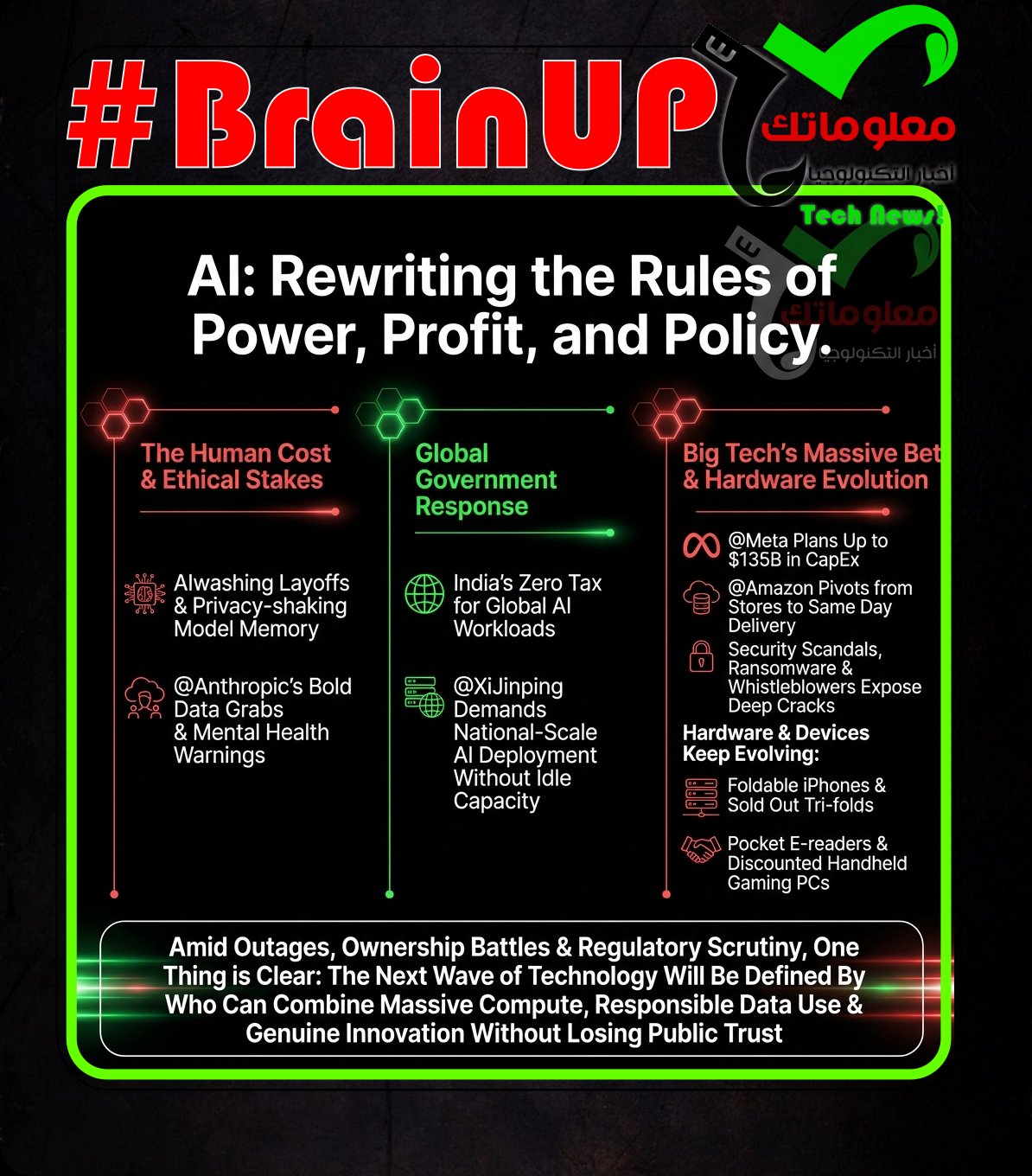
#BrainUp Daily Tech News – (Monday, February 2ⁿᵈ)
Welcome to today’s curated collection of interesting links and insights for 2026/02/02. Our Hand-picked, AI-optimized system has processed and summarized 25 articles from all over the internet to bring you the latest technology news.
As previously aired🔴LIVE on Clubhouse, Chatter Social, Instagram, Twitch, X, YouTube, and TikTok.
Also available as a #Podcast on Apple 📻, Spotify🛜, Anghami, and Amazon🎧 or anywhere else you listen to podcasts.
1. AI layoffs or ‘AI-washing’? | TechCrunch
The article questions whether layoffs blamed on AI reflect real workforce shifts or are an example of #AI-washing where AI is cited to cover other problems. Citing a @NewYorkTimes piece, it notes that AI was the stated reason for more than 50,000 layoffs in 2025, with Amazon and Pinterest among the companies named. A January Forrester report argues many companies announcing AI-related cuts do not have mature, vetted AI applications ready to fill those roles, highlighting the trend of #AI-washing. Molly @Kinder, a senior research fellow at @Brookings, calls saying layoffs were caused by AI an investor-friendly message that can mask ailing business. Overall, the piece frames this dispute as a broader debate over whether firms truly harness AI for transformation or simply use it as a narrative to justify difficult decisions.
2. Jeff Bezos’s Net Worth Jumps $5.7 Billion As Amazon Shares Rise On Plans To Shutter Stores
@Jeff Bezos’s net worth jumped by $5.7 billion to $266 billion as Amazon shares rose on plans to shutter physical stores, illustrating how stock value tracks strategic pivots in retail. The Bloomberg Billionaires Index notes Bezos is now the world’s third-richest person, behind @Larry Page, while @Elon Musk remains the richest. Amazon said it will close its #AmazonGo and #AmazonFresh stores and shift emphasis to online same-day delivery, alongside plans to open more than 100 new #WholeFoods locations in coming years. The move expands its #grocery delivery footprint and intensifies competition with #Walmart, #Target, and #Costco, showing how delivery-focused strategies can influence market position. This demonstrates that Bezos’s wealth trajectory remains closely tied to Amazon’s evolving retail strategy and delivery push.
3. Report: Apple Is Testing An iPhone Flip With A Square Foldable Design
Apple is reportedly exploring a new foldable iPhone concept featuring a square, clamshell-style design, similar to recent Samsung Galaxy Z Flip models. The design emphasizes a compact foldable phone that opens to a full-sized display, targeting users seeking portability without sacrificing screen size. This approach aligns with trends in the #foldable smartphone market, allowing Apple to enter this space with a unique take focused on form factor and user experience. Testing such a device indicates Apple’s interest in innovating beyond its traditional iPhone designs to remain competitive. The project reflects Apple’s strategic move to leverage #foldable technology while differentiating from existing devices.
4. Oracle Plans to Raise Up to $50 Billion for Cloud Investment
Oracle Corporation said it intends to raise between $45 billion and $50 billion in calendar year 2026 to expand its cloud infrastructure capacity and support growing demand for enterprise and AI-related services, planning to use a balanced blend of debt and equity financing to meet this target and maintain a solid investment-grade credit profile as it scales out data centers and network capacity for major clients including AMD, Meta, NVIDIA, OpenAI, TikTok and xAI. The company will raise roughly half the funds through equity-linked and common stock issuances, including mandatory convertible preferred securities and an at-the-market equity program of up to $20 billion, while the remainder will come from a one-time investment-grade bond sale early in the year, reflecting the immense capital needs of #cloud and #AI infrastructure build-out. Investors and analysts have shown mixed reactions to the plan, with some praising Oracle’s strategic bet on contracted cloud demand and others expressing concern about rising leverage and near-term financial pressures, especially given the company’s large existing debt load and free cash flow expectations through 2030. The fundraising strategy underscores Oracle’s commitment to competing more directly with hyperscaler infrastructure providers by locking in capacity and meeting contracted demand, even as its share price has reacted to the ambitious scale of investment and broader market scrutiny around AI-linked spending. Overall, the move highlights the escalating capital requirements tied to global cloud and AI infrastructure expansion, positioning Oracle as a key player in the evolving data-center landscape.
An alleged overwork–related death is reported for Gao Guanghui, a 32-year-old programmer who fainted at home and died in hospital, with his family saying long hours contributed. He had recently been promoted to department manager and was juggling programming tasks, management, and after-sales service, which kept him out late #Overwork. He reportedly worked on Nov 29, a Saturday, told relatives he felt unwell, and fainted; he was pronounced dead at 1pm despite hospital efforts, and his family alleges colleagues continued messaging in a WeChat group while he fought for his life #WeChat. The family has applied for work-related injury compensation but has not received updates, and the wife has asked for his personal belongings at work, some items reportedly disposed of or not properly packed. This case underscores concerns about after-hours expectations in China’s tech sector and the need for worker protections, as the article notes the ongoing debate over overwork and corporate accountability #China #TechIndustry.
6. AI security startup CEO posts alarming internal messages revealing industry risks
A CEO of an AI security startup shared internal messages underscoring significant security vulnerabilities in the AI sector, highlighting the urgent need for robust safeguards. These communications reveal potential threats that could be exploited if AI technologies are not carefully managed, emphasizing the risks posed by rapid AI advancements without adequate oversight. This situation illustrates the tension between innovation and safety in AI development, as startups rush to deploy solutions amid evolving threats. The CEO’s disclosures have sparked broader discussions about implementing stringent security measures and ethical standards in AI companies. These revelations stress the critical importance of balancing AI progress with comprehensive security strategies to protect users and data integrity.
7. India offers zero taxes through 2047 to lure global AI workloads | TechCrunch
Finance Minister @NirmalaSitharaman announced in the budget that foreign cloud providers can pay zero taxes through 2047 on services sold outside India if those workloads run from Indian data centers, a move to lure global #AI workloads and position #dataCenter capacity as a strategic rail for compute. However, sales to Indian customers would be taxed domestically if routed through locally incorporated resellers, and a 15% cost-plus safe harbour was proposed for Indian data-center operators serving related foreign entities. The announcement aligns with big bets from @Google, @Microsoft, and @Amazon as they expand data-center capacity in India, including Google’s $15B AI hub plan, Microsoft’s $17.5B expansion by 2029, and Amazon’s roughly $75B total commitment by 2030. Domestic projects like Digital Connexion’s $11B, 1-GW AI-focused campus in Andhra Pradesh and Adani Group’s up to $5B collaboration with Google illustrate growing private investment in AI-ready infrastructure. Yet constraints such as patchy power, high electricity costs, water scarcity, and state-level clearances could slow construction and raise operating costs, tempering expectations about turning India into a regional data and compute hub.
9. Motorola exploits EU software update loophole to deliver minimal updates
Motorola has found a loophole in the EU’s regulations requiring two years of software updates for smartphones by classifying devices as if they were shipped months later than their actual release date. This tactic allows the company to delay the start of the mandatory update period, effectively delivering fewer updates and postponing support for its #Android devices. While the European Union’s policy aims to improve consumer rights and encourage longer device lifespans, Motorola’s strategy undermines these goals by limiting meaningful updates and security patches. This approach raises concerns about the enforcement and effectiveness of EU regulations designed to protect users and ensure device longevity. The case highlights the need for stricter oversight and clearer policies to prevent manufacturers from exploiting such loopholes and upholding the spirit of #softwareupdate requirements.
Unredacted documents reveal that @Anthropic executives moved forward in early 2024 with a plan to scan ‘all the books in the world’ to train their #AI on how to write well. The materials, described as newly unredacted (and partially redacted) in The Bookseller, show intent to curate massive volumes of text to teach their AI tool. This ambition underscores a shift toward expansive data collection as a core training strategy for language models, raising questions about access to literary work and potential #copyright concerns. The evidence is based on unredacted files from the Anthropic case, highlighting how internal discussions framed performance and capability upgrades for their system. In the broader debate over #AI transparency and data sourcing, the revelation emphasizes the tension between aggressive training goals and safeguarding authors’ rights.
11. Gear News of the Week: Samsung’s TriFold Sells Out in Minutes, and a Leak Teases Google’s New OS
Samsung’s Galaxy Z TriFold, with a 10-inch tablet‑like display and a $2,899 price tag, sold out within minutes, underscoring strong demand for premium foldables and signaling limited supply in select U.S. stores. Leaks on Google’s Aluminium OS hint at a cross‑platform future that blends #Android and #ChromeOS with a ChromeOS‑style windowing and Android‑style start screen, a glimpse captured by @Google in a bug report and related images and video. Aluminium OS is expected to gradually replace #ChromeOS over years, but Chromebooks will remain in education markets in the near term, with an official launch teased for later this year. In contrast, @Vivaldi’s AI‑free update emphasizes human‑centric productivity tools, adding #TabTiling via drag‑and‑drop and improvements to its mail client while keeping pinned tabs constrained to one domain. Taken together, the week’s coverage highlights a tech landscape where headline hardware, cautious OS convergence, and AI‑free productivity tools shape the pace of innovation.
12. Toxin Stops Colon Cancer Growth Without Harming Healthy Tissue
Researchers discovered a bacterial toxin called CARDS toxin that selectively stops colon cancer growth without damaging healthy tissue. Studies showed the toxin triggers programmed cell death specifically in cancer cells by disrupting mitochondrial function, which cancer cells rely on heavily for survival. This targeted approach contrasts with traditional chemotherapy that harms both cancerous and healthy cells, leading to severe side effects. The findings suggest CARDS toxin could be developed into a novel therapy for colon cancer, offering a safer, more precise treatment option. This breakthrough highlights the potential of bacterial toxins as #targetedcancertreatments, addressing the critical need for therapies with minimal collateral damage.
13. X down for thousands of U.S. users, Downdetector data finds
X, previously known as Twitter, experienced significant outages affecting thousands of users in the United States as reported by Downdetector data. The disruptions began early on February 1, 2026, with reports of users being unable to load timelines, post content, or access the platform. This outage highlights challenges faced by social media platforms in maintaining stable service amid large-scale usage. The incident underscores the importance of robust infrastructure and rapid response systems to minimize downtime and user inconvenience. As social media remains integral to communication, such interruptions can impact information flow and user engagement significantly.
14. What If the Sensors on Your Car Were Inspecting Potholes for the Government? Honda Found Out
Vehicle sensors in everyday production cars can extend their role beyond safety to report road hazards to agencies, including potholes, uneven surfaces, and deficient signage. In a two-year pilot, Honda worked with ODOT’s DriveOhio, the University of Cincinnati, Parsons, and i-Probe to drive about 3,000 miles in Ohio using cameras and LiDAR to test a Proactive Roadway Maintenance System. Human reviewers and robotic verification confirmed sensor findings, with accuracy of 99% for damaged or missing signs, 93% for damaged guardrails, and 89% for potholes. Honda estimated that the program could save about $4.5 million in road maintenance costs through reduced manual inspections, better repair scheduling, and proactive maintenance planning, and future work aims to anonymize and share data with the appropriate agencies. The effort signals a move toward smarter, adaptive road maintenance using #ProactiveRoadwayMaintenanceSystem and #vehicleSensorData, with @DaisukeOshima of i-Probe framing analytics as key to asset management.
15. WhatsApp’s Privacy Promise Under Federal Scrutiny After Whistleblower Allegations Surface
Facebook’s WhatsApp faces federal investigation following a whistleblower’s claims that the company misled users about its privacy practices. The allegations suggest WhatsApp continued sharing user data with Facebook despite promising strong privacy protections. This scrutiny highlights tensions between user trust and corporate data policies, focusing on compliance with privacy laws. The investigation underscores challenges in enforcing digital privacy and raises concerns about transparency in tech companies. WhatsApp’s situation exemplifies ongoing debates about #dataPrivacy and regulation in the technology sector.
16. Match, Hinge, OkCupid, and Panera Bread breached by ransomware group
ShinyHunters claims to have stolen data from Match Group’s dating apps, Tinder, Match, Meetic, OkCupid, and Hinge, totaling more than 10 million records, alongside 14 million records from Panera Bread. @MatchGroup has confirmed a cyber incident and says there is no evidence that logins, financial data, or private chats were stolen, but PII and some tracking data appear to be in scope, including usage data from Appsflyer and hundreds of internal documents; @PaneraBread reports an incident with 14 million records containing PII and states that login credentials, financial information, or private communications were not accessed. ShinyHunters appears to have gained access through #SSO platforms and uses voice-cloning techniques, illustrating how breaches can affect users differently and potentially enable impersonation. The breaches show that dating-app data can lead to doxxing, stigma, or extortion, especially around intimate information and profiles, while Panera’s data can fuel targeted phishing and broader privacy concerns as PII is enriched across datasets and can be used to craft convincing scams. To defend themselves, users should follow company guidance, change passwords (ideally with a #passwordManager), enable #2FA with #FIDO2 where possible, watch for impersonators, verify communications through official channels, avoid storing card details, set up identity monitoring to detect if personal information is being traded, and this underscores why users should remain vigilant.
17. Why TikTok’s first week of American ownership was a disaster
TikTok’s transition to US ownership has been rocky, marked by a major outage and a privacy policy update that expanded data collection, including tracking the precise locations of its users, fueling suspicion about the new owners @Oracle and other US investors. The crisis was intensified by a severe winter storm that knocked datacenters offline, causing outages and preventing users from uploading videos or gaining views. Public figures and outlets accused TikTok of censoring content critical of federal immigration agents, with voices from @BillieEilish, @MegStalter and @ScottWeiner amplifying concerns as media outlets covered the controversy. TikTok attributed the outages to weather and related issues, while Oracle explained a temporary datacenter power loss, illustrating the fragility of the platform’s US infrastructure during the transition. The episode highlights broader questions about privacy, censorship, and data governance as TikTok competes with established platforms in the US market.
18. What AI remembers about you is privacy’s next frontier
AI systems increasingly retain user interactions and data, raising new privacy concerns that go beyond traditional data collection. Research shows that large language models and other AI architectures can memorize and recall sensitive information, unintentionally exposing private details. This phenomenon challenges existing data protection frameworks and necessitates novel regulatory approaches to safeguard personal privacy. Companies deploying AI must balance improving user experience with minimizing risks of data leakage through model memory. Understanding and managing AI’s capacity to remember and reveal user data represents a critical step in advancing privacy protections in the age of artificial intelligence.
19. Anthropic CEO Warns Of AI Brainwashing Society Or Psychotically Crushing Human Mental Well-Being
The CEO of Anthropic has issued a warning about the potential risks of advanced #AI systems, highlighting concerns that AI could brainwash society or drastically harm human mental well-being. He emphasizes the powerful influence AI can exert on human cognition and emotional health, which might result in widespread psychological distress or manipulation at a societal scale. This perspective underscores the importance of developing AI with ethical considerations and robust safety measures to prevent such detrimental outcomes. The warning aligns with broader debates on the responsible governance and regulation of AI technologies to safeguard human values. Ensuring that AI advancements benefit humanity while mitigating mental health risks remains a critical challenge for stakeholders.
20. Meta estimates 2026 CapEx to be between $115-$135bn
Meta forecasts its capital expenditure for 2026 to range between $115 billion and $135 billion, indicating significant investment in its infrastructure. This projection reflects Meta’s continued commitment to expanding its data center footprint and technology capabilities, supporting its long-term growth strategies. The substantial CapEx underscores Meta’s focus on developing advanced infrastructure to accommodate increasing demand for its services and new technologies. By investing heavily in data centers, Meta aims to maintain competitiveness in the cloud and metaverse markets. This financial outlook highlights Meta’s strategic priorities in driving innovation and scaling its operations through robust capital investments.
21. Xi Jinping pushes China’s AI ambition but warns against idle capacity
@Xi Jinping frames #AI as an epoch-making technological transformation and urges a ‘whole-of-nation’ push for domestic deployment to sustain global competitiveness, while warning against idle capacity. He cites progress like @DeepSeek’s large language model that supposedly matches leading tools with far less compute, signaling software-level gains and a strategy to overcome foreign restrictions through domestic breakthroughs. Beijing warns against reckless provincial spending, calls for integrating AI into existing sectors rather than replacing infrastructure, and stresses careful resource optimization amid limited access to high-end accelerators. The speech ties AI to the #FiveYearPlan (2026–2030) and the push to modernize industry, while acknowledging inefficiencies and overcapacity as it balances ambition with local conditions in a US-led global tech contest.
22. This tiny pocket-friendly e-reader is packed with frustration and potential
The Xteink X4 is a pocketable 4.3-inch E Ink reader priced at $69 that sacrifices features for extreme portability. With unlabeled buttons instead of a touchscreen, a 220 ppi display, and no screen lighting, it can be unintuitive to use out of the box, despite its tiny footprint #EInk #buttons. A growing community of users is developing fixes and workarounds, and Xteink notes that magnetic alignment on newer devices can be off, so it ships adhesive rings to improve compatibility with @Apple’s MagSafe mounts #MagSafe. In size terms it’s smaller than the @Kobo Libra 2 and far smaller than the Kobo Mini, and the reviewer ends up using it as a standalone e-reader rather than a phone companion. Nonetheless, at under $70 and with its ultra-slim profile, the X4 offers a tempting option for readers who value portability over premium features #portability.
23. Security Bite: X going open source is bad news for anonymous alt accounts
The decision by X (formerly Twitter) to make its algorithm open source poses significant challenges for users maintaining anonymous alternative accounts. By exposing the platform’s inner workings, it becomes easier to detect patterns and potentially identify these alt accounts, undermining user anonymity. This transparency affects how bots and deceitful accounts operate, as developers and researchers can scrutinize and counter these tactics more effectively. While open sourcing promotes accountability and innovation, it also forces a reconsideration of anonymity strategies on social media platforms. Overall, X’s move reflects a trade-off between increased openness and the privacy of certain user profiles.
24. The Asus ROG Xbox Ally isn’t even four months old, and it’s already $110 off
The Asus ROG Xbox Ally is a portable handheld PC entry into the market, now $110 off on Amazon, bringing the price from $599 to $489 and making it cheaper than Steam Deck OLED models. It packs an AMD Ryzen Z2 A processor, 16GB of LPDDR5 RAM, and a 512GB SSD, plus three months of Xbox Game Pass Premium and a 7-inch touchscreen, with the streamlined Xbox Fullscreen Experience working best with the Xbox and GamePass libraries. In a hands-on review it earned 7/10, noted as not as mighty as the higher-end Asus ROG Xbox Ally X but still a solid starter for trying PC gaming on the go and for tapping into #GamePass libraries rather than external launchers. With @Valve discontinuing the LCD Steam Deck, this device offers a practical, affordable path to portable #portablePC gaming and a way to dip into the @Microsoft Xbox ecosystem. It can function as a secondary console to reduce family contention and to explore console-quality play anywhere.
25. Capgemini to sell US subsidiary providing services to ICE
Capgemini will sell its US subsidiary Capgemini Government Solutions after saying legal constraints prevented the Group from properly controlling its operations amid controversy over its contract with @ICE. The company said US contracting rules governing federal entities performing classified work did not allow adequate oversight, with the subsidiary representing about 0.4% of worldwide sales and less than 2% of its US sales, and that the sale process will begin immediately. The move appears aimed at distancing the group from a controversial program and reflects governance and reputational risks as anti-ICE protests have grown in Europe. This case underscores the tensions between multinational #tech firms’ outsourcing and ethical concerns around #immigrationpolicies and government contracting.
26. Guest post: AI (ChatGPT)-generated paper on pregnancy and math
An AI-generated paper using ChatGPT explored connections between pregnancy and mathematics, demonstrating both the potential and current limitations of #AI in academic writing. The paper revealed interesting theoretical links but lacked original empirical data, highlighting AI’s strength in synthesizing existing knowledge rather than producing novel research. This experiment raises important questions about AI’s role in scientific publishing, ethical considerations, and how researchers might leverage AI tools responsibly. The discussion emphasizes the need for clear guidelines to ensure AI-generated content maintains academic rigor and transparency. Ultimately, AI offers promising assistance in research and writing, but human oversight remains crucial.
That’s all for today’s digest for 2026/02/02! We picked, and processed 25 Articles. Stay tuned for tomorrow’s collection of insights and discoveries.
Thanks, Patricia Zougheib and Dr Badawi, for curating the links
See you in the next one! 🚀
