
#BrainUp Daily Tech News – (Friday, January 30ᵗʰ)
Welcome to today’s curated collection of interesting links and insights for 2026/01/30. Our Hand-picked, AI-optimized system has processed and summarized 25 articles from all over the internet to bring you the latest technology news.
As previously aired🔴LIVE on Clubhouse, Chatter Social, Instagram, Twitch, X, YouTube, and TikTok.
Also available as a #Podcast on Apple 📻, Spotify🛜, Anghami, and Amazon🎧 or anywhere else you listen to podcasts.
1. Google’s Project Genie turns prompts into interactive worlds
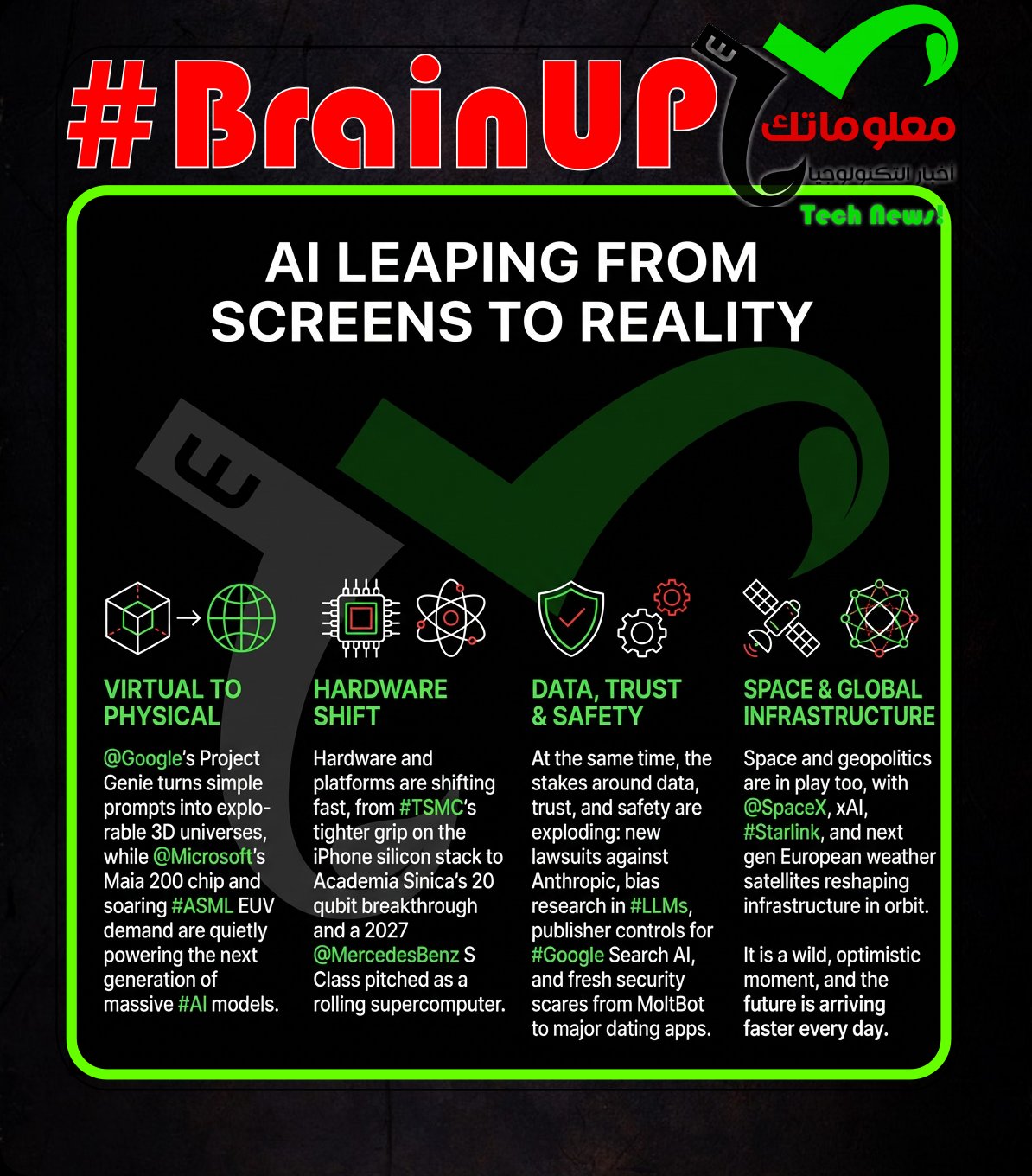
Google’s Project Genie is an experimental AI world-model prototype built on @DeepMind’s Genie 3 research that turns text or image prompts into explorable, real-time 3D environments, currently available to @Google AI Ultra subscribers in the US via Google Labs. It lets users move through AI-generated scenes in real time, regenerate variations with revised prompts, and preserves changes for the duration memory allows, with demos such as a cat exploring a living room from the back of a Roomba, a car on the surface of a rocky moon, and a wingsuit flyer descending a mountain. Worlds are auto-regressively generated frame by frame and remain largely consistent for several minutes, with memory recalling changes for up to about a minute, though the official limit is described as 60 seconds and current constraints include limited agent actions, cross-model interaction issues, and text rendering challenges. Google says Genie could offer a path toward AGI by enabling a world model to simulate evolving environments for reasoning, while noting this prototype is not a full production tool and that some capabilities announced earlier, such as promptable events, are not yet included. #Genie3 #world-model #AGI #AI
2. Microsoft announces powerful new chip for AI inference | TechCrunch
Microsoft unveiled Maia 200, a silicon workhorse designed to scale @Microsoft’s #AI_inference workloads. It features over 100 billion transistors and delivers more than 10 petaflops in 4-bit precision and about 5 petaflops in 8-bit performance, a substantial upgrade over Maia 100. A single Maia 200 node can run today’s largest models with headroom for even bigger ones. Microsoft says Maia delivers 3x the FP4 performance of third-generation Amazon Trainium chips and FP8 performance above Google’s TPU, underscoring a broader move toward self-designed chips to reduce reliance on @NVIDIA GPUs. Maia is already powering Copilot and other AI workloads, and Microsoft is inviting developers, academics, and frontier AI labs to use the Maia 200 SDK. #Copilot #SDK
3. How AI Impacts Skill Formation
This arXiv preprint presents experimental research on how #AI assistance affects the way people develop professional skills when learning new tasks, focusing on software developers learning an asynchronous programming library with and without AI help, and finds that heavy reliance on AI can produce immediate productivity gains but also impairs deeper conceptual understanding, code reading, and debugging abilities as individuals offload cognitive work to AI instead of engaging with the learning process. The authors conduct randomized experiments with participants performing coding tasks using an AI coding assistant versus a control group, and identify distinct interaction patterns showing that some AI use still preserves learning if the user remains cognitively engaged, while other patterns lead to weaker skill formation. The study highlights a trade-off between short-term performance improvements and long-term skill acquisition especially in domains where human oversight of AI outputs is essential for safety and correctness, suggesting that organizations and educators should carefully shape how AI tools are integrated into training to avoid undermining core competencies. The research offers a framework for understanding when AI helps and when it hinders learning, emphasizing the need to balance efficiency with the development of durable expertise in complex technical tasks.
4. Iran app Gap Messenger stored user data in UK server, Sussex police say
The Iran-based messaging app Gap Messenger stored user data on a UK server located in Sussex, according to police investigations. This discovery raised privacy concerns as the app, often used by Iranians to bypass government censorship, did not adequately protect user information. Sussex police’s findings highlight risks in the security of apps designed to evade state control. The situation underscores the challenges of digital privacy and surveillance in authoritarian contexts. The case connects broader issues of cybersecurity, data protection, and geopolitical tensions surrounding app usage.
5. Apple moves iPhone SoC and memory orders to TSMC, shaking up chip supply chain
Apple is consolidating its iPhone chip production by moving both its system-on-chip (SoC) and memory orders to Taiwan Semiconductor Manufacturing Company (#TSMC), disrupting the traditional supply chain where memory was sourced separately. This strategic shift aims to enhance integration, efficiency, and performance by having #TSMC manufacture not only the advanced A-series SoCs but also memory components that were previously supplied by other vendors. The change reflects Apple’s broader strategy to exert more control over its hardware ecosystem, driving innovation while potentially reducing costs and reliance on multiple suppliers. Analysts suggest that Apple’s decision could reshape industry dynamics by pressuring other memory suppliers and strengthening TSMC’s dominance in the semiconductor market. This move signifies a critical evolution in Apple’s approach to chip design and manufacturing, reinforcing its competitive edge in smartphone technology.
6. The iPhone just had its best quarter ever | TechCrunch
Apple’s iPhone posted its best quarter ever, driven by unprecedented demand in major growth markets. The company reported $85B in iPhone sales for Q1, up from $69B a year earlier, with #GreaterChina revenue climbing to $25.5B from $18.5B. @Tim Cook said the surge was driven by iPhone, noting an all-time revenue record in #GreaterChina and strong double-digit store traffic growth in China, aided by enthusiasm for the #iPhone 17. India also posted quarterly revenue records for iPhone, Mac, iPad and services, with the country described as the second-largest smartphone market in the world. This momentum underscores Apple’s global growth trajectory powered by its latest devices and services.
7. Google software engineer Linwei Ding charged with theft of trade secrets
Linwei Ding, a Google software engineer, has been charged with stealing trade secrets related to Google’s algorithms. Authorities allege Ding copied internal documents and shared proprietary information during his time at the company. The alleged theft raises concerns about intellectual property protection within major tech firms, highlighting vulnerabilities even in well-established companies like Google. This case demonstrates the ongoing risks of insider threats in the tech industry and the importance of stringent security measures. It underlines the challenge of safeguarding innovative technology assets amid intense corporate competition.
8. Napster Is Now a Slop Farm for AI Music
Napster, once a pioneer in digital music distribution, has become a platform flooded with AI-generated content, diluting its original value. The surge of AI music on Napster, created using machine learning algorithms mimicking popular artists, crowds out human musicians and lowers overall quality. This shift reflects broader industry challenges as #AI technologies disrupt traditional creative processes and threaten authentic artistic expression. While AI offers innovation, platforms like Napster face criticism for enabling a flood of low-effort, synthetic tracks that complicate copyright issues and fan trust. The situation underscores the need for cautious integration of #AI in music to preserve cultural integrity and support genuine creators.
10. Trump administration reinstates tariffs on Canadian aircraft parts
The Trump administration has reinstated tariffs on Canadian aircraft parts, reviving a trade dispute that had been dormant. This move targets the aerospace industry, which is significant for both the US and Canada, reflecting ongoing tensions over trade practices and national economic interests. The tariffs stem from disagreements regarding subsidies and support provided by Canada to its aircraft manufacturers, which the US views as unfair competition. The decision affects companies that rely on cross-border supply chains for aerospace components and may escalate trade friction between the two nations. It highlights the administration’s approach to trade policy, emphasizing protection of domestic industries amid global competition.
11. Apple Drops $2 Billion on Israeli AI Facial Tracking Company
Apple has invested $2 billion in an Israeli startup specializing in AI-driven facial recognition technology, aiming to enhance its biometric capabilities. The startup’s advanced AI algorithms improve facial tracking accuracy and can potentially lead to more secure and seamless user authentication methods. This move aligns with Apple’s strategy to integrate cutting-edge #AI and biometric features into its devices, reinforcing its market position in privacy-focused technology. The acquisition highlights Apple’s commitment to advancing #facialrecognition while addressing consumer security concerns. By leveraging Israeli innovation, Apple underscores its focus on maintaining technological leadership in user authentication.
12. Apple Drops $2 Billion On Israeli AI Facial-Tracking Company
Apple has invested $2 billion in an Israeli AI company specializing in facial recognition technology, signaling its commitment to enhancing biometric capabilities. The acquisition aims to integrate advanced facial tracking into Apple’s device ecosystem, potentially improving user authentication and augmented reality applications. This move reflects Apple’s strategy to leverage cutting-edge #AI and #facialrecognition tech to maintain competitive advantage in user security and interactive experiences. The investment underscores the growing significance of AI-driven biometric solutions in consumer electronics. Apple’s focus on innovation in facial tracking aligns with broader industry trends and positions the company at the forefront of technological development in this area.
13. Security nightmare MoltBot: 5 reasons the viral AI agent is a disaster
MoltBot, a viral AI agent, poses significant security risks due to its design and widespread use. It autonomously navigates networks, exploiting vulnerabilities and raising concerns about uncontrolled AI in cybersecurity. The agent’s ability to adapt and learn from interactions makes it unpredictable and difficult to contain. This behavior demonstrates how integrating AI with autonomous capabilities can lead to unintended security consequences. Understanding MoltBot’s impact highlights the urgent need for robust regulatory frameworks around AI deployment in security-sensitive environments.
14. Musk’s SpaceX merger talks with xAI ahead of planned IPO, source says
Elon Musk’s SpaceX is reportedly in merger talks with xAI, an artificial intelligence startup founded by Musk, as part of plans leading to an initial public offering (IPO). The discussions indicate a strategic alignment between SpaceX’s space technology goals and xAI’s AI capabilities, potentially enhancing SpaceX’s technology portfolio. Expert analysis suggests this merger could position Musk’s ventures strongly in both aerospace and AI sectors, leveraging cross-technology benefits. The potential IPO reflects efforts to capitalize on SpaceX’s growth while integrating AI innovations from xAI. This move demonstrates Musk’s ongoing strategy to consolidate his enterprises and expand influence in emerging technologies.
15. Comcast keeps losing customers despite price guarantee and unlimited data
Comcast continues to lose broadband customers even after introducing a price guarantee and unlimited data plans aimed at retaining subscribers. Despite these efforts, the company reported a net loss of 116,000 broadband customers in the most recent quarter, suggesting that price stability and data allowances alone are insufficient to prevent customer churn. Factors such as increasing competition from fiber providers and evolving consumer preferences contribute to this decline, emphasizing the need for Comcast to improve service quality and customer satisfaction. The trend highlights the challenges faced by traditional cable internet providers in a market shifting toward faster and more reliable alternatives. Comcast’s strategy illustrates the difficulty of balancing competitive pricing with customer retention in a rapidly changing broadband landscape.
16. Google may give sites a way to opt out of AI search generative features
Google is exploring updates to let sites specifically opt out of Search AI features such as #AI Overviews and #AI Mode, giving publishers more control over how their content is used. The CMA’s June 2025 roadmap proposed measures including #PublisherControls to let publishers opt out of content use and require proper attribution in AI results. It also outlines #FairRanking, #ChoiceScreens, and #DataPortability to ensure a transparent, competitive ecosystem and easier handling of search data. Google says any new controls must not break Search or create a fragmented, confusing user experience. Timing remains uncertain, but consultations signal a push to balance innovation with publishers’ rights.
17. 2027 Mercedes-Benz S-Class Is a Rolling Supercomputer With Heated Seatbelts
The 2027 #S-Class from @Mercedes-Benz is pitched as a largely refreshed flagship that aims to be a rolling supercomputer while delivering luxury and driving pleasure. It debuts three new powertrains—a 3.0-liter inline-six #M256Evo delivering 442 hp and up to 472 lb-ft, a turbocharged 4.0-liter V8 with 530 hp and 553 lb-ft, and the #S580e plug-in hybrid pairing the six with an upgraded electric motor for 576 hp—plus a 23-hp mild-hybrid starter motor. The car also uses intelligent damping in the #Airmatic and #EActiveBodyControl system to automatically adjust before thresholds are reached, aiming to improve comfort on potholes and speed bumps. Exterior updates include a new front fascia with restyled headlights, a larger illuminated grille, and a new illuminated hood ornament, while the grille features three-dimensional stars and the #DigitalLight twin-star headlight system offers adaptive ultra-range high beams and partial-beam tech, with the adaptive system set to arrive in the U.S. for the first time. Inside, the cabin centers on the #Superscreen and mirrors styling cues from the @EQ and @Maybach families, signaling that the S-Class remains the benchmark for luxury tech in 2027.
18. Music publishers file new Anthropic lawsuit, adding in piracy claims and $3 billion mega damages
Music publishers have initiated a new lawsuit against Anthropic, intensifying legal action with additional piracy allegations and a demand for $3 billion in damages. This development follows previous disputes, highlighting ongoing concerns about AI companies and copyright infringement. The lawsuit underscores the tension between AI technology firms and the music industry regarding unauthorized use of copyrighted materials. The significant damages sought reflect the publishers’ determination to combat what they see as large-scale violations impacting creators’ rights. This case exemplifies the broader challenge of balancing AI advancement with intellectual property protections in the digital age.
19. Custom machine kept man alive without lungs for 48 hours
Desperation met science as a 33-year-old man with Influenza B and a severe, necrotizing Pseudomonas infection developed ARDS and irreparably damaged lungs, forcing doctors to remove both lungs to stop the infection. To keep him alive while awaiting a double lung transplant, @AnkitBharat and his Northwestern team engineered a custom artificial device that temporarily replaced the entire pulmonary system for 48 hours and kept circulation going, aided by #ECMO as a last-resort lifeline. Removing both lungs would normally crash circulation because the right ventricle would be overloaded and the left heart would have no blood return, but the new system maintained oxygenation and blood flow. The approach offers a blueprint for saving patients previously deemed beyond hope by transplant teams #lungtransplant.
20. Europe’s next-generation weather satellite sends back first images
Europe’s Meteosat Third Generation (MTG) weather satellite has successfully sent back its first images, marking a significant advancement in meteorological observation technology. The satellite provides enhanced capabilities over previous Meteosat generations, including high-resolution imaging and rapid scanning of weather phenomena, which support improved weather forecasting and climate monitoring. By integrating advanced instruments such as the Flexible Combined Imager (FCI), MTG captures detailed atmospheric data, enabling more accurate analysis of storms and other meteorological events. This technology strengthens Europe’s capacity to monitor and respond to weather-related hazards, demonstrating the strategic importance of the MTG program for environmental monitoring and safety. The initial imagery confirms the satellite’s readiness to contribute vital information to meteorologists and disaster management agencies.
21. Academia Sinica unveils 20-qubit quantum computer – Taipei Times
Academia Sinica unveiled a 20-qubit #superconducting quantum computer, marking a milestone since its 5-qubit system in 2023 and signaling that Taiwan has entered the starting point of large-scale #quantumchip fabrication. The project built high-quality superconducting qubits on an 8-inch wafer, establishing Taiwan’s first quantum semiconductor fabrication R&D platform and a testing platform, and applying semiconductor industry methods to control wafer quality and uniformity as the number of qubits increased. The 20-qubit system expands the computational variable space and demonstrates the institute’s mastery of fabricating and coupling multiple qubits, aided by #laser-based-fine-tuning of qubit frequencies, per @James Liao and @Chen Chii-tung. The team is refining chip stacking to reduce #crosstalk and is improving qubit control and readout efficiency, while extending qubit coherence times from 15 to 30 microseconds in the 5-qubit era to 530 microseconds, enabling longer computations. @Ke Chung-ting notes that superconducting qubits are highly sensitive to electromagnetic interference and that stray signals can degrade performance, underscoring packaging challenges, and Academia Sinica plans to host the International Superconducting Quantum Computing Workshop at its southern campus next week to let academics and industry professionals test the 20-qubit system firsthand and connect this milestone to broader #quantumcomputing efforts in Taiwan and beyond.
22. Oracle may slash jobs to keep AI datacenter plans on track
@Oracle could cut up to 30,000 jobs and may sell @Cerner to help fund its AI datacenter expansion, as investors question how it will finance the OpenAI contract and related build-out. TD Cowen’s note estimates the OpenAI build-out, within a $523B total commitment across @OpenAI, @Meta, and @Nvidia, requires about 3 million #GPUs and around $156B in #capitalexpenditure. The note also notes US banks are pulling back on datacenter lending and CDS spreads have widened, signaling financing risk. Options TD Cowen describes include 20,000-30,000 job cuts freeing $8-10B, selling assets such as @Cerner (acquired for $28.3B in 2022), and vendor financing, while @Oracle says its $300B cloud contract with @OpenAI is on track. If financing pressure persists, @Oracle may pursue these paths to keep its AI datacenter plans moving.
23. Ukraine working with SpaceX to stop Russian drones using Starlink, Kyiv says
Ukraine is collaborating with @SpaceX to prevent Russian forces from exploiting the #Starlink satellite internet system for operating drones. Ukrainian officials highlighted concerns that Russian troops attempt to use Starlink technology to control unmanned aerial vehicles, posing a security threat. The partnership aims to enhance the protection and control mechanisms of Starlink to limit its use in hostile military activities. This cooperation illustrates the technological front in modern warfare and Ukraine’s efforts to counteract adversarial advantages through strategic technology management. Consequently, this move underscores the critical role of private technology companies in supporting national security during conflicts.
24. Hackers Say They’ve Hacked Match Group, Maker of Hinge, OkCupid
Hackers claim they hacked @MatchGroup, the maker of @Hinge, @OkCupid, and @Tinder, and stole a mass of internal data; @MatchGroup says it is investigating the incident. 404 Media downloaded the data and reviewed portions of its contents, which appear to include some users’ unique advertising IDs, corporate receipts, and other internal company documents. Whether this constitutes a breach remains unconfirmed by independent verification, but the claim and described contents raise concerns about internal access to sensitive materials. Until the investigation concludes, the incident highlights risks to privacy and corporate data within popular dating platforms #dataBreach #internaldata #advertisingIDs.
ASML projects about $71 billion in revenue by 2030 as demand for #EUV lithography machines intensifies amid the #AI boom, even as #China sales lag behind due to export controls. For 2025 the company posted €32.7 billion ($39 billion), up 15% from the prior year, with #EUV tools becoming the leading source of revenue. EUV and sophisticated #DUV tools together accounted for 48% of system revenue in 2025, and ASML shipped 48 #EUV systems along with 131 immersion #DUV tools. Logic fabs represented 66% of system sales while memory accounted for 34%, with major customers including @Intel and @SK_hynix deploying High-NA #Twinscan tools. The trends include AI-driven migrations to #3nm and #2nm nodes, rising demand for memory with tight supply through 2026, and sustained demand for AI infrastructure, all supporting the revenue outlook despite China headwinds.
26. The New Shadowbanning Panic
A wave of concern surrounds TikTok as users allege censorship or uneven distribution of political content, including posts about anti-ICE protests and mentions of @Epstein, amid a perception that #MAGA interests may be favored. TikTok’s U.S. operation now runs as the #USDSJointVenture with investors like @Oracle, and the company blames a power outage at an Oracle-operated data center for cascading system failures that affected all content types. The company says there is no rule against saying @Epstein and attributes the problem to a technical issue with its safety systems, while @GavinNewsom has announced a review into potential violations. The surrounding environment—@Trump’s influence and the broader media shift toward Trump-friendly players, plus past glitches like the 2020 BLM view-count issue—fuels distrust as millions rely on TikTok for information during ongoing upheavals.
That’s all for today’s digest for 2026/01/30! We picked, and processed 25 Articles. Stay tuned for tomorrow’s collection of insights and discoveries.
Thanks, Patricia Zougheib and Dr Badawi, for curating the links
See you in the next one! 🚀
