
#BrainUp Daily Tech News – (Sunday, January 25ᵗʰ)
Welcome to today’s curated collection of interesting links and insights for 2026/01/25. Our Hand-picked, AI-optimized system has processed and summarized 22 articles from all over the internet to bring you the latest technology news.
As previously aired🔴LIVE on Clubhouse, Chatter Social, Instagram, Twitch, X, YouTube, and TikTok.
Also available as a #Podcast on Apple 📻, Spotify🛜, Anghami, and Amazon🎧 or anywhere else you listen to podcasts.
1. Europe wants to end its dangerous reliance on US internet technology
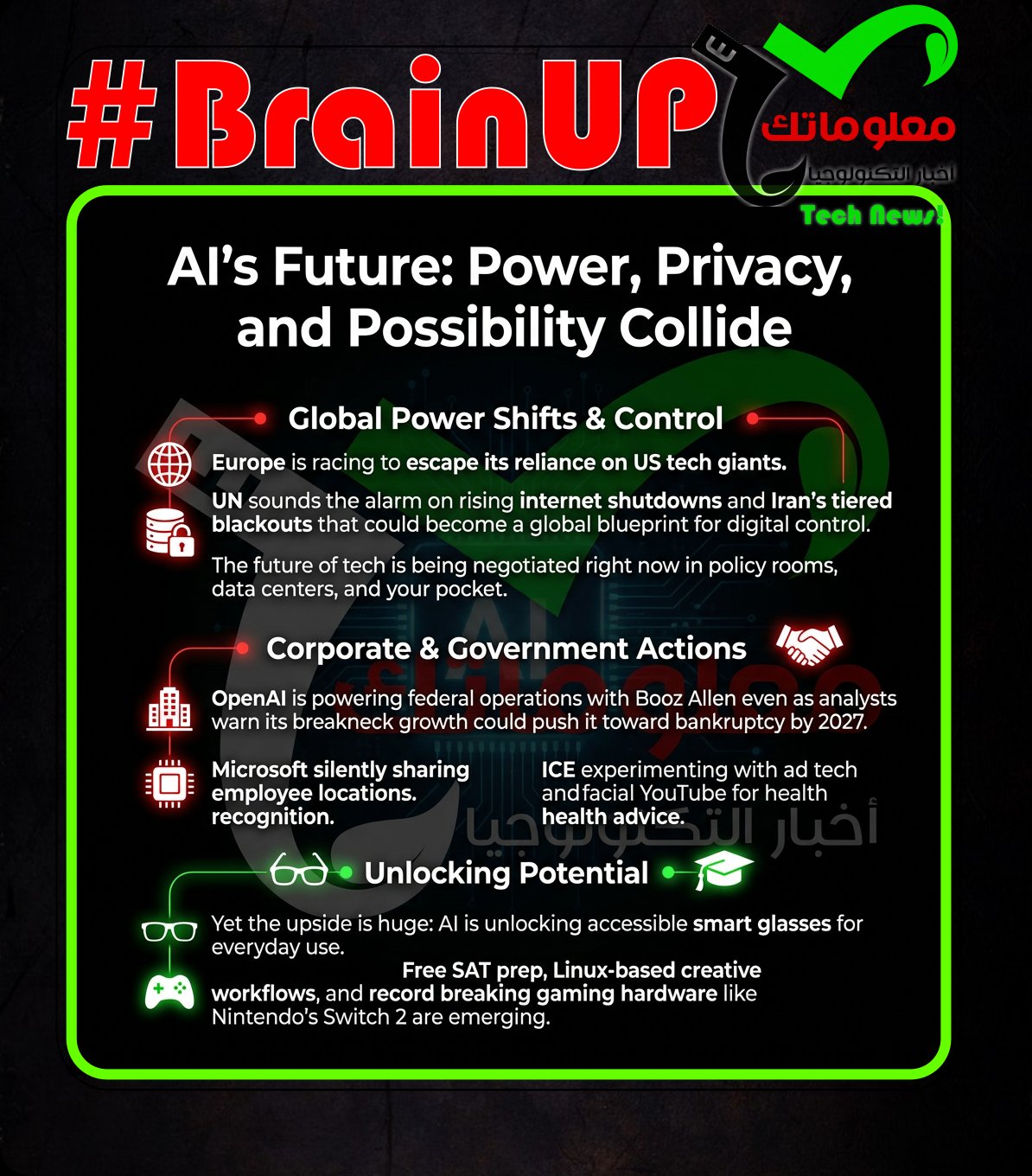
Europe aims to reduce its dependence on US internet technology due to concerns about security, sovereignty, and economic control. The continent faces challenges from American dominance in digital infrastructure and data management, which raise issues of privacy and geopolitical leverage. Prominent European policymakers advocate for investing in homegrown technology and regulatory frameworks to foster a more autonomous digital ecosystem. This shift is partly motivated by a desire to protect citizen data and cultivate a competitive tech industry independent of US firms. Strengthening Europe’s digital sovereignty is presented as crucial to ensuring long-term technological and political stability on the continent.
2. Microsoft Starts Sharing Your Location With Your Employer
Microsoft has introduced a feature that shares users’ real-time location data from Microsoft 365 apps with their employers, raising privacy concerns among employees. This capability allows employers to track where their workforce is throughout the day via integrated location services in platforms like Teams and Outlook. Critics argue this level of monitoring can erode trust, impact employee morale, and potentially violate privacy rights. Supporters claim it enhances operational efficiency and ensures compliance with workplace safety protocols. The development highlights the tension between leveraging technology for productivity and safeguarding individual privacy in modern digital workplaces.
3. Pope Leo warns of ethical risks posed by AI chatbots
Pope Leo cautioned against the ethical dangers of #AI chatbots, emphasizing the need for responsible development and use to avoid misinformation and manipulation. He highlighted that while AI technologies can offer benefits, they also pose significant risks to truth and human dignity if left unchecked. The Pope urged policymakers, developers, and users to prioritize transparency and moral considerations in AI creation and deployment. This stance reflects growing concerns in Europe surrounding the societal impact of emergent digital technologies. The call for ethical vigilance aims to ensure AI serves humanity constructively without compromising core values.
4. OpenAI Partners with Major Government Contractor to Transform Federal Operations
OpenAI has partnered with Booz Allen Hamilton, a prominent government contractor, to enhance federal operations through advanced AI solutions. This collaboration aims to integrate OpenAI’s #GPT and other AI technologies into government workflows to improve efficiency and decision-making processes across various agencies. Booz Allen’s expertise in consulting and analytics complements OpenAI’s cutting-edge models, potentially revolutionizing how federal operations leverage artificial intelligence. The partnership reflects a growing trend of AI adoption in public sector services, promising significant advancements in automation and data analysis. By combining their strengths, OpenAI and Booz Allen are poised to deliver innovative, AI-driven capabilities that streamline government functions and enhance service delivery.
5. Gmail is having issues with spam and misclassification | TechCrunch
Gmail is having issues with misclassification of emails and increased spam warnings, according to Google Workspace’s status dashboard, starting around 5am Pacific. Users report their Primary inbox contains messages that would normally appear in Promotions, Social, or Updates, and spam warnings appear on messages from known senders. The situation has sparked complaints that spam is reaching inboxes unchecked, underscoring a challenge in #spam #filters and prompting @Google to work toward a fix while advising users to follow best practices with messages from unknown senders. TechCrunch has asked @Google for additional comment, and the article notes ongoing updates as the issue evolves.
A former crypto mining company is constructing a new AI data center in a secret location to avoid local community backlash, reflecting broader tensions around large-scale tech buildouts. The company plans to keep the project discreet, as opposition from residents concerned about environmental impact and resource usage has intensified. This covert approach highlights the challenges AI infrastructure providers face when expanding amidst public scrutiny. By avoiding publicity, the company aims to complete its buildout without delays or protests. This strategy illustrates the growing sensitivity and resistance to tech projects that can strain local resources, linking to wider discussions on sustainable and community-friendly AI facility development.
7. US gov’t: House sysadmin stole 200 phones, caught by House IT desk
A House of Representatives sysadmin, Christopher Southerland, allegedly ordered 240 brand-new cell phones for a committee in early 2023, far exceeding staff needs, and shipped them to his Maryland home. He is accused of selling over 200 of those phones to a local pawn shop to bypass the House’s #MDM (mobile device management) software, and at least one phone ended up on #eBay where a buyer found a contact for the House IT desk. The buyer’s call to the House IT desk triggered an investigation that found several phones were unaccounted for and the scheme reportedly cost the government over $150,000. Southerland was indicted in December 2025, arrested on January 8, 2026, pled not guilty, and was released on personal recognizance with a court date scheduled later this month. The case, noted by @Nate Anderson, underscores oversight gaps in congressional equipment provisioning and asset tracking, highlighting insider risk in government IT procurement.
8. UN warns of rising internet shutdowns as digital blackouts spread worldwide
Rising government-enforced internet shutdowns threaten freedom of expression, access to information and other human rights @UNESCO reports; there have been at least 300 incidents in more than 54 countries over the past two years, with 2024 the worst year since 2016 and blanket shutdowns continuing into 2026 during protests or elections, according to @AccessNow data. Examples include Iran’s near-total nationwide blackout in January 2026, Afghanistan’s 2025 nationwide shutdown, Nepal’s 2025 suspension of 26 social media platforms, Sri Lanka’s 2024 online-content restrictions, and disruptions in Cameroon and Tanzania around 2025 elections. Access to information underpins the universal right to freedom of expression, and connectivity supports education, assembly and political participation, while disruptions fuel misinformation by cutting off verification. UNESCO urges governments to adopt policies that expand access rather than restrict it, warning that such shutdowns undermine humanitarian work, journalism and digital civic space, a concern echoed by warnings from a 2022 UN rights office report. #internetShutdowns #digitalBlackouts #freedomOfExpression #AccessToInformation
9. ICE Asks Companies About ‘Ad Tech and Big Data’ Tools It Could Use in Investigations
ICE is seeking information from companies about commercial #BigData and #AdTech products that could directly support investigations, signaling a shift toward private-sector data analytics in federal law enforcement. The Federal Register filing says ICE is handling increasing volumes of investigative documentation from internal and external sources and is surveying tools that are ‘comparable to large providers of investigative data and legal/risk analytics,’ including ad tech compliant and location data services. The entry provides few specifics about applicable regulations or privacy standards and does not name particular vendors, marking the first appearance of the term ‘ad tech’ in ICE’s federal filings. The report underscores how tools born in digital advertising are being considered for law enforcement, noting past ICE use of @Palantir’s #Gotham and #FALCON within the customized #InvestigativeCaseManagement system and location data products like #Webloc from #Penlink. These developments illustrate ongoing tensions between civil liberties and privacy concerns and the regulatory constraints governing the use of commercial data in investigations.
10. Financial experts warn OpenAI may go bankrupt by mid-2027
OpenAI’s finances look precarious as it spends heavily to advance AI and maintain a lead, a view echoed despite @Satya Nadella’s claim of a two‑year head start that would help OpenAI stay ahead in a rapidly evolving field #ChatGPT #LLM. The article cites a potential $14B loss in 2026 driven by infrastructure expansion, model training, research hiring and compute costs, while OpenAI reportedly generates up to $13B in annual revenue from ChatGPT and LLM access yet spends about $1.4B on computing. Altman says revenue is growing steeply and expects demand across consumer and enterprise businesses to surge, while Tom’s Hardware disputes that forecast and suggests the firm could run out of cash by mid‑2027; previous projections also warned of a possible $8B loss in 2025 rising to $40B by 2028. Economist @SebastianMallaby of the Council on Foreign Relations argues that even strategic changes or reliance on overvalued shares won’t easily fix the situation, underscoring a need for another funding round and a clear profitability path to sustain operations #funding #profitability. Without a clear profitability path, the article highlights the risk that OpenAI may struggle to keep the lights on as investor interest wanes, amid ongoing concerns such as ads backlash and legal battles.
11. White House Push AI-Altered Images Of Arrested ICE Protesters To Manufacture Cruelty
The piece contends that officials are pushing #AI-altered images of arrested ICE protesters to manufacture cruelty among the public. It speculates that federal prosecutors may be submitting AI-generated photos as evidence in ICE protest cases and notes talk of how such edits would be framed, including references to LLMs and #deepfakes. It cites Trump’s alleged strategic borrowing from @Pussy_Riot and Putin’s crackdown as a cautionary parallel. The author argues that opponents distort facts and that the administration uses provocative imagery to justify aggressive actions, signaling a troubling pattern in political manipulation. If true, this would signal a troubling expansion of manipulation in political conflict and the use of AI in legal proceedings, raising civil rights concerns about protest and prosecutorial neutrality.
12. ICE Is Scanning Civilians’ Faces, Telling Them They’re Being Entered Into a Terrorism Database
The article reports that ICE officers are using facial recognition to scan civilians’ faces and index them in a government database, with a claim that this could label people as domestic terrorists. A video shared by @Brian Allen shows an agent scanning a couple’s faces and stating, “we have a nice little database, and now you’re considered domestic terrorists.” It notes earlier reporting that ICE has used facial scans to check citizenship, a development @PatrickEddington of @CatoInstitute warned could trigger constitutional crises. In a separate Minnesota case, an ICE agent allegedly addressed a woman by name and warned of facial recognition, then she learned her #GlobalEntry or #TSAPreCheck status was revoked days later. The piece frames this as intimidation rather than routine enforcement and raises concerns about #privacy and the risks of #facialrecognition tech in immigration enforcement, suggesting potential civil-liberties consequences.
13. Latest ChatGPT model uses Elon Musk’s Grokipedia as source, tests reveal
The latest ChatGPT model incorporates data from Elon Musk’s Grokipedia, enhancing its responses with a unique knowledge base. Tests show that integrating #Grokipedia has improved the model’s accuracy and topicality, particularly in emerging technology fields. This inclusion reflects a growing trend in AI development towards diversifying source material to enrich context and reduce bias. By using Grokipedia, ChatGPT leverages Musk’s platform’s extensive user-generated content to broaden its information scope. This advancement demonstrates how proprietary and open-source data can be synergized to boost #AI performance.
14. WhatsApp Tests Chat History Sharing for New Group Members
WhatsApp is testing a feature that allows new group members to see previous chat history, improving context and continuity in conversations. This feature enables group administrators to decide how much chat history is shared with newcomers, addressing concerns about privacy and information overload. The update aims to enhance user experience by making group chats more inclusive and informative from the start. By allowing controlled access to past messages, WhatsApp balances transparency with privacy, which may increase user engagement in groups. This development aligns with WhatsApp’s ongoing efforts to improve communication within its platform while respecting user control.
15. Google AI Overviews cite YouTube more than any medical site for health queries, study suggests
AI Overviews from @Google frequently rely on @YouTube to answer health queries, more than any medical site. In a German-language study of 50,807 healthcare prompts, YouTube accounted for 4.43% of all AI Overview citations and 20,621 citations, making it the top source overall. The researchers warn that YouTube is a general‑purpose video platform where content comes from board‑certified physicians, hospital channels, wellness influencers, and untrained creators, raising questions about reliability. Google says AI Overviews surface high‑quality content from reputable sources across formats, but the German focus and prior Guardian findings of misinformation—including cases where AI Overviews gave dangerous wrong liver‑function guidance and were partially removed—signal public‑health risks. The pattern suggests that a popular platform can disproportionately shape health information in #AI Overviews, underscoring the need for transparent sourcing and safeguards in digital health guidance.
16. The Best Use for Smart Glasses Might Have Nothing to Do With Entertainment
Smart glasses may prove most transformative not for notifications or gaming but for accessibility, helping people with low vision or hearing #accessibility. The @eSight Go glasses process images in real time and shift visual information to the periphery of a dual OLED display, offering up to 24x #magnification, image stabilization, better contrast, and color adjustments for reading. Likewise, @Cearvol’s Lyra glasses pair with NeuroFlow AI 2.0 Technology to analyze acoustic environments in real time, enhance speech, reduce background noise, and even dampen the wearer’s own voice for more natural conversations. Meta’s @Ray-Ban AI and @Ray-Ban Display push accessibility forward with ‘conversation focus’ that augment speech while using built-in microphones, and #computer-vision could translate menus in real time to help people understand their surroundings. Accessibility-focused applications may wind up being the most useful use case for smart glasses, even if they aren’t as flashy as other features.
Microsoft’s Windows 365 cloud PC service experienced a significant outage shortly after the company highlighted its vision of reimagining the PC as a subscription-based cloud service. The outage affected users’ ability to access their streamed cloud PCs, raising questions about the reliability and stability of cloud-dependent computing. This disruption underscores the challenges inherent in adopting cloud technology for fundamental computing needs, emphasizing the importance of robust infrastructure and resilient service design. As Microsoft pushes forward with its cloud-first strategy under leadership such as @Satya Nadella, the incident highlights the critical balance between innovation and dependable user experience. Ultimately, the event calls attention to ongoing concerns about cloud service dependencies impacting everyday PC functionality.
18. Gemini now offers free SAT practice tests with instant scoring
Gemini Learning has introduced free SAT practice tests that provide instant scoring, enhancing student preparation by enabling immediate insight into performance. The platform uses AI to simulate realistic test-taking conditions and detailed feedback, helping users identify strengths and weaknesses effectively. This development supports exam readiness by offering accessible, on-demand practice without cost barriers. Gemini’s approach uses technology to democratize access to high-quality educational resources, potentially improving outcomes for a wide range of students. By integrating instant results and tailored recommendations, this tool optimizes study efficiency, aligning with modern educational demands.
20. Adobe Photoshop spotted running on Linux with a Windows compatibility fix
The article reports a community-driven effort to run @Photoshop on #Linux using tweaks to #WINE and #Proton designed for #SteamOS and devices like #SteamDeck. Developer ‘Phiality’ contributed a GitHub pull request aimed at mshtml and msxml3 dependencies, with the Creative Cloud reportedly running on the latest #WINE release and tested with Photoshop 2021 and 2025, and an update noting that the Collection Installer works from the r/linux_gaming patch; it remains unofficial and involves no Valve involvement and can be done without Steam. This could reduce dual-boot friction and widen Linux workflows, but it remains informal, contingent on installer behavior and ongoing compatibility, while Adobe’s SaaS business faces competitive pressure from AI-powered tools. If confirmed, this development could reshape how widely Adobe’s tools are used on Linux, potentially prompting broader support for Creative Cloud apps on non-Windows platforms.
The Nintendo Switch 2 finished 2025 as the fastest-selling US video game hardware, with 4.4 million units sold in the US for the year, per Circana via @Mat Piscatella. It was the December 2025 best-seller by both unit and dollar sales, and for the year led unit sales 35% ahead of the PS4, nearly doubling the original Switch’s pace, underscoring its status as the fastest-selling hardware platform in tracked history. Circana’s forecast was 4.3 million, so Switch 2 beat the projection; hardware spending rose 6% in December 2025 vs December 2024, and 9% for the year, helped by the console’s momentum and PS5 discounts. On software, Battlefield 6 was the year’s best-selling title in the US by physical and tracked digital sales, while Call of Duty: Black Ops 7 topped December as the best-selling US title that month; Nintendo’s digital sales are not disclosed, so the Switch 2’s digital contribution isn’t included; Pokémon Legends: Z-A was Nintendo’s best physical title of 2025, and the Switch 2 Pro Controller was the top accessory with a 24% attach rate. Overall, the late holiday surge and discounting around competing platforms contributed to a solid year for hardware, reinforcing Switch 2’s revolutionary performance and its place in US gaming history #fastest-selling #hardware @Mat Piscatella @Circana.
22. Iran’s Crackdown on the Internet Could Become a Model for Other Revolts
Iran is implementing a sophisticated internet blackout strategy during protests, using a tiered approach that restricts access to global platforms while keeping a controlled national network operational. The government blocks popular social media and messaging apps like Instagram, WhatsApp, and Twitter, but allows domestic alternatives and state-approved content, effectively controlling information flow and surveillance. This tactic aims to suppress dissent while maintaining a semblance of connectivity, limiting international scrutiny and complicating activists’ communication efforts. Experts warn that this model could inspire other authoritarian regimes facing similar unrest to adopt comparable digital repression strategies. The tiered internet blackout reflects the broader trend of governments using digital tools to exert control during social upheavals, illustrating a new frontier in information warfare linked to political stability.
23. Stanford Scientists Reveal Oldest Map of the Night Sky, Previously Lost to Time | KQED
Stanford researchers have recovered what may be the oldest known star catalog by peering under a centuries-old palimpsest. Using #X-ray beams# at the SLAC National Accelerator Laboratory and the Stanford Synchrotron Radiation Lightsource, they scanned the Codex Climaci Rescriptus, a Saint Catherine’s Monastery palimpsest, to reveal ancient Greek star coordinates hidden beneath a Syriac religious text. The work hinges on ink chemistry—the iron-rich top layer and the calcium-rich underlying Greek text—allowing researchers to separate and identify the astral notes that were erased. This discovery sheds light on @Hipparchus’s early attempt to log the sky and showcases how advanced imaging can resurrect lost scientific knowledge #palimpsest#.
That’s all for today’s digest for 2026/01/25! We picked, and processed 22 Articles. Stay tuned for tomorrow’s collection of insights and discoveries.
Thanks, Patricia Zougheib and Dr Badawi, for curating the links
See you in the next one! 🚀
