
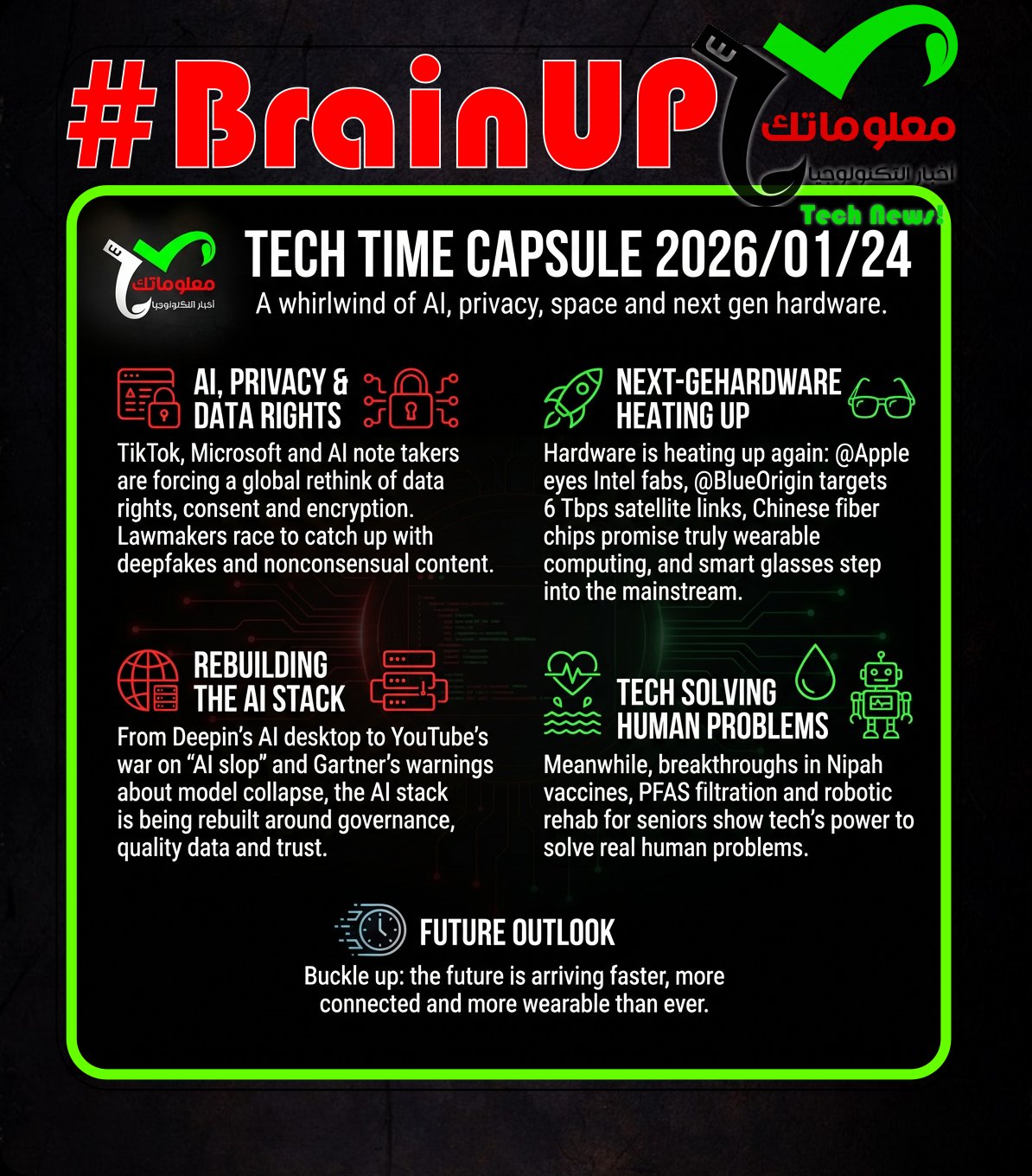
#BrainUp Daily Tech News – (Saturday, January 24ᵗʰ)
Welcome to today’s curated collection of interesting links and insights for 2026/01/24. Our Hand-picked, AI-optimized system has processed and summarized 28 articles from all over the internet to bring you the latest technology news.
As previously aired🔴LIVE on Clubhouse, Chatter Social, Instagram, Twitch, X, YouTube, and TikTok.
Also available as a #Podcast on Apple 📻, Spotify🛜, Anghami, and Amazon🎧 or anywhere else you listen to podcasts.
1. TikTok users freak out over app’s immigration status collection. Here’s what it means.
TikTok faced backlash after it was discovered that the app collected users’ immigration status information, raising privacy and trust concerns. The company clarified that this data collection is part of efforts to comply with legal requirements and support platform security. Users expressed fears about potential misuse of sensitive information, especially given ongoing regulatory scrutiny of #TikTok. This situation highlights the tension between user privacy and compliance in popular social media apps amidst geopolitical concerns. Understanding TikTok’s policies and data practices is crucial for informed user engagement and advocacy.
2. Apple Rumored to Partner With Intel on iPhone Chips
Apple is rumored to revive a chipmaking partnership with @Intel, with chips designed by @Apple rather than @Intel, and @Intel would fabricate some future iPhone chips using its upcoming #14A process, expected to reach mass production in 2028. GF Securities analyst @Jeff Pu reiterated that Intel could begin supplying some Apple chips for at least some non-pro iPhone models starting in 2028, potentially the #A21 or #A22, while #TSMC would remain Apple’s primary foundry. There is no indication that Intel would design the chips itself, a departure from the era when Apple used #Intel-designed Macs; Intel previously supplied cellular modems for iPhone 7 to iPhone 11, and @Ming-Chi Kuo said Intel could ship Apple’s lowest-end #M-series chips for Mac and iPad as early as mid-2027 using #18A, though he did not mention the iPhone. The report frames the move as a way to diversify Apple’s supply chain and boost #USManufacturing amid rising competition for chip supply, with @Nvidia reportedly surpassing Apple as TSMC’s largest customer. Overall, the piece ties this to broader questions about domestic production and supplier diversity for @Apple, as described in the MacRumors report.
3. Microsoft BitLocker encryption keys can be legally obtained by the FBI, raising privacy concerns
Microsoft’s handling of BitLocker encryption keys in Windows 11 has raised privacy concerns as the company can provide these keys to the FBI under legal orders. This practice means that even when users rely on BitLocker for securing their data, law enforcement agencies like the FBI may access encrypted content without the user’s consent. Critics argue that this situation presents a privacy nightmare, as it puts the control of encrypted data in the hands of service providers and legal authorities instead of users. The policy reflects a tension between law enforcement’s access needs and individual privacy rights in the digital age. This issue highlights the challenges in balancing data security and legal compliance in modern operating systems.
4. Report: Apple plans to launch AI-powered wearable pin device as soon as 2027
Apple is pursuing an AI-powered wearable pin that could arrive as early as 2027, with an initial target of about 20 million units and @Apple aiming to extend its #AI hardware footprint. The pin is described as AirTag-sized but slightly thicker, worn as a pin, with a single button, a speaker, three microphones, two cameras, and a magnetic inductive charger like the Apple Watch. It’s not clear whether the device will be standalone or paired with an iPhone, and pricing remains undisclosed, though the product is being fast-tracked for a 2027 release. Apple may offload processing to an external device such as the iPhone to address performance and battery life concerns seen with similar attempts, while facing competition from @OpenAI and @Meta, and Google’s #Gemini for Siri. This move fits @Apple’s broader AI push, including plans for smart glasses and an in-home display, signaling a race in #AI hardware despite internal questions about true LLM-based capabilities.
5. How researchers got AI to quote copyrighted books word for word
Researchers discovered that AI language models trained on vast datasets can reproduce substantial excerpts from copyrighted books verbatim, raising significant concerns about intellectual property rights and data privacy. They demonstrated that by prompting these models carefully, it is possible to extract long passages identical to those in the original texts, bypassing typical content filtering mechanisms. This finding highlights the challenges in balancing AI development with copyright compliance and suggests the need for new policies to address unauthorized replication of protected works. It underscores the tension between advancing #artificialintelligence technology and respecting creators’ rights. The study calls for stronger safeguards in dataset curation and model training to prevent the inadvertent dissemination of copyrighted material.
7. AI Note-Takers at Work: The Silent Threat to Privacy and Compliance
AI note-takers such as @Otter.ai are increasingly embedded in meetings, joining platforms to transcribe in real time and syncing with calendars, while the organizer bears responsibility to obtain others’ permission, potentially recording without their knowledge. All data are transmitted to and stored on US servers, creating cross-border data transfer concerns under #GDPR, where Articles 6 and 7 require valid consent that is informed, specific, and freely given rather than delegated to a single participant. Guidance also notes power imbalances in employment and the handling of #SpecialCategories data under Art 9, and emphasizes transparency under Articles 13 and 14, which a silent transcription bot cannot satisfy, while Art 32 requires robust security. In the US, a class action (Brewer v. Otter.ai, Inc., Case No. 5:25-cv-06911) alleges that non-users’ conversations are recorded without knowledge or consent, illustrating cross-jurisdictional risks and the need for stronger data governance and controls.
8. New filtration technology could be gamechanger in removal of Pfas ‘forever chemicals’
@Michael Wong and @Rice University researchers have developed a copper- and aluminum-based layered double hydroxide (#LDH) material that can absorb long-chain #Pfas up to 100 times faster than existing filtration systems, potentially changing how these pollutants are removed from water. The material attracts negatively charged Pfas due to its positively charged surface, enabling rapid uptake and enabling practical regeneration and reuse, and it absorbs a broad range, including long-chain Pfas and some smaller ones. The non-thermal process concentrates Pfas to enable destruction at relatively low temperatures (400–500°C) with the fluoride trapped as calcium fluoride, reducing hazardous byproducts. Because it is a ‘drop-in’ material compatible with existing filtration infrastructure, it could lower deployment costs and accelerate remediation, moving beyond current barriers to scale.
9. Trump cabinet member attacks ‘this DEI crap’ at Micron groundbreaking ceremony (transcript)
At a Micron groundbreaking ceremony at a Syracuse University veterans building, U.S. Secretary of Commerce @Howard Lutnick denounced ‘DEI crap’ and argued that diversity and inclusion rules should not govern semiconductor manufacturing. He credited @Donald Trump with erasing DEI requirements for companies like Micron, a claim the article notes is not entirely accurate, as the bipartisan Chips Act still provides $52B in incentives and Micron is receiving $20.4B in federal grants and tax credits to build the Clay plant. The project, led by @Sanjay Mehrotra, is expected to create up to 9,000 jobs in Clay over 20 years and about 40,000 more in the surrounding supply chain, while Micron has shifted public messaging to say it supports a ‘global culture and workforce’ rather than using the DEI label. The piece frames this as part of a broader policy debate, where DEI concepts remain embedded in federal requirements even as critics push to remove them, highlighting tension between national security incentives and inclusion goals. The event, attended by hundreds, underscores how policy, industry ambitions, and local economic development intersect around Micron’s U.S. investment.
10. Devs assessing options for MySQL’s future beyond Oracle
Developers are assessing MySQL’s future beyond Oracle as governance comes into question and a wresting of control is considered. In a San Francisco meeting, engineers from @Percona and @PlanetScale—who have built a service around Vitess, a distributed MySQL-based database—joined others to discuss options after Oracle’s recent MySQL staff cuts and a drop in commits, with @MontyWidenius heartbroken by the news. @PeterZaitsev warned that Oracle is moving more features to cloud and enterprise software while cutting MySQL staff, risking suboptimal development of the project. Potential paths include leaving governance with Oracle or forking the open source code, either a hard fork like #MariaDB or a tracking fork such as @Percona Server for MySQL, with @SamLambert noting @PlanetScale’s commitment to MySQL and to an open, flourishing community.
11. China’s Deepin Linux has built-in AI, snazzy desktop
Deepin 25.0.10 from @Uniontech blends a familiar Deepin Desktop Environment with built-in #AI features, signaling a push beyond visuals while the base system remains on the current X11 stack. The UI resembles Windows 11 with a central app launcher and a left-side launcher for the #UOS_AI bot, which can translate, explain, summarize, and perform local file search in Chinese-language contexts. A new #Wayland compositor named #Treeland is in development, but the release itself uses X11, and English-language support is limited (the boot screen is Chinese and English appears only in isolated places). Under the hood, the OS uses a partially-immutable #Solid OSTree-based layout that protects key directories, alongside Linglong for cross-platform packaging and a suite of preinstalled #Linyaps apps. This approach reflects the 2026 trend of FOSS desktops embracing embedded #AI as a selling point in a geopolitically aware landscape, even if practical improvements are incremental.
12. TikTok Is Now Collecting Even More Data About Its Users. Here Are the 3 Biggest Changes
TikTok’s new US ownership and updated privacy policy expand data collection for US users, including precise location data.#locationTracking @TikTok @Oracle. The policy states that if you enable location services, the app may collect granular GPS-like details, and that location information based on your device and network data may be collected even without enabling location services.#privacyPolicy. It also adds AI interactions to the data TikTok may retain, including prompts, inputs, generated outputs, and related metadata #AIInteractions. This shift reflects the transition to a US-based entity with investors like @Oracle while raising privacy concerns about how much information is collected. Users should review the updated terms and privacy policy before agreeing, as the changes could broaden data collection to include location and AI interactions.
13. Rivian Teases Physical Dash Buttons In New R1S Patent Filing
Rivian’s latest patent filings hint that the @Rivian R1S/R1T could move away from a pure all-screen interior toward physical controls. The cockpit illustration in US Patent No. 12,522,055 B2 shows a row of four circular buttons/knobs beneath the main touchscreen, a detail @Car and Driver also views as a strong signal. While patent imagery doesn’t guarantee production and Rivian has offered boilerplate statements that patents are inventions and may not reach production, the presence of these controls in mockups suggests a potential design direction #analogInterior #R1S. The tailgate patent idea includes independent glass opening with a wiper, a flip-up shelf to create a standing workstation, touch-to-unlock door receivers, heated cupholders, and a deployable rear diffuser #tailgate #R1S. If realized, these features would mark a shift toward blending physical controls with modern tech to improve usability.
14. AI is quietly poisoning itself and pushing models toward collapse – but there’s a cure
AI models are being poisoned by unverified AI-generated data, causing results to drift and leading toward what experts call model collapse when systems train on their own outputs. @Gartner warns this GIGO problem will spread across enterprises, with about half of organizations expected to adopt a #zero-trust posture for data governance by 2028 to authenticate data, verify quality, and track lineage. As @Phaedra_Boinodiris notes, understanding the data’s context and relationships is essential, because untrusted data can cascade through automated workflows and worsen biases, hallucinations, and factual errors at AI scale. The article advocates stronger mechanisms such as appointing an AI governance leader, verifying data quality, tagging AI-generated content, and continuously managing metadata to know what systems are consuming. The cure lies in a cross-enterprise, disciplined approach to #data-governance #zero-trust and related practices that keep AI outputs aligned with reality.
15. ‘They sold my pain for clicks’: Paris Hilton urges lawmakers to act on nonconsensual deepfakes
@Paris Hilton joined @Alexandria Ocasio-Cortez and @Laurel Lee on Capitol Hill to press for the #DEFIANCEAct, a bill that would let victims of explicit nonconsensual deepfakes sue the creators, distributors or commissioners and seek profits from their likeness. Hilton recounted the 2003 leak of a sex video and the stigma she faced, noting that more than 100,000 nonconsensual deepfake images of her have circulated. The bill has unanimously cleared the Senate and now awaits a House floor vote, with bipartisan support from Reps. Rashida Tlaib, Sarah McBride, Anna Paulina Luna, Claudia Tenney, Nancy Mace and Marianette Miller-Meeks, and with House Speaker Mike Johnson expressing a favorable view. The article frames this as part of a broader shift to outlaw image-based sexual abuse as AI-generated deepfakes proliferate, arguing current laws have not kept up with technology. If enacted, the DEFIANCE Act would allow survivors to sue the creators, distributors or commissioners and recover profits from their likeness, signaling progress for victims and accountability for perpetrators #deepfakes
16. Blue Origin’s Starlink rival TeraWave promises 6-terabit satellite internet
Blue Origin’s #TeraWave, backed by @JeffBezos, promises up to 6Tbps bidirectional satellite internet available anywhere on Earth, aimed at enterprise customers. The system uses a multi-orbit network of 5,408 satellites, with most in #LEO delivering ground connections up to 144Gbps, plus 128 #MEO satellites that could support 6Tb bidirectional links. Deployment is slated to begin toward the end of 2027, but it will not be consumer-facing; @DaveLimp says it’s ‘purpose-built for enterprise customers,’ with plans to serve tens of thousands of users in #dataCenters and #government sectors, capped at roughly 100,000. The strategy contrasts with Starlink and Leo, signaling a focus on high-capacity, selective clients rather than mass market service, and links Blue Origin’s ambitions to compete in the space internet race for critical operations.
17. Volvo’s EX60 To Get Power Door Handles, Following Recharge Line Tradition
Volvo plans to equip its upcoming EX60 electric SUV with power door handles, continuing the tradition set by its Recharge electric line. These handles are flush with the door surface and pop out when unlocked or approached, enhancing both aesthetics and aerodynamics. This design choice aligns with Volvo’s goal of modernizing its EV lineup, improving user experience while maintaining sleek vehicle profiles. The innovation reflects a broader industry trend where tactile features support functionality and style in electric vehicles. Volvo’s integration of power door handles in the EX60 demonstrates its commitment to evolving design elements for better performance and customer appeal.
Singapore researchers have introduced the #DRBA, the Data-driven Robotic Balance Assistant, touted as the world’s first robotic chaperone to assist seniors with mobility challenges. Using built-in sensors and AI, it detects a loss of balance and provides instant support to help users stand, walk, or participate in activities such as standing Zumba, potentially preventing serious falls. Trial results from the Lions Befrienders’ Active Ageing Centre in Tampines show stroke survivor Leow Cher Hwa benefiting from the device, regaining confidence to join a class and dance with peace of mind, while carers note it enables previously seated seniors to re-engage in standing activities. However, affordability remains a barrier, with a price around S$90,000, prompting researchers to explore a rental model and potential subsidies from government or philanthropists to widen access. As Singapore moves toward a super-aged society, developers hope community care groups can deploy DRBA to boost rehabilitation and independence and avoid excessive muscle weakening from long-term seated confinement.
19. Feds Won’t Pursue Criminal Charges Against Tuners For OBD-II Tampering Anymore
The federal government has decided to stop pursuing criminal charges against automotive tuners who manipulate OBD-II systems, which are critical for vehicle emissions monitoring. This change follows concerns that aggressive legal actions were hindering the automotive tuning community and innovation in vehicle performance modifications. The decision reflects a shift toward a more balanced approach that recognizes the importance of tuning for enthusiasts and the economy while still aiming to protect environmental standards. This policy adjustment may foster growth and creativity in aftermarket automotive tuning without compromising emissions regulations. It represents a significant move to reconcile regulatory enforcement with the interests of #car tuners and the broader automotive performance industry.
20. RFK Jr. Spreads New Bogus Scare Mongering Bullshit About Cell Phone Safety
The article argues that @RFK Jr. is spreading a new, unsubstantiated scare about #cellphones and #5G safety, claiming that #electromagnetic_radiation is a major health concern. It cites his public remarks on #5G towers and argues that there is no peer‑reviewed replicable science proving harm, while criticizing politicians for misrepresenting scientific findings. The author, who holds degrees in physics and electrical engineering and specializes in #electromagnetic_field_theory, contends that scientists withhold certainty even as politics amplifies uncertainty, fueling public confusion and surfacing examples like investigations into a power substation and references to the #MAHA_Commission. The piece portrays this pattern as a tendency to translate cautious science into alarmism, urging readers to demand credible evidence. Until credible, replicable science emerges, @RFK Jr.’s claims are presented as unfounded and should be weighed against established research, with the article linking back to the broader critique of misinformation.
21. This startup will send 1,000 people’s ashes to space affordably in 2027
A new startup plans to offer affordable space funerals by sending the ashes of 1,000 individuals into space in 2027. Using innovative cost-cutting technologies, the company aims to make space memorials accessible to a broader audience, contrasting the traditionally high expenses associated with such services. This initiative reflects a growing trend in the commercialization and personalization of space experiences, tapping into public fascination with space exploration. By democratizing access to space memorials, the startup could create a new niche market within the rapidly expanding #spaceindustry. The concept also resonates with cultural shifts in how people commemorate lives, blending #technology and sentimentality.
22. World’s first Phase II Nipah virus vaccine trial launch | University of Oxford
The University of Oxford has launched the world’s first Phase II Nipah virus vaccine trial in Bangladesh to test the safety and immune response of #ChAdOx1NipahB, developed by scientists at the #PSI. The study, conducted with icddr,b and funded by CEPI, will enroll 306 healthy participants aged 18 to 55 and began earlier this month. Nipah virus is a deadly #NipahVirus with up to 75% fatality and recurring outbreaks in Bangladesh; bats transmit it, and transmission can occur via contaminated date palm sap or person-to-person spread, including healthcare workers. The vaccine uses the same viral vector platform as the Oxford/AstraZeneca COVID-19 vaccine, and #PRIME designation from the #EMA was granted in June 2025 to speed development. As Prof @Sarah Gilbert and Prof @Brian Angus note, this international collaboration and long-term investment in pandemic preparedness are crucial for equitable access to protection against emerging infections.
23. Artemis II Crew Enters Quarantine Ahead of Journey Around Moon – NASA
Artemis II’s crew has begun a health stabilization quarantine to protect a potential February launch and keep options open as NASA tests the SLS rocket and Orion spacecraft. The crew—Reid Wiseman, Victor Glover, Christina Koch, and CSA’s Jeremy Hansen—will limit exposure for about 14 days before lift-off, and if testing remains favorable they will relocate to NASA’s Kennedy Space Center about six days before launch to stay in the @Neil Armstrong Operations and Checkout Building. During quarantine they can keep in touch with friends and colleagues under guidelines, continue training, and perform mission simulations and medical checkouts while masking and keeping distance. Ground teams at Kennedy have completed checks on mechanical power systems, cryogenic propellant lines, and engines, and pad servicing for the SLS booster is planned to begin over the weekend after the perimeter is cleared. Artemis II, a roughly 10-day mission around the Moon, will test systems and hardware to support future crewed missions to the Moon and Mars, advancing scientific discovery and economic benefits #Artemis #SLS #Orion
24. Once mocked, now a must-have: How smart glasses became tech’s next big thing
Smart glasses have evolved from a mocked gadget to a highly anticipated technology reshaping user interaction and digital experiences. Major tech companies like Meta and Apple have propelled smart glasses forward by integrating advanced features such as augmented reality (AR) and voice commands, making them more practical and stylish. This shift is supported by growing consumer demand for seamless, hands-free connectivity and the promise of immersive digital environments. As smart glasses become more accessible and versatile, they reflect a broader trend in wearable technology moving beyond fitness tracking to enhancing daily life and work productivity. The rising adoption of smart glasses signals their transition into mainstream tech essentials, underscoring their potential as a key interface in the future digital ecosystem.
25. Chinese Researchers Create World’s First Fiber Chip, Paving Way for Wearable Electronics
World’s first fiber chip, developed by a Fudan University team led by @Peng_Huisheng and @Chen_Peining, packs high-density ICs into a fiber thinner than a hair with about 100,000 transistors per centimeter. Its information-processing capability rivals most classic chips while offering unique advantages such as extreme flexibility, stretchability, and weaveability into fabrics. Because fiber chips can operate without an external processor, they can be woven into soft, breathable fabrics and could power #wearable_electronics, #smart_clothing, and #virtual_reality applications, including #tactile_gloves for remote robotic surgery and #brain_computer_interfaces that may require less external equipment. The researchers have proposed the concept of #fiber_devices and developed over 30 types, with some technologies already transferred to domestic firms, signaling potential for medical implants, automotive, and clothing industries through integrated circuits and signal transmission on a single #fiber.
26. When two years of academic work vanished with a single click
A Nature Careers Community article recounts the harrowing experience of a researcher who lost two years of academic work when a routine action in an #AI system caused critical files and data to disappear, highlighting how emerging AI tools integrated into research workflows can pose serious risks to the integrity and continuity of scientific work without sufficient safeguards. The author reflects on the emotional and professional toll of the loss and the broader implications for researchers increasingly reliant on AI-powered tools for writing, code generation, data analysis, literature review, version control, and collaboration, cautioning that automated systems may introduce hard-to-reverse changes, deletions, or corruptions that traditional backup strategies might not anticipate. Drawing on this experience, the piece argues for stronger institutional policies, better training for scientists using AI tools, robust versioning practices, and the adoption of reliable backup systems to protect against both technical failures and unintended consequences of AI assistance. By framing the incident as a cautionary lesson for the scientific community, the article urges careful evaluation of how and where AI is incorporated into research processes, especially when large investments of time and intellectual effort are at stake.
Definition: AI-linked data loss
AI-linked data loss refers to situations where the use of artificial intelligence systems in research or creative workflows inadvertently leads to the deletion, corruption, or irreversible alteration of valuable work, often due to over-reliance on automated tools without sufficient manual backups, version control, or safeguards. This concept highlights the need for disciplined data management and clear understanding of how AI integrations can impact file integrity.
27. Tesla removes Autosteer from new Model 3 and Model Y orders
Tesla has quietly updated its vehicle configurator in the United States and Canada so that new orders of the Model 3 and Model Y no longer include Autosteer, the lane-centering component of the broader Autopilot driver-assistance suite, as standard equipment, meaning buyers will still get Traffic-Aware Cruise Control but must pay for a Full Self-Driving (FSD) subscription to regain lane-centering capability. This shift is part of a broader change in how Tesla packages and monetizes its driver assist technologies, with Autosteer and other advanced features moved behind the FSD paywall priced at about $99 per month or available for a limited time via trial. The move has sparked controversy because lane-centering, previously part of basic Autopilot, was once standard and is offered by many traditional carmakers without extra cost, and critics argue this push toward subscription models undermines vehicle value and safety expectations. CEO @ElonMusk’s strategy to expand recurring revenue from software and AI-powered driving features is driving this transition, but it has drawn customer backlash and regulatory scrutiny as buyers reassess the core benefits of Tesla’s vehicles.
Definition: Autosteer
Autosteer is the lane-centering feature within Tesla’s driver-assistance suite that keeps a vehicle centered within highway lanes while paired with adaptive cruise control, reducing driver workload on long drives. It is considered a foundational component of semi-automated driving systems and, unlike fully autonomous driving, still requires driver attention and supervision at all times.
28. YouTube CEO reveals plans to combat “AI slop” as creators rake in millions – Dexerto
@Neal Mohan outlines plans to curb #AIslop on YouTube while embracing AI for content moderation and creation, aiming to preserve a high quality viewing experience. In his 2026 letter, he says YouTube will expand its existing moderation tools to reduce the spread of low quality, repetitive AI content and will let creators make #AIShorts using their own likeness. The article notes the rapid rise of AI content, with studies indicating over 20% of YouTube is AI content and examples like @BandarApnaDost earning millions, including more than 2.07 billion views and about $4.25 million annually, as well as a 21-year-old computer science student from the Philippines who earned roughly $9,000 in one month by creating AI-generated cartoon kitten videos. It also mentions past moderation missteps that led to false flags, underscoring the need for ongoing improvements, and Mohan promises further investment in moderation technology this year. By blending AI assisted safeguards with open expression, YouTube aims to balance creator opportunity with viewer trust in 2026.
29. CISA confirms active exploitation of four enterprise software bugs
CISA has confirmed that four vulnerabilities affecting enterprise software are actively exploited, posing a significant cybersecurity threat. The flaws impact widely used applications, enabling attackers to execute unauthorized code and potentially gain elevated privileges. Prompt detection and mitigation efforts are critical as threat actors leverage these bugs to compromise organizational networks and steal sensitive data. CISA’s advisory urges organizations to apply patches immediately and enhance monitoring to prevent further breaches. This situation underscores the urgent need for robust security practices and timely software updates in safeguarding enterprise infrastructure.
That’s all for today’s digest for 2026/01/24! We picked, and processed 28 Articles. Stay tuned for tomorrow’s collection of insights and discoveries.
Thanks, Patricia Zougheib and Dr Badawi, for curating the links
See you in the next one! 🚀
