
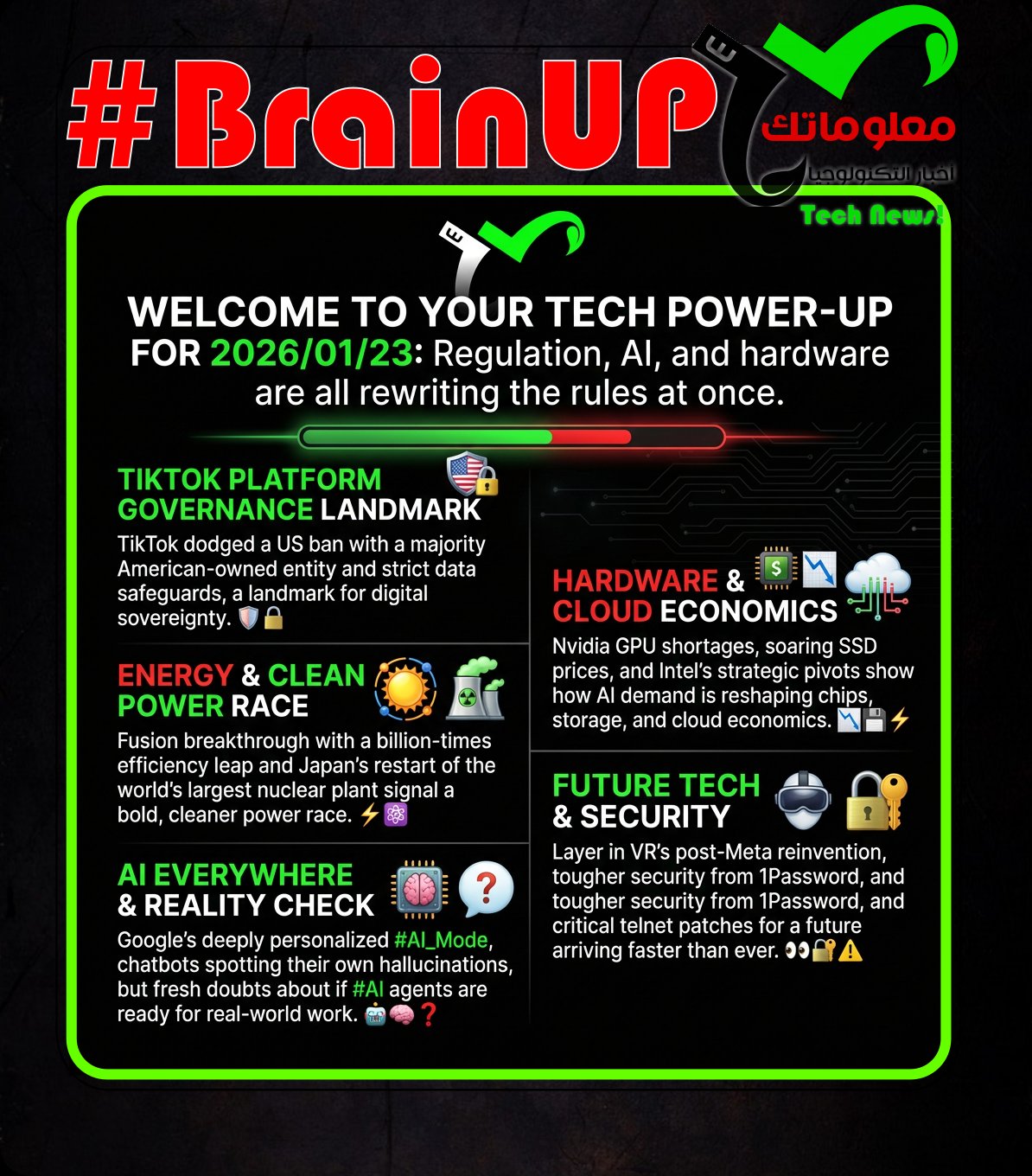
#BrainUp Daily Tech News – (Friday, January 23ʳᵈ)
Welcome to today’s curated collection of interesting links and insights for 2026/01/23. Our Hand-picked, AI-optimized system has processed and summarized 30 articles from all over the internet to bring you the latest technology news.
As previously aired🔴LIVE on Clubhouse, Chatter Social, Instagram, Twitch, X, YouTube, and TikTok.
Also available as a #Podcast on Apple 📻, Spotify🛜, Anghami, and Amazon🎧 or anywhere else you listen to podcasts.
1. TikTok’s US deal closes amid growing regulatory scrutiny
TikTok has completed its agreement with US regulators to address national security concerns, ensuring its continued operation in the US under new ownership rules. The deal requires TikTok to establish a US-based entity with American investors controlling the app’s data and security protocols. This move follows increasing pressure from the US government over #dataprivacy and potential foreign influence linked to ByteDance, TikTok’s Chinese parent company. By meeting these demands, TikTok aims to retain its large American user base while complying with tighter regulations. The agreement exemplifies ongoing tensions between US tech policy and global digital platforms, reflecting broader efforts to secure data sovereignty.
2. TikTok announces it has finalized deal to establish US entity, sidestepping ban
TikTok has closed a deal to form a majority US-owned entity, allowing it to sidestep a ban and end a years-long legal battle. Oracle, Silver Lake, and MGX will own 80.1% of the new entity, with ByteDance holding 19.9%, and @AdamPresser will serve as CEO alongside a seven-member, majority-American board that includes @ShouChew. The venture will operate with defined safeguards on data, #algorithm security, content moderation, and software assurances for US users, including retraining the recommendation algorithm on US data. US officials signaled approval from both governments, while @DonaldTrump framed the deal as saving TikTok amid the backdrop of #USlaw and #executiveOrder actions that delayed enforcement. Critics remain concerned about data security and possible Chinese access, reflecting the ongoing national-security debate that has shaped the ban since Congress acted in 2024.
Researchers have achieved a fusion reaction that is a billion times more efficient than prior attempts, marking a significant advancement in #fusionenergy. By using a novel approach involving advanced lasers at the Lawrence Livermore National Laboratory, the experiments have demonstrated unprecedented energy gains in fusion reactions. This breakthrough could potentially accelerate the development of practical fusion power, offering a clean, virtually limitless source of energy. The increased efficiency addresses one of the main challenges in fusion research, moving closer to viable energy production. Such progress reinforces fusion’s promise as a transformative technology for global energy sustainability.
4. Vimeo starts layoffs after acquisition by Bending Spoons | TechCrunch
Vimeo is laying off a portion of its global staff after being acquired by @BendingSpoons for $1.38B in an all-cash deal, signaling a major restructuring. The layoffs were reported by Business Insider and confirmed by Bending Spoons, though no headcount was disclosed, and The Verge says the cutbacks affect a large portion of the workforce based on a LinkedIn post by Vimeo’s former VP. Vimeo, founded in 2004, has struggled to compete with @YouTube and has increasingly leaned into AI, announcing in 2023 plans for AI-powered script writing and video editing, and in October adding AI-powered creator tools to connect filmmakers’ content to AI workflows. Bending Spoons has also acquired Meetup, Evernote, and WeTransfer, illustrating its broader platform consolidation strategy. These layoffs illustrate the ongoing challenge of aligning growth ambitions with cost controls after the acquisition.
5. Autodesk cuts 475 jobs, seeking more efficiency after pandemic boom
Autodesk announced layoffs of about 475 employees, roughly 7% of its global workforce, aiming to improve efficiency after a surge in demand during the pandemic. The company experienced rapid growth as remote work increased demand for its #software in design and construction, but now faces a shift toward “normalization” of business operations. Autodesk CEO Andrew Anagnost explained the cuts are necessary to align the workforce with current market conditions and prioritize key areas for innovation and customer success. This restructuring is part of a broader trend in the tech industry where companies adjust staffing following pandemic-related growth spikes. Autodesk’s move reflects a strategic effort to maintain competitiveness and focus on long-term growth in a changing economic environment.
Meta has laid off over 270 employees in California as it shifts its focus towards artificial intelligence (#AI) and reduces its emphasis on the metaverse. The layoffs impacted offices in Los Angeles and Burlingame, reflecting a broader strategic pivot within the company. This move aligns with Meta’s plan to prioritize AI development while scaling back metaverse initiatives. The reduction in California staff indicates a realignment of resources toward future-focused technologies rather than the previous metaverse vision. Meta’s layoffs demonstrate its effort to adapt to evolving technology trends and reallocate talent accordingly.
7. Intel prioritizes Xeons over client chips to meet AI demand
Intel is reallocating wafer capacity from client chips to meet rising demand for #Xeon processors used in AI servers. CFO David Zinsner said the company faced a capacity crunch after misjudging datacenter demand, noting that six months ago hyperscale customers planned fewer high-core-count chips but demand surged in Q3 and Q4. Intel will prioritize mid- and high-end client parts and push excess capacity into the datacenter, signaling a shift toward higher-margin products while not abandoning the consumer business entirely. Industry-wide, memory makers such as @Micron, @SKHynix, and @Samsung are reallocating capacity to DRAM and high-bandwidth memory for AI infrastructure, while consumer memory prices have risen. The firm expects the constraints to ease in Q2 as yields improve and more tooling comes online across Intel 7, Intel 3, and Intel 18A, with the Panther Lake Core Ultra 3-series ramp contributing to the mix and illustrating Intel’s effort to balance AI demand with its consumer business.
Chinese firms facing an import ban on Nvidia’s H200 GPUs are reportedly turning to the black market to meet urgent AI hardware needs, underscoring a clash between high demand for #AI acceleration and regulatory controls. The South China Morning Post reports that customs are holding H200 chips at the border, that orders are considered highly sensitive, and that buyers are paying about a 50% premium for eight-GPU servers on illicit markets. Domestic chips have not yet matched the H200, while Beijing pursues #silicon-sovereignty amid a US-led AI leadership race, making illicit channels a riskier option as authorities crackdown. This dynamic highlights how geopolitics and export controls shape procurement strategies, pricing, and the pace of AI advancement in China, even as @DonaldTrump and @JensenHuang figures and policy moves loom in the background.
The NAND flash shortage continues to push SSD prices far above HDDs, making hybrid storage systems with SSD caching and HDD capacity far cheaper for datacenters than SSD-only deployments, with SSDs now costing about 16x HDDs #NAND #SSD #HDD #datacenter. Between Q2 2025 and Q1 2026, 30TB TLC enterprise SSDs rose 257%, from $3,062 to nearly $11,000, while HDD pricing rose 35% in the same period. Datacenter storage costs for SSD versus HDD capacity went from 6.2x in Q2 2025 to 16.4x in Q1 2026, and a mixed fleet with SSDs for caching and HDDs for capacity showed a 3-year ownership cost of $5.99M vs $25.20M for an SSD-only setup. This divergence forces budget planning anew and indicates that hybrid deployments offer substantial savings as NAND supply remains constrained and AI demand drives HDD backorders. For datacenter customers and analysts, understanding this pricing gap is critical, and adopting hybrid architectures offers a lower total cost of ownership, as reported by @VDURA and noted by @Kioxia.
10. Amazon plans thousands more corporate job cuts next week, sources say
Amazon is preparing to announce thousands of additional corporate job cuts next week as part of ongoing efforts to reduce expenses and improve operational efficiency, according to sources familiar with the matter. This follows prior rounds of layoffs that have affected tens of thousands of employees, predominantly in corporate positions. The move reflects Amazon’s response to a slowing economy and shifting business priorities under CEO Andy Jassy, aiming to rebalance its workforce to better align with current growth and cost management goals. Analysts view the job reductions as a strategic realignment rather than a sign of deeper troubles, highlighting the company’s focus on streamlining operations amidst challenging market conditions. These cuts demonstrate Amazon’s commitment to adjusting its workforce for sustainable long-term growth amid evolving economic pressures.
A Brentwood woman lost $176,000 of her life savings after accepting a remote job she believed was with @Facebook, only to discover a sophisticated scam that used AI-like tactics and a fake app that mirrored her real messages. She was paired with a ‘training mentor’ and directed to wire funds into a crypto platform to buy ads, with the scammers posing as @Facebook support and threatening to freeze her money unless she paid a 20% penalty. The fake app displayed her actual Facebook messages, and she logged in with the same credentials, making the scheme seem legitimate while most communication happened on WhatsApp. The case, which involved collaboration with @Meta to pursue action, shows how scammers leverage emerging tech to lure people into remote work and warns to verify offers and avoid moving money or sharing access. #AI #remote-work #scam #crypto
12. Maybe VR Doesn’t Need Meta After All
VR may not need @Meta to thrive, as new hardware advances hint at a vibrant future beyond the company’s footprint. While @Meta has shuttered most of its first-party VR studios and signaled a waning emphasis on VR, hardware makers like @Lynx with its R2 offer a 126-degree field of view versus @Quest 3’s 110-degree and are choosing to publish schematics, embracing an #open-source mindset. At CES 2026, @Pimax showcased the Dream Air, a light, bright, wired headset focused on #gaming, underscoring ongoing progress that isn’t tied to a single platform. The scene also reflects a broader tension: @Meta’s pricing subsidies and marketing push helped bring #VR to a wider audience, even as rivals like @Apple and @Samsung struggle to gain traction with their headsets. All this suggests VR could settle into a niche ecosystem driven by multiple players and continued hardware innovation rather than a single company dominating the space, with @Meta’s retreat potentially accelerating exploration by others.
13. AI Fools Itself, Top Chatbots Don’t
Top chatbots such as ChatGPT, Google Bard, and Anthropic Claude exhibit strong critical thinking by recognizing when AI-generated content is hallucinated, whereas many other AI models fail this test. A Stanford study found that general AI models often do not question or correct their own factual inaccuracies, effectively misleading users. Leading chatbots incorporate methods that allow them to evaluate and acknowledge their own hallucinations, fostering user trust and reliability. This distinction underscores the importance of #AI alignment and robust testing to prevent misinformation and enhance AI’s real-world application. Understanding these differences helps users make informed choices about AI tools and their outputs.
15. Ancient telnet bug happily hands out root to attackers
A critical vulnerability in the GNU InetUtils telnet daemon (telnetd) is trivially exploitable, tracked as CVE-2026-24061 (9.8), introduced in May 2015 and disclosed on Jan 20, 2026. The flaw lets attackers gain root by injecting a crafted USER environment value ‘-f root’ when telnetd passes USER to /usr/bin/login, bypassing authentication, a detail described by @Simon Josefsson. Exploitability is high and evidence shows ongoing attempts: Rapid7’s @StephenFewer calls it straightforward and GreyNoise reports 15 unique IPs in the past 24 hours attempting a remote authentication bypass. Mitigations include upgrading telnetd or disabling it, restricting access, or migrating to #SSH; CERT-FR and other authorities urge decommissioning telnet services on the internet.
16. Are AI agents ready for the workplace? A new benchmark raises doubts | TechCrunch
AI agents are not yet ready for the workplace, despite strong progress in foundation models, as Mercor’s new benchmark #APEX-Agents shows most leading models struggle with real white-collar tasks drawn from #consulting, #investment-banking, and #law. Even the best models fail to answer more than a quarter of questions correctly, often returning wrong or no answers. The core difficulty is cross-domain information access and tool use across Slack, Google Drive, and other apps that real professionals rely on. The scenarios were drawn from Mercor’s expert marketplace and posted on Hugging Face, including a Law question about an EU production outage that requires in-depth policy and privacy-law assessment. @Satya Nadella’s early forecast that AI would replace knowledge work underscores how far current systems still are from real-world readiness, highlighting the need for improved multi-domain reasoning and better integration with workplace tools. This evolving gap suggests caution about when AI agents can meaningfully augment professional work, even as researchers continue to build richer environments and benchmarks like #APEX-Agents.
17. KSU students express privacy concerns over AI surveillance devices on campus
Kennesaw State University students are raising privacy concerns about AI surveillance devices on campus, including license plate readers from @FlockSafety and audio detection microphones that could track daily activity, even as some say they improve safety. Austin Mann reports seeing license plate readers near the parking deck that can reveal his location, and Isaac Thoman worries the microphones could record private conversations while they are sold as safety tools #privacy #surveillance #licenseplatereaders #AI. Flock Safety says its Audio Detection is not a continuous recording device, wakes up only for safety events like gunshots, car crashes, or distress sounds, and does not monitor conversations #safety. The debate highlights a tension between security measures and students’ rights to privacy, with trust in the vendor and clarity from the university still unclear. KSU did not respond to requests for comment or data on how many devices are in use, leaving questions about oversight, data retention, and accountability unresolved #policy.
18. Japan restarts world’s largest nuclear plant as Fukushima memories loom large
Japan restarts the world’s largest nuclear plant by bringing reactor 6 online at Kashiwazaki-Kariwa, signaling a continued reboot of its nuclear sector nearly 15 years after the Fukushima disaster. The plant, which previously housed seven reactors with a combined capacity of 8.2 GW, has faced safety scrutiny and a one-day delay due to an alarm malfunction before commercial operation is slated for next month, with reactor 7 not expected back until 2030. The Fukushima meltdown led to evacuations and lasting distrust, and although Japan has restarted 15 of 33 operable reactors since 2015 as part of a shift toward energy self-sufficiency, nuclear’s share remains a fraction of pre-2011 levels (about 8.5% in 2023) as the country pursues emissions goals. Critics warn that safety upgrades and running costs are rising, even as the government and Tepco stress nuclear as a more reliable backbone for energy and self-sufficiency, with @Sanae_Takaichi pushing for higher nuclear ambition and a target of 20% of electricity from nuclear by 2040 within a broader drive toward #netzero by 2050, while the IAEA sees global capacity potentially doubling by 2050.
19. Intel forecasts first-quarter sales, profit below estimates
Intel projected its first-quarter sales and profit to be below analysts’ expectations due to weak demand for personal computers and a gradual recovery in the data center business. The company anticipates revenue between $15 billion and $16 billion, under the consensus of $16.4 billion, with adjusted earnings per share forecasted at 25 cents to 35 cents compared to the $30 analysts predicted. CEO Pat Gelsinger highlighted ongoing challenges in the PC market and the impact of an inventory correction. Despite these issues, Intel is focusing on its long-term growth initiatives such as advancements in semiconductor technology and expanding its manufacturing capacity. This outlook reflects the broader tech industry’s current cycle, emphasizing supply chain adjustments and shifts in consumer demand.
20. White House posts digitally altered image of woman arrested after ICE protest
A Guardian analysis finds that the White House posted a digitally altered image of @NekimaLevyArmstrong from an ICE protest to depict her as crying, illustrating how official posts have used image manipulation to shape public perception #AI. The analysis shows the two images are the same photograph: one neutral where Armstrong appears composed, and a second altered version in which she sobs, with a darker skin tone, and the arrest scene aligned in exactly the same way, including a figure behind the agent #immigration #ICE. Armstrong was among three people arrested after a demonstration that disrupted church services in St Paul, Minnesota; Bondi announced the arrests, @KristiNoem posted the arrest image, and the White House reposted the crying version within less than an hour. White House officials did not confirm the alteration when asked, instead citing a post from @KaelanDorr, while Guardian notes that the White House has posted at least 14 AI-assisted posts since Trump’s second term, raising questions about accountability and trust in government messaging #AI. This incident underscores the tension between compelling visuals and factual representation (#AI, #immigration, #ICE), suggesting that even high-level communications can be shaped by manipulated imagery that may influence public opinion on enforcement and policy.
21. Are Microsoft Outlook and Teams down? | Thousands of outages reported
Thousands of users reported outages affecting @Microsoft’s products, including #Microsoft365, #Outlook, and #Teams, after a brief prior disruption. More than 15,000 users reported issues with #Microsoft365 around 3 p.m. Eastern, with about 12,000 specifically citing #Outlook and 500 reporting #Teams problems, according to DownDetector; Microsoft Support said the issue was tied to a portion of service infrastructure in North America not processing traffic. To recover, traffic was redirected to alternate infrastructure and a recovery plan focused on load balancing to restore a healthy state. Investigators noted that after about two hours the infrastructure was restored to a healthy state, but further load balancing was needed to mitigate impact. Microsoft and observers continued to monitor progress, with updates and status information available at https://status.cloud.microsoft and MO1221364, while DownDetector counts had fallen to about 3,000 for #Microsoft365 by 6:20 p.m. ET.
22. AMD’s faster Ryzen 7 9850X3D CPU arrives on January 29th for $499
AMD’s #Ryzen 7 9850X3D will arrive January 29 at $499, offering a faster option over the 9800X3D. The 9850X3D keeps an 8-core/16-thread design but boosts clocks by 400MHz while maintaining a 120W TDP, and it carries a $20 premium over the 9800X3D. AMD describes it as a better-binned version of the 9800X3D, an upgrade AMD announced at #CES earlier this month. However, it’s unclear how much higher boost will help with most games, with benefits likely in frequency-sensitive titles such as esports. As @Tom_Warren notes, the upgrade provides a modest speed bump for buyers if it’s available at launch, without a large price jump.
23. 1Password Launches Anti-Phishing Warnings for Pasted Passwords
@1Password today rolled out an anti-phishing feature that acts as a second pair of eyes when users paste credentials, blocking autofill on sites that are spoofed. When users paste a username and password into a site, the browser extension displays a warning prompt to pause and verify the site before continuing, adding a layer of protection by discouraging careless submission. The protection is on by default for individual and family plans, with Admins able to enable it for employees, and the rollout begins today; pricing starts at $2.99 per month for individuals. This approach strengthens #phishing #security by encouraging cautious credential handling and complements existing protections, reinforcing safer use of @1Password for guarding passwords.
24. Intel to Discontinue Select 12th Gen “Alder Lake-S” & 4th Gen Xeon “Sapphire Rapids” CPUs
Intel is winding down select 12th Gen Alder Lake-S desktop CPUs (#AlderLakeS) and 4th Gen Xeon Sapphire Rapids server SKUs (#SapphireRapids). An Intel PCN issued Jan 6 (#869847-00) lists end-of-life for Alder Lake-S models, with last product orders through July 24 and the final discontinuance shipments dated Jan 22, 2027, followed by shipments through Mar 31, 2028. For Sapphire Rapids, a Jan 14 publication notes the sunsetting of 17 boxed and tray server SKUs (#SapphireRapids), while Xeon W workstation lines (W-2400, W-3400, W-2500, W-3500) remain for a little longer; last discontinuances were in 2025 with final shipments by 2028. The shifts suggest Intel is clearing room for upcoming Bartlett Lake-S (#BartlettLake-S) and Emerald Rapids-SP (#EmeraldRapids-SP) generations, while Alder Lake-H mobile variants have already retired. This quiet transition, reported by @TechPowerUp and @Tom’s Hardware based on Intel PCNs, signals a broader move toward newer platforms while preserving some workstation options.
Google’s @AI_Mode now includes ‘Personal Intelligence,’ enabling it to tap into your Gmail and Google Photos to provide more individualized responses, with an opt-in rollout for @AI_Pro and @AI_Ultra subscribers in English in the U.S. Evidence from the company notes that it doesn’t train directly on your Gmail or Photos libraries; instead, it trains on prompts and the model’s responses. The feature extends across the Google ecosystem, drawing on Search and YouTube history, and can suggest tailored itineraries or shopping picks based on past plans and purchases, like a personal shopper who already knows your itinerary. This approach aims to deliver recommendations that fit your life rather than generic lists, though you can turn Personal Intelligence on or off at any time. By leveraging Gmail bookings and Photo memories, @Google’s AI_Mode seeks to provide a more personalized starting point for planning and discovery across its services, from travel to shopping and beyond. #Personal_Intelligence #AI_Mode #Gmail #Google_Photos
26. Seven years after its last Bluetooth turntable, Sony is spoiling us with two new models
Sony has launched two new Bluetooth turntables, the PS-LX3BT and PS-LX5BT, seven years after the PS-LX310BT, prioritising sleek minimalist design and fully automatic operation @Sony #Bluetooth #automatic. Both models reuse the LX310BT mechanism, include a built‑in phono stage with three‑level gain control, and feature improved carbon resistors and a revised grounding layout for better sound, plus control dials for swapping between 7in and 12in records and 33⅓ or 45rpm, with a 45rpm adapter in the box and a solid aluminium tonearm, aluminium die‑cast platter, and a rubber slip mat. The LX3BT uses a moving magnet cartridge with a 3.5 g tracking force, while the LX5BT features an upgraded MM cartridge with a 2.0 g tracking force, with different headshells and needles that can be changed on both; the LX5BT cartridge can be swapped only for an identical model, a process handled by Sony service. On outputs and wireless, the LX3BT has a captive audio cable while the LX5BT has a dedicated output, and both models support aptX Adaptive for high‑res Bluetooth streaming with up to eight devices paired #aptXAdaptive. Prices are £299 / €350 / AU$469 for the LX3BT and £399 / €460 / AU$599 for the LX5BT, with both on sale now, underscoring Sony’s aim to make high‑quality Bluetooth turntables easier to use.
27. Samsung Galaxy S26 Ultra might finally kill screen protectors
The Samsung Galaxy S26 Ultra is rumored to feature a nearly unbreakable screen, potentially eliminating the need for screen protectors. Reports suggest Samsung is using a new glass technology or coating that dramatically enhances durability and scratch resistance compared to previous models. This advancement could save users from the inconvenience and additional costs linked to screen protectors, while maintaining the device’s display clarity and touch sensitivity. If true, the S26 Ultra’s innovation will set a new standard for smartphone displays, influencing consumer expectations and market trends. Samsung’s move aligns with the broader industry push for stronger, more resilient #smartphone displays.
28. Google and Epic Games struck a secretive $800 million deal, ‘helping Google market Android’
An $800 million, six-year agreement between @Google and @Epic Games emerged in the antitrust case, centering on joint product development, joint marketing commitments, and partnerships around #UnrealEngine, #Fortnite, and #Android. Evidence presented by Judge James Donato shows that @Epic Games would help @Google market #Android while Google would leverage @Epic Games’ core technology. Tim Sweeney described the arrangement as ‘new business between @Epic Games and @Google,’ suggesting ongoing work in the #metaverse and broader collaboration that could let Google use Unreal Engine more fully. Details remain secret, the deal appears tied to settlement dynamics in the long-running case, and both sides say they are building separate product lines while planning to work together.
29. Trump sues Jamie Dimon, JPMorgan Chase over debanking the suit calls ‘political’
@Trump filed a state court lawsuit in Miami-Dade County, Florida against @JamieDimon and #JPMorganChase, alleging the bank closed his and related entities’ accounts in early 2021 as political action and seeking at least $5 billion in civil damages. The closures came on the heels of the Jan. 6, 2021 Capitol riot and Trump’s exit from the White House later that month. JPMorgan says the closures were due to federal rules and regulations, not political reasons. The suit claims JPMorgan acted with political and social motivations, including publishing a blacklist at Dimon’s direction that reportedly includes Trump, the Trump Organization and related entities, though the plaintiffs say they complied with banking rules. Trump described feeling debanked and the article notes the suit portrays this as part of a broader trend of banks cutting access to banking services due to political views.
30. TSLA Stock Today: January 15 Musk Net Worth Soars on xAI, SpaceX | Meyka
Elon Musk’s surging net worth linked to #xAI funding and #SpaceX valuations is shaping short-term sentiment around @Tesla stock ahead of the January 28 earnings. Estimates place his net worth in the hundreds of billions, with reports citing a one-day surge of about $42.2B and other figures around $640-$722B, underscoring how private valuations can ripple into public market moves. Musk holds about a 12% equity stake in Tesla and roughly 304 million options, so private-market repricing and related headlines can influence flows and governance considerations. For Canadians, FX and hedging add another layer as CAD/USD moves translate into reported returns, while the stock shows near term volatility with price around $440.82, an RSI near 47, and a MACD negative signal awaiting earnings guidance. The piece concludes that earnings guidance on January 28 will be a key driver, with investors advised to monitor board disclosures and incentive structures alongside the quarterly results.
31. Sonic Booms From Falling Space Junk Are More Frequent Than You Think
Falling space debris frequently creates sonic booms that are more common than often assumed. Recent research highlights that as space junk reenters Earth’s atmosphere, these objects break apart and generate audible sonic booms detectable over wide areas. This phenomenon raises awareness about the increasing presence of man-made debris and its impact on the environment and potentially public safety. Understanding these #sonicbooms offers valuable insight into #spacejunk behavior and could inform future efforts to manage orbital debris. Tracking and studying these events is essential to anticipate risks and guide policy on responsible space activities.
That’s all for today’s digest for 2026/01/23! We picked, and processed 30 Articles. Stay tuned for tomorrow’s collection of insights and discoveries.
Thanks, Patricia Zougheib and Dr Badawi, for curating the links
See you in the next one! 🚀
